Communist‐led insurgents killed 19 people and wounded 25 in a rocket attack today on Phnom Penh and nearby Pochentong Airport. It was the highest one‐day death toll in the city since the insurgents began their current offensive on January 1. In one incident, 11 persons were killed and more than a dozen seriously injured when a rocket hit a few yards from the front door of the Monorom Hotel on the city’s main street.
Suggestions from members of a congressional fact-finding mission that he make a new, major diplomatic effort to end the wars in South Vietnam and Cambodia got an unenthusiastic response from Secretary of State Kissinger. A State Department official said that Mr. Kissinger appreciated the desire that the conflicts be settled diplomatically, but that he felt there was little sense in trying when the situation, especially in Cambodia, was weighted so heavily in favor of the Communist-backed forces. The eight members of the delegation returned this morning from a week‐long trip to South Vietnam and Cambodia and held a meeting late in the afternoon. At that session they agreed to recommend Congressional approval of $75‐million in emergency economic aid for Cambodia and a yet undetermined amount for medical aid, according to a spokesman.
The group was divided on the question of military aid, with the majority reportedly in favor of recommending emergency ammunition supplies for 75 more days, or until the rainy season begins in Cambodia. The Administration has requested $222‐million in additional military aid for this fiscal year but the delegation members supporting the 75‐day plan were not sure how much of that amount they would recommend. They said they needed more information before making a decision. The eight members of Congress were accompanied back, to Washington by Graham A. Martin, the Ambassador to South Vietnam, who is expected to make a strong effort on Capitol Hill to press for stepped‐up aid to the Saigon regime. At least two members of the delegation, Senator Dewey F. Bartlett, Republican of Oklahoma, and Representative Bella S. Abzug, Democrat of Manhattan, felt that Mr. Kissinger should undertake new diplomatic initiatives.
Senator Barry Goldwater said tonight that “Cambodia is going down the tubes,” and he doubted that additional American aid could prevent the Communist‐led insurgents from taking over the government. “I think Cambodia will fall about anyday now and probably should,” the Arizona Republican said. “The government isn’t stable and isn’t willing to do anything.” Mr. Goldwater, long a supporter of the American military role in Indochina, made these remarks after a speech to 650 people at a high school in this South Jersey community.
The new civilian minority Thai Government announced plans today to set an 18‐month deadline for the withdrawal of United States forces from Thailand. This development, which came as a surprise in view of the recent pro‐American statements of Premier Seni Pramoj, was regarded as an appeal for support for the vote of confidence that the government faces in the lower house of Parliament on Thursday. The declared intention to set the 18‐month deadline is included in the policy statement the government is making to Parliament, and it reportedly is the minimum price the coalition must pay for liberal and leftwing support for a majority. The government, a coalition of the Premier’s moderate Democratic party with the Social Agrarians, commands only 91 of the 269 seats in the house. American spokesmen said they knew of no consultations between the new government and United States officials over the issue before the announcement was made.
The West German government capitulated to the demands of the kidnappers of Peter Lorenz, the leader of West Berlin’s Christian Democratic party, and flew five radicals from prison to the Middle East, where they landed in Aden in southern Yemen. With them were Heinrich Albertz, a 66‐year‐old Protestant minister and former mayor of Berlin, and a four‐man Lufthansa crew. The airline wanted to send two crews, but the prisoners refused. In Bonn last night, Chancellor Helmut Schmidt presided over emergency meetings of the West German Cabinet, and carefully brought in national leaders of all the major political parties, including Mr. Lorenz’s Christian Democratic Union, before deciding to let the prisoners go. Berlin’s Social Democratic mayor, Klaus Schutz, flew to Bonn twice to take part, even while it was unclear who would win the elections. Meanwhile, Mr. Lorenz was still a hostage.
European consumers are starting to pay less for gasoline, heating oil and other petroleum products, reflecting the growing world surplus of oil and the increase in the value of their currencies against the dollar. The sharpest price cuts have taken place in Switzerland.
The foreign ministers of the Common Market decided in Brussels to continue beyond 1980 their pioneer plan to help the poor countries of the world by reducing tariffs on some of their manufactured goods and letting other imports into the nine European nations duty-free. The decision came after the signing Friday in Lome, Togo, of a five-year trade and aid pact between the market and the 46 countries in Africa, the Pacific and the Caribbean-mostly former British and French colonies.
The directors of Bread for the World, headed by Eugene Carson Blake and including Rep. Robert Drinan (D-Massachusetts) and Senator Mark Hatfield (D-Oregon), proposed that the United States join a world food reserve, backed by a grant of at least 10% of the nation’s food exports, with an initial goal of 10 million tons of grain. Under a nine-point plan, the group also urged a minimum income and guaranteed employment, with expansion of the food stamp, school lunch and other programs, to open the way to “an end of hunger in the United States.”
Two bombings and two shootings in Belfast wounded six people in what police said was an apparent continuation of the feud between rival groups in the Irish Republican Army. The feud between the IRA and the Irish Republican Socialist Party broke into the open last week when a member of the IRSP was shot to death. His murder was followed by the slaying of two members of the IRA and the attempted murder of two brothers.
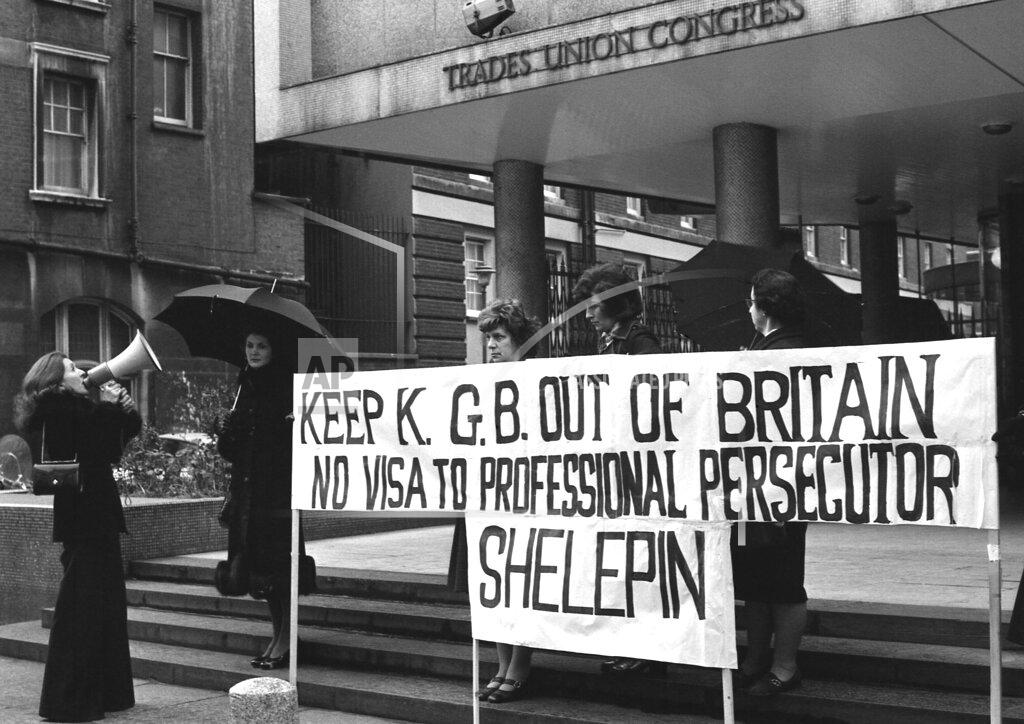
British labor union leaders were attacked for inviting the chief of the Soviet labor union organization to visit Britain as the head of a union delegation, because he is Alexander Shelepin, former head of the Soviet secret police. Members of Parliament from both the ruling Labor Party and the Conservative Party plan protests.
President Tito has begun a political campaign against suspected adversaries at home and abroad. In the process, Yugoslavia’s foreign relations have become thornier than ever and rule at home grows more autocratic by the month. But the price is not too high, the government’s defenders maintain, if Yugoslavia is to survive what is viewed here as the crisis looming — the death or incapacity of the 82-year‐old Yugoslav leader. Despite his still fairly robust constitution, Marshal Tito realizes he may not have much longer, and is acutely aware of the problems ahead. The first of these problems, as always, is nationalist separatism.
[Ed: The clock is ticking towards Sarajevo and Bosnia.]
Twenty-three Soviet dissenters sent a letter to President Ford asking him to help fellow dissenter Anatoly Marchenko emigrate to the United States. The letter was made available to newsmen in Moscow. Marchenko, author of an account of Soviet prison camp life, was arrested Thursday. The letter said: “Your country has often served as a shelter for the repressed and persecuted. Anatoly Marchenko has received an invitation to come to your country. We ask you to help him in this.”
The president of the American Jewish Congress told a convention of the women’s division in Philadelphia that Arab investment in U.S. companies “is both inevitable and welcome as a stimulus to our economy.” But he warned that it “must not be permitted to distort the political institutions, business practices or foreign policy of our country.”
In Israel’s soul‐searching about the extent of her occupied territory that she is ready to yield in return for a measure of Arab acceptance of her national existence, the only unequivocal voices come from the political opposition. Menahem Begin, the perennial leader of the opposition to the perennial Labor party governments, is not beset by soul‐searching. “Dr. Kissinger tells us to trade territory for legitimacy,” Mr, Begin said in an interview in his modest groundfloor apartment, where he has lived since he was in hiding as the man most wanted by the British authorities as leader of the underground army known as Irgun Zval Leumi. “We don’t need legitimacy — from the Arabs or from anybody. We exist. Therefore we are legitimate.” Using the Biblical names for the territories of the occupied West Bank, he added, “We believe the Land of Israel, which includes Judea and Samaria, belongs by right to the Jewish People. It was partitioned, it was reunited, it should not be partitioned again.”
One soldier was killed and 29 were wounded when their truck was ambushed in the strife‐torn southern port of Saida today, according to a military communique issued in Beirut. It said that the soldiers were unarmed and were returning from leave to resume duty on Lebanon’s southern border with Israel. Their truck was attacked by gunfire and rockets from an ambush, the statement said. Ambulances that went to the scene also were said to have come under fire. The ambush occurred only 24 hours after calm had been restored in the city, 25 miles south of Beirut, in the wake of two days of fighting between the army and gunmen of group called the “Popular Resistance.” Troops were pulled out of the city yesterday and were replaced by police units as part of the cease‐fire.
[Ed: And, Lebanon begins to slide towards mayhem and civil war…]
India is quietly discussing purchasing several types of American arms, despite New Delhi’s strong criticism of the United States for lifting the weapons embargo on the subcontinent. Sources involved in the discussion say that India’s military leaders are considering A‐4 Skyhawk attack fighters, transport planes and maritime reconnaissance aircraft. It is known that for years the nation’s air force has sought A‐4’s for India’s only aircraft carrier, the 18,000‐ton Vikrant. The issue of United States arms for India is extremely delicate. The sources emphasized that any sales would not be in large quantities, nor would they affect India’s reliance on the Soviet Union for armaments. Moreover, India is not expected to ask for the arms directly but to use, instead, middlemen to deal with American companies. The sales themselves would have to be approved by the United States Government.
Opponents of President Park Chung Hee increased their attacks on his government today over charges that security agents had tortured a large number of students and political figures critical of his leadership. With the governing Democratic Republican party opposing attempts to open a debate on the issue in the National Assembly, the opposition New Democratic party made public an open leter to the President this morning before it was delivered to him. The letter demanded that the government seek out and punish the security agents who have been accused and that it set up institutional safeguards to insure that no torture is used in future. “The nation is astonished and shocked at such brutal behavior,” the letter said. A group of opposition members of the National Assembly tried unsuccessfully to meet with Premier Kim Jong Pil to deliver the letter.
The U.N. Command in Seoul accused North Korea of bringing the two Koreas to the brink of a confrontation last week after a collision between a Communist boat and a South Korean naval vessel in the Yellow Sea. A UN. Command spokesman said that during and after the incident North Korean planes violated South Korea’s airspace 11 times. North Korea charged that their boat was an unarmed fishing boat and that it was sunk with gunfire.
The first 30 women “Mounties”, officers of the Royal Canadian Mounted Police for the all-female RCMP Troop 17, graduated from RCMP Academy, Depot Division, after 32 had entered the academy on September 16, 1974 for regular training.
Argentine farmers called a 24-hour strike today to protest low prices for agricultural products and high taxes. Farmers in the five most important agrarian provinces — Buenos Aires, La Pampa, Entre Rios, Santa Fe and Cordoba — are refusing to send animals to slaughter or grain to market today. The gesture could lead to a more prolonged strike soon. Although agricultural products account for more than 70 percent of Argentina’s earnings abroad, farmers have had little political impact in recent years and have repeatedly failed to unite in a common front. Before the rise of Juan Domingo Perón three decades ago, wealthy farmers dominated agriculture and national politics. General Perón broke the political power of the large landholders, presided over a population shift that brought most Argentines to the cities, and imposed price controls on farm produce for the benefit of urban residents.
Today, Argentina has the fourth lowest food prices in the world after Colombia, India and the Philippines, according to the government’s own reckoning. But farmers protest that they are selling beef below cost and that they are receiving less than half the world market price for their grain, with the government pocketing the difference. Argentina, which 30 years ago was the second largest wheat exporter and accounted for half of the world’s exports of beef and as much as 80 percent of corn, has ceased to be a food producer of international imoprtance — largely, agronomists maintain, because of heavy taxes and price controls.
[Ed: Wow, Socialism wrecked a country’s economy? What a Surprise. Not.]
One of the worst tribal clashes in South Africa’s troubled mining history left 28 African workers dead and 14 injured at the Northfied coal mines in Glencoe. Fighting broke out between Basuto and Xhosa tribesmen in a dormitory Saturday night and lasted until Sunday morning, when police finally got into the dormitory area.
The basis of a possible energy compromise between the administration and Congress began to take shape at a House Ways and Means Committee hearing. Witnesses for the administration indicated that the White House could accept two proposals offered over the weekend by the committee Democrats — a substantial but gradual increase in the federal gasoline tax and a federal excise tax on new cars that use relatively large amounts of gasoline. President Ford’s decision to put off until today an announcement deferring part of his fee on crude oil imports disappointed both Republicans and Democrats, but they seemed confident that he would take that first step toward compromise.
The Ford Administration wants to cut Federal school lunch subsidies for children from middle-income homes, and Agriculture Department experts say that up to six million children could be involved.
The Senate began moving toward a final vote on a compromise filibuster reform plan amid growing prospects of approval by week’s end. By a vote of 51 to 40, the Senate reversed itself and threw out a vote taken last week which held the Senate, at the start of a new Congress, could cut off debate and dilatory motions by a simple majority vote for the purpose of changing its rules, notwithstanding the two-thirds debate cutoff requirement normally in force. Reversal of the earlier vote was an important step toward assuring enough votes to win passage of the compromise filibuster rule. The compromise would require only a three-fifths vote to stop debate on any issue except further reform of the filibuster rule, which still would need a two-thirds vote.
The Supreme Court ruled that newspapers and radio and television stations cannot be subjected either to criminal prosecution or civil damage suits for disseminating accurate information available from public law enforcement records. Voting 8 to 1, the Court struck down a Georgia law that made it a misdemeanor to print or broadcast the name of a rape victim, and the majority denied the right of the victim or her parents to start an action for invasion of privacy because the victim’s name had been made public.
Victims of the 1970 police shootings on the Jackson State College campus in Mississippi failed today to persuade the Supreme Court to review lower court decisions denying them damages from the officers involved.
John N. Mitchell filed notice of appeal from his conviction and 2½- to 8-year prison sentence in the Watergate coverup trial. The former attorney general was the last of the four convicted to file. H.R. Haldeman, John D. Ehrlichman, and Robert C. Mardian filed their notices last week. All four are free without bond pending the outcome, a process that could take one year or more.
The chief witness for the prosecution in former Oklahoma Governor David Hall’s trial in charges of bribery and extortion said today that he was helping prove “Hall was a crook,” prompting the defense to move for a mistrial. The motion was overruled.
Former Ohio Governor John J. Gilligan announced the formation of a Council on National Priorities with an initial aim of shifting government spending from defense to social needs. The council, composed of existing national groups, generally liberal, will begin its activities next Monday when a representative testifies before the Senate Budget Committee on the national budget for the next financial year.
William E. Colby, the Director of Central Intelligence, has told the agency’s employes he believes that none of them will face prosecution for any illegal activities, a C.I.A. spokesman said tonight. The spokesman confirmed that Mr, Colby distributed two and a half page bulletin to agency employes today, urging them to cooperate with the Rockefeller commission’s investigation into allegations of massive, illegal domestic activities by the agency. According to the spokesman. Mr. Colby said in the staff bulletin, “My own belief, after careful review of all activities in question, is that legal action will not be taken against individuals.” He added, “The final decision, however, must rest with the Department of Justice and other legal authorities and the risk of such action is a judgment each employ must make for himself.”
Trial of four men charged in the “Zebra” murders which terrorized San Francisco nearly a year ago began in the court of San Francisco Superior Judge Joseph Karesh. A panel of 100 potential jurors was called. Defendants are Jessie Lee Cooks, 30, Manuel Moore, 30, J.C.X. Simon, 28, and Larry C. Green, 23, all members of the Black Muslim sect. All victims of the 13 murders and seven assaults between October, 1973, and April, 1974, were white. The term “Zebra” was used by police as its channel code for the investigation.
Armed members of the American Indian Movement peacefully ended their weeklong occupation of an electronics assembly plant on the Navajo Reservation at Shiprock, New Mexico, under a grant of unconditional amnesty from its Navajo tribe owners. During the day 40 Indians left and 10 others departed in the evening after an inspection of the facility by tribal officials. The Fairchild Camera & Instrument Corp. which operates the plant under lease, said it would meet. Navajo official Peter MacDonald to discuss possibly reopening the plant.
In Oakland, California, District Attorney General Lowell Jensen filed felony assault charges today against two members of the self‐styled Symbionese Liberation Army who seriously wounded a guard in an attempt to escape from the courthouse jail. Mr. Jensen filed charges of attempted escape, felony assault upon police officers and robbery against Joseph Remiro, 28 years old, and Russell Little 25, in connection with an escape attempt Saturday evening at the Oakland courthouse. The robbery charge is based on the taking from deputies of a key that unlocks a gun cabinet. Mr. Little and Mr. Remiro are facing murder charges in the death of Marcus Foster, the Oakland school superintendent, who was killed November 9, 1973, with a cyanide‐bullet.
A New York state appeals court threw out a three-year prison term given Dr. Thomas W. Matthew, who had been prominent in former President Richard M, Nixon’s black capitalism program. It was the second time in five years that Matthew, 51, was spared a prison term. Mr. Nixon pardoned him in 1969 after a federal income tax evasion conviction. “There is not one fragment of evidence to suggest that the defendant acted with larcenous intent,” the court said. Neurosurgeon Matthew was convicted in 1973 on 21 counts of illegally diverting a total of $200,000 in Medicaid money intended for his Interfaith Hospital.
General Motors Corp. will recall 2,133 new Oldsmobiles to correct malfunctioning anti-smog equipment on their 455-cubic-inch engines, the California Air Resources Board announced. ARB Chairman Tom Quinn said GM offered to repair the vehicles after tests disclosed that more than 10% of the affected vehicles destined for the California market exceeded state limits on one of the three principal automotive pollutants. GM is now notifying owners of the affected cars — all 1975 models built prior to last October 30 — that they should return the vehicles to a dealer for repair.
A New York state appeals court ruled that the state and city departments of social services must foot the bill for a sex-change operation. The 3-1 ruling reversed an earlier one concerning the ‘genetic male,” identified only as Denise R, 41, who has. been living and working as a woman for the last 16 years. The two agencies informed Denise R.’s doctor that the application had been rejected “on a medical basis.” The appellate decision, however, noted that the transvestite was suffering from “severe psychopathology” and that state law “does not restrict medical assistance to purely physical problems”
As cleanup operations were completed, the Coast Guard reported that from 50,000 to 60,000 gallons of oil had spilled into Lake Michigan from a tanker barge grounded on the Milwaukee breakwater. Earlier estimates of the spill ranged from 3,000 to 12,000 gallons.
Larry Grossman and Hal Hackady’s historical musical comedy “Goodtime Charley”, based on King Charles VII of France, and starring Joel Grey, opens at Palace Theater, NYC; runs for 104 performances.
Linda McCartney is charged in the U.S. with possession of marijuana.
First People’s Choice Awards: John Wayne & Barbra Streisand win (Motion Pictures) and Alan Alda, Telly Savalas & Mary Tyler Moore win (TV).
Dow Jones Industrial Average: 753.13 (+14.08, +1.91%)
Born:
Patricia Potter, English actress (“Holby City”), in Canterbury, England, United Kingdom.
Allison Cratchley, Australian actress (“All Saints”), in Sydney, New South Wales, Australia.
Albert Fields, American pop and hip-hop singer (The Party – “Rodeo”, “That’s Why”), in Gary, Indiana.
Zdeněk Nedvěd, Czech NHL right wing (Toronto Maple Leafs), in Lány, Czechoslovakia.
Died:
General Oscar Bonilla Bradanovic, 56, Chilean Minister of National Defense, in a helicopter crash, while returning from vacation at Curicó. Two French technicians of the Aérospatiale helicopter company were killed on March 22, in another helicopter accident, after investigating the crash.