
The Soviet Government press agency Tass today denied United States accusations that Moscow had violated arms agreements, branding the allegations as unfounded and designed to complicate future negotiations. A United States Government report said Friday that the Soviet Union had violated of the 1963 treaty on a limited nuclear test ban, the 1972 treaty on limiting antiballistic missile defenses and the 1979 treaty limiting strategic, or long-range, nuclear weapons. The 1979 pact was never ratified. “There is not a single hard, confirmed fact in the whole report,” Tass said, adding that the report was intended to influence public opinion ahead of new arms negotiations due to begin in Geneva on March 12. The report said a Siberian radar array in Abalakovo, near Lesosibirsk, appeared to be designed to track incoming missiles as an aid to their destruction. Moscow has opposed President Reagan’s plans for developing a space-based missile defense on the ground that invulnerability to attack would be an incentive to launch a first strike without fear of retaliation.
Expansion of U.S.-Soviet trade is a matter of “strong interest” to the Soviet Union, which has agreed to take a number of steps, including ending discrimination against American companies. But a United States Government report on trade talks in Moscow in January also notes that American restrictive legislation on trade with the Soviet Union was unlikely to be changed. A United States Government report on trade talks with the Russians in Moscow on Jan. 8-9 also says that the Americans “made it plain at the outset of the meetings that our security and foreign policy interests remain paramount and will continue to set limits to acceptable trade.” The report says that one official, Vladimir S. Alkhimov, chairman of the State Bank, hinted unofficially that Jewish emigration might be stepped up if relations improved. The renewed interest in Soviet- American trade coincides with an agreement between the two countries to resume arms-control negotiations next month. American officials say there is an implicit link between the trade and the disarmament talks.
The Norwegian government has banned or restricted Soviet Bloc commercial and charter planes at eight airports, charging that they were engaged in electronic espionage. Officials said there was proof that East European airliners have carried out such espionage while flying over Norway and also while on the ground at Norwegian airfields. Armed forces chief General Fredrik Bull-Hansen identified only one East Bloc country — Bulgaria — as engaging in electronic espionage. The restrictions do not affect Oslo’s Fornebu airport.
A Finnish air force helicopter lifted the main frame and engine of a wayward Soviet target missile from a frozen lake and military officials reiterated earlier statements that it was not a cruise missile. Finnish authorities told reporters that the recovered debris showed it was “an old-type missile dating from 1971-72 and without military capacity.” The unarmed missile was launched on Dec. 28 during Soviet naval target practice in the Barents Sea and crashed in Finland’s Lake Inari after crossing Norwegian territory. The Soviet Embassy in Helsinki has requested that the recovered debris from the missile be returned.
About 70 people, most of them American military personnel stationed at an air base near Athens, were wounded tonight in an explosion in a crowded bar, a police spokesman said. The spokesman said it was not certain whether the explosion was the result of a bomb or of a gas leak. He said no group had taken responsibility.
The Reagan Administration agreed secretly in 1982 to sell advanced computers to France to upgrade nuclear missiles, apparently in exchange for the Paris government’s greater cooperation in abiding by nuclear arms agreements, Newsday reported. The Long Island, New York, newspaper said that senior State Department officials had confirmed the deal and that French government officials had refused to discuss it. If true, the agreement on high-tech computers would help France challenge the United States for the lead in placing commercial satellites in space.
Israel’s economic recession appears to be doing what years of Peace Now demonstrations and political debates have not: slow the growth of Jewish settlements in the West Bank. Consider tiny Abir Yaacov. It consists of four families, one dog and four Israeli Army soldiers who stand guard around the clock. The place is so small that late-morning visitors often find no one home. Abir Yaacov was built hastily on July 1, 1984, right before the national elections, and began with 30 families living in tents. But when the Ministry of Housing allocated enough money for just four trailer homes, almost everybody folded their tents and moved back to their apartments in Jerusalem and Tel Aviv.
The Lebanese Cabinet met in a marathon emergency session today to deal with a series of major crises, any one of which could bring it down. Most pressing was the withdrawal of the Israeli Army from the Sidon area, expected any day, and the Government’s efforts to deploy the Lebanese Army into the area in the hope of heading off the civil strife that some fear will follow the Israeli departure. The Government of Prime Minister Rashid Karami also faced the crumbling of the once-resilient economy and continued lawlessness in West Beirut and other areas. No details of the Cabinet’s discussions were immediately available after the session.
Iraq said its troops repelled an early morning Iranian attack, aimed at retaking positions captured by Iraq last week on the central front of the Persian Gulf war. An Iraqi command statement said the Iranians, for the second day, attacked positions held by the 606th Brigade and were met with heavy artillery and mortar bombardment. In another war development, about 30 captured Iranians. said in the Iraqi capital of Baghdad that they will not return to their homeland. Speaking in Farsi through an interpreter, they said they will either remain in Iraq or travel abroad.
Iraq said today that its jet fighters had raided a “very large naval target” in the Persian Gulf as part of its attempt to blockade the Iranian oil terminal at Kharg Island. Iraq often uses the phrase to refer to supertankers. It has made 27 similar announcements this year, but only 6 have been independently confirmed. Shipping sources in Bahrain said there had been no distress signals from any vessel in the gulf. A military communique on the Baghdad radio said the raid occurred at 9:45 AM south of Kharg Island, but it gave no report on damage inflicted.
Sheik Sabah al-Ahmed al-Jabir, the Foreign Minister of Kuwait, arrived in Damascus today as part of an effort to press Syria to use its good relations with Iran to try to end the gulf war.
The gas leak disaster in Bhopal has brought into focus the problems and dilemmas faced by multinational companies in developing countries such as India. The accident, many Indian technological experts and others say, has raised questions about doing business in the third world.
Afghanistan has delivered a protest note to China’s charge d’affaires in Kabul, complaining of Chinese military support for rebels fighting the Soviet- backed Government, the Soviet party newspaper Pravda said today. It said the note had been sent after Afghan Government forces wiped out rebel bands and discovered large amounts of Chinese-made weapons, including ground-to-air rockets and launchers and antiaircraft guns. Pravda said the note “demanded an end to armed and any other kind of interference by China in the internal affairs of Afghanistan.” Chinese instructors in rebel camps in Pakistan were training the insurgents in the use of weapons and terrorism, the newspaper added.
About 400 Vietnamese troops covered by artillery barrages seized two Cambodian outposts of the Khmer Rouge guerrillas, military officers in neighboring Thailand reported. Rebel and Thai military reports said Vietnamese heavy artillery and mortars attacked Khmer Rouge guerrillas Friday night and today in mountains south of Aranyaprathet, near the Thai border. The barrage was seen as a prelude to a full-scale attack. They said the guerrillas, meanwhile, attacked a Vietnamese base and supply line to slow the buildup of Vietnamese forces trying to wipe them out. More than 40 Khmer Rouge have been killed and 80 wounded in the past week of stepped-up Vietnamese attacks, Thai sources said. The Khmer Rouge is the strongest of the three Cambodian factions in the insurgent coalition.
The Commerce Department said today that it had evidence a West German businessman had illegally shipped to North Korea as many as 82 Hughes helicopters with potential military applications. Theodore Wu, deputy assistant secretary for export enforcement of the Commerce Department, said the transaction involved enough helicopters “to support a large-sized force like a regiment.” He said that for the past two years, Kurt Behrens, the businessman, had been buying the aircraft from Hughes Helicopters Inc. and then shipping them to Japan, the Netherlands or other countries where they were diverted to North Korea.
The Central Committee of the Cuban Communist Party gave strong support to Fidel Castro this week and demoted a top party official who was apparently a leading critic of Mr. Castro’s foreign policy. The moves, which included several other party changes, were made Thursday night at a special session of the Central Committee. The fact that Mr. Castro sought such an endorsement, and the wording of the Havana communique, indicated to analysts here that Mr. Castro’s policy of apparently seeking accommodation with the United States had been opposed by some members of the leadership.
Cuba is ready to reduce its military presence in Africa and has already sharply cut the number of troops stationed in Ethiopia, according to the Cuban leader, Fidel Castro. In an interview published in Sunday’s issue of The Washington Post, Mr. Castro said that his country has about 5,000 soldiers in Ethiopia, a reduction of about 12,000 men. In the interview, Mr. Castro reiterated his hope for better relations with the United States and he suggested talks on such issues as Coast Guard activities, fishing rights, air hijacking and radio signal interference could be “an expression of good will.”
Costa Rica and Nicaragua, through the mediation of the four Contadora countries, have agreed to settle one of the disputes blocking the sputtering Central American peace initiative, Panama announced. The dispute centered around a Nicaraguan who sought refuge in the Costa Rican Embassy in Managua but was arrested last Christmas Eve under mysterious circumstances. Costa Rica had demanded that Nicaragua return the man, saying it would boycott the February 14 meeting with the Contadora Group — Colombia, Mexico, Panama and Venezuela — on its proposals to bring peace to Central America. Details of the agreement were not disclosed.
In his first five months in office, the new American Ambassador to Guatemala has appeared especially concerned about improving ties between the United States and the country’s military Government after years of strained relations because of continuing human rights abuses. In meetings with Government officials and a broad range of private groups, the Ambassador, Alberto M. Piedra, has shown a willingness to listen and a desire to increase American aid, according to participants in some of the meetings. His welcoming attitude is seen in sharp contrast to that of the former American envoy here, Frederic L. Chapin, who reportedly ended his tour on a bitter note, harshly criticizing human rights violations in private meetings with senior Guatemalan military officials.
Pope John Paul II stepped up his attacks today on advocates of violent social change, warning against what he called “anti- Christian methods” and “class hatred.” The Pope, a week into his South American tour, spoke in Lima, Peru this evening to a chanting crowd of young people estimated at well over one million. The chants at times forced the Pope to stop his speech for several minutes. This afternoon, he flew to Arequipa, an ancient Inca crossroads on the Vitor River, 7,554 feet up in the Andes, to preside over the beatification of a Peruvian nun and to crown a statue of the Madonna di Chapi, an object of widespread devotion in Peru.
The military Government in Chile decreed a 90-day extension of the state of siege today, retaining curbs on the press and public gatherings that block opposition political activity. A decree signed by President Augusto Pinochet and published in the official bulletin resolved to maintain the clampdown until May 6 because of what it called “internal convulsion” in the country. General Pinochet, who seized power in a 1973 coup, has ignored international protests and defections of key civilians from his Government over the restrictions he imposed November 6. Six opposition magazines shut down in November will remain banned and a seventh one under censorship. Political reporting and commentary by all other Chilean news organizations remains restricted to official communiques. The decree also continues a ban on gatherings that lack authorization by regional governors. The state of siege authorizes the Government to tap telephones, open mail and hold dissidents indefinitely without charge.
President Reagan makes a Radio Address to the Nation on the 1986 Budget. Large cuts in domestic spending were insisted on by President Reagan as he sought public support for his budget proposal to be submitted to Congress tomorrow. The proposal will represent “the most exhaustive effort ever made” to reduce “Government’s chronic overspending,” Mr. Reagan said in his weekly radio speech. Mr. Reagan, devoting his weekly radio broadcast to the 1986 budget he will submit to Congress Monday, offered what amounted to a pre-emptive strike against expected Congressional opposition to some of the spending cuts he will propose. The President ruled out tax increases and further cuts in military spending and Social Security benefits; he argued instead for significant reductions in domestic spending.
Delivering the Democrats’ response later, the Speaker of the House, Thomas P. O’Neill Jr., set the stage for a budget battle by challenging Mr. Reagan to justify his fiscal package to the American people. But the Democratic leader offered no counterproposal. He pledged, as he did in a January meeting with the President, to consider Mr. Reagan’s proposal in “good faith.”
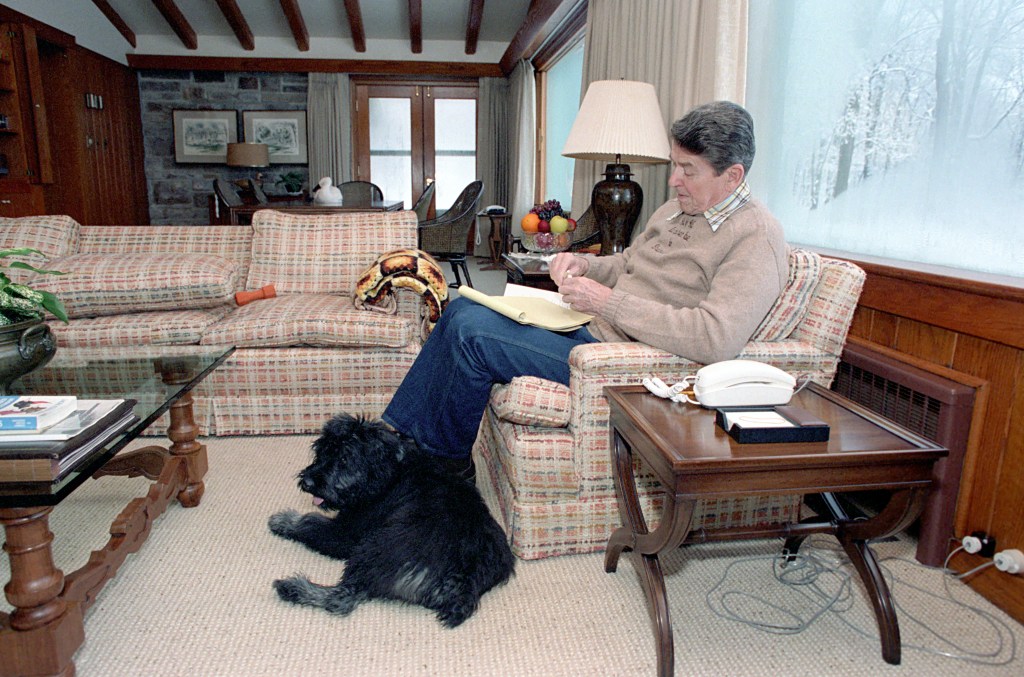
President Reagan spends the day at Camp David reading and doing homework.
State and city governments will fight the Reagan Administration if it tries to use the states’ fiscal health as an excuse to re-direct tax revenues from state to Federal coffers in an effort to reduce the Federal deficit. The warning came from both Republican and Democratic officials.
Steps to ease the farm debt announced by the Reagan Administration Friday will help some troubled farmers, but leave many others facing a planting season without funds and little hope of obtaining additional credit, according to bankers in the Farm Belt.
An elevator carrying 16 persons attending a Jaycees convention plunged from the 20th floor of the Radisson South Hotel in Bloomington, Minnesota, to the first floor before emergency brakes stopped its descent, injuring all aboard, a spokesman for the Radisson Hotel Corp., owners of the hotel, said. Three persons were admitted to Fairview-Southdale Hospital and were listed in stable condition with back and leg injuries. The rest of the injured were treated and released. The cause of the accident was under investigation.
Senator Max Baucus (D-Montana) said that he plans to vote against confirming Edwin Meese III as attorney general when the Senate Judiciary Committee meets this week. The 18-member panel completed confirmation hearings on the nomination last Thursday and is scheduled to vote on Tuesday. Despite opposition from Democrats who believe that Meese’s tangled finances make him unfit for the job, Meese is expected to be confirmed. Baucus said Meese does not have public trust and lacks integrity.
The Federal authorities in Cleveland have recommended that Jackie Presser, president of the International Brotherhood of Teamsters, and two other people be charged with illegal payment of union funds to nonexistent employees of Teamsters Local 507, according to published reports. The Cleveland Plain Dealer and The Los Angeles Times reported Saturday that the recommendation had been made in a memorandum from the Justice Department’s Strike Force Against Organized Crime in Cleveland to department officials in Washington. The memorandum named Harold Friedman, a close associate of Mr. Presser, and Anthony Hughes, a business associate of Mr. Presser’s estranged wife, The Plain Dealer said. Mr. Presser, Mr. Friedman and Mr. Hughes could not be reached for comment Saturday. The Labor Department has been investigating Mr. Presser and Mr. Friedman since 1982 because of an alleged payroll at Mr. Presser’s Local 507 for people who were not employees. Court documents say Mr. Hughes is one such employee, The Plain Dealer said.
South Florida firefighters hampered by dry, windy weather, continued to battle 68 new fires that broke out Friday and burned 3,422 acres, said Paul Wills, a Division of Forestry spokesman. Seventeen small fires burned 341 acres north of Orlando. All but two of the new fires were under control. Using tractors and heavy equipment, firefighters tried to strengthen fire lines to hold a blaze in the Golden Gate area near Naples against shifting winds that were expected to accompany a cold front moving into the area. Since the first of the year, 1,573 fires have destroyed 60,513 acres of wooded land and about 60,000 acres of grasslands.
The Federal Aviation Administration, because of recent plane crashes and safety violations, is reviewing its inspection programs. Safety experts are particularly concerned about the January 21 crash of a Galaxy Airlines turboprop aircraft that killed 68 persons in Reno, and the crash-landing Tuesday of another Galaxy plane that the FAA had inspected a few days earlier.
The Philadelphia Commission on Human Relations has decided that Temple University helped the United States military services discriminate against two homosexual students. The law students, Richard Brown and Loretta DeLoggio, charged that the school had violated the city’s fair practices ordinance by allowing military recruiters on campus and by helping them arrange interviews. Military enlistment policies bar homosexuals. The ordinance bans discrimination on the basis of sexual orientation. “All we were looking for is an order from the commission telling the university not to assist the military recruiters,” said David Webber, the students’ attorney. A commission spokesman said the panel would issue a written decision and recommendations soon. “We don’t agree with the military’s policy with respect to hiring, but we also believe in free speech,” said Richard Reinstein, a Temple attorney.
The Social Security Administration, responding to harsh criticism from Congress, has proposed to broaden eligibility requirements for disability pensions to persons with mental disorders. The agency said it will now recognize that symptoms of mental illness can disappear temporarily and that persons who can cope with a sheltered daily life can deteriorate under the stress of working. The rules also add some new categories of illness such as anxiety disorders resulting from a traumatic experience, and agoraphobia, whose victims fear leaving home.
City officials in Akron, Ohio say the explosions and fires that killed three men last December at a city garbage recycling plant occurred because of wastes sent there by a New Jersey company. Mayor Tom Sawyer said that on December 20, the day of the explosions, S&W Waste of Kearny, New Jersey, sent the plant wastes containing three highly flammable chemicals that were not supposed to be dumped there. The chemicals, xylene, toluene and methyl ethyl ketone, may have been accidentally mixed in with wastes that S&W was authorized to take to the plant, Mr. Sawyer said. He said city officials did not know whether shipment of the unauthorized waste was accidental or deliberate, but he said they were studying that question and investigating possible legal action.
The families of seven coal miners killed in an underground explosion in 1981 near Topmost in eastern Kentucky will share $5.15 million to be paid by two coal companies, a lawyer for the families says. A lawsuit stemming from the explosion at the mine of the Akdins Coal Company had been scheduled for trial Monday. State and Federal mine safety agencies had said the accident was caused by illegal blasting procedures. A settlement was reached in separate agreements among the victims’ families, the Island Creek Coal Company and partners of the Adkins Coal Company, said Joseph A. Yablonski Jr., a Washington lawyer. Eight men were killed by the explosion in December 1981. The family of the eighth victim did not join the suit.
Murder and involuntary manslaughter charges against an obstetrician who aborted a 32-week fetus have been dropped, but he has been ordered to face lesser felony charges. Judge Michael Conroy ruled Thursday after a preliminary hearing in Municipal Court that the state had not presented enough evidence to prosecute the homicide charges against Dr. Joseph Melnick, who performed the abortion on a 13-year-old girl last Sept. 12 at West Park Hospital. The remaining counts are infanticide and abortion after viability, lesser felonies under the state’s Abortion Control Act of 1983. Prosecutors say they believe Dr. Melnick is the first physician to face a criminal trial in connection with an abortion in Pennsylvania.
One of the four black students who ordered a snack at a segregated lunch counter 25 years ago, touching off civil rights demonstrations across the South, re-enacted that event Friday. “The reception is quite different today,” said the former student, David Richmond, 43 years old, of Greensboro, North Carolina, after ordering apple pie and coffee, the same items he was refused at the counter in the downtown F. W. Woolworth store on February 1, 1960. The store manager and the counter waitress, now retired, told the four that they could not be served. The next week the four returned with 23 more students, then 66 the day after. Within two months sit-ins spread to 54 cities in nine states. On July 25, 1960, Woolworth integrated the counter.
The General Public Utilities Corporation’s struggle to reopen its undamaged nuclear reactor at Three Mile Island has come under a new cloud. The staff of the Nuclear Regulatory Commission said this week that Ivan W. Smith, chairman of the commission board hearing the relicensing request, was biased and should be removed. A spokesman said it was the first time in the commission’s 10-year history that the staff had supported a challenge to the impartiality of one of its hearing officers, officially known as administrative law judges. Officials of the commission said that the staff recommendation was likely to further delay a vote by the full commission on whether to reopen the $450 million Unit 1 reactor.
Suk J. Kim, 36, of Skokie, Illinois, and Jang Han Bae, 35, of Streamwood, Illinois, were each charged with three counts of murder and a charge of arson for profit in connection with a Chicago fire that killed three firefighters and seriously injured a fourth. Detective Lawrence Poli said Bae is the owner and operator of Vicstar Electronics, which was housed in the two-story building that burned Friday. Captain Dan Nockels, 56, and firefighters Michael Forchione, 29, and Mike Talley, 26, died. A fourth firefighter, Sam Lasco, 31, was in serious condition at Cook County Hospital.
Herds of wild cattle that have been trampling three Aleutian islands won a reprieve after Alaska Governor Bill Sheffield asked federal wildlife officials to postpone plans to shoot the animals. Officials said a 30-day delay was ordered to allow residents time to salvage the cattle for beef. The U.S. Fish and Wildlife Service says the cattle must be killed or removed because they are stripping migratory waterfowl nesting areas and causing erosion.
Warning labels on art supplies will soon appear under a voluntary program involving about 35 companies that produce 90 percent of the materials used by hobbyists, schoolchildren and professional artists. The labels will warn consumers that some of the materials contain chemicals linked to nervous disorders, respiratory ailments and fetal damage.
Former NFL running back, broadcaster, actor and (later) convicted felon O.J. Simpson marries second wife Nicole Brown (murdered 1994).
Born:
Scott Maine, MLB pitcher (Chicago Cubs, Cleveland Indians), in Palm Beach Gardens, Florida.
Morris Almond, NBA shooting guard (Utah Jazz, Washington Wizards), in Dalton, Georgia.
Melody Gardot, American jazz singer (“My One and Only Thrill”), in New Jersey.






[Ed: Remember when this charlatan piled on Jim Bakker after his sex scandal, only to be revealed as way, way pervier than Jim? That was hilarious. Glass houses and stones, Dude.]



 History Diaries