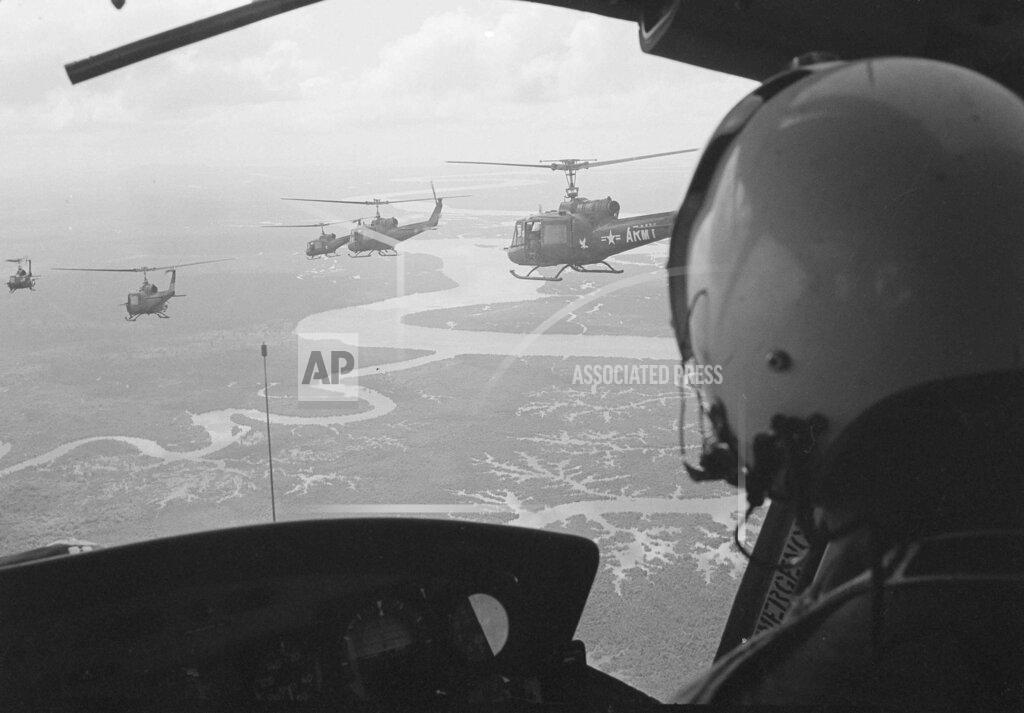
The Battle of Bình Giã concluded, as the Việt Cộng withdrew while in a superior position. The South Vietnamese Army of the Republic of Vietnam (ARVN) lost 201 killed, while the U.S. had its biggest losses in the Vietnam War up to that time, with five killed. The battle of Bình Giã reflected the Việt Cộng’s growing military strength and influence, especially in the Mekong Delta region. It was the first time the Việt Cộng launched a large-scale operation, holding its ground and fighting for four days against government troops equipped with armor, artillery and helicopters, and aided by U.S. air support and military advisers. The Việt Cộng demonstrated that, when well-supplied with military supplies from North Vietnam, they had the ability to fight and inflict damage even on the best ARVN units.
The Việt Cộng apparently suffered light casualties with only 32 soldiers officially confirmed killed, and they did not leave a single casualty on the battlefield. In recognition of the 271st Regiment’s performance during the Bình Giã campaign, the Việt Cộng High Command bestowed the title ‘Bình Giã Regiment’ on the unit to honour their achievement. Following the Bình Giã campaign, the Việt Cộng went on to occupy Hoài Đức District and the strategic hamlets of Đất Đỏ, Long Thành and Nhơn Trạch along Inter-provincial Road No. 2 and 15. They also expanded the Hát Dịch base area, which was located in Bà Rịa and Bình Thuận Provinces, to protect the important sea transportation routes used by the Vietnam People’s Navy to supply Việt Cộng units around the regions of the Mekong River.
Unlike their adversaries, the South Vietnamese military suffered heavily in their attempts to recapture the village of Bình Giã and secure the surrounding areas. The South Vietnamese and their American allies lost the total of about 201 personnel killed in action, 192 wounded and 68 missing. In just four days of fighting, two of South Vietnam’s elite Ranger companies were destroyed and several others suffered heavy losses, while the 4th Marine Battalion was rendered ineffective as a fighting force. At that stage of the war, Bình Giã was the worst defeat experienced by the South Vietnamese. Despite their losses, the ARVN considered the battle as their victory and erected a monument at the site of the battle to acknowledge the sacrifices of the soldiers who had fallen to retake Bình Giã.
This was the fifth consecutive day of combat around the Roman Catholic refugee village 40 miles southeast of Saigon. Communist guerrilla commanders have apparently decided to hold their ground rather than follow their usual tactic of withdrawing before superior firepower in the air and on the ground. The intensity of the fighting around Bình Giã has dropped since the first attack on the village last Monday. But military analysts expressed surprise that the guerrillas were there at all. Their practice has been to filter away in darkness after any sharp engagement.
With increasing concern, analysts are asking if the insurgents are moving into the “third phase,” or “mobile phase,” of guerrilla warfare. According to the tactical theories of Mao Tse-tung, this phase resembles conventional warfare in which large concentrations of insurgent troops defend specific territory and engage large regular forces. Senior American officers said, however, that they saw no evidence that this had become the Communist strategy. The number of outright Communist attacks remains low, compared with the incidence of sabotage, terrorism, and propaganda distribution. Last week only 17 outright attacks were reported throughout the country, out of 640 incidents.
Maxwell D. Taylor, the United States Ambassador to Saigon predicted yesterday that the political crisis between military leaders and the civilian Government in South Vietnam “will soon be over.”
Britain and Malaysia are meeting the Indonesian military buildup on the border of Indonesian Borneo and the Malaysian states of Sarawak and Sabah with a buildup of their own. British troop reinforcements are expected to arrive for deployment along the border in the next few days. Heavy supply drops have been made in the last week to units stationed on the border and Hunter jet fighters, which could be used for air-to-ground attack, have been brought in from Singapore to reinforce Malaysian Borneo’s air strength. Artillery units have been deployed to positions where a heavy barrage could be brought to bear on known Indonesian crossing points. A total of about 12,000 British and Malaysian troops are based in Malaysian Borneo and this force will be substantially increased within a week, according to informed sources.
Indonesia announced its intention to leave the United Nations, as Indonesian ambassador Lambertus Palar told the news verbally to Secretary General U Thant and UN General Assembly President Alex Quaison-Sackey. No member of the United Nations had quit the organization since its creation in 1945.
Premier Aleksei N. Kosygin was quoted today as having said that the Soviet Union would carry out an “active policy of peace and relaxation of international tension” in 1965. The Soviet leader made the pledge in an interview with the Japanese newspaper Asahi. He also called for a joint Soviet-Japanese appeal for disarmament, for a complete ban on the use of nuclear weapons and a ban on foreign intervention in the affairs of other states. The interview, granted to I. Suzukawa, chief editor of the Japanese newspaper, followed a New Year’s tradition established by former Premier Nikita S. Khrushchev to outline Soviet foreign policy objectives in: reply to questions submitted by foreign news organizations. A summary of the interview was made public by Tass, the Soviet press agency.
Communist China reported today having received a message from Premier Aleksei N. Kosygin of the Soviet Union urging immediate measures to end the nuclear arms race.
The Indian Government said today that “tension is mounting” in Communist China because of the United States decision to station the nuclear ballistic missile submarine USS Daniel Boone in the western Pacific. A government statement said Peking had imposed a curfew along its entire coastal area. It said reports told of increased patrolling of the coastal areas by the army and militia. “Canton airport has been busier than ever, with incessant movement of military planes to step up their coastal patrol and reconnaissance units,” the statement said.
Reports reaching Belgrade indicate that the Council of Mutual Economic Assistance, or Comecon, the Communist organization promoting the economic integration of East Europe, is undergoing a radical transformation. The pressures for this change” are said to be political as well as economic. The pressures include Rumania’s refusal to participate in joint industrial projects, national planning reforms under way in Czechoslovakia, East Germany and Bulgaria, gaps in development levels between the member states and difficulties in building up investment capital.
Other pressures arise from growing nationalism of individual governments, the recent inclusion of Yugoslavia as an affiliate and the ouster of Nikita S. Khrushchev from the Soviet leadership. Comecon, now in its 17th year, was founded by Stalin as a tool for implementing the “proportional development of all East European countries.” It did not begin effective operation until the late nineteen-fifties, well after Stalin’s death in 1953. Comecon’s statutes were formally adopted in December, 1959, at a meeting in Sofia, Bulgaria. According to information available in Belgrade, the Comecon members are now engaged in redrafting the statutes to make the organization more flexible. It is thought that the new statutes will be submitted for adoption some time next year.
Fatah, the “Palestinian National Liberation Movement” led by Yasser Arafat, issued its Military Communique No. 1, announcing the formation of a military wing, Al-‘Asifah and declaring that it was going to launch a guerrilla action against Israel. Its declared purpose was to show that “the armed revolution is the way to Return and to Liberty” and that the cause of Palestinian reoccupation of the Israeli lands “has not died and will not die.” Fatah’s first attempt at an attack would come on January 13, when four men rigged an explosive device to water pumps at Beit Netofa Valley water plant and then exchanged gunfire with the Israeli Defense Forces.
Pakistan’s 80,000 Presidential electors will decide tomorrow whether a soldier or a convent-educated spinster will govern Pakistan for the next five years. The choice is between the incumbent President, Field Marshal Mohammad Ayub Khan, and Miss Fatima Jinnah, 71-year-old sister of the late Mohammed Ali Jinnah, who is revered here as the founder of Pakistan. The consensus of political observers is that President Ayub still holds the edge over Missi Jinnah, although she has cut deeply into his early lead. The possibility of an upset has not been discounted. The closeness of the race has generated an almost electric tension in Karachi and other cities of Pakistan. There have been numerous clashes between rival political groups here and elsewhere in the country, and many people are fearful of greater and more widespread violence to come.
An hour before he was scheduled to broadcast a nationwide address, Nigeria’s President Nnamdi Azikiwe canceled the speech. National elections had been held on December 29, but had been widely boycotted by people who felt they were fraudulent. The text of his address showed that Azkiwe planned to say that he would resign rather than to ask anyone to form a government based on the election results.
The Administration is hopeful that the United Nations Security Council’s call for nonintervention in Africa has opened the door to a solution of the Congo crisis by Africans.
A Scottish missionary lost his life in the northeastern Congo because he refused to abandon an American colleague who had been condemned to death by the rebels.
President de Gaulle’s radio and television speech to the French people last night provoked some unfriendly comments in the French press today.
Twenty-two people were killed, and 22 others injured, when their bus overturned near Jalapa in the Veracruz state of Mexico. More might have survived the wreck, but the bus burst into flames after one of the passengers struck a match in order to find his way out of the darkness.
Luis Muñoz Marín, Governor of Puerto Rico since 1949, was succeeded in the post after twenty years by Roberto Sánchez Vilella.
The People’s Democratic Party of Afghanistan is founded in Kabul.
Don Drummond, who was one of the most famous ska musicians in Jamaica, but who also was known to be mentally ill, stabbed and killed his girlfriend, Anita Mahfood, after she returned to their home in Kingston from a nightclub performance. Found to be insane, Drummond was committed to a mental hospital, where he would die four years later.
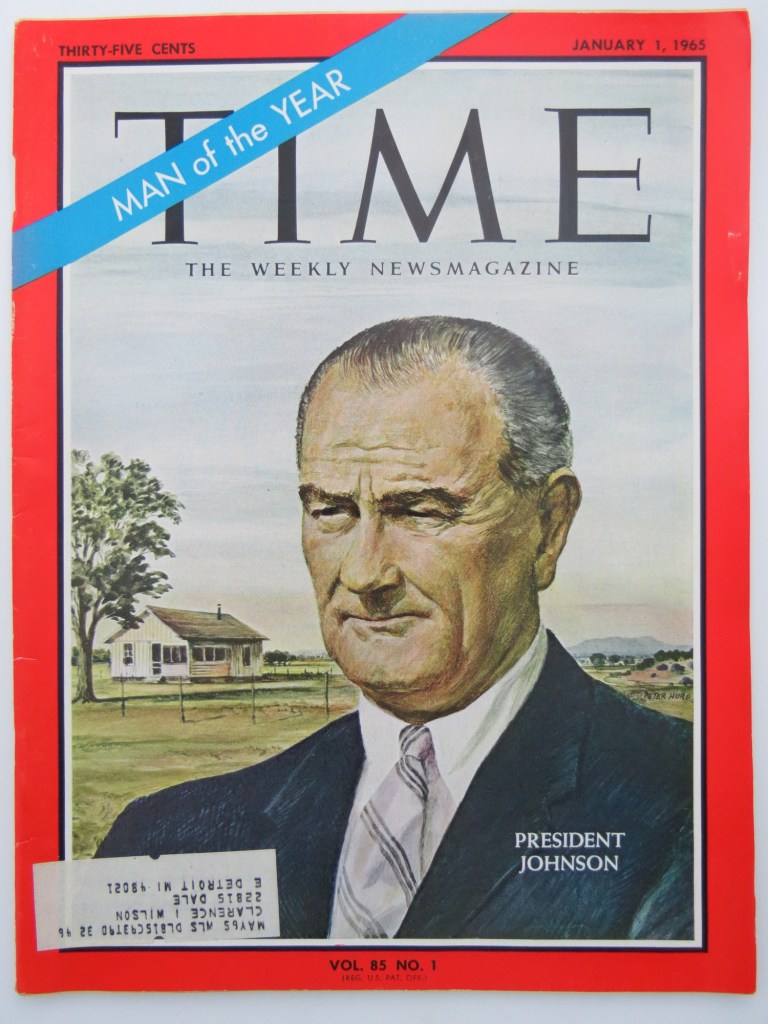
President Johnson will ask Congress this month to adopt a broad education program, costing from $1 to $2 billion and carefully tailored to skirt the church-state issue. Administration sources confirmed today reports that the President had abandoned the idea of seeking general aid to elementary and secondary schools, long the goal of most professional educators and liberal Democrats. Instead, his education program will embrace three principal proposals for elementary and secondary schools. One will be the use of the shared-time concept under which parochial and other private-school students attend some classes in public schools. Several hundred public-school systems in the nation, mostly in the Middle West, are already operating such shared-time programs.
Representative Charles A. Halleck of Indiana, showing little of his customary relish for combat but grittily determined to win, is fighting what may be the most important and closely contested battle of his political life. His adversary is Representative Gerald R. Ford of Michigan, who hopes to take another big step in a quiet and methodical march toward political eminence by winning Mr. Halleck’s job as House Republican leader. Mr. Ford has apparently lined up enough votes to make the contest a nip-and-tuck affair. It will be decided by secret ballot Monday morning at a caucus of the 110 Republicans who will take seats in the House when the 89th Congress convenes later that day. Regardless of who wins, the basic course of the Republican party in the House is unlikely to be changed appreciably. Both men are generally classified as conservatives on fiscal, economic and social questions and as advocates of a bipartisan approach to foreign policy.
Liberal Democrats hope to set a precedent in party discipline tomorrow by purging two Southerners from the House Democratic caucus. If the move is successful, Representatives John Bell Williams of Mississippi and Albert W. Watson of South Carolina will lose their seniority on House committees and be deprived of other party privileges such as job patronage at the Capitol. The caucus is made up of the 295 Democratic members of the House in the new Congress. It meets tomorrow afternoon to vote on the proposed purge and consider various procedural reforms designed to curtail the power of conservatives in the House. The proposals will be offered by leaders of the Democratic Study Group, an informal organization of House liberals. The group claimed a membership of 125 in the expiring Congress and expects to expand its roster to about 175 in the 89th Congress, which convenes Monday. Representatives Williams and Watson are disciplinary targets because they openly supported the Republican candidate, Senator Barry Goldwater of Arizona, in the Presidential election last year. Both have announced that they would fight to retain their party privileges.
Internal disputes between militants and moderates in the civil rights movement have clouded next Monday’s attempt by Mississippi integrationists to challenge the seating of five Representatives in Congress. The dispute is between the younger, more militant members of the movement and their more moderate elders. In some ways, it is a microcosm of the disagreement that has penetrated the movement during the last year, a disagreement that some observers feel is sapping much of the drive’s energy. Representatives of almost every element of the movement agree that the five-man Mississippi Congressional delegation was elected unconstitutionally — through elections in which Blacks were denied their right to register and vote — and that it should be denied seats in the House of Representatives on Monday.
But only a few of the organizations also favor an attempt to seat three Mississippi Black women in the House, to take non-voting positions in Congress until the basic challenge is settled by the House Subcommittee on Elections and Privileges. These organizations include the Congress of Racial Equality, the Student Nonviolent Coordinating Committee, and the Rev. Dr. Martin Luther King Jr’s Southern Christian Leadership Conference.
A civil rights Freedom House in Hattiesburg, Mississippi ushered in the New Year by candlelight today. The city had cut off electric power. “The reason I ordered the power cut off was because the wiring was not adequate to take care of the electrical load,” said Ralph Brehaney, city electrical inspector. “It endangered human life and property,” he added. The Council of Federated Organizations called the action harassment aimed at shutting down the facility, if possible. It said that some 30 college students spent some of their Christmas holiday repainting and cleaning up the one-story frame house.
President Johnson sent New Year’s praise today to many thousands of United States servicemen and civilians facing dangers and hardships overseas “to help create order and progress in a troubled world.”
President Johnson began today the process of reassigning United States Ambassadors around the world with the announcement that new envoys had been named to serve in Venezuela and Ecuador.
President Johnson has asked Gardner Ackley, chairman of his Council of Economic Advisers, to look into recent selective increases in steel prices.
The newest House Office Building, a marble and granite structure that has been variously called “the 10-year Pyramid,” “Edifice Rex” and “the Thing on the Hill,” is opening for business. The first of 169 Representatives are to move in after submitting requests for suites on Sunday.
The State Department is on the verge of abolishing a special office that has dealt for nearly two years with the problem of establishing an Atlantic alliance fleet armed with nuclear weapons.
Governor George Romney, bidding for cooperation from Michigan’s first Democratic Legislature in 30 years, called today for an end to political partisanship in order to move the state in “new directions for the future.”
American actor George Murphy begins his term as U.S. Senator from California.
Malcolm X said this week that he had prepared the political groundwork in the capitals of Africa for the recent concerted attack on American “racism” in the debate on the Congo in the United Nations.
American novelist Michael Crichton (22) weds high school sweetheart Joan Radam; they divorce in 1970.
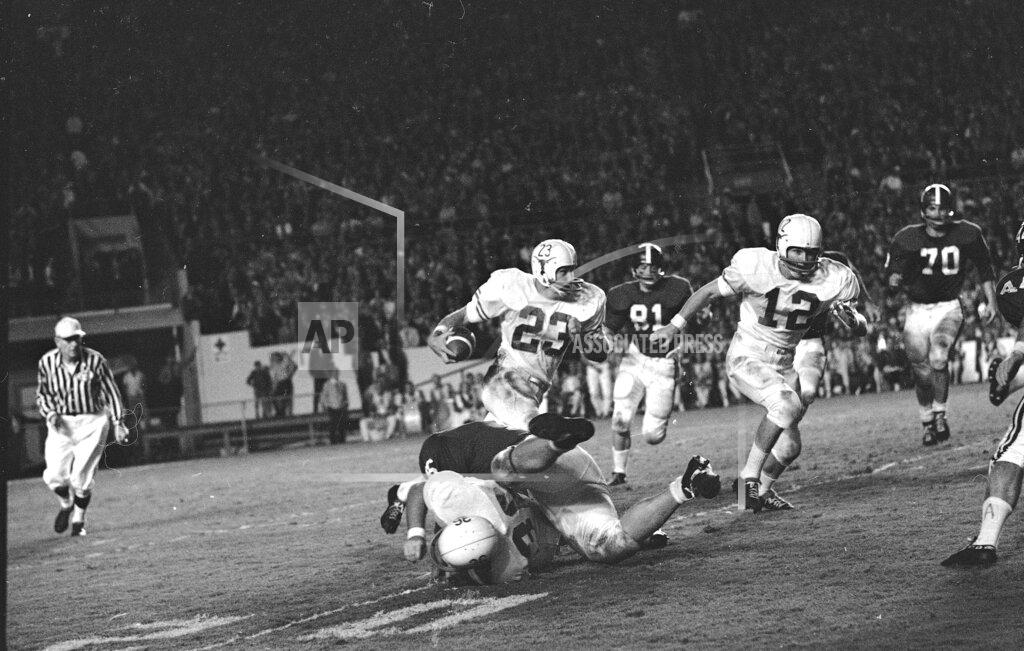
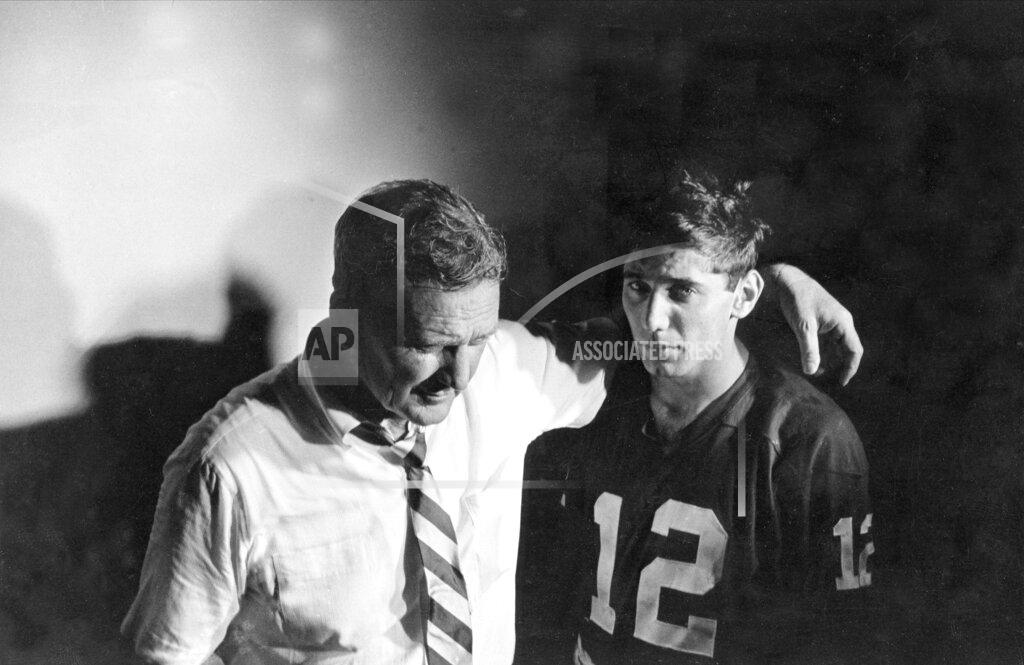
The #1 ranked team in college football, the Alabama Crimson Tide, was beaten by the #3 Texas Longhorns, 21–17, in the Orange Bowl. Meanwhile, the #2 Arkansas Razorbacks rallied to beat the #6 Nebraska Cornhuskers, 10–7, in the Cotton Bowl and remained the only unbeaten major team from 1964. However, since the final Associated Press and United Press International polls had been made at the end of the regular season, Alabama’s loss did not affect its #1 standing.
31st Orange Bowl: #5 Texas beat #1 Alabama, 21–17. After the defense stopped Alabama at the one-yard line on fourth down, Texas responded quickly with the first score of the evening. After moving the ball 20 yards, Longhorn running back Ernie Koy took the ball 79-yards for a 7–0 Texas lead with only :23 remaining in the first quarter. Texas extended their lead to 14–0 on their next offensive possession when George Sauer caught a 69-yard touchdown reception from Jim Hudson. Alabama cut the lead in half later in the second quarter when Joe Namath hit Wayne Trimble for a 7-yard touchdown reception. On the following possession, Alabama blocked a 35-yard David Conway field goal attempt, recovered the ball, but fumbled it on the return, which Texas recovered. Ernie Koy capped the ensuing 38-yard drive with a two-yard touchdown run to give the Longhorns a 21–7 lead at halftime. In the second half, Texas was held scoreless, but Alabama was unable to take the lead with only ten additional points. The first score was a 20-yard Ray Perkins touchdown reception from Namath and the second on a 26-yard David Ray field goal early in the fourth quarter. Although on the losing side, Alabama quarterback Namath was selected as the game’s outstanding player for completing 18 of 37 passes for 255 yards and a pair of touchdowns.
29th Cotton Bowl: #2 Arkansas defeated #6 Nebraska 10–7. A standing room only crowd watched as Arkansas opened the scoring on a Tom McKnelly field goal in the first quarter. Nebraska responded in the second, with Harry Wilson punching it into the end zone from one yard out for a touchdown, giving the Huskers a 7–3 lead at halftime. The third quarter passed with no scoring. Fred Marshall took over at quarterback for the Razorbacks in the fourth quarter and engineered an 80-yard drive with little time left on the game clock. Marshall pitched to running back Bobby Burnett, who scampered in from the three-yard line for the game’s final touchdown, giving Arkansas a 10-7 victory. It was their first win in a major bowl and their first bowl win in four years.
31st Sugar Bowl: #7 LSU beat Syracuse, 13–10. Syracuse opened the scoring in the first quarter with a 23-yard Roger Smith field goal. When Syracuse got the ball next, LSU’s defense forced a safety, as lineman George Rice tackled halfback Floyd Little in the end zone, making it 3–2. Syracuse’s Bradlee Clarke returned a blocked punt 28 yards for a touchdown, and after a scoreless second quarter, Syracuse led 10–2 at halftime. In the third quarter, LSU reserve quarterback Billy Ezell threw a 57-yard touchdown pass to Doug Moreau, and converted for two points on a pass play to tie the game at ten. With under four minutes remaining, Moreau kicked a 28-yard field goal to put LSU ahead, 13–10, which was the final score, and he was named Sugar Bowl MVP.
51st Rose Bowl: #4 Michigan beat #8 Oregon State, 34–7. Michigan was an 11-point favorite, but after a scoreless first quarter, it was the Beavers who struck first, with Paul Brothers completing a five-yard pass to Doug McDougal early in the second quarter, with Steve Clark kicking the extra point. The Beavers held the Wolverines for a while, but on their third possession following the Beavers’ score, tailback Mel Anthony ran 84 yards, a Rose Bowl record at the time, for a touchdown. Richard Sygar’s kick was no good. The Beavers’ 7–6 advantage was short-lived, however, as on the very next possession, Carl Ward ran for 43 yards and a touchdown. While the conversion pass from Bob Timberlake to Ben Farabee was broken up, the Wolverines led 12–7 at the half. The second half was all Michigan. Anthony blocked a punt and rushed for two more touchdowns in the third quarter, and quarterback Timberlake ran 24 yards for the final touchdown, making the final score 34–7. For his efforts, Anthony was named the game’s Most Outstanding Player.
Born:
Andrew Valmon, American athlete (Olympic gold medal, 4x400m relay 1988, 1992; World Championship gold 1993), in Brooklyn, New York, New York.
Harry Galbreath, NFL guard (Miami Dolphins, Green Bay Packers, New York Jets), in Clarksville, Tennessee (d. 2010, of an apparent heart ailment).
Richard Stephens, NFL guard (Los Angeles-Oakland Raiders), in St. Louis, Missouri.
Scott Watters, NFL linebacker (Buffalo Bills), in Columbus, Ohio.
Teddy Nelson, NFL defensive back (Kansas City Chiefs), in Pittsburgh, Pennsylvania.
Died:
Juan Bautista Plaza, 66, Venezuelan composer.




 History Diaries