Negotiations between the North Atlantic Treaty Organization and the Soviet bloc in Vienna on reducing East-West troop levels in central Europe recessed with spokesmen for both sides conceding that 13 months of talks have not produced any real progress toward an agreement. They did agree that the talks probably will resume in late January but in all other respects they indicated that both sides remain frozen behind widely divergent proposals on how to bring about a disengagement of forces.
Senator Edward M. Kennedy and two other Senators introduced a resolution today expressing. broad support for the Vladivostok aims control agreement but calling on President Ford to try to negotiate lower ceilings for Soviet and American force levels before submitting the accord for Senate approval.
A deadlock of 50 years over the 1925 Geneva protocol on chemical warfare was ended today when the Senate Foreign Relations Committee voted unanimously to send the treaty to the Senate for approval. The United States is the only country among the major powers that has not ratified the treaty, which bans the use of chemical and bacteriological warfare. It appears virtually certain that the treaty will be approved by the Senate and ratified by President Ford.
The U.N. General Assembly, overriding objections by the United States and other Western industrial nations, overwhelmingly approved a far-reaching charter for states’ economic rights and privileges. The 34-article document, drafted by developing nations, includes a provision that every state may nationalize, expropriate or transfer ownership of foreign property, with appropriate compensation if “all relevant circumstances call for it.”
Foreign ministers of the Atlantic alliance countries opened a two‐day meeting here today with dispute over oil diplomacy and gloomy predictions about the economic outlook for the West. According to a West German diplomat, all the ministers agreed during the closed sessions that there should be a meeting between the major oilconsuming and oil‐producing countries. The dispute reportedly arose when the French Foreign Minister, Jean Sauvagnargues, said that the meeting his Government had proposed between oil producers, oil consumers and developing nations should be held soon. Secretary of State Kissinger was said to have held out for the American position, which is that the major oil‐consuming nations should prepare their position first. As a result, a senior official of the North Atlantic Treaty Organization said, the ministers failed to agree today on the timing or other aspects of a meeting between producers and consumers.
Two rush-hour explosions in an electrical junction box near the Marylebone commuter station sent bomb-jittery Londoners scurrying for shelter but the blasts apparently were the result of an electrical failure and not terrorists. The first burned the hand of a mailman emptying a nearby post box. Police were searching for a possible second bomb when the junction box exploded a second time, injuring three officers.
Secretary of State Kissinger and other officials of NATO countries continued efforts today to find common ground between Greece and Turkey on the deadlocked Cyprus issue. But there were no signs of substantial progress. Mr. Kissinger met separately with the Greek Foreign Minister Dimitri S. Bitsios, and Foreign Minister Mehil Esenbel, of Turkey. He held exploratory talks with both men in Brussels yesterday on ways to break a deadlock in talks between the Greek and Turkish Cypriots. Mr. Kissinger said that he would meet both Foreign Ministers again tomorrow.
Archbishop Makarios was described by a highly placed source today as sobered and saddened by the Cyprus he found on his return last Saturday from the exile he began after the coup that deposed him from the Presidency last July 15. The Archbishop was said to be convinced of the urgency of beginning negotiations for a political settlement between the Greek and Turkish communities of Cyprus. Although his negotiating position toward Turkey and the Turkish Cypriots was unbending in the 14 years after Cyprus gained independence from Britain, the Archbishop was described by the source, who has conferred with him, as ready now to meet the Turkish side with a clear understanding of how greatly the situation has shifted in the Turks’ favor since the invasion by the Turkish Army in July. Archbishop Makarios has toured a number of the camps in which well over 100,000 ethnic Greeks, driven from their homes in the Turkish‐occupied north, have been living for nearly five months, increasingly dejected over a lack of progress toward allowing them to return home.
Wells Stabler, a deputy assistant secretary of state, will be nominated ambassador to Spain in place of Peter M. Flanigan, it was learned in Washington. Flanigan’s nomination touched off stormy controversy in the Senate on several issues and President Ford dropped the appointment in face of the opposition. If confirmed, Stabler will replace Admiral Horacio Rivero, who left Madrid recently.
Well-informed sources in Athens said that Greece intends to allow the United States to keep military bases in Greece that serve mutual interests, but may request the removal of bases that are used only by the United States. It is uncertain how this will be done, but it appears likely that most bases will remain. But American diplomats expect Athens to insist on renegotiating the basic agreement that governs the use of American facilities here. At a time of détente between East and West, Greece wants to be treated as an equal not a dependent, with far greater control over the American presence here.
As one diplomat put it: “The old permissive atmosphere that existed when the shadow of the Slav menace hung over Greece won’t be restored.” In a speech to Parliament last night, Premier Konstantine Karamanlis disclosed that he had sent a note to Washington formally asking for a review of the American bases here. Today well‐informed sources explained and interpreted the note, which was delivered within the last few days. The West German government scrapped the remains of its anti-inflation program and announced an anti-unemployment and anti-recession economic policy instead. It did so “with fingers crossed,” as one official said, that the United States will soon follow suit to avoid a world depression.
Israeli planes attacked two Palestinian areas in the southern outskirts of Beirut today, less than 24 hours after a guerrilla grenade attack in a Tel Aviv movie theater. Lebanon’s Premier Rashid al-Solh, said in Parliament tonight that one woman had been killed and 10 people wounded in the raid by four planes. He said Lebanon would lodge a complaint with the United Nations Security Council. The casualties were reported at the Sabra area, where a large Palestinian community lives. A building in the area was said to have been destroyed. According to a guerrilla communiqué, the building was a supply center for the “militia of the Palestinian revolution.” The attacking planes also strafed the Shatila camp, which houses 9,000 refugees and is adjacent to the Sabra area. No damage or casualties were reported in the Shatila camp. The planes were fire upon by guerrilla and Lebanese antiaircraft guns.
The guerrillas said two jets had been shot down. The Lebanese Defense Ministry said an object emitting smoke and believed to be a plane was seen plunging into the Mediterranean. In Tel Aviv, it was officially reported that all planes had returned safely.” The air raid, which the Lebanese Defense Ministry said had lasted seven minutes, came during the evening rush hour. As the jets swept low over the capital, air raid sirens howled and traffic was disrupted.
The raid came only hours after a guerrilla organization had claimed responsibility for the grenade attack in the Tel Aviv movie theater last night, in which three persons were killed and 59 wounded. One of the dead was a guerrila, one was killed by one of his own grenades. Yasser Arafat, chairman of the Palestine Liberation Organization, said the Tel Aviv attack had been in retaliation for the rocket attacks on three P.L.O. offices in Beirut on Tuesday. In a statement printed today in the pro-guerrilla daily Al Moharrer, Mr. Arafat warned the Israelis that the guerrillas had the ability to retaliate within a few hours for any new Israeli attacks.
Renewed rioting broke a temporary calm in Rangoon as roaming groups of students and workers ignored martial law and set fire to government buildings in a second day of violence. The Burmese government said nine people were killed when police opened fire on crowds to prevent them from storming police stations and other official buildings. The situation reportedly returned to normal by nightfall. The violence was originally touched off after troops recovered the body of U Thant from a university campus where it had been entombed by students.
A helicopter crashed in the western Mekong Delta yesterday and first reports said that 54 South Vietnamese soldiers had been killed, according to a Saigon command announcement today. The helicopter went down near the town of Mộc Hóa, about 50 miles west of here and south of an area where there has been fighting near the Cambodian border. The command said the cause of the crash was unknown. Communist troops in the area reportedly are equipped with SA‐7 shoulder‐fired antiaircraft missiles.
The South Korean government is moving to deport the Rev. George Ogle, an American Methodist missionary who has been working with Korean clergy to improve the living and working conditions of Koreans. The U.S. Embassy in Seoul, acting on behalf of the government of President Park Chung Hee, has informed Mr. Ogle that unless he issues a statement dictated by the regime, he will be deported. The statement would have Mr. Ogle promise not to criticize the Korean constitution devised by President Park. The constitution eliminates many civil rights in Korea.
Four crewmen were missing after an Air Force B-52 crashed about 25 miles west of Guam. The copilot, 1st Lieutenant John D. Watson, and the navigator, 1st Lieutenant Brad L. Busby, parachuted into the Pacific and were rescued. The pilot is among the missing crewmen. The bomber was not armed on the training flight, the Air Force said.
Hundreds of angry demonstrators forced President Valéry Giscard d’Estaing of France to cancel part of his program today shortly after he arrived in this Caribbean island on his way to a weekend meeting in Martinique with President Ford.
The United States welcomed as “an extraordinary and unprecedented step” a declaration signed in Peru by eight Latin American countries that they intend to limit armaments and cease acquiring offensive weapons. The signers were Peru, Chile, Bolivia, Ecuador, Venezuela, Argentina, Colombia and Panama.
Congress approved by large margins legislation intended to reduce the effects of the nation’s rapidly growing unemployment. The House and the Senate passed a measure that would provide hundreds of thousands of federally financed public service jobs for the unemployed, and unemployment compensation for up to 3 million persons not now covered by the federal unemployment insurance system. In addition, the House, voting 374 to 2, approved a bill that would give at least 13 more weeks of unemployment compensation to persons already covered by federal insurance. A similar measure is expected to be approved by the Senate in a few days.
Auto industry and labor leaders urged President Ford at a White House meeting to consider an income tax cut and a “pause” on federal emission and safety standards to bolster sagging car sales and the general economy. Gov. William Milliken of Michigan, who also attended the meeting, said he had the impression that the President would consider a tax cut.
The Labor Department reported that the nation’s inflation, as measured by the sensitive Wholesale Price Index, abated further in November, though prices were still going up. The overall index, after adjustment for normal seasonal changes in some prices, rose by 1.2 percent last month, one of the smallest increases this year and only half the October rise.
The House Judiciary Committee recommended, by a vote of 26 to 12, the confirmation of Nelson Rockefeller as Vice President. All 17 of the committee’s Republican members voted to approve the nomination; 12 of the 21 Democrats voted against approval. A vote by the full House is expected December 20. The Senate voted Tuesday to confirm Mr. Rockefeller, 90 to 7. Six of the eight Democrats who voted, slightly more than a year ago, against the nomination of Gerald R. Ford as Vice President also voted against Mr. Rockefeller today. They are Representatives, Robert W. Kastenmeier of Wisconsin, Don Edwards of California, John Conyers Jr, of Michigan, Jerome R. Waldie of California, Robert F. Drinan of Massachusetts and Elizabeth Holtzman of Brooklyn.
Two Democrats who voted against Mr. Ford’s confirmation —Representatives Barbara C. Jordan of Texas and Charles B. Rangel of Manhattan—joined the majority in voting for Mr. Rockefeller. Representative Peter W. Rodino Jr., the New Jersey Democrat who is the committee’s chairman, voted for Mr. Rockefeller’s confirmation. He also voted for Mr. Ford in committee — but voted against him when the full House of Representatives voted, 387 to 35, to confirm him as Vice President December 6, 1973.
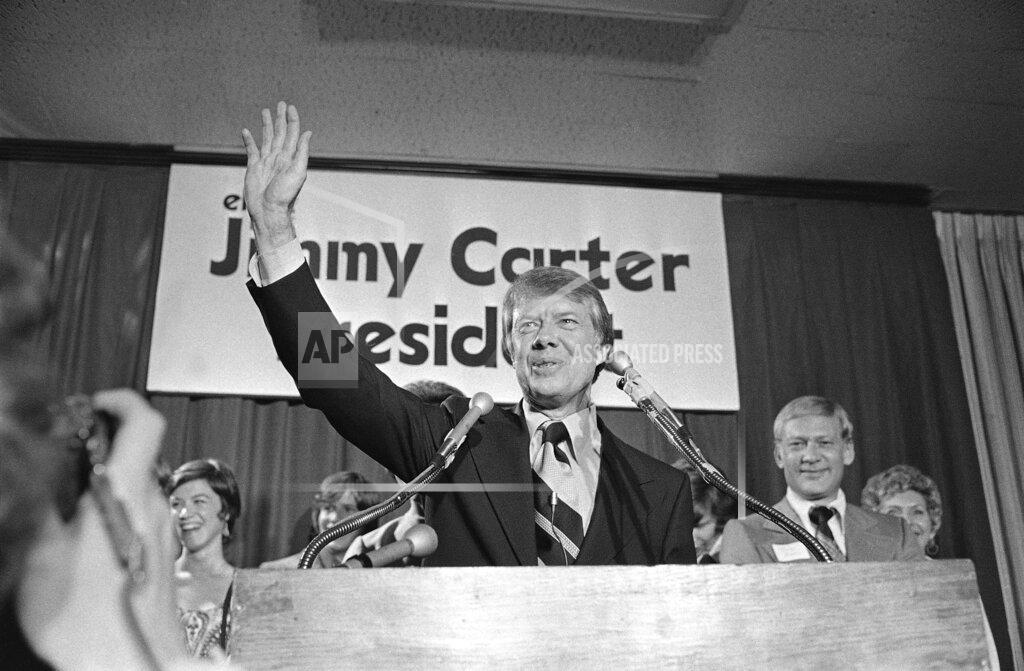
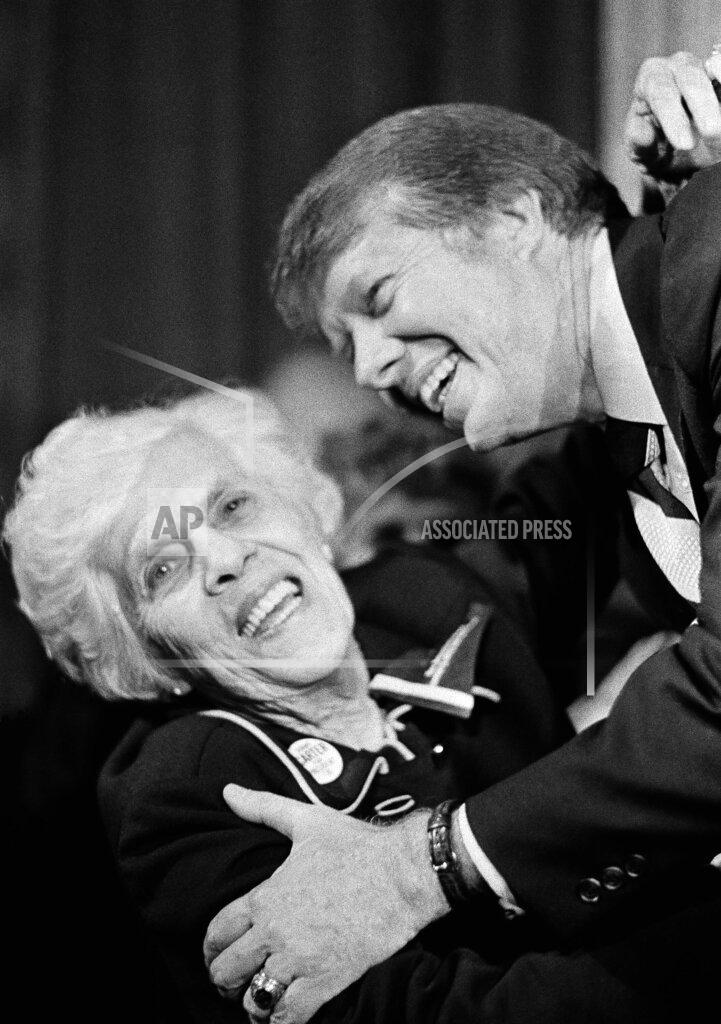
At the Atlanta Civic Center, 50-year-old Jimmy Carter, the Governor of Georgia, announced his candidacy for the Democratic nomination in the 1976 United States presidential election. He is the second formally declared candidate for the 1976 Democratic nomination. Representative Morris Udall of Arizona is the other. The 50‐year‐old Governor, whose term ends January 14, said he intended to enter all of the state primaries and to pursue delegates in nonprimary states. In the latter category, he mentioned Alabama, Texas and Washington — the respective homes of Gov. George C. Wallace and Senators Lloyd M. Bentsen Jr. and Henry M. Jackson, all likely candidates tor me Democratic nomination. A recent Gallup survey listed no fewer than 31 persons “mentioned” as possible candidates. Governor Carter was not on that list—a measure of the uphill battle he faces to gain recognition among voters outside the South.
White House aides said that President Ford, although he will accept the wishes of Congress to nullify his agreement granting former President Richard M. Nixon custody of his presidential tapes and papers, had not decided whether he would sign the bill or simply permit it to become law without his signature. Mr. Nixon’s attorney, Jack Miller, apparently argued strongly for a veto at a meeting with White House aides. Under the bill, Mr. Nixon would still have access to his papers but would not be allowed to remove them from government custody.
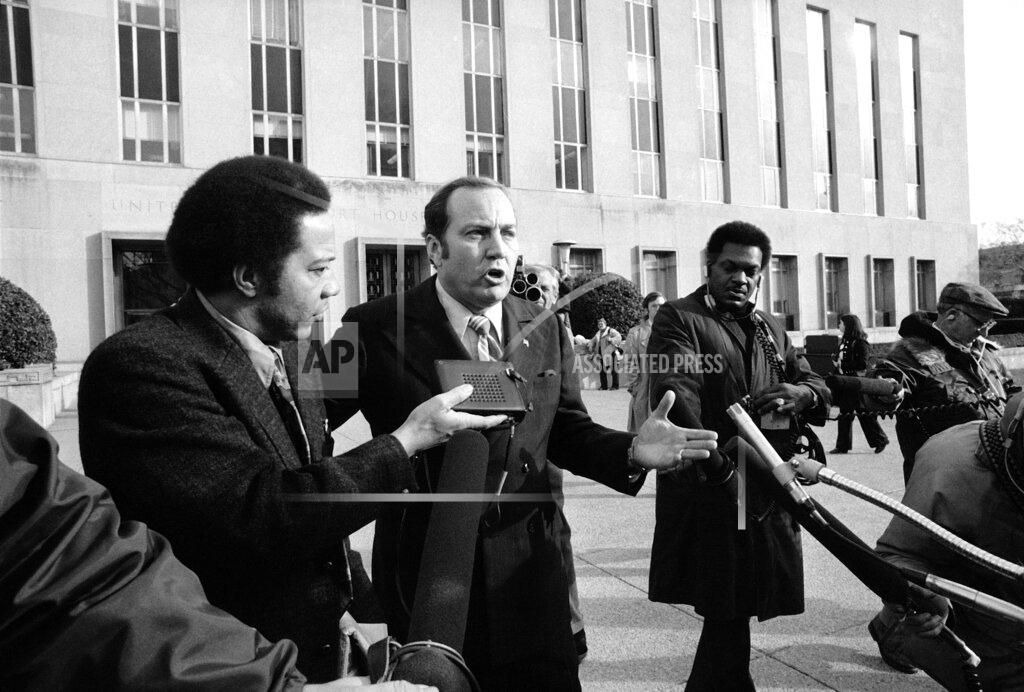
The conviction of James W. McCord Jr. for the Watergate break-in and bugging was upheld unanimously by a federal appeals court in Washington, D.C. Also upheld was the contempt sentence of G. Gordon Liddy for failing to testify before a grand jury about the break-in after his conviction. McCord, security chief for former President Richard M. Nixon’s 1972 campaign, and Liddy, counsel to the campaign finance committee, were convicted on January 30, 1973, and both appealed. Liddy’s conviction was upheld unanimously a month ago.
A 15-year-old boy tried and convicted as an adult in the first-degree murder of a 12-year-old girl was sentenced to death in the electric chair by a Circuit Court judge in Ft. Pierce, Florida. The boy, George Thomas Vasil, showed no emotion when the verdict was announced, courtroom observers said. He was convicted in the Sept. 19 strangulation of Pamela Vassar. Under Florida law, a jury in such a case can recommend either execution or life imprisonment. The trial judge does not have to abide by the recommendation but Judge Wallace Sample concurred in the jury’s recommendation of the death sentence.
The governor of Idaho gave an emphatic “no” to an Atomic Energy Commission proposal to use his state as the site of a temporary nuclear garbage dump. However, a spokesman told an AEC hearing in Salt Lake City that the governor, Cecil D. Andrus, might agree later to the proposal if the radioactive wastes were to be reprocessed and if the agency removed waste now buried at the Idaho National Engineering Laboratory.
Two witnesses whose recantations in the Rubin (Hurricane) Carter murder case were disbelieved by a judge insisted yesterday that they had testified truthfully when they tried to clear the former boxer and a co‐defendant of triple‐homicide charges. “You tell the truth and they don’t believe you; you tell a lie in court and they do believe you,” said one of the witnesses, Arthur D. Bradley, commenting on a refusal by a New Jersey judge to grant Mr. Carter and John Artis a new trial. The other recanting witness, Alfred P. Bello, who is in jail on a burglary conviction, said he had expected the appeal to be denied because both he and Mr. Bradley had criminal records. “Two statements from two known criminals are two very small voices to be heard by deaf ears,” Mr. Bello said. At a recent hearing for a new trial, Mr. Bradely and Mr. Bello testified that they had lied at the trial because of coercion by detectives from the Passaic County Prosecutor’s office. The coercion charges were denied by Passaic County officials.
Conductor Skitch Henderson was convicted of a second count of filing false income tax returns in a Manhattan federal court. A charge of income tax invasion was dismissed after the jury could not agree on a verdict. Sentencing was set for February 15. Henderson faces a maximum penalty of three years in prison and fines of $10,000. He had been accused in a five-count indictment of evading more than $40,000 in income taxes in 1969 and 1970 by taking an illegal deduction of $350,000.
Two commonly prescribed tranquilizers may be linked to increased rates of birth defects among the children of women who took them, according to a study published in the New England Journal of Medicine. The drugs are meprobamate and chloriaz epoxide hydrochloride, which are marketed as Librium, Equanil and Miltown. The researchers said that “the prescription of these drugs to women of childbearing age should be restricted to cases with strong indications (reasons to prescribe).” However, they said, their findings “merely imply associations that need further confirmation.”
The epic crime film “The Godfather Part II,” director Francis Ford Coppola’s sequel to his 1972 film The Godfather, received its premiere in New York City. It would go into release throughout the United States on December 20.
Dow Jones Industrial Average: 596.37 (+1.02, +0.17%).
Born:
Kostas Karamanlis, Greek politician (10th Prime Minister of Greece, 2004–2009), nephew of Konstantinos Karamanlis.
Julius Matos, MLB second baseman, third baseman, and shortstop (San Diego Padres, Kansas City Royals), in New York, New York.
Brad Costello, NFL punter (Cincinnati Bengals), in Moorestown, New Jersey.
Died:
Karl Arnstein, 87, Bohemian-born American airship engineer, designer of the airships USS Akron (ZRS-4) and USS Macon (ZRS-5)
Sir Edward Maufe, RA, FRIBA, 92, English architect known for designing Guildford Cathedral.

 History Diaries