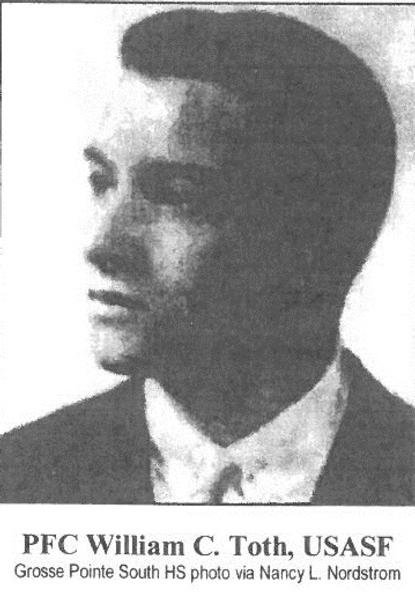
Heavily influenced by the deaths of Special Forces Soldiers James Gabriel and Wayne Marchand on April 8, 1962, PFC Toth had enlisted in the Army while attending the University of Arizona. He had over two years of service and was 22 years old and unmarried when he died. William is buried at White Chapel Cemetery, Troy, Michigan. He is remembered on the Wall at Panel 1E, line 69. (vvmf.org Wall of Faces web site)
Prince Norodom Sihanouk, Cambodian Chief of State, warned today that he would sever diplomatic relations with the United States if his nation was attacked again on its border with South Vietnam. A communique accused the United States of being jointly responsible with South Vietnam for a recent series of frontier incidents that have claimed the lives of Cambodians and American servicemen. Clashes have taken place along the poorly marked border as South Vietnamese forces, with their United States advisers, have pressed military action against Việt Cộng guerrillas.
In Washington, officials were weighing the advisability of giving fighter cover to United States transport planes carrying American personnel near the Cambodian border.
The Cambodian Government has indicated that its forces downed the United States C‐123 transport plane that was shot, down Saturday with the loss of eight American lives. Prince Sihanouk also warned that his government would take the following additional actions simultaneously and immediately in the event of what he termed the “next aggression”:
- Cambodia will recognize North Vietnam and the National Liberation Front in South Vietnam, which is the political organization of the Communist insurgents.
- The Cambodian armed forces will retaliate by undertaking “reprisals regardless of the consequences.”
“We will never be the first to attack,” the communiqué added.
The Cambodian Army of of about 30,000 troops is outnumbered more than 10 to one by South Vietnam’s army, which is engaged against the Việt Cộng. The communiqué was issued by Norodom Sihanouk in the name of the Government and Parliament after a meeting last night of the nation’s leaders. The Chief of State coupled the communiqué with an appeal for support addressed to President Liu Shaochi and Premier Chou Enlai of Communist China.
“I am convinced that all peaceful countries, in particular those such as the People’s Republic of China, which are determined to oppose belli cose acts of American imperialism, will assist Cambodia in its resistance to the criminal aggression of the American‐South Vietnam forces of oppression,” the message to Peking said. It asked for the support of “our brother Chinese.”
Prince Sihanouk refused last month to accept the credentials of the new United States Ambassador, Randolph A. Kidder, who is now out of the country. The staff was sharply cut back after Cambodian rioters damaged embassy buildings last March, and also earlier, when the Chief of State decided to cancel United States economic and military aid programs. The new deterioration in relations comes shortly after Prince Sihanouk’s return from a visit to Peking. Cambodia, the only non‐Communist country to congratulate Communist China on its detonation of a nuclear device, has hailed the Chinese as her best friends and the guardians of her neutrality and independence.
More than recent border incidents have heightened the traditional suspicions and animosities between the Cambodians and Vietnamese. The Pnompenh Government has broken diplomatic relations with South Vietnam and Thailand, its other Western‐aligned neighbor, and has accused them of seeking to divide Cambodia.
The South Vietnamese Defense Ministry charged today that three Cambodian fighter planes and 100 boatloads of Cambodian soldiers violated Vietnamese territory Monday in the same area where the American captain was kidnapped and shot in the back. The ministry said the Cambodian planes crossed the frontier and bombed and strafed the area. It added that the troops crossed the border in conjunction with the air attack. Air Commodore Nguyen Cao Ky, air force commander, said there had been “several” Cambodian raids in the last few days. He said two Americanbuilt T‐28 fighters of the Cambodian Air Force slipped into Vietnam Sunday and attacked a Government outpost 50 miles west of Saigon.
In the fighting in South Vietnam, an American soldier was “severely” wounded today when a United States Army helicopter was shot down by Communist guerrillas 65 miles southwest of Saigon, a military spokesman reported. One U.S. soldier is wounded when the Việt Cộng downed the U.S. Army helicopter, and one U.S. soldier is killed and two wounded in a Việt Cộng ambush.
Patrick Gordon Walker, the new British Foreign Secretary, reacted favorably tonight to a suggestion by U Thant that the five nuclear powers, including Communist China, confer next year on disarmament. Mr. Gordon Walker said at a news conference that he would be in favor of any “reasonable” step to prevent the proliferation of nuclear weapons. “We would consider very favorably” any suggestion by Secretary General Thant, he said. The State Department had previously rejected Mr. Thant’s suggestion, made at a news conference Thursday. Emphasizing that Britain would do everything she could to prevent the spread of nuclear weapons, the Laborite Minister declared that there was also “a good deal to be said” in favor of inviting Communist China to join the 17nation disarmament talks in Geneva.
Asked whether Britain would vote in favor of seating Communist China at the 1984 session of the General Assembly the Foreign Secretary replied that she would vote for seating “China — Communist if you like to call it that.” Britain, which recognized Peking in 1950, voted last year in favor of seating the Communist delegation. In contrast, the United States has led the 14-year fight to hold China’s seat for the Nationalist Government, now established on Taiwan. Summing up the Labor Government’s views on Communist China, which entered the “nuclear club” when it‐exploded an atomic device October 16, Mr. Gordon Walker said that Britain wanted China in the United Nations and was in favor of a “dialogue within the United Nations.”
The Congress party’s working committee, the policy‐making caucus of the ruling party in India, decided today against lndia’s making an atomic bomb. The group, which includes Prime Minister Lal Bahadur Shastri, has authorized former Defense Minister V. K. Krishna Menon and Foreign Minister Sardar Swaran Singh to draw up a draft resolution for adoption at the all‐India Congress committee meeting next month in Guntur, in the state of Andhra. The resolution will reiterate India’s policy of peaceful use of nuclear power. After the recent explosion of an atomic bomb by Communist China, pressure has been mounting for India to give up this policy.
The leaders of the new Soviet regime gave explanations today to foreign Communists on the circumstances of the ouster of Nikita S. Khrushchev from positions of leadership. Leonid I. Brezhnev, the new First Secretary of the Communist party, led a group of officials in a meeting with a three‐man delegation of the French Communist party, which came to Moscow to seek a clarification of the reasons behind the Kremlin shakeup and the methods used in bringing it about. Mikhail A. Suslov, Nikolai V. Podgorny and Boris N. Ponomarev also were present. These three men are among the most influential in the party leadership after Mr. Brezhnev. Mr. Suslov, the party’s chief ideologist, was the principal speaker at the Central Committee meeting that deposed Mr. Khrushchev.
U.S. President Johnson disclosed today that he had received what he considered an encouraging message from Premier Aleksei N. Kosygin of the Soviet Union. “lt shows that the leaders of the world are not trying to figure out ways to destroy you,” Mr. Johnson told a group of Latin American diplomats. “They are trying to evolve means to save humanity.” The President did not elaborate on the message. Government sources said it had been contained in a report from Foy D. Kohler, the United States Ambassador to the Soviet Union on a conversation with Mr. Kosygin Friday. The sources said the message was reassuring and in general line with Mr. Kosygin’s other remarks to Mr. Kohler, which reiterated that “peaceful coexistence” remained the basis of Moscow’s foreign policy.
France and the Soviet Union moved rapidly today toward the conclusion of a new trade pact in an atmosphere of revived friendship. An editorial in Pravda, news paper of the Soviet Communist party, which emphasized the “real ground for cooperation” between the two Governments, was viewed by diplomats here as an expression of mutual interest in improved political as well as economic relations. French sources suggested that the importance attached to France in the Soviet view of Europe could be seen in a statement by Foreign Minister Andrei A. Gromyko. He had said that, “if France responds” to Soviet wishes for closer ties,, “relations should develop.” The opinion is developing among diplomatic missions here that “something is up” between the French and the Russians. The initiative appears to come from Moscow. But some suggested that the origin of the new warmth could be traced to confidential French approaches to the new Soviet leadership.
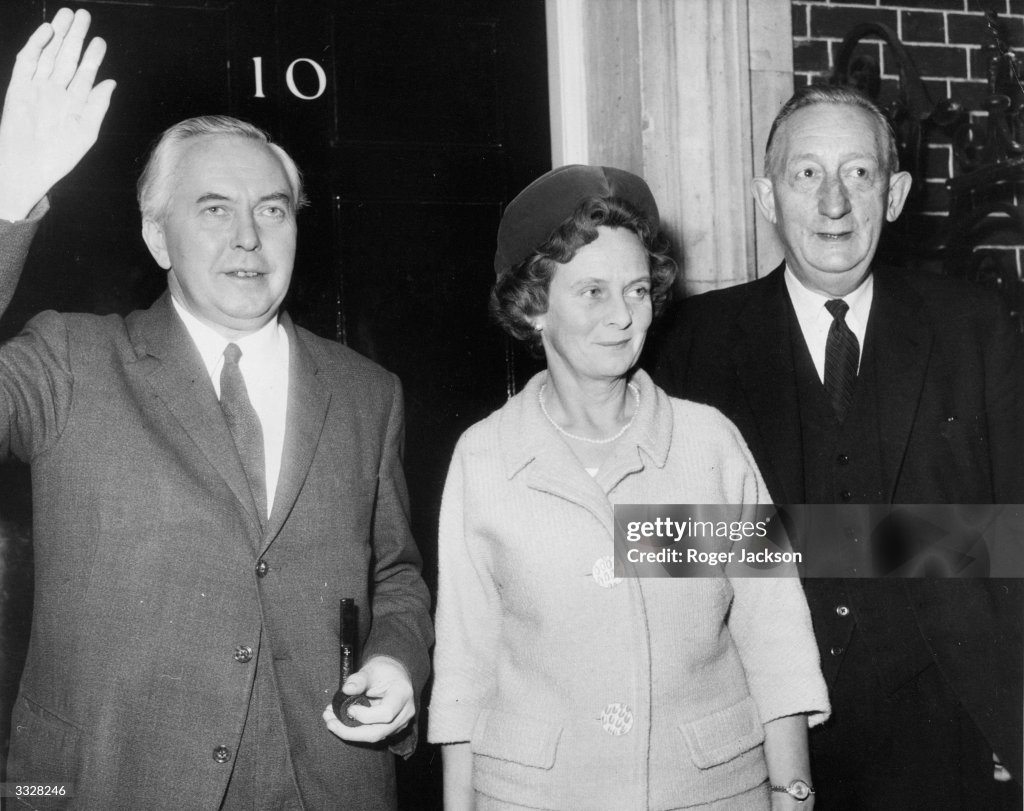
The British Government appealed today to the voters of Rhodesia to repudiate their Prime Minister, Ian D. Smith, and force him to resign. Arthur Bottomley, Secretary of State for Commonwealth Relations, said on his return from Africa that the British Government hoped “internal pressures” would result in “a change of government” in Salisbury, the Rhodesian capital. Mr. Smith, opening debate in the Rhodesian Parliament Tuesday, charged Britain with “blackmail and intimidation.” Earlier in the day Prime Minister Harold Wilson warned the colony’s white population about the dangers of setting up an independent Rhodesian state.
Students invaded the offices of the United States Information Service in Santa Cruz, Bolivia today and burned the American flag during renewed demonstrations against the Government of President Victor Paz Estenssoro. One man was reported killed and 10 persons injured as the police battled the rioters in Santa Cruz, about 330 miles east of La Paz. A Government statement called the rioting Communist inspired. Reports from Sucre, 260 miles southeast of La Paz, said that 54 persons there had been injured in clashes with the police. Thirty of the injured were students.
The Ayatollah Ruhollah Khomeini, a Shi’ite Muslim religious leader in Iran, appeared at the city of Qom and gave an anti-government speech against that would get him exiled for 14 years, but that would also identify him as the most prominent foe of Iran’s monarch, the Shah Reza Pahlavi and the future leader of the Islamic Republic of Iran. The address, titled The Granting of Capitulatory Rights to the United States, was a response to the recent passage of the “law of capitulation” that gave U.S. servicemen in Iran diplomatic immunity from local prosecution. “The government has sold our independence, reduced us to the level of a colony, and made the Muslim nation of Iran appear more backward than savages in the eyes of the world!” He added that “If the religious leaders have influence, they will not permit some agent of America to carry out these scandalous deeds; they will throw him out of Iran.”
As the Congo Crisis deepened, Christophe Gbenye offered to negotiate for the safe passage of white settlers (60 Americans and 800 Belgians) from Stanleyville and other areas controlled by the Simba Rebellion.
Ronald Reagan, at the time “a supposedly washed-up actor” whose last leading role in a movie had been in 1957’s Hellcats of the Navy, appeared in a nationally televised speech that launched him into a new career that would make him President of the United States. The address, which would later be referred to as “A Time for Choosing”, had been given earlier at a fundraiser for Republican presidential nominee Barry Goldwater in Los Angeles. A group of California businessmen were so impressed by Reagan that they purchased 30 minutes of airtime on NBC to broadcast the speech again; Goldwater’s national campaign headquarters tried to get Reagan to cancel the program because of fears that it was “too incendiary”, and Reagan refused unless he heard from Goldwater himself. Reagan told his audience, “We have come down to a time for choosing. Either we accept the responsibilities for our own destinies, or we abandon the American Revolution and confess that a little intellectual elite in a far distant capital can plan our lives for us better than we can plan ourselves. Reagan’s endorsement was so appealing to conservatives that it “raised more than a half-million dollars for the Republican Party, and when he finished it, Ronald Reagan was a national political figure.”
President Johnson endorsed in principle today a new plan for setting aside a fixed portion of the Federal income tax each year for automatic distribution to the states. The President’s endorsement, the first he has given to the proposal, came in a brief and cautiously worded White House statement that gave no details. It was learned, however, that he was highly receptive to the plan, which would require Congressional approval.
The essential details are being worked out by a study group, made up of private and Government members, that will report to the President in midNovember. The chairman of the group, which is near agreement on the details, is Joseph A. Pechman, an economist formerly in Government service who is now director of economics at the Brookings Institution. As the plan is believed likely to shape up, it would have four main features.
First, a fixed and constant portion of Federal income tax revenue would be set aside each year. One formula under discussion would set aside from $2 billion to $3 billion at the present tax rates and national income. The amount would gradually rise with the growth of the economy.
Second, this money would be put in a trust fund for distribution to the states at the end of the year. Thus, the payment would not be a Federal budget expenditure.
Third, the money would go to the states virtually unconditionally. That is, they could use it almost any way they wanted. The money would be in addition to the present system, under which several billion dollars in grants‐in‐aid go to the states annually. These are tied to specific programs such as highways, hospitals and public assistance, some of which require state matching funds.
Professional surveys of voter opinion are predicting that President Johnson will win the Presidential election next Tuesday by an overwhelming majority of popular and electoral votes. Most of these surveys report Mr. Johnson, the Democratic candidate, leading Senator Barry Goldwater by at least 20 percentage points. This is by far the biggest gap the polls have ever shown in a contest for President a week before the balloting. Only twice in the century have Presidential candidates won by margins like those indicated for Mr. Johnson at this juncture.
Warren G. Harding, a Republican, was elected in 1920 with 60.4 percent of the popular vote. In 1936, President Franklin D. Roosevelt, a Democrat, was re‐elected with 60.8 percent of the vote. The most impressive landslide victory in recent years, that of President Dwight D. Eisenhower in 1956, was with 57.4 percent of the total vote. The latest nationwide poll of Dr. George C. Gallup’s American Institute of Public Opinion rates Mr. Johnson at 64 percent and Mr. Goldwater at 29 percent, with 7 per cent undecided.
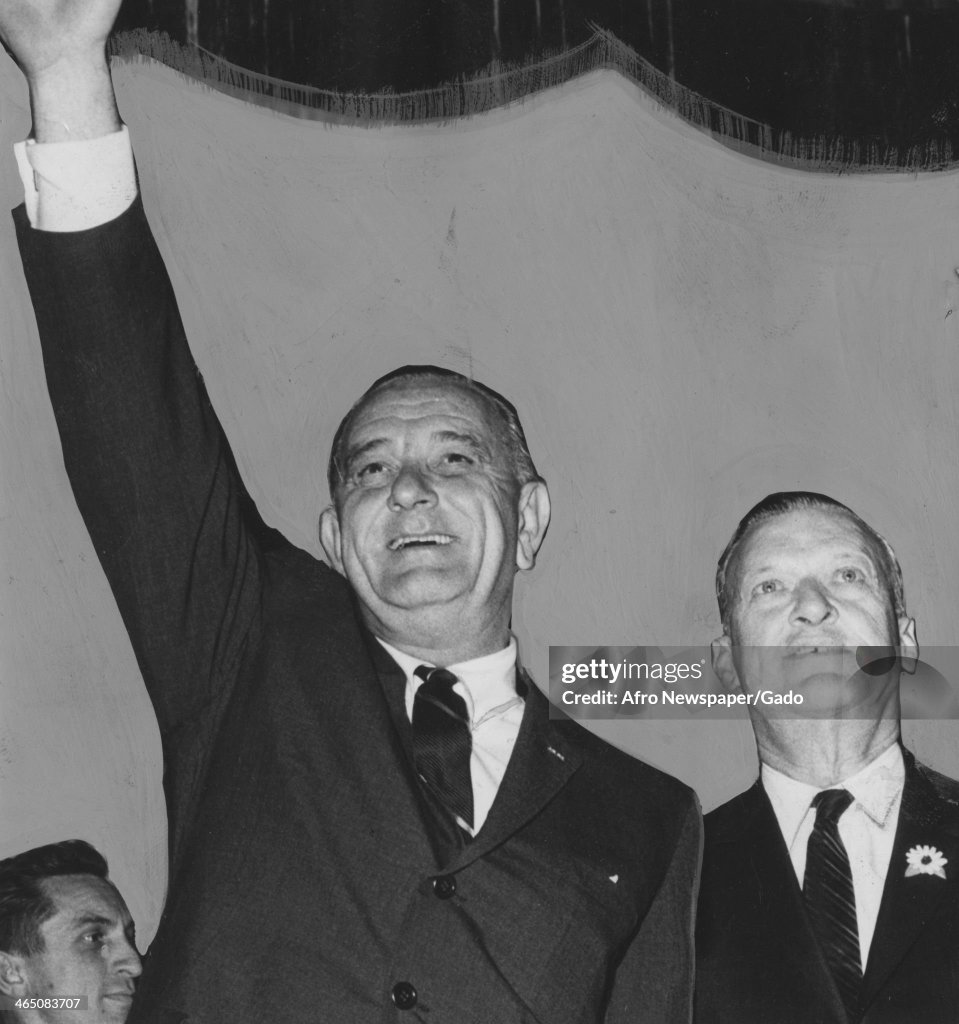
President Johnson said tonight that while Senator Barry Goldwater of Arizona wanted to talk about “Bobby Baker, Walter Jenkins and Billie Sol Estes,” the Democrats wanted to talk about social programs the Republican candidate opposes. “And we’re wrapping them around his neck,” the President said. Speaking to about 13,000 persons in the Pittsburgh Civic Arena, Mr. Johnson mentioned for the first time to a live political audience the case of Mr. Jenkins, who resigned as a special Presidential assistant after disclosure that he had been arrested twice on morals charges.
Mr. Johnson, possibly also alluding to Robert G. Baker, who resigned as Secretary to the Democratic majority in the Senate, said that sometimes in government “unfortunate things” happen and that men “disappoint” you. In a government of three million men, he said, some of them “make mistakes.” He said the only thing to do was to take their jobs away from them and “ask for their resignation” and order impartial investigations. He said that he had done these things, and that “some similar people in the other party get promoted.” He did not amplify.
Senator Hubert H. Humphrey of Minnesota, buoyantly — optimistic about his Vice‐Presidential campaign, returned tonight to the scene of his bitterest political defeat. Charleston is the battleground where he was defeated by John F. Kennedy in a primary in 1960, and abandoned his fight for the Democratic nomination. This was the Senator’s second campaign visit to West Virginia, but his first to Charleston. Tonight it was a far different campaign from the debt‐ridden entourage whose aftertaste of defeat in 1960 was a police parking tag hung on its campaign bus. Senator Humphrey, encouraged by the forecasts of his and President Johnson’s victory next Tuesday, arrived in a plane labeled “The Happy Warrior,” and his first words were: “Morale is up.”
He said at a rally that “morale is an expression of selfconfidence of a people in themselves and in their leaders.” Further, he said, the KennedyJohnson Administration has produced “good years for West Virginia,” with reduced unemployment and improved income. Of the Republican Presidential candidate, Senator Barry Goldwater of Arizona, he said: “Senator Goldwater had the gall to come to Charleston recently and announce his opposition to the progressive programs which have contributed so much to the economic progress of the past four years.” Senator Goldwater, in a recent speech here, reiterated his opposition to the Administration’s antipoverty program, which would bear directly on the problems of West Virginia’s, coal‐mining areas.
Representative William E. Miller said tonight the Johnson Administration was forging a “dangerous alliance” of big Government, big labor, and big business that could lead to the destruction of liberty in the United States. Offering a comparison to the government‐business‐labor alliances that he said were created in Nazi Germany and Fascist Italy, the Republican Vice‐Presidential candidate declared: “In many cases we know it, is not a willing alliance. The tremendous pressure of government contracts appears to have influenced many businessmen into a political alliance with this Administration. The immense power of the regulatory agencies is another political lever in the hands of this Administration, and many business leaders are obviously mindful of it.”
Senator Barry Goldwater carried his campaign into Ohio tonight with an outspoken attack on the Civil Rights Act of 1964. Republican strategists number Ohio among the states that the Republican Presidential candidate must carry to win the election. Polls and other soundings, however, indicate that he is running behind President Johnson. Mr. Goldwater’s prospects for taking the state’s 26 electoral votes seem to hinge in considerable measure on whether there is a sizable white backlash for him by ordinarily Democratic voters disturbed over Black militancy. Cleveland, a Democratic stronghold, has had racial friction. It also has sizable ethnic and worker groups, sometimes said to be particularly resentful about Black pressure for equality.
An Alabama court ruled today that Congress, in passing the civil rights act, had not intended to halt prosecutions pending under state law. The State Court of Appeals came to that conclusion in refusing to reconsider an earlier decision that upheld the convictions of 11 Blacks arrested during demonstrations at Tatladega. They were convicted in March, 1963. Attorneys for the Blacks, in petitioning for a rehearing, contended that the Civil Rights Act passed this year “sustains the conduct of the appellants and forbids their punishment.” The demonstrators, charged with trespassing during a lunch counter sit‐in at two Talladega drugstores, were convicted before the federal law was enacted. Their appeals were pending before the appellate court when the civil rights act went into effect last July. The court, in an opinion by Judge Aubrey Cates, said today “we fail to find any expression that the Congress wished to wipe out prior state prosecutions.”
The first Black to win nomination to public office in Brunswick, Georgia in modern times defeated two white opponents tonight in a Democratic primary election for a City Commission seat. The Rev. Julius Caesar Hope, president of the Brunswick chapter of the National Association for the Advancement of Colored People, polled 1,701 votes, defeating W. H. Sigman, the incumbent, and Hugh D. Leggett. Mr. Sigman, who had been on the commission 11 years, polled 1,148 votes, Mr. Leggett received 1,130.
Lieutenant Colonel John H. Glenn Jr., the first American to orbit the earth, was promoted today to full colonel in the Marine Corps by President Johnson. He accepted the commission papers from the President during a White House ceremony. Colonel Glenn’s wife and Navy Secretary Paul H. Nitze pinned silver eagles on his epaulets. Mr. Johnson said the astronaut had been reluctant to accept the promotion because he believed it would deprive some other worthy officer of the rank. He is leaving the Marines to enter private industry. Because the Senate adjourned before confirming the promotion, the new rank is, in effect, a recess appointment, subject to confirmation by the Senate before it is permanent.
Mark Sandrich and Sidney Michaels’ musical “Ben Franklin in Paris”, starring Robert Preston, opens at Lunt-Fontanne Theatre, NYC; runs for 215 performances.
American singers Sonny Bono (29) & Cher Sarkisian wed, Cher wears bell-bottoms; they divorce in 1975.
Dow Jones Industrial Average: 875.98 (-1.03)
Born:
Mary T. Meagher, American swimmer (Olympic gold medals, 100m and 200m butterfly, 4x100m medley 1984; world record 100m and 200m butterfly, 1981), in Louisville, Kentucky.
Died:
Pierre C. Cartier, 86, French jeweler.
Sammee Tong, 63, Chinese-American actor (“Bachelor Father”, “Mickey”).
Willi Bredel, 63, German anti-Nazi Communist writer (“Die Prüfung”).
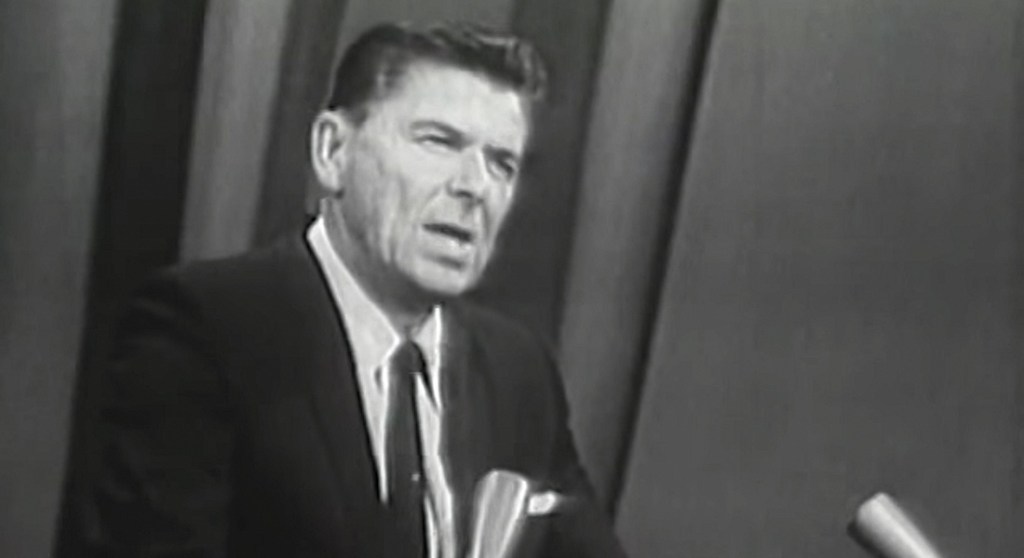
This is an excerpt of the 30 minute speech supporting the Republican presidential nominee Barry Goldwater. Reagan speaks of big government, high taxation, and the “war on poverty.” He addresses foreign policy issues including the risk of appeasement, “peace through strength,” and the Vietnam War. The speech establishes Reagan as an important figure in the conservative wing of the Republican party. To a significant degree, Ronald Reagan’s election to the presidency stems from this speech, given on national television on behalf of, and sponsored by, Barry Goldwater’s 1964 presidential campaign. The speech remains amazingly fresh as a statement of modern American conservative philosophy four decades after it was delivered.

Written by Burt Bacharach and Hal David, first performed by Dionne Warwick, then by Lou Johnson, and then covered in 1983 by Naked Eyes.
 History Diaries