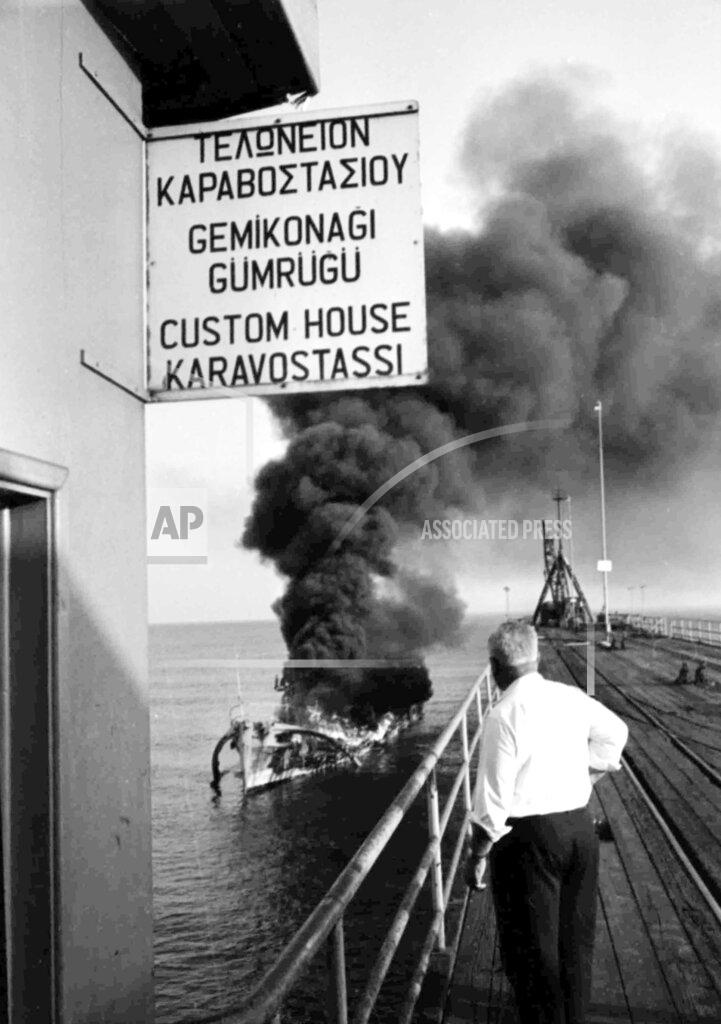
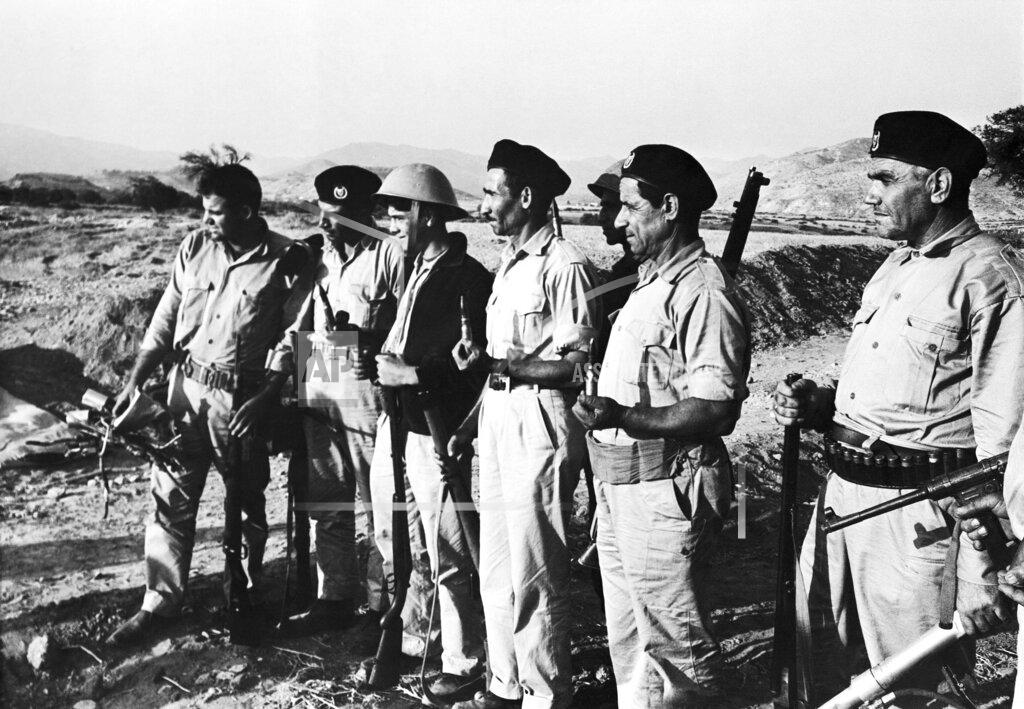
On August 7, the Unficyp commander had sent a strong written protest to the government and asked that the operation be stopped. Despite the request, the attack continued and by the early hours of August 8, both Mansoura and Ayios Theodoros had been evacuated by the Turkish Cypriots. The fighters retreated to Kokkina and the women and children were taken by Unficyp to Kato Pyrgos where a camp was set up. Meanwhile the battle continued into August 8 with only Kokkina remaining under heavy bombardment.
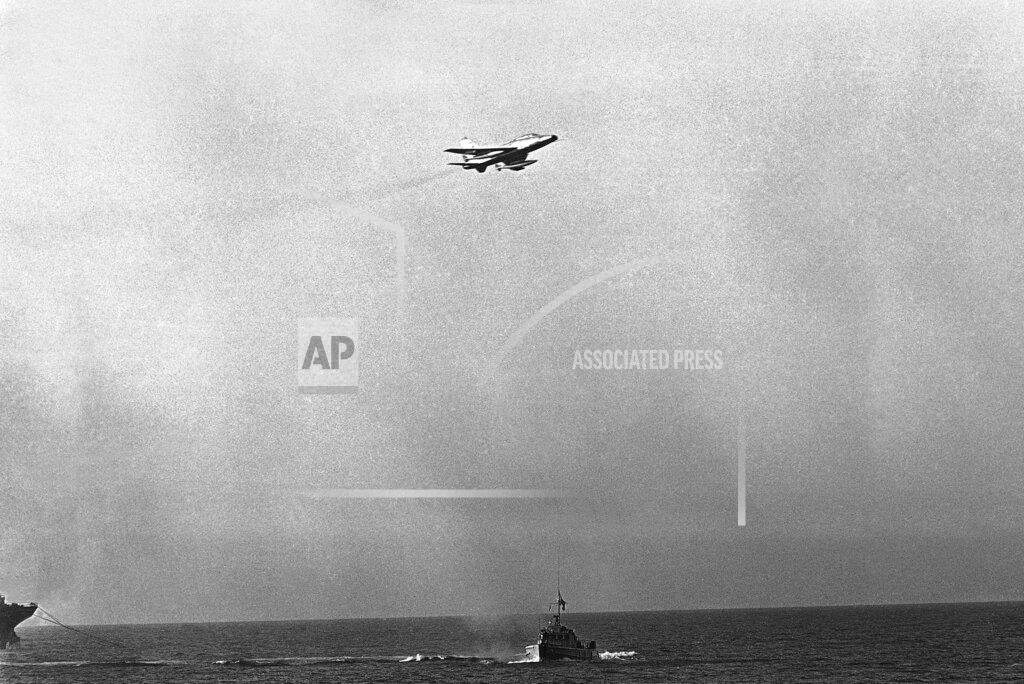
The Turkish Air Force began strikes on seven Greek Cypriot towns and villages in Cyprus, as well as other strategic positions on the northwest side of the island republic. The Cyprus government said that 24 Greek Cypriots had been killed, and 200 wounded in the day’s attacks. Turkey’s government admitted to the strikes, and said that they had happened after efforts to stop Greek Cypriot attacks against the Turkish Cypriot minority had proved to be unsuccessful. Three Turkish Cypriot villages (Ayios Theodhoros, Mansoura and Alvega) were besieged by Greek Cypriots, while the Turks blasted Polis, Xeros, Kokkina, Kato Pyrgos, Ghoudi, Pakhyammos and Pomos. The United Nations Security Council demanded an immediate cease-fire the next day, and attacks halted on August 10. For nearly ten years, there would be no further invasions by either Turkey or Greece, until July 20, 1974, following the overthrow of the Cyprus government by a group favoring union with Greece. Following an invasion by Turkish troops, the island would be divided into Turkish and Greek zones.
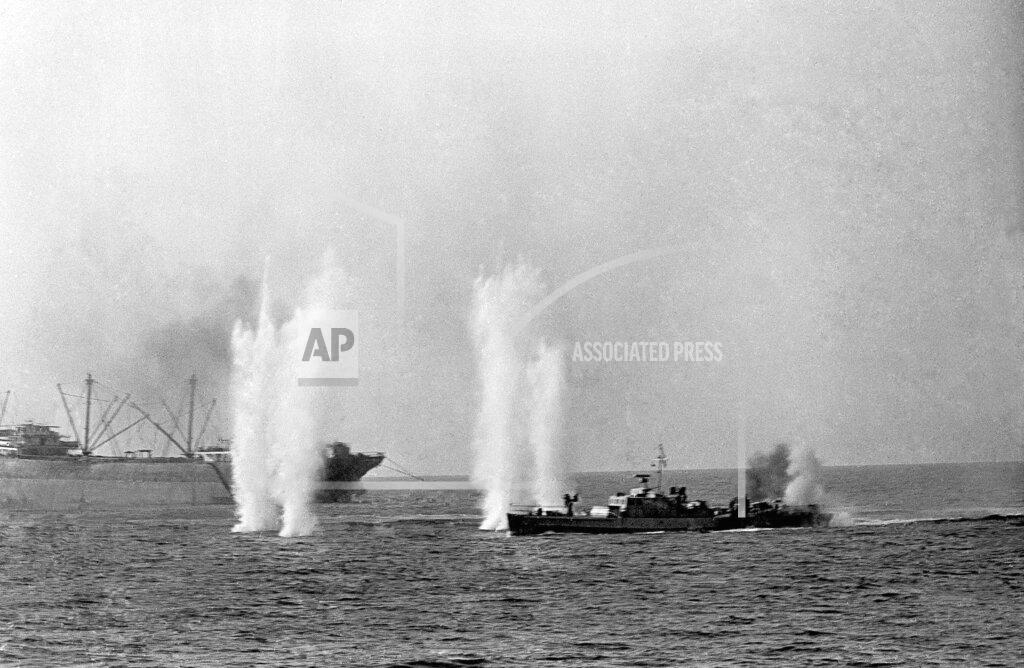
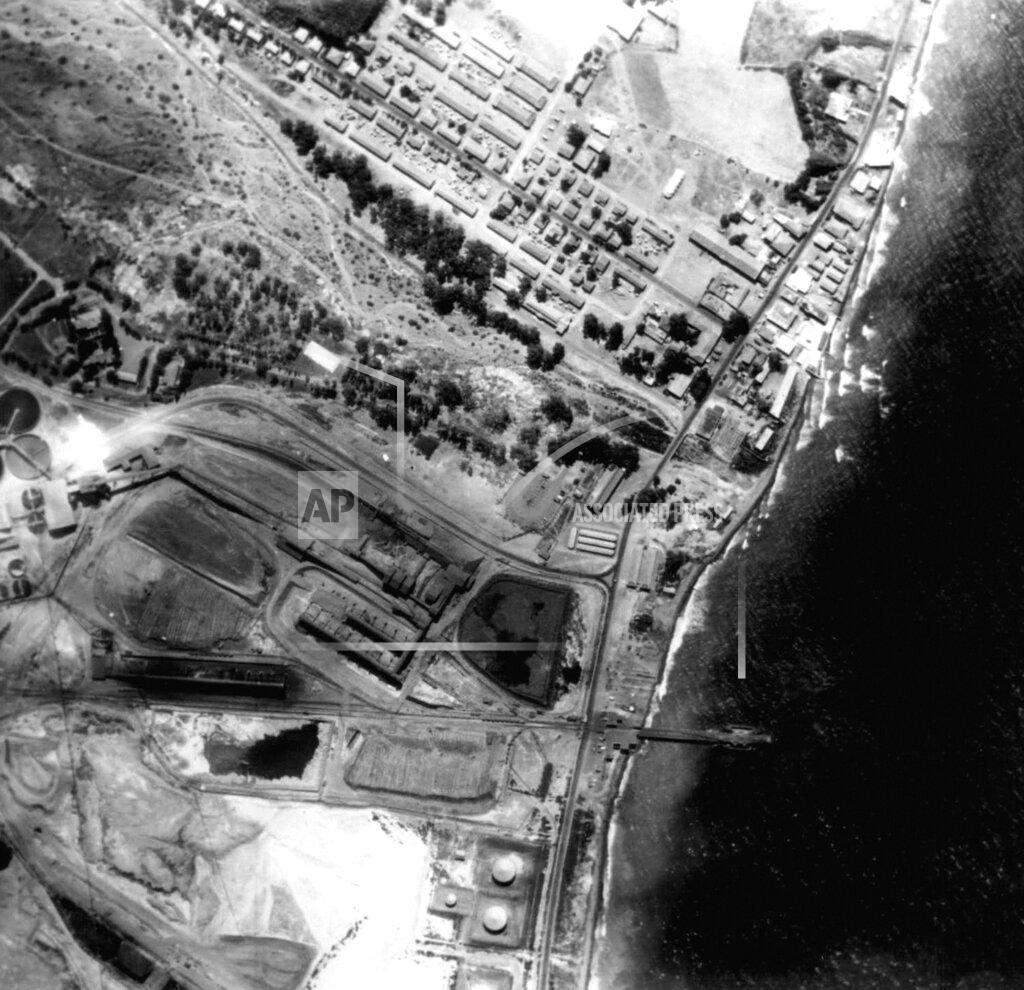
Jet fighter planes of the Turkish Air Force fired rockets and machine guns today in three attacks on Cyprus’s northern coast. The Government reported that 24 Greek Cypriots had been killed and at least 200 wounded. Three planes assaulted the Greek Cypriot ore‐exporting harbor of Xeros, 25 miles west of Nicosia. Antiaircraft fire downed one of the craft. During the Xeros attack, the Turkish planes strafed a Greek Cypriot gunboat, killing 5 crewmen and wounding 13. The boat was abandoned. Turkey’s raids began over Greek Cypriot military positions around the Turkish Cypriot village of Kokkina.
Kokkina, with a population of 300, is the last Turkish Cypriot village holding out on the Mansoura beachhead, where arms and men have recently been landed from Turkey. Four other Turkish villages in the area have fallen to the Greek Cypriots in the last two days, and Kokkina is encircled. The attackers flew along a 40‐mile stretch of Cyprus’s northern coast. Polis, Xeros and Pakhyammos, a Greek Cypriot coastal village near Kokkina, were targets. Later other planes attacked Polis, 20 miles east of Kokkina. Some machine‐gun bullets landed near a camp of Swedish soldiers in the United Nations peace‐keeping force.
Polis is mainly a Turkish village. For months the Turkish Cypriots have been hemmed into a small area there by the Greek Cypriot forces. Turkish planes swooped over Polis yesterday as well, but a spokesman for the United Nations said they had not strafed it then. He said they had fired rockets toward the sea. These planes were identified as F‐104 Starfighters. The Cyprus radio pointed out today that 24 of these planes had been supplied to Turkey by the United States.
Heavy firing went on all day in the Kokkina area, where the Greek Cypriots were pressing hard. Women and children of the village, who had earlier refused to be removed, consented in the afternoon to be taken out by armored personnel carriers operated by Swedish soldiers. They went to a refugee camp hurriedly set up at Kato Pyrgos, about five miles to the east, and joined women and children from other villages taken by the Greek faction. The biggest of these — Mansoura and Ayios Theodoros — remained vacant for some hours after the families had left and the men had taken to the hills to continue fighting. But Greek Cypriot forces were moving in. Later the Cyprus radio reported that the villages were under Greek Cypriot control and that order had been restored in the whole area.
A four‐man Swedish patrol occupying an isolated hilltop in the area was rescued by a British helicopter under United Nations command after Greek Cypriots had refused permission for vehicles to reach the men, United Nations officials reported. They said even the helicopter had been fired on. The plane that was shot down at Xeros was flying no more than 500 feet high. It made a crash landing, and its pilot survived. He was taken to Nicosia for interrogation. At one point the Turkish planes, apparently by mistake, strafed the Swedish refugee camp at Kato Pyrgos. Four Turkish Cypriot refugees were injured.
In Ankara, the Turkish Government said a “police action” had been ordered by Premier İsmet İnönü to stop Greek Cypriot advances in the Tylliria Promontory area, The Associated Press reported. Reuters said President Cemal Gürsel had warned that unless the Greek Cypriots showed reason, “action will continue with increased severity.”
“Throughout the entire battle, Unficyp made strenuous attempts to secure a ceasefire but was continually hindered by the (Greek Cypriot) government forces,” the U.N. report said.
At a news conference, President Johnson says that the U.S. air strike and the Congressional resolution show the United States’ “determination to resist and repel aggression” in Southeast Asia. Thus, the President said, “Our friends who are defending their freedom and independence in the area can take new courage from this unity and this support as they carry on, with our help, in the continuing work of repelling aggression by terror and by infiltration.” Mr. Johnson, who was speaking at a news conference at the LBJ Ranch, said the situation in Southeast Asia “remains serious.” But he added that there had been “no further incidents in the last 24 hours.”
The president was asked for his reaction to a statement by Senator Barry Goldwater, the Republican Presidential nominee, that while South Vietnam was not a political issue now it might become one later in the campaign. Mr. Johnson, choosing his words carefully, said he would “prefer to treat it as a problem of free people without associating it with a political campaign.” It was his view, he said, that “all Americans are going to support their country in defending our interests in the world.” Therefore, he added, he saw “no evidence that our action in Vietnam should be made a partisan matter.”
A group of 30 U.S. Navy and U.S. Air Force jet fighters took to the air to confront a wave of MiG fighters from the People’s Republic of China, after radar detected a wave of Chinese jets flying south from China’s Hainan Island. The F-102 fighters departed from the USAF base at Đà Nẵng while the F-4 and F-8 jets departed from the aircraft carriers USS Ticonderoga and USS Constellation, but the Chinese jets stopped short of penetrating South Vietnamese airspace and flew a “holding pattern” over North Vietnam.
A U.S. intelligence report states that the Communists are winning the struggle for the allegiance of the Vietnamese and that the Việt Cộng strength has increased despite heavy casualties.
Soviet Premier Khrushchev warned today that if the Western powers sought to impose war on the Communist camp, they would find the Soviet Union willing and ready to light for itself and other Communists. He added that if the “imperialists” provoked a war, there would be casualties and misfortune in all nations, but it would inevitably “end in the complete rout of capitalism.” The Premier’s warning was his first comment on the crisis in Vietnam following United States air strikes on torpedo boats and bases in retaliation for attacks on United States warships. It also was the strongest Soviet statement on the issue to date. Mr. Khrushchev spoke at Ordzhonikidze in the North Caucasus. He is touring farm installations in that region.
“The Soviet Union does not want war and does everything to prevent it,” the Premier said, “but if the imperialists impose war on the Socialist countries, the Soviet people will fulfill their sacred duty and will stand up for their fatherland and for other Socialist countries.” The warning was published tonight by Izvestia, the Government newspaper, with a long statement the Premier made on Soviet farm problems. Excerpts from his speech covered the major part of two pages of the paper. The Premier said that the Soviet Government denounced the “aggressive actions” of the United States against North Vietnam.
The first protest demonstration against U.S. involvement in the Vietnam War came on the first weekend after U.S. air raids, with about 100 protesters marching near New York’s Times Square. The rally in Duffy Square against the military role of the United States in Vietnam was broken up by mounted policemen and patrolmen using nightsticks. The crowd had gathered in front of the statue of Father Duffy, between Broadway and Seventh Avenue at 47th Street, to hear speeches denouncing the Johnson Administration’s policies. The police ordered the demonstrators to disperse. They refused. Then, as hundreds of visitors and other bystanders watched, two mounted policemen moved into the crowd. One unidentified young man in a checked jacket was stepped on by a horse, but evidently was unhurt. A dozen foot patrolmen followed the horses, swinging their clubs to disperse the demonstrators, who cried: “Fascist cops! Fascist cops!”
Paris will apparently be the site of a meeting of the leaders of Laos’s three political factions. Sources close to the Laotian Premier, Prince Souvanna Phouma, said today that he would probably accept a suggestion of the pro‐Communist Pathet Lao leader, Prince Souphanouvong, for such a meeting. The two Laotian leaders, who are half‐brothers, have long been bickering over a suitable place to meet. Over the last two months they have eliminated such sites as the Laotian royal capital of Luang Prabang, Vientiane, Jakarta, Pnompenh and New Delhi. The proposed meeting, according to the text of Prince Souphanouvong’s latest telegram to Premier Souvanna Phouma, should be to clear the way for a reconvening of the 14‐nation Geneva conference, which, in 1962, sought to settle the strife in Laos by guaranteeing the country’s independence and neutrality.
As the leftist‐led rebels seized Stanleyville on Wednesday, a voice in the control tower of the Stanleyville airport announced that the airport was now operating “under control of the Popular Army of Liberation.” Five hundred miles away, the Luluabourg control tower operator picked up the message and requested a repetition. “Are the rebels already in Luluabourg?” asked the voice in Stanleyville. “Of course not,” said Luluabourg. “They will be soon,” replied Stanleyville.
The smaller North Atlantic powers will participate in the mixed‐crew nuclear fleet proposed by the United States even if Britain withdraws, a qualified diplomatic source said today. The issue is considered important because earlier this year there was evident reluctance on the part of some Governments to participate in a force that, in the event of a British withdrawal, would be dominated by the United States and West Germany. However, in recent weeks other participants in the planning sessions, Italy, Belgium, tha Netherlands, Greece and Turkey, have made it clear that, in the words of the source, “they will play” if the British drop out.
Britain’s Conservative Government supports the American concept of the force, but with some modifications. The United States has proposed the creation of a fleet of surface ships armed with Polaris missiles and manned by mixed crews drawn from the participating navies. The British want to widen the proposal to include land‐based missiles and nuclear bombers, including the Royal Force’s TSR‐2, a low‐level bomber that is not yet in operation. Supreme Headquarters Allied Forces Europe, the North Atlantic Treaty Organization’s military arm, favors the British idea. Its strategists are convinced that the addition of land‐based missiles would increase the accuracy of the force’s nuclear arsenal because these would be launched from “hard” platforms on land rather than from mobile platforms at sea. However, NATO is uncertain about effect of the possible election of a Labour Government upon British policy toward the force. Britain is scheduled to hold a national election in October.
President Johnson won a major victory today when the House passed his $947.5‐million antipoverty bill by a 42‐vote margin. The final vote of 226 to 184 was little more than a formality, for the House had tentatively approved the controversial measure late last night by a vote of 228‐190, a margin of 38 votes. Voting for the bill on final passage were 204 Democrats and 22 Republicans. Voting against were 144 Republicans and 40 Democrats, most of them Southerners.
While praising the House action, Administration leaders are worried that the bill may run into trouble in the Senate. The Senate passed the bill, 61 to 34, on July 23, but the measure now goes back to the Senate for action on House amendments. The biggest possible block in the Senate is expected to be a House amendment requiring written disclaimers of belief in or membership in any organization seeking to overthrow the Government by force.
Such written disclaimers — violently opposed by liberals and in many academic circles — would be required of all persons, including students, farmers, small‐business men, and others receiving Federal funds under the antipoverty program. The disclaimer amendment, sponsored by Representative John Bell Williams, Democrat of Mississippi, was adopted by the House last night during a boisterous session in which opponents proposed many changes in the antipoverty bill. Representative Paul M. Landrum, the Georgia Democrat who was floor leader for the bill, said he hoped that the Senate would agree to the House changes and send the bill along to the White House. Senate action is expected early next week.
The Administration’s wide margin of victory in the House failed to reflect the difficulty that Administration forces had in lining up support for the bill. Last week, Administration leaders thought they were 25 votes short of victory. Efforts to line, up votes continued almost until the voting began. The antipoverty bill is designed to wage a nationwide attack on poverty and its causes. It was described by Administration leaders as an attempt to “break the circle of poverty” and to make “taxpayers out of tax-eaters.”
President Johnson said at Johnson City, Texas, that all Americans could be proud that the House had passed the antipoverty measure. The bill’s passage, he said, is a commitment of the strength and talents of the nation to eliminating poverty.
Mississippians waited expectatitty today for arrests in the case of three slain civil rights workers. President Johnson’s news conference statement that “substantive results” were expected “in a very short time” in the Federal Bureau of Investigation’s inquiry brought a flood of speculation. There were reports from Philadelphia, the east‐central Mississippi town where bodies of the two whites and a Black were found Tuesday night, that agents had several persons under surveillance.
Meanwhile, a controversy developed in Jackson over sharp contradictions between a partial, unofficial report of autopsies of the victims conducted Wednesday and a second, private examination of the Black victim yesterday. The first indicated that none of the three had suffered any beating or mutilation. The second showed that James E. Chaney, a 21‐year‐old Meridian, Mississippi, member of the Congress of Racial Equality, received a severe beating, which may have killed him even before he was shot three times, once at the base of the skull. The official results of the three autopsies conducted by a publicly unidentified pathologist at the University of Mississippi Medical Center, have not been released. However, a highly placed medical associate of the pathologist, who had personal knowledge of the autopsies and the pathologist’s report, said flatly Thursday that the three men’s bodies bore bullet wounds but no evidence of beatings or mutilation.
In contrast to this, Dr. David M. Spain of New York said in summing up his findings in the second examination: “The jaw was shattered; the left shoulder and upper arm reduced to a pulp; the right forearm was broken completely across at several points, and the skull bones’ were broken and pushed in towards the brain. Under the circumstances, these injuries could only be the result of an extremely severe beating with either a blunt instrument or a chain. The other fractures of the skull and ribs were the result of bullet wounds. It is impossible to determine whether the deceased died from the beating before the bullet wounds were inflicted. In my extensive experience of 25 years as a pathologist and as a medical examiner, I have never witnessed bones so severely shattered, except in tremendously high‐speed accidents, such as airplane crashes.”
The mother of one of three slain civil rights workers said today they will have died in vain if Mississippi Blacks fail to assert their rights. Mrs. Fannie Lee Chaney, whose 21‐year‐old son James was murdered June 21, issued a statement after making public the findings of a second medical examination on his body. The mother noted that her son James had been buried last night after completion of the examination, which was performed by Dr. David M. Spain, former medical examiner of Westchester County, New York. She said she had agreed to release Dr. Spain’s findings, which differ sharply with reports of those made after an earlier examination, because “no stone ought to be left unturned to find out the truth behind his death.”
One of the enduring myths of American politics is that Democrats fight out their battles in primaries and conventions, then get together like good fellows and present a solid front on Election Day. That is roughly what happened in 1960, when Lyndon Johnson joined forces with John F. Kennedy after an acrimonious convention. In 1952, however, a number of disgruntled Southerners refused to swallow the party’s civil rights plank and bolted to Gen. Dwight D. Eisenhower. They voted for him again in 1956. In 1948, not only the Southerners put their own party and candidate — Senator J. Strom Thurmond—in the field; so did the so‐called Progressives, who ran Henry Wallace.
Since even the Kennedy‐Johnson combination could not hold all the Southern states in 1960, the fact is that the “solid South” has not been solid since Franklin Roosevelt’s last campaign in 1944. Hence, the Democratic party has not really been united since then. Nor will it be this year. President Johnson’s Republican opponent, Senator Barry Goldwater, probably assured that when he cast his vote against the civil rights bill. Once again, the South will be solid only in calling itself Democratic, and Republican hopes are high for big gains in Dixie.
The Democratic difficulties do not stop there, though no one can say how much further they really go. That is because no one yet has been able to measure the party’s response to Mr. Johnson’s dismissal of Robert F. Kennedy as a Vice Presidential candidate. At the White House, the best-informed opinion is that Mr. Kennedy’s elimination will have, little, if any, adverse effect. On the contrary, Mr. Johnson ruled the Attorney General out because he found strong opposition within the party to his nomination, both on the civil rights issue and on other grounds. Mr. Kennedy would have been, first of all, a drag on the ticket in the South. Moreover, Mr. Johnson’s polls and his numerous conversations with state, city and other party leaders convinced him that the Attorney General would be a liability in other, more crucial areas. Specifically, he found bitter opposition to Mr. Kennedy in business circles. He found many labor leaders opposed, too. He learned that, in polls reflecting the public’s view of whether various possible candidates would make a good President, Mr. Kennedy scored near the bottom.
Republican party unity — without compromise of conservative principles — is the goal of Senator Barry Goldwater and he is having more luck in attaining it than had been expected. The Republican party hierarchy is still split over Mr. Goldwater, but not clown the middle. The dissident faction is, indeed, a splinter. A revealing incident took place Thursday at a closed breakfast with Mr. Goldwater and his Vice‐Presidential running mate, Representative William E. Miller, attended by about 100 Republican members of the Senate and House. According to a source who was present, one Congressman asked Mr. Miller if he and Senator Goldwater would support all Republican candidates in the election.
When Mr. Miller said, according to the source, that they would — if the candidates supported the national ticket first — there was a burst of applause. What the applause meant was that many conservative Republicans in Congress do not want to see Mr. Goldwater dilute the sweet taste of victory by placating or cultivating liberals. He has made clear in private that there is no danger of his doing so. A handful of party liberals have repudiated the Republican nominee. But most liberals, including his two most important foes, Governors Rockefeller and William W. Scranton of Pennsylvania, say they will support the ticket. However, Governor Rockefeller has indicated that his support will be only nominal and that he would not campaign for the national ticket. Mr. Goldwater has taken firm control of the Republican National Committee and has conducted a merciless housecleaning there, so there is no danger of treachery or foot‐dragging in that quarter.
Secretary of Defense Robert S. McNamara has ordered the Air Force to “proceed immediately” with a plan to orbit 24 satellites for an interim military spacecommunications system. President Johnson announced the plan today at his ranch in Texas, and the details were later released here. The satellites would be used for worldwide, jam‐proof military communications circuits. Existing circuits have become overburdened. A Pentagon plan to share the Government‐sponsored commercial satellite program was recently abandoned. The program announced today calls for the first launching of military‐communications satellites early in 1966. The program calls for launching eight satellites at a time into near‐equatorial orbits high above the earth. Three Titan III‐C missiles will be used as boosters, each with eight satellites as a payload.
N. Richard Nash, Harvey Schmidt and Tom Jones’ musical “110 in the Shade”, based on Nash’s drama “The Rainmaker”, closes at Broadhurst Theater, NYC after, 330 performances.
The Dutch Opera forms in Amsterdam.
A Rolling Stones concert in the Netherlands resort of Scheveningen, near The Hague, ended in a near riot after the Stones had played only four songs.
The California Angels sign a contract to move to Anaheim in 1966.
The Cleveland Indians scored their highest run total in seven years today, overwhelming the Minnesota Twins, 16–8, for their fourth consecutive victory. Six of the first seven Indian runs in the first two innings were unearned as the Indians went on to their third straight victory over Minnesota and their ninth in 11 games. Cleveland collected 16 hits off six Minnesota pitchers. Fred Whitfield paced the attack with three hits, including a home run, and five runs batted in. Chico Salmon hit safely four times. Trailing 8–0, the Twins got to the Indian starter, Dick Donovan, in the fifth, when they scored six times on five hits, which included home runs by Tony Oliva, Jimmy Hall and Bob Allison, closing the gap to 8–6. But the Indians bounced back in their half of the fifth to also score six times.
Jake Wood’s pinch‐hit single in the 13th inning scored Bill Freehan and gave the Detroit Tigers a 4–3 victory over the Kansas City Athletics today. Freehan led off the inning with a single off Ken Sanders, the fifth Kansas City pitcher, and advanced to second on Dick McAuliffe’s sacrifice bunt. After an intentional walk to Norm Cash, Wood batted for Fred Gladding and lined a hit to left field. Gladding blanked the Athletics over the last four innings and picked up his fifth victory in six decisions.
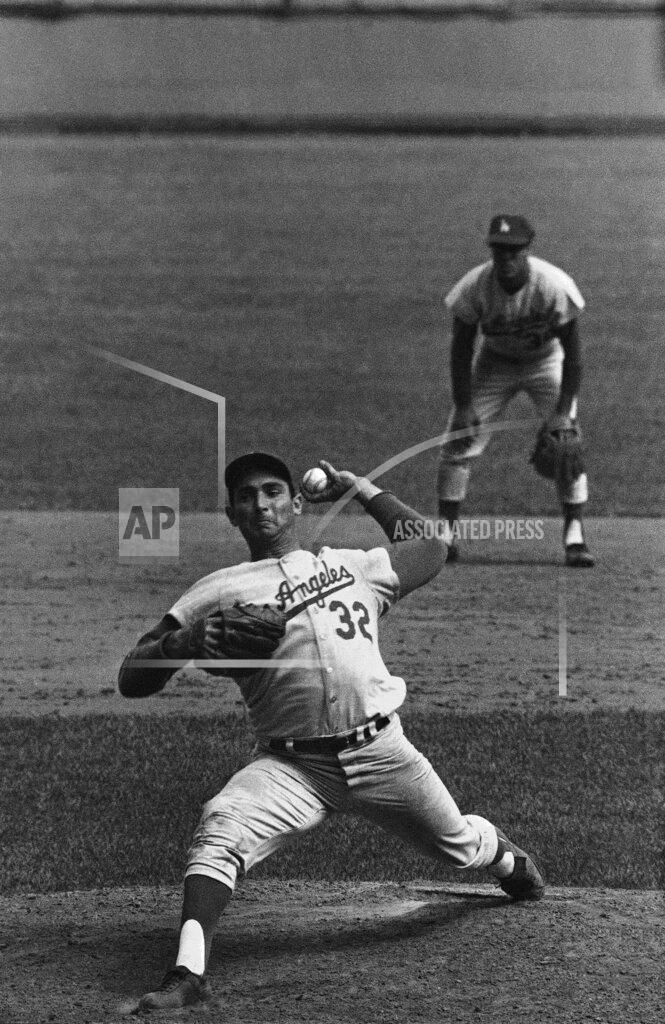
Ron Fairly’s triple with the bases filled marked a four‐run fifth inning and carried the Los Angeles Dodgers to a 5–4 victory over the Milwaukee Braves today. Sandy Koufax withstood a late Milwaukee counterattack and gained his 17th triumph against five defeats. En route to his victory Koufax set a National League record — striking out 200 or more batters for the fourth straight season. He fanned nine all told, running his season total to 200. Tony Cloninger was the losing pitcher. He carried a 2–1 lead into the fifth, then ran into a volley of four hits. They sent him to the shower and netted the Dodgers four runs.
Jim Owens snuffed out an eighth‐inning St. Louis rally with two strike‐outs tonight as the Houston Colts edged the Cardinals, 4–3. Owens, the third Colt pitcher in the inning, came on after the Cardinals had rallied on Ken Boyer’s two‐run home and had put the potential tying and goahead runs on base. Owens ended the threat by fanning two pinch‐hitters, Dal Maxvill and Mike Shannon. Dave Roberts’s two‐run triple in the second inning off Ron Taylor and a two‐run seventh had given the Colts a 4–1 lead.
Gaylord Perry blanked Cincinnati on two hits and Willie Mays drove in the only run with sixth‐inning triple tonight as the San Francisco Giants beat the Reds, 1–0. The victory kept the Giants 2½ games behind the National League‐leading Philadelphia Phillies, who beat the New York Mets in an afternoon game, and dropped third‐place Cincinnati 5½ games off the pace. Perry faced only 30 batters in evening his season record at 8–8. He gave up singles to Vada Pinson, in the fourth inning, and to a pinch‐hitter, Mel Queen, leading off in the ninth. The only other Red to reach base was Johnny Edwards, who got aboard in the second inning when Hai Lanier booted his ground ball. The San Francisco right‐hander struck out seven and didn’t walk anyone.
Born:
Giuseppe Conte, Italian jurist and politician, Prime Minister of Italy (2018–2021), in Volturara Appula, Italy.
Scott Sandelin, NHL defenseman (Montreal Canadiens, Philadelphia Flyers, Minnesota North Stars), in Hibbing, Minnesota.
Sean Dykes, NFL defensive back (New York Jets), in New Orleans, Louisiana.
Remi Watson, NFL wide receiver (Cleveland Browns), in Plant City, Florida.
Torgeir Bryn, NBA center (Los Angeles Clippers), in Oslo, Norway.
Anastasia Ashman, American writer and digital strategist (GlobalNiche), in Berkeley, California.
Jan Josef Liefers, German film and television actor, in Dresden, East Germany
Died:
Josie Hannon Fitzgerald, 98, maternal grandmother of the late John F. Kennedy. She was the first, and remains the only, grandparent of an incumbent President of the United States.
Fontaine Fox, 80, American comic strip artist known for Toonerville Folks, featuring the “Toonerville Trolley”


 History Diaries