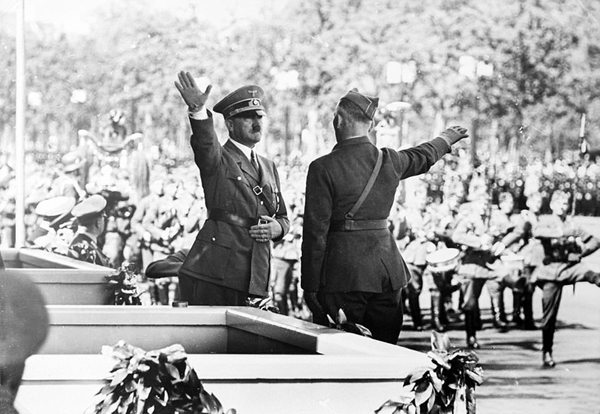
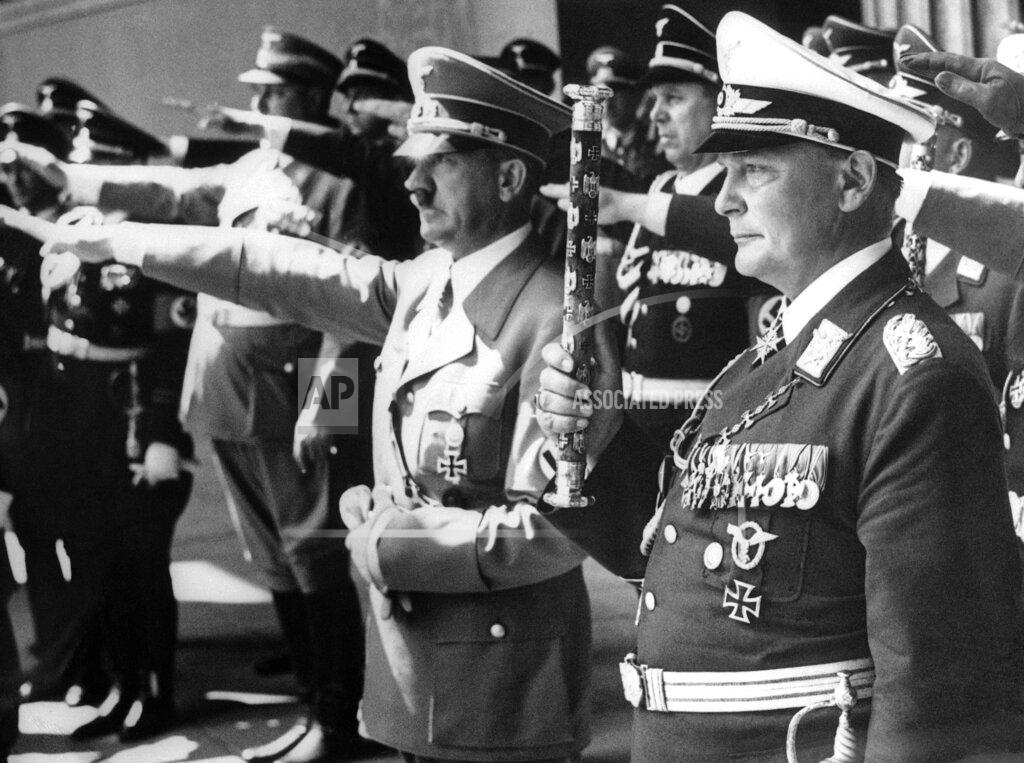
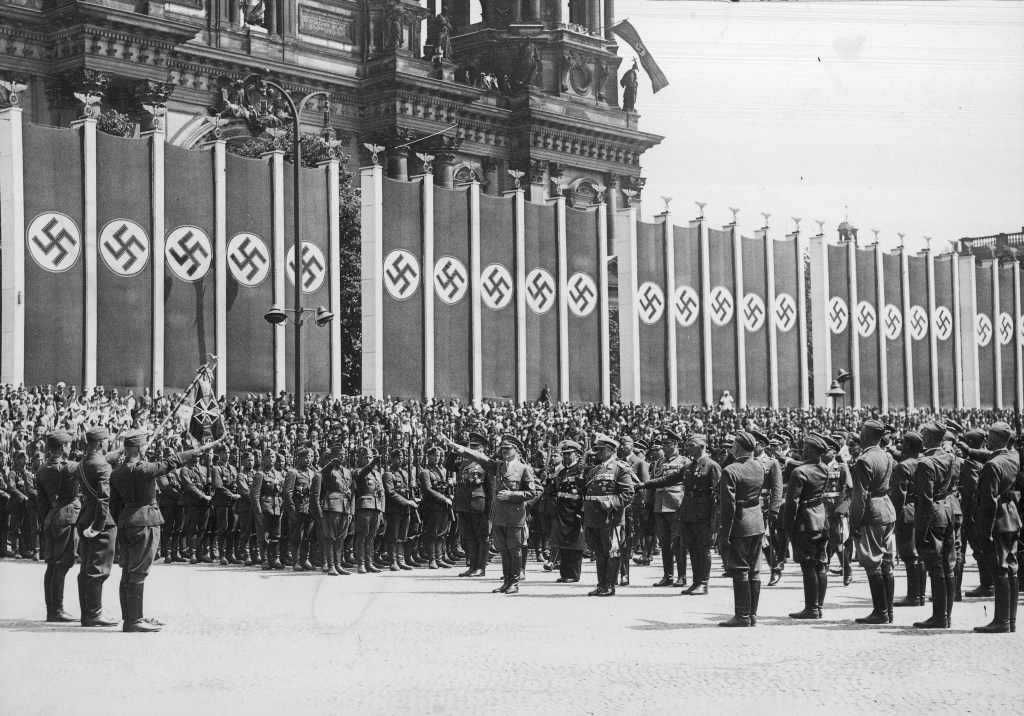
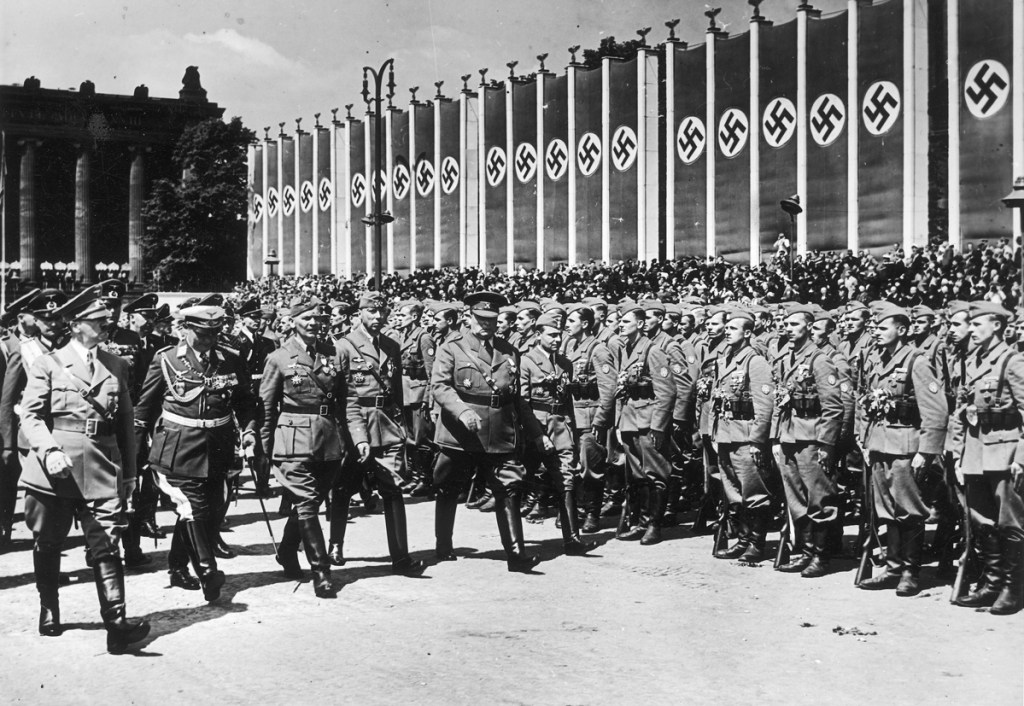
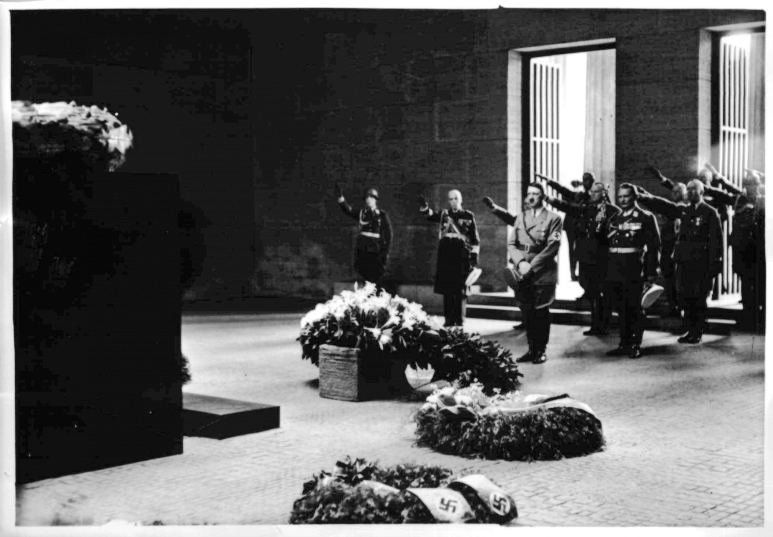
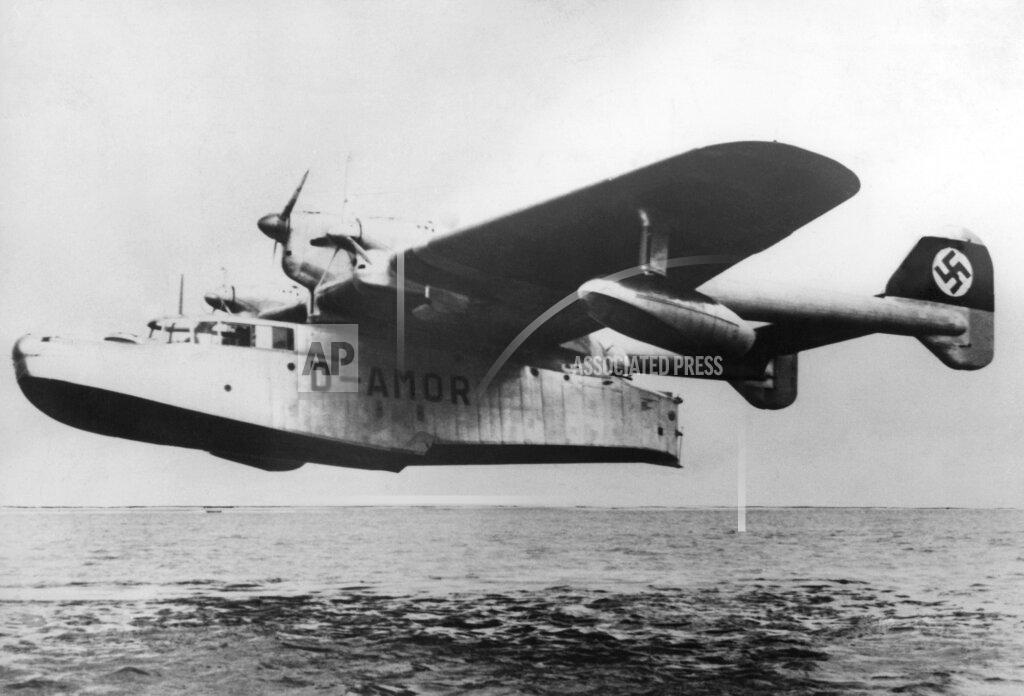
Simultaneously with her ally, Italy, Greater Germany today formally celebrated the conclusion of her successful intervention in Spain, when the Condor Legion, some 15,000 strong, held its victory parade before Chancellor Adolf Hitler and assembled German and Spanish generals, and was then welcomed home by Herr Hitler in a speech bristling with defiance of Germany’s “encircling enemies.”
Dispatched secretly to fight under the camouflage of Spanish uniforms, and long publicly denied by its own government, the legion was at last able today to pass openly in pride of victory under the eyes of its own Führer and war lord amid the cheers of hundreds of thousands. A hot sun beating down from a cloudless sky conspired with the numerous Spanish flags on display to give the event a Spanish touch. It was so hot, in fact, that quite a number of the husky legionnaires were overcome and had to be carried from the ranks.
In his speech Herr Hitler publicly proclaimed what for three years the whole German propaganda apparatus had vehemently denied, namely, that he himself had given the order sending the legion to Spain. Declaring that Generalissimo Francisco Franco “was facing a conspiracy that was fed from all parts of the world,” Herr Hitler, according to The Associated Press, added: “In July, 1936, I decided immediately to fulfill an appeal for help that this man addressed to me to such an extent and for just as long as the rest of the world gave its support to the internal enemies of Spain.” But whereas the legion was assembled and dispatched under the slogan, “War against Bolshevism,” it now learns from Herr Hitler’s speech on its return that Bolshevism is no longer mentioned as the enemy but rather the “Christian democracies” generally and Great Britain particularly.
Italy’s conquering army from Spain paraded through Naples this morning to receive the tributes of the King, the government and the people. They seemed strong, happy and proud, as well they might be, for they were alive and they had won, and for thirty months, in the words of their Premier, Benito Mussolini, they had been the “nightmare of the pluto-democracies.” It was a parade of unusual simplicity because, except for their rifles, all arms had been left behind in Spain. Artillerymen went by cannon-less, tankers tankless, and even the machine gunners walked unencumbered. It was just a stream of 23,000 khaki uniforms and gray-green helmets, with two groups of Arditi in black shirts providing a somber interruption.
Pope Pius XII conferred with the British minister to the Holy See, Francis D’Arcy, and dispatched separate messages to London, Paris, Berlin, Rome, and Warsaw in which he sought to indicate a definite way out the problems confronting European statesmen. In an effort to bring about improved relations between the dictatorships and the democracies and thus prevent the conclusion of a British-French-Soviet pact, Pope Pius has intensified his diplomatic activity. Because of the secrecy in which the Pope’s moves have been shrouded, it became known only today that yesterday he had twice received the Rev. Pietro Tacchi-Venturi as well as a representative of the French Embassy and an influential British prelate whose name was not disclosed. Father Tacchi-Venturi, a friend of Premier Benito Mussolini, was received before and after the Pope’s audiences to the French and British representatives.
Vatican circles described the Pope’s meetings with Father Tacchi-Venturi as “very important,” especially because of the weight his advice carries with Premier Mussolini. He had an outstanding part in preparing for the Lateran Treaty between the Vatican and Italy. It is reported the Pope is considerably perturbed by the planned alliance of Britain, France and Russia because of fears that the Soviet will be allowed to play an important part in European diplomacy. The church is an irreconcilable enemy of Bolshevism, so there is little doubt that the Pope will do everything in his power to prevent the conclusion of this alliance or to minimize its effect if the negotiations now in progress are successful.
Spaniards tackle post-war tasks, creating labor syndicates.
Augustus Schmidt, Minister of Estonia in London, met Viscount Halifax, the British Foreign Secretary, today. They discussed the situation created by the negotiation of an Anglo-Russian pact and the refusal of the Baltic States of Estonia, Latvia and Finland to permit other powers to guarantee their independence against aggression by Germany. Mr. Schmidt is a diplomat whose personal position is far greater than the small size of his country would warrant, and the views expressed by him may be taken to express the common attitude of the three Baltic States named. The position of the Baltic republics neighboring Russia has now been made perfectly clear to the British Foreign Secretary. They reject a guarantee for the following reasons:
First, the essence of their policy is to preserve a rigid neutrality between potential adversaries. Therefore, they cannot recognize the right of some powers to play the part of their protectors against others.
Second, the Baltic governments do not want to do anything to provoke the hostility of Germany. Official protection granted by Britain, France and Russia would be to Germany like a red rag to a bull.
Third, the governments named suspect an intention by Russia to take advantage of the present crisis to establish her protectorate over the whole coast of the Baltic. The guarantee suggested would serve as the thin end of a wedge for the penetration of Russian influence, which the Estonians, the Latvians and the Finns do not want at any price.
The Finnish Cabinet, through Foreign Minister Eljas Erkko, today gave the Diet a declaration on Finland’s reaction toward Soviet Russia’s much-resented intervention in the Aland Islands fortification question and Joseph Stalin’s determined efforts to induce Britain and France to make a pact guaranteeing Finland’s neutrality even against Finland’s consent. Mr. Erkko’s statement dealt exceedingly frankly with Russia’s moves. He characterized them as entirely unwarranted and left no doubt that Finland was resolved to continue, on present lines, her neutrality and close cooperation with Scandinavian countries. The Soviet veto on the Aaland fortifications constitutes, Mr. Erkko said, no formal obstacle to Finland and Sweden in proceeding with a project that concerns only them, though he seemed not to close the door upon further negotiations with Russia.
“It is reported that Russia wishes to give Finland an automatic guarantee and thus detach Finland from other Nordic States by placing her in an exclusive position,” Mr. Erkko said. “We realize perfectly well what such an automatic guarantee, if given to Finland, means if offered without her consent and without negotiations. I have every reason to inform you on this occasion that such a guarantee cannot be accepted. It is not compatible with Finland’s independence, and sovereignty, and Finland is bound to treat as an aggressor every power that on the strength of such a self-assumed guarantee intends to extend its so-called assistance when, perhaps, it considers the guaranteed state needs it. The Finnish nation is determined to protect its neutrality to the bitter end. Nobody can convince us that if we, in the name of peace, should be dragged into the great powers’ constellations, it could help the world, or ourselves.” The Diet passed tonight all the bills relating to the status of the Aland Islands, including measures for military service.
The Suez Canal Company rejects an Italian demand for representation in canal management.
The Jewish city of Tel Aviv was virtually cut off from the outside world today when, by order of the British military commander of the Southern District, all Jewish motor traffic into or out of the city was prohibited until tomorrow night. Only medical and milk transportation is permitted. The order came as a punitive measure for the murder early today of an Arab kerosene vendor, who was shot while riding on a highway between Tel Aviv and the Jewish colony of Petach Tikvah. There was also some firing today on the Tel Aviv-Jaffa border without casualties.
Fourteen Arabs were killed and six rifles and a quantity of ammunition were seized when British troops, cooperating with aircraft, today fought a large armed group in a hilly area southward of the town of Tulkarm, in Samaria. After searching since yesterday, an airplane early in the morning spotted the band in a ravine and took action when the Arabs opened fire. Additional aircraft summoned inflicted severe casualties among the Arabs. The search began when information was received from Arab villagers that an armed band was prowling in the neighborhood. It is believed it was this group that killed four British soldiers and three Jewish constables near Kalkilieh last Friday.
President Roosevelt ignores a telegram sent on behalf of the Jews aboard the MS St. Louis. The St. Louis refugee ship idles off the Florida coast. German Jews aboard await news.
Today in Washington, President Roosevelt sent to the Senate the nominations of Admiral William D. Leahy to be Governor of Puerto Rico and of Edward J. Noble to be Under-Secretary of Commerce, announced his selection of Archibald MacLeish as Librarian of Congress and postponement of his trip to the Pacific Coast pending enactment of a resolution extending excise taxes and a new relief appropriation.
The Senate, considering amendments to the Housing Authority Act, heard an attack on the program by Senator Tydings and recessed at 2:49 PM until noon tomorrow. The Banking and Currency Committee favorably reported a bill extending the President’s dollar devaluation powers and the currency stabilization fund; education and labor subcommittees heard more witnesses on Wagner act amendments and on the La Follette bill to curb unfair labor practices.
The House considered amendments to the Social Security Act, heard Representative Martin J. Kennedy urge renomination of President Roosevelt and adjourned at 4:57 PM until noon tomorrow. Its Foreign Affairs Committee rejected an amendment to the Bloom neutrality bill providing mandatory embargo on arms shipments to belligerents and the appropriations subcommittee continued hearings on WPA administration in New York.
President Roosevelt today postponed his trip to the Pacific Coast pending Congressional action on the new relief appropriation and a resolution extending the manufacturers excise taxes beyond June 30, their expiration date. He feared that either measure might get caught in a legislative jam toward the end of the session. Tentative plans had been made by the President to leave Washington on June 15 for a trip to San Francisco and Seattle and Juneau, Alaska, on which he could observe for himself the sentiment of the country toward his Administration and to pave the way for the revision of neutrality legislation proposed, with his approval, by Secretary Hull.
The question of whether he should leave Washington’s semi-tropical Summer to Congress and the executive departments had been simplified, the President said, by the inability of legislative leaders with whom he conferred Monday to give him sufficient assurance that the session could be terminated by July 15. He explained that the two measures face a June 30 deadline and had to be acted on by that time since the Treasury could ill afford the loss of revenues coming from the nuisance taxes. Moreover, there would be no funds for financing work relief unless Congress appropriated more money before the end of the present fiscal year.
The President said he was simply being a little Scotch or cautious regarding the two measures. Although the bills could easily reach him within twenty-four hours, if acted on by the June 30 deadline, he explained, there had been instances in which urgent legislation was delayed until the closing hours of the session. Consequently, he felt compelled to remain in Washington at least until after action had been taken on the two deadline measures. He did not explain whatever plans he may have had in mind for expediting the bills.
The President said he would review the legislative situation again about June 24 or 25 and that if Congress showed signs of a protracted session — he mentioned Thanksgiving Day — he might depart on the Western trip about July 2 or 3.
President Roosevelt declined today to be drawn into a discussion of his plans for 1940, or his possible candidacy for a third term. In other quarters, however, third term talk was stimulated by a magazine article in which Secretary Ickes urged Mr. Roosevelt’s renomination and criticized Vice President Garner and other possible candidates.
Three witnesses asserted today before the House Appropriations Committee investigating relief that the Workers Alliance was dominated by Communist influences and that the Alliance in turn influenced the Works Progress Administration in awarding a large percentage of relief jobs in Greater New York. Two of the witnesses, who said they were former Communists, were Charles H. White and Mrs. Frankie Duty, Blacks. The other, Charles St. Bernard Dinsmore Walton, is a state director of the Federal Theatre Project. All came from New York.
The Alliance “absolutely dominates” the theatre project, Mr. Walton said, adding that it was nothing but a “fence” for communism. He asserted 90 percent of the project’s administrative employees had had no previous theatrical training and that most of them obtained and held their jobs through the Alliance’s influence. He said he was demoted after testifying last year before the Dies committee and that there might be “reprisals” this time. Mr. White, an information writer on Federal Project No. 1, testified that he was sent to Moscow with 100 other American Communists to study the technique of street fighting, Communist philosophy and aims and was instructed “to pay attention to the armed forces of the United States” with a view to recruiting their aid in a future Red revolt.
In Russia, he said, he met Herbert Benjamin, secretary-treasurer of the Alliance. He said Mr. Benjamin was called upon the carpet in Moscow for being too inactive and that upon his return to the United States the Alliance official organized the “hunger march” on Washington to show his devotion to the Cause. Reading from the tenth plenum of the Communist party, Mr. White said the Moscow aim was to capitalize on the hunger and want among the unemployed of capitalist countries and organize them for the revolution. There also was to be a “black belt” republic in the United States for Blacks, he said, presided over by commissars appointed from Moscow.
New York Supreme Court justice J. F. Crater is legally declared dead.
At the Polo Grounds, the Giants unload on the first-place Reds with five home runs after two are out in the 4th inning, a Major League record. Entering the inning, the Giants sport a 6–0 lead, thanks in part to homers by Jo Jo Moore and Met Ott. After two are out, Harry Danning homers off Peaches Davis. Then Ott singles, Zeke Bonura walks and Frank Demaree lifts a 3-run homer. Former batting practice hurler Wesley Livingood relieves and walks Tony Lazzeri. Burgess Meredith acts like a slugger, belting one of his two homers of the year, and pitcher Frank Salvo follows with his only career homer, an inside-the-park hit. Up for a 2nd time in the inning, Jo Jo Moore hits an upper deck blast for the 5th homer after 2 outs, an unsurpassed mark. The Giants coast to a 17–3 win.
In Cleveland, three Red Sox players throw a baseball 122 feet a second into a new photo-electric pitching meter (as noted by historian Dick Thompson). Three Cleveland Indians can only do 119 feet. Pitchers are not included in the test but ‘unofficially’ Bob Feller of Cleveland fires three balls into the meter from a distance of 20 feet. The best mark he recorded was 119 feet. His less-touted teammate, pitcher Johnny Humphreys, recorded 127 feet. There will be a contest for pitchers later. Jimmie Foxx, Jim Tabor and Roger Cramer made it a clean sweep with a first-place tie in the contest. The Indians best is a tie at 119 feet by Ben Chapman, Moose Solters and Jim Shilling. The Cleveland men who developed the speed meter said the only comparable scientific marks were made in 1917. Walter Johnson threw the ball 134 feet a second, Christy Mathewson 127 and ‘Smoky Joe’ Wood 124. Their speeds were shown by a gravity drop interval recorder. In the contest that counts, the Indians edge the Red Sox, 8–7.
The very first Little League Baseball game was played in Williamsport, Pennsylvania. Bert and George Bebble and Carl Stotz form the Little League organization in Williamsport, Pennsylvania. Stotz, a lumberyard clerk, solicited sponsorship for an amateur youth baseball league from local businesses, and in the first game (June 6, 1939) Lundy Lumber beat Lycoming Dairy 23–8. He modified the playing diamond by spacing the bases 60 feet apart, by placing the pitcher’s mound 40 feet from home plate, and by introducing lighter bats and balls. Along with George and Bert Bebble, he managed the first three Little League teams. The league originally included boys age 8 to 12.
The progress of King George VI and Queen Elizabeth through Canada took them late, today to Windsor, just across the Detroit River from American soil, which they will touch tomorrow night for the first time. It was the closest the royal visitors have come to United States territory in their whole tour of North America, more than 7,000 miles of which have been covered thus far. Windsor’s citizens, many of whom work in the automobile factories across the border in Detroit, turned out in droves to see the King and Queen and thousands of their fellow workers crossed the Ambassador Bridge from Detroit and the neighboring cities of Michigan to join in the welcome.
As the royal train drew nearer to American soil, the precautions for the safety of the King and Queen were increased. A heavy guard of mounted police patrolled the railroad yard tonight at London, where the King and Queen slept on board their train on their last night in Canada before entering the United States at Niagara Falls.
The Cuban Government will not permit the 907 Jewish refugees from Germany aboard the Hamburg-American liner St. Louis, now somewhere on the Atlantic, to land at any Cuban port, Secretary of the Treasury Joaquin Ochotorena told the press today following a conference with President Federico Laredo Brú. He cited in explanation the expiration of the forty-eight-hour period granted last Sunday to Lawrence Berenson of the National Coordinating Committee of New York to post cash bonds of $500 for each refugee and to furnish additional guarantees to cover lodging and food for the group in a proposed concentration camp on the Isle of Pines. Señor Ochotorena, one of a committee appointed by the President to handle the refugee negotiations, declared that Mr. Berenson yesterday afternoon presented a counterproposal which was unacceptable. Therefore, he added, no arrangement for admittance of the refugees was possible. He said he would immediately advise the steamship company to that effect.
The ship MS St. Louis, carrying 907 Jewish refugees from Europe, begins sailing back to the continent after it was refused entry into America. Approximately a quarter of those on board would perish in the Holocaust.
It was reported that thousands of Chinese abandoned their homes at Swatow and fled for the interior as word spread that Japanese forces had made a long expected landing near the harbor entrance. Military authorities said Japanese landing had been repulsed but Japanese warships were concentrated off the coast.
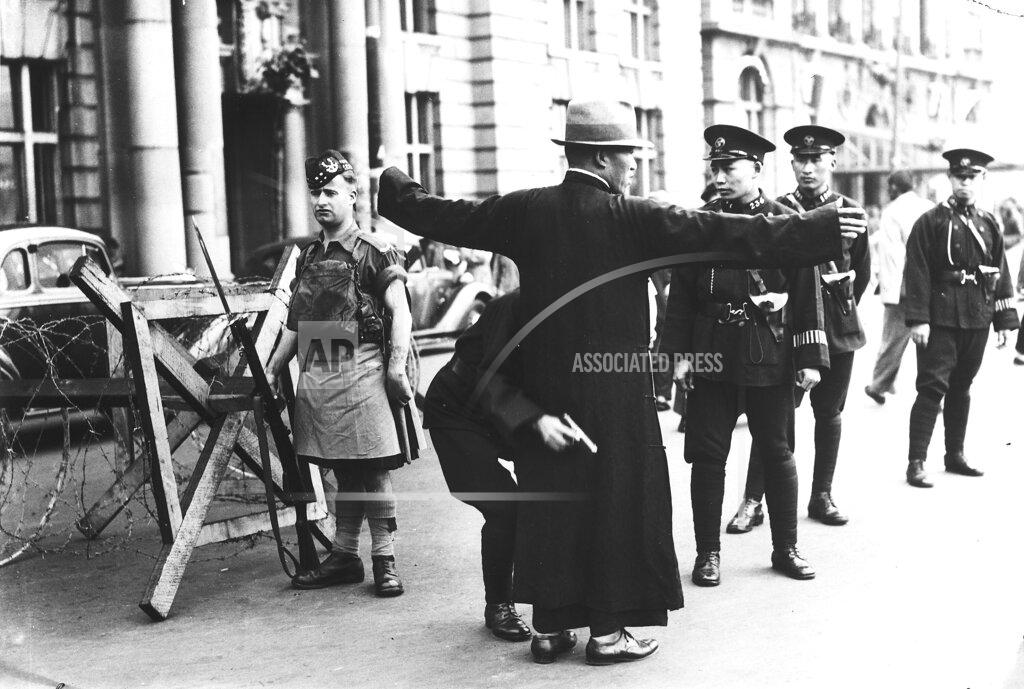
R. M. Tinkler, a British former inspector of the Shanghai municipal police, died in Japanese custody today after an emergency operation for injuries suffered in a scuffle with a Japanese naval landing party. The 45-year-old employee of a British-owned cotton mill in the Pootung industrial district of Shanghai was accused by the Japanese of firing at a Japanese officer and threatening to kill others when they invaded the mill to break up a fight among Chinese strikers and non-strikers.
Mr. Tinkler was disarmed in a scuffle and was hit on the head with a rifle butt. At the Shanghai General Hospital, it was discovered he had serious head wounds, three stab wounds in the abdomen and a foot injury. The operation was performed by two Japanese naval surgeons and two German surgeons while armed Japanese sentries stood guard, indicating he still was in “protective custody.”
British authorities had requested that Mr. Tinkler be taken to a hospital in the British area of the International Settlement, but Japanese insisted that the operation be performed at the General Hospital in Japanese-occupied Hongkew. A spokesman for the Japanese Embassy declared Mr. Tinkler’s action “was a deliberate insult to the Japanese Navy, whose men were guarding the English plant at Pootung.”
“We are surprised he was not shot and killed on the spot,” he said. “The matter did not involve merely pointing a gun by a Briton at a Japanese. It involves lawlessness toward a Japanese officer in uniform. It is extremely grave. That Japanese marines should have disarmed Tinkler and manhandled him is to be expected under the circumstances.” British-Japanese relations suffered further strain as a result of the incident. British officials refused to comment except to say that the “case is being studied,” but unofficial British circles declared the Japanese had “misrepresented the facts.”
Dow Jones Industrial Average: 138.36 (+1.30).
Born:
Gary U.S. Bonds, singer (“New Orleans”), in Jacksonville, Florida.
Richard “Popcorn” Wylie, pianist, bandleader, songwriter and record producer, in Detroit, Michigan (d. 2008).
Louis Andriessen, composer and pianist, in Utrecht, Netherlands (d. 2021).
Dave Grayson, AFL and NFL cornerback and safety (AFL Champions, Texans-1962, Raiders, 1967; AFL All-Star, 1962-1965; 1968-1969; Dallas Texans-Kansas City Chiefs, Oakland Raiders), in San Diego, California (d. 2017).
Eddie Giacomin, Canadian NHL goalie (Hall of Fame, 1987; NHL All-Star, 1967-1971, 1973; New York Rangers, Detroit Red Wings), in Sudbury, Ontario, Canada.
Nganani Enos J Mabuza, South African leader (Inyandza National Movement), in Barberton, South Africa (d. 1997)
Joachim Wendler, aquanaut, in Erfurt, Germany (d. 1975).
Died:
George Fawcett, 78, American actor.
Naval Construction:
The Royal Navy Dido-class light cruiser HMS Euryalus (42) is launched by the Chatham Dockyard (Chatham, U.K.); completed by Hawthorn Leslie & Co. (Hebburn-on-Tyne, U.K.).
 History Diaries