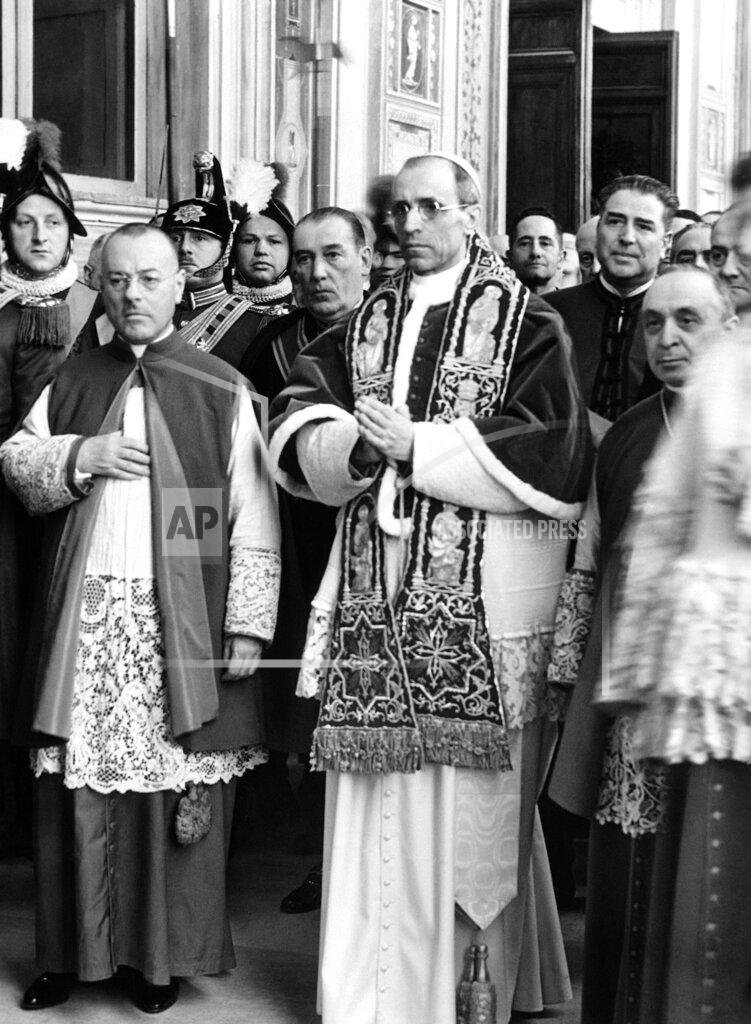
Among the first official acts that Pope Pius XII performed after his elevation to the pontificate was to launch a radio appeal this morning to all the peoples of the world, calling on them to forget their quarrels and enjoy the “sublime gift of peace.” In accents whose earnestness and fervor must have recalled his predecessor to many hearers, the new Pope invoked “peace which is desired by all honest souls and which is the fruit of charity and justice.” He invited all mankind to turn its thoughts to peace — peace of conscience, peace of family and peace between nations.
Then, taking cognizance of the fact that peace can be achieved only in the face of grave difficulties, he added a prayer to God “for all those who are entrusted with the high honor and grave burden of guiding peoples on the road to prosperity and progress.” Pope Pius made his appeal from a throne on the top step of the altar in the Sistine Chapel, which is still exactly as it was during the conclave. Here he had just received his third “obedience” from the Sacred College.
He was dressed in his pontifical robes with a golden miter and a rich white cape lavishly embroidered in gold. He read his appeal from a typewritten text, which he held in both hands, into a portable microphone. On each side of the throne stood a Cardinal in a crimson robe and ermine cape. The remainder of the Cardinals, similarly dressed, made a wide band of red and white on the more sober background of the violet thrones arranged on each. side of the chapel.
Pope Pius XII spoke in a magnificent voice, clear, resonant and strong. Each word was enunciated with scrupulous care and one of his principal preoccupations, apparently, was to make himself clearly understood by radio listeners throughout the world. This did not decrease, however, the force and conviction with which the address was delivered. It was obvious that he was much in earnest and felt very strongly on the subject on which he was speaking. The appeal was addressed in Latin and was later rebroadcast in all principal languages from the Vatican wireless station.
Cardinals support the new pope’s decision to counter materialism.
Colonel Segismundo Casado begins a week-long anti-Communist coup in Madrid, and tries unsuccessfully to negotiate with General Franco.
The Spanish Nationalists have received reports that Republican political leaders opposed to Premier Juan Negrín are attempting to form a new government in Madrid. The leaders of the so-called Republican dissidents are said to be opposed to Communists, who form much of Señor Negrín’s support, and to represent a large part of Madrid’s population which Nationalists said had been calling for “bread or surrender.”
Britain appoints an envoy to the new Spanish government.
The Nationalist Government of Spain at Burgos today decreed all church property exempt from taxation. At the same time Generalissimo Francisco Franco rewarded six Nationalist brigadier generals for service in the Catalan campaign by promoting them to the rank of division (major) generals. Those advanced were Generals José Moscardo, Miguel Aranda, Ricardo Serrador, Eladio Alvarez Arenas, Emilio Solchaga and Canovas.
Franco agrees to hold a prisoner exchange between Spain and the United States.
The Soviet Union has withdrawn from the Non-Intervention Committee on the ground that it ceased long ago to function and has lost all reason for existence. The decision to withdraw, as announced tonight in a brief Tass (Russian news agency) statement, was taken by the Council of People’s Commissars on Wednesday. Instructions have been telegraphed to Ivan M. Maisky, Ambassador in London, to cease participating in the committee’s work.
The Socialist group in the French Chamber of Deputies in a letter to Premier Édouard Daladier today protested against alleged accords made with the Spanish Nationalist government for returning the gold held in France. for the Bank of Spain and against the agreement whereby armaments intercepted en route to Republican Spain should be surrendered to the Franco regime. A court at Ceret in the south of France today refused to release fifteen motor trucks loaded with gold and coins to representatives of the Spanish Republican government. The court held the gold would have to be kept under seal until a ruling by higher courts.
Danzig expels 500 Jews. Their destination is believed to be Palestine. The first contingent of about 500 Jews expelled from Danzig left early this morning for an unknown destination. Carrying large bundles of personal possessions, men, women and children were dispatched in buses and trucks to a German railway station, whence, it is believed, they will be transported via Hungary to Constanta, Rumania.
There, it is said, a ship is waiting to take them to Tel Aviv or Haifa, Palestine, although no valid visas have been issued permitting the emigrants to enter Palestine. Their departure was well organized, but there were distressing farewell scenes. A second contingent, it is reported, will leave in about ten days. The emigrants’ passports bear the notation that the police will raise no objection to their returning to Danzig at any time before April 1. Presumably this is to meet the possibility that the emigrants may not be able to enter a foreign country.
According to newspaper reports, two British correspondents, Vaughan Jones of The Daily Express and Miss Ruby Margaret Hobling of Reuters, were arrested by the Nazi police in Danzig. They were charged with smuggling foreign currency and only released after strong representations by the British Consul. Some diplomats watching the departure of the Jews were themselves saved from being taken prisoner only by showing their diplomatic passports. Mr. Jones asserted the police arrested him because they were “enraged” that details of the Jews’ expulsion had leaked out. The police forbade the taking of pictures, he said.
The Reich agrees to continue with the Jewish emigration program.
The Reich plans a drive against alcohol and tobacco, and encourages others to emulate the good habits of Hitler.
Italy quits using radio as a propaganda tool in Latin America.
Josef Stalin places the ashes of Lenin’s widow by her husband’s tomb.
In Willesden a railway man, Henry George West, prevented an IRA bomb attack on a railway bridge during the night.
The prototype Vickers Wellington Mk II (L 4250) aircraft flies today.
A small informal meeting of British and Jewish delegates to the Palestine conference was held in London today. Apparently, it got nowhere, the Jews still insisting the British proposals for settlement of the dispute over the Holy Land do not even merit discussion. Since this is the attitude the Jews have held ever since they received the proposals almost a week ago, it would appear that the British delegates have not as yet succeeded in persuading the Zionists that their suggestions do not mean what the Jews first interpreted them as meaning.
However, the Jews have not yet decided to carry out their original threat to break off the conference completely. Formal discussions. have not been held all week, but informal discussions continued and will continue again on Monday. Pending the outcome of these, the formal discussions are only suspended and the British officials are continuing with the other half of the Palestine conference-discussions with the Arabs. These will be continued tomorrow and the British must consider the Palestine Arabs’ counter-proposals for immediate independence. It is regarded here as foregone that these counter-proposals will be excluded.
The Jews added one more step today to what is being generally described as a gradual disintegration of the conference. The official Jewish delegation broke up, leaving the power to negotiate in the hands of the Executive of the Jewish Agency, the official organization of the Zionists. Though some Jewish delegates are leaving — Rabbi Stephen S. Wise and Mrs. Wise will sail on the Queen Mary tomorrow — many more are staying on. The fact that the delegation has received permission to go is said here to be insignificant, in view of the fact that most of the members are remaining and formal discussions could be renewed at any time.
The Arabs already have appointed a small committee to deal with the British and it is believed the Jews are following the same system, with the difference that future conversations between the Jews and the British probably will continue on an informal basis, while the Arabs remain in formal session. The Jewish decision to turn over the negotiations to the executive of the agency is interpreted in many quarters here as an indication that the conference is not being broken up, but is rapidly disintegrating, as the British realize the conference itself is a failure so far as reaching an agreement is concerned. Instead, it is being turned into meetings in an effort to determine the best solution for the British to impose on the Holy Land.
The bodies of twelve Arabs believed killed by terrorists were found in a cave by troops searching Arab villages near Tul Karm today. Two Arabs were killed when they attempted to break a military cordon during searches of the Samaria and Jerusalem districts. In another incident a Jew was shot and injured near the Jerusalem military headquarters by a youth who escaped into the old city of Jerusalem.
The U.S. House of Representatives passed unanimously today the $499,857,936 Army Supply Bill for the fiscal year 1940, without amendment and with practically no debate. The last hour of consideration of the bill was enlivened by Representative Collins of Mississippi, who criticized the Army Intelligence Service as failing to give this nation a true picture of armaments abroad, and demanded that those responsible for the alleged failure to report on the extent of air supremacy by European powers be dismissed from the service and called before the House Military Affairs Committee to explain.
The unanimity of House action caused Representative Snyder of Pennsylvania, who was in charge of the bill, to declare that passage without amendment “served notice on the dictators that we mean business.” He added, “The best answer that the American people have given of their attitude toward being prepared in case any foreign foe would choose to disturb our liberties and our institutions was demonstrated today on the floor of Congress when Congress passed the largest peacetime Army Appropriation Bill of approximately $520,000,000 in fifteen minutes and established a record, not having a single amendment offered to the bill. It is the first Army Appropriation Bill in 150 years of our constitutional history that hasn’t had an amendment offered.”
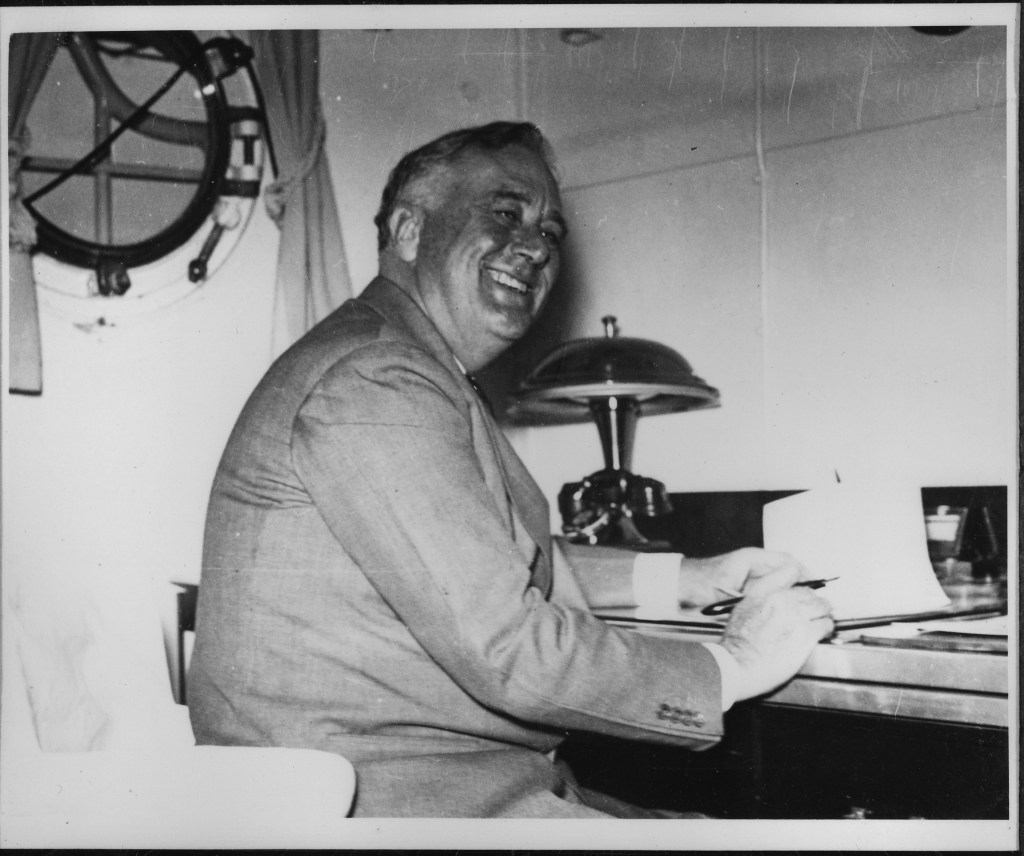
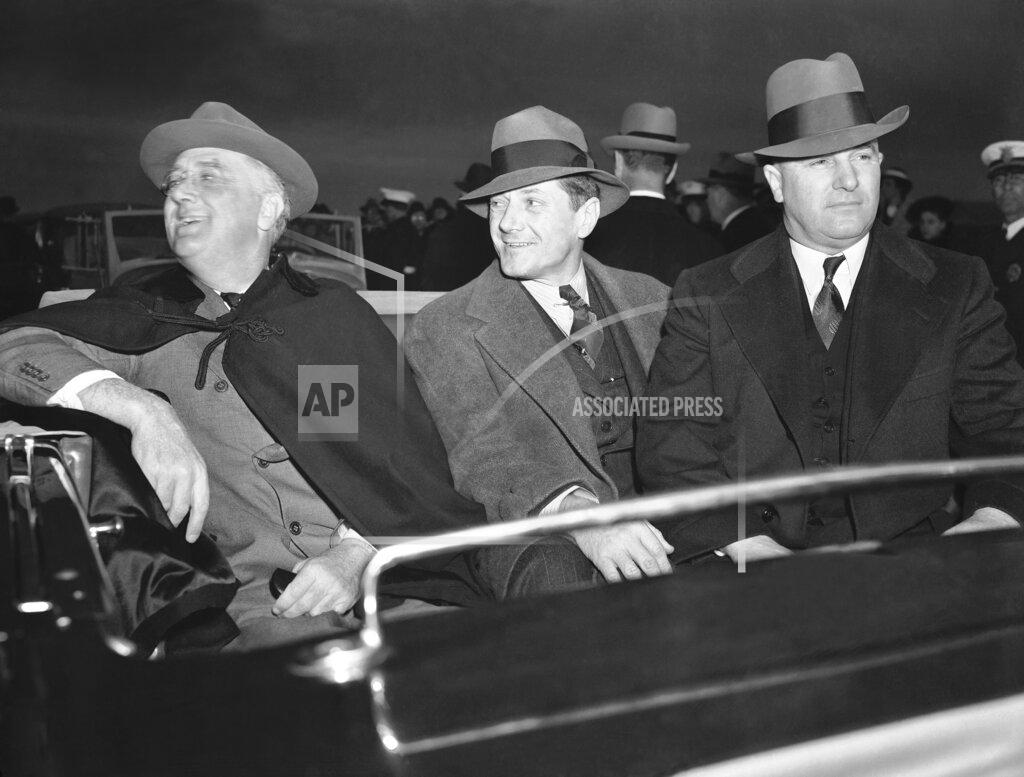
President Roosevelt announced on his return to the United States today that Fleet Problem XX, the first and most extensive naval maneuvers of their kind held in Atlantic waters had proved eminently satisfactory and had demonstrated the wisdom of the navy’s recommendation for subsidiary bases at San Juan, Puerto Rico, and St. Thomas in the Virgin Islands. Tanned and invigorated after his two weeks’ cruise, the President, seated in the admiral’s cabin of the USS Houston, gave reporters who went out to meet him on his arrival at Charleston, South Carolina, a thumbnail sketch of the theory on which the war game had been based. He told of attacks and counter-attacks waged on an imaginary sea off the hazy coast of a phantom continent and of the complete destruction of cruisers, destroyers and capital ships that were later ‘restored’ for the final mass maneuvers.
The President began his dissertation with the warning that it was difficult to explain the maneuvers in such a way as not to give the layman a false impression. To understand the objectives it was necessary to completely forget all about potential enemies, natural geography and the difference between land and water. The President told of traveling 200 miles on imaginary voyages over “dry land” so as to remove the Houston from the immediate theater of operations and send a radio dispatch to the temporary White House offices at Miami. Neither side had won in what was generally supposed to be a simulated test of the Administration’s continental defense policy, the President explained. Nor was either side supposed to be the victor. However, it was evident from some of Mr. Roosevelt’s remarks that the war game had proved even more than the satisfactory maneuverability of the warships participating and that the defense of something more than a theoretical coast line from invasion was involved.
U.S. Ambassador Joseph Kennedy writes to President Roosevelt intimating that the U.S. should intervene on behalf of Britain in any forthcoming conflict.
Steps for practical realization of business appeasement were started in both the executive and legislative branches of the government today, topped by a move on Capitol Hill for immediate tax revision as an incentive to industrial revival and expansion. The steps were all in line with a general purpose to have the movement for government and business cooperation under way by the time President Roosevelt returns to Washington tomorrow.
The tax-revision drive was touched off by Representative Doughton, chairman of the House Ways and Means Committee, and Senator Harrison, chairman of the Senate Finance Committee, the latter of whom yesterday hoisted the banner of the economy bloc for a new and bolder offensive against excessive government spending. These two leaders today addressed a letter to Secretary Morgenthau, taking up his suggestion of a few days ago that business might be aided through the elimination of deterrent tax laws. They invited the Treasury to submit its recommendations on this subject as soon as the March 15 revenue returns had been compiled, so Congress might get to work at once removing the undesirable levies.
Amendments designed to reconstitute the National Labor Relations Board under a new name and increase its membership to five were introduced in the form of a bill today by Representative Barden, Democrat, of North Carolina, who is a member of the House Labor Committee.
The new Goldfish swallowing craze began to sweep college campuses getting a start at the Ivy League’s Harvard University.
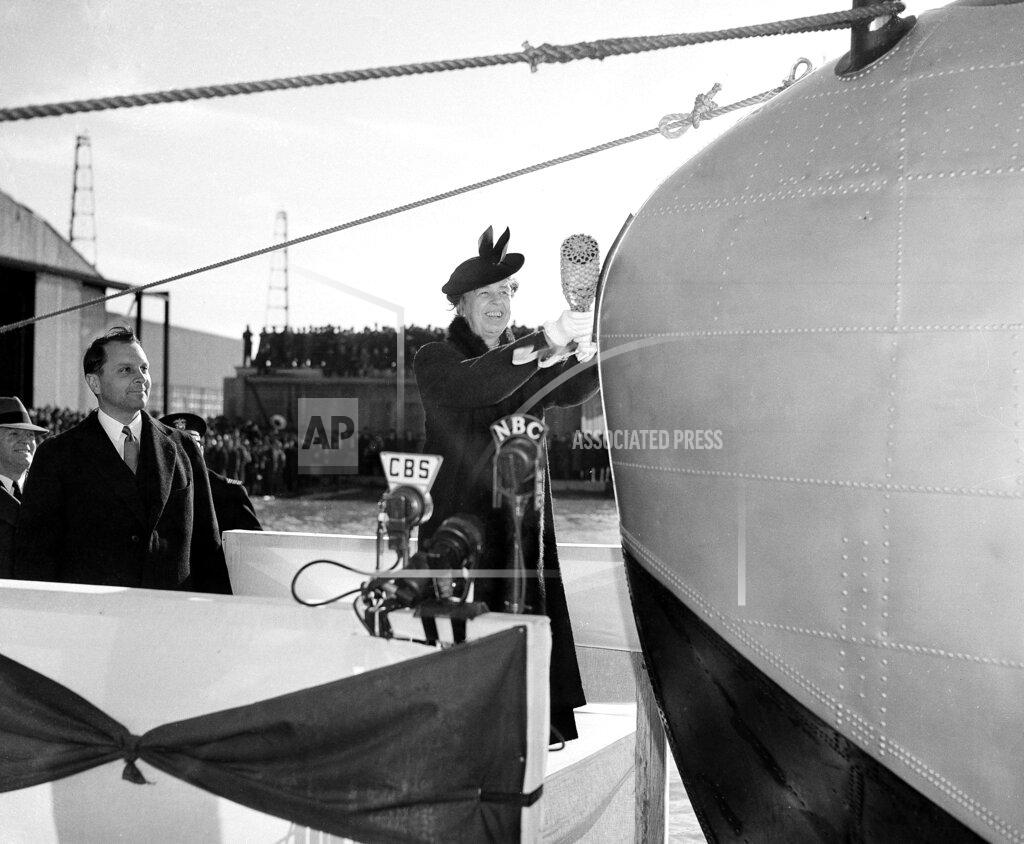
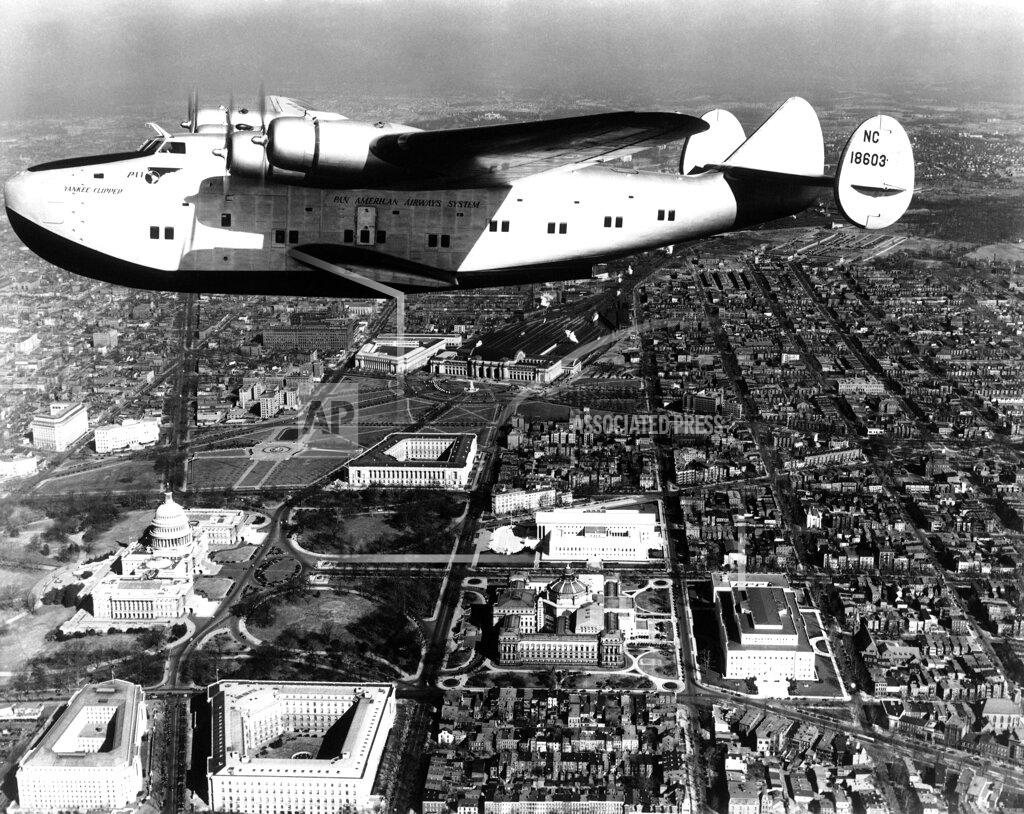
Eleanor Roosevelt christened Pan Am’s new Boeing built Yankee Clipper. Boeing employees in Seattle listen to a live radio broadcast the christening in Washington, D.C. A Clipper will start regular airmail service across the Atlantic on May 20.
Port commissioners in Astoria, Washington vote to ban shipments of scrap to Japan.
The Navy plans a gun salute to welcome President Franklin Roosevelt back to the United States.
Actor Bert Lahr asks for an annulment. He says his wife has been insane for the past five years.
Mahatma Gandhi begins a fast in Bombay (today Mumbai) to protest against autocratic rule in India.
Two people have been killed in new rioting between Hindus and Muslims in Lucknow, India. Fifteen have died in the last two days in Rangoon, Burma during rioting and fighting between adherents of the two religions.
The Japanese attack Chinese strongholds. Two powerful Japanese armies, using tanks and bombing planes, pressed campaigns today on widely separated fighting fronts in China. A battle was reported in Hupeh Province, where the Japanese are attempting to advance up the Yangtze River west of Hankow. In Kiangsu Province, on the coast north of Shanghai, another Japanese army is driving north of the Yangtze River in an area bounded by the Yellow River, Yellow Sea. Grand Canal and Lung-Hai Railway. The invaders’ objective apparently is Haichow, the only port north of Shanghai still in Chinese hands.
An estimated 60,000 Chinese soldiers, who dug in northwest of Shanghai after they had been defeated along the Lunghai Railway last Summer, and a large force of guerrillas are reported to be facing the Japanese. On the inland front, Japanese reported they were attacking Shayang, 100 miles west of Hankow in the Han River sector, preparatory to an assault on Shasi, an important Yangtze River port thirty miles to the southwest.
Shanghai’s International Settlement and French Concession will allow Japan to share policing duties, ending the disagreement. Japanese and Shanghai International Settlement authorities tonight announced an agreement ending their dispute over policing of the Settlement, a dispute that had caused apprehension that the Japanese might forcibly occupy the area. The Japanese had demanded a share in the policing of the Settlement to help suppress increasing terrorism. The accord provides for cooperation between Settlement police and Japanese gendarmes for the prevention of terrorism, effective control of Chinese entering the Settlement from the Whangpoo River and Soochow Creek, the searching of Chinese passing through the Settlement and an additional number of Japanese police on the Settlement force.
United States consular authorities joined British and French officials today in representations to Japanese authorities against the enclosing of foreign areas of Tientsin with an electrified fence. The representations stressed that the fence endangered United States, British and French nationals in the populous foreign sections. No specific reference was made to the concessions concerned, British, Italian, French and Japanese.
The Japanese Emperor will present his new daughter with a sword and skirt. He will name her in seven days.
Dow Jones Industrial Average: 148.76 (+1.80).
Born:
Chester Weger, American ex-convict found guilty of murdering three women in 1960 at Starved Rock State Park in Illinois, in Derby, Iowa.
Naval Construction:
The Вое́нно-морско́й флот СССР (ВМФ) (Soviet Navy) Project 7U-class (Storozhevoy-class) destroyer Soobrazitelny (Сообразительный, “Astute”) is laid down by 61 Kommunara (Nikolajev, U.S.S.R.) / Yard 200.
The Royal Navy British Power Boat 60 feet-type motor torpedo boat HMS MTB 16 is commissioned.
 History Diaries