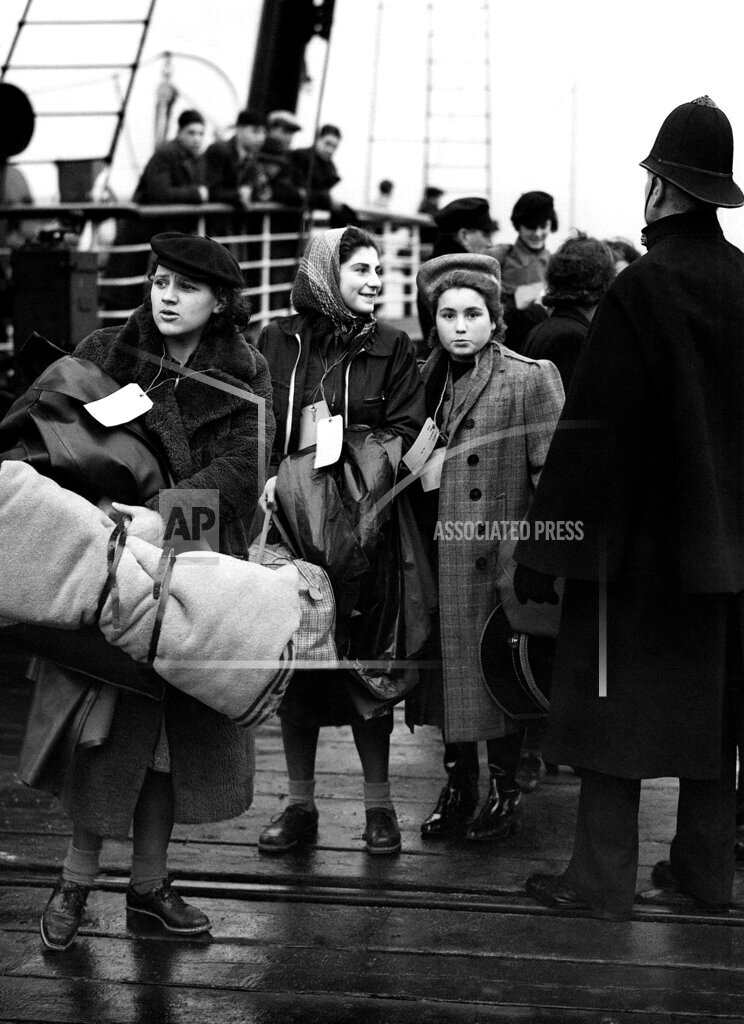
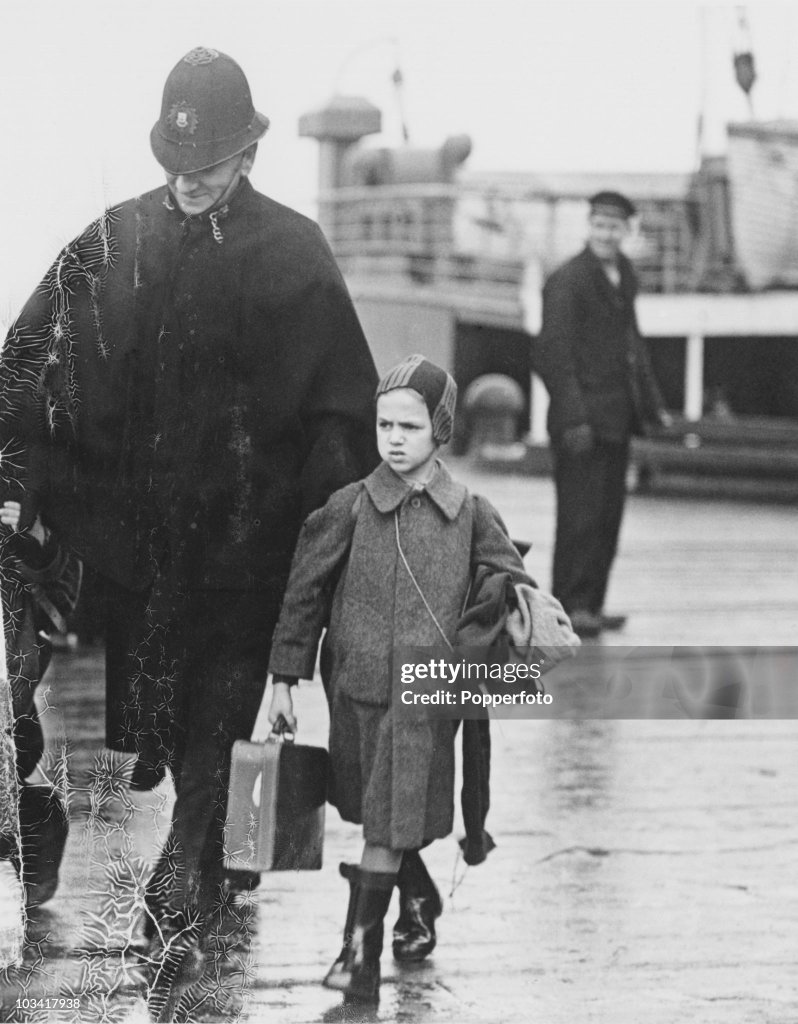
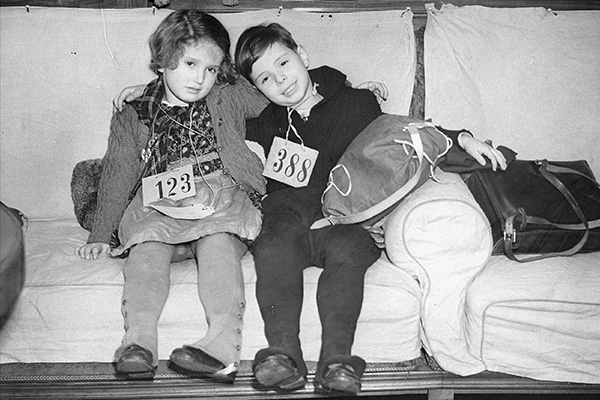
More than 500 mostly Jewish children arrived in Lowestoft from Vienna, having been rescued from Nazi oppression. On arrival they were moved to Pakefield Holiday Camp before switching on to more permanent accommodation.
Walter Kammerling was one of them, leaving behind his parents and two sisters, when he was just 15. “I was almost in a daze,” he remembers. “My father was in the Jewish hospital at the time with angina. When I said goodbye to him, he was in tears and I didn’t want to go. I remember I stood at the door and it was awful. “My mother and sister came to the station and that was it. But the pain it must have caused my parents…” Walter’s eldest sister, who was 18, was able to get a work visa to come to Britain. His other sister, however, was just 17 – too young for a work permit and too old for the Kindertransport. She remained in Vienna and Walter never saw her, or his parents, again. They were murdered at Auschwitz.
A new foreign currency law in Nazi Germany restricted the possessions emigrants could take out of the country (including money and valuables) to only include items of personal use.
Britain and France ask Germany to respect the autonomy of Memel, Lithuania. Great Britain and France today joined hands in another attempt to stop Adolf Hitler, who is planning new “conquests” in his drive toward the east. The London and Paris governments told Berlin they were worried lest Germany incorporate little Memel in the German empire. Prime Minister Neville Chamberlain informed the house of commons that British and French envoys to Berlin had received instructions to “join in expressing the hope that the German government will use its influence to insure respect for the Memel statute.”
This statute gave the former German territory a great measure of autonomy under Lithuanian sovereignty. Britain and France, together with Japan and Italy, signed the measure in 1924. However, London and Paris are not expected to do anything more than register a protest if and when Hitler decides to annex Memel. Some diplomatic observers ventured the belief that Germany, flushed with the success of its previous “conquests” — Sudetenland and Austria — will not hesitate to proclaim possession of the Memel territory. Others said Berlin probably would be satisfied to set up Memel as a separate Nazi state controlled through the Nazi party from Berlin.
Chamberlain, in a reply to a question about the overwhelming Nazi victory in yesterday’s parliamentary elections, told the House of Commons: “There is reason to think that after the Memel elections demands may be made upon the Lithuanian government by majority parties in the diet (parliament) which would be inconsistent with the statute of Memel. “The British government, as a signatory of the Memel convention, cannot ignore this possibility. “In view of the special influence which the German government is in a position to exert in these matters. the British chargé d’affaires in Berlin has been instructed to join with the French ambassador in expressing the hope that the German government will use its influence to insure respect for the statute.”
Thirty-eight Spanish sailors were held prisoners tonight by high waves aboard a sinking Spanish government oil tanker off the coast of southern France. The 1,200-ton tanker, described as the Lefac 61, ran on a rock reef last night in a storm. Throughout today rescue crews attempted to reach the vessel, but each time they were turned back by high breakers. A tug tonight came within several hundred yards of the tanker, but the contact efforts were in vain.
Bulgaria accepts several hundred Jewish refugees, hoping they will move on to Palestine.
The Royal Navy Fleet Air Arm Fairey Albacore biplane torpedo bomber aircraft took its first flight. The Albacore, popularly known as the “Applecore”, was conceived as a replacement for the Fairey Swordfish, an earlier biplane introduced during the mid-1930s. It was typically operated by a crew of three and was designed for spotting and reconnaissance as well as level, dive, and torpedo bombing. First flown on 12 December 1938, the Albacore was in production between 1939 and 1943, and entered FAA service with 826 Naval Air Squadron during March 1940. The type was initially operated from land bases, being dispatched on attack missions against enemy shipping and harbours in the vicinity of the English Channel. The first operations on board an aircraft carrier commenced in November 1940.
At its height, 15 first-line FAA squadrons flew the Albacore. The type was much used in the Mediterranean, participating in the Battle of Cape Matapan, the Second Battle of El Alamein, as well as the landings at Sicily and Salerno. Despite the intention to replace the Swordfish, the Albacore served with it and was eventually retired before it, both aircraft having been replaced by a pair of monoplane designs, the Fairey Barracuda and Grumman Avenger. In addition to the FAA, the Royal Air Force (RAF) and the Royal Canadian Air Force (RCAF) operated the type.
The Daily Express reported that Lloyd’s of London was quoting 32 to 1 odds against Britain being involved in a war before December 31, 1939.
The U.S. Supreme Court decided Missouri ex rel. Gaines v. Canada. The Supreme Court rules that the University of Missouri Law School must admit qualified African-American student Lloyd Gaines, or a law school must be established at Lincoln University, Missouri, for black students. The Court held that by establishing Lincoln University as a state university for black students, the state of Missouri established precedent for providing equal opportunity in higher education for both black and white students. Therefore, the denial of access to legal education was unlawful discrimination. The Court also held that the state’s intent to eventually create a law school at Lincoln University was not enough to absolve the responsibility to provide a legal education in this case. The Court held that Missouri failed in its constitutional duty to provide equal protection under the law by failing to provide equal access to public education within the state.
The Missouri General Assembly chose the latter option. It authorized conversion of a former cosmetology school in St. Louis to establish the Lincoln University School of Law, to which other, mostly black, students were admitted.
Justice McReynolds wrote a dissenting opinion and argued that education was a states’ right issue, and there can only be federal interference when there is a “clear and unmistakable disregard of rights.” Because the state of Missouri was prepared to pay Gaines’ tuition at an out-of-state law school, Gaines would still have access to a legal education and therefore was not being denied his rights.
Gaines will disappear in March 1939, never getting the education he fought for. The National Association for the Advancement of Colored People (NAACP), which had supported Gaines’s suit, planned to file another one challenging the adequacy of the new law school. While waiting for classes to begin, Gaines traveled between St. Louis, Kansas City and Chicago looking for work. He worked odd jobs and gave speeches before local NAACP chapters. One night in Chicago he left the fraternity house, where he was staying, to buy stamps, and never returned. He was never seen again by anyone who knew or recognized him and reported doing so.
No law enforcement agency of the era formally investigated Gaines’s disappearance; it had not been reported to any, and many African Americans distrusted the police. J. Edgar Hoover, director of the Federal Bureau of Investigation (FBI), who was more concerned about potential communist influence on the civil rights movement, wrote in an internal memo in 1940 that he did not believe the case fell under the FBI’s jurisdiction.
Efforts of the National Labor Relations board to force reinstatement, with back pay, of CIO seamen who engaged in mutinous sitdown strikes were halted today by the United States Supreme court. By denying the labor board’s petition for review in its case against the Peninsular and Occidental Steamship company, the Supreme court upheld the decision of the 5th Circuit Court of Appeals. The Circuit court found the CIO sitdown strikers guilty of mutiny, condemned the board for disregarding undisputed evidence, and set aside the board’s order in its entirety. In refusing to review the case, the Supreme court apparently accepted the unanimous opinion of the Circuit court as adequate and final expression of the law in the matter.
It was the second defeat for the labor board within a week. Last Monday the Supreme court set aside an order of the board in so far as it required the Consolidated Edison company of New York to abrogate collective bargaining contracts with American Federation of Labor unions. The case today was the first in which the Supreme court refused to grant a labor board petition for review of an unfavorable lower court decision.
The U.S. Maritime Commission begins an investigation into two Japanese shipping lines, accused of unfair practices in the Americas.
The Board of Directors of pharmaceutical company McKesson and Robbins demands the resignation of top officers. An $18 million fraud is revealed, hidden by nonexistent warehouses and drugs.
Republic Steel asks an appeals court to order the NLRB to reopen its case and allow the company to present more testimony.
“Wrong-Way” Douglas Corrigan has earned $75,000 in the last 90 days.
Comedian George Burns pleaded guilty in a New York federal courtroom to charges of smuggling jewelry. Burns pleads guilty to jewelry smuggling, having bought bracelets from those who smuggled them into the United States. Sentencing was deferred until January, but Burns faced a maximum of 18 years in prison and fines up to $45,000.
The Tigers buy PCL pitching sensation Fred Hutchinson from Seattle for cash and four players.
Chinese military leaders asserted today that Japanese armies occupy only about one-seventh of the area of eleven provinces included in the principal zone of the Japanese invasion. The Chinese said the invaders occupy only 119 hsien, or counties, in the eleven provinces, which have a total area of 550,000 square miles and 375,000,000 population. This 550,000-square-mile region is only about one-fourth of China’s total area, but it includes nearly all of China that figures in world trade. In this section the Japanese hold practically all cities, railways, and industrial centers. The Chinese claim apparently is based on the relatively small area actually garrisoned by Japanese troops. Its mention of eleven provinces omits two of the thirteen provinces into which the Japanese occupation has penetrated.
The Chinese survey of the occupation agrees in some degree with reports of foreign observers that, although the Japanese hold the ports, cities, and railways of the area of nominal occupation, their actual rule does not, in many districts, extend more than a rifle shot from their bases. The undeclared war was in its 525th day today, with opposing armies of more than 2,000,000 men embattled over one of the most widespread fighting fronts in history. The greatest loss of territory has been in Shantung, the “sacred province,” where the Japanese have occupied thirty-two of the 109 districts, according to the Chinese estimates. Despite severe but unspectacular fighting on all fronts, the situation changed little last week.
Japanese forces claim that 10,000 guerrillas surrendered to them near Shanghai, but admit that six times that number still raid from positions in the Yangtze Delta. A Japanese army spokesman said the Japanese were constantly conducting mopping up operations on the lower Yangtze Delta, gradually breaking large Chinese guerrilla ranks into small, disorganized and poorly equipped units. He estimated, however, there still were 60,000 Chinese guerrilla fighters operating in the general Shanghai area. He said 10,000 such fighters under General Ting, long active in the Lake Tai area, west of Shanghai, had now surrendered, giving up 8,000 rifles and a large number of machine guns. Small units are surrendering almost daily, he said. Chinese reports from Hong Kong said Chinese had recaptured several important towns close to Canton, great southern port held by the Japanese. These reconquests were reported to include Waichow, key city between Canton and the coast at Bias Bay.
Both the American and British governments, it was learned today, are considering economic retaliation against Japan for excluding their nationals from business enterprises in China. This is reputed to be the real reason that the State Department cabled Nelson T. Johnson, American ambassador to China, to return to Washington for consultation. The ambassador started for America today. Also returning to Washington for consultation is Joseph P. Kennedy, American ambassador to Great Britain. Mr. Kennedy, who has been conferring with the British Foreign Office almost daily of late, will be able to lay before President Roosevelt the British government’s attitude toward measures of retaliation against Japan.
The form of economic retaliation under consideration is that of increasing tariff rates on Japanese goods imported into the United States, or possibly the exclusion of such imports altogether. This clash between Japan and the western powers over commercial opportunities is a byproduct of Japan’s undeclared war on China. Japan does not possess even recognized belligerent rights to interfere with the business activities of foreigners in China. Yet, in forcible possession of the greater part of China in which foreigners have been conducting business, Japan has slammed shut the “Open-Door” of equal opportunity, provided by treaty, and has declared that foreigners may continue only such business as Japanese authorities see fit to permit. Both the United States and Great Britain have protested against such action as breaches of the Open-Door treaty and also of the nine-power pact guaranteeing the territorial integrity of China.
Dow Jones Industrial Average: 148.65 (+0.34).
Born:
Carl Wetzel, NHL and WHA goalie (NHL: Detroit Red Wings, Minnesota North Stars, WHA: Minnesota Fighting Saints), in Detroit, Michigan.
Died:
James McNeill, Irish politician, 2nd Governor-General of the Irish Free State.
Naval Construction:
The U.S. Navy fleet tug USS Navajo (AT 64), lead ship of her class of 28, is laid down by the Bethlehem Steel Corp. (Staten Island, New York, U.S.A.).
The Royal Navy Bar-class boom defense vessel HMS Barlight (Z 57) is commissioned.
The Royal Navy Tribal-class destroyer HMS Somali (L 33, then F 33, finally G 33) is commissioned. Her first commanding officer is Captain Randolph Stewart Gresham Nicholson, DSC, RN.



 History Diaries