Easter Sunday.
Easter Sunday in a world at war finds America almost alone observing Christendom’s most joyful festival in traditional fashion. Sunrise services at Arlington cemetery in Washington, in Hollywood, and many other places, church services with the ancient hymns customary to the day and sermons on the risen Christ and the usual fashion parades, with bright colors gleaming in the bright spring sunshine predicted for much of the country, filled the day’s schedule. Tens of thousands of Easter visitors jammed the national capital. To its day was added the opening of the annual cherry blossom festival.
In Rome, capital of the Catholic world, as well as capital of a belligerent nation, the bells of the city’s 320 churches proclaimed the end of Lent yesterday. But because of wartime conditions, the Easter mass, customarily celebrated by the pope, was cancelled.
Pope Piux XII broadcasts an Easter appeal calling for an end to terror attacks against population centers. He also obliquely asks the Germans to follow the Golden Rule, saying:
“let your conscience guide you in dealing justly, humanely and providently with the peoples of occupied territories. Do not impose upon them burdens which you in similar circumstances have felt or would feel to be unjust.”
Pope Pius XII besought the belligerent nations in his Easter Sunday message today to refrain from using “still more homicidal instruments of warfare,” and urged all Catholics to redouble their prayers for an early, universal and just peace. He likewise urged upon “the powers occupying territories during the war” that they deal “justly, humanely and providently” with the peoples under their domination. “Prudent and helpful humanitarianism is the commendation and boast of wise generals.” he observed. “And the treatment of prisoners and civilians in occupied areas is the surest indication and proof of the civilization of individuals and nations.” The pope also called for an end to attacks against civilian targets.
Hitler is no fan of the Pope but does recognize that deposing or harming him would be politically disadvantageous.
German and Hungarian troops enter Belgrade and occupy the city. While Belgrade officially surrendered on the 12th, the mass of Wehrmacht troops enter the city today, 13 April 1941. It is a hub of activity and the start of a very long and dark chapter in Belgrade’s history. German panzer units rolled into Belgrade, Yugoslavia’s abandoned and battered capital, shortly after dawn today, the Nazi high command announced, just a week to the day after launching its twin campaign against that Balkan country and Greece. The triumphant entry, at 6:30 a.m., was reported to the German people in a communique which listed other important axis victories in North Africa and the battle of the Atlantic. Nazi mechanized units pounding up the Serbian plain from the south moved into Belgrade, the high command reported, after small groups of storm troopers had crossed the Danube from the north late yesterday and entered the city to hoist the swastika over the German legation. The Yugoslav capital, heavily assaulted by the Luftwaffe and long since abandoned by its government, had been the objective of German forces driving in from the Bulgarian border, some 40 miles to the east, from the north and from the south. The high command, still silent on land operations against Greece, announced further that at Nazi-occupied Zagreb, capital of Croatia in northwest Yugoslavia, 22 generals, including two army commanders, 200 other officers and 12.000 men had been seized.
The Battle of Ptolemaida was fought, resulting in German victory. The Battle of Ptolemaida refers to two distinct engagements, the first around the village of Sotir north of Ptolemaida and the second around the village of Proasteion south of Ptolemaida, both fought on 13 April 1941 during the German invasion of Greece. These battles were delaying actions fought by Allied units under the overall command of the British 1st Armoured Brigade against the German 9th Panzer Division, to cover the Allied escape from their positions at Mt. Vermion toward the new defensive line of Mt.Olympus – river Aliakmon – Mt. Siniatsikon.
In Greece, General Wilson decides to withdraw to the Thermopylae line — running from the town of Molos on the Gulf of Euboea east of Thermopylae, to Eratine on the Gulf of Corinth. This is a naturally strong defensive line, and had the merit of being only 50 miles long (compared with the 100 miles of the Olympus-Vermion line) and could in theory be held by the British troops on their own. The main question is whether the British and their allies can get to this 50-mile line ahead of the Germans and garrison it sufficiently to halt the Wehrmacht’s panzers.
The Germans in Thessaloniki watch the British go from across the Aliakmon River, not wishing to rush them and biding their time before they cross the river. While the British are retreating, they retain strong rear guards just west of the river.
The main action continues to rest with the 1st SS Panzer Division Leibstandarte SS Adolf Hitler (LSSAH), which at this stage of the war is still of brigade size (about 6,000 men). After having taken the Klidi Pass and advanced well into the Kleisoura Pass, the LSSAH is pursuing a beaten enemy. The Mackay Force of Australians, New Zealanders, British and Greeks is in disarray, with units spread to the four winds and heading south by whatever roads they can find that have not yet been blocked by the fast motorcycle troops of “Panzer” Meyer’s LSSAH reconnaissance force.
The Greeks held their ground too long at Klidi, and the other Allied troops basically left them holding the bag. The Greek 20th and 12th Divisions are trapped on Mount Siniatsiko and facing a nightmarish cross-country trek to the south. As the British attempt to form a line of resistance at Mount Olympus, their 1st Armoured Brigade today fights delaying engagements in the Ptolemaida area against the German 9th Panzer Division at Sotir and Proasteion (Proastio). The Germans are barely halted at all, and, while accounts vary, the British lose at least 30 tanks versus the Germans losing 8 — and German claims suggest a much higher disadvantage to the Allies of up to 80 British tanks lost.
The Battle of Kleisoura Pass took place from the evening of 13 April 1941, when first contact was made, until the midday of 14 April, when Greek organized resistance collapsed. The battle was fought over the narrow pass that crosses between Mt. Vitsi and Mt. Siniatsiko, between elements of the Greek 20th Infantry Division which were occupying the pass and the German Leibstandarte SS Adolf Hitler, a mechanized infantry unit of brigade level. The pass was strategically important for it stood on the main Allied defensive line (Mt.Vitsi– Mt. Siniatsiko– river Aliakmon – Mt. Olympos), behind which passed the withdrawal route of the Greek army engaged against the Italians in Albania.
The German Leibstandarte SS Regiment attacked through the Metsovon Pass in an attempt to flank the Greek positions on the front with Albania. To prevent this, Greek General Papago ordered Greek troops in Albania to fall back, allowing Italian 11th Army to capture Koritsa (Korçë), Permet, and Porto Palermo in Albania. Further south, German aircraft attacked Piraeus, Greece, sinking Greek destroyer Psara and damaging destroyer Vasilevs Georgios I.
The powerful Greek forces in Albania accelerate their withdrawal south. In retrospect, one can say that they took to long to begin moving, but nobody expected the Yugoslav and British defenses to crack so easily. In addition, the Greek forces have been pinning down large Italian formations which now can join the German advance, so the withdrawal has its drawbacks as well as its benefits.
The Wehrmacht High Command announced: “Yesterday the Luftwaffe again inflicted heavy losses in repeated raids on the remains of the Serbian army. Dive-bomber, destroyer and fighter aircraft cut enemy march columns to pieces in the lower Bosnia valley and in the area between the Sava and Drin rivers. Ground-attack aircraft bombed military installations around Sarajevo and scored bomb hits on aircraft stationed on the ground at Mostar airfield. Other Luftwaffe formations blew up Greek troop assemblies at Deskati. In the Lake Prespa area, German fighter planes shot down 6 British Bristol Blenheims. In bomb raids on Piraeus harbor, the Luftwaffe sank four merchant vessels totaling 35,000 tons, badly damaged eight large merchant vessels, and set the harbor installations on fire. During the last two nights, heavy caliber bombs hit a destroyer and 3 large merchant ships in the inlet at Eleusis and outside the port of Piraeus. Another effective high-explosive bomb raid was made on Eleusis airfield.”
Hitler orders swift mopping-up operations in Yugoslavia and Greece.
Paul von Kleist was mentioned in the Wehrmachtbericht daily radio report. German radio mentions General von Kleist, whose 2nd Army forces took Belgrade, in the nightly Wehrmachtbericht communique. This is an honor even for a senior general and shows that he is in good favor with the German hierarchy.
Visiting Australian Prime Minister Robert Menzies records in his diary that everyone at Chequers, including President Roosevelt’s special envoy W. Averell Harriman, is “depressed by the news of what I call the ‘botch’ in Libya.” He is too polite to note in his diary, of course, that he was the only one at the time to call into question Churchill’s fixation on transferring troops from the winning campaign in Libya to the almost inevitable defeat in Greece.
The First Siege of Tobruk is underway. The Italians finally give Afrika Korps commander Lieutenant General Erwin Rommel blueprints of the port fortress’ defenses so that he can plan his attacks better.
A heavy German assault on Tobruk begins. Axis artillery bombarded Allied defensive positions at Tobruk, Libya at 1700 hours, and 30 minutes later German 5th Light Division, Italian Ariete Division, and Italian Trento Division commenced an attack. Australian troops repulsed the repeated attacks. The Australian 9th Division (General Morshead) remains trapped in Tobruk, and no relief is in sight. The Germans, astounded by their quick advance, become confident and attempt to seize as much of Egypt as they can before the British and Australian troops return from Greece. Rommel orders Forward Detachment Knabe to take Sollum and then advance toward Marsa Matruh. The Ariete Division advances to El Adem while Knabe occupies Fort Capuzzo. The next British blocking position is at Sollum as the Germans basically roll up the British gains of Operation Compass.
The Australians bottled up in Tobruk have something to say about all this, however. They repulse an attack on a key road junction south of Tobruk. After dark, the Germans infiltrate through the Tobruk wire defense, but a fierce local counterattack kills a dozen Germans and sends the rest fleeing. Basically, the Australians let the Germans know that they are going to fight it out in the port city. Without taking Tobruk, Rommel’s advance cannot hope to advance far into Egypt.
German and Italian forces slashing across North Africa toward the Suez canal have recaptured Bardia, last British-held stronghold in Libya. German columns, which brushed aside British opposition in Libya in a rapid sweep from beyond Benghazi, have reached the Egyptian-Libyan border. Fighting is reported going on in area of Sollum which lies five miles within Egypt. Thus the axis force has driven to within a few miles of the point from which the British launched their Libyan offensive last Dec. 9. German troops captured Fort Capuzzo near the Libyan-Egyptian border. The Germans also capture Sollum on this day.
Luftwaffe aircraft conducted a heavy raid on Malta. Malta is facing another, more insidious problem than daily bombing raids. The constant action is wearing out the antiaircraft guns that are the main source of protection. In addition, there are not enough anti-aircraft soldiers, so many guns are manned by “amateurs” or they won’t be operated at all.
The South African 1st Infantry Brigade advances north from Addis Ababa toward Dessie, while the East African 22nd Infantry Brigade advances south from Addis Ababa. Meanwhile, the Indian 29th Infantry Brigade advances south toward Amba Alagi. The Italians under the Duke of Aosta have bottled themselves up in mountain fortress, and while the British control the main cities, the Italians remain an oppressive presence.
The two Swordfish aircraft squadrons of HMS Eagle which had been temporarily transferred to Port Sudan, Anglo-Egyptian Sudan three weeks prior returned to the carrier shortly after she had transited the Suez Canal.
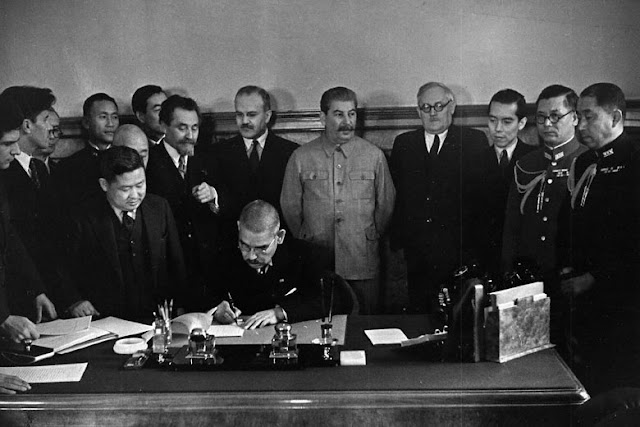
The Soviet Union and Japan signed a 5-year neutrality pact. In Moscow, Russia, German ambassador Friedrich Werner von der Schulenburg reported that Joseph Stalin was unexpectedly friendly to both Japanese and German diplomats on this date. By acknowledging existing borders the pact, negotiated by Molotov, give Russian recognition to Japanese Manchuria (now known as Manchukuo) for the first time. Under the pact, should either the Soviet Union or Japan become the object of military action, then the other party will observe neutrality. The impetus came from Russia, increasingly concerned by the deterioration of its relationship with Germany. In Tokyo the pact was welcomed as guaranteeing Japan’s “back door”. This means that Stalin can begin troop movements east and that Japan can look south.
The British armed merchant cruiser HMS Rajputana was torpedoed and sunk in the North Atlantic by German submarine U-108. German submarine U-108, commanded by Kapitänleutnant Klaus Scholtz, having tracked and unsuccessfully attacked the British armed merchant cruiser HMS Rajputana (F 35) for the past two days, sank her with a torpedo 100 miles west of Iceland at 0743 hours. Of the ship’s complement, 40-42 died and 283 survivors were picked up by the destroyer HMS Legion (F 74). The ship sinks in about an hour. There are 42 deaths, including the Commodore of Convoy HX 117 (which it recently had left), while about 280 men are saved by destroyer HMS Legion. All else aside, the loss is serious to the Royal Navy because it depends on these AMCs to free up its cruisers and capital ships for other, less mundane, tasks. The Rajputana thus joins her sister ship HMS Rawalpindi on the bottom.
The forty Manchester bombers on the strength of Nos. 207 and 97 Squadrons were grounded for engine modifications. During the work alterations were also made to allow the carriage of 4000-pound HC (high capacity) bombs; the first of which was dropped by a No. 207 Squadron aircraft on Berlin, Germany on the night of 8 to 9 May 1941.
RAF Bomber Command: Day of 13 April 1941
16 Blenheims to industrial targets in Holland and to Borkum. These targets were not reached but shipping was attacked. 1 aircraft lost.
RAF Bomber Command: Night of 13/14 April 1941
17 Hampdens minelaying off La Pallice and 11 Whitleys bombing at Merignac airfield. No losses.
The Luftwaffe attacks the port of Volos with 70 bombs, causing massive destruction to the harbor facilities. Among the damage is a hit on 7140-ton British freighter City of Karachi. There are no casualties. The City of Karachi is towed to a nearby bay and beached, where it makes a tempting target for further attacks. Another ship, 4968-ton Norwegian freighter Brattdal, also is damaged and disabled. There is one death on the Brattdal.
The port of Piraeus is back in action after the violent Luftwaffe attacks on the first days of the invasion. Convoys GA 12 and ASF 25 depart for Alexandria. However, the Luftwaffe is still focusing on Piraeus and the nearby seas — the German consulate overlooks the harbor and they know how important it is — and today they bomb and damage Greek destroyer Basileus Georgios I in the Saronikos Gulf. The destroyer makes it to Salamis.
The Luftwaffe also bombs and sinks Greek destroyer Psara in the Gulf of Athens.
The RAF bombs Tripoli Harbor, bombing and destroying medium-sized Italian tanker Santa Giulia. There is one death.
The Luftwaffe raids Tobruk Harbor and damages anti-submarine whaler Skudd IV just outside the port. The whaler makes it back into Tobruk in tow.
The Luftwaffe bombs Malta just after midnight on the 14th. The bulk of the destruction takes place at Mdina and nearby areas, but Luqa and some areas along the coast also are hit. It is a “lucky” raid for the British because many of the bombs narrowly miss causing much worse damage. For instance, bombs hit a large shelter protecting a hundred people, cut all escape unharmed.
U-108 sank armed merchant cruiser HMS Rajputana (16,444grt, Captain F. H. Taylor DSC) in 64-50N, 27-25W. At 0743 hours on 13 April 1941, HMS Rajputana (F 35) (Capt F.H. Taylor, DSC, RN) was hit by one torpedo from U-108 west of Reykjavik. She had been the ship of the convoy commodore Cdr C.T.O. Richardson, RNR in convoy HX.117 but was then dispatched to patrol the Strait of Denmark. The armed merchant cruiser had been first spotted by the U-boat at 0945 hrs on 11 April and was followed while she was patrolling on a zigzag course at high speed and sometimes making 180° turns. The chase was hampered by problems with the periscope, pack ice and snow. Two torpedoes were fired at 1808 hrs on 11 April missed as did two more fired at 2046 and 2048 hrs on 12 April. A fifth torpedo at 0740 hrs on 13 April missed, but the sixth at 0743 hrs hit the stern and caused a fire on the ship, which then opened fire on the periscope. An intended coup de grâce at 0823 hrs failed, but the next torpedo at 0930 hours struck in the after part and caused the ship to sink by the stern with a list to port. The commodore, four officers and 37 ratings were lost. 283 survivors were picked up by HMS Legion (F 74) (Cdr R.F. Jessel, RN) and landed at Reykjavik. T/Cdr C. T. O. Richardson RNR, T/Sub Lt (E) V. S. H. Andrews RNR, T/Sub Lt (E) W. Mitchell RNR, Lt (E) V. R. Bussereau RCNVR, T/A/Sub Lt (E) G. Gray RNVR, A/Lt B. G. Johnson RCNVR, and thirty six ratings were lost on the merchant cruiser.
U-124, commanded by Kapitänleutnant Georg-Wilhelm Schulz, sank British steamer Corinthic (4823grt) at 8-10N, 14-40W. At 2229 hours on 13 April 1941 the unescorted Corinthic (Master Townson Ridley) was hit underneath the bridge by one torpedo from U-124 and stopped southwest of Freetown. Because the vessel did not sink the U-boat fired a coup de grâce at 2244 hours, but this proved to be a dud and they had to fire another torpedo 10 minutes later that hit and sank the ship. Two crew members were lost. The master, 36 crew members and two gunners were picked up by the Dutch motor tanker Malvina and landed at Freetown. The 4,823-ton Corinthic was carrying grain and was bound for the United Kingdom.
Battleship HMS King George V, light cruiser HMS Nigeria, and destroyers HMS Mashona, HMS Electra, and HMS Escapade departed Scapa Flow at 0107 for position 46-30N, 18-10W. However, bad weather delayed the ships’ progress. The destroyers were detached to Londonderry to refuel at 1045/16th. They sailed at 1100/17th and rejoined at 0900/20th.
Light cruiser HMS Hermione arrived at Scapa Flow at 0919 to work up and join 15th Cruiser Squadron.
Light cruisers HMS Galatea and HMS Arethusa departed Scapa Flow for Siedisfjord. The cruisers then proceeded to Reykjavik, via Akureyri. After refueling at Reykjavik, the cruisers patrolled in the Denmark Strait.
Destroyers HMS Inglefield and HMS Eclipse departed Hvalfjord at 0300 to join convoy HX.118 for additional escort. The destroyers were detached in the Minches. Destroyer Eclipse arrived at 0615/17th and destroyer Inglefield at 0830/17th.
Destroyer HMS Eridge departed Scapa Flow at 0600 for Londonderry to join the Western Approaches, following working up. The destroyer arrived at Londonderry at 2000.
Submarine HMS Union departed Portsmouth for Gibraltar where she arrived on the 22nd.
British steamer Baron Belhaven (6591grt) was damaged by German bombing in 51-33N, 5-32W. Four crewmen were killed on the steamer. The steamer was towed to Milford Haven and later drydocked at Barry.
Aircraft carrier HMS Eagle passed through the Suez Canal to return to England.
Anti-aircraft cruiser HMS Phoebe and destroyer HMS Kandahar arrived at Alexandria for duty with the Mediterranean Fleet.
Destroyer HMS Isis and Australian destroyer HMAS Vampire departed Alexandria for Port Said. They arrived and departed that same day with troopships Glenearn and Glengyle for Alexandria. The force arrived safely at Alexandria on the 14th.
Greek destroyer RHS Vasilevs Georgios I (Captain Mezeviers, S. O. Greek destroyers) was badly damaged by German bombing near Piraeus in the Saronikos Gulf. The destroyer was docked at Salamis.
Greek destroyer RHS Psara was sunk by German bombing in the Gulf of Athens.
Anti-submarine whaler HMS Skudd IV was damaged by German dive bombing at Tobruk. Trawler Moy towed the trawler into harbor.
British steamer City of Karachi (7140grt) was badly damaged by German bombing at Volo, Greece. There were no casualties on the steamer. On the 14th, the steamer was towed, assisted by British steamer Destro (3553grt) and a Greek destroyer, and beached in a bay southwest of Volo. Bombed again on the 15th, steamer City of Karachi was a total loss.
Norwegian steamer Brattdal (4968grt) was badly damaged by German bombing at Volo Bay. One crewman was killed. The steamer sank on the 17th after repeated air attacks.
Battlecruiser HMS Repulse departed Gibraltar, escorted by destroyers HMS Highlander and HMS Fortune, for 41-00N, 16-30W.
Light cruiser HMS Fiji departed Gibraltar for Freetown.
Submarines HMS Undaunted, having departed Portsmouth on the 3rd, and HMS Torbay and HMS Taku from patrol in the Bay of Biscay arrived at Gibraltar.
Convoy OB.310 departed Liverpool, escorted by destroyers HMS Amazon, HMS Bulldog., and HMS Chesterfield, corvettes HMS Aubretia, HMS Hollyhock, HMS Nigella, and HMS Picotee, minesweepers HMS Gossamer, HMS Harrier, and HMS Salamander, and anti-submarine trawlers HMS Daneman and HMS St Apollo. The minesweepers and the trawlers were detached that day. On the 15th, Anti-submarine trawlers HMS Buttermere, HMS Wastwater, and HMS Windermere joined the convoy. The escort was detached on the 18th when the convoy dispersed.
Convoys GA.12 of three British ships and ASF.25 departed Piraeus in company escorted by anti-aircraft cruiser HMS Carlisle, destroyers HMS Hereward and HMS Defender, and sloop HMS Auckland. Sloop HMS Flamingo at Piraeus was retained by the Naval Attaché Athens for anti-aircraft duties at Salamis. Anti-aircraft cruiser Carlisle arrived at Alexandria to refuel on the 15th. Convoy GA12 arrived at Alexandria with destroyers Hereward and Defender on the 15th. Destroyer Hereward immediately departed with three ships to join convoy AN.27. Convoy ASF.25 arrived at Alexandria late on the 15th, escorted by destroyer Hereward and sloop Auckland.
Alarmed by the Soviet-Japanese Neutrality Pact, U.S. President Franklin Roosevelt ordered the U.S. Navy to scale back operations in the Atlantic Ocean to avoid war with Germany, as naval resources might need to be diverted to the Pacific Ocean to counter this new threat. It is clear to everyone that Japan would only desire this Pact if it were focusing its military ambitions to the south.
Alarmed by Germany’s success in Africa and the Balkans and apprehensive about the implications of of the new Russo-Japanese nonaggression pact, members of Congress ended a ten day Easter recess tonight with predictions that a new effort will be made to rush all pending national defense legislation through both houses. After a hurried roll-call tomorrow, when, despite the general apprehension about the war, the main event in the capital will still be the opening baseball game between the Washington Senators and the New York Yankees, both houses will get down to work Tuesday with special investigations of the national defense effort. On Thursday President Roosevelt’s request for authorization to purchase foreign ships immobilized in American ports will be studied in committee. Administration leaders expect this to be hurried to the floor of the House and probably passed early next week. There is a possibility that it will get to the floor of the House on Friday.
Public reaction of State Department officials to announcement of the Russo-Japanese neutrality pact indicated today it was no surprise although they withheld comment. Chairman Bloom, New York Democrat, of the House Foreign Affairs Committee declared the treaty had no “real significance.” “It is just another of those papers,” Bloom said. “It really doesn’t mean anything because they have not kept faith in the past with what they have signed.”
Secretary Harold L. Ickes declared tonight that “Hitler’s unconscious tools” in this country “serve him to better purpose than those in his actual pay.” In an address at a Passover celebration of the Jewish National Workers Alliance of America, Ickes mentioned several public figures by name and declared: “Isn’t it about time that some of these fellows should wake up to the fact that they are playing Hitler’s game; that they are either Hitler’s conscious tools or dupes; that they are lending aid and comfort to the enemies of democracy to those who would enslave them and theirs?” The “Nazi fellow travelers,” he said, “pretend as they may wish to see Hitler successful and victorious” because “they fear that a defeat of Nazism would mean a resurgence of true democracy throughout Europe and the world.” He declared that Colonel Charles Lindbergh was “the No. 1 U.S. Nazi fellow traveler” and that “every act of his and every word proves that he wants Germany to win.” “It would seem that he prefers fascism to democracy; that he is indifferent to liberty, agrees with Hitler that Christian civilization is decaying, and condones, if he does not actually applaud, the brutalities of which the Nazi Ideology has already been guilty.” The “Nazi fellow travelers,” he said, “have their own organizations, probably the most important of which is the America First committee. Among the active supporters of the America First committee are such men as Hugh S. Johnson, Hanford MacNider, Henry Ford, Ernest Weir, and General Robert E. Wood. I suppose it would be difficult to find a collection of worse reactionaries than these.”
Asserting that “99 per cent of the people are still right-thinking, law-abiding, patriotic and decent Americans,” the American Federation of Labor said today that “there can be no question that the recent disorderly minority strike of the U.A.W.-C.I.O. against the Ford Motor Company is regarded as a nauseating communistic spectacle by an overwhelming majority of the American people as a whole.”
President Roosevelt, attending Easter services at St. Thomas’ Church, bowed his head as the Rev. Dr. Howard S. Wilkinson prayed that the “forces of tyranny and aggression” be overcome and that the United States be led to do “whatever is right” to see that “peace with righteousness and justice may be established for the sake of all mankind.”
Dr. Annie Jump Cannon of Harvard, most famous woman astronomer in the world, died tonight at a hospital after a month’s. illness. She was 77 years old. Miss Cannon, who was retired officially from Harvard last September, had been working at the Harvard observatory on a special astronomical commission from Yale up to a few weeks ago.
U.S. Navy heavy cruiser USS Astoria entered Mare Island Naval Shipyard, California, United States for a refit.
In the final pre-season tune-up game with Brooklyn, the Yankees win their 3rd in a row at Ebbets Field, 3–0, on Sunday afternoon. The Dodgers had come into the series with an 11-game winning streak, including 4 with the Yanks on the way North.
At Fenway, the Bees take the 2nd game in a 2-game set against the Red Sox, winning, 10–3. Babe Dahlgren and Max West homer.
Japan and the Soviet Union signed a five-year non-aggression pact. Under the Soviet-Japanese Neutrality Pact each country agreed to remain neutral if the other became engaged in hostilities. Additionally the two countries signed a Declaration in which the Soviet Union recognized Tokyo’s suzerainty over Manchukuo while Japan pledged to respect the Soviet-dominated Outer Mongolian People’s Republic. The Pact recognizes existing borders, and from the Japanese standpoint is desirable because the Soviets finally recognize Japanese control of Manchukuo (Manchuria). It is not an agreement like the Tripartite Act, in which one party agrees to come to the aid of the other when acted, just a promise not to join an attack on the other country. In some ways, the course of World War II will turn on which side observes this treaty, and which does not. In grand strategic terms, the Pact will free each party to cast their military eyes elsewhere. The Pact is almost entirely the doing of Japanese Foreign Minister Matsuoka, who negotiated it at the end of his visit to Europe.
Japan’s agreement with Soviet Russia in a neutrality pact and in an accord respecting the position of each in Manchukuo and Outer Mongolia was announced to the Japanese people this morning in an official statement by Premier Prince Fumimaro Konoe. The Premier, who had previously reported the pact to the throne, announced enthusiastically that its object was to promote peace, in this statement:
“The Japanese Government some time ago made public, both at home and abroad, their unalterable determination, by concluding the tripartite pact among Japan, Germany and Italy. to prevent the world-wide spread of war and to insure the peace of Greater East Asia with the pact as the axis of its foreign policy. It goes without saying that in order to realize such a purpose, it is essential that Japan and the Soviet Union, which are neighbors in the Far East, must place their friendly relations on a lasting basis, reinforcing thereby the spirit of the Triple Alliance pact. With this conviction the government have, for some time, been conducting negotiations with the Soviet Government with a view to bringing about a fundamental adjustment of Japan’s relations with the Soviet Union.”
Born:
Michael Stuart Brown, American geneticist (Nobel Prize in Physiology or Medicine, with Joseph L. Goldstein, 1985, for describing the regulation of cholesterol metabolism), in Brooklyn, New York, New York.
Harvey Pratt, Native American forensic artist and the designer of the National Native American Veterans Memorial in Washington, in El Reno, Oklahoma (d. 2025).
John Stephenson, MLB catcher and pinch hitter (New York Mets, Chicago Cubs, San Francisco Giants, California Angels), in South Portsmouth, Kentucky.
Jim Barnes, NBA power forward and center (New York Knicks, Baltimore Bullets, Los Angeles Lakers, Chicago Bulls, Boston Celtics), in Tuckerman, Arkansas (d. 2002).
Died:
Annie Jump Cannon, 77, American astronomer (Henry Draper Catalogue).
 History Diaries