Belgrade falls
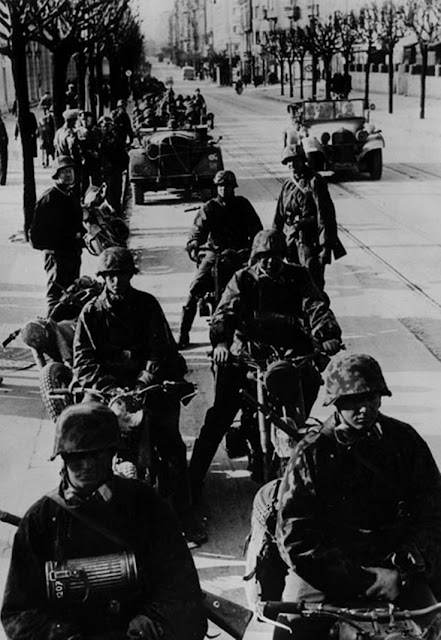
The Germans captured Belgrade. In the early evening SS-Obersturmfuhrer Fritz Klingenberg, commanding the 2nd SS Division Das Reich, finding all bridges over the Danube in Belgrade destroyed, took an SS patrol across the river in captured pneumatic rafts. The patrol entered the Belgrade unmolested, and at 5 p.m. hoisted a Swastika flag atop the German legation. About two hours later the mayor of Belgrade officially handed over the city to Klingenberg who was accompanied by a representative of the German Foreign Ministry, previously interned by the Yugoslavs. As German troops captured Belgrade in the Serbia region of Yugoslavia, Hungarian troops also crossed the border into Yugoslavia, joining the invasion. On the Danube River in Yugoslavia, German Ju 87 Stuka dive bombers, sinking river monitor Drava (54 were killed, 13 survived) while forcing three others, Morava, Sava, and Vardar, to be scuttled.
Belgrade will become the seat of the puppet Nedić regime, headed by General Milan Nedić. Due to its quick surrender, Belgrade is spared the savagery of artillery bombardment that accounts for the preponderance of devastation of European cities on the Continent throughout the war even in the presence of terror bombing.
Hungarian troops (3rd Army) join the invasion of Yugoslavia.
Yugoslavian Headquarters announced: “In the northern sector, the superior enemy forces have crossed through Drvar (Yugoslavia) and reached the Save river; they have also occupied Kragujevac. German troops have marched into Zagreb unopposed by our troops.”
The Yugoslav monitors Morava, Sava and Vardar were scuttled to prevent capture.
The Battle of Vevi ended in German victory. While the occupation of Belgrade, of course, is a matter of great significance, its fall has been a foregone conclusion. The real issue of decision is playing out far to the south. German SS troops overran British and Australian troops south of Vevi, forcing the Allies to fall back from the Aliakmon Line to the Mount Olympus Line to block the German troops at Vevi from advancing further. The British and Imperial forces, deployed along the rugged terrain from the Gulf of Salonika to Edhessa in the Vermion mountains, have been pulled back to Mount Olympus, the next defensible line, some hundred kilometers to the south. The Allied C-in-C, General Sir Henry Maitland Wilson, decided he had no other choice when he learnt that the Germans were pouring into Greece through the Monastir Gap and Yugoslav resistance was crumbling.
The 53,000 strong British and Imperial forces have had little or no time to prepare their defenses, and their strength is insufficient to organize a defense in depth. If the Germans are not stopped at Monastir they will soon be turning the British left flank.
At Vevi the Germans thrust back the Rangers but the Royal Horse Artillery and Australian anti-tank gunners held back German infantry and tanks. By dusk German tanks were among the forward posts of the 2/8th and it was out of touch with Brigade Headquarters. It withdrew but the men reached the vehicles further south and on the west the 2/4th withdrew except for a company which walked into the German lines and was captured. After two successful rearguard actions by the armoured brigade the force was extricated and the infantry reached the Olympus-Aliakmon Line.
Sepp Dietrich’s 1st SS Panzer Division Leibstandarte SS Adolf Hitler (LSSAH), still of brigade-size at this time, begins the day being held up in the Klidi Pass. This is the key route for the Wehrmacht LX Corps (Lieutenant-General George Stumme) heading south from Yugoslavia into the Greek interior. This battle effectively decides the campaign in Greece, though much fighting remains to be done.
Snow fell during the night. At 09:00, the Germans, after being frustrated on the 11th by the British, Australian and Greek troops (“Mackay Force”) that had hurriedly been redirected to the Pass from the Aliakmon Line to the east, resumes its attack. The LSSAH first takes a hill off their left flank, Hill 997, taking it by 11:00 and wiping out all but 6 of the Australian defenders. These Germans, the 1st Company of LSSAH, then take another hill nearby. The Australians troops begin to withdraw around mid-day, though the Greek troops nearby stay put — though sources are mixed on exactly who did what.
The Germans then bring up assault guns and Panzerjäger vehicles and continue their assault from the two hills they have taken. By 14:00, the Greek troops also are ordered to retreat by General Iven Mackay, and Obersturmbannfuhrer “Panzer” Meyer leads his assault guns forward into hills that had been thought inaccessible. By 16:00, the Germans take Klidi at the southern end of the pass, then spread out quickly to take nearby towns Kelli and Petra. By 20:00, the German armor (six StuG and nine PzJg I) are through the pass and harassing a retreating Greek column, forcing the British to riposte with about 25 tanks of their own. By 22:30, after a very hard day of fighting, the Germans have secured the entire pass, inflicting severe casualties on the defending Australians.
Allied histories cast a favorable light on the battle of Klidi Pass. The defense “bought time for the retreat” of Allied forces on the Aliakmon Line. However, when the battle began, there was no thought of retreating anywhere, and the battle only held the Germans up for two days. Many Greek troops are given the order to retreat too late, and they wind up essentially surrounded by the advancing Germans. The Allied withdrawal is pell-mell, with units intermixed, leading to confusion that remains throughout the campaign. The Allies attempt to form a new defensive line to the south at Kleisoura and begin pulling back their troops in northern Greece toward Mount Olympus.
General Iven Mackay renames his troops from 1 Australian Corps to Anzac Corps to honor the New Zealanders taking part.
The powerful Greek Western Macedonia Army formations in Albania to the west are seeing their lines of communication cut by the German LX Corps advance, but are reluctant to retreat. General Stumme’s forces also attempt to broaden their gains to the west. With this German breakthrough, their position is even less secure. However, it is a matter of Greek pride to give no ground to the Italians, so today they only grudgingly begin heading south, blowing up the roads as they leave to slow the Italian advance. The Italians, meanwhile, watch them go without pursuing them today.
The British reinforcement of mainland Greece, Operation Lustre, continues despite the reversals to the north. The Australian 17th Infantry Brigade arrives today at Athens.
The Luftwaffe attacks Piraeus again, bombing and sinking 8271-ton British tanker Marie Maersk. The Italians later re-float and repair her, putting her in use as the Luisa. This sinking continues the devastation wrought on the Danish Mærsk shipping line, which began the wars with a total of 46 ships but dwindles to 7 by war’s end, with an additional 14 under control of the US shipping board until 1946. Denmark, of course, is a non-combatant that is occupied by Germany.
The Luftwaffe carry out a heavy raid on Kozani behind the position of the Amynteion Detachment. There was virtually no opposition to the raiding aircraft and the town was severely damaged.
For his successes in Yugoslavia and Greece, Lieutenant General Alexander Löhr, commander of Luftwaffe IV in Austria, receives a highly coveted mention in the evening’s Wehrmachtbericht radio despatches. The Yugoslavs consider the bombing of Belgrade to be a war crime, and they have long memories.
British anti-aircraft cruiser HMS Coventry, destroyer HMS Decoy, destroyer HMS Encounter, and troopship Glenroy evacuated a battalion of troops, 1,000 tons of supplies, and 40 vehicles from the Greek island of Lesbos in the Aegean Sea near Salonika.
The Greek Albanian forces in the Northern sector begin their withdrawal from Albania today, 6 days after the initial German thrust into north-eastern Greece. The Italians, in fact, do not respond to the Greek withdrawal by advancing themselves until the following day.
In North Africa, the Germans captured Fort Capuzzo and Bardia. At Tobruk, the German probing attacks with tanks and armored cars were repulsed. Meanwhile, columns of Axis troops were dispatched to move toward the Libyan-Egyptian border to cut off the Allied forces in Libya.
The Germans take Bardia in the morning without a fight. Afrika Korps Detachment Graf Schwerin closes the German landward envelopment of Tobruk. Lieutenant General Erwin Rommel somewhat hopefully orders the occupation of Tobruk as well. A force composed of the 5th Light Division, 5th Panzer Regiment and Trento Division attacks the Tobruk perimeter but is stopped at an anti-tank ditch constructed by the Italians and has to retreat. This becomes known as the beginning of the First Siege of Tobruk (which ignores the fact that Tobruk already has been put under siege by the British in January, but that’s history for you).
The Germans wish to move quickly against Tobruk, and they have an excellent source of intelligence about the fortress: the Italians who built it. However, the Italians are very slow to provide detailed information, forcing the Germans to rely on 1:400,000 maps which provide no worthwhile details. General Rommel moves his command post to about 4 km west of the Via Balbia that runs parallel to Tobruk. At this time, his intelligence sources are unclear about the amount of opposition that he faces in Tobruk. While he thinks that there are few troops holding the fortress, in fact, the British have accumulated about 30,000 men there. The Luftwaffe attacks Tobruk and loses three Junkers Ju 87 Stukas.
While the British are determined to hold Tobruk, considered virtually impregnable (but the Italians thought so in January), they fortify Halfaya Pass and the coastal strip nearby to prevent an Afrika Korps eruption into Egypt. There are some minor skirmishes in that area, with the RAF bombing and strafing German columns and the Germans claiming to knock out some British tanks.
A flotilla of four destroyers now based on Malta leaves port to intercept a southbound convoy from Naples to Tripoli. However, the destroyers find no sign of the convoy. The RAF also sends patrols out from St. Angelo on Malta to find the convoy, and they do — but they score no hits while losing a plane and four men from No. 803 Squadron. The four airmen wind up interned by the French.
Daily Keynote from the Reich Press Chief: “The Minister has ordered that the music of the grand Prince Eugen Fanfare and the German national anthem should no longer be played every time a special announcement is made, because then we would have no way left to intensify [the people’s mood]. He has reminded us that our broadcast for the ceasefire with France moved the people most profoundly, precisely because [the music played] was unique. Thus the grand Prince Eugen Fanfare and the German national anthem must be played only two or three times throughout the whole Balkan campaign.”
Adolf Hitler arrives at his forward headquarters of Mönichkirchen on his train “Amerika.” He is just in time to be portrayed in the media as leading his troops to victory at Belgrade. He would remain in his village to oversee the operations in the Balkan Peninsula.
Vichy-France’s head of government Admiral François Darlan consults with Adolf Hitler.
Alexander Löhr was mentioned in the Wehrmachtbericht daily radio report.
The Allies conducted a Commando raid on the fish oil factories in Hammerfest, Norway. Norwegian-manned HNoMS Mansfield completes its destruction of the Øksfjord fish oil factory near Alta Fjord. Commandos landed at the factory completely the demolition caused by the destroyer’s guns. However, they fail to locate the local Quisling leader for capture.
Soviet Premier Joseph Stalin has been receiving a wave of warnings from numerous sources about a possible German invasion to commence as soon as 15 May. While he dismisses the warnings, he hedges his bets by issuing a secret directive to construct fixed defenses on the western frontiers. Some 150,000 construction workers have been drafted in, but work is held up by shortages of such materials as timber and cement.
Soviet Russia, asked by Hungary to endorse the Hungarian invasion of Yugoslavia, has replied with her disapproval and a reminder that Hungary, too, might one day be “torn to bits,” Tass, official Soviet news agency, disclosed tonight. “It is not difficult to realize what would be the position of Hungary should she herself get into trouble and be torn to bits, since it is known that there are national minorities in Hungary, too,” was the word sent back to Budapest, Tass said.
Demonstrating once again his political savvy, Prime Minister Winston Churchill confers honorary LL.D degrees from Bristol University (where he is chancellor) on several high-profile visitors. These include visiting Australian Prime Minister Robert Menzies, US Ambassador John Gilbert Winant, and Dr. J.B. Conant. The ceremony in Bristol is marred somewhat due to the fact that the Luftwaffe conducted a major raid on it last night.
US Army Air Corp General Henry “Hap” Arnold arrives in London for talks with the British leadership about cooperation with the RAF.
With Operations Order 17, the RAF expands its anti-shipping priority to include the area from Norway to Bordeaux. During the day, 20 RAF planes attack Dusseldorf and Gelsenkirchen and also conducts Rhubarb operations over France. After dark, RAF Bomber Command attacks Brest with 66 aircraft and Bordeaux’s airfield with 24 aircraft.
Visiting Australian Prime Minister Robert Menzies, in Bristol to receive an honorary degree, comments on the devastation of last night’s Luftwaffe raid:
“Bristol is a sad sight — churches blazing and streets of houses in ruins but St. Mary Radcliffe, the “fairest church in Christendom” of Elizabeth, stands untouched among the ruins. So I must say, seemed also the spirit of the university, where many a gown was worn over working uniform, and many learned participants had been up fire-fighting all night.”
RAF Bomber Command: Day of 12 April 1941
20 Blenheims to Thisseldorf, Gelsenkirchen and inland targets in Holland. 1 aircraft lost.
RAF Bomber Command: Night of 12/13 April 1941
Brest
66 aircraft — 35 Wellingtons, 13 Whitleys, 12 Hampdens, 6 Manchesters. Only 37 aircraft bombed at Brest, in poor cloud conditions; most other aircraft bombed Lorient as an alternative. No losses.
Bordeaux
24 aircraft attacked Merignac airfield; 1 Wellington lost.
6 Hampdens minelaying off Brest. No losses.
In Malta, air attacks continue. Just before midnight, nine Luftwaffe planes strafe the airbase at Kalafrana and drop bombs on the St. Paul’s Bay area. Another raid causes damage to the Ta Qali airfield area.
U-124, commanded by Kapitänleutnant Georg-Wilhelm Schulz, sank British steamer St Helena (4313grt) in 7-50N, 14W. At 0509 hours on 12 April 1941 the unescorted St. Helena (Master Percy John Reavley) was hit under the bridge by one torpedo from U-124 and sank capsizing to port about 100 miles southwest of Freetown. The U-boat surfaced and questioned the survivors before leaving the area. The master, 35 crew members, two gunners and three passengers were picked up by HMS Wishart (D 67) (Cdr E.T. Cooper) and landed at Freetown. The 4,313-ton St. Helena was carrying grain and general cargo, including canned meat, cotton, rice, and wet hides and was bound for Hull, England.
Submarine HMS Unbeaten departed Portsmouth for Gibraltar arriving on the 21st.
Naval drifter HMS Rypa (31grt), with a Norwegian crew, was lost in Loch Ewe in heavy weather.
Belgian steamer Arbel (901grt) was sunk by German bombing in 50-06N, 5-46W. Three crew were lost.
Swedish steamer Kexholm (3815grt) was sunk by German bombing in 59-50N, 8-22W. The entire crew was rescued.
British grain elevator Chicago was sunk by German bombing at Millwall Dock, London.
British steamer Dartford (4093grt) was damaged by German bombing one and a half miles south of Mumbles Light. The steamer was towed to port.
Greek steamer Nicolaos D. L. (5486grt) was sunk by German raider Kormoran at 1-54S, 22-12W. The entire crew was taken as prisoners of war.
Italian submarine Tazzoli attacked a Destroyer without success in 45N, 19W.
Anti-aircraft cruiser HMS Phoebe arrived at Suez for duty in the Mediterranean Fleet after WS.6A convoy escort. The light cruiser moved through the Canal in the dark. Destroyer HMS Kimberley also arrived at Suez on the 12th to join the Mediterranean Fleet.
Anti-aircraft cruiser HMS Coventry, destroyers HMS Decoy and HMS Encounter, and troopship Glenroy evacuated Mudros. The entire battalion of troops, over 1000 tons of stores, and forty army vehicles were embarked in twelve hours. The ships departed Mudros at 0645/13th and arrived at Alexandria on the 15th.
In Operation MBD3, destroyers HMAS Stuart, HMS Griffin, HMS Juno, and HMS Jaguar were sweeping off Cyrenaica from Ras Tayones to Ras et Tin covered by light cruisers HMS Orion, HMS Ajax, and HMAS Perth and destroyer HMS Hasty during the night of 12/13 April. This operation was repeated the next night. Destroyers Juno and Jaguar swept from Ras Tayones to Ras Tolmeita. Destroyers Stuart and Griffin swept from Ras Tolmeita to Ras el Hillal. Destroyers HMAS Vendetta and HMAS Waterhen swept from Ras el Hillal to Ras el Tin. The sweep was covered by the same covering force as the night before. The sweep started at midnight. There were no contacts.
After the sweep, destroyers HMAS Vendetta and HMAS Waterhen returned to the Inshore Squadron. Light cruiser HMAS Perth and destroyers HMS Juno, HMS Jaguar, HMAS Stuart, HMS Griffin, and HMS Hasty returned to Alexandria. En route, destroyers Griffin and Stuart were diverted to Sollum to arrive at daylight on the 14th. Light cruisers HMS Orion and HMS Ajax remained to the west of Crete to cover convoy movements.
Submarine HMS Ursula unsuccessfully attacked shipping south of Cape Bon.
Destroyers HMS Jervis, HMS Janus, HMS Mohawk, and HMS Nubian departed Malta to intercept southbound convoy of steamers Ankara, Marburg, Kibfels, Reichenfels, and Galilea, escorted by destroyers Vivaldi, Da Noli, Malocollo, and Dardo. Torpedo boats Circe and Montanari joined from Tripoli. In air attack on this convoy during the night of12/13 April, A/Sub Lt (A) A. P. Dawson with Leading Airman A. Todd and Petty Officer Airman C. H. Wines with Leading Airman L. M. Edwards of 830 Squadron from HMS St Angelo (Fort St. Angelo, Malta), were shot down and interned by the French. The destroyers made no contact and returned to Malta.
Battlecruiser HMS Repulse arrived at Gibraltar, escorted by destroyers HMS Highlander and HMS Fortune. Destroyers HMS Fury and HMS Velox were detached off Gibraltar to join arriving battleship HMS Queen Elizabeth. Destroyer HMS Boreas departed Gibraltar on the 12th to join the other two destroyers to escort the battleship.
Light cruiser HMS Fiji arrived at Gibraltar.
Ocean boarding vessel HMS Camito departed Gibraltar for Western Patrol.
Submarine HMS Olympus arrived at Malta to reinforce the Mediterranean submarines. However, she was in such poor condition, she was to be sailed back to Gibraltar as soon as repairs could be arranged.
British tanker Marie Maersk (8271grt) was sunk by German bombing at Piraeus. The steamer was later refloated and repaired at Trieste. She was renamed Luisa for Italian use.
Armed merchant cruiser HMS Dunnottar Castle captured French steamer Banfora, which had departed Dakar on the 10th, near Port Etienne. The steamer arrived at Freetown on the 17th.
Convoy OB.309 departed Liverpool, escorted by destroyers HMS Chelsea, HMS Verity, HMS Veteran, and HMS Wolverine, armed boarding vessel HMS Maron, seaplane carrier HMS Pegasus, sloop HMS Deptford, and corvettes HMS Begonia, HMS Convolvulus, and HMS Larkspur. Destroyers Chelsea and Verity were detached on the 15th and sloop Deptford on the 16th. On the 15th, destroyer HMS Rockingham and corvettes HMS Campanula and HMS Pimpernel joined the escort. Destroyers Veteran and Wolverine were detached on the 18th. The remainder of the escort was detached on the 19th when the convoy dispersed.
The United States has decided to establish air and naval bases in Greenland, under an agreement concluded here yesterday between Henrik Kauffman, the Danish minister, and the US secretary of state, Cordell Hull. Kauffman has been disowned by Danish leaders in Nazi-occupied Copenhagen, but he said he was acting in the name of the Danish king. In terms of war, if not law, it will ease the ferrying of aircraft to Britain and enable the US Navy to patrol further eastwards to protect Allied convoys. The code name for Greenland was BLUIE. Bases on the west coast of Greenland were coded “Bluie West numeric,” e.g., Bluie West 1, or BW-1, was Narsarssuak while BW-8 was Sondre Stromfjord. BW-1 was located about half way between Goose Bay, Labrador and Reykjavik, Iceland making it an ideal emergency field. BW-8 was planned as a backup but the flying weather proved to be better through BW-8 and across the Greenland ice cap. The Army Airways Communication System (AACS) had stations in operation at both of these bases on 7 December 1941. The USAAF could not find a suitable site on the east coast and never built a landing field there.
Senator Burton K. Wheeler, Montana Democrat, today called President Roosevelt’s action in opening the Red Sea and the Gulf of Aden to American shipping “an asinine policy” that might force the United States to fight single-handedly “in all parts of the world.” “The warmongers in France have destroyed the French republic and the warmongers in England have all but destroyed the British Empire,” he said in a statement. “The same type of warmongers will destroy the United States if we keep on letting our sentiments, rather than our judgment, control our policies.”
Extension of American lend-lease aid to Ireland to promote its closed cooperation with Britain was reported in official circles today as possibly the next step in United States moves to strengthen Britain’s hand in the battle of the North Atlantic. Informed officials said such a plan is under consideration in connection with current efforts of Eire to purchase foodstuffs and arms in this country. The strategy would be to meet Irish requirements on a promise that Eire would give Britain certain long-sought base sites. The Irish thus far have resisted all such proposals.
The U.S. Navy’s experiment in converting a standard cargo vessel into an aircraft carrier was viewed by unofficial observers here today as a possible future boon to Britain’s raid-menaced shipping. If the new carrier proved successful, it was suggested. Great Britain might receive a number of these craft to carry fighter planes which could combat German bombers preying on North Atlantic shipping. Pursuit planes operating from such a carrier also might locate German submarines and attack them with depth charges. The Navy recently disclosed that the 7,886-ton Mormacmail was being converted at Newport News, Virginia, into an experimental carrier, but officials of the department declined to discuss possible expansion of the conversion program. In other quarters, however. there were reports that from 16 to 30 such carriers might be developed.
Southern soft coal producers asked the United Mine Workers (C.I.O.) to negotiate separately with them for a new wage agreement, saying they were through with the eight-state Appalachian conference of operators for “all eternity.” This development added new complications to a situation which began April 1 when the U.M.W. contract with the Appalachian conference expired without a new one being agreed upon and production of fuel essential to defense industry came to a halt in some of the nation’s biggest fields.
The National Defense Mediation Board won an agreement today to end the seventy-six-day-old strike of 650 men at the Standard Tool Company in Cleveland, Ohio. It was the eighth strike settled by the board.
More than 6,000 employees of the New York Shipbuilding Corporation, which has a $546,819,402 backlog of defense orders, laid down their tools for an hour this afternoon in a “wildcat” work stoppage for which union officials disclaimed responsibility.
While the Ford Motor Company was calling back 20,000 employes for duty on Monday in order to resume operations in its River Rouge plant, union machinery continued to move toward a showdown between the General Motors Corporation and spokesmen for 165,000 employes.
Taking office as Federal Price Administrator, Leon Henderson gave notice today that he would resist with economic sanctions any efforts to raise the price of basic commodities and said specifically that he did not think a steel price increase would be warranted if the C.I.O. won its demand for a wage increase of 10 cents an hour for steel workers.
Various methods of conserving aluminum for defense needs were suggested today in a preliminary report from an advisory group of the National Academy of Sciences to the Office of Production Management, which said that this and subsequent reports of the group would be considered by its Unit of Conservation in formulating policies.
Expansion of the WPA airport construction program to include 350 new projects at a cost of $150,000,000 was announced today by Howard O. Hunter, Acting Works Projects Commissioner.
The CBS radio show “The Life of Riley” commences its run. This series stars Lionel Stander as J. Riley Farnsworth. It has no relation to the more famous “The Life of Riley” radio show that begins on 16 January 1944 starring William Bendix.
The Boston Bruins beat the Detroit Red Wings 3–1 to win the Stanley Cup in a four-game sweep.
The 8th airfield in the Panama Canal Zone was declared operational.
Domei, Japanese news agency, declared today that a party of British naval officers from Singapore was on the way to Hanoi, French Indo-China, to confer with French colonial authorities. The impending conference was attracting sharp attention from Japanese officials in Hanoi, Domei declared. The agency said Japanese in Hanoi believed the British mission. was to investigate Japanese military activities in Indo-China and to hinder progress of Japanese-Indo-China economic conferences in Tokyo by “offering favorable trade to Indo-China from British colonies as a lure,”
Higher taxes, part payment of official salaries in promissory notes instead of cash to prevent inflation and greater economy in the consumption of rice and charcoal were forecast by Cabinet Ministers in Japan.
Dow Jones Industrial Average: 118.6 (-1.06)
Born:
Julio Euson, Aruban-Dutch singer (“I Use The Soap”), in Aruba.
Naval Construction:
The U.S. Navy 77′ Elco patrol motor torpedo boat USS PT-37 is laid down by the Electric Launch Company Ltd. (Elco), (Bayonne, New Jersey, U.S.A.).
The U.S. Navy Accentor-class coastal minesweeper USS Advance (AMc-63) is laid down as USS Aggressor by the Greenport Basin and Construction Co. (Greenport, Long Island, New York, U.S.A.).
The merchant ship SS Rio de Janeiro is launched by the Sun Shipbuilding and Drydock Company (Chester, Pennsylvania, U.S.A.). She will be acquired by the Royal Navy after completion in 1942 and, after conversion, be commissioned as the Avenger-class escort aircraft carrier HMS Dasher (D 37).
The Royal Navy Dale-class fleet tanker RFA Derwentdale (X 14; postwar A114) is launched by Harland & Wolff (Belfast, Northern Ireland, U.K.).
The U.S. Navy submarine tender USS Euryale (AS-22) is launched by the Federal Shipbuilding & Drydock Co. (Kearny, New Jersey, U.S.A.).
The Royal Navy “P”-class (Second group) minesweeping trawler HMS Product (T 188) is launched by Uniao Fabril (Lisbon, Portugal).
The Royal Navy MMS I-class motor minesweeper HMS MMS 35 (J 535) is launched by Wilson Noble (Fraserburgh, Scotland, U.K.).
The Royal Navy MMS I-class motor minesweeper HMS MMS 36 (J 536) is launched by the Wivenhoe Shipyard Ltd. (Wivenhoe, England, U.K.).
The Royal Navy MMS I-class motor minesweeper HMS MMS 50 (J 550) is launched by Clapson & Sons Ltd. (Barton, England, U.K.).
The Вое́нно-морско́й флот СССР (ВМФ) (Soviet Navy) “M” (Malyutka)-class (3rd group, Type XII) submarine M-118 is launched by Marti Yard (Nikolayev, U.S.S.R.) / Yard 198.
The Kriegsmarine (German Navy) Type VIIC U-boat U-574 is launched by Blohm & Voss, Hamburg (werk 550).
The Вое́нно-морско́й флот СССР (ВМФ) (Soviet Navy) Project 7U-class (Storozhevoy-class) destroyer Serdity (Сердитый, lit. ’Enraged’) is commissioned.
The Вое́нно-морско́й флот СССР (ВМФ) (Soviet Navy) Project 7U-class (Storozhevoy-class) destroyer Silny (Сильный, lit. ’Strong’) is commissioned.
 History Diaries