In northern Greece, German troops captured Vevi. In the evening, British, Australian, and New Zealand troops engaged German troops in Greece for the first time just south of Vevi, stopping the advance of Leibstandarte SS Adolf Hitler Regiment at Klidi Pass. The Germans attack near Vevi and Kelli in front of Amynteion, with tanks supported by infantry. It is beaten off with considerable enemy casualties.
On 11 April 1941, Hungary sends its forces, the 3rd Army, across the Yugoslav border in the morning. Admiral Horthy did not invade during the initial German crossings because he claimed to feel bound by the fact that Yugoslavia also had signed the Tripartite Pact. However, once Croatian separations proclaimed a new state in Zagreb, he decided that Yugoslavian no longer existed, and thus the Pact no longer applied.
Italy and Hungary joined the German invasion of Yugoslavia. Italian forces redoubled their efforts to link up with units in Albania. General Ambrosio and the Italian 2nd Army advances from Trieste toward Ljubljana. Other Italian units advance south down the Dalmatian coast.
Subotica and Novi Sad, west of the Banat region in Yugoslavia, are occupied by Hungarian forces. Soon afterward, in Subotica, the Germans execute 250 members of a Jewish youth movement who had carried out the first acts of sabotage against German occupation forces. In Novi Sad, Hungarian troops and local Germans murder 250 Jews and 250 Serbs at random.
Italy also is advancing south. General Ambrosio’s 2nd Italian Army makes progress from Trieste, both south along the coast and toward Ljubljana. One of Ambrosio’s intentions is to link up with the Italian forces in Albania, but for some reason, the Yugoslav Army has committed some of its best formations in that theater, and the going is slow.
Sepp Dietrich’s 1st SS Panzer Division Leibstandarte SS Adolf Hitler (LSSAH) brigade is at the spearpoint of the German drive south from Vevi through the Klidi/Kleisoura Pass area (also known as the Kirli Derven). The defense is centered around the town of Kelli and the pass itself, and the German objective is the town of Kliki at the southern entrance to the pass.
“Panzer” Meyer’s reconnaissance battalion ran into a mixed Greek /British /Australian /New Zealand force (“Mackay Force,” named after Australian General Iven Mackay) on this drive south on the 10th, stopping it cold. The Germans regroup, and in the afternoon try to force their way down the main road. The hugely confident Germans drive their troops forward in lorries within sight of the defenders, which irks some on the Allied side. The Allied forces under Captain Gordon Laybourne Smith of the 2/3rd Field Regiment respond with accurate artillery fire, destroying five German trucks, which quickly forces the Germans to pull back.
The Germans again regroup and launch an attack in the evening. It then begins to snow. The Australians and New Zealanders have difficulties with their weapons and are exhausted from their quick march from their bivouacs on the Aliakmon Line, but they hold the line for the time being.
The German 30 Corps and Corps and XVIII Mountain Corps, and opposing British and Greek troops, continue to eye each other across the Aliakmon River just west of Thessaloniki. However, the Germans do not attempt to cross the river. Their basic strategy is to wait until the LSSAH and the rest of XL Corps advances to the west of the British line, then smash it between the two German formations. The British, meanwhile, are looking anxiously over their shoulders toward the advance of the LSSAH and related formations. They are shifting troops northwest to try and prevent this breakout.
It is announced that the Germans have captured Monastir and its Pass.
British Middle East Commander General Archibald Wavell meets with General Henry Maitland Wilson in Athens to discuss the situation. Among other things, they discuss a possible evacuation.
The Greeks also are recognizing the likelihood of defeat. King George II requests permission to establish his government in Cyprus — but is told to stay in Athens.
Visiting Australian Prime Minister Robert Menzies summarizes the air-war outlook presented at the day’s War Cabinet meeting:
“More bombing of aircraft factories in England. The Hun is becoming too accurate, and picking our factories off too regularly.”
First Sea Lord John Tovey comments that the Luftwaffe has command over the skies in the Straits of Sicily, affording protection to the Italian convoys that supply the Afrika Korps.
The Luftwaffe bombs and sinks 2561 ton Greek hospital ship Attiki in Doro Channel (between Euboea and Andros). There are 28 crew deaths. Hospital ships are clearly marked and intended to be left alone. It always is a fuzzy area whether such incidents can be prosecuted based on intent, accidents, mistaken identity and the like. However, make no mistake, sinking hospital ships is frowned upon by both sides.
Erwin Rommel performed a flanking movement in Libya, cutting the road east of Bardia at 1300 hours; all attacks on the city itself, however, were repulsed. The Germans cut the Tobruk-Bardia road putting Tobruk in a state of siege. The Australian 9th Division withdraws into Tobruk. On the same day, German aircraft bombed Tobruk harbor, damaging British ship Draco.
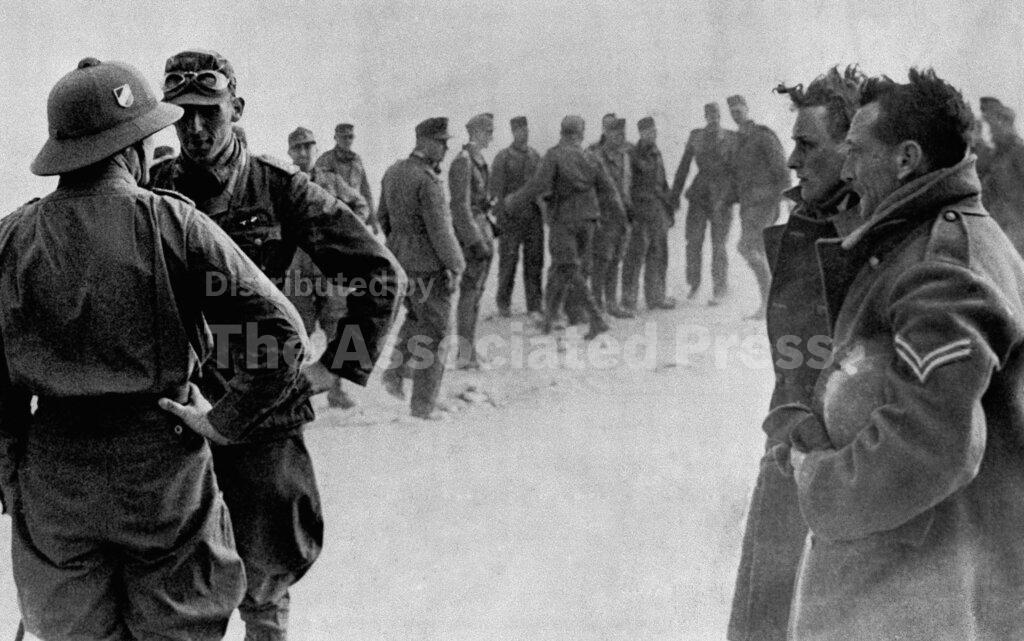
The Afrika Korps has surrounded Tobruk on the landward side with the 5th Light Division and the Brescia Division, but of course the British supply route from Alexandria remains intact through the port. A sandstorm hits the perimeter during the afternoon, and the Germans use that as cover for an attack. However, the Australian/British troops focus their artillery on the trucks that have brought the Germans close to the perimeter, destroying many. The German attacks make no progress.
To the south, the British send a group of 14 tanks to relieve the port. Panzerjäger-Abteilung (Sfl.) 605 is waiting for them, however, and knocks out half a dozen of the tanks. This sends the British at El Adem into further retreat, so Lieutenant General Rommel sends his own panzers in pursuit of Bardia. They set off at once, not waiting for daybreak, reflecting the excellent morale in the Afrika Korps. Rommel also orders Forward Detachment Knabe (Gustav Georg Knabe) to join the pursuit toward Sollum in the morning.
The American United Press News Agency reported (delayed until the 17th): “The Germans launched their first infantry attack on the outer defensive perimeter at Tobruk this afternoon under cover of a sandstorm; but the attack was repulsed by the British with heavy losses to the Germans. The storm had reached such a pitch of violence that it was hard to see farther than one yard. But at 5:00 P.M. the storm suddenly abated and approximately 800 German infantrymen sprang into view, dismounting from about 30 trucks and heading in tight formation toward the outer defensive perimeter. The British then attacked the trucks that had brought the infantry and the accompanying tanks.”
Foreign Secretary Anthony Eden and CIGS John Dill have returned from their diplomatic efforts in the Balkans. They give a presentation to the War Cabinet about the situation in the Mediterranean, which visiting Australian Prime Minister Robert Menzies summarizes in his diary:
“Libya represents a gross underestimate of German capacity. Tobruk is a poor place to defend, with an extended perimeter, but Dill thinks the supply of anti-tank guns and field artillery quite good.”
On the larger question of overall armored strength between the two sides, Dill is reassuring. He states that Germany only has 15 armored divisions out of its 200 total divisions, while Britain is forming “as many armored divisions as humanly possible” — though he does not place a number on them.
The Italians for all intents and purposes have been evicted from their ports in East Africa or have scuttled their ships in the few that remain. Accordingly, President Roosevelt quickly lifts his designation of the Red Sea/Gulf of Aden as a “combat zone.” This means that U.S. freighters are free to bring supplies directly to the British troops there.
German armored train Atlas arrived at Mönichkirchen, Germany (occupied Austria) to prepare the village for Adolf Hitler’s arrival on the following day.
Adolf Hitler and Benito Mussolini concluded their four-day meeting at Salzburg in occupied Austria, during which Hitler convinced Mussolini to remain in the war. Hitler and Mussolini wind up a meeting in Salzburg. Mussolini is getting cold feet about the war (as well he might, considering his military’s performance to date), but Hitler remonstrates with him to keep fighting.
Now that he is the leader of an independent state and not just a loudmouth in exile, Ante Pavelić has the standing to meet with Mussolini. Previously Mussolini went many months without deigning to meet with Pavelic, who was camped out in Florence. Now, the two men meet as leaders and discuss Italian recognition of Croatia.
French Lieutenant Alain le Ray became the first Allied serviceman to escape from Colditz Castle, site of the prisoner of war camp Oflag IV-C, in Germany. French officer Alain Le Ray, a company commander with the French Chasseurs Alpins (mountain troops), escapes from Colditz Castle. He is the first escapee from the prison, that is, the first to get out of prison (eventually he is recaptured). Le Ray already has escaped from a different camp and was brought to Colditz because the Germans feel it is exceptionally secure. He escapes, not through a tunnel dug from the clock tower that he has been helping to build, but on his own. Le Ray notices a deserted house near an exercise yard that the prisoners are allowed to use, and today he slips into it, waits for everyone to return to the castle, and then climbs a wall and is gone.
Under American pressure Darlan agrees not to move the battleship ‘Dunkerque’ from Oran to dry dock in Toulon lest it should fall into German hands.
A little group of men and women, some weeping, some grimy, some without sleep for three days and three nights, held Good Friday services tonight in a battered, roofless cathedral in the heavily bombed midlands town of Coventry. In a drizzling rain, the Very Rev. R. T. Howard, archdeacon and provost of Coventry, led the services from a huge block of masonry he improvised as a pulpit. A cross made from burned timbers of the cathedral ruins was silhouetted against the sky. A Salvation Army band played. “Surely this is the strangest gathering Coventry ever has seen,” Mr. Howard said. “These ruins are full of strange power. It does not matter when we die; it only matters how.” After Easter hymns were sung, the congregation returned to the work of clearing away debris left from the fierce German raid of last night.
Marshal Petain’s cabinet announced today that French frontiers were closed to all Frenchmen between 17 and 40 years of age to prevent their fleeing to join the forces of Gen. Charles de Gaulle, “free French” leader. “Every day boats try to leave the coast of Normandy and Brittany for British ports,” the announcement said.
Destroyers HMS Jervis, HMS Janus, HMS Nubian, and HMS Mohawk of the British 14th Destroyer Flotilla arrived in Malta to act as a night striking force.
A single page information bulletin called “Joodsche Weekblad” (Jewish Weekly) was published in Amsterdam, The Netherlands. This information bulletin was supposedly produced by the Jewish Council of Amsterdam but it was actually written by the German Bureau of Jewish Affairs to keep the Jews in the Amsterdam ghetto unaware of what really went on in the concentration camps.
Royal Norwegian Navy destroyer HNoMS Mansfield (G 76 — on loan from the Royal Navy) parks offshore Øksfjord in the far north of Norway (north Alta Fjord). It destroys the Øksfjord fish oil factory, the British believing that fish oil is an important part of the German diet (and it also can be used to manufacture weapons). The Mansfield lands a crew of commandos who complete the factory’s destruction. The mission is a success.
President Roosevelt informs Prime Minister Winston Churchill that he intends to shift the US Security Zone to 26 degrees west. He further intends to have US escorts for convoys to that point and requests that the Admiralty provide the US Navy with convoy information to accomplish this purpose. This is an astonishing request — anyone with that information holds the fate of Great Britain in his hands — but such is the trust between the two men that there is no question but that Churchill will supply the information. It just shows the depth of the relationship between England and the United States in this situation.
Coventry has again been the target for the Luftwaffe. 230 aircraft dropped 330 tons of bombs, but the fires started by the incendiaries did not get out of control, thanks to prompt action by fire-watchers and the Auxiliary Fire Service. A hospital was hit repeatedly by HE over several hours. The staff struggling to save 160 patients by moving them to the basement as ward after ward was hit. At one point oxygen cylinders were used to provide air in the packed conditions. Several doctors and nurses were killed. Bath is also bombed.
153 Luftwaffe aircraft bombed Bristol, England, United Kingdom; it was nicknamed the “Good Friday Raid”. The city’s docks, St Philip’s Bridge, and residential areas were damaged. The city tramways power supply line was destroyed by the bomb that hit St Philip’s Bridge; it was decided that the damage was too severe to repair and all the tram cars were soon to be scrapped for the war effort; none of the tram cars were preserved for historical purposes. It is the sixth major raid of the city, the first having been on 24 November 1940 — and the last. More than 1400 people have been killed in the raids, and the town’s medieval center has been destroyed.
The primary damage is to the dock area (including Prince Street, Canon’s Marsh and Queen Square ) and residential areas. The raid causes a lot of damage, but it more notable in a historical context from some odd facts. First, that the Germans lose seven Heinkel He 111 bombers to Hurricanes from RAF No. 151 Squadron. Second, St. Philip’s Bridge is hit, which disrupts power to the tramways — which are scrapped as a result. Thus, this raid ends tram service in Bristol forever.
Another Luftwaffe raid by 18 Heinkels made is on Bridlington. There are two deaths amidst a lot of damage, including to Lloyd Hospital. One of the deaths is a two-year-old boy.
RAF Bomber Command: Day of 11 April 1941
20 Blenheims to Emden, Heligoland, Rotterdam and shipping patrols. 1 aircraft lost.
The air war over Greece is going very well for the Germans at this point. The Luftwaffe bombs and sinks 674-ton British cable ship Retriever off Phleva Island, Greece. There are 11 deaths, and 6 men become prisoners. There are 29 men who are rescued by the Allies.
U-124, commanded by Kapitänleutnant Georg-Wilhelm Schulz, sank Greek steamer Aegeon (5285grt) in 6-55N, 15-38W. At 2059 hours on 11 April 1941 the unescorted Aegeon was hit in the engine room by one torpedo from U-124 about 170 miles west-southwest of Freetown. The ship sank by the stern at 2135 hours, shortly after the U-boat surfaced and left without questioning the survivors because the Alcinous had been sighted. The crew had managed to send a distress signal before they abandoned ship and HMS Wishart (D 67) (Cdr E.T. Cooper, RN) was redirected to their position, but the destroyer found no trace of wreckage or lifeboats during a short search of the area the next morning and had to return to Freetown as she was low on fuel. The survivors were picked up by the British motor merchant Sheaf Holme landed at Freetown on 14 April. The 5,285-ton Aegeon was carrying wheat.
Heavy cruiser HMS London, aircraft carrier HMS Argus, and steamer Narkunda (16,632grt) arrived in the Clyde from Gibraltar. Aircraft carrier HMS Furious which travelled in company proceeded to Belfast.
Destroyer HMS Mansfield with a Norwegian crew departed Lerwick on the 8th. She carried commandoes to Hammerfest, near North Cape, to destroy a fish oil factory at Oksfjord on 11/12 April. The destroyer arrived back on the 14th.
Boom defence vessel HMS Othello (201grt, T/Boom Skipper W. Trench RNR) and boom tender HMS Yorkshire Belle (56grt) were sunk on a mine at the entrance to the Humber, 3½ cables 10° Haile Sand Fort. Trench, T/A/Warrant Engineer J. A. Wakefield, and nine ratings were lost in Othello. Four ratings were lost in Yorkshire Belle.
Destroyer HMS Greyhound departed Alexandria escorting netlayer HMS Protector and anti-submarine trawlers HMS Syvern and HMS Kos 23 for Suda Bay and corvette HMS Salvia and South African Seaward Defence Force minesweeper HMS Muroto for Piraeus. The corvette and the South African minesweeper were to assist corvette HMS Hyacinth in clearing Piraeus Harbor. Both sections arrived on the 14th.
Light cruiser HMS Orion with destroyers HMAS Stuart, HMS Griffin, HMS Juno, HMS Jaguar, and HMS Hasty departed Alexandria at 2000 to join light cruisers HMS Ajax and HMAS Perth for an offensive sweep along the Cyrenaican coast eastwards from Benghazi during the night of 12/13 April in Operation MBD3.
Gunboats HMS Aphis and HMS Gnat bombarded Bomba during the night of 10/11 April. The gunboats bombarded the same district and the Gazala airdrome during the night of 11/12 April.
Australian destroyers HMAS Waterhen and HMAS Vendetta arrived at Alexandria at 0400 with British steamer Thurland Castle (6372grt) carrying captured tanks from Tobruk. The destroyers departed Alexandria again that day with another supply ship for Tobruk.
Destroyers HMS Jervis, HMS Janus, HMS Mohawk, and HMS Nubian arrived at Malta from Suda Bay. They immediately refueled and sailed to intercept the southbound convoy of steamers Bosforo, Ogaden, Persiana, and Superga, escorted by torpedo boats Montanari, Missori, and Perseo between Lampione Island and Kerkenah Bank. They failed to intercept a subsequent message from submarine HMS Unique which corrected the speed of the convoy. No contact was made and the destroyers returned to Malta.
During the night of 11/12 April, Greek cruiser RHS Averoff departed the Gulf of Saronikos and proceeded unescorted to Alexandria. No escorts could be spared for this unit.
Cable ship Retriever (674grt) was sunk by German bombing one mile 264° from Aliki Rocks, off Phleva Island, Greece. Eleven crewmen were lost and six were taken prisoner. Twenty nine crewmen were rescued.
Greek hospital ship Attiki (2561grt) was sunk by German bombing in Doro Channel. Twenty eight crew members were missing.
British steamer Draco (2018grt) was badly damaged by German bombing at Tobruk and beached. The steamer was bombed again on the 21st and was a total loss. The gunner was killed, but rest of the crew was rescued.
Destroyer HMS Boreas arrived at Gibraltar with British steamer Glenartney (9795grt).
In Washington, President Roosevelt issued an Executive order removing the area at the entrance to the Red Sea from the combat zone which United States ships are prohibited from entering; a proclamation declaring Germany and Italy to be at war with Yugoslavia and another Executive order establishing the Office of Price Administration and Civilian Supply and naming Leon Henderson to head it. He conferred with Camille Gutt, Minister of War and Finance in the refugee Belgian government; and with Attorney General Jackson, on the question of shipment of supplies to the Red Sea in the light of the provisions of the Neutrality Act. He received from Clark Griffith, president of the Washington baseball club, an annual pass.
The Senate and the House were in recess and their committees inactive.
J. Edgar Hoover declined today to testify at a House investigation of defense production, saying that a disclosure of F.B.I, information otherwise than through the courts would be “fatal to the future usefulness of the Federal Bureau of Investigation.” The F.B.I, chief said that Attorney-General Jackson concurred in his decision. Hoover’s views were made public in a letter to Chairman May, Kentucky Democrat, of the House Military Affairs Committee.
U.S. President Franklin D. Roosevelt informed British Prime Minister Winston Churchill that the U.S. would extend its security zone and patrol areas to a line covering all North Atlantic waters west of West Longitude 26 degrees, the “sea frontier of the U.S.” The decision was prompted by the mounting losses to Allied shipping from German air, surface, and submarine forces.
President Roosevelt disclosed today that he had signed the resolution adopted by Congress which binds the United States to oppose any transfer of sovereignty of foreign possessions in the Western Hemisphere. Congressional action was completed on April 1 when the House accepted the resolution as passed by the Senate.
U.S. President Franklin D. Roosevelt proclaimed that the Red Sea and Gulf of Aden were no longer combat areas and were open to U.S. shipping.
Office of Price Administration and Civilian Supply (OPACS) was established within the Office for Emergency Management by Executive Order 8734. The functions of the OPA were originally to control prices and rents after the outbreak of the war. The OPA eventually had the power to place ceilings on all prices except agricultural commodities, and to ration scarce supplies of other items, including tires, automobiles, shoes, nylon, sugar, gasoline, fuel oil, coffee, meats and processed foods. Later in the war, Director Henderson will ride a bicycle to his office as a way of promoting petrol rationing. Most Americans complied with the OPA but the agency could not quell the spread of black markets for certain items, including meat, petrol and cigarettes.
The Ford strike in Michigan ended after ten days with both sides agreeing to make concessions. While both sides make concessions, the strike is a turning point in labor relations in the automobile industry because Ford becomes the last of the Big Three automakers to recognize the United Auto Workers (UAW).
An RAF B-17 Flying Fortress (serial number AN-531) departs Seattle, Washington bound for England via Canada. Manned by a British crew, it is one of the lesser-known elements of Lend-Lease.
The U.S. Army BuAer issues a requirement for a bomber capable of carrying a 5-ton bomb-load for 5,000 miles and return. The US Army Air Corps publishes a request asking for bids for a bomber meet the following specification:
— 450 mph/720 km/h top speed
— 275 mph/443 km/h cruising speed
— a service ceiling of 45,000 ft/14,000 m
— range of 12,000 miles (19,000 km) at 25,000 ft/7600m
These are extraordinary specifications that exceed anything in the air. In fact, there are no operational fighters in the world that can achieve that top speed, let alone bombers. US aircraft designers are left scratching their heads at this wish list. This tender, however, is the genesis, after a mid-course correction on the requirements, of post-war bombers such as the Northrop B-35 and the Convair B-36.
George Patton was made the commanding officer of the 2nd Armored Division. This involves promotion to Major General. Patton is one of the premier tank experts in the world, having directed tank operations during World War I. Like Rommel, Patton likes to fly above his units to see exactly what they are capable of doing.
The U.S. Navy destroyer USS Niblack (DD-424), while rescuing survivors of the Dutch freighter Saleier (torpedoed and sunk by German submarine U-52 the day before after the dispersal of convoy OB. 306) depth charged what was believed to be a German U-boat off Iceland. A thorough investigation by the German navy, however, would conclude that none of their submarines were in the vicinity at the time of Niblack’s attack. The U.S. Navy’s conclusion was that the USS Niblack had depth-charged a false contact.
U.S. Army freight transports will soon begin bringing rubber, hemp and charcoal from the Dutch East Indies to release tonnage for the Atlantic and ease congestion in the Pacific.
Starlet Deanna Durbin files papers to wed Vaughn Paul. Durbin is considered a competitor of Judy Garland, and her films reportedly saved Universal Pictures from bankruptcy. Paul is an assistant director.
The comedy film “Road to Zanzibar,” the second in the popular Road to … film series starring Bing Crosby, Bob Hope, and Dorothy Lamour, was released. The picture is written by the same writers as 1940’s “The Road to Singapore,” is extremely similar in terms of structure and plot — and also is similar in the huge success the film enjoys, becoming the eighth highest-grossing picture of 1941. “The Road to Zanzibar” ensures that the “Road” pictures will become a continuing series.
Tonight’s episode of “Mandrake the Magician” is “Tommy Has Found Princess.” The series features 15-minute programs featured on the Mutual Broadcasting System and airs five days a week. Raymond Edward Johnson voices Mandrake, who is based on the syndicated newspaper comic strip, created by Lee Falk.
At the Bee Hive, the Red Sox beat the Bees, 11–6, pinning the loss of Wes Ferrell. Sibby Sisti hits a home run.
Australian heavy cruiser HMS Australia departed Colombo on 24 March with two troopships for convoy US.10. On the 7th, heavy cruiser Australia and light cruisers HMS Achilles and HMAS Hobart departed Wellington with two liners for Australia to sail in the convoy. New Zealand Division light cruiser ACHILLES departed Jervis Bay, N. S. W. with liner Queen Mary on the 11th to join convoy US10 at Sydney. This convoy was composed of Queen Mary (81,235grt), Queen Elizabeth (83,673grt), Ile de France (43,450grt), Mauretania (35,739grt), and Nieuw Amsterdam (36,287grt). On the 12th, light cruiser Achilles and heavy cruiser Australia were detached from the convoy for patrol. They then proceeded to Sydney to refuel. Achilles then returned to New Zealand.
Liner Nieuw Amsterdam was detached to Singapore. The troops from this liner were embarked on troopship Aquitania which departed Singapore on the 27th, escorted by light cruiser HMS Danae. Troopship Aquitania arrived at Colombo on 1 May. On the 27th, convoy US10A departed Trincomalee with liners Queen Elizabeth and Queen Mary, escorted as far as Perim by Australian heavy cruiser HMAS Canberra, arriving on 1 May, and arrived at Suez on 3 May, escorted by Australian sloop HMAS Parramatta. On 6 May, convoy US10B departed Colombo for Suez with liners Aquitania, Ile de France, and Mauretania.
New Zealand Division light cruiser HMS Leander departed Madras with a convoy for Singapore. The convoy was turned over to light cruiser HMS Ceres on the 12th. The cruiser proceeded to Trincomalee arriving on the 13th. She proceeded on to Colombo arriving on the 14th.
Convoy BM.6 departed Madras for Malaya with steamers Talma (10,000grt), Santhia (7754grt), Neuralia (9182grt), and Devonshire (11,275grt), escorted by light cruiser HMS Leander to 12 April when light cruiser HMS Danae relieved her. Steamers Jalapadma (3935grt) and Jalakrishna (4981grt) departed Madras on the 12th, unescorted, with vehicles and stores for the units carried in convoy BM.6, and arrived at Penang on the 16th.
Soviet Ambassador to the Chungking government Panyushkin meets with Chiang Kai-shek and affirms that the USSR is not supporting Japan.
Taking a calm view of both the foreign and domestic problems confronting Japan, Premier Prince Fumimaro Konoe in an interview with the Japanese press today, reiterated that Japan’s aims were purely peaceful, asserted that there would be no change in any of the policies on which his second Cabinet has embarked, and declared that he did not expect any remarkable events to take place in the near future.
Born:
Ellen Goodman, American political columnist (Pulitzer Prize, 1980), in Newton, Massachusetts.
Frederick “Rick” Hauck, American astronaut (NASA Group 8 (1978); STS-7 [Challenger, 1983], STS 51-A [Discovery, 1984], STS-26 [Discovery, 1988]), in Long Beach, California.
Shirley Stelfox, English actress, in Dukinfield, Cheshire, England, United Kingdom (d. 2015).
Naval Construction:
The Nihon Kaigun (Imperial Japanese Navy) Yūgumo-class destroyer HIJMS Makinami (巻波, “Overflowing Waves”) is laid down by the Maizuru Naval Arsenal (Maizuru, Kyoto Prefecture, Japan).
The Royal Navy LCT (Mk 1)-class landing craft, tank HMS LCT 22 is launched by Vickers Armstrong (Newcastle-on-Tyne, U.K.).
The U.S. Navy 77-foot Elco patrol motor torpedo boat USS PT-21 is launched by Electric Launch Company Ltd. (Elco), (Bayonne, New Jersey, U.S.A.).
The Royal Navy corvette HMS Chrysanthemum (K 195) is launched by Harland & Wolff Ltd. (Belfast, Northern Ireland). She is transferred to the Forces Navales Françaises Libres (Free French Naval Forces) before completion and commissions as the Commandant Drogou (K 195).
The Nihon Kaigun (Imperial Japanese Navy) Kagerō-class destroyer HIJMS Akigumo (秋雲; “Autumn Clouds”) is launched by the Uraga Dock Co. (Uraga, Yokosuka, Kanagawa Prefecture, Japan).
The Royal Navy Fairmile B-class motor launch HMS ML 213 is commissioned.
The Royal Navy harbor defence motor launch HMS HDML 1049 is commissioned.
The Royal Fleet Auxiliary Ranger-class fleet support tanker RFA Brown Ranger (X 69; postwar A169) is commissioned. Her commanding officer is Captain Donald B C Ralph, RFA.
The U.S. Navy Pipit-class coastal minesweeper USS Longspur (AMc-10) [conversion; ex-New Ambassador] is commissioned.
The Royal Navy MMS I-class motor minesweeper HMS MMS 11 (J 511) is commissioned.
The Royal Navy Hunt-class (Type II) escort destroyer HMS Blankney (L 30) is commissioned. Her first commanding officer is Lieutenant Commander Philip Frederick Powlett, RN.
 History Diaries