The White House chief of staff said today that the Administration was “coming close” to a “final conclusion” on whether Libya was responsible for the bombing last week of a West Berlin discotheque frequented by American soldiers. The comments by the White House chief of staff, Donald T. Regan, and by other officials fortified the impression conveyed by the Administration for the last three days that the United States is moving toward a military strike against Libya in retaliation for anti-American terrorist actions such as the discotheque attack. President Reagan said this week that the United States was prepared to strike militarily at Libya if evidence pointed directly to Libyan support for terrorists. There was concern in Congress, meanwhile, about compliance with the War Powers Resolution of 1973, which requires the President to consult with Congress before sending military forces into actual or imminent hostilities. Mr. Regan’s comments today came as efforts by the United States to enlist strong allied support against Colonel Muammar el-Qaddafi, the Libyan leader, appeared to be foundering, much to the Administration’s annoyance.
A State Department official said the Europeans were fearful of an American military attack on Libya because they were concerned this would harm their trade with Libya and generate more terrorism. He said President Reagan would have to decide soon on whether to proceed with an attack on Libya and on what targets to hit, without being able to count on allied backing. Vice President Bush is to return from the Middle East on Saturday and Defense Secretary Caspar W. Weinberger, from an Asian trip, on Sunday. It was probable, an Administration official said, that Mr. Reagan would wait to consult with them next week before making a final decision. Mr. Weinberger has been opposed to the use of military force in response to terrorist attacks except in cases where those responsible for an incident could be pinpointed. Pentagon officials said the Navy carriers Coral Sea and America were to rendezvous in the Mediterranean south of Sicily within 24 hours. That would put them within a day’s sailing of Libyan waters, in case they are ordered into action against the Libyans. For the second day in a row, neither the White House nor State Department spokesmen said anything about Libya.
Chancellor Helmut Kohl cautioned the United States today against taking retaliatory military action against Libya. He acknowledged that West Germany had “a whole lot of indications” of Libyan involvement in the bombing of a West Berlin discotheque. At a news conference, Mr. Kohl was asked about the possibility of “reprisals” against Libya by the Sixth Fleet ships assembling in the Mediterranean. “If you introduce this term into the debate,” Mr. Kohl said, “you must know what you are starting and how you are going to get out of it at the end.”
Italy, concerned about the possibility of military action by the United States against Libya, called today for an urgent meeting of the European Community’s foreign ministers. The Dutch Government later announced that the meeting would be held next week, The Associated Press reported from The Hague. The Netherlands acted in its capacity as current chairman of the European Community, a Foreign Ministry spokesman said. A statement from the Italian Foreign Ministry said Rome had asked for the meeting to discuss the “situation created in the Mediterranean following the most recent acts of terrorism and to seek political and diplomatic solutions.”
Senior Western diplomats said today that the United States had unsuccessfully sought Soviet help in an effort to prevent terrorist attacks in Europe by Libyans based in East Germany. The diplomats reported that in one of the first such efforts by Washington to enlist Soviet support in fighting terrorism, American officials met with Soviet representatives in Washington, Moscow and East Berlin last month to seek help in dealing with terrorists believed to be operating out of the Libyan Embassy in East Berlin. The diplomats said Moscow never responded to the requests. Administration officials in Washington have been saying that they have evidence of Libyan involvement in the bombing of a West Berlin discotheque last Saturday. An American serviceman and a Turkish woman were killed and 230 people were wounded.
Since the most recent terrorist acts against American targets, the information about possible Libyan involvement and American strategy provided by Administration officials has often been either sketchy and cryptic or bold but undocumented. Sometimes, information comes from officials who are not fully informed but who talk anyway; sometimes, from officials who know what is happening but are holding back. Sorting this out is further complicated by competition among reporters to be first with the inside story and by what appears to be manipulation of the press by the White House to suit its political tactics. But from this welter, three points are emerging:
First, officials throughout the Administration say they have good evidence that Colonel Muammar el-Qaddafi had a hand in the bombing of a West Berlin discotheque last Saturday, although they say it was carried out by a Palestinian group.
Second, officials’ assertions that the evidence is “strong but inconclusive” or that it is “incontrovertible” tend to be tied to their policy stances. For example, several who say the evidence is definitive seem to favor a strong military response.
Third, Mr. Reagan has probably decided in principle to use force against Libya, but might be willing to hold off for a while or until further terrorist attacks occur, if European allies join Washington in strong political and economic sanctions against Libya.
Moscow renounced its moratorium on underground nuclear testing, saying continued American tests threatened Soviet security. An American underground test, the second of the year and the ninth since the moratorium began last August 6, was conducted Thursday in Nevada.There was no immediate indication of when Moscow would resume underground testing, but Western diplomats said they thought it would be soon. Moscow said it was prepared to revive the moratorium any time “the United States declares that it will refrain from conducting such explosions.” The United States said it was not surprised by the Soviet announcement. “They had indicated that they would do this,” said the White House spokesman, Larry Speakes, adding that “we will have to wait and see” when the next test occurs. He did not elaborate. The Reagan Administration has said it regards the Soviet moratorium as a propaganda gesture and has offered instead to improve verification provisions in existing treaties that limit underground tests to 150 kilotons, the force of 150,000 tons of TNT.
The Soviet statement said, “The U.S.S.R. Government declares that from now on it is free from the unilateral commitment made by it to refrain from conducting any nuclear explosions.” The statement added, “The Soviet state cannot forgo its own security and that of its allies.” The statement also said Mikhail S. Gorbachev, the Soviet leader, remained willing to meet with President Reagan in Europe to discuss an end to nuclear testing. The meeting, proposed by Mr. Gorbachev in a nationally broadcast speech March 29, was rejected by the White House. The Soviet decision to end the moratorium had been expected since Mr. Gorbachev said in the same speech that Moscow would resume testing if the United States set off another underground explosion. The Soviet statement said, “The American Government’s irresponsible actions are an open challenge not only to the Soviet Union but also to the peoples on all continents, to the world as a whole.”
After several days of discussion, the Western powers responsible for West Berlin — Britain, France and the United States — were reported late tonight to have reached a compromise accord to increase the security of the city. It would reportedly include tightened surveillance of the entry points to West Berlin. It would reportedly include tightened surveillance of the entry points to West Berlin. American military commanders and their civilian advisers have been pressing for several days for stiff measures that would effectively ban Libyan diplomats accredited to East Berlin from crossing into West Berlin. But French representatives had resisted these demands, saying there was no conclusive proof of Libyan involvement in the bombing last Saturday at a discotheque in West Berlin. By late tonight the command had issued no statement on its reported compromise agreement, but Western diplomats said that as a result of the French objections it appeared to have fallen short of an outright ban on the Libyans.
The United Nations today permitted the United States to examine a secret United Nations War Crimes Commission file on former Secretary General Kurt Waldheim. At the same, it gave Israel access to two other secret files today. The Waldheim file was made available to the deputy American delegate, Herbert S. Okun, at the United Nations archives at 345 Park Avenue South near 25th Street, after a formal request by the Justice Department’s Office of Special Investigations. The file, which was made available Wednesday to Israeli and Austrian officials, was forwarded to the State Department for examination. The Office of Special Investigations, whose purpose is to track down, investigate and deport Nazi war criminals, has sought the file to help determine whether Mr. Waldheim should be banned from entry into the United States under a 1978 amendment to the immigration law. Benjamin Netanyahu, Israel’s chief delegate to the United Nations, today received access to two other files in the United Nations archives that were requested by Israel Thursday.
The Italian wine scandal, arising when 20 people died from drinking wine adulterated with methanol, is a disaster whose effects may be felt there for many years to come. Its impact may even cast a shadow over all European wines. Italy has been fighting the poor image of its wines for 30 years, and in the past decade its best winemakers have made great strides in changing that image. On Thursday the Bureau of Alcohol, Tobacco and Firearms, the Federal agency responsible for wine imports, initially directed importers to tell their retailers to remove all Italian wines from the shelves.
A deadline for payment of a $2.6 million ransom for the wife of a prominent banker passed today, but the police said that it had not been paid and that there had been no word from the kidnappers. Hundreds of police officers searched Ireland today for the woman, Jennifer Guinness, who was kidnapped on Tuesday by unidentified gunmen. The kidnapping was reported by the police on Thursday. Before taking his wife away Tuesday, the police said, the kidnappers told Mrs. Guinness’s husband, the merchant banker John Guinness, that he had three days to pay the ransom. Press reports in Britain and Ireland described the deadline as a “life or death” threat, but a police spokesman said, “They didn’t actually say the woman would be killed if the money wasn’t paid in three days.” Government policy forbids payment of ransom, but there have been unconfirmed reports that money was delivered in previous abductions.
Prime Minister Shimon Peres and Foreign Minister Yitzhak Shamir held more talks today on the details of a proposal to resolve the problems in Israel’s coalition Government, but they failed to work out a final accord. The Government-run Israeli television cautioned its listeners tonight that it would be premature to pronounce the weeklong coalition crisis at an end. If a deal is sealed between the leaders of Likud and Labor, it will not be formally announced until ratified by the full Cabinet on Sunday, Government sources said. On Thursday, Mr. Shamir offered to resolve the Cabinet crisis and prevent the breakup of the national unity Government by agreeing to give his post as Foreign Minister to Finance Minister Yitzhak Modai, and, in exchange, to take Mr. Modai’s finance portfolio. Mr. Peres quickly accepted the proposal.
A Frenchman kidnapped in Muslim West Beirut earlier this week was rescued today in the Bekaa region of eastern Lebanon. The rescue of the Frenchman came as another Westerner, a teacher from Northern Ireland, was abducted in Beirut in an apparently unrelated case. He was identified as Brian Keenan, a professor at the American University of Beirut. The Frenchman, Michel Brian — his last name was erroneously given Tuesday as Brillant — was freed by three Lebanese who said they were out rabbit hunting. The three Lebanese said they found him sitting in a parked car blindfolded, his hands tied behind his back. When they challenged his captors, they said, a gunfight ensued and the kidnappers fled.
A Palestinian guerrilla commander was kidnapped by unidentified gunmen near Beirut today, according to the Palestinian group Al Fatah, whose leader is Yasser Arafat, chairman of the Palestine Liberation Organization. The group said Raji an-Najami, the highest Fatah official in Lebanon, was seized near Khalde, south of the capital, as he was returning to Sidon after attending talks in Beirut on ways of preventing bloodshed in Palestinian refugee camps.
Benazir Bhutto, elated by the tumultuous turnout at her anti-Government rally Thursday, demanded Friday that new elections be held in Pakistan but pledged not to resort to violence in seeking the ouster of President Mohammad Zia ul-Haq. At the same time, Miss Bhutto seemed to warn General Zia to take her cause seriously when she said the hundreds of thousands of supporters who thronged the streets here had it in their power to force him from office. “That crowd was so responsive it would have done anything which I or my party directed,” she said of the rally, the largest anti-Government demonstration in Pakistan since General Zia took power in a military coup and imposed martial law in 1977.
President Reagan participates in a briefing for his upcoming meeting with the Prime Minister of Japan.
A battalion of about 360 soldiers battled leftist guerrillas Friday along the San Salvador Volcano ridge, leaving at least two rebels dead and four wounded, an army officer said. There were no immediate reports of army casualties. A captain, who declined to be identified for security reasons, said the operation started early Friday against about 40 rebels from the Farabundo Marti National Liberation Front, a coalition of five guerrilla armies. The captain said the army had detected a buildup of guerrillas in the region just outside the capital. The guerrillas are in the seventh year of a war against the Government, which the United States supports and which is now headed by President Jose Napoleon Duarte. It is estimated that 60,000 people, most of them civilians, have died in the conflict. The last major rebel activity in the area of the volcano took place in March 1985.
Congressional backers of President Reagan’s $100 million aid package for Nicaraguan rebels said today that allegations of corruption and drug trafficking by rebels must be cleared up, and one said Mr. Reagan had personally promised to get the answers. Representative Charles W. Stenholm, Democrat of Texas, who favors the aid, said Mr. Reagan assured a group of lawmakers Thursday that the White House was examining accusations that rebel leaders diverted funds and that some rebels took part in cocaine smuggling. Mr. Stenholm said the President promised “a written refutation” to some allegations and requested more information on others.
Representative Bob Dornan, Republican of California, another backer of the rebels, known as contras, said the cutoff of United States aid two years ago left many of them with no money to fight the Nicaraguan Government. “Desperate men do desperate things,” Mr. Dornan said about the drug allegations. “But the ends do not justify the means.” It was reported this week that Federal investigators, directed from Miami, were examining allegations that Nicaraguan rebels and some private American backers had engaged in gun-running, drug trafficking and violations of the Neutrality Act. The State Department spokesman, Bernard Kalb, said today, “We support the efforts of the F.B.I., Congress and any other Government agency that believes it has cause to investigate charges that members of the United Nicaraguan Opposition are involved in illegal activities.”
Paced by a record 21.9 percent drop in gasoline prices, the Producer Price Index fell in March for the third consecutive month, the Labor Department reported today. The sharp 1.1 percent drop in the index for finished goods, reflecting what industry charges retailers, brought the first quarter’s decline to an annual rate of 12.4 percent, the steepest for any three-month period since the index was first calculated in 1947. The Government also reported that retail sales fell a sharp eight-tenths of 1 percent last month. The decline, the biggest in five months, was largely the result of a 3.4 percent drop in automobile sales, as financing incentives lapsed, and the plummeting price of gasoline. Although the producer price performance was better than most analysts expected, the Labor Department noted that “the dominant and pervasive influence” was oil. Amid signs that oil prices have now bottomed out, some analysts said that the best inflation news — at least at the producer level — would soon be history.
The White House vowed today to continue President Reagan’s push to overhaul the Federal tax code, saying that Congress should keep the issue separate from budget considerations. Responding to a Senate resolution Thursday that called for a budget agreement before a vote on a tax bill, the White House spokesman, Larry Speakes, accused Congress of seeking to make the Reagan Administration compromise on a budget by deferring action on the tax plan, which is one of Mr. Reagan’s top domestic priorities. “This is mixing,” Mr. Speakes said. “This is trying to force us to give in on the budget, is what it amounts to.”
The President and First Lady watch the movie “Just Between Friends.”
A report urging suspension of a program for minority businesses should be reworked, the U.S. Commission on Civil Rights said today. The panel voted to ask its staff to revise a draft report that recommended a one-year suspension of programs that reserve contracts for black, Hispanic or female employers. The Reagan Administration has said it supported the program but Clarence M. Pendleton Jr., chairman of the commission, said he was “upset and disappointed with the White House.”
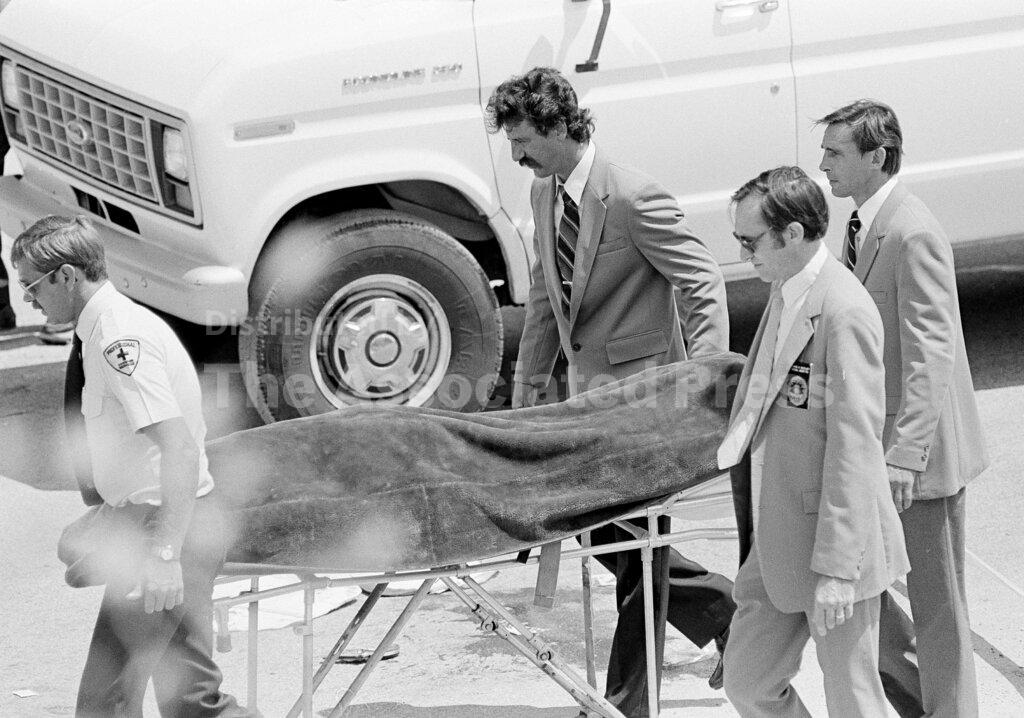
Two F.B.I. agents were killed and five others were wounded in Miami in a heavy exchange of gunfire with suspects in a series of armored car robberies. The two suspects were killed. shootout occurred between field agents for the Federal Bureau of Investigation (FBI) and two armed men in what is now Pinecrest, Miami-Dade County, Florida. The two men, former U.S. Army servicemen Michael Lee Platt and William Russell Matix, were suspected of committing a series of robberies and violent crimes, including a murder, in and around the Miami metropolitan area. Although they had partially surrounded the suspects after maneuvering them off a local road, the agents involved quickly found their firepower was outmatched by the weapons which Platt and Matix had in their vehicle. During the ensuing shootout, Platt in particular was able to repeatedly return fire despite sustaining multiple hits. Two special agents—Benjamin Grogan and Jerry Dove—were shot and killed, while five other agents were injured by gunfire. The shootout ended when both Platt and Matix were killed while attempting to flee the scene. The incident is infamous as one of the most violent episodes in the history of the FBI and is often studied in law enforcement training. The scale of the shootout led to the introduction of more effective handguns, primarily switching from revolvers to semi-automatics, in the FBI and many police departments around the United States.
The Democratic Party today managed to conduct a harmonious public discussion on foreign policy, but the illusion of a party consensus on this issue was shattered in an impromptu argument outside the meeting room. Conservative Democrats have expressed displeasure with the tone and substance of a foreign policy position paper being drafted by a 33-member task force headed by Representative Stephen J. Solarz of Brooklyn. Among other things, the draft accuses the Reagan Administration of engaging in “puerile name-calling” with the Soviet Union, an “injudicious confrontation” in Central America and “ideological ineptitude” in dealing with Southern Africa. Mr. Solarz included excerpts from the draft in his remarks today to the Democratic Policy Commission, a party panel seeking to break new policy ground on foreign affairs and other issues.
As Solarz was leaving the session, he encountered one of the critics of his report, Penn Kemble, chairman of the executive committee of the Coalition for a Democratic Majority, an independent group of moderate and conservative Democrats. As a small crowd of reporters and party members gathered around, Mr. Solarz and Mr. Kemble debated the issue as their associates tried in vain to advise them that a stairwell was not a proper place to air their differences. Mr. Kemble told reporters on Thursday that Democrats of his viewpoint were “not at all happy” with the draft version of the Solarz report, contending that it went too far in charging that the nation’s problems over foreign policy “were mainly the creation of Ronald Reagan’s rhetoric.” Mr. Solarz said the report not only reflected the viewpoint of mainstream Democrats, but also the voting record of Congressional Democrats on key foreign policy issues. Mr. Kemble said he regarded the report, written primarily by Theodore H. Sorenson, an aide to President Kennedy, as “a regression” to the party’s post-Vietnam foreign policy views.
Richard Craig Smith, the former Army intelligence officer who said he sold information about United States spying operations to the Soviet Union as part of a plot to infiltrate the Soviet intelligence agency, was found not guilty today at his espionage trial. The Federal District Court jury of nine women and three men acquitted Mr. Smith on all five counts, one of conspiracy, two of espionage and two of passing classified information to the Soviet Union. If convicted, he could have faced life imprisonment. The verdict was returned after five and a half hours of deliberation. Mr. Smith’s wife, Susan, wept as the verdict was read, as did several other members of his family. “I am so eternally grateful to the jurors to do what they felt was right,” Mr. Smith said outside the courthouse. “I am a free man tonight.”
Police officers clashed with about 250 union sympathizers blocking the George A. Hormel & Company packinghouse here early this morning in one of the most violent confrontations of the eight-month meatpackers’ strike. Eight officers were hospitalized for minor injuries and 17 demonstrators were arrested before the crowd was dispersed with tear gas. Police Chief Donald Hoffman termed the demonstration a “riot” and said officers were pelted with pieces of asphalt and sprayed with a chemical irritant. Jim Guyette, president of local P-9 of the United Food and Commercial Workers Union, was charged with aiding a riot and other offenses. He said, “We feel we had a peaceful demonstration that was turned into a riot by the police.”
Saying that acquisitions by large communications companies threaten free speech and the quality of newspapers, a journalism school dean told the nation’s newspaper editors here today that they should support Federal antitrust action to prevent further consolidation of ownership. But a Justice Department official warned the editors, who are attending the annual convention of the American Society of Newspaper Editors, that any new antitrust laws or other intervention by the Government could pose a tremendous threat to press freedom. Ben Bagdikian, dean of the Graduate School of Journalism at the University of California at Berkeley, challenged the society to underwrite a survey in which independently owned newspapers would be compared with those owned by groups on such things as newsroom budgets as a percentage of profit margins.
A Brown University senior and a Providence insurance agent were indicted today on charges of participating in a prostitution ring. A Providence County grand jury charged that the insurance agent, Stanley Henshaw 3d, a past president of the Rhode Island State Association of Life Underwriters, persuaded three young women to become prostitutes, including Dana E. Smith, the Brown University senior. And it charged that Mr. Henshaw and Miss Smith persuaded a fourth woman, Rebecca R. Kidd, also a senior at Brown, to become a prostitute. Miss Kidd, 21 years old, of Orange, Connecticut, was named as an unindicted co-conspirator. Miss Kidd and Miss Smith, 21, of Avon, Connecticut, were arrested March 6 and charged with prostitution but the charges were dropped April 4. The Attorney General’s office said then that the case had been referred to the grand jury.
Pharmacists in Florida will be able to prescribe drugs for minor ailments under rules approved today. Supporters said the move would lower health care costs, but doctors said it could lead to misdiagnoses. They say druggists do not have the training to spot symptoms that could turn out to be major medical problems. Beginning May 1, pharmacists will be able to prescribe shampoo for head lice, drugs for ailments like colds and headaches, and fluoride products aimed at preventing tooth decay. Those remedies now require a prescription.
Ten students suspended from Dartmouth College for attacking shanties built to protest South Africa’s racial policies have been given lighter sentences, a move recommended by an alumnus appointed to hear their appeals. Protesting that decision, twenty members of the student group that built the shanties occupied the library bell tower, where they remained late tonight. Walter Peterson, president of Franklin Pierce College in New Hampshire and a former Governor, recommended that four students who had been given two- and three-term suspensions be suspended for only one term. Six other students who had been given one-term suspensions will receive no suspension, but their activities on campus will be restricted.
Just before dawn on April 12, 1861, a Confederate artillery battery fired a shell over the ramparts of Fort Sumter, S.C., the first round in a 34-hour bombardment that marked the beginning of the Civil War. On Saturday, at a quiet ceremony overlooking the harbor of Charleston, S.C., the National Park Service will mark the 125th anniversary of the attack on Fort Sumter. The Fort Sumter program will be the first in a series of anniversaries scheduled for this year, and over the next four years, to commemorate what historians describe as the most significant Civil War milestone since the war’s centennial 25 years ago. But unlike 1961, when the anniversary of the Fort Sumter battle was marked by pageantry and full-dress re-enactments, as well as often bitter racial divisions underscoring the tone of the times, the Park Service has planned a low-key ceremony this weekend, including speeches and a guest list that will have blacks as well as whites. “There are still sensitivities, to be sure,” said Edwin C. Bearss, chief historian of the National Park Service, who is scheduled to speak at Fort Sumter this weekend.
The parent company of the 7-Eleven stores has announced it will stop selling adult magazines, and fundamentalist religious leaders immediately ended a boycott of the establishments. The Southland Corporation of Dallas said it noted a growing public concern over a possible connection between adult magazines and crime in its decision to discontinue sales.
A 1921 Canadian 50 cent coin is auctioned in New York for $22,000.
Dodge Morgan sailed solo nonstop around the world in 150 days.
Halley’s Comet makes its closest approach to Earth this trip, 63 Million km.
KXA-AM in Seattle, Washington changes call letters to KRPM.
Major League Baseball:
The Boston Red Sox thumped the Chicago White Sox, 7–2. Marty Barrett’s two-run triple highlighted a four-run third inning. Don Baylor added a bases-empty homer, his second of the season, with two out in the eighth for Boston to make it 5–1. Roger Clemens scattered six hits over eight and two-thirds innings as the White Sox lost their fourth straight without a victory.
Forty-seven-year-old Phil Niekro yielded only one earned run today but lost in his debut with the Cleveland Indians, who signed the knuckleball pitcher after the Yankees cut him just before the season opened. Niekro, who won 16 games for the Yankees last year and earned his 300th career victory on the season’s final day, lasted until the seventh inning today, allowing one hit in every inning. The Detroit Tigers scored a 7–2 victory, the 251st loss of Niekro’s career. Yet there were special moments — the old man needing one pitch at a key moment and, invariably, finding it.
Houston’s Glenn Davis hit his second home run of the season to break up a strikeout string by David Palmer and lead an Astros rally that gave them a 2–1 victory over the visiting Braves. Davis’s seventh-inning home run over the left-field fence ended a dominating performance by Palmer, who struck out 10 batters, tying a career high.
George Bell drove in three runs with two doubles and Lloyd Moseby hit a home run as the Blue Jays downed the Royals, 6–2. Jim Clancy, coming off an injury-plagued 1985 season, allowed six hits in seven innings, then gave way to Mark Eichhorn, who struck out the side in the eighth and set the Royals down in order in the ninth.
Brad Gulden singled in Dan Gladden from second base in the 12th inning to give the San Francisco Giants a 9–8 victory over the Los Angeles Dodgers Friday night. Gulden’s hit came moments after teammate Candy Maldonado was thrown out at home plate by Dodger center-fielder Franklin Stubbs on Gladden’s third hit of the game. Jeff Robinson, 1–0, was the winner with last-inning relief help from Jim Gott, who recorded his first save. Robinson left the game for a pinch-hitter in the top of the 12th. The Dodgers, who scored only five runs in their first four games, overcame a 7–0 deficit in the fourth inning and tied the game with three runs in the ninth off reliever Greg Minton. The key blows were a runscoring single by Franklin Stubbs, who hit a three-run homer in the seventh off reliever Mike LaCoss, and a two-run double by Mike Scioscia. Earlier, San Francisco scored three unearned runs on an error by outfielder Ken Landreaux and Jeff Leonard hit a two-run homer to help the Giants build their 7–0 lead.
Bert Blyleven pitched a strong game, and Gary Gaetti and Tom Brunansky hit home runs, as the Minnesota Twins turned abck the Seattle Mariners, 5–1. Blyleven struck out four Mariners and walked three in seven and two-thirds innings. He allowed seven hits. Ron Davis, who entered the game with the bases loaded, retired Jim Presley to end the inning. Gaetti had four hits and Kirby Puckett three as Minnesota totaled 12 hits.
Yankee Stadium fans saluted Bob Tewksbury with a standing ovation last night. But then, Tewksbury had just pitched the longest of any of the team’s starters in this first week of the season. The 25-year-old rookie, displaying the kind of pitching that earned him a spot in the starting rotation in spring training, worked into the eighth inning and emerged the winner as the Yankees handed the Milwaukee Brewers their first loss, 3–2. The Brewers also started a rookie pitcher, but Bill Wegman made the mistake of throwing a 3–0 fastball over the middle of the plate, and Mike Pagliarulo, batting in the fourth inning after Ken Griffey’s run-scoring single tied the game, 1–1, drove it all the way to the right-center field bleachers. It was the second time in two games that Pagliarulo, who hit no home runs in spring training, deposited a ball into the distant bleachers.
Reggie Jackson, Bobby Grich and Brian Dowling hit homers to pace the Angels to a 10–3 win over the A’s. Downing’s grand slam, his third home run of the season, capped a five-run ninth inning that wrapped up the Angels’ rout. Rookie Wally Joyner’s second RBI single of the game drove in the first run in the ninth and Downing followed with his slam off Tim Birtsas, the fourth Oakland pitcher. Winner Ron Romanick, 1–0, pitched six innings and gave up all three Oakland runs. Ken Forsch hurled three innings of hitless relief to record his first save since 1978 when he was with Houston. Grich’s second homer of the season gave the Angels a 1–0 lead in the second inning and Jackson’s two-run shot, the 532nd home run of his career, highlighted a three-run sixth.
The Mets made it two in a row tonight when they defeated the Philadelphia Phillies, 9–7, with Gary Carter knocking in five runs and Bob Ojeda pitching three innings in relief for his first victory in the National League. But it was no game for the faint of heart. Ron Darling, making his 1986 debut, lost his control, lost his command and nearly lost a seven-run lead, and did not survive the fifth inning. And seven other pitchers also were chilled by the wintry weather as the temperature dropped toward the 30’s and the score kept rising. The Mets staked Ojeda to a 2–0 lead in the first inning and a 9–2 lead in the fourth, but he still could not pitch his way past the fifth. By then he had walked three batters, committed a balk, thrown a wild pitch and thrown home-run balls on consecutive pitches.
The Cubs edged the Pirates, 5–4. Steve Trout gave up four hits in six innings and hit a bases-loaded single as Chicago scored four runs in the fourth inning. Trout, taken from the game because of a pulled groin muscle after allowing both Pirate runs in the sixth, retired 14 of 15 batters at one point as the Cubs built a 4–0 lead. Trout retired 10 consecutive batters on ground balls from the first through the fourth innings.
The Padres bested the visiting Reds, 4–3. Tim Flannery delivered a bases-loaded single in the 11th inning to give San Diego a victory in the Padres’ home opener. Flannery’s game-winner came off Cincinnati reliever Ted Power, 0–2, the Reds’ third pitcher in the game.
Willie McGee, Jack Clark and Tito Landrum hit home runs in the third inning to power St. Louis to its third consecutive victory, routing the Expos, 9–1. The rally backed the strong pitching of Bob Forsch, who gave up seven hits in eight innings. Forsch also chipped in with a two-run single as the Cardinals got 12 hits off Joe Hesketh and three Montreal relievers. Vince Coleman stole three bases.
Don Aase, the Baltimore relief pitcher, threw wildly to first base on a pickoff attempt with two out in the ninth inning, and two Rangers scored to give Texas a 5–4 win over the Orioles. Tom Paciorek, who had doubled, scored standing up after the attempt to pick off Oddibe McDowell, who had walked. McDowell, who had hit a home run earlier in the game, raced around the bases and collided with Rick Dempsey, the Baltimore catcher, at the plate, knocking the ball loose for what proved to be the winning run. Aase took the loss, and the Ranger reliever Ricky Wright earned the victory.
Boston Red Sox 7, Chicago White Sox 2
Detroit Tigers 7, Cleveland Indians 2
Atlanta Braves 1, Houston Astros 2
Toronto Blue Jays 6, Kansas City Royals 2
San Francisco Giants 9, Los Angeles Dodgers 8
Seattle Mariners 1, Minnesota Twins 5
Milwaukee Brewers 2, New York Yankees 3
California Angels 10, Oakland Athletics 3
New York Mets 9, Philadelphia Phillies 7
Chicago Cubs 5, Pittsburgh Pirates 4
Cincinnati Reds 3, San Diego Padres 4
Montreal Expos 1, St. Louis Cardinals 9
Baltimore Orioles 4, Texas Rangers 5
Stock prices declined slightly, as investors, already concerned about the Libyan situation, decided to take some profits while waiting to see whether the Federal Reserve cuts the discount rate. “You have a lot of caution today,” said Michael Sherman, chairman of the investment policy committee at Shearson Lehman Brothers Inc., who believes Wall Street is mainly worried about the apparently worsening relations with Libya. “Traders don’t like to have exposed positions when there is concern.”
Dow Jones Industrial Average: 1790.18 (-4.12)
Born:
Ramon Sessions, NBA point guard and shooting guard (Milwaukee Bucks, Minnesota Timberwolves, Cleveland Cavaliers, Los Angeles Lakers, Charlotte Bobcats-Hornets, Sacramento Kings, Washington Wizards, New York Knicks), in Myrtle Beach, South Carolina.
Connor Barth, NFL kicker (Kansas City Chiefs, Tampa Bay Buccaneers, Denver Broncos, Chicago Bears), in Wilmington, North Carolina.
Charlie Furbush, MLB pitcher (Detroit Tigers, Seattle Seahawks), in South Portland, Maine.
Russ Canzler, MLB outfielder, first baseman, and designated hitter (Tampa Bay Rays, Cleveland Indians), in Berwick, Pennsylvania.
Laura Harper, WNBA forward and center (Sacramento Monarchs), in Elkins Park, Pennsylvania.
Stephanie Pratt, American television personality (“The Hills”), in Los Angeles, California.
 History Diaries