The Germans of the XL Panzer Corps continue to roll in Yugoslavia on 10 April 1941. By the morning, the Germans have regrouped and now are ready to advance south toward Kozani. Capturing Kozani would put the Wehrmacht troops in position to drive to the coast at Larissa or nearby, cutting off the British forces holding on the Aliakmon Line near Thessaloniki. However, there is a lot of rough terrains to cover, things are a little different now than in the drive west against light opposition.
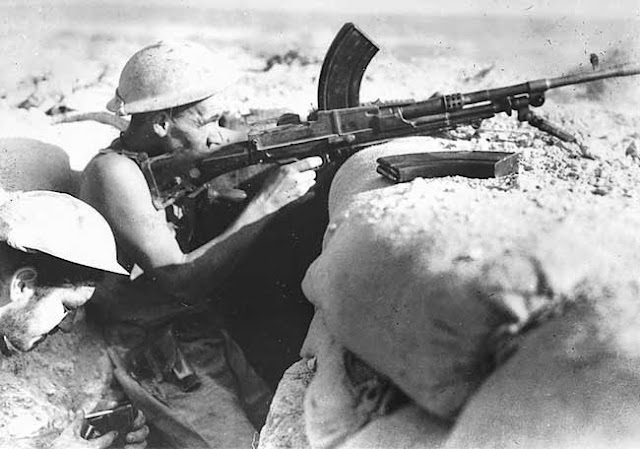
The Germans attack the Florina gap, held by a force known as the Amynteion Detachment and including the 27th New Zealand Machine Gun Battalion (less two companies), the 64th Medium Regiment, Royal Artillery, and the 3rd Royal Tank Regiment along with units of the 6th Australian Division.
The attack is halted by artillery fire and the RAF bombing the enemy columns on the roads.
At Vevi the German and British guns exchange fire in the valley and Mackay is ordered to hold until the night of 12 April before withdrawing. Mackay’s infantry is commanded by Brigadier Vasey who has 3 battalions spread across ten miles of front much of which is covered with snow; the 2/8th Australian Battalion on the east, the 1st Rangers in the center and the 2/4th Australian Battalion on the hills to the west.
The 1st SS Panzer Division Leibstandarte SS Adolf Hitler (LSSAH), under the command of Hitler’s former chauffeur Josef “Sepp” Dietrich, captures Vevi in southern Macedonia and immediately turns to clear the enemy from the Kleisoura Pass southwest of Vevi. pass This leads to the town of Klidi in the south (it also is known as the Klidi Pass or Kirli Derven). The plan is to take Klidi and then drive downhill to Kastoria in northwest Greece.
SS-Sturmbannführer Kurt “Panzer” Meyer leads LSSAH’s reinforced Aufklärungs-Abteilung (reconnaissance battalion) south into the pass, which is defended by scratch forces mixed Australian/New Zealand/Greek formation known as the “Mackay Force” under the Australian General Iven Mackay. Meyer’s forces, backed by the 73rd Infantry Division, attack Glava Hill and Delinski Dol, but the Mackay Force is under orders from General Henry Maitland Wilson to “stop a blitzkrieg down the Florina Valley.” Today, it does that, stopping the Germans cold.
The 16th Australian Brigade, having established itself on the Veria Pass, is ordered to march back through the snow covered mountains to fill a gap on the New Zealand front west of Servia.
In Yugoslavia, German troops of the 14th Panzer Division of General von Kleist’s 2nd Army capture the Croatian capital of Zagreb. Further South, German 9th Panzer Division and Leibstandarte SS Adolf Hitler Regiment moved through the Monastir Gap, moved across the Greek border, and captured the town of Florina. British troops fell back from the Aliakmon Line southwest of Salonika, Greece.
Paul von Kleist was mentioned in the Wehrmachtbericht daily radio report.
The Independent State of Croatia was established under Croatian Fascist chief Ante Pavelic and the Ustasha party. One week later Croatia declares war on Britain and thereby joins the Axis. Croatian fascist strongman Ante Pavelic returns from his exile in Italy to join in the proclamation, illustrating its Fascist orientation. This declaration of independence triggers an unexpected result, causing Hungary to decide that the Tripartite Pace to which both it and Yugoslavia are signatories no longer bars it from invading the now-dismembered country. Hungary prepares to send its tanks across the border tomorrow, the 11th.
Daily Keynote from the Reich Press Chief: “Next the Minister calls our attention to reports about Belgrade. Expression like “The city is one single heap of rubble, its streets covered with corpses of women and children” are naturally to be omitted before publication.”
Meanwhile, local Communist Party Secretary-General Josep Broz “Tito” (Tito is one of his assumed names taken when the Communist Party in Yugoslavia is outlawed) forms a Military Committee.
To the southeast in Greece, the battle of the Metaxas Line is over. The Greek commander of the Eastern Macedonian Army Section, Lieutenant General Konstantinos Bakopoulos, has ordered the forces holding out behind German lines to surrender. As of yet, the Germans at Thessaloniki and the British on the other side of the Aliakmon River have not engaged in any battles aside from a minor encounter between a German patrol and defending New Zealanders. Both sides took minor casualties, relatively speaking, during the battle, the Germans about 500 men killed.
The German government grows sensitive about the image it is projecting by bombing Belgrade in Operation PUNISHMENT. It ends the bombings, and the Ministry of Propaganda warns the media to “omit” sensational comments such as “its streets are covered with corpses of women and children.” In fact, Luftflotte IV stops bombing northern Yugoslavia altogether — it hasn’t bombed any Croatian areas at all — and turns its attention solely to southern Yugoslavia and Greece.
The Afrika Korps encircled the port of Tobruk, Libya. This marked the beginning of the siege of the Australian 9th Division, which has retreated to Tobruk. The siege would last until November 18, 1941. The German 15th Panzer Division under General Heinrich von Prittwitz und Gaffron attacked Tobruk, Libya from the west. Prittwitz was killed while personally leading a reconnaissance mission by armored cars.
Lieutenant General Erwin Rommel records his thoughts today:
“I am convinced the enemy is retreating, we have to push after him with all forces. Target to be made clear to every man is the Suez canal. To prevent a breakout of the enemy from Tobruk, an encirclement has to be pursued by all means.”
Forward Detachment Prittwitz (led by Major General von Prittwitz) advances south on the Via Balbia, which runs east of Tobruk and is the main road in the region. At noon, the detachment encounters British troops. Everything is extremely fluid with no clear battle lines, and, just as with British Generals Neame and O’Connor recently, the Germans lose one of theirs due to the confusion. Prittwitz perishes when he is fired upon by them — his driver had driven past the lead elements of his detachment without noticing. Lieutenant Colonel Graf Schwerin takes over the detachment.
Rommel orders the Italian Brescia Division forward from Mechili to take over for Schwerin’s force. He also orders the Ariete Division forward toward El Adem. Due to all these troop movements, today is often cited as the start of the siege of Tobruk. The port city is defended by the 9th Australian Division, with overall command under General Morshead. The British strengthen their defenses at Halfaya Pass to the south by bringing up the 22nd Guards Brigade.
Moving his headquarters forward to Gazala airfield, Rommel’s biggest problem is one of supply. Some detachments have run out of food and water.
The British war office acknowledged today a severe blow to its strategy in North Africa in the probable loss of three key generals and 2,000 troops believed to have been captured by German-Italian columns racing across the sands of eastern Libya, “We are without news of three senior officers, Lieutenant General P. Neame, V.C., Lieutenant General Sir Richard Nugent O’Connor, and Major General M. D. Gambier-Parry,” said a war office communique. The Germans said six generals and two colonels were among 2,000 prisoners at El Mechili, 50 miles southwest of Derna. O’Connor was the right hand man of General Sir Archibald P. Wavell, commander-in-chief of the near east and was regarded as one of the best tacticians in the British army. He and Lieutenant General Sir Henry Maitland Wilson were praised by Prime Minister Churchill last February for carrying out Wavell’s offensive which shoved the Italians out of Egypt and back beyond Benghazi. Each was made a knight commander of the Bath. Gambier-Parry, one of the foremost tank and tank-gunnery specialists of the British army, also was a valuable man in carrying out whatever strategy is planned to stop the axis offensive which both Berlin and Rome now say has reached beyond Derna, 160 miles from the Egyptian frontier.
An Italian convoy of four ships (Bosforo, Ogaden, Persiano, and Superga) departs from Palermo, Sicily for the final leg of its trip from Naples to Tripoli. Another convoy arrives at Tripoli.
The Royal Navy sends off four destroyers from Suda Bay to be based in Malta. A striking force of four destroyers under Captain Mack in HMS Jervis are sent to Malta to operate against Rommel’s convoys. Rommel’s advances on land, the British believe, can be stopped — at sea.
The War Office transfers Special Service troops from Malta back to Alexandria. They have been among the troops guarding Gozo Island pursuant to Operation PICNIC.
The British now hold the key points in Italian Somaliland, Eritrea, and Abyssinia. However, many Italian strongholds remain in far-flung places. The British 11th African Division advances southwest from Addis Ababa to attack one of them, Jimma. They have to halt at Abaiti on the Omo River, where the Italians have blown the bridges.
At Assab, Eritrea, the Italians watch British troops approach and do what Italians in other ports have done in that situation: they start scuttling their ships.
The Indian 5th Division marched from Massawa, Eritrea toward Amara, Abyssinia.
Visiting Australian Prime Minister Robert Menzies is an advocate of less rigid English relations with Ireland. He has prepared a memo on the matter, and Prime Minister Winston Churchill finds it “very readable.” Menzies continues in his diary:
“Winston and Kingsley Wood exhibit the blank wall of conservatism. There is triangular prejudice on this matter. Winston is not a receptive or reasoning animal. But they will come to it! [Emphasis in original].”
In this instance, Menzies’ liberal instincts clash with Churchill’s conservative ones. Throughout his diary, Menzies is alternately attracted and repelled by Churchill’s very strong personality, and this is an instance of the latter. The bottom line is that Churchill has very definite ideas about how to handle the Irish question, and those ideas do not include being “soft” or “lenient.”
The Berlin state opera and the historic Prussian state library are burning this morning as the result of incendiary bombs dropped bv British raiders in an air attack on Berlin during “the night, it was announced officially today. The raiders scattered their bombs over the capital, hitting two hospitals as well as apartment houses, it was added, killing and wounding a number of persons.
A considerable portion of the 700,000 population of Istanbul on the Golden Horn will be removed to the interior of Asiatic Turkey, the government announced today, thus indicating the gravity with which it regards the possibility of war. Istanbul is on the European side of the Eosporus, about 100 miles from Bulgaria and 150 miles from eastern Greece, both under German occupation. Free transportation by train and boat will be provided by the government. There was no hurried removal, but it was noted that Istanbul is the only major Turkish city immediately vulnerable to air attack.
President İsmet İnönü of Turkey once again declines to join the Allies.
The British at Habbaniyah Airfield outside Baghdad are getting increasingly nervous about the new government of Rashid Ali. While there haven’t been any attacks on the base yet, the Ali government is distinctly anti-British and pro-German. The British War Cabinet authorizes troop transfers from General Claude Auchinleck’s command in India to Iraq.
In Berlin, meanwhile, Reichsmarschall Hermann Göring has his eye on Iraq as well. The country fits into the, shall we say, larger war aims of the Third Reich. However, it is far away over air space largely controlled by the British, so even getting airplanes to it is a chore. Göring believes that supporting the Ali government with his Luftwaffe would increase his own prestige within the hierarchy — which of course he is almost at the top of already, but there is a lot of infighting that he worries about nonetheless — so he is thinking of sending some units there. The main problem is that there is no ground support for Luftwaffe planes in Iraq because it is all controlled by the British, so capturing the RAF facilities is somewhat of a prerequisite to Luftwaffe operations. However, the facilities likely can’t be captured without the Luftwaffe’s assistance.
Adolf Hitler is very upset at last night’s bombing that gutted the Berlin Opera House. He confronts Luftwaffe boss Reichsmarschall Hermann Göring about antiaircraft defenses, then departs from his Fruhlingssturm headquarters south of Vienna to oversee Operation 25/Operation Marita. While he just as easily could review the operations from Berlin, Hitler likes to give the appearance of being at the front with his troops.
The Luftwaffe attacks Birmingham on the night of 10/11 April, with 206 bombers dropping 246 tons of high explosives and 1183 incendiaries. After dark, it attacks Coventry again. Overall, about 475 people are killed and 700 seriously wounded in the two Coventry raids of two nights earlier and tonight.
206 Luftwaffe aircraft attacked Birmingham, England, United Kingdom, dropping 246 tons of high explosive bombs and 1,183 incendiary bombs.
RAF Bomber Command: Day of 10 April 1941
21 Blenheims on coastal raids in the Frisians and the German Bight. Several targets were attacked. 1 aircraft lost.
RAF Bomber Command: Night of 10/11 April 1941
Brest
53 aircraft — 36 Wellingtons, 12 Blenheims, 5 Manchesters — reported good bombing. It was later established that 4 bombs hit the Gneisenau, recently damaged by a Coastal Command torpedo bomber, during this raid and 50 Germans were killed and 90 injured. 1 Wellington lost.
Dusseldorf
29 Hampdens and 24 Whitleys. 5 Hampdens lost.
Minor Operations: 11 Wellingtons to Bordeaux/Merignac airfield and claimed hits there, 3 Wellingtons to Rotterdam. 1 aircraft lost from the Merignac raid.
Egmont Prinz zur Lippe-Weißenfeld shot down a British Wellington bomber shortly after 0000 hours over the IJsselmeer in the Netherlands.
Light cruiser HMS Naiad, under repair in the Tyne, was damaged by the near miss of German bombing causing superficial splinter damage and some shock damage to her turbine mountings. The cruiser had no additional time out of service.
Destroyer HMS Somali, which had arrived at 1730 from patrol, began repairs to her boilers alongside depot ship HMS Tyne at Scapa Flow.
Destroyer HMS Brocklesby arrived at Scapa Flow at 1000 to carry out working up.
The British DS convoy series began with convoy DS.1 of troopships Royal Ulsterman (3244grt) and Royal Scotsman (3244grt) departing the Clyde, escorted by destroyer HMS St Marys. Destroyer HMS Lancaster departed Scapa Flow and joined at sea. The convoy arrived at Reykjavik on the 12th. The return convoy SD.1 departed Iceland on the 14th with the same escorts. The convoy arrived in the Clyde on the 16th. Battleship HMS King George V and destroyers HMS Somali and HMS Mashona arrived at Scapa Flow at 1811. Escorting destroyer HMS Matabele was detached en route to refit at Barrow, arriving at 1150/11th.
Battleship HMS Resolution, armed merchant cruiser HMS Derbyshire, and destroyers ORP Piorun and ORP Garland departed Hvalfjord for Canada.
Heavy cruiser HMS Norfolk departed Hvalfjord to meet convoy HX.119.
Light cruiser HMS Aurora, escorting minelayer HMS Agamemnon, departed Scapa Flow at 1908 to refit at the Tyne.
Canadian convoy TC.10 of troopships Georgic (27,759grt) and Batory (14,287grt) departed Halifax. Battleship HMS Rodney escorted the convoy for the entire voyage. Canadian destroyer HMCS St Croix escorted the convoy on 10 and 11 April. On the 15th, destroyers HMS Hesperus, HMS Legion, and HMS Leopard joined the convoy. Destroyer Leopard was detached the next day. On the 16th, destroyers HMS Active, HMS Echo, ORP Garland, and ORP Piorun, which had departed Iceland on the 14th, joined the convoy. Destroyers Echo and Active arrived at Scapa Flow at 2000/18th, and arrived at Greenock on the 19th with battleship Rodney and destroyers Hesperus, Legion, Garland, and Piorun.
U-52, commanded by Kapitänleutnant Otto Salman, sank Dutch steamer Saleier (6563grt), from dispersed convoy OB.306, in 58-04N, 30-48W. At 1912 hours on 10 April 1941 the Saleier (Master J. Riedel), dispersed from convoy OB-306 on 9 April, was hit by two torpedoes from U-52 and sank by the bow in 15 seconds after being hit by a coup de grâce at 1955 hours. All crew members, some of them wounded, abandoned ship in three lifeboats and were picked up by USS Niblack (DD 424) the next day and brought to Reykjavik. En route, the USS Niblack (DD 424) attacked a sonar contact with three depth charges. This action is often mentioned as first military action between Germany and the USA in the Second World War, but no U-boat reported being under attack on that day in the area, so the contact was probably false. The 6,563 ton Saleier was carrying coal and was bound for Port Said, Egypt.
British steamer Thirlby (4887grt) was damaged by German bombing 140 miles north, northwest of Butt of Lewis. Destroyer HMS Bedouin was sent to assist, but could not locate the steamer. Anti-submarine trawler HMS Lady Madeleine (581grt) escorted tug Brigand to assist the steamer. The steamer arrived at Loch Ewe on the 11th.
British steamer Busiris (943grt) was damaged by German bombing off Runnelstone, Mounts Bay.
Dutch steamer Virgo (397grt) was damaged by German bombing five miles northwest of Bar Light Vessel. The steamer was towed to Liverpool.
German battlecruiser Gneisenau was struck by four bombs and was badly damaged at Brest.
Due to the damage of the German battleships, submarines HMS Torbay, HMS Taku, HMS Unbeaten, HMS Union, HMS Undaunted, HMS Urge, and HMS Cachalot were sent on to the Mediterranean when relieved by the 6th Submarine Flotilla, transferred from Blyth.
Destroyers HMS Jervis, HMS Janus, HMS Mohawk, and HMS Nubian of the 14th Destroyer Flotilla departed Suda Bay at 0700 for Malta to conduct raiding operations on Italian supply lines. Light cruisers HMS Ajax and HMAS Perth departed Alexandria to cover their passage during the night of 10/11 April. Destroyers Jervis, Janus, Mohawk, and Nubian arrived at Malta at daylight on the 11th. Light cruisers Ajax and Perth called at Salamis on the 11th. The cruisers then refueled at Suda Bay before returning to patrol in the Aegean to cover convoys AG.12 and AS.25.
British troopship Glenroy, escorted by destroyers HMS Decoy and HMS Encounter, departed Port Said to reembark troops recently landed at Lemnos by British supply ship Breconshire. On the 11th, troopship Glenroy and destroyers Decoy and Encounter arrived at Alexandria. Anti-aircraft cruiser HMS Coventry left convoy AS.25 on the 11th to join this force.
Convoy AG.12 of one British ship departed Alexandria escorted by anti-aircraft cruiser HMS Carlisle, destroyer HMS Hereward, and sloops HMS Flamingo and HMS Auckland, and arrived at Phaleron Bay on the 12th. The escort remained at Salamis. Convoy AS.25 of five Greek ships departed Piraeus escorted by destroyer HMS Wryneck and sloop HMS Grimsby. Anti-aircraft cruiser HMS Coventry sailed to accompany this convoy for the first part of the voyage, and then departed on the 11th to escort troopship Glenroy. Anti-aircraft cruiser HMS Calcutta joined the convoy from Suda Bay on the 11th. Damaged oiler Pericles joined this convoy from Suda Bay for passage to Alexandria. Naval tanker Pericles (8324grt) broke in half in heavy weather on the 14th in 32-09N, 29-40E. Sloop Grimsby took off the crew and stood by while destroyer HMS Kimberley was sent to her assistance. Destroyer Kimberley sank the stern section of the tanker with gunfire, and arrived at Alexandria on the 14th. Destroyer Wryneck escorted the Port Said section. Destroyer Kimberley and sloop Grimsby arrived at Alexandria on the 15th.
Minesweeper HMS Abingdon was damaged by mining at Malta. The minesweeper was under repair until June.
British troopship Ulster Prince (3791grt) grounded in Great Pass at Alexandria. The troopship was gotten off without serious damage, but docking was required.
Italian supply convoy of steamers Bosforo (3567grt) and Ogaden (4553grt) and tankers Persiano (2474grt) and Superga (6154grt) departed Palermo escorted by torpedo boats Missori, Montanari, and Perseo. The convoy was attacked off Cape Bon by submarine HMS Upholder on the 11th but no damage was done. Submarine HMS Tetrarch sank Italian tanker Persiano in 33-29N, 14-01E, thirty miles northeast of Tripoli on the 12th, and arrived at Tripoli at 1500/12th.
Ocean boarding vessel HMS Malvernian departed Gibraltar on Western Patrol.
Italian steamer India (6366grt) was scuttled at Assab. The steamer was later salved.
Italian steamer Piave (7565grt) was scuttled at Assab. The steamer was later salved.
Italian steamer Sannio (9834grt) was scuttled at Assab. The steamer was later salved.
Italian coastal steamer Scillin (57grt) was scuttled at Assab.
Italian coastal steamer Circeo (59grt) was scuttled at Assab.
Italian coastal steamer Dante (80grt) was scuttled at Assab.
Italian coastal steamer Sicilia II (64grt) was scuttled at Assab.
Convoy HX.120 departed Halifax, escorted by corvettes HMCS Cobalt and HMCS Collingwood. The corvettes were detached later that day. Battleship HMS Royal Sovereign and armed merchant cruiser HMS Laconia joined the convoy on the 12th. Armed merchant cruiser HMS Chitral joined on the 19th. The battleship was detached on the 20th and the two armed merchant cruisers were detached on the 21st. Destroyers HMS Bulldog. and HMS Walker joined on the 21st and minesweepers HMS Niger and HMS Speedwell joined on the 22nd. Destroyer Bulldog. was detached on the 24th. Destroyer Walker arrived with the convoy at Liverpool on the 29th.
In the American capital today, President Roosevelt announced the signing of an agreement with Denmark whereby Greenland is included in the system of cooperative defense of the Western Hemisphere. He conferred with Secretaries Hull, Morgenthau, Knox and Stimson; Admiral Harold R. Stark, chief of Naval Operations and Harry L. Hopkins on the defense program, with Sidney Hillman on labor conditions in defense industries, with Benjamin F. Fairless and Irving S. Olds on labor conditions in the steel industry, and with Douglas Fairbanks Jr. He sent to the Senate the nominations of Robert A. Lovett to be Assistant Secretary of War for air. John J. McCloy to be an Assistant Secretary of War, and promotions of ten brigadier generals and thirty-nine colonels.
The Senate adopted a resolution of regret over the death of Senator Morris Sheppard and adjourned out of respect at 12:07 PM until noon on Monday.
The House was in recess.
The United States pushed its line of air and naval defenses to the middle of the north Atlantic and the very limits of the German sea blockade zone today by acquiring rights for bases and other military fortifications in Greenland. Under an agreement signed with the Danish minister in Washington, Henrik de Kauffman, the United States assumed responsibility for “assisting” the Danish colony in “the maintenance of its present status” as a part of the defense of the western hemisphere. The minister acted “on behalf” of the king of Denmark and with the approval of the local governor of Greenland but it was indicated that the government in German-occupied Denmark itself had no advance knowledge of the agreement. President Roosevelt, in announcing the inclusion of Greenland “in our system of cooperative hemispheric defense,” said that the government in Denmark under present circumstances “cannot, of course, act in respect of its territory In the western hemisphere, but we propose to make sure that when the German invasion of Denmark has ended, Greenland will remain a Danish colony.”
U.S. President Franklin D. Roosevelt sent a message to the U.S. Congress asking for the power to requisition idle foreign ships that had been interred in American waters since the onset of the European war. Lest a “growing shortage of shipping facilities” defeat the armament program, President Roosevelt today asked congress for authority to commandeer any foreign-owned vessel lying idle in American waters. “We should have statutory authority,” he said in a special message, “to take over any such vessels as our needs may require, subject, of course, to the payment of just compensation.” That congress would comply with the president’s request, none doubted. The message and a proposed draft of the legislation which accompanied it were referred in the senate to the commerce committee. The house is in recess until after Easter. The scope of the proposal nevertheless caused some surprise. Previous discussions of the subject had to do with the 39 Danish, two German and 28 Italian vessels which were seized on March 30. Under the language of the president’s message it was patent that the legislation requested was not to be limited to these.
The U.S. State Department announced that the United States and Danish governments signed an agreement whereby the American government agreed to take over the defense of Greenland in exchange for the right to construct air and naval bases on the island. Read the State Department statement and text of the agreement. This allowed the United States to establish a protectorate over and occupy Greenland. With the approval of a “free Denmark,” the U.S. would build naval and air bases as counters to the U-boat war.
Having met with President Roosevelt, General Sikorski concludes his brief visit to the United States and returns to England.
The question of postponing a National Labor Relations Board hearing on a complaint, charging the Ford Motor Company with violating the National Labor Relations Act, was the chief obstacle today to immediate settlement of the nine-day strike at the River Rouge plant.
Six of seven members of a legislative committee investigating the recent seventy-five-day strike at the Allis-Chalmers Manufacturing Company’s Milwaukee plant issued a statement today declaring that two officers of the striking union at the plant, the C.I.O.’s United Automobile Workers, were Communists.
As a result of three days of testimony by government officials before the House Military Affairs Committee and the success so far of the National Defense Mediation Board on ending labor troubles, Congressional sentiment favoring drastic labor legislation appeared today to have cooled considerably and the chances seemed to be that only “last resort” means of keeping production lines operating would be adopted.
On 10 April 1941, as she was nearing the coast, the U.S. Navy destroyer USS Niblack (DD-424) picked up three boatloads of survivors from a torpedoed merchantman. When a submarine was detected, the division commander, Denis L. Ryan, ordered a depth charge attack which drove off the U-52. This bloodless battle apparently was the first (intended) action between American and German forces in World War II. The destroyer then set course for Reykjavik, Iceland, with the rescued mariners. A thorough investigation by the Kriegsmarine, however, concluded that no U-boats were in the vicinity at the time of Niblack’s attack. The U.S. Navy concluded that Niblack had depth-charged a false contact.
Roosevelt authorized, under the Lend-Lease Act, the transfer of 10 “Lake”-class Coast Guard cutters to the Royal Navy. Roosevelt’s decision was based on his belief that the defense of the United Kingdom was essential to the defense of the United States. U.S. Coast Guardsmen would train the British crews in the waters of Long Island Sound.
Major Gen. Henry H. Arnold, chief of the Army Air Corps, left for Europe yesterday afternoon aboard the Dixie Clipper to serve in London as an official observer of the war. He is expected to be there for three or four weeks.
The trial of Anthony and William Esposito began in New York City. The brothers faced two counts of murder for the January 14 slaying of a police officer and a holdup victim. The case was a sensation in the New York media, who dubbed the defendants the “Mad Dog” brothers because they entered an insanity defense and displayed wild behavior such as walking in and out of the courtroom like apes, howling and gnawing on their own fingers.
Hooverville, in Seattle’s Pioneer Square, burns down today. A Depression-era shantytown begun about 1931, its burning causes the Seattle Port Commission to condemn all shacks and other rudimentary habitations in the area.
The U.S. Navy heavy cruisers USS Chicago (CA-29) and USS Portland (CA-33) and destroyers USS Clark (DD-361), USS Conyngham (DD-371), USS Reid (DD-369), USS Cassin (DD-372) and USS Downes (DD-375) arrive at Pearl Harbor, thus winding up the Australia-New Zealand good-will cruise.
Secretary of the Interior Harold Ickes repeats his request to Roosevelt to be placed in charge of Philippine defense.
The actor Douglas Fairbanks Jr has been commissioned as a junior-grade lieutenant in the US Navy.
The Chinese Central News agency asserted today in a dispatch from Chungking that the Japanese had massed 70,000 troops at Hainan in preparation for southward push.
The Imperial Japanese Navy formed the 1st Air Fleet, consisting of the First Carrier Division (including the carriers HIJMS Kaga and HIJMS Akagi), the Second Carrier Division (including the carriers HIJMS Hiryu and HIJMS Soryu), the Third Carrier Division (HIJMS Hosho), the Fourth Carrier Division (including the carriers HIJMS Ryuho and Shoho when it is commissioned), and the Fifth Carrier Division (HIJMS Shokaku and HIJMS Zuikaku). Akagi became the flagship of the newly organized First Air Fleet and assigned to Carrier Division 1. She spent the next few weeks in and around Yokosuka, Japan and off Kyushu. Altogether, they can launch 474 aircraft. Admiral Nagumo Chūichi is the First Air Fleet’s first commander.
Ito Seiichi was named the chief of staff of the Japanese Navy Combined Fleet.
War hawks Musatsume Ogura, Admiral Teijiro Toyoda, and Lieutenant General Teiichi Suzuki join the cabinet. Admiral Osami Nagano becomes the new chief of the Naval Staff, replacing Prince Hiroyasu Fushimi, who has resigned (but technically remains in the cabinet).
Dow Jones Industrial Average: 119.66 (-0.19)
Born:
Mike Stratton, AFL and NFL linebacker (AFL Champions-Bills, 1964, 1965; AFL All-Star 1963–1968; Buffalo Bills, San Diego Chargers), in Vonore, Tennessee (d. 2020).
Paul Theroux, American travel book writer and novelist (Mosquito Coast), in Medford, Massachusetts.
Died:
(Dorothy) “Dolly” Wilde, 45, English socialite, and niece of Oscar Wilde
Naval Construction:
The Kriegsmarine (German Navy) Type VIIC U-boats U-241, U-242, U-243, U-244, U-245, and U-246 are ordered from F. Krupp Germaniawerft AG, Kiel (werk 675–680).
The Kriegsmarine (German Navy) Type VIIC U-boats U-274, U-275, U-276, U-277, U-278, and U-279 are ordered from Bremer Vulkan-Vegesacker Werft, Bremen-Vegesack (werk 39–44).
The Kriegsmarine (German Navy) Type VIIC U-boats U-345, U-346, U-347, and U-348 are ordered from Nordseewerke, Emden (werk 217–220).
The Kriegsmarine (German Navy) Type VIIC U-boats U-421, U-422, U-423, and U-424 are ordered from Danziger Werft AG, Danzig (werk 122–125).
The Kriegsmarine (German Navy) Type VIIC U-boats U-475, U-476, U-477, U-478, U-479, and U-480 are ordered from Deutsche Werke AG, Kiel (werk 306–311).
The Kriegsmarine (German Navy) Type IXC/40 U-boats U-533, U-534, U-535, U-536, U-537, and U-538 are ordered from Deutsche Werft AG, Hamburg (werk 351–356).
The Kriegsmarine (German Navy) Type VIIC U-boats U-647, U-648, U-649, and U-650 are ordered from Blohm & Voss, Hamburg (werk 623-626).
The Kriegsmarine (German Navy) Type VIIC U-boats U-715, U-716, U-717, and U-718 are ordered from H C Stülcken Sohn, Hamburg (werk 781–784).
The Kriegsmarine (German Navy) Type VIIC U-boats U-735, U-736, U-737, U-738, U-739, and U-740 are ordered from F Schichau GmbH, Danzig (werk 1532–1537).
The Kriegsmarine (German Navy) Type IXC/40 U-boats U-805 and U-806 are ordered from Deutsche Schiff und Maschinenbau AG, Bremen (werk 363 and 364).
The Kriegsmarine (German Navy) Type VIIC U-boat U-901 is ordered from Stettiner Maschinenbau AG, Stettin (werk 14).
The Kriegsmarine (German Navy) Type VIIC U-boats U-951, U-952, U-953, U-954, U-955, U-956, U-957, and U-958 are ordered from Blohm & Voss, Hamburg (werk 151–158).
The U.S. Navy Accentor-class coastal minesweeper USS Defiance (AMc-73) is laid down by the Herreshoff Manufacturing Co. (Bristol, Rhode Island, U.S.A.).
The Royal Navy “R”-class destroyer (Flotilla leader) HMS Rotherham (H 09) is laid down by the John Brown Shipbuilding & Engineering Company Ltd. (Clydebank, Scotland).
The Royal Navy Isles-class minesweeping trawler HMS Islay (T 172) is launched by Smith’s Dock Co., Ltd. (South Bank-on-Tees, U.K.).
The U.S. Navy Accentor-class coastal minesweeper USS Develin (AMc-45) is launched by the Gibbs Gas Engine Co. (Jacksonville, Florida, U.S.A.).
The Kriegsmarine (German Navy) Type VIIB U-boat U-85 is launched by Flender Werke AG, Lübeck (werk 281).
The Kriegsmarine (German Navy) Type VIIC U-boat U-132 is launched by Bremer Vulkan-Vegesacker Werft, Bremen-Vegesack (werk 11).
The Royal Navy Flower-class corvette HMS Buttercup (K 193) is launched by Harland & Wolff Ltd. (Belfast, Northern Ireland). In 1944 she will be loaned to the Royal Norwegian Navy. In 1946 she will be sold to Norway outright, becoming the HNoMS Nordkyn.
The Royal Navy Hunt-class (Type II) escort destroyer HMS Hurworth (L 28) is launched by Vickers Armstrong (Newcastle-on-Tyne, U.K.); completed by Parsons.
The Royal Navy “P”-class destroyer HMS Pathfinder (G 10) is launched by Hawthorn Leslie & Co. (Hebburn-on-Tyne, U.K.).
The Royal Navy Fairmile B-class motor launch HMS ML 161 is commissioned.
The U.S. Navy coastal patrol yacht USS Moonstone (PYc-9) [ex-yacht Nancy Baker, Mona, and Lone Star] is commissioned.
The Royal Navy Thornycroft 75 foot-type motor torpedo boat HMS MTB 49 is commissioned. Her first commanding officer is Lieutenant Kenneth Alston Cradock-Hartopp, RN.
The Kriegsmarine (German Navy) Type VIIC U-boat U-401 is commissioned. Her first commanding officer is Kapitänleutnant Gero Zimmermann.
The Kriegsmarine (German Navy) Type VIIC U-boat U-565 is commissioned. Her first commanding officer is Oberleutnant zur See Johann Jebsen.
 History Diaries