The Metaxas Line in Greece begins to collapse.
The strongest resistance to the Germans has been in the Struma valley, where the frontiers of Yugoslavia, Greece and Bulgaria meet. German military spokesmen admitted that the Greeks were putting up a tough fight. But then the weight of German armor forced the Yugoslavs to withdraw, leaving the Greek flank exposed. The Greeks were brushed aside and the Panzers raced on to Salonika.
Salonika falls. Within three days of crossing into Greece from Bulgaria, German forces have captured the key port of Salonika, and forced the surrender of the whole eastern wing of the Greek army between Salonika and the Turkish border. This brings them within striking distance of the main defense line, which is manned by British, Australian and New Zealand troops.
Lieutenant General Konstantinos Bakopoulos, commanding the Eastern Macedonia Army Section, orders isolated Greek fortresses behind the German lines to surrender. Some do, and some don’t. Either way, the troops in them now have no hope of avoiding capture. Greek resistance east of the Axios River effectively ends today. Already, the British and Greeks are considering withdrawing from the Aliakmon Line.
An announcement from a British military spokesman in Athens indicates though that there has not yet been any contact between Germans and Commonwealth forces, although a small patrol was fired upon by New Zealanders when trying to cross the river Aliakmon.
The danger to the Olympus-Aliakmon line is also an outflanking move from Yugoslavia through the Monastir Gap. Wilson decides to create a blocking force in the Florina valley directly under his command. The 1st Armoured Brigade and the 19th Australian Brigade are detached from Blamey’s 1st Australian Corps and placed under command of General Mackay. Mackay’s force deployed at Vevi where the Monastir valley narrows to 100 to 500 yards and followed a winding course through a defile flanked by steep rock-strewn hills with few trees.
The German high command announced in a swift succession of communiques today the capture of Salonika, surrender of the entire eastern Greek army giving Germany control of north eastern Greece from the Vardar valley to the Turkish border and a powerful thrust westward across Yugoslavia toward Albania. Authoritative Germans said that, for purposes of any practical military consideration, Yugoslavia might now be regarded as cut in two in the latitude of Nis. The main body of Yugoslavs is now separated from the Greeks and British, and the Nazi thrust seemed to be moving on with irresistible force toward the Albanian border, these sources said.
The Greek high command announced today that Greek troops cut off in eastern Macedonia by the German capture of Salonika were still holding out late yesterday afternoon. These troops, estimated at 300,000 before the Nazi offensive began, “did not weaken their resistance on the frontier and held their lines intact, according to information received during the afternoon.” The strong Greek fortress defenses are along the Bulgarian frontier at Rupel pass and east of there on the Nevrokop plateau. All this section was cut off by the German drive down the Vardar valley to Salonika.
Prime Minister Churchill warned Russia today that Germany’s Balkan drive pointed in her direction and pledged that no matter how Adolf Hitler goes “we who are armed with the sword of retributive justice shall be on his track.” “There are many signs which point to an attempt to secure the granary of the Ukraine and the oil fields of the Caucasus,” the prime minister told the House of Commons in a lengthy war review. He also warned British-allied Turkey that the German army “driving fast through the Balkans” may at any time turn upon her.
In a message to his people, King George of the Hellenes says: “We shall win with the help of God and the benediction of the Holy Virgin. Yes, we shall win! The historians will once again have to write that the country renowned for Marathon and Salamis does not waver, does not submit, does not surrender. Forward, Children of Hellas, for the supreme struggle, for your altars and your hearths.”
More German troops reached the Monastir Gap in Macedonia, southern Yugoslavia, preparing to cross into Greece to outflank the Metaxas Line and the Aliakmon Line.
German forces take Veles and are advancing rapidly towards the Albanian border and junction with Italian forces after taking Tetovo and Prilep. Nis has also been captured and the advance guard of the German forces has crossed the Drava River.
The Wehrmacht High Command announced: “Mobile troops and infantry divisions under the command of Field Marshal List, advancing from Bulgaria, have broken through the Yugoslavian border defenses and despite difficult mountain terrain, have penetrated over 60 miles into the Skopje (Ueskub) Basin and crossed the Vardar river, thereby cutting off the Yugoslav forces from their Greek and British allies.”
The Yugoslav General Staff announced: “All troop reports which have reached our general staff so far indicate that the situation on the fronts is progressing favorably. We have succeeded in halting all attacks and have in part repulsed them. Our troops are fighting with the greatest determination and have inflicted heavy losses on the enemy.”
On 9 April 1941, the day that the German offensive expands dramatically and devours strategic objectives, the Yugoslav government issues a statement. It reads in part:
“We inform all civilized peoples of the frightful crimes committed by the German armed forces in the war imposed upon us. Belgrade, the capital of our country, which in good time was proclaimed an open and undefended city, was bombed by German aircraft without a declaration of war…. Never during the long history of this martyr city were such cruelties committed even by the most primitive invaders…. Horrible scene occurred during the bombardment when German planes machine-gunned women and children fleeing from their burning homes. Flying low, the German bombers turned houses into hecatombs.”
Deutschland Radio is more pithy, reporting:
“Belgrade is still burning.”
In Libya, the British disaster is gaining momentum.
The Afrika Korps captures Bardia, a town on the coastal road near the Egyptian border. Almost all the gains of Britain’s brilliant winter offensive in the Western Desert have been lost.
Italian 27th Division “Brescia” and German 5th Light Division reached Tobruk, Libya. Lieutenant General Rommel, in receipt of air reconnaissance reports that the British are in full retreat, decides to invest Tobruk. He orders Major General von Prittwitz of the 15th Panzer Division to advance south of Tobruk and then conduct patrols around the fortress. He also orders General Bortolo Zambon in command of the Italian Brescia Division to close in from the west and create the appearance of more troops than he actually has — “Make lots of dust in the terrain.” This is a standard Rommel trick, and it invariably works in deceiving his opponents as to his own strength.
Rommel flies in his Fieseler Storch to Mechili, where the 5th Light Division is in complete control. He orders the division to head down the Via Balbia to Gazala in preparation for an attack on Tobruk.
Britain announced the virtual windup of the east African campaign today with the capture of the Red sea port of Massawa, in Italian Eritrea, but acknowledged that the rear guard of the imperial forces in Libya was “heavily engaged all day” yesterday against eastward-moving axis armored units. The Germans and Italians reported the capture of Derna, Libya, and the German command said six British generals and 2,000 men had been taken prisoners at El Mechili, 50 miles southwest of Derna.
The British now have occupied Addis Ababa and Massawa. Middle East Commander General Archibald Wavell decides to focus on withdrawing whatever troops he can for transfer up to Egypt. He orders General Cunningham to send the 1st South African Division north from Massawa toward Port Sudan, where he hopes it will become available for transfer to the Egyptian desert. The 4th Indian Infantry Division already is standing by for transfer to Egypt.
An Italian supply convoy departs from Naples bound for Tripoli. It has five transport ships (Andrea Gritti, Sebastiano Venier, Rialto, Birmania, and Barbarigo.
Royal Navy aircraft carrier HMS Eagle departs from Alexandria to transit the Suez Canal and enter the Indian Ocean.
Winston Churchill made a lengthy speech before the House of Commons reviewing the course of the war. He said in conclusion: “Once we have gained the Battle of the Atlantic and are sure of the constant flow of American supplies which are being prepared for us, then, however far Hitler may go or whatever new millions and scores of millions he may lap in misery, we who are armed with the sword of retributive justice shall be on his track..”
Visiting Australian Prime Minister Robert Menzies notes that Churchill’s speech is:
Not a good speech. He was earth-bound and hesitating, and failed to electrify the House. But even then managed a good phrase, “and then the sword of retribution in our hands, we shall be after him!”
Churchill obviously knew that Massawa was captured before today, but decided to delay his announcement of that victory to ease the pain of the defeat in Greece — an indication that he knows things are going poorly elsewhere.
Even as Winston Churchill made an implied plea for more aid in the battle of the Atlantic, the United States announced today that it would turn over 10 coast guard cutters to Great Britain. The transfer was disclosed at the White House almost simultaneously with a prediction by the British prime minister to the House of Commons that they would “soon be in action.” Like the 50 naval destroyers transferred last fall, the rugged craft are considered well suited to escorting harassed shipping convoys and to helping combat the U-boats which Churchill said were ranging ever farther westward in an effort to frustrate American lend-lease efforts.
The Netherlands government in London breaks diplomatic relations with Hungary.
Danish ambassador to the United States Henrik Kauffmann signed an agreement with the U.S. that made Greenland an American protectorate for the duration of the war. The two governments formally sign the agreement with the Danish government in which the US takes over the defense of Greenland in exchange for the right to build air and naval bases there (which are necessary for the defense of Greenland, of course). Danish Ambassador Henrik Kauffmann signs for Denmark/Greenland. Denmark, of course, is occupied, though technically not — it is a very unique situation. The Danish government in Copenhagen disavows the agreement, while Greenland accepts it. Kauffmann basically is operating without true authority, but is continuing his role of ambassador as if Denmark were still free — he becomes known as the “King of Greenland” for this and other agreements made on its behalf.
Subhas Chandra Bose has escaped from British-controlled India and is in Berlin. He proposes an alliance between India and Germany. India, for some reason, is often on Hitler’s mind — he has proposed “giving it” to the USSR in exchange for concessions in Europe. Mahatma Gandhi supposedly also has had correspondence with Hitler, but some suspect that the letters he is supposed to have sent to Hitler were actually forgeries by British intelligence.
237 German bombers conducted a raid on Birmingham, England, United Kingdom, dropping 285 tons of high explosive bombs and 1,110 incendiary bombs. Belfast was also bombed last night, killing 13 and injuring 81. The Luftwaffe gradually is improving its night-fighter capabilities. Another Luftwaffe attack on the Newcastle/Tynemouth coastline region causes extensive damage, with 116 bombers dropping 152 tons of high explosives and incendiaries.
Ernst Heinkel AG are put in control of Hirth Motoren Gmbh in order to speed up production of their turbojet engines for the Luftwaffe. Hirth Motoren GmbH, being run by trustee Reichsministry of Civil Aviation, is taken over by Ernst Heinkel AG. The Hirth company makes aircraft turbojet engines, and the Air Ministry hopes that Heinkel can speed up jet engine development. Heinkel just recently, on 5 April, demonstrated his new He 280 jet engine to top Luftwaffe officials such as Ernst Udet, and Heinkel undoubtedly mentioned at that time that the jet engine problems were the only thing holding back a fleet of Luftwaffe jet fighters.
The Italian P.111 prototype aircraft took its first flight. While the Regia Aeronautica has not exactly covered itself in glory so far in the war, Italian engineers are making huge progress with new aircraft designs that match anything in the air. Today, The prototype Piaggio P.111, a high-altitude research aircraft, takes its maiden flight. It is a three-seat, twin-engine, high-speed, high-altitude bomber with a pressurized cabin. It is mainly a research vehicle, not intended for mass production, but shows the vibrancy of the Italian aircraft industry.
The head of the Soviet Air Force Directorate Pavel Rychagov complained to Joseph Stalin that his pilots were flying in “coffins”, referring to the poor condition of aircraft due to state neglect. Commander of the Soviet Air Forces (VVS) Rychagov complains about the quality of the planes in the air force, calling them “flying coffins.” He is referring specifically to a very high accident rate in the Air Force, but he will be confirmed correct during Operation Barbarossa in terms of their combat capabilities. Warning about these problems, however, does not insulate him from criticism, and the Politburo begins an inquiry into his claims — with Rychagov to be held responsible for any failures or problems.
RAF Bomber Command: Day of 9 April 1941
20 Blenheims to Belgian, Dutch and Danish coasts. Many attacks on ships and land targets. No losses.
On the night of April 9 British airmen made the heaviest attack on Berlin which the city had so far suffered. The damage was done in the Government quarter and civilian casualties amounted to more than 2,000.
RAF Bomber Command: Night of 9/10 April 1941
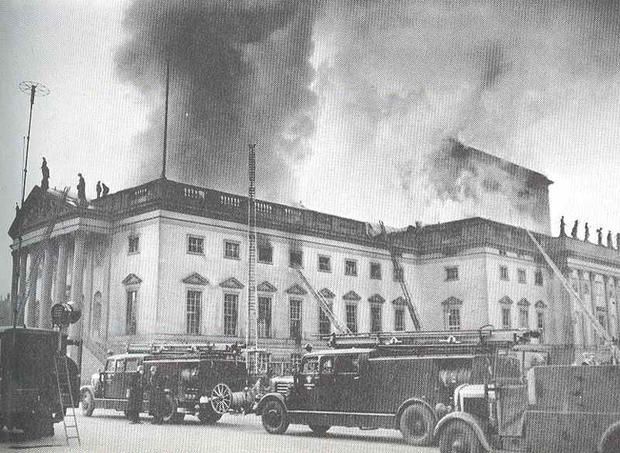
RAF Bomber Command stages another raid on Berlin after dark. It is a fairly average raid as these things go, but this raid affects Adolf Hitler perhaps more than any other during the war. Why? Because some of the bombs drop on the German State Opera House on the Unter den Linden. The building is largely destroyed by fire. Hitler is a huge opera fan, and this is one of the few times that he shows real emotion about an RAF raid. It is the first German theater to be destroyed during the war. Hitler orders reconstruction immediately under the Head of Division Erich Effort from the engineering department of the Prussian Ministry of Finance. The project is not just personal — Hitler hopes to reassure the German populace that everything was fine and victory was still assured.
Berlin
80 aircraft — 36 Wellingtons, 24 Hampdens, 17 Whitleys, 3 Stirlings. 5 aircraft — 3 Wellingtons, 1 Stirling, 1 Whitley — lost. Overnight, RAF aircraft attacked Berlin, Germany, destroying the historical Opera House. It would be restored by 1943, but would again be bombed in February 1945.
Minor Operations: 9 aircraft to Vegesack, 7 to Emden and 3 Hampdens minelaying in the East Frisians. 2 Wellingtons lost from the Vegesack raid and 1 Wellington from the Emden raid. The Wellington lost on the Emden raid was from 12 Squadron, which was flying its first operation with Wellingtons on this night; the pilot was the squadron commander, Wing Commander V. Q. Blackden, who was killed and is buried at Lemsterland in Holland.
U-107, commanded by Kapitänleutnant Günter Hessler, sank British steamer Harpathian (4671grt) in 32-22N, 22-53W. At 0037 hours on 9 April 1941 the unescorted Harparthian (Master John Wharton, MBE), dispersed from convoy OG.57, was hit by two torpedoes from U-107 and sank southeast of the Azores. Three crew members and one gunner were lost. The master, 36 crew members and two gunners landed at Hierro, Canary Islands. The Germans misidentified this ship as the British steam merchant Malancha (8124 grt). The 4,671-ton Harpathian was carrying RAF stores and was bound for Freetown, Sierra Leone.
U-107 later sank British tanker Duffield (8516grt) in 31-13N, 23-24W. At 1920 hours on 9 April 1941 the unescorted Duffield (Master Mariston Manthorpe) was hit by two stern torpedoes from U-107 west-southwest of Madeira. The tanker caught fire, developed a list and stopped, but the flames went out after one minute and the crew managed to get her underway again at 12 knots. The U-boat had to work hard to overtake the fleeing ship for another attack and eventually hit the Duffield amidships and in the bow with two G7e torpedoes at 0308 and 0330 hours, but only the fifth torpedo, fired 15 minutes later, hit the engine room and caused the tanker to break up and sink in flames in 31°13N/23°40W. 25 crew members were lost. The master, 25 crew members and two gunners landed at Hierro Island, Canary Islands. The 8,516-ton Duffield was carrying fuel oil and was bound for Gibraltar.
U-98, commanded by Kapitänleutnant Robert Gysae, sank Dutch steamer Prins Willem II (1304grt), which was straggling behind convoy HX.117, in 59-50N, 24-25W. At 0216 hours on 9 April 1941 the unescorted Prins Willem II (Master Christiaan Anthony van der Eijk) was hit amidships by one torpedo from U-98 and sank by the stern within three minutes. The ship was straggling from the convoy HX.117 since the night of 7/8 April due to thick mist and heavy weather. Three crew members were lost. The survivors abandoned ship in both lifeboats and were questioned by the Germans, but this proved to be difficult due to the strong winds. They apparently misunderstood the name of the vessel and reported their victim as Dutch merchant Willemsplein (5500 grt). The master and eleven men abandoned ship in the starboard lifeboat and rescued one man swimming in the water. They were picked up on 11 April by the Swedish motor merchant Klipparen which unsuccessfully searched for the other boat and eventually landed the survivors in Thorshavn, Faroe Islands. The port lifeboat was launched with seven men and rescued two more from the water. The occupants of this boat were rescued by Tuscan Star on 15 April and taken to Buenos Aires, Argentina. The 1,304-ton Prins Willem II was carrying sugar and was bound for London, England.
Destroyers HMS Electra and HMS Escapade departed Scapa Flow at 2350 to search for a German submarine reported to the westward of the Shetland Islands. The destroyers returned to Scapa Flow at 1900/10th after an unsuccessful search.
Destroyers HMS Brighton and HMS Lancaster, escorting minelayer HMS Agamemnon, arrived at Scapa Flow at 2130 en route to Rosyth. Destroyer Brighton and the minelayer departed Scapa Flow at 1900/10th for Rosyth. Destroyer Lancaster departed Scapa Flow at 0900/10th for Iceland.
Anti-aircraft ship HMS Curacoa departed Scapa Flow at 0730 to provide cover for convoy WN.11 from Pentland Firth to Methil. The ship arrived at Rosyth on the 10th after the escort to May Island for refitting.
Auxiliary minesweeper HMS Marmion (409grt, T/Lt D. MacFarlane RNR) was sunk by German bombing alongside Harwich Pier. The minesweeper was beached on Harwich Hard on 10 May. The ship was refloated on 21 May and berthed at Harwich. She eventually was towed to Tilbury where she was scrapped.
British examination ship D’arcy Cooper (126grt, Second Hand D. Noble) was sunk by German bombing at Harwich. Noble and two other ratings were lost.
British tanker Lunula (6363grt) was badly damaged at Shellhaven jetty in Thames Haven on a mine. Twenty six crew members and two gunners were lost. The tanker was assessed to be a constructive total loss. Tug Persia (165grt) assisted the steamer to shift berth. While assisting the steamer, the tug was damaged on a mine and driven ashore on Blyth Sand.
British fire float Queen was sunk by German bombing during the night of 9/10 April while in dock at Ipswich. The vessel was raised on the 12th.
British fire floats Alert and Greta were badly damaged by German bombing during the night of 9/10 April at Ipswich. Both were declared a total loss.
Motor lifeboat John Pyemont was sunk by German bombing at Tynemouth when the Tynemouth R. N. L. B. I. boathouse was bombed.
British launch Falcon was sunk by German bombing at Harwich.
British steamer Dudley Rose (1600grt) was sunk by German bombing 150 miles four miles from Berry Head. The entire crew was rescued.
Norwegian tanker Buesten (5187grt) was sunk by German bombing four miles 150° from Berry Head. Twenty three crewmen and five gunners were lost on the tanker.
British steamer Kylegorm (622grt) was damaged by German bombing at four miles 245° from St Ann’s Head. The steamer was towed to Milford Haven by a tug.
British tanker British Workman (6994grt) in convoy EC4 was damaged by German bombing in 58-31N, 2-40W. The convoy was being escorted at the time by anti-aircraft ship Alynbank and escort vessel Gleaner. The tanker arrived at Kirkwall on the 10th.
British steamer Aberhill (1516grt) was damaged by German bombing in 54-37N, 00-48W. The steamer arrived at Leith on the 11th.
Norwegian steamer Bjornvik (812grt) was damaged by German bombing four miles 150° from Berry Head. One crewman was killed. The steamer arrived at Dartmouth on the 9th leaking through damage caused by near miss. A delayed action bomb exploded after the ship arrived at Dartmouth.
British tanker British Statesman (6991grt) was damaged by German bombing in Barrow Deep off Harwich.
British steamer Pandorian (4159grt) was damaged by German bombing 140 miles fifteen miles from Duncansby Head.
Aircraft carrier HMS Eagle departed Alexandria, escorted by destroyers HMS Decoy and HMS Encounter, for Port Said in preparation to leaving the Mediterranean through the Suez Canal. The aircraft carrier began moving through the Canal on the 11th.
Gunboats HMS Aphis and HMS Gnat bombarded Bomba during the nights of 9/10 and 10/11 April.
Italian supply convoy departed Naples with transports Andrea Gritti (6338grt), Sebastiano Venier (6311grt), Rialto (6099grt), Birmania (5305grt), Barbarigo (5293grt) escorted by destroyer Dardo and torpedo boats Clio, Cosenz, and Papa, and arrived at Tripoli on the 11th.
Yugoslav destroyer Beograd was badly damaged by the near misses of German air bombs at Sibenik.
Ocean boarding vessels HMS Malvernian and HMS Camito arrived at Gibraltar from Western Patrol.
Corvettes HMS Erica and HMS Snapdragon departed Gibraltar for Freetown en route to Simonstown and the Eastern Mediterranean.
Submarine HMS Upholder made two unsuccessful attacks on shipping off Cape Bon.
In British air operations from Maleme, a Swordfish of 815 Squadron ditched north of Crete. Sub Lt (A) A. W. B. Drayson drowned attempting to swim ashore. T/Sub Lt (A) A. Carroll RNVR, and Leading Airman F. Faulks drifted ashore in a dingy after four days at sea.
British steamer Craftsman (8022grt) was sunk by German raider Kormoran at 00-32N, 23-37W. Six crewmen were lost and forty three were taken prisoner.
Convoy SL.71 departed Freetown escorted by armed merchant cruiser HMS Cilicia that day only and corvettes HMS Clematis, HMS Crocus, HMS Cyclamen, and HMS Clematis to 17 April. On the 10th, light cruiser HMS Mauritius joined the convoy to 23 April. Light cruiser Mauritius was relieved on the 23rd by heavy cruiser HMS London which continued to 29 April. On the 28th, destroyers HMS Leamington, HMS Lincoln, and HMS Sherwood and ocean boarding vessel HMS Malvernian joined the convoy to 4 May. On the 30th, destroyers HMS Rockingham to 2 May, HMS Vanquisher to 5 May, and HMS Viscount to 2 May, sloop HMS Londonderry to 5 May, and corvettes HMS Freesia, HMS Hibiscus, and HMS Pimpernel all to 5 May, and anti-submarine yacht HMS Philante to 5 May joined the convoy, and arrived at Liverpool on 5 May.
Convoy SC.28 departed Halifax, escorted by armed merchant cruiser HMS Chitral. Submarine HMS Talisman joined the escort on the 11th. Battleship HMS Royal Sovereign joined the convoy and was detached on the 20th along with submarine Talisman The submarine arrived back at Halifax on the 26th. The armed merchant cruiser was detached on the 21st. On the 24th, destroyer HMS Scimitar, corvettes HMS Dianthus, HMS Mallow, HMS Marigold, HMS Nasturtium, HMS Periwinkle, and HMS Primrose, and minesweepers HMS Bramble, HMS Hazard, and HMS Speedy joined the convoy. The minesweepers departed that day. On the 26th, corvette Mallow was detached. Destroyer HMS Wanderer joined on the 27th. The escort was detached when the convoy arrived at Liverpool on the 28th.
U.S. Secretary of State Cordell Hull and Danish Minister to the United States Henrik de Kauffman signed an Agreement Relating to the Defense of Greenland whereby the American government agreed to take over the defense of Greenland in exchange for the right to construct air and naval bases on the island. This allowed the United States to establish a protectorate over and occupy Greenland. With the approval of a “free Denmark,” the U.S. would build naval and air bases as counters to the U-boat war.
The Senate Naval Affairs Committee, after a brief hearing today, unanimously approved legislation authorizing President Roosevelt to increase the permanent enlisted strength of the Navy from 230,000 to 300,000 whenever in his judgment a national emergency existed to justify this. The measure, already approved by the House, provides that the authorized number of commissioned officers in the active line of the Navy, exclusive of commissioned warrant officers, shall be 5% percent of the authorized enlisted strength of the active list, and that the authorized enlisted strength of the Marine Corps shall be 20 percent of that of the Navy. The committee also approved a bill authorizing the President to pay time and a half for all work over 40 hours a week performed by civilian employees of the Navy, Marine Corps and Coast Guard.
Legislation permitting the army and navy to take over strike-bound defense plants after mediation had failed was mildly advocated today by William S. Knudsen, director of the office of production management. At the same time, the defense production chief opposed legislation to outlaw strikes, and favored the “cooling off period” system of meeting the problem, the latter enforced, if need be, by law. Knudsen outlined his views to the house military committee after Secretary Perkins had expressed the opinion that jurisdictional strikes were unjustified in defense industries and “most unfortunate at any time.” The committee is investigating the defense program. The labor secretary attributed the current strikes principally to a “rather sudden expansion of employment,” the “efforts of people long without steady work to improve their conditions” and the “resistance of a few employers to the ideas and purposes of contractual relations with their employees.”
While mine owners representing two thirds of the nation’s soft coal production were officially reported yesterday as ready to reopen their mines next week, the United Mine Workers of America let it be known that anthracite mines, mostly in Pennsylvania, employing more than 110,000 men, will be closed at midnight April 30 upon expiration of the current agreement with the owners if a new contract is not negotiated by that time.
Minority strikes and Communist leadership in the labor movement were denounced yesterday by William Green, president of the American Federation of Labor, as “the gravest dangers” menacing national defense production. Mr. Green called upon all A.F. of L. unions to put their reliance in mediation and arbitration and to do everything within their power to avoid strikes that might impede the arms program.
A prolonged night meeting of federal and state mediators with Ford Motor Co. officials and striking C.I.O. union leaders, seeking to end the week-old strike at Ford’s giant Rouge plant, ended shortly after 2 a.m. Thursday with official word that settlement prospects appeared “better than they did (Wednesday).”
Philip Murray, president of the C.I.O., gave President Roosevelt an optimistic report today on the defense labor situation.
The White House revealed today steps to transfer ten Coast Guard Lake-class cutters to the British for use in the Atlantic. The sturdy cutters, of about the same tonnage as destroyers but not as heavily armed or as fast, are expected to be of considerable value to Britain in combating Nazi submarine activities.
[Ed: These ships turned out to be significantly more useful then the earlier, better known transfer of 50 overage destroyers. Better sea boats in the Atlantic, for one.]
Urging American convoys to insure delivery of materials to Britain and her allies, and pledging every effort to awaken this country to the need for “intensive action,” Mrs. J. Borden Harriman, former Minister to Norway, accepted yesterday the vice chairmanship of the Committee to Defend America by Aiding the Allies.
President Roosevelt gave his approval today to “Young America Wants to Help,” a new organization of college students which seeks to mobilize American youth in the drive to send armed assistance to Great Britain.
President Roosevelt and other leaders expressed sorrow today over the death of Senator Morris Sheppard of Texas, the “father of prohibition,” dean of congress and chairman of the important Senate Military Committee. Sheppard, who was 65 years old, died this morning in Walter Reed hospital of a brain hemorrhage. He had served in the house 10 years and in the senate 28. President Roosevelt issued a statement calling Sheppard a “tower of strength” in the national defense.
Methods by which Austrians in the Western Hemisphere could combat “fifth column” activities of German Nazi organizations were described here today by Count Ferdinand Czernin, chairman of the new Austrian Action, in a press conference designed to make known the objectives of the organization.
William Worthington passes away in Beverly Hills, California, age 69. Worthington was a star in silent films, starring, for instance, in “Damon and Pythias” (1914) and other films that were popular at the time. With the advent of talkies, Worthington’s career plummeted, and he spent the last ten or so years of his career in uncredited walk-ons.
LPGA Titleholders Championship Women’s Golf, Augusta CC: Dorothy Kirby wins comfortably by 16 strokes ahead of Helen Sigel.
The PGA establishes the Golf Hall of Fame.
A break in diplomatic relations between Mexico and the axis powers was predicted as “probable” by official sources tonight as a result of Mexico’s expropriation of 12 German and Italian ships. As the Mexican merchant marine colors were hoisted on the vessels in place of the struck axis ensigns, President Manuel Avial Camacho’s decree of expropriation was hailed as one made with full realization that a rupture of relations probably would follow.
Japan’s Foreign Minister, Yosuke Matsuoka, met for more than three hours today with Soviet Premier and Foreign Commissar Vyacheslav M. Molotov. En route back to Tokyo, after state visits to Berlin and Rome, Mr. Matsuoka originally was scheduled to leave Moscow tomorrow. It was understood, however, that he had decided to prolong his stay until Saturday. Mr. Matsuoka said after his first talk with Mr. Molotov that he would prolong his stay here if it would serve “a useful purpose.”
The Battle of Shanggao ended in Chinese victory. The Japanese have been retreating from Shanggao for some time. Today is considered the end of the Battle of Shanggao, as the Japanese make it back to their main base. While the Japanese did not win the battle, they successfully kept the Chinese on the defensive and also avoided repeated attempts to surround them on the way back.
Prince Hiroyasu Fushimi steps down as chief of the Japanese Navy General Staff. However, he remains on the Supreme War Council, though basically he is retired. Hiroyasu is a “moderate” and has qualms about Japanese alignment with Germany via the Tripartite Pact. Admiral Osami Nagano, former Commander-in-Chief of the combined Japanese Fleets and lately the naval member of the Supreme War Council, was appointed to replace him.
It is understood here that there is sharp cleavage in important Japanese circles over Foreign Minister Yosuke Matsuoka’s sojourn in Moscow. The Japanese Army is said to be ranged on one side, while the Japanese financiers and industrialists are taking the other.
Dow Jones Industrial Average: 119.85 (-1.36)
Born:
(Princetta) Kay Adams, American country singer (“I Cried At Your Wedding”, “Little Pink Mack”), in Knox City, Texas.
Al Gafa, American jazz and session guitarist (Dizzy Gillespie; Susannah McCorkle), in New York, New York.
Hannah Gordon, British actress (“Oh Alfie”), in Edinburgh, Scotland, United Kingdom.
Larry Martin, AFL defensive tackle (San Diego Chargers), in Tulare County, California.
Died:
John Morris Sheppard, 65, American politician (Senator-D-Texas, 1913–1941), of a brain hemorrhage.
William Worthington, 69, American actor.
Naval Construction:
The U.S. Navy Accentor-class coastal minesweeper USS Dominant (AMc-76) is laid down by the Gibbs Gas Engine Co. (Jacksonville, Florida, U.S.A.).
The Kriegsmarine (German Navy) Type VIIC U-boats U-445 and U-446 are laid down by F Schichau GmbH, Danzig (werk 1505 and 1506).
The Royal Navy Bar-class boom defense vessel HMS Barbour (Z 169) is launched by Blyth Shipbuilding & Drydock Co. Ltd. (Blyth, U.K.).
The Royal Canadian Navy Flower-class corvette HMCS Moose Jaw (K 164) is launched by the Collingwood Shipyards Ltd. (Collingwood, Ontario, Canada).
The Royal Navy Fairmile B-class motor launch HMS ML 240 is commissioned.
The U.S. Navy Heywood-class transport USS Fuller (AP-14; later attack transport APA-7) [former merchant ship SS War Wave and SS City of Newport News] is commissioned. Her first commanding officer is Captain Paul Seymour Theiss, USN.
The Royal Navy Shakespeare-class minesweeping trawler HMS Laertes (T 137) is commissioned. Her first commander is T/Skipper Joseph Allan Prettyman, DSC, RNR.
The Royal Navy harbor defence motor launch HMS HDML 1033 is commissioned.
The Royal Navy Flower-class corvette HMS Aster (K 188) is commissioned. Her first commanding officer is Lieutenant Commander Eric Hewitt, RNR.
The Royal Navy Hunt-class (Type II) escort destroyer HMS Brocklesby (L 42) is commissioned. Her first commanding officer is Lieutenant Commander George Pepys Huddart, RN.
The Svenska Marinen (Royal Swedish Navy) Göteborg-class destroyer HSwMS Norrköping (J10) is commissioned.
The U.S. Navy battleship USS North Carolina (BB-55), lead ship of her class of 2, is commissioned. Her first commanding officer is Captain Olaf Mandt Hustvedt, USN. The USS North Carolina was the first new U.S. Navy battleship to enter the fleet since USS West Virginia (BB-48) was commissioned in 1923.
 History Diaries