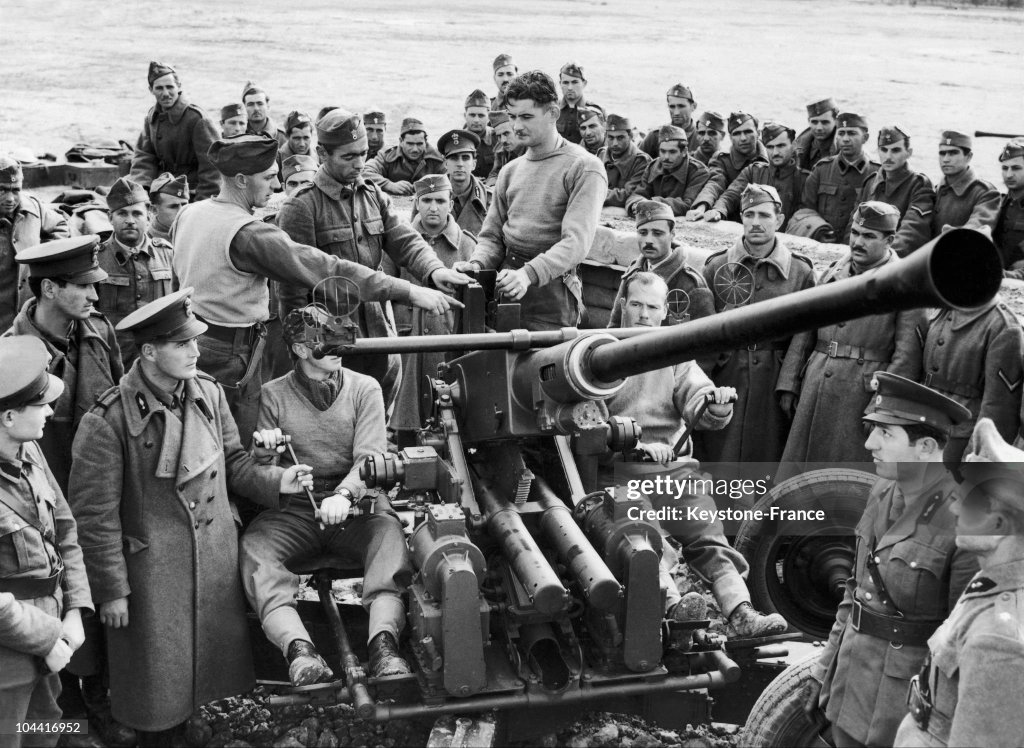
At day’s end, the Germans have broken through the Greek lines along the Bulgarian border, while the Germans have isolated Yugoslavia from the outside world and are in the vicinity of Zagreb and advancing toward Belgrade.
Belgrade is the prize in Yugoslavia, and Ewald von Kleist wants it. He sends his panzers off at 05:30 toward the city from the northwest. They capture Nis in Serbia and head down the Morava Valley toward the capital. The Yugoslav is giving ground everywhere.
German sources reported late today their troops had advanced from Bulgaria and Rumania to Skopje, important Yugoslav military center commanding the head of the Vardar river valley and about 100 miles northwest of Salonika, Greece. Both Skopje and Nis, a key railway center on the Morava river, have been occupied by the Germans, according to unconfirmed reports from Budapest, capital of German-dominated Hungary. The Yugoslav government was last reported to have set up at Vranje, about halfway between Skopje and Nis. The Germans said they were advancing about 28 miles a day.
President Roosevelt sent Peter II of Yugoslavia a message promising that “the United States will speedily furnish all material assistance possible in accordance with its existing statutes. I send Your Majesty my most earnest hopes for a successful resistance to this criminal assault upon the independence and integrity of your country..”
Associated Press reports the Greeks holding firm at Rupel Pass, through which another German armored column was trying to penetrate to the Struma River valley.
German armor advancing through the Dorian Gap pushes back the Greek 19th Division and the British 1st Armoured Brigade is sent to their aid. German units moving down the Axios Valley reach Kilkis late in the evening. The weather on the battlefield is terrible. Snow falls intermittently on the mountains and it is raining in the valleys and sometimes fog envelops the mountains and does not lift until 1000 hours. A force of Australian, British and New Zealand units under Major General Iven Mackay, General Officer Commanding 6th Australian Division, is formed to stop the German advance down the Florina Gap. General Thomas Blamey, General Officer Commanding I Australian Corps, is ordered to prepare for the defense of the Aliakmon line with the Australian 16th Brigade, Greek 12th Division and the New Zealand Division.
The 16th Australian Brigade is hurried forward to the Veria Pass where it begins to take up its positions. The brigade is astride a mountain road some 3000 feet above the sea and troops have to carry their gear, ammunition, and rations, either by hand or on the backs of donkeys. Snow and rain falls on the mountains and for shelter each platoon has a tent-fly which sags under the weight of the snow.
In Athens, the Greek High Command announced: “The Yugoslavia army in southern Serbia is retreating under enemy pressure and thereby exposing the left flank of our brave army. Nevertheless our soldiers are fighting with an incomparable spirit of sacrifice for every foot of the land of our ancestors.”
Some Yugoslav units do see what is going on and take pains to try and prevent it. The 20th “Bregalnička” Infantry Division, part of the 3rd Territorial Army of the Yugoslav army, ties in with the Greeks on the Metaxas Line. It works hard to stop the German 2nd Panzer Division of XVIII Mountain Corps from outflanking the Greek divisions, a task which is vital for the Metaxas Line to have any chance of holding. The 20th Infantry Division, however, can do nothing about the Germans heading due west to the north in what everyone recognizes is a deep flanking maneuver.
Meanwhile, the Yugoslav 3rd Army is fighting well — but headed in completely the wrong direction. While the Germans invade from the north and east, the Yugoslavs are heading… west. In what must have seemed like an extremely clever strategy over holiday dinners, the Yugoslavs intend to defeat the Italians in Albania before turning back around and then dealing with the Germans. This, the strategy posits, would free the mass of the Greek Army stuck in Albania to head east and stop the Germans flooding in from Bulgaria. However, while the Italian Army is weak, it isn’t that weak, and in fact, has been dramatically strengthened for their recently concluded Primavera Offensive. The Yugoslavs are making a high stakes gamble based upon the assumption that the Germans can be held at the frontiers until the Italians surrender — a fatal misreading of the situation.
Two nights of German air raids have wreaked havoc on Belgrade, Yugoslavia; estimates of dead range from 1,500 to 30,000 people.
The German 1st Panzer Group Kleist under General Ewald von Kleist captures Nis (or Nish) in Serbia and advances along the Morava Valley towards Belgrade. The Yugoslav Army in southern Serbia is retreating under enemy pressure and thereby exposing the left flank of the army.
German 2nd Panzer Division crossed from southern Yugoslavia into northern Greece near Dojran Lake. Elsewhere, German 73rd Infantry Division moved into the Monastir Valley and captured Prilep, Yugoslavia and prepared to move south toward Salonika, Greece. This action severed an important rail line between Belgrade and Thessaloniki and isolated Yugoslavia from its allies.
German 6th Mountain Division penetrated the Metaxas Line by crossing a 7,000 feet mountain range.
The German XXX Infantry Corps on the left wing reached its designated objective on when the 164th Infantry Division captured Xanthi, Greece. The 50th Infantry Division had already advanced far beyond Komotini.
Major General John Lavarack assumed the duties of Lieutenant General Philip Neame as the British military governor of Cyrenaica, Libya; Neame was captured by a German patrol on the previous day.
Axis troops captured Mechili, Libya. Surrounded British units in Mechili, Libya attempted to fight their way out but were unable to do so. Mechili falls to the German attacks in the morning and the Germans immediately begin to organize an advance to Tobruk. British Major-General Michael Denman Gambier-Parry, the 2nd Armoured Division HQ, Brigadier Vaughn, and most of the 3rd Indian Motor were taken prisoner.
General Erwin Rommel quickly tasks the Italians with occupying Mechili while the sends the German 5th Light Division troops to help out at Derna. By nightfall, the Germans have taken the Derna airfield, the town itself, and about 800 prisoners. While some British troops still hold out, their cause is hopeless.
With Benghazi, Derna, and Mechili in their pocket, the Germans now can focus on Tobruk. Middle East Commander General Archibald Wavell flies out of Tobruk, but his plane experiences engine trouble (likely due to desert sandstorms) and lands in the desert near Sollum. An armored car picks him up.
An Axis convoy of five freighters departs Naples for Tripoli.
Berlin reports said axis troops including “strong panzer units” had advanced more than 150 miles beyond Benghazi, which they occupied April 4, recapturing Derna and moving on toward Egypt as far as Dsebel el Agbar. Axis occupation of Tobruk, 100 miles east of Derna and only 75 miles from the Egyptian frontier, unofficially was reported to be imminent. Italians noted it took the British six days to capture Derna after they occupied Tobruk January 30, and said the Italian-German advance was moving at a faster rate. Dispatches from Libya indicated the British were retreating rapidly eastward after offering what the Italian high command called strong resistance.
The Italian Stefani News Agency reported: “Motorized German and Italian troops have recaptured the city of Derna.”
Meanwhile, the British still don’t know what has happened to General O’Connor and Lieutenant General Philip Neame, their military leaders in Libya (they are in German custody). As visiting Australian Prime Minister Robert Menzies notes in his diary following discussions at the War Cabinet:
“Balkans bad. O’Connor & Neame missing in Libya. The clouds are dark and there is a lurid patch in the sky — I hope not sunset…. The generals of the War Office are still behind the times. “We have so many divisions” — as if divisions counted. Armour and speed count, and when we catch up to that idea, we will catch up to the Germans.”
Menzies notes that “we hope to make a stand” at Tobruk. Until Neame can be located, Major General John Lavarack assumes his duties.
British forces captured the crucial port city of Massawa and completed the conquest of Italian Eritrea. British, Indian, and Free French troops captured hill forts surrounding Massawa, Eritrea, Italian East Africa. RAF aircraft sank Italian minelayer Ostia in the Massawa harbor; avoiding capture, Italian destroyer Orsini and 12 other vessels were scuttled, leaving the harbor nearly unusable with so many wrecks. Shortly after, British General Heath accepted the formal surrender by Italian Admiral Bonetti and his 10,000-strong garrison. Prior to the surrender, ammunition and supply dumps were destroyed.
The Italians had destroyed the workshops and had scuttled all ships in the harbor and the large floating drydock. The British were anxious to restore Massawa to operation as a working dockyard as it was geographically well-suited to support the RN in the Mediterranean, the current support then being conducted from South Africa, and had been a very modern and well-equipped facility. The British, however, lacked the resources to salvage the scuttled ships and to restore the port to operating condition. The Royal Navy asked the U.S. Navy for support. This was a political hot potato as the U.S. was still at peace and rehabilitating a military base for use by a warring power seemed to be more than a bit of a challenge to the US claims to neutrality. The USN developed a team of salvage personnel to go to Massawa once the White House approved the move but a decision was deferred and was still pending on 7 December 1941. Following the Japanese strike against Pearl Harbor and the declaration of war on the US by Germany and Italy on 10 December 1941, White House approval became a moot point but the team originally intended for Massawa was diverted to Pearl Harbor, along with almost all of the USN’s salvage assets.
At Addis Ababa, the British occupation forces turn their attention to securing their lines of communication back to Asmara. The Duke of Aosta and his Italian and colonial forces now are bottled up in the mountains and no longer poses an immediate threat even as they continue to hold out. However, at some point, the British will have to flush these troops out.
Princess Mary visits Hull.
The Luftwaffe conducted a large air raid using 237 bombers on Coventry, England dropping 315 high explosive bombs and 710 incendiary canisters. In this and another raid two nights later about 475 people were killed and over 700 seriously injured. Among the devastation, the main body of the “new” Christchurch off New Union Street, constructed in 1830-32, is destroyed.
The Gloster E28/39 jet powered prototype made a series of short hops along the Hucclecote airfield runway in Gloucestershire, England, United Kingdom before being dismantled and moved by road to RAF Cranwell in Lincolnshire, England where it was felt that the longer runway would be an advantage for flight tests.
RAF Bomber Command: Day of 8 April 1941
17 Blenheims on coastal operations. Many targets were attacked. There were no losses.
RAF Bomber Command: Night of 8/9 April 1941
Kiel
160 aircraft — 74 Wellingtons, 44 Whitleys, 29 Hampdens, 12 Manchesters, 1 Stirling. 4 aircraft — 2 Wellingtons, 1 Hampden, 1 Manchester — lost and 9 further aircraft crashed in England. The bomber crews claimed another successful raid. From the Kiel reports, it seems that this attack fell more in the town than in the dock areas. A long list of buildings damaged includes a bank, a museum, an engineering college and the gasworks. Gas and electricity were cut off and in some areas the water supply also failed, causing great difficulty. 125 people were killed and 300 injured. This casualty list is believed to be the heaviest of the war so far in a German town. 8,000 civilians and 300 naval personnel were bombed out and large numbers of civilians decided to leave the city by any means possible, including on foot. These two raids on Kiel in consecutive nights were probably the most successful of the war on any target till then.
Bremerhaven
22 Blenheims; claimed good bombing. No losses.
Minor Operations: 10 Hampdens minelaying off Brest and Calais, 5 Wellingtons to Rotterdam, 2 Blenheims to Emden. 1 minelaying Hampden lost.
The weather is poor over Belgrade, so the Luftwaffe’s Operation PUNISHMENT ends today. There is tremendous devastation, but total casualty estimates vary from the as low as 1,500 to 17,000. Later estimates of the extent of the damage also vary wildly, with some stating that half of the housing stock is destroyed. Among many other national treasures, the National Library of Serbia is destroyed, along with its medieval manuscripts and other irreplaceable artifacts.
The Luftwaffe pays Piraeus another visit, which they are doing every day during this period. They previously virtually destroyed the port on the 6th when they scored a lucky hit on ammunition ship Clan Fraser. Today, the Germans damage 7777-ton Greek tanker Ekaterini Coumantarou.
U-107, commanded by Kapitänleutnant Günter Hessler, sank British steamer Eskdene (3829grt) in 34-43N, 24-21W. At 0742 hours on 8 April 1941 the Eskdene (Master William Joshua Thomas), dispersed from convoy OG.57, was hit by two torpedoes by U-107 southeast of the Azores and was sunk by the U-boat with 104 rounds of gunfire. The master and 38 crew members were picked up on the same day by the British steam merchant Penhale and landed at Pernambuco on 22 April. The 3,829-ton Eskdene was carrying coal and general cargo and was bound for Buenos Aires, Argentina.
U-107 later sank British steamer Helena Margareta (3316grt) in 33N, 23-52W. At 1940 hours on 8 April 1941 the Helena Margareta (Master Owen Thomas Jones), dispersed from convoy OG.57, was hit by one torpedo from U-107 and sank about 330 miles west of Madeira. 27 crew members were lost. The master, six crew members and two gunners were picked up on 14 April by the fleet oiler Cairndale (Master Stanley Guy Kent) and landed at Gibraltar five days later. The master Owen Thomas Jones was awarded the Lloyds War Medal for bravery at sea. The 3,316-ton Helena Margareta was carrying ballast and was bound for Takoradi, Ghana.
U-124, commanded by Kapitänleutnant Georg-Wilhelm Schulz, sank British steamer Tweed (2697grt) in 7-43N, 15-11W. At 1225 hours on 8 April 1941 the unescorted Tweed (Master Henry Fellingham), dispersed from convoy OB.296, was hit underneath the bridge by one torpedo from U-124 southwest of Freetown. The ship was missed by a second torpedo two minutes later because she turned, but sank by the bow at 1230 hours. Three crew members were lost. The U-boat surfaced after the attack, approached a capsized lifeboat and took the ten men on it aboard for questioning. While the boat was rightened, the German doctor took care of an injured crew member and they were all allowed to reboard the lifeboat. The master, 25 crew members and two gunners in two lifeboats made landfall at Conakry, French West Africa. The 2,697-ton Tweed was carrying ballast and was bound for Pepel, Sierra Leone.
Destroyer HMS Intrepid, escorted by destroyers HMS Cleveland and HMS Fernie, laid minefield JO in the English Channel. Destroyer HMS Icarus had loaded mines and was due to sail on this operation, but was held back due to vibration experienced between fifteen and twenty five knots.
British tanker Ahamo (8621grt) was sunk on a mine in 53-22N, 00-59E. Fourteen crewmen were missing. Dummy aircraft carrier Mamari (7924grt) was sunk on 4 June when she collided with this wreck in Wold Channel while under attack by German S-boat.
British steamer Cormarsh (2848grt) was damaged by German bombing off Sheringham Buoy near 56A Buoy. The steamer arrived at Hull.
British steamer Chaucer (5792grt) was damaged by German bombing near Humber Light Vessel. The steamer was attacked again on the 9th. The steamer arrived at Hull on the 9th. An Afrika Korps supply convoy of steamers Leverkusen (1273grt), Wachtfels (8467grt), Arcturus (2596grt), Castellon (2086grt), and Ernesto (7272grt) departed Naples escorted by torpedo boats Procione, Cigno, and Orione, and arrived at Tripoli on the 10th without event.
Light cruiser HMS Ajax and Australian light cruiser HMAS Perth departed Suda Bay to cover convoys AG.11 and ASF.24.
At sea on the 8th in the eastern Mediterranean were Convoy AN.25 of nine steamers escorted by anti-aircraft cruiser HMS Coventry and destroyers HMS Jervis and HMS Janus. Convoy AG.11 of six steamers escorted by destroyer HMS Mohawk, Anti-aircraft ship HMS Wryneck, and sloop HMS Grimsby. Two Greek destroyers joined convoy AG.11 to replace destroyer Mohawk. Destroyers HMS Nubian, HMS Hero, and HMS Defender departed Alexandria in company. Destroyers Hero and Defender relieved destroyers Janus and Jervis in convoy AN.25 escort. Destroyers Jervis, Janus, and Mohawk were ordered to Suda Bay. They arrived on the 9th and joined destroyer Nubian there.
Destroyers HMS Encounter and HMS Isis arrived at Suez to join the Mediterranean Fleet. The destroyers and sloop HMS Flamingo arrived at Alexandria on the 9th.
Greek steamer Ekaterini Coumantarou (7777grt) was damaged by German bombing at Piraeus. The steamer was further damaged on 9, 11, and 15 April in bombing.
Mooring vessel HMS Moor was sunk on a mine 270 yards 211° from Ricasoli Breakwater Light Vessel, Malta.
Armed merchant cruiser HMS Bulolo captured French steamer Fort de France (4279grt), which had departed Martinique on the 1st for Casablanca,at 27-39N, 28-06W. The steamer was sent towards Gibraltar under armed guard. French destroyer Fougueux had departed Casablanca on the 7th to escort the steamer into port. On the 10th, light cruiser Primauguet and destroyers Albatros, Simoun, and Frondeur departed Casablanca to intercept the steamer and joined the destroyer Fougueux. Light cruisers Georges Leygues and Montcalm and destroyers Fantasque and Terrible departed Dakar on the 10th to intercept the steamer if it proceeded towards Freetown. Submarines Sidi Ferruch, Aurore, Casablanca, and Archimede departed Casablanca to search. The steamer was stopped on the 12th by light cruiser Primauget and boarded by French destroyer Albatros. The steamer was taken to Casablanca, arriving on the 13th. The prize crew was interned. Anti-submarine trawler HMS Kingston Chrysolite sighted these ships on the 12th in 33-36N, 13-14W. The submarines arrived back at Casablanca on the 14th. The prize crew was later released and arrived at Gibraltar on 18 May. On 23 May, the crew left Gibraltar in destroyer HMS Havelock and arrived at Liverpool on 1 June.
Italian minelayer Ostia was sunk at Massawa by the RAF with all mines still in her racks.
Italian destroyer escort Orsini and motor torpedo boats MAS.204, MAS.206, MAS.210, MAS.213, and MAS.216 were scuttled at Massawa.
Italian steamer Colombo (11,760grt) was scuttled at Massawa. The steamer was later salved.
Italian steamer Clelia Campenella (3245grt) was scuttled at Massawa. The steamer was salved as Empire Prize.
Italian tanker Giove (5211grt) was scuttled at Dulac Island. The tanker was salved as Empire Trophy.
Italian steamer Prometeo (4958grt) was scuttled at Dulac Island. The steamer was later salved.
Italian coastal steamer Sole (15grt) was scuttled at Massawa.
Italian coastal steamer Ardita (19grt) was scuttled at Massawa.
Italian coastal steamer San Giorgio (90grt) was scuttled at Massawa.
Italian coastal steamer Pirano (108grt) was scuttled at Massawa. The steamer was later salved.
Italian coastal steamer Trieste (96grt) was scuttled at Massawa.
Italian coastal steamer Mario M. (18grt) was lost in the Red Sea due to unknown cause.
Convoy ASF.24 of five British ships and supply ship Breconshire departed Piraeus escorted by destroyers HMS Havock and HMS Hotspur, and arrived at Alexandria on the 11th.
President Roosevelt cheered on the fighting Yugoslavs today with a renewed pledge of material aid and with words of admiration for what he termed courageous resistance to a “criminal assault.” In a message to young King Peter II, the first sent by the United States government since the attack on Yugoslavia, the president described the German invasion as “unprovoked and ruthless aggression.” Expressing hope the resistance would be successful; he said the people and government of the United States were “witnessing with admiration the courageous self-defense of the Yugoslav people which constitutes one more shining example of their traditional bravery.”
President Roosevelt today asserted he will ask Congress Thursday for legislation under which Danish ships in American ports would be purchased by the United States government. The chief executive said at a press conference that in this step he had the acquiescence of Denmark’s minister to this country, Henrik de Kauffman, a White House caller earlier in the day. Mr. Roosevelt placed 30 German and Italian ships which have been taken into “protective custody” along with 39 Danish vessels, in a different category. He said that under present conditions the axis ships could be taken over by what he termed forfeiture. The Danish ships, Mr. Roosevelt said, would be purchased outright instead of being acquired otherwise. He implied that other forms of acquisition would apply to the German and Italian ships. As for the legal background of the matter, Mr. Roosevelt remarked that if the federal government, in time of emergency, could take away the yacht of a private American citizen against his will, he thought the government would have the right of eminent domain to take over foreign ships. This could be done under a state of full emergency, he said, although such a condition does not now exist. He added that that was the way he construed the law, although some authorities thought the right existed under the present state of limited emergency. Meanwhile Secretary Hull said Germany has sent a new note reinforcing its protests over the seizure of German merchant ships and crews in the United States.
Viewing a large pickup in disbursements for war equipment as a sign of progress in the American effort to rearm and give aid to Britain and her Allies, President Roosevelt asserted today that results were still far from satisfactory and blamed the human beings involved for the lag.
President Roosevelt meets with General Sikorski, leader of the Polish government in exile.
President Roosevelt asked Americans today to support the United Service Organizations for National Defense, formed yesterday at New York.
The American Institute of Public Opinion (AIPO) asked a cross section of America the following question: “If it appeared certain that there was no other way to defeat Germany and Italy except for the United States to go to war against them, would you be in favor of the United States going into the war?” Yes — 68%, No — 24%, No opinion — 8%.
The body of one member of the crew of a naval patrol bomber which plunged into the sea off Great Machipongo Inlet, Virginia, yesterday was brought into port tonight by a destroyer which had been dragging the sea bottom for several hours. Two officers and eight enlisted men were aboard the big plane which disappeared a few minutes after taking off from here in early morning mists. The recovered body was not identified immediately. Shortly before arriving here, the destroyer reported by radio that she had recovered wreckage near the scene of the crash and was bringing back an inflated life raft and a yellow life preserver. The navy vessel joined coast guardsmen in an unsuccessful search for survivors or bodies in the vicinity of two floating rafts and a yellow life jacket found during the afternoon. One of the rafts was deflated. The destroyer marked the scene with a buoy and began dragging in 30 feet of water.
A total investment of about $3,000,0000,000 of Federal funds in facilities devoted to the production of munitions, airplanes and other materials of war was indicated today by a compilation of information obtained from official sources.
Evans Fordyce Carlson, considered a Far East specialist due to his experience in China, resigned his commission in 1939. Today, he is recommissioned at the rank of Major. Carlson has extensive experience working with Chinese Communist guerillas fighting Japanese invaders.
Two key figures in the labor phase of the national defense drive testified before the House Military Affairs Committee today that, in their opinion, legislation to check strikes was unnecessary and inadvisable. Both Sidney Hillman, associate director of the Office of Production Management, and William H. Davis, vice chairman of the Defense Mediation Board, said that, instead, the promotion of cooperation between management and employees was the preferable course.
Harry Bridges, president of the West Coast International Longshoremen and Warehousemen’s union, asked the group’s annual convention today to oppose his deportation hearing as an “anti-labor move.” In his annual report, submitted in printed form, the union leader also made frequent references to discrimination against aliens, war hysteria and imperialism.
Bridging a gap of thirty-eight years in which the Ford Motor Company has refused to negotiate with any union official, Philip Murray, president of the C.I.O., made an unheralded and dramatic visit here today and conferred on the strike situation with Ford officials and State and Federal mediators.
Declaring that the city “does not and cannot recognize the right of any group to strike against the city,” New York Mayor La Guardia directed the Board of Transportation yesterday to start a court action to test the validity of the labor contracts with the Transport Workers Union and other organizations that the city assumed at the time of unification.
Earle W. Graser perishes in an automobile accident when he apparently falls asleep at the wheel while driving to his radio station in Detroit. Graser, a young radio actor, has played The Lone Ranger since 30 January 1933 — coincidentally, the same date that Adolf Hitler took power. His is the voice that yells “Hi-Yo, Silver” in both the radio and television series and likely the one that most people would recognize.
In his 4th title defense in 9 weeks Joe Louis beats Tony Musto by TKO in the 9th round at the Arena, Saint Louis, Missouri to retain NYSAC heavyweight boxing crown.
President Avila Camacho issued a decree tonight expropriating the 12 German and Italian merchant ships taken in custody by the Mexican navy at Tampico and Vera Cruz. The president ordered the Ministry of the Navy to place crews aboard the 10 Italian and 2 German ships immediately so that Mexico could use them in the coastal and international trade without delay. Under the decree, settlement of claims against the expropriation would be deferred until the end of the European war. The president ordered Foreign Minister Padilla to notify the German and Italian ministers immediately. This action quickly followed Mexico’s flat rejection of those ministers’ requests for the immediate surrender of seized ships. The president said any failure to provide Mexico with a merchant marine by such expropriation would have caused “the national economy to suffer transcendental consequences and the gravest possible injury” as the European conflict has swept the seas clean of the prewar shipping facilities on which Mexico’s foreign trade depended.
A bomb exploded tonight in the offices of the German consulate in the heart of Havana, Cuba. Office furniture was damaged but no casualties were reported. The offices of the “Fascist legion’ are located on the same fourth floor with the German consulate in the Manzana de Gomez building.
Yosuke Matsuoka, Japanese Foreign Minister, has decided to extend his stay in Moscow three days until Sunday. He is on his way back to Tokyo after a visit to Berlin and Rome and was scheduled to leave Moscow Thursday.
French troopship Felix Roussel, carrying Indian troops, departed Singapore. Light cruiser HMS Dauntless escorted the steamer from the vicinity of Penang to 10N, 80E. The troopship arrived at Bombay on the 18th.
Dow Jones Industrial Average: 121.21 (-2.43)
Born:
Peggy Lennon, American singer (The Lennon Sisters), in Los Angeles, California.
Darlene Gillespie, Canadian-American former child actress (“The Mickey Mouse Club”), in Montreal, Quebec, Canada.
Vivienne Westwood, English fashion designer (Vivienne Westwood), in Tintwistle, England, United Kingdom.
Naval Construction:
The Royal Navy Bangor-class (Reciprocating-engined) minesweeper HMS Qualicum (J 138) is laid down by the Dufferin Shipbuilding Co. (Toronto, Ontario, Canada); completed by Montreal-Loco.
The U.S. Navy 77′ Elco motor torpedo boat USS PT-36 is laid down by the Electric Launch Company Ltd. (Elco), (Bayonne, New Jersey, U.S.A.).
The Royal Navy Hunt-class (Type III) escort destroyer HMS Limbourne (L 57) is laid down by A. Stephen & Sons Ltd. (Glasgow, Scotland).
The Royal Navy Fairmile B-class motor launch HMS ML 226 is commissioned.
The Kriegsmarine (German Navy) Type VIIC U-boat U-80 is commissioned. Her first commanding officer is Oberleutnant zur See Georg Staats.
The Royal Canadian Navy Flower-class corvette HMCS Chilliwack (K 131) is commissioned. Her first commanding officer is T/Lieutenant Leslie Lewendon Foxall, RCNR.
 History Diaries