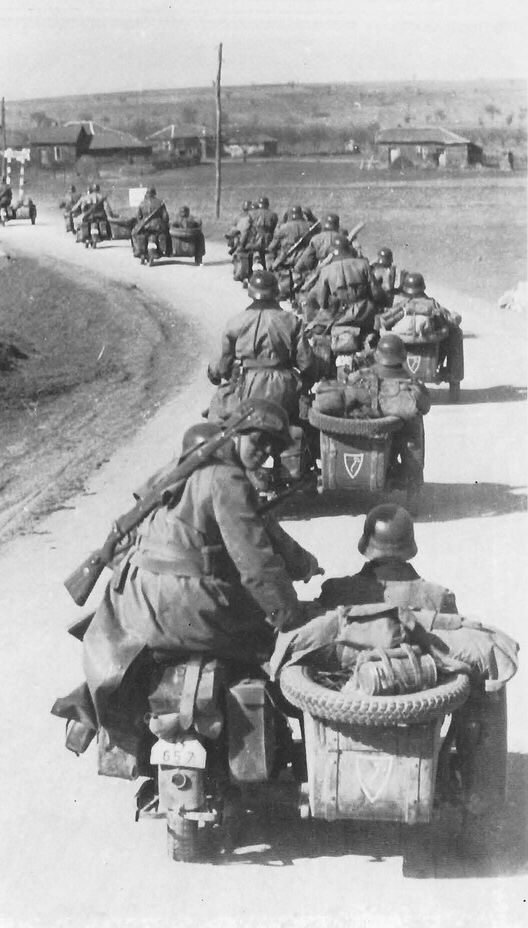
British general Richard O’Connor was captured by a German reconnaissance patrol in North Africa. Before dawn, a motor column containing British military governor of Cyrenaica, Libya Lieutenant General Philip Neame and British Lieutenant General Richard O’Connor got lost and became captured by a German patrol between Mechili and Derna.
The Afrika Korps continues its rampage across Libya. The panzers effectively capture Derna, capturing the airfield and block the Via Balbia — the British position there now is hopeless. At Mechili, reached by the Germans on the 6th, the Afrika Korps twice demands that the remnants of the shattered British 2nd Armoured Division surrender, but the British hold out. Rommel orders his panzers forward (Group Olbrich) for an immediate attack. After a difficult march over harsh terrain, Group Olbrich is in position around Mechili as night falls, ready for a final attack on the 8th. General Rommel is upset at the delay, feeling the attack should have been conducted today. General Johannes Streich, the commander of the 5th Light Division (of which Group Olbrich is a part), claims among other things that yesterday’s sandstorms clogged his panzers’ turrets.
This battle presents a sort of an alternate reality to the majority of World War II. Throughout the conflict, the Allies, via their Ultra decryption service, read many German communications in real-time — in fact, there may be cases when the British read German messages before the intended German recipient does. However, with General Rommel leading from the front and ignoring orders from his supposed Italian commander, the British have very little spy intelligence to work with. On the other hand, the British are retreating in a pell-mell fashion that approaches raw panic. As they go, they are sending radio messages in the clear and on the fly to headquarters identifying their positions — which the Wehrmacht’s intelligence service is reading and forwarding to Rommel.
General Erwin Rommel continues flying in his personal Fieseler Storch observation plane above the battlefield. By doing this, he sees not only where the British forces are, but also exactly where his own forces are — which is a lot more than the British commanders know. The Luftwaffe also helps out, reporting that large British forces are concentrating around Gazala, now the westernmost tip of British control. Luftwaffe transport planes work overtime bringing in supplies to the forces investing Mechili. Supply is a major developing problem for the Wehrmacht, with some troops without rations for four days now — a consequence of unexpected success.
The Germans and Italians spirit Generals O’Connor and Neame out of Libya to imprisonment in Italy.
At Malta, supplies continue to tighten. Food rationing is introduced.
In his diary, visiting Australian Prime Minister Robert Menzies notes after the War Cabinet meeting, with classic understatement: “Things have gone wrong in Libya.”
The German 12th Army under General Wilhelm List crosses the Greek border from Bulgaria and after hard fighting, capture the important Rupel Pass. Facing this force are four Greek divisions and about 30 miles (48 kilometers) away, the British Expeditionary Force of four British and Commonwealth divisions and a Polish brigade. Another three and a half Greek divisions are on the Metaxas Line, a system of fortifications about 100 miles (161 kilometers) long extending from the Beles mountains to the Nestos River.
At 1800 hours on the 6th, the III Staffel of Kampfgeschwader (Bomber Wing) (III./KG 30) equipped with Junkers Ju88s) take off from Gerbini, Sicily, to mine the approaches to Piraeus Harbor. The aircraft of 7./KG 30 led by Hauptmann (Captain) Hajo Herrman carried both bombs and mines and came in to the attack at low-level. Herrman’s aircraft released its bombs on the freighter SS Clan Frazer which, unbeknown to the German crew, still had 250-tons of high explosives on board. With a shattering explosion of almost nuclear proportions, the ship blew up at 0330 hours on the 7th, destroying in the holocaust 12 other ships totaling 51,569 tons, in addition to 60 light sail boats and 25 motor sailors, and making the port of Piraeus unusable for many weeks. The defenses were temporarily shattered, and then one anti-aircraft gun suddenly opened fire, putting Herrman’s port engine out of action. With great skill Herrmann managed to land his aircraft at Rhodes which had recently fallen to the Italians.
German armored divisions and parachutists dropped behind Greek lines were reported today to have broken through to the Aegean Sea in western Thrace to split Greece from her potential ally, Turkey. With this southern anchor, Nazi troops were strung out in a long irregular line extending some 750 miles northward to Yugoslavia’s border with Hungary and old Austria and the vast bloody battlefront threatened to engulf every Balkan nation.
The Wehrmacht continues grinding forward in Yugoslavia against very light opposition — and often none at all. The XL Panzer Corps continues skidding across southern Yugoslavia at a lightning pace. Exactly when particular areas fall is difficult to ascertain, as the Germans are simply driving east as fast as they can. Yugoslavian troops were forced to withdraw to southern Macedonia when the Germans captured Skopje, exposing their flank. German 2nd Panzer Division had reached Strumica, Yugoslavia by the end of the day, which was only 10 miles from the Greek border, from which point it would be able to bypass the Metaxas Line defenses, where German troops conducted a failed frontal assault on this day. The United Kingdom promised aid to Yugoslavia and broke off relations with Hungary; meanwhile, RAF bombers conducted a raid on Sofia, Bulgaria.
The Yugoslav Army counterattacks against the northern flank of the XL Panzer spearhead but fails to make any progress.
In the north, General Maximillian Baron von Weichs continues moving south with his 2nd Army. The Hungarians occupy territory north of the Danube that was lost in the treaties ending World War I.
Along the coast, the Italian 2nd Army under General Ambrosio makes a lunge south from the Trieste region. The Yugoslav 3rd Army attacks with five infantry divisions (13, 15, 25, 31 and 12 Divisions) in northern Albania west toward Elbasan, apparently to help the Greek Army conquer the Italians. This makes sense in the context of the Yugoslavs having watched the Italian/Greek conflict for months and contemplating how they could help the Greeks, and perhaps was a standing plan for the eventuality of hostilities with Italy. In the abstract, freeing the Greek forces to shift east would help the Allies to form a front there, but it assumes that the Yugoslavs can hold off the Germans while that plan plays out — a very risky bet.
The Luftwaffe continues pounding Belgrade in Operation Punishment. The Luftwaffe has complete command of the skies, but estimates of each side’s losses during the battle vary widely and are completely unreliable. This is the climax of the Luftwaffe’s attack on the capital. Estimates of Yugoslav casualties in Belgrade also vary widely and are completely unreliable, ranging from 1500 to 17,000, with the official figure 2,271.
Fires from yesterday’s raid burn out of control, creating giant plumes of smoke and guiding follow-up raids to the city. The main targets hit today include the main railway station and a pontoon bridge across the Danube east of the city. The rail line is the major means of international communication from Belgrade, and XL Panzer Corps already has cut the mainline to Greece around Prilep. The Stukas also continue their work on the Yugoslav Air Force, which essentially has been missing in action, with many of its planes destroyed on the ground.
Dr. Ante Pavelic, Croat nationalist leader who was charged with plotting the assassination of Yugoslav King Alexander Oct. 9, 1934, pledged Premier Mussolini the support of his followers today in a telegram from his haven in Turin, Italy. Croatian exile Ante Pavelic continues his broadcasts from Florence. He calls on Croats, who by and large are sympathetic to Germany, to resist the central government and set up their own state Naturally, Pavelic has some ideas on who might lead such an independent Croatian government.
At this stage of the invasion, Greece remains of secondary importance while the Wehrmacht carves up Yugoslavia. The Wehrmacht has attacked the incomplete Greek Metaxas Line on the Bulgarian/Greek border, with the British positioned further back. The German XVIII and XXX Corps are leading the attack.
A simple glance at the map, however, shows that the panzers at Skopje are perfectly positioned to turn south and head toward Thessalonica (Thessaloniki). This would cut off the Greeks on the Bulgarian frontier and the British expeditionary force on the Aliakmon River line. Strategically, the German 12th Army under the command of Field Marshal Wilhelm List is best off by just keeping the Allied forces in place while they are enveloped to the west.
However, that does not mean that the Bulgarian/Greece front is quiet, and suggesting that does the men fighting there a huge disservice. Soldiers are fighting and dying there just like they are in Yugoslavia — in fact, given the ease of the German invasion of Yugoslavia, there may be more soldiers dying in Greece at any particular time. The Germans make progress on the western flank.
The people at the port of Piraeus continue picking up from the events of the 6th. Then, the harbor was rocked on the first day of the invasion when ammunition ship Clan Frazer blew up, sinking and damaging over a dozen ships. The dock facilities, which have been used to bring in British troops, are completely wrecked and the Royal Navy withdraws its remaining ships from the port to Suda Bay, Crete.
In Athens, the Greek High Command announced: “Throughout the day bitter fighting has ensued near the Greek-Bulgarian border, especially around the Beles Mountains and in the Struma valley.”
Stuka dive bombers aided the German advance on Greece in the Struma valley sector Sunday, bombing with “extraordinary effect,” the official DNB news agency said today.
The Luftwaffe sank 12 ships in an attack on the Greek port of Piraeus.
Britain severed diplomatic relations with Hungary, saying it had “become a base of operations against the Allies..”
Greece breaks diplomatic relations with Bulgaria and Hungary.
The South Africans consolidate their control over Addis Ababa. The Polizia dell’Africa Italiana (Police of Italian Africa) remain on patrol in the city with their approval. At Massawa, the British once again call on Italian Admiral Bonetti to surrender, but he refuses. The 7th Indian Infantry Brigade Group, 10th Indian Infantry Brigade, and a tank squadron prepare to assault the port on the 8th.
The Royal Navy is standing offshore bombarding Massawa in Operation ATMOSPHERE, but Admiral Bonetti still has naval forces at his disposal. He sends Italian MAS 213 (torpedo boat) out after dark to shoo the British off. The Italians torpedo light South African cruiser HMS Capetown, badly damaging its stern and killing four sailors. The Capetown must be towed to Port Sudan, and later to Bombay. The repairs will take until July 1942.
General Montgomery is appointed commander of British 12 Corps, responsible for the defense of the southeast British coast, covering Kent and Sussex. General Bernard Law Montgomery, aka “Monty,” is appointed commander of XII Corps. This is a key command, responsible for the Kent/Sussex sector in southeast England. With invasion fears running wild as spring approaches, this is a key vote of confidence. Montgomery immediately institutes a training program for all ranks and begins sacking officers he believes are incompetent.
Invasion fears are mounting. The Admiralty for some reason fears a major Luftwaffe raid on Scapa Flow in northern Scotland, so it orders the Home Fleet to sail. There is no air raid, and the ships return.
On Budget Day in the United Kingdom, Chancellor of the Exchequer Kingsley Wood presented an innovative plan modeled after Keynesian economics that used taxation and forced savings to attack an estimated £500 million “inflation gap”. Wood increased taxes by £250 million and projected a deficit of £2.304 billion, almost identical to the previous year’s deficit of £2.475 billion. British newspaper editorials generally found the wartime sacrifices asked for in the budget to be reasonable and the stock exchange also took the news of the budget well. For the first time in British history, a majority of the population was liable to income tax. The British government raised the standard rate of income tax was today raised by 1/6 to ten shillings in the pound (50%). Personal allowances and tax exemption limits are also drastically reduced. Money raised by the cuts in allowances will be treated as compulsory savings, to be repaid through Post Office savings accounts after the war. Steps to peg the cost of living have been promised.
Vichy French leader Petain makes a radio broadcast demanding complete obedience from the French people.
Berlin radio reports that Allied shipping losses for March 1941 totaled 718,000 tons. Losses indeed were high for the month, but that is about double the actual amount. The broadcaster also does not mention the 5 U-boats lost during the month. Excessive shipping claims by the Germans become a running joke, especially among Allied POWs who keep running totals and show that, if the claims were remotely true, the entire Allied fleet of vessels would be at the bottom of the sea.
The British forces at Habbaniyah in Iraq are growing increasingly worried about the change in government from a pro-British to pro-Axis orientation. Whitehall telegrams Middle East Commander General Archibald Wavell asking him what troops he can spare for Iraq. Wavell responds that, given operations in both Libya and Greece, all that he can spare is a battalion.
In an attempt to combat the growing losses suffered at the hands of radar equipped night fighters and AA guns the Luftwaffe simultaneously attack a number of targets stretching all the way from the southern coast to Scotland. The Luftwaffe remains active on the Channel Front despite the fact that numerous formations have been withdrawn to support Operation MARITA. There are several different attacks that leave a lasting impression.
The Luftwaffe sends 179 bombers against Glasgow and 43 against Liverpool and Greenock. These attacks begin around 23:05.
A Heinkel He 111 equipped with X-Verfahren direction-finding equipment guides a small group of bombers from KG 54 and 55 to attack Bristol and Avonmouth after 21:00. A Beaufighter of RAF No. 219 Squadron shoots down a Heinkel from 1,/KG 55.
It is the first night of the “Belfast Blitz.” This is not the first raid on Belfast, but it apparently is the first intentional bombing of the city. The Germans bomb the docks and also hit nearby residential areas. It is a small attack by half a dozen bombers and causes — by Blitz standards — only light damage, including destroying a factory used to manufacture fuselages for Short Stirling bombers. There are 13 deaths. The Luftwaffe loses a plane, but the pilots are delighted that the air raid defenses are relatively light.
The Gloster E28/39 jet powered prototype piloted by Chief Test Pilot P.E.G. Sayer commenced taxiing trials at Gloster’s Hucclecote airfield in Gloucestershire, England, United Kingdom. This version does not include a fully working jet, the key component of any jet fighter, but the engine provided can power the aircraft sufficiently to make short hops off the ground. A Power Jets W.1 engine is just about ready for delivery to the airfield for full flight tests.
RAF Bomber Command: Day of 7 April 1941
25 Blenheims to Dutch and Danish coasts. Several ships were attacked and 8 aircraft bombed industrial targets at Ijmuiden. 1 aircraft lost.
RAF Bomber Command: Night of 7/8 April 1941
Kiel
229 aircraft — 117 Wellingtons, 61 Hampdens, 49 Whitleys, 2 Stirlings — on the largest raid to one target so far in the war. 2 Wellingtons and 2 Whitleys lost. Visibility was perfect and bright moonlight toned down the intensity of searchlights. The raid lasted nearly 5 hours and, at the end of it, the Kiel electric-light supply failed. Numerous fires were started requiring outside reinforcement of the fire services. Widespread damage of naval, industrial and civilian housing was caused. Particular damage is reported in the eastern dock areas and the night shifts at the Deutsche Werke and at the Germania Werft, both making U-boats, were sent home during the raid and both yards were out of action for several days. A fire in a naval armaments depot burnt for 2 days. 88 people were killed and 184 injured.
Bremerhaven
24 Blenheims. No losses.
Minor Operations: 9 aircraft to Emden, 2 O.T.U. sorties. No losses.
RAF planes bomb Sofia, Bulgaria, in retaliation for enemy raids on Belgrade.
British authorities expected an air raid on Scapa Flow during the night and ships were ordered to sail. Battleship HMS Prince of Wales, escorted by destroyers HMS Electra and HMS Escapade, departed Scapa Flow. Destroyer HMAS Nestor, which had departed Scapa Flow for Greenock earlier, was recalled and joined the escort. Also sailing were heavy cruiser HMS Exeter, light cruiser HMS Arethusa, and anti-aircraft ships HMS Curacoa, HMS Pozarica, and HMS Springbank. When no raid materialized, the ships returned to Scapa Flow during the morning of 8 April. Destroyer Nestor continued to Greenock, arriving at 1116 on the 9th.
Convoy OB.307 departed Liverpool, escorted by destroyers HMS Keppel and HMS Venomous, corvettes HMS Dianella, HMS Kingcup, and HMS Sunflower, anti-submarine yacht HMS Philante, and anti-submarine trawlers HMS Lady Elsa, HMS Man O’ War, and HMS Northern Dawn. Destroyer Keppel was detached on the 11th. The remainder of the escort was detached on the 13th when the convoy dispersed.
Anti-aircraft ship HMS Alynbank departed Scapa Flow at 1000 to carry out exercises prior to joining convoy WN.10 in the Pentland Firth. The convoy was covered to Methil. Off May Island at 0245/9th, convoy EC.4 was joined. Ship Alynbank arrived back at Scapa Flow at 0030/10th.
Minesweeping trawler HMS Roche Bonne (258grt, Chief Skipper W. R. Settlefield RNR) was sunk by German bombing eight miles south, southeast of the Lizard. Settlefield and nine ratings were lost. One rating died of wounds.
U-124, commanded by Kapitänleutnant Georg-Wilhelm Schulz, sank British steamer Portadoc (1746grt) in 7-17N, 16-53W. At 1739 hours on 7 April 1941 the unescorted Portadoc (Master John Evan Jones) was hit by one torpedo in the stern from U-124 about 150 miles southwest of Freetown. The ship settled by the stern but did not sink, so the U-boat surfaced at 1750 hours and shelled her with 21 rounds from the deck gun and the 20mm AA gun. The master and 19 crew members had abandoned ship in two lifeboats and were provided with water after being questioned. The survivors made landfall six days later at Benty, French Guinea and were interned by the Vichy French authorities. The 1,746 ton Portadoc was carrying ballast and was bound for Freetown, Sierra Leone.
British steamer Elisabeth (945grt) was sunk on a mine five miles east, southeast of Porthscatho, S. E. Cornwall. Ten crewmen were lost.
British trawler Sylvia (213grt) was sunk by German bombing in 61-27N, 5-48W. One crewman was lost on the trawler.
British steamer Kirnwood (3829grt) was damaged by German bombing in 51-47N, 1-30E.
Greek steamer Kyrapanagia II (1012grt) was sunk by German bombing at Piraeus.
Italian motor torpedo boat MAS.213 departed Massawa and at 2315 torpedoed light cruiser HMS Capetown which was bombarding the port in Operation ATMOSPHERE. The light cruiser’s stern was badly damaged. Four ratings were killed. Destroyers HMS Kimberley and HMS Kingston came into the area to assist. The sloop was towed to Port Sudan by sloop HMAS Parramatta and escorted by Indian sloop HMIS Indus, arriving on the 10th. The cruiser was towed on to Bombay for repair. She arrived on 20 May in tow of tug Taikoo and escorted by special service vessel Botlea. Repairs were completed in July 1942.
Convoy BN.23 departed Suez, escorted by sloop HMIS Hindustan Sloop HMS Shoreham joined on the 8th. Sloop Hindustan was detached on the 10th and sloop Shoreham on the 11th. The convoy arrived at Suez on the 13th.
Convoy BS.23 departed Suez, escorted by sloop HMS Clive. Sloops HMIS Hindustan and HMS Shoreham joined on the 11th. Sloops Clive and Hindustan were detached on the 12th. The convoy was dispersed on the 14th.
New Zealand Division light cruiser HMS Achilles departed Wellington with Australian heavy cruiser HMAS Australia and light cruiser HMAS Hobart escorting two liners to Australia. On the 10th, the New Zealand cruiser departed the convoy and put into Jervis Bay, NSW.
German tanker Nordmark replenished U-105 and U-106 at sea prior to the submarines proceeding to Rio de Janiero to escort German steamer Lech (3290grt). In mid-April, submarine U-105 is detached from this duty and proceeded to Freetown.
In Washington, D.C., today, President Roosevelt conferred with Governor Lehman of New York, James C. Bonbright of the New York State Power Authority, Leland Olds, chairman, and William S. Youngman Jr., member of the Federal Power Commission on the St. Lawrence power project and received the Irish Minister, who presented General Frank Aiken.
The Senate heard discussion of the defense labor situation, received the Thomas-Harrison bill for Federal grants for education in States where population increases due to the defense program have caused congested conditions in schools, and recessed at 1:29 PM until noon Thursday.
With the House in recess, its Military Affairs Committee began an inquiry into the defense program, hearing Mrs. Frances Perkins, Secretary of Labor, and John D. Biggers.
John D. Biggers, production chief of the Office of Production Management, told the House Military Affairs Committee today that America was “just about 100 days from the beginnings of real mass production of many vital items,” and appealed to industry and labor to make the most of “these precious” days. Secretary Perkins was another witness at the first hearing held by the committee in its investigation of the defense program. Miss Perkins inferentially opposed anti-strike legislation, and called upon both industry and labor to cooperate in the defense program.
The U.S. soft coal industry, in which 90 percent of the mines have been idle for a week, continued to be virtually paralyzed tonight as labor and management failed to break their wage dispute deadlock, after being on the verge of agreement. Negotiations will be resumed at 2:30 PM tomorrow. A new contract, covering 330,000 United Mine Workers of America (C.I.O.) in the 8-state Appalachian area and indirectly affecting 120,000 others in outlying states, was expected today, but a rift between northern and southern operators over local wage conditions postponed settlement.
Acting with unprecedented speed because of the importance of both companies to the nation’s all-out defense effort, the National Labor Relations Board today ordered collective bargaining elections among workers at the Ford Motor Company’s River Rouge and Lincoln plants near Detroit and the Bethlehem Steel Corporation’s plant at Lackawanna, New York. The three plants have about 100,000 employees. About 85,000 production, maintenance and clerical employees in Ford’s struck Rouge plant will vote within forty-five days in the largest single NLRB election in history and say whether they want to be represented by the United Automobile Workers, C.I.O., an American Federation of Labor Federal local union or neither; about 3,000 workers at the Lincoln plant will make the same choice.
Reflecting the great industrial acceleration in the defense effort, the number of workers in occupations covered by the old-age and survivors insurance system Jumped by almost 2,700,000 in the last three months of 1940, compared with the similar period of 1939.
The United States Supreme Court refused today to order a review of a decision upholding the California railroad commission in restraining Consolidated Freightways, Inc., from charging transportation rates less than the minimum established by the commission. Consolidated Freightways, in asking for a review, appealed from the California Supreme Court which upheld the commission order.
Moves by the Department of Justice to break up disputes between labor organizations and prevent certain other union tactics were thwarted when the Supreme Court held today that its recent decision in the Hutcheson case precluded its interference with union quarrels and practices involved in cases from Chicago, New Orleans and Washington State.
Lieutenant General Walter C. Short, Hawaiian Department Commander of the Army, asked the civilian population of the Territory of Hawaii today to organize for defense and evacuation of non-combatants in event of emergency.
The U.S. Navy transferred 3 battleships, 1 carrier, 4 light cruisers, 18 destroyers, and other ships from the Pacific Fleet to the Atlantic Fleet.
The U.S. Naval Operating Base, Bermuda, is established, Captain Jules James, USN, commanding. American TG 72, which departed the New York Navy Yard on the 6th, arrived at Bermuda on the 8th with aircraft carrier USS Ranger (CV-4, Flagship of Rear Admiral Arthur B Cook), heavy cruisers USS Tuscaloosa, USS Wichita, and destroyers USS Kearney and USS Livermore. These vessels are to be based here as the Central Atlantic Neutrality Patrol. These forces will be considerably increased by three battleships and two carriers later in April and during May and June.
The Gallup opinion research firm publishes the results of a poll. The question posed is:
“Which of these two things do you think it is more important for the United States to try to do — to keep out of the war ourselves, or to help England win, even at the risk of getting into the war?”
Of the respondents, 67% prefer to help England win. This is a 7% increase from a similar question asked in January 1941.
Mexico flatly rejected tonight requests of Italy and Germany for the immediate surrender of the 12 Axis merchant ships seized in Mexican ports. The German request became known only tonight when a foreign office statement showed Germany had filed four separate protests. In almost identical notes to German Minister Rudt Von Collenberg and Italian Minister Count Alberto Marchetti, Foreign Minister Ezequiel Padilla declared: “To withdraw from these ships and place them, without restrictions, below the authority of their captains, not only would involve danger for the security of these vessels, but would represent a threat to the safety of this country’s maritime traffic.”
Nationalist leader Chiang Kai-shek, in an appearance before the Executive Yuan, vows to cooperate with the Communist military — temporarily. He previously has ordered his troops to attack the Communists when they come to close to his own sphere of control, but now changes his tune:
“…these border imbroglios are mere secondary questions. We can’t worry too much over such trivialities. As the international situation improves, they will automatically be settled. Let’s wait at least until we get a definite assurance from England and the United States before we clamp down on the Communists.”
Japanese Foreign Minister Yosuke Matsuoka’s “sudden” departure homeward from the European axis capitals was coupled today with reports that Thailand may join the axis and sharpen the crisis in the Pacific, centering on Singapore.
Japanese Foreign Minister Yosuke Matsuoka saw Premier and Foreign Commissar Vyacheslaff M. Molotoff late today for what he had said in advance would be a general discussion of Russo-Japanese relations. Tomorrow he will be guest of honor at a luncheon at Spasso House, the official residence of United States Ambassador Laurence A. Steinhardt.
Japan’s foreign policy continues to be based upon the Three-Power Pact with Germany and Italy, Premier Fumimaro Konoe told the opening session of the annual conference of provincial governors today. In a general explanation of the policies of the government Prince Konoe told the governors that his Cabinet is determined “to solidify more and more our cooperation with friendly nations in order to restore world peace as soon as possible.” The empire faces a grave situation at home and abroad, the Premier said, urging the governors to carry home to the people the need for basic reforms in all phases of “our national structure.” The conference, at which an effort will be made to obtain full support of the provincial bureaucracy for the government’s program, will continue for eight days.
Dow Jones Industrial Average: 123.64 (-0.68)
Born:
Cornelia Frances [Zulver], British-Australian actress (“Home and Away”, “Sons and Daughters”), in Liverpool, England, United Kingdom (d. 2018).
Gorden Kaye, British actor (“Allo Allo”), in Huddersfield, England, United Kingdom (d. 2017).
Naval Construction:
The U.S. Navy PC-461-class (173-foot steel hull) submarine chaser PC-484 is laid down by the Consolidated Shipbuilding Corp. (Morris Heights, New York, U.S.A.).
The Kriegsmarine (German Navy) Type IXD2 U-boat U-182 is laid down by AG Weser, Bremen (werk 1022).
The Kriegsmarine (German Navy) Type VIIC U-boat U-609 is laid down by Blohm & Voss, Hamburg (werk 585).
The Royal Navy Hunt-class (Type II) escort destroyer HMS Bramham (L 51) is laid down by A. Stephen & Sons Ltd. (Glasgow, Scotland). She will be transferred to the Royal Hellenic (Greek) Navy in 1943, becoming the RHS Themistocles (L 51).
The Sjøforsvaret (Royal Norwegian Navy) Fairmile B-class motor launch HNoMS ML 210 is commissioned.
The Royal Navy Fairmile B-class motor launch HMS ML 229 is commissioned.
The Royal Navy Isles-class minesweeping trawler HMS Canna (T 161) is commissioned. Her first commanding officer is T/Lieutenant Gerald Charles Leonard Payne, RNVR.
The Royal Navy Flower-class corvette HMS Woodruff (K 53) is commissioned. Her first commanding officer is Lieutenant Richard Valentine Smith, RNR.
 History Diaries