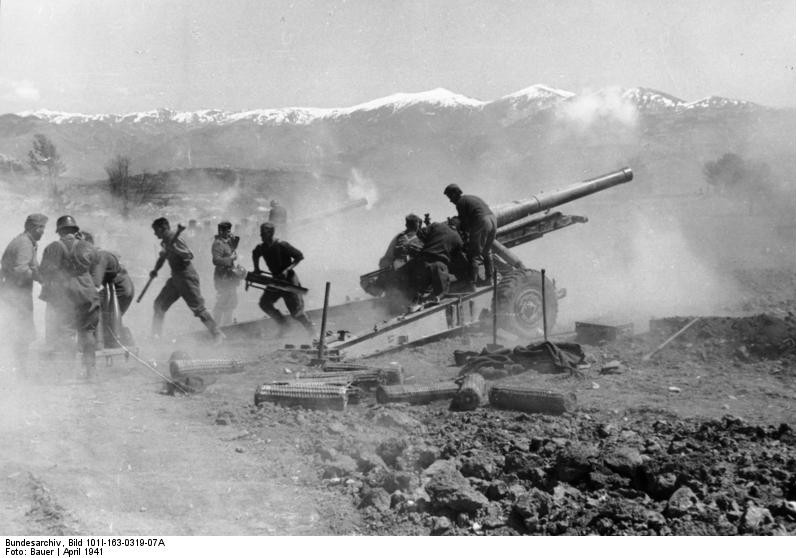
Operation PUNISHMENT (Unternehmen Strafgericht) began with the Luftwaffe opening the assault on Yugoslavia by conducting a saturation-type bombing raid on the capital city of Belgrade. Before dawn, German, Hungarian, and Italian forces invaded Yugoslavia from Austria, Rumania, Bulgaria, and Albania.
At 0515 hours, the Luftwaffe’s Luftlotte 4 (General Lohr) consisting of 210 fighter, 400 bombers and dive bombers and 170 reconnaissance aircraft, launches a heavy attack (Operation CASTIGO) on Belgrade even though it has been declared an open city by the Yugoslav government. The Yugoslav Air Forces has 400 aircraft consisting of 144 fighter, 160 bomber and 40 reconnaissance aircraft. Belgrade is bombed by 150 bombers escorted by fighter flying from bases in Austria and Rumania.
The first strike is made in three waves consisting of 484 sorties. The attack was an act of terror resulting in the death of some thousands of civilians (sources vary from around 2,000 to 17,000 or more) — the largest number of civilian casualties in a single day since the start of the war. Making the slaughter all the worse was that nearby towns and villages had emptied out into the capital city to celebrate Palm Sunday. All of the airfields are also bombed and 600 aircraft are destroyed on the ground. Included in the air assaults on Greece and Yugoslavia are I, II and III Staffel of Kampfgeschwader (Bomber Wing) 2 and III/KG 3 equipped with obsolete Dornier Do 17s; three dive bomber wings, I and III Stukageschwader 2 under Oberst (Colonel) Oskar Dinort and I/St.G 3 under Oberstleutnant (Lieutenant Colonel) Heinrich Eppen, fly their Ju 87B Stuka in devastating attacks on the Greeks and Yugoslavs. These units are later joined by St.G 77.
US Secretary of State Cordell Hull weighs in on the German invasion, calling it “barbarous.” The Yugoslavian military attaché in Washington asks for as much immediate support as possible, including 700 aircraft, 100 tanks and so forth. The US is not in a position to supply anything immediately.
The German 2nd Army under General Maximillian von Weichs advances towards Belgrade from Austria while the Panzer Group Kleist under General Ewald von Kleist advances from Bulgaria towards Nis in the north and Skopje and Monastir in the south to prevent Yugoslav troops with joining up with the Greeks. The 2nd Panzer Division (XVIII Mountain troops) entered Yugoslavia from the east on and advanced westward through the Strimon Valley. It encountered little enemy resistance, but was delayed by road clearance demolitions, mines, and muddy roads. The Yugoslav Army, which is antiquated and riven by dissent, mutinies and inefficiency, consists of 28 infantry and three cavalry divisions but only five infantry and two cavalry regiments resist the German invasion, due to their national compositions — they were mostly Serb, Montenegrin and Albanian.
The Battle of the Metaxas Line began.
At dawn Germany began Operation MARITA (Unternehmen Marita) when the XL Panzer Corps crossed Greece’s border with Bulgaria at two separate points. The offensive on Greece begins with an assault by the German 18 Corps on the Greek left flank. This is followed by an attack by the German 30 Corps on the right flank of the Greek Army of Eastern Macedonia under General Bakopoulos. German, Hungarian, and Italian forces invaded Greece from Bulgaria. Unlike the success in Yugoslavia, the invasion was slowed by Greek and British troops at the Metaxas Line. After sundown, a Luftwaffe raid on Piraeus, Greece, got an unexpected boost when the ammunition ship Clan Fraser was hit, with the resulting blast doing more damage to the port facilities than the aerial bombs dropped by the Germans; the explosion also caused the sinking of 11 other freighters.
Wehrmacht units include the 12th Army, with the 2nd Army expected to add support shortly.
In the east, the German Army’s 12th Army under General Wilhelm von List moves into Greece from Bulgaria and attacks the Greek Army of Eastern Macedonia (Lieutenant-General Konstantinos Bakopoulos) on the Metaxas Line in Macedonia. The west of the Metaxas Line is attacked by the German XVIII Corps while the east of the line is attacked by the German XXX Corps. The troops of British General Henry Wilson, General Officer Commanding W Force, man the Aliakmon Line consisting of three Greek divisions, the New Zealand Division, the Australian 6th Division and the British 1st Armoured Brigade.
There are also 15 Greek divisions in Albania, 3 divisions on the Metaxas Line on the Greek-Bulgarian border, in eastern Macedonia and Thrace and the remaining divisions with the British on the Olympus-Aliakmon line in central Macedonia, stretching from Mount Olympus to the Yugoslav border.
Yugoslavia had 28 infantry and 3 cavalry Divisions. Only 5 infantry and 2 cavalry divisions resisted, not due to geographical location but due to their national compositions — they were mostly Serb, Montenegrin and Albanian.
Secretary of State for Dominion Affairs Anthony Eden and General John G. Dill conferred with General Archibald P. Wavell, Commander-in-Chief, Mediterranean, Admiral Andrew Cunningham, and Air Marshall Sir Arthur Longmore in Cairo about the Mediterranean situation.
In Berlin, Von Ribbentrop tells the Yugoslav envoy that “a clique of conspirators” had prevented Yugoslavia from joining the Axis which would have ensured “a happy future for the Yugoslav people.”
Hitler addresses his armies: “Soldiers of the southeast front: Since early this morning, the German people are at war with the Belgrade government of intrigue. We shall only lay down arms when this band of ruffians has been definitely and most emphatically eliminated and the last Briton has left this part of the European continent, and these misled people realize that they must thank Britain for this situation.”
Hitler reveals his real reason for Operation Marita in this order’s opening paragraph. The Yugoslavs and Greeks pose no threat to Germany. However, Hitler worries about the British presence in that region of the continent. His worry is not about British land forces, but rather the RAF — as he later tells Marshall Mannerheim, he has nightmares of the Romanian oil fields burning from end to end from RAF attacks.
Italy declares war on Yugoslavia and the Italian Second Army occupies some frontier villages in Venezia Giulia, a narrow strip of land west of Trieste. Hitler doesn’t even bother.
At 1:30 AM in Moscow, the Soviet Union and the new government of Yugoslavia signed a treaty of friendship and non-aggression. The treaty was backdated to April 5, possibly in anticipation of a German attack and the Russians wanting to avoid any impression that the agreement was signed while Yugoslavia was at war.
British and Australian troops hurriedly evacuated Barce and Derna, Libya, falling back toward Tobruk to avoid being cut off by the advancing German troops. On the same day, Axis troops captured Msus, Libya, a major fuel and supply dump; the fuel was destroyed by the Allies before German capture. German troops besieged Mechili by 1700 hours. After dark, British generals General Neame and O’Connor began evacuating themselves to Tmimi west of Tobruk.
It is one of the most successful days of the North African campaign for the Afrika Korps, but all the worldwide attention is directed toward events on the other side of the Mediterranean. The Afrika Korps continues rolling forward in a day marked by dust storms that keep the Luftwaffe grounded. The Germans capture the fortress of Mechili, south of Derna. However, bad as it is, that is not the worst loss of the day for the British.
British Middle East Commander General Archibald Wavell has become increasingly worried about the course of the campaign in Libya under new General Officer Commanding & Military Governor of Cyrenaica Lieutenant-General Philip Neame. Wavell has sent the man that Neame replaced, Lieutenant-General Richard O’Connor, who arrived yesterday, to see if he can be of help. Nobody at Neame’s headquarters really knows where the Afrika Korps panzers are, but everyone knows they are getting closer. Accordingly, Neame and O’Connor lead a small convoy of vehicles to a new headquarters further back. However, the Afrika Korps is even closer than they obviously thought, because advance motorcycle units under Gerhard von Schwerin capture the convoy and the two generals. The Germans quickly spirit the two bemused officers to imprisonment in Italy, along with a travelling companion and now fellow prisoner Brigadier John Combe. The loss of O’Connor in particular is a real blow to the British.
The 9th Australia Division, which starred in Operation Compass against the Italians, now is in rapid retreat against the Germans. It falls back into Tobruk, considered the most defensible position in Libya. Joining it are what remains of the 2nd Armored Division which had been holding the front, along with the 3 Indian Motor Brigade. The Australians and others have no interest in evacuating through the port, but rather intend to make a stand in the same place that they themselves captured in January.
Rommel’s forces close the pincer on Mechili between Italian and German troops and capture about 3000 British soldiers. Rommel leads from the front, as is his habit. Afrika Korps also takes Msus. One might think that this would be viewed by headquarters as a monumental victory — but in Berlin, the high command is dismayed that so many British have escaped to Tobruk.
British Empire forces today captured the Ethiopian capital of Addis Ababa without a struggle. It was the climax of a triumphant conquest which, in only 11 weeks, shattered fascism’s east African empire that took Italy 70 years to build. The union jack was raised over the plateau city of 170,000, still smoking with fires set by waves of British bombers, after its surrender by beaten Italian troops of the Duke of Aosta. They were reported to have fled before British South African forces stormed into the town. The Duke of Aosta sent a message to Gen. A. G. Cunningham, who led the victorious South Africans into the city, thanking him for giving protection “to the women and children of Addis Ababa and thereby demonstrating that strong bonds of humanity and race still exist between our nations.” British 11th African Division captured the Abyssinian capital Addis Ababa unopposed; the Italian garrison originally based in Addis Ababa had withdrawn north to Gondar and Amba Alagi.
General Mombrini, Military Governor of Addis Ababa in Ethiopia, surrendered the city to British officers at the Duke of Aosta’s palace. British troops capture Addis Ababa the capital of Ethiopia which had been abandoned by its Italian defenders who are believed to be heading northeast to re-group with other units of the beleaguered Italian East African army. Many Italian women and children are still in Addis Ababa, suggesting that the Italian army’s evacuation was a last-minute affair. Two brigades under Lieutenant General Alan Cunningham, Commander in Chief East Africa Command, had, in effect, been racing each other to the Ethiopian capital.
The 1st South African Brigade got there first after covering 700 miles (1127 kilometers) in barely a month. Just outside the capital they overtook the 22nd East Africa Brigade commanded by Brigadier Charles Fowkes. Cunningham thought it important that white soldiers enter Addis Ababa first and ordered Fowkes to slow down. Fowkes initially reacted with the Nelson touch. Signals telling him to stop were pronounced garbled in transit; despatch riders were detained by his rear troops. Finally just 10 miles (16 kilometers) from Addis, a plane dropped him a halt order which he could not ignore. It would “look bad” for the black Africans to get their first. Yes, this is completely racist and everyone knows exactly what is going on. That’s the real world of the times, folks. From 10 January 1941 to today, the British forces under General Cunningham have covered 1,700 miles (2736 kilometers) without fighting a major battle; their total killed is about 500 while the Italian Army has lost the majority of their arms, equipment and supplies and tens of thousands have been taken prisoner.
A transport of 1,021 prisoners from Pawiak Prison in Warsaw, Poland arrived at Auschwitz Concentration Camp. Famous actors Bronislaw Dardzinski, Tadeusz Hertman Kanski, Stefan Jaracz, Zbigniew Nowakowski, and Leon Schiller were among them, arrested for the murder of actor Igo Sym who collaborated with German propaganda efforts.
RAF Beaufort aircraft torpedoed German battlecruiser Gneisenau at Brest, France. During this attack, Flying Officer Kenneth Campbell of No. 22 Squadron RAF Coastal Command, who scored the hit with an Mk XII torpedo, was hit by anti-aircraft fire and crashed with the loss of the entire crew. Campbell would be awarded a posthumous Victoria Cross for his gallantry. With the RAF now sending regular bombing missions overhead targeting cruisers Gneisenau and Scharnhorst, the German naval authorities decide to do something to protect them. Accordingly, they move the two ships out of their drydocks and anchorages in the harbor. They do so just at the wrong time.
The British are under the misapprehension that the two German cruisers are on the verge of another sortie into the Atlantic. Desperate to stop this, the RAF quickly takes note of their change of positions and switches from bombs to torpedoes for another attack while they are still in port. They send a massive formation of 71 Bristol Beauforts against the ships, and one, piloted by Flying Officer Kenneth Campbell (KIA, receives the VC posthumously), makes a successful torpedo run and gets a hit on the Gneisenau. While not threatening to the survival of the ship, the hit roughly beneath the aft main turret causes 3000 tons of water to enter the ship. There is tremendous internal damage due both to the concussive effects of the detonation on electronic components and stresses on the centerline propeller shafts. The ship quickly is returned to dry dock.
In addition to the attack on Brest itself, RAF Coastal Command attacks three German destroyers sailing off Brest on unrelated business. A couple of near misses do not cause any appreciable damage, nor does a failed submarine attack.
In addition to the RAF attacks, the Royal Navy puts its major surface vessels out to sea to confront the expected escape by the Gneisenau and Scharnhorst. However, since the two ships do not leave Brest, the British ships — led by battlecruiser HMS Hood in Scapa Flow and HMS King George V at Gibraltar — return to port.
RAF Bomber Command: Day of 6 April 1941
14 Blenheims to Belgian and Dutch coasts. Shipping and harbours were attacked. No losses.
RAF Bomber Command: Night of 6/7 April 1941
Brest
71 aircraft — 65 Wellingtons, 4 Manchesters, 2 Whitleys; only 47 aircraft located the target in bad weather. No losses.
Minor Operations: 19 aircraft to Calais, Rotterdam and airfields, 24 Hampdens minelaying off Brittany and Frisians. 1 minelaying Hampden lost.
The Luftwaffe (KG 307) also raids Piraeus, and this raid also is one of the classics of World War II. This is the main disembarkation point for Operation Lustre, the British expeditionary force on mainland Greece. The Germans get a lucky hit on munitions ship Clan Fraser. The ship is carrying 350 tons of high explosives and explodes in a massive fireball, killing six men, destroying 13 ships, wrecking the port facilities and inflicting massive casualties ashore.
During the Luftwaffe attack on Piraeus and explosion of the Clan Fraser, the casualties include, but are not limited to:
Greek tug Elpis (sunk);
Corvette HMS Hyacinth (damaged, two officers ashore killed);
7108-ton British freighter City of Roubaix (sunk);
1988-ton British freighter Cyprian Prince (sunk, four deaths);
1706-ton British freighter Patris (sunk);
1393-ton Greek freighter Acropolis (sunk);
3256-ton Greek freighter Styliani (sunk);
4792-ton Greek freighter Evoikos (sunk);
Greek caique Halcyon (sunk);
6565-ton Greek freighter Petalli (on fire, scuttled outside the port);
5314-ton British freighter Goalpara (damaged);
7264-ton freighter Clan Cumming (damaged);
8474-ton British tanker Cingalese Prince (damaged);
6054-ton British freighter Devis (damaged, one death);
3100-ton British freighter Katie Moller (damaged);
1656-ton Greek freighter Agailiani (damaged);
4697-ton Greek freighter Constantinos Louloudis (damaged);
496-ton Royal Navy armed yacht HMY Surf (sunk);
386-ton British salvage vessel Viking (sunk);
146-ton Greek auxiliary Georgios (sunk).
The loss of ships obviously is horrendous. However, the port is virtually destroyed and made unusable. As the main port of entry — and exit — to mainland Greece for the British expedition force, this poses a real problem for further reinforcement — or evacuation — of the British troops. It is not accurate that the British abandon the use of the port, but they withdraw what ships they can and send them to Suda Bay on Crete.
U-94, commanded by Kapitänleutnant Herbert Kuppisch, sank Norwegian tanker Lincoln Ellsworth (5580grt) in 62-37N, 27-06W. At 1530 hours on 6 April 1941 the unescorted Lincoln Ellsworth was hit on the port side forward of amidships by one G7a torpedo from U-94 about 150 miles west of Iceland. At 1601 hours, the tanker was hit aft by a coup de grâce and developed a list to port, but did not sink. The U-boat surfaced and fired 121 rounds from the deck gun of which about 100 were hits, set the ship on fire and caused her to sink by the stern about 1700 hours. The crew had abandoned ship in two lifeboats after the first hit. The master and 12 survivors in one lifeboat were picked up after two days by HMS Derbyshire (F 78) off Sandar and landed at Reykjavik, while the survivors in the other boat were rescued by several small Icelandic fishing boats out of Hellissandur on 8 April. The 5,580-ton Lincoln Ellsworth was carrying ballast and was bound for Trinidad.
The German battleships at Brest were reported to be leaving port on the 6th. Battlecruiser HMS Hood and destroyers HMS Electra, HMS Escapade, and HMS Tartar arrived at Scapa Flow at 0815 for refueling. Battlecruiser HMS Hood and destroyers HMS Zulu, HMS Maori, and HMS Arrow departed at 1946 that day to be in position 54N, 15-30W at 0800/8th. Destroyer HMS Cossack departed Londonderry at 1400/9th to join the Hood group in 50N, 21W at 0800/11th. Destroyer Arrow was detached on the 10th to refuel at Londonderry. The destroyer departed at 1412 on the 10th to rejoin. Destroyers Maori and Zulu were detached to Londonderry to refuel. They sailed at 0845/12th to rejoin. Battlecruiser Hood and destroyers Cossack, Zulu, and Maori arrived back at Scapa Flow at 2230/14th. Destroyer Arrow, which was unable to maintain the speed and had been detached, arrived at Scapa Flow at 0630/15th. Battleship HMS King George V departed Gibraltar on the 6th and joined light cruiser HMS Kenya which had departed Greenock. Destroyers HMS Somali, HMS Bedouin, HMS Matabele, and HMS Mashona joined the battleship King George V group to be in position 50N, 21W at 0800/8th. Heavy cruiser HMS London was ordered to relieve battlecruiser HMS Repulse escorting aircraft carriers HMS Furious and HMS Argus and British steamer Narkunda (16,632grt) from Gibraltar. The group was to steam along the meridian 23W. Battleship HMS Queen Elizabeth and battlecruiser HMS Repulse were to be in position 46N, 21W. Force H, with battlecruiser HMS Renown, aircraft carrier HMS Ark Royal, light cruisers HMS Fiji and HMS Sheffield, and destroyers HMS Faulknor, HMS Fearless, and HMS Foresight departed Gibraltar at 0230/6th to operate in Biscay until 16 April to blockade the German battleships at Brest. The ships were joined at sea by destroyers HMS Highlander and HMS Fury, which had been detached from the escort of battlecruiser Repulse. Destroyer HMS Velox on the 4th with battlecruiser Repulse arrived back at Gibraltar on the 6th. Oiler RFA Cairndale and submarine HMS Pandora were in 32-30N, 32-30W.
On the 8th, these dispositions were cancelled.
Submarines HMS Tigris, HMS L26, HMS Sunfish, HMS H50, HMS Tuna, HMS Taku, HMS Torbay, HMS H34, HMS Oberon, HMS Sealion, HMS H44, and HMS H31 and Polish submarine ORP Sokol were on patrol in Biscay. On the 10th, the submarines were dispersed. Submarines Torbay and Taku proceeded to Gibraltar and the rest returned to England.
Battlecruiser HMS Repulse, on relief by heavy cruiser HMS London at daylight on the 7th, returned to Gibraltar. Destroyers HMS Highlander, HMS Fury, HMS Fortune, and HMS Velox escorted the battlecruiser, arriving on the 12th. They had arrived off Gibraltar on the 11th, but were unable to enter because of bad weather. Battleship HMS King George V proceeded to Scapa Flow. Battlecruiser HMS Hood and light cruiser HMS Kenya were ordered to patrol 50N, 21W on the 9th. Battleship HMS Queen Elizabeth was ordered to patrol in vicinity of 45N, 23W. The battleship left her patrol area on the 11th and proceeded to Gibraltar.
British Coastal Command aircraft attacked German destroyers Steinbrinck, Ihn, and Heinemann off Brest. Destroyer Ihn was near missed by bombs. Destroyer Heinemann was missed by two torpedoes.
Armed yacht HMS Torrent (336grt, former Anna Marie, Cdr M. W. Noel Rtd) was sunk by mining off Falmouth, in 50-05N, 4-57W. Noel, T/Lt K. Sinclair RNR, T/Lt I. A. D. Wilson RNVR, T/Sub Lt (E) J. E. Armstrong RNVR, and a number of ratings were lost in the yacht.
Armed merchant cruiser HMS Comorin (Captain J. I. Hallet Rtd), carrying military personnel for Freetown and escorting steamer Glenartney with military stores for Suez, was escorted by destroyer HMS Lincoln when she caught fire in the North Atlantic in 54-34N, 21-20W. Destroyer Lincoln took off 121 survivors. British steamer Glenartney (9795grt) rescued 104 survivors. Destroyer HMS Broke in the area was called to assist and rescued 180 survivors. Destroyer Broke scuttled the cruiser. Fourteen ratings were lost in the cruiser.
British steamer Dunstan (5149grt) was sunk by German bombing 59-09N, 8-22W. Two crewmen were lost on the steamer. Destroyer HMS Boadicea rescued the survivors.
Greek steamer Nicolaou Zografia (7156grt) was sunk by German bombing in 57-10N, 12-30W. The entire crew of thirty one was rescued by destroyer HMS Eskimo which took them to Greenock, arriving at 1200/7th. Destroyer Eskimo arrived back at Scapa Flow at 1530/8th.
British steamer Olga S.(2252grt) was sunk by German bombing in 55-48N, 9-45W. Four crewmen were lost.
British trawler Daneland (289grt) was sunk by German bombing thirty miles north by one half mile west of Rathlin O’Birne Island. The entire crew was rescued.
Faroes trawler Naeraberg (352grt) was sunk by German bombing in 60-30N, 5-30W. The entire crew was rescued.
British steamer Glenfinlas (7572grt) was damaged by German bombing in 52-01N, 1-47E. Eleven crewmen were killed. The steamer was towed to Harwich arriving on the 7th. She was repaired in the Tyne.
German battlecruiser Gneisenau was damaged by a British torpedo plane at Brest. Six Beaufort torpedo-bombers from 22 Squadron of Coastal Command attacked the German cruiser SMS Gneisenau anchored in Brest harbor. One, piloted by Flight Officer Kenneth Campbell made a successful attack before being shot down. The damage done to the SMS Gneisenau took six months to repair. Campbell was awarded a posthumous Victorian Cross.
British steamer Clan Fraser (7529grt) of convoy ANF.24 was damaged by German bombing and set afire in Piraeus. At 0330/7th, the explosion of her TNT cargo sank the steamer and wrecked the harbor. Six crew members were lost and six were taken prisoner.
Greek tug Elpis was sunk at Piraeus.
Light cruisers HMS Ajax and HMAS Perth had arrived at Piraeus late on the 5th after screening convoys. Anti-aircraft cruiser HMS Calcutta was also in the port of Piraeus at the time of the explosion. Cdr F. Douglas-Watson, of HMS Nile, and Lt R. S. M. Humphrey RNVR, of corvette HMS Hyacinth were killed ashore by the explosion. In addition, the corvette’s minesweeping equipment was put out of action by the explosion.
British steamers City of Roubaix (7108grt), Cyprian Prince (1988grt), and Patris (1706grt), Greek steamers Acropolis (1393grt), Styliani (3256grt), and Evoikos (4792grt), and Greek caique Halcyon were sunk by bombing and the explosion.
Greek steamer Petalli (6565grt) was set afire by the explosion. She was towed out of the harbor and sunk.
There were no casualties on steamer City of Roubaix.
Steamer Cyprian Prince was beached near Salamis after having been struck by a parachute mine. Four crewmen were lost on steamer Cyprian Prince.
British steamers Goalpara (5314grt) and Clan Cumming (7264grt) were damaged.
British steamers Cingalese Prince (8474grt), Devis (6054grt), and Katie Moller (3100grt) and Greek steamers Agailiani (1656grt) and Constantinos Louloudis (4697grt) were damaged by German bombing at Piraeus. Steamer Cingalese Prince was repaired at Port Said and Bombay. One crewman was killed on steamer Devis. Steamer Devis was temporarily repaired at Suez.
Armed yacht HMS Surf (496grt, T/Lt R. W. E. Whitton RNVR) was sunk by German bombing at Piraeus.
Salvage vessel Viking (386grt), former Danish, was sunk by German bombing at Piraeus.
Greek auxiliary Georgios (146grt) was sunk by German bombing at Akti Alkimo, Piraeus.
The port of Piraeus was largely unusable from this incident.
Cruisers HMS Ajax, HMAS Perth, and HMS Calcutta departed Piraeus for Suda Bay late on the 7th.
Gunboat HMS Gnat departed Alexandria for Tobruk. Gunboat HMS Ladybird following during the night of 7/8 April.
Greek steamers Maroussio Logotheti (4669grt) and Yiannis (4391grt) were seized by Vichy French authorities at Madagascar. The steamers were renamed Duquesne and Amiral Pierra, respectively, for French use.
Italian steamer Antonia C. (5877grt) was scuttled at Massawa. The steamer was later salved.
Italian steamer Riva Ligure (2136grt) was scuttled at Massawa. The steamer was later salved.
Italian steamer Nazario Sauro (8150grt) was scuttled off Dulac Island. The steamer was later salved.
Italian steamer Tripolitania (2722grt) was scuttled off Dulac Island. The steamer was later salved.
Italian steamer Capitano Bottego (2316grt) was scuttled off Dulac Island. The steamer was later salved.
Convoy OB.308 departed Liverpool, escorted by destroyers HMS Caldwell, HMS Ramsey, HMS Ripley, and HMS Volunteer, and corvettes HMS Hydrangea, HMS Tulip, and HMS Wallflower. Corvette Wallflower was detached on the 10th. The escort was detached on the 11th when the convoy dispersed.
Convoy OG.58 departed Liverpool escorted by destroyers HMS Burwell and HMS Watchman, sloops HMS Fleetwood and HMS Wellington, corvettes HMS Amaranthus, HMS Arabis, HMS Heliotrope, and HMS Primula, special service vessel HMS Fidelity, and anti-submarine trawlers HMS Northern Gem and HMS Northern Spray. Destroyer HMS Malcolm joined the escort on the 9th. The three destroyers, sloop Fleetwood, corvettes Arabis and Heliotrope, and the two trawlers were detached on the 12th. On the 21st, the convoy arrived at Gibraltar escorted by sloop Wellington, corvette Primula, Dutch submarine HNLMS O.21, and special service vessel Fidelity. Corvette Amaranthus had been detached earlier due to shortage of supplies and arrived at Gibraltar on the 18th.
Convoy HX.119 departed Halifax Armed merchant cruiser HMS Montclare. Battleship HMS Revenge joined the convoy at sea.
Convoy AC.3 of troopship Ulster Prince (3791grt) and steamer Thurland Castle (6372grt) departed Alexandria at for Tobruk escorted by anti-aircraft cruiser HMS Carlisle and destroyers HMS Defender and HMAS Voyager. Destroyers HMAS Waterhen and HMAS Vendetta sweep ahead of this convoy. Anti-aircraft cruiser Carlisle and destroyers Voyager and Defender arrived back at Alexandria on the 8th.
Convoy AG.11 of five British ships, including armed boarding vessel HMS Fiona to be detached en route to Tobruk, departed Alexandria escorted by destroyers HMS Mohawk and HMS Wryneck and sloop HMS Grimsby. Major General Weston, RM, and a reconnaissance party were embarked in destroyer Mohawk to prepare for the establishment of a Mobile Base at Suda Bay. Two Greek destroyers relieved destroyer Mohawk on the 9th for duty with a striking force to be based at Malta. Anti-aircraft cruiser HMS Calcutta joined the convoy at 1000/8th. On the 9th, the ships were dispersed to Volo, Eleusis, Khalkis, and Stylis as Piraeus Harbor was stilled closed. Anti-aircraft cruiser Calcutta proceeded to Suda Bay for fuel and ammunition.
Convoy HX.119A departed Halifax, escorted by armed merchant cruiser HMS Aurania and corvettes HMCS Chambly and HMCS Orillia. The corvettes were detached the next day. On the 8th, battleship HMS Revenge joined the convoy and travelled with it until 11 April. Heavy cruiser HMS Norfolk was with the convoy from 14 to 16 April. The armed merchant cruiser was detached on the 15th. Destroyers HMS Havelock, HMS Hurricane, HMCS Restigouche, and HMCS Saguenay joined the convoy on the 16th. On the 17th, destroyer HMS Viscount, sloop HMS Scarborough and corvettes HMS Auricula, HMS Campanula, HMS Hibiscus, HMS Pimpernel, and HMS Rhododendron joined. Destroyer HMS Rockingham and corvette HMS Freesia joined on the 18th and corvette HMS Hollyhock on the 19th. Destroyer Saguenay was detached on the 20th, destroyers Restigouche and Viscount and corvettes Freesia on the 21st. The remainder of the escort was dispersed when the convoy arrived Liverpool on the 22nd.
Convoy HX.119 B departed Halifax, escorted by corvettes HMCS Cobalt and HMCS Collingwood. The corvettes were detached the next day. Armed merchant cruiser HMS Montclare was with the convoy from 13 to 15 April. The convoy arrived at Liverpool on the 22nd.
Senator Burton K. Wheeler, Montana Democrat, predicted today American convoys would be sent to the south Atlantic as “trial balloons,” and then, “if the American people do not object too seriously,” into combat zones. American involvement in the war would follow, he said in an address at a rally sponsored by the America First committee. During the 1940 campaign “when Wendell Willkie was making promises of peace, he was a tool of Wall street,” the senator said. “But today,” after “Mr. Willkie renounced his peace pledges as ‘mere campaign oratory,’ President Roosevelt called him a great patriot,” he continued. Declaring President Roosevelt had stated “Nazi agents and those who unwittingly help them are preaching peace,” he said “certainly the president would not call Cardinal O’Connell, leader of the Catholic church in the United States, a dupe.”
The troublesome Allis-Chalmers strike, which had tied up $45,000,000 of vitally-needed defense orders since Jan. 22 and caused serious violent outbreaks, was settled tonight with an unusual resort to a referee with absolute powers. The defense mediation board, to which the strike was referred after Governor Julius P, Heil of Wisconsin found it beyond control of state authorities, announced the agreement after 19 hours of negotiations behind locked doors with company and union representatives. The agreement was made subject to ratification by members of the CIO. United Automobile Workers union but Ed Hall, international representative, said that the union would recommend ratification at a meeting at the state fairgrounds in Milwaukee tomorrow morning.
Moving to avert a threatened strike among the 261,000 employees of the United States Steel Corporation, representatives of the company and the C.I.O. Steel Workers Organizing Committee were reported last night as ready to agree to continued plant operation and an extension of contract negotiations until April 15. The walkout had been set for midnight tomorrow. Although no official confirmation was forthcoming, optimism about the prospect of a truce was heightened when it became known that Dr. John R. Steelman, director of the United States Conciliation Service, had canceled tentative plans to leave for Pittsburgh and would remain in New York City today to complete negotiations for a new soft-coal contract. Dr. Steelman previously had served notice that the federal government would expect production on defense orders in the steel mills to go forward whether or not a final agreement had been reached by tomorrow night. He said a shutdown would be unnecessary if both sides adopted a reasonable view.
The contract agreed upon between representatives of the United Mine Workers and Northern bituminous coal operators of the Appalachian area Saturday will be signed this morning by spokesmen for both. sides at the Hotel Biltmore, thus clearing the way for the return to work tomorrow of 250,000 miners in the Northern Appalachian and outlying fields in the West and Middle West. It is expected that 65 percent of the nation’s bituminous production will be resumed by Wednesday. While the new contract was being put in writing yesterday afternoon Southern operators openly split with those of the North, announcing they would not sign the agreement because it placed them in an unfair competitive position. Under the new contract the miners will receive an increase of $1 a day over the former basic rates of $6 in the North and of $1.40 over the rate of $5.60 in the South, thus eliminating the regional differential.
While the United Automobile Workers, C.I.O., and the Ford Motor Company exchanged charges today as to the issues underlying the strike at the River Rouge plant, James F. Dewey, Federal conciliator, quietly continued his efforts to arrange for a joint round-table conference tomorrow night. Hopeful that the first direct negotiations ever held officially between Ford executives and the union would be in progress within twenty-four hours, Mr. Dewey spent most of the day in talks with union officials.
A walk-out of employees affiliated with the United Electrical, Radio and Machine Workers of America halted work on millions of dollars worth of defense materials at the Elizabeth, New Jersey plant of the Phelps Dodge Copper Products Company last midnight.
On the anniversary of the United States entrance into the World War, speakers at the Town Hall last night under the auspices of the New York committee of the Keep America Out of War Congress pointed to the failure of American aims in that conflict and warned that participation in the war would result in loss of the freedoms we seek to save.
Under closest army scrutiny, Douglas aircraft’s 82-ton B-19 bomber was wheeled into the sunlight today for the first time. Only army officers and company representatives were permitted on the field. Spectators were halted at the plant’s gates. Motors were warmed up for more than an hour before the air giant, with a 212-foot wingspread, was wheeled back into its hangar. Unofficially, an army spokesman said ground tests would be made for an indefinite period before the ship is taken aloft.
Craig Wood won the Masters Tournament. Wood wins his first major title, 3 strokes ahead of runner-up Byron Nelson; Masters’ first wire-to-wire champion. It is his first Major victory after losing all four Majors at various times in extra holes.
Convoy BN.24 departed Bombay, escorted by light cruiser HMS Colombo. The convoy arrived at Aden on the 13th.
At Wellington, Australian heavy cruiser HMAS Australia lost her Seagull aircraft when the catapult failed during launching. Lt J. J. Hoath was killed. Petty Officer R. Clark and Leading Airman G. A. S. Stephenson were seriously injured.
Born:
(William) Louis Shelton, American session guitarist and music producer, in Little Rock, Arkansas.
Gheorghe Zamfir, Romanian pan flute musician, in Găești, Rumania.
Died:
Kenneth Campbell, 23, Scottish pilot and posthumous Victoria Cross recipient (killed in the attack on the Gneisenau).
Agenore Frangipani, 64, Italian general and Governor of Addis Ababa (suicide).
 History Diaries