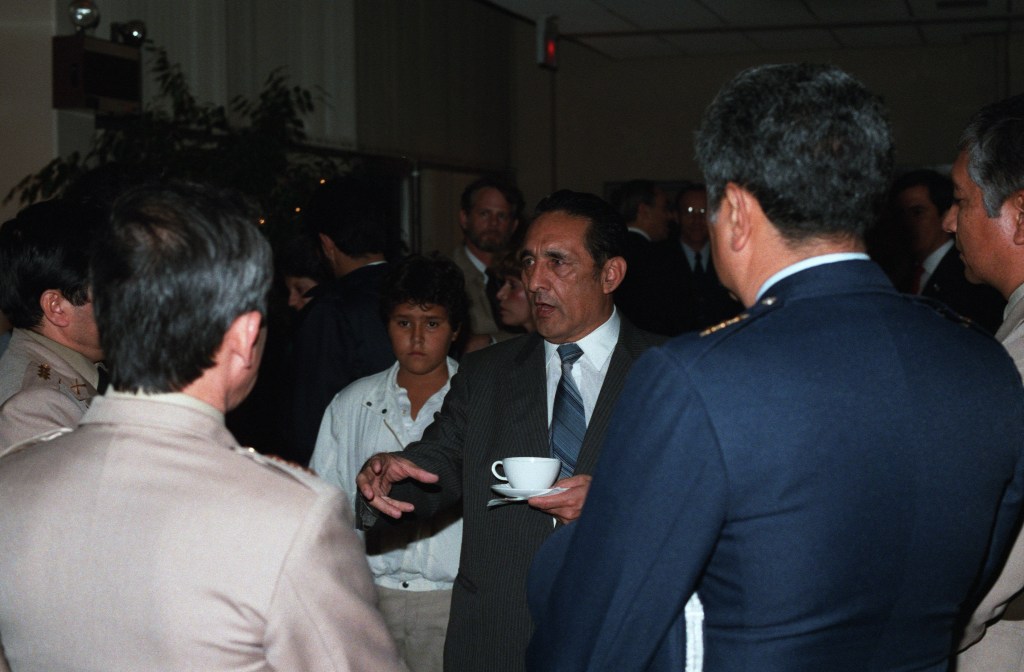
The United States and the Soviet Union are engaged in a fundamental struggle to define the shape and content of Soviet-American relations for years to come, according to Administration officials. Moscow, the officials say, is seeking to make nuclear arms control the focal point, as was largely the case during the Nixon and Carter Administrations. The Reagan Administration, they say, is resisting this narrow focus and wants equal attention on the settlement of such regional disputes as those in Afghanistan and Angola and on human rights issues. To get his way, the officials said, President Reagan is prepared to live without new arms-control treaties, although he is said to want treaties of the right kind. And, the officials said, he is determined to go beyond containing Soviet influence in the developing nations, to the point of breaking or loosening Moscow’s influence there. They also said the President was determined to promote democracy, although he was said to understand this would introduce added strains in dealings with Moscow.
Although some Administration officials tended to describe these attitudes as contrived to put Washington in a better bargaining position, most maintained that they represented firm convictions, not negotiating ploys. Most of the Administration officials contended that past Administrations played into Soviet hands by allowing nuclear arms control to become the overriding priority in relations. “To say that arms control is so important that it had to be separated from other issues gave Moscow too much leeway in challenging American interests around the world” without fear of derailing the arms-control agenda, said a high-ranking Administration official involved in fashioning Administration policy on the Soviet Union. He went on to say that the Reagan Administration’s approach did not mean linking progress on arms control to resolving regional issues, but that “psychological linkage” did exist. “It’s like saying to the Soviets, ‘Don’t think that we will let arms control get so big that it can’t be undone by your acts elsewhere’,” the official said.
Behind these judgments is a new and fundamental consensus in the Administration that Mr. Reagan has altered the correlation of overall power with Moscow and that the Russians are “on the run,” as one high-ranking official put it. “The Soviets were on the move in the 1970’s — they had the dynamism,” a senior Administration official said. “Now, we have it and they know it.” Summit Meeting Expected As Moscow and Washington set the terms of relations, most White House, Pentagon and State Department officials have come to three conclusions: They say they believe Mr. Reagan and Mikhail S. Gorbachev will meet as planned later this year, even though the Soviet leader might want to get out of his commitment to do so. It is reported that Anatoly F. Dobrynin, the Soviet Ambassador, is bringing back with him to Washington a proposal for a meeting between Secretary of State George P. Shultz and the Soviet Foreign Minister, Eduard A. Shevardnadze as a step toward setting a date for the summit meeting. The officials also express little optimism that at this meeting the two leaders will reach either important new agreements or major breakthroughs on nuclear arms control or regional conflicts. The officials speak with less pessimism about the possibility of breakthroughs if the leaders meet as agreed in the Soviet Union in 1987. Even without significant new accords or breakthroughs, the officials expect Soviet-American relations to remain relatively stable and nonconfrontational as each side concentrates on domestic economic matters. These officials say they expect this to be the case despite new challenges by the Administration to Soviet client states around the world.
The Soviet Union, after months of delay, told the United States today that it was ready to discuss the date for talks expected to center on the next Soviet-American summit meeting, Administration officials said. The officials said the United States Ambassador to the Soviet Union, Arthur A. Hartman, was told by Foreign Minister Eduard A. Shevardnadze today that Anatoly F. Dobrynin, the Soviet Ambassador, will be empowered next week to work out a date for Mr. Shevardnadze to meet with Secretary of State George P. Shultz in Washington. Mr. Dobrynin, who is leaving as Ambassador and has been in Moscow, was recently elevated to the Soviet leadership by being named the Central Committee secretary in charge of foreign relations with non-Communist countries. The State Department said today that Mr. Dobrynin would see President Reagan on Tuesday at the White House and would have meetings with Mr. Shultz.
The Soviet Union lodged a formal protest with the Bonn Government today over an accord covering West German participation in the Reagan Administration’s missile-defense research program. The Foreign Ministry, in a statement, said Moscow’s Ambassador in Bonn repeated “known Soviet objections” to the space-defense program, the Strategic Defense Initiative, in a meeting with Foreign Minister Hans-Dietrich Genscher. The statement said Mr. Genscher told the Ambassador, Vladimir S. Semyonov, that the accord, which was signed Thursday in Washington, limited participation in the program to research projects by West German companies and research institutes. He also said it involved no public funding. Bonn is the second American ally to join in research in the program, popularly known as “Star Wars.” Britain agreed to take part in the research in December, but the Soviet Union is not known to have formally protested that accord.
The T.W.A. explosion inquiry seems to center on two questions: Who was the woman who sat in seat 10F on an earlier leg of the plane’s journey and did she plant the bomb that later exploded under the seat? Some of the investigators among the Greeks, Egyptians, Italians and Americans believe that the passenger might be a woman with a Lebanese passport who traveled under the name of May Elias Mansur. The authorities have said she boarded the Boeing 727 Wednesday at its point of origin in Cairo and got off at the first of two stops that day in Athens. The bomb exploded almost six hours later as the airliner was about to make a second landing here returning from Rome. The explosion, which killed four Americans and wounded nine other people, occurred under seat 10F just before the plane landed safely at the airport. The woman assigned to seat 10F at the plane’s point of origin was listed on the passenger manifest as May Elias Mansur.
Airport security in many Middle Eastern cities has been an on-and-off affair, according to travelers. In the aftermath of hijackings and episodes similar to the Trans World Airlines bombing Wednesday, there have been frequent efforts by authorities to tighten procedures and improve techniques for detecting terrorists. Last fall, for example, a heightened security plan was introduced in Cairo after terrorists hijacked an Egyptair flight to Malta and 59 people died when an elite Egyptian commando unit managed to set fire to the plane during a rescue attempt. All those boarding aircraft, including crews, had to put their baggage through metal detectors, and passengers had to point out each of their suitcases on the tarmac before it could be loaded into the hold. Passengers were frisked before they could even enter the waiting room and carry-on bags were unpacked and examined.
Britain today granted a visa to Olga Peters, the American-born teen-age granddaughter of Stalin, who was taken to the Soviet Union by her mother, Svetlana Alliluyeva, in 1984. A British Embassy official in Moscow said a student visa was issued for the 14-year-old girl at the request of Soviet authorities. “They sent her passport along, and we issued the visa,” the official said. No immediate word emerged on the plans of Miss Alliluyeva, 60 years old, who defected in 1967 but returned to Moscow with her daughter in November 1984. The British Government said Miss Alliluyeva, who became an American citizen while living in the United States, had not asked for a visa.
The Danish and Swiss authorities today reported seizing thousands of gallons of Italian wine adulterated with methyl alcohol, a poison. The Danish Government banned all sales of Italian wine products by importers and warned Danes against drinking such wines. In West Germany, where tainted Italian wine was found earlier, a Member of Parliament called for a similar ban.
The Gaza Strip seems forgotten in Middle East politics, though it is jammed with Palestinian refugees, while the Israeli-occupied West Bank always seems to be at the center of political debates about the Middle East and the focus of international diplomacy. Tawfik Abu Ghazaleh, a Palestinian lawyer, tried to express to a visitor what it is like living in Gaza these days. He tried several variations of “ignored” and “abandoned” until he finally hit on his real mood. “I guess you could say we have fallen off the map.”
The United Nations said today that it would make available to Israel a secret file on former Secretary General Kurt Waldheim. Until today, officials here had declined to say whether a United Nations file on Mr. Waldheim existed. The United Nations file on Mr. Waldheim, numbered 79/724 according to a list found in the National Archives in Washington, is one of 40,000 sealed files on war criminals, suspects and witnesses compiled by the United Nations War Crimes Commission from 1943 to 1948 and stored in archives at 345 Park Avenue South in Manhattan. The United Nations decision is in response to a formal request by Israel’s chief delegate, Benjamin Netanyahu, to Secretary General Javier Perez de Cuellar. The request asked for “access to the file of Kurt Waldheim and any other relevant material stored at the United Nations archives by the War Crimes Commission.”
Crowds burned effigies of Pakistan’s President and Prime Minister today as up to 70,000 people gathered to mark the seventh anniversary of the execution of former Prime Minister Zulkifar Ali Bhutto. It was the most open protest in years against President Mohammad Zia ul-Haq and Prime Minister Mohammed Khan Junejo. The crowds spilled into the wheat fields surrounding the hamlet of Garhi Khuda Bakhsh, 200 miles north of Karachi.
Philippine Finance Minister Jaime V. Ongpin, a key adviser to President Corazon C. Aquino, has disclosed that the company he headed for 12 years was secretly controlled by a relative of Ferdinand E. Marcos. Mr. Ongpin, an early supporter of Mrs. Aquino’s candidacy and one of the most highly regarded of her ministers, told reporters Thursday that the Benguet Corporation, a large mining concern that he headed from 1974 until late last year, when he resigned to campaign for Mrs. Aquino, was controlled by a group of Philippine businessmen led by Benjamin Romualdez, brother of Mr. Marcos’s wife, Imelda. “I can say without reservation that the company was managed on a perfectly professional basis,” Mr. Ongpin said. “This is not to say I was not asked to do certain things, but I refused to do them, and I got away with it.”
Ferdinand E. Marcos, in an interview broadcast last night, asserted that the United States aided Philippine military forces who rebelled against him in the final hours of his presidency. He said Americans had refueled and rearmed helicopters that attacked his presidential palace. “I learned that the helicopters that attacked Malacanang,” the presidential palace, “were gassed and rearmed in Clark Air Force Base,” Mr. Marcos said in an interview with the reporter Ted Koppel. Portions of the interview were broadcast on the ABC News programs “World News Tonight” and “Nightline.” By Americans, then?” Mr. Koppel asked. “Yes,” Mr. Marcos replied. Philippine military sources said in early March that Philippine helicopters controlled by anti-Marcos forces had been rearmed and refueled at Clark Air Base during the crisis. But the sources did not say whether the ground support came from American or Philippine crews. In Washington, a State Department spokesman, Joseph W. Reap Jr., said the department would have no immediate comment on the Marcos interview.
The homes of four anti-apartheid activists, including the head of South Africa’s leading black business association, were set on fire early today in a township near Pretoria. The township, Winterveld, which falls within the so-called homeland of Bophuthatswana, was the scene of an incident on March 26 in which police officers opened fire at a crowd in a soccer stadium, killing at least 11 people. Among the homes attacked today was that of Dr. Sam Motsuenyane, president of the National African Federated Chamber of Commerce. Dr. Motsuenyane’s wife, Jocelyn, and the three other activists whose homes were attacked were among 67 people released from prison Tuesday on bond. They were detained after the stadium shootings.
The Reagan Administration has drafted a legislative proposal that would sharply limit the damages people could collect from the Government for injury or death caused by the negligence or misconduct of a Federal employee. Administration officials said they wanted to impose similar limits on lawsuits against Government contractors, which supply thousands of products ranging from office machines to airplanes and submarines. The draft bill, distributed to federal agencies this week, states that the damages awarded by Federal judges to people suing the Government “have become increasingly unreasonable and unfair.” In part, it says this is because the government is perceived as financially having a “deep pocket.” The proposal grows out of an Administration study on the availability and affordability of liability insurance, which concluded that a “crisis” existed. The study, conducted for President Reagan’s Domestic Policy Council and completed last month, said there had been an “explosive growth” in damage awards and “massive increases” in premiums charged by private insurers. Until now there was no indication that the Government also wanted to protect itself from such suits, filed under a special law dealing with personal injuries for which a civil suit can be filed, the Federal Tort Claims Act of 1946.
President Reagan enjoys a horseback ride around the grounds of Rancho del Cielo.
President Reagan continues to work on chores around the ranch.
The chairman of the Senate Select Committee on Intelligence said today that officials in the executive branch were largely to blame for unauthorized disclosures of secret information affecting national security. “Every administration has faced the problem of leaks, but none so much as this one,” the chairman, Senator Dave Durenberger, Republican of Minnesota, said in a speech before the Chicago Council on Foreign Relations. The speech text was made available by his office here. Mr. Durenberger asserted that no group in Congress or the Reagan Adminstration took greater care to protect secrets than the Senate panel. Late last year the Director of Central Intelligence, William J. Casey, said that members of the Senate intelligence committee had compromised sources and methods of intelligence gathering by discussing secret matters in public.
Although the dollar has fallen sharply in recent months, business executives say foreign competitors have not raised prices as much as expected. With foreign producers battling so hard to hold on to their market share, many economists and executives say it will be difficult, if not impossible, for the United States to regain the jobs and the sales lost as a result of years of cheap imports. Indeed, many experts say, even with a weaker dollar, it will take years to reverse many of the negative effects of the strong dollar: the two million or more jobs lost, the market share captured by imports, the weakening of whole industries. Executives were confident a few months ago that the weaker dollar would quickly force up the price of imports, causing them to relinquish market share on everything from Japanese cars to Italian shoes to German machinery. Although the dollar has fallen about 25 percent against a basket of 17 currencies, many executives say foreign producers have not raised the price of their products by anywhere near that amount.
A Federal district judge reacted sharply today to closing statements by a defense lawyer in the trial of 11 church workers accused of smuggling Central Americans into the United States. In beginning the arguments for the defense Thursday, the lawyer, Robert J. Hirsh, accused the Government of “trying to sinisterize, trying to make criminal” the actions of the workers. Mr. Hirsh, in a flamboyant style that sharply contrasted the sober arguments of the Federal prosecutor, Donald M. Reno, drew an analogy comparing the Immigration Naturalization Service to Hitler’s Gestapo. He also said there was something “wicked” about how the Government paid expenses to its main witness. The judge, Earl H. Carroll, charged today that Mr. Hirsh was ignoring his orders against bringing the issue of religion before the jury. The defendants contend they gave sanctuary to refugees because of religious motives.
College students observed a National Divestment Protest Day today, aimed at getting trustees to discontinue investments in South Africa, and their leaders are hoping the movement will be a springboard to involvement in other issues. Today’s protests, timed to coincide with the 18th anniversary of the assassination of the Rev. Dr. Martin Luther King Jr., were part of a campaign that has become the biggest campus issue since the end of the Vietnam War. Educators who saw student activism unfold in the 1960’s think the circumstances were different and that the current protests are not likely to gather the same momentum. Among the many colleges that have not divested themselves, including seven of the eight Ivy League schools, are trustees who maintain that they can be more effective in helping blacks in South Africa by owning stock in companies that do business there.
The jobless rate eased one-tenth of a point in March, despite rising unemployment in the oil and gas industry, the Labor Department reported. The rate’s small decline, to 7.1 percent, followed a sharp February increase that was partly a result of exceptionally severe weather. Some economists had expected a somewhat bigger improvement in March. The civilian unemployment rate for March was 7.2 percent, also down a tenth of a point from the previous month.
A tax credit enacted in 1978 to help the hard-core unemployed get jobs may actually hurt their chances of employment, according to a study published by the Brookings Institution. The economist who conducted the study of the program, the Targeted Jobs Tax Credit, said recently that the study had found that companies discriminated against job seekers who identified themselves as eligible for the program. Gary Burtless, an economist with the research institution, who conducted the survey in 1981, when he was with the Labor Department, said he believed the stigma associated with Government assistance deterred employers from hiring participants.
What seems to be a never-ending flow of new automobiles and trucks moves across the valley behind Seattle’s old Navy piers off Elliott Bay to be loaded onto railroad cars or trucks for the trip to sales showrooms across the Pacific Northwest. Here the vehicles are Nissans imported from Japan. In other cities — Portland, Oregon; Tacoma, Washington; Wilmington, San Pedro, Long Beach, Benicia, and Oakland, California — Toyotas, Hondas and Subarus from Japan as well as Volvos, Saabs, BMW’s, Mercedes-Benzes and Peugeots from Europe move across the piers. As the traffic has grown, economists and labor unions have come to realize that Detroit’s loss to automobile imports has been the port cities’ gain.
A Chicago man accused in the slaying of his landlord and a police officer before taking a woman hostage continued his standoff with the police today, telling negotiators that he had made breakfast for his captive and drawn up his will. “We are in constant communication,” said John Townsend, a deputy chief of the Chicago Police Department’s patrol division. “We have a good rapport.”
United Press International asked permission yesterday in Federal Bankruptcy Court to file its long-awaited plan for a reorganization that could deliver the news agency out of its financial difficulties. U.P.I. filed for protection from creditors under Chapter 11 of the United States Bankruptcy Code in the spring of 1985. If the plan is approved, the agency could emerge from Chapter 11 bankruptcy by July. Last November, the news agency’s management, principal union and a committee representing its creditors endorsed a proposal by Mario Vazquez Rana, a wealthy Mexican publisher, to acquire U.P.I. The plan outlined yesterday in documents filed with Bankruptcy Judge George Bason reflects Mr. Vazquez Rana’s proposal, which has taken months for lawyers to refine since his proposal was chosen as the best of several offers for the company.
Prostitution charges were dropped today against two Brown University seniors arrested in an alleged sex-for-hire ring, but they still could be indicted by a grand jury. The State Attorney General’s office dismissed misdemeanor charges against Dana E. Smith of Avon, Connecticut, and Rebecca R. Kidd of Orange, Connecticut, both 21 years old, in a pretrial hearing at Providence District Court. Reasons for the move were not disclosed. The women were arrested March 6 and charged with loitering for prostitution. Both pleaded not guilty. Their arrests led to an investigation of a possible prostitution ring involving college students and other college-age women. No other arrests have been made.
The California Supreme Court has agreed to decide whether William Peter Blatty may sue The New York Times Company because his novel “Legion” did not appear on the paper’s best-seller list. Six of the court’s seven Justices agreed Thursday to hear appeals from both sides in the dispute. In March 1984 Mr. Blatty sued The New York Times for $1 million in compensatory damages and $5 million in punitive damages after the novel did not appear on the list. He also challenged the validity of the paper’s method of determining best sellers. A California Court of Appeal in Los Angeles ruled that Mr. Blatty had a right to sue The Times for intentional interference with sales, but emphasized the newspaper had “no duty to include” Mr. Blatty’s book on its best-seller list. The Times contends that the list is protected by the First Amendment rights of a free press and free speech.
Federal agriculture officials may not force farmers to brand the faces of dairy cows destined for slaughter or export to end a national milk surplus, Federal District Judge Michael Telesca ruled today. Judge Telesca issued a temporary restraining order after deciding that the Humane Society of Rochester and Monroe County had raised “substantial questions” about the branding. His order, in effect until Tuesday, prevents the Agriculture Department from forcing farmers to brand dairy cows with an X. Farmers may so brand their cows if they choose. Under the program, the Government pays farmers $22.50 for every 100 pounds of milk the cows produced in a previous period.
Lee A. Iacocca, who worked at an annual pay rate of only $1 a year for several months in the early 1980’s while the Chrysler Corporation was near bankruptcy, received $1.6 million in salary and bonuses last year, realized $15.5 million from stock options over the last five years and this fall is due to collect 225,000 shares of common stock outright, worth nearly $10 million. The compensation of Chrysler’s chairman and of other top officials was disclosed in a proxy statement released today. The bonuses of Mr. Iacocca and the others were based on their performance in 1984, when Chrysler reported record earnings.
Edmonton’s Wayne Gretzky sets a new NHL record with his 213th point of season. Gretzky’s three assists tonight, two on power-play goals by Jari Kurri and one on a power-play effort by Paul Coffey, increased his point total to 214 for the season to break his own record of 212, set in 1981-82. Coffey’s goal, his 48th of the season, extended his single-season league record for defensemen, which he broke on Wednesday night. He also moved to 138 points, one short of Bobby Orr’s single-season mark for defensemen. But two goals by Joey Mullen led the Calgary Flames to a 9–3 rout of the Oilers.
The fear that the bargain in oil prices may soon come to an end unsettled Wall Street yesterday, sending stock prices sharply lower and producing the biggest weekly loss ever in the Dow Jones industrial average. With a 27.18-point drop yesterday, to 1,739.22, the Dow industrials lost 82.50 points for the week. Particularly hard hit were airline and other transportation stocks, which tend to benefit the most from lower fuel costs. The Dow transportation index fell a record 21.34 points yesterday, to 779.32.
Dow Jones Industrial Average: 1739.22 (-27.18)
Born:
Cameron Barker, Canadian NHL defenseman (Chicago Blackhawks, Minnesota Wild, Edmonton Oilers, Vancouver Canucks), in Winnipeg, Manitoba, Canada.
Andrew Gardner, NFL tackle and guard (Miami Dolphins, Houston Texans, Philadelphia Eagles, San Francisco 49ers), in Chamblee, Georgia.
Louis Coleman, MLB pitcher (Kansas City Royals, Los Angeles Dodgers, Detroit Tigers), in Greenwood, Mississippi.
Rachel Korine, American actress (“Spring Breakers”), in Nashville, Tennessee.
 History Diaries