In Italian East Africa, Asmara, the capital of Eritrea has fallen to the advancing 5th Indian Division. Italian General Nicola Carnimeo, commander of the 2nd Colonial Division, though wounded in the leg, tries with scraps of his defeated army to hold up the Indian advance at Adi Tecesan, 35 miles (56 kilometers) from Asmara. He failed. Advancing British tanks were then met by 2 police officers from Asmara, declaring the Eritrean capital an open city; troops of Indian 5th Division entered the city at 1000 hours, accepting the surrender of 5,000 Italian prisoners of war, while British armored cars under Colonel Bernard Fletcher raced toward Adigrat to cut off the Italian retreat into Abyssinia. To the east, German merchant ships continued to leave the port of Massawa; British destroyer HMS Kandahar intercepted German ship Bertram Rickmers, which was scuttled by her own crew. The Italian destroyer Leone runs aground off Eritrea and is scuttled by its crew to prevent it from being captured by the British.
Churchill instructs Wavell to not hesitate to implement a full blockade on French Somaliland and its port of Djibouti.
The British withdraw from Mersa Brega, abandoning one of the last defensible positions available. Lieutenant General Sir Philip Neame, General Officer Commanding Western Desert Force, orders the British 2nd Armoured Division to withdraw towards Benghazi; the retreat is hampered by the breakdown of most of their tanks. He also orders the Benghazi garrison to prepare demolition charges and be prepare to evacuate on 24 hours’ notice.
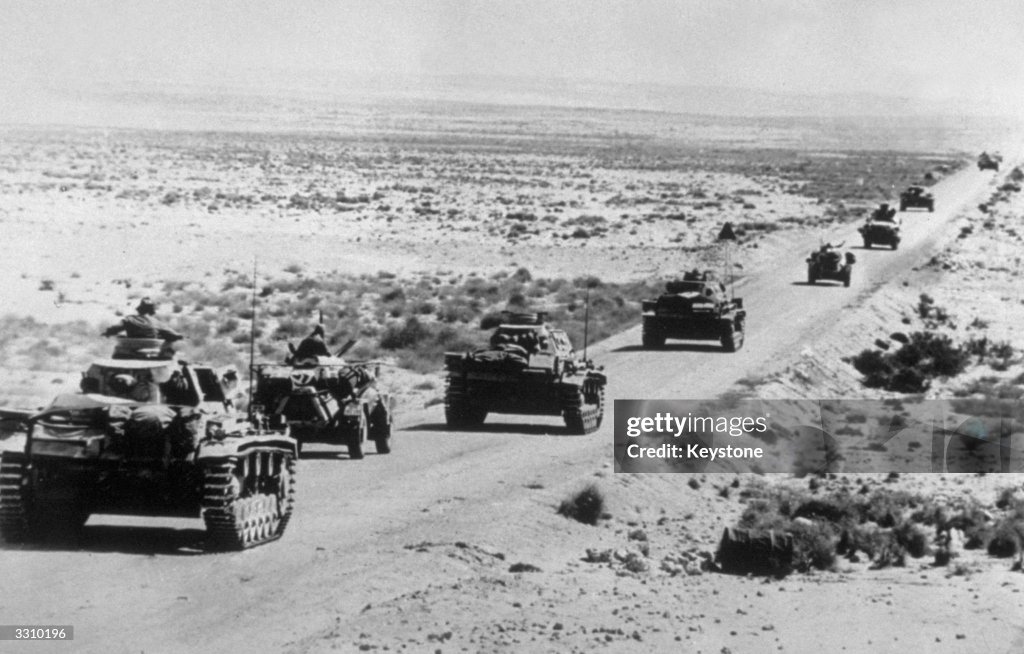
The German 5th Light Division, which has a small position within the Mersa Brega (also known simply as Brega) defenses, finds to its soldiers’ delight that the British have left. They immediately occupied the town and the surrounding area. Advance units of the division pursue the British east toward the Via Balbia. There is no fighting at all — the British 2nd Armoured Division simply bugs out.
The Luftwaffe aids the Afrika Korps advance, using Stukas to destroy British tanks and trucks. By the end of the day, the advanced German detachments of the 5th Light Division are approaching Agedabia. Italian Libyan Commander Gariboldi, meanwhile, tries to place the breaks on the German advance, sending a letter to Afrika Korps Commander Lieutenant General Erwin Rommel warning of the “strong enemy defense” and the need to wait for “necessary reinforcements.” Rommel technically is subordinate to the Italian command in North Africa, but displays a strong tendency to ignore them (and, at times, the Wehrmacht high command as well). The Italians also fail to supply transport planes for Rommel’s Gialo operation, so it is postponed again.
Richard O’Connor was Mentioned in Despatches.
An Italian convoy of four troopships departs from Naples bound for Tripoli.
The Yugoslavian Senate is dissolved and the government orders a general mobilization. The Yugoslav Army has 900,000 men on active service but with mobilization, that will be increased to 1.4 million.
Hitler today demanded the demobilization of the Yugoslav army and ratification of the Axis Pact. A third demand — that Yugoslavia apologize for the anti-Nazi demonstrations — is less of a problem for Belgrade. Meanwhile the Germans are making plans to attack Yugoslavia in line with the Fuhrer’s 25th war directive.
Ante Pavelić, with Mussolini’s permission, uses Italian radio facilities in Florence to transmit an appeal to the people in Croatia calling for its liberation from the Belgrade government by the Axis. Croatia is notable for its strong pro-German sentiments, as opposed to the rest of Yugoslavia which favors the Allies.
Yugoslav officials are planning to sign a non-aggression pact with the Soviet Union. The treaty promises no Enmity between the two nations and that each country will come to the aid of the other, should one be attacked by a third party.
British CIGS Sir John Dill is in Belgrade discussing joint defense with Yugoslavian Prime Minister Simovic. There is little that Great Britain can offer except promises of future aid whenever it can be made available.
While things have changed in Belgrade following the March 27 coup, they haven’t changed that much. The new Yugoslavian Prime Minister, General Dušan Simović, is under no illusions about the country’s military power. British Foreign Secretary Anthony Eden, who had been on his way back to Britain when the coup took place, is now back in Athens and requests a meeting there with Simović. However, Simović is a former chief of the general staff and is well aware of the danger facing the country. He turns down the meeting so as not to provoke the Germans into a quick invasion.
In Hungary, Prime Minister Teleki cooperates with Admiral Horthy and authorizes the mobilization of the Hungarian Army. However, he remains opposed to any military participation by Hungary in attacks on Greece or Yugoslavia.
Additional thousands of Serbs, Croats, Bosnians and Montenegrans poured into Yugoslavia cities tonight to join the army as popular indignation flared in response to a German press and radio campaign. Troops with fixed bayonets stood guard to enforce a government order against panicky evacuation by Yugoslav citizens. Most Yugoslavs heeded Premier Dusan Simovic’s stern warning to stay at home and prepare to defend the country with their lives if need be, but trains to the south have been Jammed the last few days with both refugees and soldiers. The government issued a restrained denial of German charges that terrorism had been unleashed against German residents.
Five hundred students joined hundreds of men and women in a spontaneous pro-American, pro-Yugoslav demonstration late today in Lyons, France. The crowd massed outside the United States consulate, singing the French and American anthems, cheering President Roosevelt and King Peter, and shouting for the American flag to be raised. Police did not attempt to interfere with the demonstration.
The British House of Commons rejects government proposals to allow theaters to open on Sundays.
When a small boy told Alice Stutley, a Cambridge air-raid shelter marshal, that there was a dead body in the shelter in the park, she thought it was an April Fool’s Day trick. When she finally agreed to go and look she found a man who had shot himself through the head. The body was that of Jan Willen ter Braak (actual name Engelbertus Fukken), a German spy charged with “liquidating” Churchill. He had lodged in Cambridge since last autumn, posing as a Dutch scientist who was working on fossils. But frequent visits to London, and to Whitehall in particular, soon alerted the Secret Service. Today they had found a transmitter, a Luger pistol and a file on Churchill’s movements in ter Braak’s rooms and were waiting for him to return.
George Giffard was Mentioned in a Despatch for his service in the Middle East between 1939 and 1940.
Nazis forbid Jewish access to cafés.
Japanese Foreign Minister Matsuoka Yosuke, on an official visit to Rome, has separate meetings with King Victor Emmanuel III and Italian dictator Benito Mussolini. Matsuoka has arrived from Berlin where he had discussions with Chancellor Adolf Hitler and Foreign Minister Joachim von Ribbentrop.
Two hundred Italian schoolboys demonstrated tonight in front of the United States embassy in Rome, guarded by steel-helmeted Italian troops, a few hours after Premier Mussolini and Japanese Foreign Minister Yosuke Matsuoka greeted a wildly cheering crowd of 150,000 at Piazza Venezia. Police chased the youths away from the embassy, on the Via Veneto. Observers called the demonstration one of friendship for Matsuoka, guest of Italian Foreign Minister Count Galeazzo Ciano at a state dinner in the Excelsior hotel across the street. Matsuoka’s appearance with II Duce concluded a round of talks with Italy’s leaders. Informed observers said they believed the talks were devoted largely to growing interest of the United States in the war, and what to do about it.
To avoid being captured by the Americans and Canadians, 8 German merchant ships were scuttled by their own crews in various South American ports.
Werner Haase, Hitler’s deputy personal physician, joins the SS.
Four Iraqi nationalist army colonels, led by the nationalist politician Rashid Ali, and known as “the Golden Square” staged a military coup in Iraq that overthrew the regime of Regent ‘Abd al-Ilah. The Regent ‘Abd al-Ilah of Hejaz moves on from the British gunboat where he has taken refuge to Amman, Jordan. The Germans have great hopes to use the uprising as a way to undermine British power throughout the Middle East. The British, meanwhile, have a large airbase at Habbaniya and don’t intend to leave. Thus, the stage is set for an epic clash in unexpected theater operations. The Golden Square intended to use the war to press for full Iraqi independence following the limited independence granted in 1932. To that end, they worked with German intelligence and accepted military assistance from Germany. The change in government led to a British invasion of Iraq and subsequent occupation until 1947.
The Luftwaffe moves several units to Austrian airfields in preparation for Operation Marita. These include elements of JG 27, 54, 77, along with LG 2 and ZG 26.
Some Luftwaffe planes do remain on the Channel Front. To prove it, Bf 109s strafe a train near Berwick.
The Royal Air Force dropped the first 4,000-pound blockbuster bombs of the war last night, by Vickers Wellington medium bombers in a raid over Emden.
RAF Bomber Command: Day of 1 April 1941
12 Blenheims to Belgian coast; several ships were attacked. No losses. 11 Hampdens to Brest turned back; 1 lost.
Hans-Joachim Marseille receives a promotion to Leutnant. His unit, JG 27, is scheduled to head east along with many other formations to aid in Operation Marita.
German heavy cruiser Admiral Scheer returned to Kiel after sinking 17 ships for 113,233 tons in the North and South Atlantic and in the Indian Oceans.
The German supply system in the Atlantic continues in fine operational form. German tanker Nordmark restocks from German tanker Ill in the Mid-Atlantic.
Commander in Chief Home Fleet transferred his flag from battleship HMS Queen Elizabeth to battleship HMS King George V.
Destroyer HMS Quorn in the Nore Command was damaged by two near misses of German bombing, but only sustained superficial damage.
Destroyers HMS Anthony, HMS Nestor and anti-submarine trawlers of the 10th Anti-Submarine Striking Force departed convoy HX.115 at daylight and proceeded to Scapa Flow. The destroyers arrived later on the 1st.
A submarine was sighted ten miles 305° from Dunnet Head by heavy cruiser HMS London. Destroyers HMS Whaddon and HMS Quantock departed Scapa Flow at 2015 to hunt for her, and anti-submarine whalers HMS Southern Shore (328grt), HMS Southern Flower (328grt) and HMS Sposa (316grt) were also dispatched. At 2330, the destroyers were instructed to abandon the search and proceed to Rosyth. At 0030/2nd, they were ordered to search for a downed aircrew in 58-40N, 4-28W. At 0645, but lacking success, they proceeded towards Rosyth. The airmen were sighted off Whitten Head at 0800, but before the destroyers arrived, they were rescued by an RAF launch. The destroyers were able to continue to Methil and join Rosyth Command.
German bombing attacked convoy HX.M114 off Smalls.
British tanker San Conrado (7982grt) was badly damaged by German bombing 13 miles 325° from Smalls. The tanker was taken in tow. When taken under attack again by German bombing, the tow was cut. The tanker sank on the 2nd.
Norwegian tanker Hidlefjord (7639grt) was sunk by German bombing twenty miles northwest of Smalls. Twenty nine crewmen were missing.
British tanker Adellan (7984grt) was damaged by German bombing seven cables from Sea Buoy, Milford Haven. The tanker was brought to Milford Haven. After the cargo was discharged, the tanker proceeded to Newport for repairs.
British tanker Chesapeake (8955grt) was attacked by German bombers fifteen miles north of the Smalls. The tanker was attacked again later that day ten miles southwest of St Goven’s Head and badly damaged by German bombing. The tanker anchored in Walton Bay on the 3rd.
Norwegian tanker Kaia Knudsen (9063grt) was damaged by German bombing twenty miles north, northwest of Smalls. The tanker was towed to Milford Haven.
On an anti-submarine search, an Albacore of 828 Squadron force landed at A’Mhouine, Whiten Head, Sutherland. Lt Cdr L. A. Cubitt, sub Lt M. G. Goodger RNVR, and Petty Officer D. E. Polmeer were all injured.
Lt A. A. Pettigrew, in a Blenheim of RAF 55 Squadron from Maraua, Libya, detached from 826 Squadron, was killed when his aircraft failed to return from a reconnaissance mission off Libya.
Swedish steamer Lidingo (5842grt) was damaged on a mine west of Falsterbo. The steamer was beached and was later towed to Malmo.
Battlecruiser HMS Renown and aircraft carrier HMS Ark Royal, joined by destroyers HMAS Napier, HMAS Nizam, and HMS Fortune which departed Gibraltar on 31 March, arrived at Gibraltar after escort duties. Destroyers Napier and Nizam departed Gibraltar escorting British liner Highland Monarch (14,139grt) for Freetown where they arrived on the 8th. All three ships departed Freetown on the 8th and arrived at St Helena on the 12th.
Light cruiser HMS Edinburgh arrived at Gibraltar after being relieved in convoy WS.7.
Destroyers HMS Highlander, HMS Velox, and HMS Wrestler departed Gibraltar to meet battlecruiser HMS Repulse, aircraft carrier HMS Furious, and troopship Narkunda arriving from Freetown and escort them to Gibraltar. On the 3rd, the ships arrived at Gibraltar.
From 1 to 4 April, German tanker Nordmark took on fuel and stores from German tanker Ill (7603grt) at sea.
Italian troop convoy of troopships Esperia (11,398grt), Conte Rosso (17,879grt), Marco Polo (13,098grt), and Victoria (13,098grt) escorted by destroyers Tarigo, Euro, and Baleno and torpedo boats Polluce and Partenope departed Naples, and arrived at Tripoli on the 2nd.
Destroyer HMS Kandahar intercepted German steamer Bertram Rickmers (4188grt), which departed Massawa on 29 March, in the Red Sea. The German steamer scuttled herself near Gondurmiat.
German steamer Lichtenfels (7566grt) departed Massawa. The steamer is unable to evade British patrols and is forced to return to Massawa.
German steamers Hermonthis (4833grt) and Muenchen (5619grt) departed Callao at 1930 on 31 March. Steamer Muenchen (5619grt) scuttled herself when intercepted by armed merchant cruiser HMCS Prince Henry at 11-18S, 79-09W. Steamer Hermonthis (4833grt) scuttled herself when intercepted by Canadian armed merchant cruiser Prince Henry at 12-13S, 80-10W. The wreck was scuttled by Peruvian cruiser Almirante Grau off Callao, Peru.
German steamers in western South American ports scuttled themselves. Steamer Cerigo (1120grt) was scuttled at Guayaquil. The steamer was later salved by Ecuador for use as 24 de Mayo.
Steamer Eisenbach (4323grt) was scuttled at Puntarenas.
Steamer Friesland (6310grt) was scuttled at Paita, Peru.
Steamers Leipzig (5898grt) and Monserrate (5578grt) were scuttled at Callao when they were unable to leave port. A Peruvian warship turned the steamers back when they attempted to leave harbor.
Convoy ANF.24 of six British ships departed Alexandria escorted by destroyers HMS Nubian and HMS Hereward and corvette HMS Hyacinth. Netlayer HMS Protector sailed in this convoy with Fleet Air Arm torpedoes for Piraeus and nets for Suda Bay. Also in this convoy was British steamer Northern Prince (10,917grt) that should have arrived in the EXCESS convoy. However, after she ran aground at Gibraltar and missed the convoy, the steamer was sent around the Cape to Alexandria. Anti-aircraft cruiser HMS Calcutta joined the convoy from convoy ASF.22 at 0700/3rd, and arrived at Piraeus on the 4th.
Convoy AG.10 of one British ship and supply ship Breconshire departed Alexandria escorted by destroyers HMS Ilex, HMS Havock, and HMS Hotspur. Supply ship Breconshire carried troops to be disembarked at Lemnos and Mytilene. The convoy was joined by anti-aircraft cruiser HMS Carlisle at 0630/2nd from Suda Bay, and arrived at Piraeus on the 3rd. On the convoy’s arrival at Piraeus, supply ship Breconshire and destroyers Havock and Hotspur proceeded to Mudros to disembark troops.
Convoy ASF.22 of seven British ships departed Piraeus escorted by anti-aircraft cruiser HMS Calcutta and destroyers HMS Hasty, HMS Defender, and HMAS Vampire. Anti-aircraft cruiser Calcutta was detached to convoy ANF.24 south of Kithera, and arrived at Alexandria on the 4th.
Convoy AS.23 of one British and six Greek ships departed Piraeus escorted by destroyers HMAS Voyager and HMS Wryneck and sloop HMS Grimsby. Leaving Piraeus, destroyer Wryneck attacked a submarine contact in Phleva Bay, and arrived at Alexandria on the 4th and Port Said on the 5th.
Convoy BS.22 departed Suez, escorted by sloop HMS Clive. Destroyer HMS Kimberley joined on the 3rd, destroyer HMS Kingston on the 5th and light cruiser HMS Caledon on the 6th. Destroyer Kingston was detached on the 7th and destroyer Kimberley on the 8th. The convoy was dispersed on the 9th.
Today in Washington, President Roosevelt returned from a fishing cruise in Southern waters. He conferred with Congressional leaders on the defense labor situation and with Secretary Wickard and Leon Henderson on the food situation.
The Senate completed Congressional action on the $1,415,000,000 Independent Offices Appropriation Bill, approved the $4,389,284,174 Fifth Supplemental Defense Appropriation Bill with a compromise amendment limiting foreign purchases of food and wool which was believed to solve the controversy over restrictions on the purchase of Argentine beef by the Army and recessed at 4:59 PM until noon tomorrow.
The House completed Congressional action on the resolution affirming United States non-recognition of transfers of Western Hemisphere areas to non-American powers, amended and passed the Senate resolution bringing into effect the inter-American coffee agreement, defeated the bill to standardize covering for baled cotton and adjourned at 5:38 PM until noon tomorrow. The Rules Committee approved a resolution for the investigations of the defense program by the Military Affairs and Naval Affairs Committees.
President Roosevelt today turned thumbs down, for the present at least, on a newly-introduced bill which would give him vast new authority to take over defense factories tied up by strikes. Offered a few hours earlier by Chairman Vinson, Georgia Democrat, of the house naval committee, the measure would permit the government to take possession of any defense factory after the president had found “an existing or threatened failure of production is such as to interfere with, or hamper, delay or impede the national defense.” But Mr. Roosevelt told his press conference the defense mediation board he recently created was getting along all right, and he indicated he saw no necessity at present for taking new legislative steps to curb strikes that have dotted the defense landscape.
In face of axis demands for release of 30 ships and crews seized by the United States, the Justice Department late today ordered immediate criminal prosecutions in all cases of sabotage. With German and Italian notes of protest against seizures facing certain rejection, other western hemisphere countries raced against a widespread scuttling campaign to get possession of axis merchantmen in their waters. On basis of coast guard reports that one of the two German and at least 20 of the 28 Italian vessels in American waters had been critically crippled by their crews, Attorney-General Jackson ordered district attorneys at various ports to begin prosecutions under a law penalizing sabotage of any ship, foreign or domestic, in territorial waters.
The United Automobile workers (C.I.O.) declared a strike today at the vast Ford Company’s Rouge plant and most of the 20,000 men involved in the work stoppage, said union officials, had left the factory and prepared to take up picket positions. An aide of Gov. Murray D. Van Wagoner declared “everything was peaceful and orderly.” Frank Wynn, U.A.W. publicity director, speaking for Michael Widman Jr., chairman of the U.A.W.-C.I.O. Ford organizing committee, said “most of the men have left the plant.
The Allis-Chalmers Manufacturing Co. plant in Milwaukee, Wisconsin, scene of a three-hour battle between police and strikers in which 48 were injured today, will cease production tomorrow at request of Gov. Julius Heil. Max W. Babb, president of the huge West Allis firm, said he had ordered the plant closed at the urgent request of Sheriff Joseph Shinners and of Governor Heil. The situation now is “in the hands of the federal government for action” Babb stated. Governor Heil simultaneously announced that he had wired President Roosevelt that a “mob had created disorders beyond the control of all peace officers which can be assembled by the combined forces of the state, county and city.” Union strikers, using bricks and rocks, tangled with peace officers armed with tear gas weapons and fire hoses late today. At least seven men were injured seriously and taken to the Milwaukee General hospital. Others were treated at the plant hospital. Hundreds of windows of the company’s main office and laboratory were broken; automobiles, including that of Gov. Julius P. Heil, were smashed and damaged; an eight-foot fence was torn down, and the governor himself stoned as he tried to leave the shop office in which he had taken refuge.
A work stoppage in the nation’s bituminous coal mines became fully effective tonight after labor and management failed to reach a contract agreement, but a federal conciliator said he believed continued negotiations during the next 48 hours would bring “a temporary arrangement for resumption of operations.” The United Mine Workers of America (C.I.O.) and the nation’s major soft coal producers agreed shortly before midnight to continue negotiations and Dr. John R. Steelman, director of the United States conciliation service, announced at once that “I therefore assure the public that there is no cause for alarm.”
President Robert E. Gross told stockholders of Lockheed Aircraft Corp. at the annual meeting today that construction of the P-38 interceptor is gaining speed. Five, he said, have been delivered to the government and 15 more are on the assembly line. Gross disclosed that first quarter deliveries approximating $22,500,000 have been made, and that production during that period was up approximately 100 per cent over last year.
U.S. Naval Intelligence in Washington alerted all naval districts that “past experience shows the Axis Powers often begin… [attacks] on Saturdays and Sundays or on national holidays…” and that commanders should put “proper watches and precautions… in effect.”
The U.S. Navy took over Treasure Island in San Francisco Bay for use as a military base. Built for the 1939 Golden Gate International Exposition, Treasure Island will be turned into Naval Station Treasure Island.
The heavy cruisers USS Chicago (CA-29), under command of Rear Admiral John H. Newton, Commander Cruisers Scouting Force, and USS Portland (CA-33) and the destroyers USS Clark (DD-361), USS Conyngham (DD-371), USS Reid (DD-369), USS Cassin (DD-372), and USS Downes (DD-375), arrived at Suva, Fiji Islands (see 3 April 1941).
4th Tactical Reconnaissance Squadron of 13th Composite Wing of 72nd Observation Group of US Army Air Corps was assigned to Losey Field in Puerto Rico.
Joseph Creamer, owner/operator of Station W71NY of New York City signs the first contract for advertising on a commercial FM station. This is a big change for the radio industry, as advertisers to this point have felt that it was not worthwhile to advertise on FM.
Lillian Hellman’s play “Watch on the Rhine” premieres in NYC.
The United States and Mexico signed an agreement in Washington allowing the reciprocal use of airfields and air space for the civil and military aircraft of both countries.
Interior Department motorship North Star and auxiliary Bear (AG-29) of the U.S. Antarctic Service, departed Punta Arenas, Chile; the former will proceed back to the United States via the west coast of South America, the latter via the east coast (see 5 and 18 May, respectively).
Peru tonight barred the German news agency “Transocean” from operations in this country on the ground its dispatches are “spreading news that may disturb the good international relations of Peru.” The interior ministry’s decree added that the agency might also “hurt the national sentiments of other countries and affect our democratic institutions. Therefore it is resolved to cancel the permit given Transocean to operate in national territory as a news agency.”
The Japanese 11th Army continues withdrawing under pressure after the Battle of Shanggao in China. The Chinese recover Kaoan and Hsiangfukuan.
The military crisis in China has passed and even the Japanese now admit that conquering China is an impossible task, Generalissmo Chiang Kai-shek told the opening session of the Kuomintang Central Executive Committee Assembly, which convened here a week ago. Details of General Chiang’s opening address were released yesterday.
Japanese authorities virtually closed the Yangtze River today when, reliable sources reported, permits for travel on the waterway would not be issued for at least four weeks.
Rice is rationed in Japan. While Japan is not at war, it greatly depends upon fertilizers based upon phosphate. The German raider Komet attack on Nauru of 27 December 1940 crippled phosphate exports upon which Japan greatly relied. Even though shipments have resumed recently, they are at greatly reduced levels. Japan thus has run short of fertilizer, which has strained its relations with Germany.
Masatsune Ogura, chairman of the board of directors of the Sumitomo interests, and one of the leading business magnates of Japan, was formally appointed Minister Without Portfolio in Premier Prince Fumimaro Konoye’s Cabinet tonight and will be invested as a Minister of State at the Imperial Palace tomorrow.
British Far East Commander RAF Air Marshal Brooke-Popham flies to Manila for consultations with US commanders General MacArthur and Admiral Hart.
Rear Admiral John H. Newton, fresh off his successful visit to Australia with his cruiser squadron, arrives at Suva, Fiji.
Dow Jones Industrial Average: 123.26 (+0.54)
Born:
Tom Shipley, American folk-rock singer-songwriter (Brewer & Shipley — “One Toke Over the Line”), in Mineral Ridge, Ohio (d. 2025).
David Childs, American architect who helped design the One World Trade Center, in Princeton, New Jersey (d. 2025).
Dick Kenworthy, MLB third baseman and pinch hitter (Chicago White Sox), in Red Oak, Iowa (d. 2010).
Guy Trottier, Canadian NHL and WHA right wing (New York Rangers, Toronto Maple Leafs; WHA: Ottawa Nationals, Toronto Toros, Michigan Stags-Baltimore Blades), in Hull, Quebec, Canada.
Benny Nelson, AFL safety (Houston Oilers), in Gadsden, Alabama.
Naval Construction:
The Royal Navy Isles-class minesweeping trawlers HMS Eday (T 201) and HMS Fetlar (T 202) are laid down by Cochrane & Sons Shipbuilders Ltd. (Selby, U.K.); completed by Amos & Smith.
The Royal Navy Hill-class ASW trawler HMS Butser (T 219) is laid down by Cook, Welton & Gemmill (Beverley, U.K.); completed by Holmes .
The Kriegsmarine (German Navy) Type VIIC U-boat U-337 is laid down by Nordseewerke, Emden (werk 209).
The U.S. Navy Gato-class submarine USS Guardfish (SS-217) is laid down by the Electric Boat Co. (Groton, Connecticut, U.S.A.).
The Kriegsmarine (German Navy) Type IXC U-boat U-131 is launched by AG Weser, Bremen (werk 994).
The Royal Navy Hunt-class (Type II) escort destroyer HMS Dulverton (L 63) is launched by A. Stephen & Sons Ltd. (Glasgow, Scotland).
The Royal New Zealand Navy minesweeper (ex-lighthouse tender) HMNZS Matai (T 01) is commissioned.
The Royal Canadian Navy armed patrol yacht HMCS Beaver (S 10) is commissioned. Her first commanding officer is Lieutenant Commander George Humphrey Griffiths, RCN.
The Royal Navy British Power Boat 70 foot-type (ex French) motor gunboat HMS MGB 66 is commissioned.
The Royal Navy White 73 foot-type motor torpedo boat HMS MTB 44 is commissioned.
 History Diaries