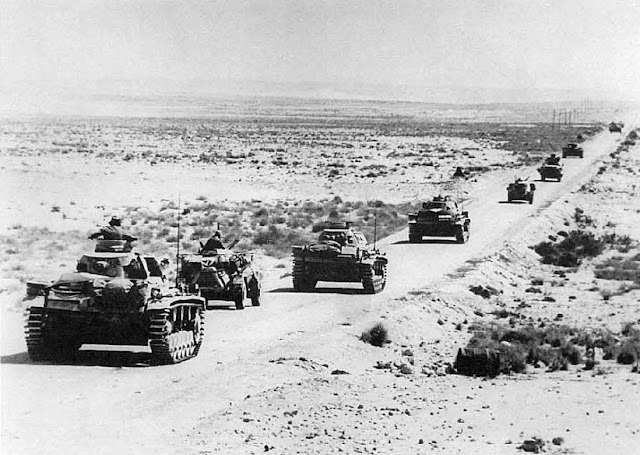
Erwin Rommel’s forces attacked Ajdabiya and expelled the 2nd Armoured Division. German 5th Light Division attacked British 2nd Armoured Division at Mersa Brega, Libya starting at 0745 hours, supported by dive bombers. After holding off the offensive for most of the day, German tanks broke through at 1730 hours, capturing the town by 1900 hours. The forward positions of 13 Corps were occupied by scattered elements of the 2nd Armoured Division, which were soon passed through. The British seemed convinced that Rommel was attacking in overwhelming strength, although the Germans had concentrated all their tanks into one force, which consisted of the 5th Light, with the 5th Panzer Regiment, with Panzer IIIs and IVs as its strongest element, and two Italian divisions, the Ariete and the Brescia. As the sun slowly set, British commanders decided not to counterattack with their tanks, but instead withdraw 30 miles northeast toward Agedabia. The day’s engagement cost the British 60 men killed, 8 armored carriers destroyed, and 1 anti-aircraft gun destroyed.
This attack is an unusual example of how British top-secret Ultra intelligence can work against them. The British have been decoding messages from Berlin which effectively have ordered Lieutenant General Rommel not to attack until he has all of his projected forces assembled. This is not supposed to be the case until May. Wavell and Neame, informed by Ultra of the state of Rommel’s forces had assumed he would wait until all the Afrika Korps had arrived. However, Rommel has decided on his own initiative to attack, confounding the British, who expected him to wait.
The German 15th Panzer Division arrives at Tripoli, Libya.
British and Indian troops broke through the roadblocks on the road between Keren and Asmara in Eritrea, Italian East Africa, capturing 560 Italian troops; continuing the push south, Indian 5th Infantry Division engaged Italian troops near Adi Tekelezan, which was less than 50 kilometers from Asmara and was the last town before Asmara. To the east, Italian destroyers Leone, Pantera, and Tigre departed Massawa, Eritrea to attack British port facilities at Port Sudan, British Sudan; Leone struck underwater rocks en route, and Pantera and Tigre were forced to sink Leone by gunfire, and the attack was called off with two surviving ships heading back to Massawa.
The front in Albania is quiet on 31 March 1941. The RAF raids Italian road convoys, while the Greeks claim some minor successes in the hills on the approaches to the port of Valona.
The British Air Force in Greece reported: “On Sunday British bombers made successful raids on Elbasan (Albania) and its environs. Enemy fighter planes tried to stop our aircraft, but gave up the battle after one enemy fighter was brought to crash. Our armed reconnaissance flights in the Tepeleni area of Albania also went off successfully. All British aircraft returned to base.”
Germany and Yugoslavia severed diplomatic relations.
British CIGS General John Dill is in Belgrade for discussions of joint defense with the Yugoslav government.
There is dissension within the Hungarian government. Admiral Horthy has told Hitler that Hungarian forces will contribute to the attack on Yugoslavia. However, Prime Minister Count Teleki disagrees.
Germany and Italy protested to the United States today against the government’s action in taking axis ships into “protective custody” on grounds of sabotage. Embassies of the two axis powers acted quickly after seizure of a total of 69 German, Italian and Danish vessels, in sweeping weekend raids.
Daily Key note from the Reich Press Chief: “We must wait for reports of Italian losses in the sea battle in the Aegean Sea [before issuing news about it]. If further reports arrive concerning the British aircraft carrier that we crippled, we must not mention [in press reports] that the carrier in question was once again the ‘Ark Royal’”
Following Adolf Hitler’s February order to form an air command to support the Kriegsmarine in the Atlantic, the Oberkommando der Luftwaffe (OKL) forms the Fliegerführer Atlantik. This comes under the overall jurisdiction of Field Marshal Hugo Sperrle at Luftflotte 3. Martin Harlinghausen is the unit’s first commander. The Fliegerführer Atlantik is allocated KG 40 and some units at various ports along the coast. At this time, it has an establishment of 21 Fw 200s, 26 He 111s, 24 Heinkel He 115s, and a mixed force of Messerschmitt Bf 110s and Junkers Ju 88s, numbering 12 aircraft. While the Condors are effective, the command never has aircraft with the proper capabilities, or sufficient numbers of any aircraft, to fully accomplish its mission.
The OKH completes the first draft of the infamous Commissar Order discussed by Adolf Hitler on the 30th at the Reich Chancellery.
Martin Harlinghausen was appointed chief of the newly created Fliegerführer Atlantik.
British Army Private Laurence Arthur Coe of the Army Dental Corps escapes from a German POW camp and arrives in Switzerland. He will be awarded the Distinguished Conduct Medal, as announced in the Second Supplement to The London Gazette, 18 March 1941. Coe is the first escapee from a German POW camp (there already has been at least one German escapee from British captivity, Franz Xaver Baron von Werra).
Italian submarine Ambra sank British cruiser HMS Bonaventure 125 miles south of Crete, Greece at 0244 hours. Bonaventure was escorting Allied convoy GA8 from Greece to Alexandria, Egypt at the time. 138 were killed, 310 survived.
Crown Prince and Regent of Iraq Abd al-Ilah learned of a plot to assassinate him and fled the country to Jordan. He first takes shelter aboard Royal Navy gunboat HMS Cockchafer, then goes to Amman, Jordan as a guest of Prime Minister Nuri as-Said.The next day four Iraqi nationalist army colonels, known as “the Golden Square” staged a military coup in Iraq that overthrew the regime of Regent ‘Abd al-Ilah and installed the pro-Axis Rashid Ali as Prime Minister.
The Luftwaffe sends 47 bombers to attack Hull, dropping 39 tons of high explosives and 22,688 incendiaries. The docks are hit, along with the police station and an infirmary. Estimates are that the raid destroys 500 houses and damages 2000 more. There are 44 deaths and 72 badly wounded.
The early part of the month featured several sharp raids on England. There are 4259 civilian deaths and 5557 injured. Many children have returned to the cities after a quiet period earlier in the year, and 598 of them perish during March.
Before dawn, 109 RAF bombers attacked German warships Scharnhorst and Gneisenau in Brest, France, scoring no hits.
RAF Bomber Command: Day of 31 March 1941
20 Blenheims on coastal sweeps from France to Germany. Two destroyers were bombed from low level and one was hit; other ships were attacked and some hit. This was the first day of what was known as ‘Fringe Operations’, when the Blenheims were ordered to attack land targets along the coasts they were patrolling. Several German gun positions and a parade of troops were attacked in Holland. 2 Blenheims lost.
RAF Bomber Command: Night of 31 March/1 April 1941
Bremen
28 Wellingtons; haze and cloud prevented accurate bombing. 1 aircraft lost.
Minor Operations: 6 Wellingtons to Emden and 5 to Rotterdam. 1 aircraft each from 9 and 149 Squadrons dropped the first 4,000-lb bombs of the war on Emden. These ‘high-capacity’ blast bombs, called ‘blockbusters’ or cookies' by the British andLuilminen’ by the Germans were due to become one of Bomber Command’s main weapons. No aircraft lost.
U-46, commanded by Oberleutnant zur See Engelbert Endrass, sank Swedish tanker Castor (8714grt) in 57-59N, 32-08W. At 1033 hours on 31 March 1941 the unescorted and neutral Castor (Master David H. Julin) was hit on the starboard side ahead of amidships by one G7a torpedo from U-46 about 430 miles east-southeast of Cape Farewell. The highly flammable cargo of the tanker immediately caught fire and the flames soon spread over the whole ship. The master and all other men that were in the forward part of the ship were lost, while the surviving crew members abandoned ship in both lifeboats from the after boat deck, but the starboard boat swamped because the ship still had headway. About 10 minutes after the torpedo hit, the survivors observed the U-boat in the starboard quarter of the burning tanker. Apparently the Germans identified the ship by reading the name on the stern and then left without questioning the survivors. Some hours later, all 21 survivors got into the port lifeboat and took the damaged starboard boat in tow, but remained about a mile from the Castor which continued to burn fiercely. On 2 April, the flames had subsided and some men, led by the chief engineer officer, reboarded the wreck. They discovered that the fire was out, but heavy smoke was still coming from several places below decks. The engine room and the superstructure amidships and aft had been completely destroyed by the flames. The boarding party gathered together various useful articles in the forward store rooms before leaving the tanker again. At 1200 hours on 3 April, the Otaio (Master Gilbert Kinnell) encountered the drifting and still smoking wreck in position 57°59N/32°08W and within 30 minutes picked up the survivors and both lifeboats, landing them later on Curaçao. The next day, they informed the escort of an eastbound convoy about the last position of the tanker, which probably foundered during the night of 3/4 April. The 8,714-ton Castor was carrying oil and was bound for Gothenburg, Sweden.
Light cruisers HMS Dido and HMS Aurora arrived at Scapa Flow from patrol in the Faroes-Iceland Channel.
Battleship HMS King George V, escorted by destroyers HMS Cossack, HMS Maori, and HMS Zulu, arrived at Scapa Flow at 1416 from escorting convoy HX.115.
Destroyers HMS Intrepid, HMS Icarus, and HMS Impulsive, escorted by destroyers HMS Kelly, HMS Kashmir, HMS Kelvin, and HMS Jackal, laid minefield GZ in the English Channel.
Minesweeping trawler HMS Lord Selborne (247grt, T/Skipper F. Watkinson RNR) was sunk by mining three miles 102° from Spurn Head Port War Signal Station. Watkinson, T/Lt J. G. Browne RNR, and fifteen ratings were lost in the trawler.
British steam drifter Helpmate (76grt) was lost to an unknown cause off Newlyn, Cornwall.
British trawler Ontario (208grt) was sunk by German bombing in 60-15N, 11-00W. The entire crew of the trawler was rescued.
British trawler Rattray (182grt) was damaged by German bombing two miles southeast by east of Hook Point.
Yugoslavian steamer Una (1397grt) was seized by Italian authorities on the steamer’s arrival at Genoa.
Light cruiser HMS Bonaventure (Captain H. J. Egerton) was escorting convoy GA.8 since 30 March with anti-aircraft cruiser HMS Carlisle and destroyers HMS Hereward, HMS Griffin, and HMAS Stuart. The convoy was covered by light cruisers HMS Ajax and HMAS Perth. Italian submarine Dagabur made an attack on light cruiser Bonaventure at 2027 on the 30th. Italian submarine Ambra attacked this convoy at 0244 on the 31st and sank light cruiser Bonaventure in 33-20N, 26-35E and missed Australian destroyer Stuart. Cdr E. F. Disbrowe, Lt Cdr C. W. Hope, Lt D. A. C. Brock, Cdr (E) D. H. Tollenache, Lt (E) R. C. H. D’Oyly, Lt (E) C. W. Russ, Surgeon Lt Cdr J. W. Oliver, MRCS, LRCP, Surgeon Lt (D) F. P. Ewens, Lt E. G. Ott RNR, Paymaster Cdr W. S. A. Stapley, Paymaster Lt E. S. Ellis RNR, Gunner L. H. Wilson, Warrant Shipwright J. J. Grose, Warrant Engineer J. S. Kanavan, Warrant Engineer R. W. Ley, T/A/Warrant Electrician W. Widdowson, Captain J. O. G. Hayter, RM, T/Sub Lt E. R. Gould RNVR, T/Sub Lt D. H. Robb, RCNVR, T/Sub Lt A. Norman RNVR, T/Electrician Sub Lt A. A. J. Leach RNVR, T/Paymaster Sub Lt G. Williams RNVR, A/Paymaster Sub Lt D. A. Eden, RCNVR, and 115 ratings were lost on the cruiser.
Destroyer HMAS Stuart made anti-submarine attacks. Destroyers HMS Hereward and HMAS Stuart rescued the 310 survivors from the cruiser. Destroyer Hereward arrived at Alexandria with the survivors at 1300. Destroyers Stuart and HMS Griffin arrived with the convoy at Alexandria at 1600.
Destroyer HMS Greyhound departed Alexandria and joined destroyer HMS Griffin of the GA.8 escort and proceeded to Port Said. These destroyers were to be based at Suez to counter the threat of attack by the Italian destroyers at Massawa. Gunboats HMS Aphis and HMS Gnat were stationed at Suez on this same duty.
Italian submarine Pier Capponi was sunk by submarine HMS Rorqual south of Stromboli in 38-42N, 15-12E.
A Swordfish of 815 Squadron from Maleme ditched off Kithera Island. Lt (A) E. D. J. R. L. Whatley and P/Midshipman (A) F. T. C. Wallington RNVR, were rescued.
Italian destroyers Leon, Pantera, and Tigre departed Massawa to bombard the port of Suez. Leon ran aground near Massawa on 1 April and Pantera and Tigre scuttled her with gunfire. The two destroyers then returned to Massawa.
Italian steamer Fella (6072grt) was scuttled at Punta Arenas.
Italian tankers Jole Fassio (5169grt) and Trottiera (6205grt) were scuttled at Puerto Cabello. Jole Fassio was later salved by the U.S. as the Alcibiades, later acquired by the U.S. Navy as the station oiler USS Andrew Doria (IX-132).
Convoy HX.118 departed Halifax escorted by armed merchant cruiser HMS Wolfe. On 3 April, battleship HMS Ramillies and the Free French submarine Surcouf were with the convoy. The submarine was detached on 9 April and the battleship on 10 April. On 13 April, destroyers HMS Caldwell, HMS Ramsey, HMS Ripley, HMS Volunteer, and HMS Walker and corvettes HMS Kingcup and HMS Tulip joined the escort. The corvettes were with the convoy for that day only. The armed merchant cruiser and destroyer Ramsey were detached on 14 April. The escort was detached with the convoy arrived at Liverpool on 18 April.
Today in Washington, the Senate considered the $4,389,284,174 Fifth Supplemental Defense Appropriation Bill, approving the amendment prohibiting purchase of Argentine beef by the Army; received the Tobey resolution to prohibit convoying of merchant vessels by United States warships; received the final report of the Temporary National Economic Committee and the La Follette committee report on the 1937 “Little Steel” strike, and recessed at 4:36 PM, until noon tomorrow.
The House considered the bill to require marketing of cotton by net weight; heard discussion of the defense strike situation; received the Ford bill to make treasonable and punishable by death, where fatalities occur, strikes against the government or defense industries; received the Sabath and Vinson resolutions for investigation of the defense program by the House Military and Naval Affairs Committees; approved the resolution continuing for two years the Tolan committee to investigate migrant labor problems, and adjourned at 5:47 PM until noon tomorrow.
President Roosevelt interceded last night in the dispute between 330,000 soft coal miners and operators which threatened to stop production of much coal necessary to defense industries. With orders already out for all United Mine Workers (C.I.O.) in the eight-state Appalachian area to quit work at midnight until a new working contract was negotiated, the president wired from his capital-bound train to Ezra Van Horn, chairman of the conference which had failed to work out a new contract: “Uninterrupted operation of bituminous coal industries extremely important. Suggest if necessary you continue negotiations during Tuesday looking to satisfactory arrangement.” He added he expected a report before midnight through Dr. John R. Steelman, federal conciliator.
A coalition of western senators caught administration forces napping for the second time in two weeks today, rolling up a 34 to 29 majority for a prohibition against buying foreign-produced food including Argentine canned beef, or clothing out of a pending supplemental defense appropriation. The restriction, approved by the house, would apply only to funds spent from the pending $4,389,284,174 army-navy supplemental bill.
Milwaukee Police drove a six-ton armored car into a crowd of 3,000 C.I.O. strikers at the Allis-Chalmers Manufacturing Company’s West Allis plant today and dispersed it with tear gas bombs. It was the first outbreak of violence in a sixty-eight-day old strike at the plant. The company reopened Friday in defiance of the C. I. O. strike after the government had appealed for resumption of work on $45,000,000 worth of key defense orders. Strikers lined the factory gates as the day shift left the plant at 4:20 PM today. A squad of 150 police patrolled the area. When strikers started to stop automobiles containing employees who had returned to work the police intervened. A squad manned the huge armored car, a truck recently rebuilt by the police for the announced purpose of disposing of bombs, and drove into the crowd, which fled in confusion. From slots in the side of the car police fired round after round of tear gas bombs at the fleeing pickets. Shouts of pain were heard. One woman was reported hit by a tear gas shell.
The U.S. Supreme Court decides Cox v. New Hampshire, 312 U.S. 569 (1941). The Court holds that a New Hampshire state statute prohibiting unlicensed parades does not violate the First Amendment rights of Jehovah’s Witnesses who staged a march in town without a permit. This decision allows local governments to regulate competing uses of public forums using a reasonable permit scheme tailored to the public interest.
The American Federation of Labor’s nineteen building trades unions have voted to ban jurisdictional strikes among themselves on defense projects, it was announced today by Herbert Rivers, secretary-treasurer of the Building and Construction Trades Department of the Federation.
Admiral Husband Kimmel, Commander of the U.S. Fleet, and General Walter Short received a report noting the weakness of the base at Pearl Harbor, U.S. Territory of Hawaii to surprise air attacks. Major General Frederick Martin and Rear Admiral Patrick Bellinger, the air defense officers of the Army and Navy, submit a report to Admiral Husband Kimmel (CINCPAC) and General Walter Short, the commanders of naval and ground forces in Hawaii. The report states that there is a likelihood of a Japanese air attack on U.S. forces on Oahu, with the greatest likelihood that such an attack would take place on a Saturday or Sunday at dawn.
At around this time — the exact date is unknown, but is in the final week of March 1941 — Captain Ellis M. Zacharias calls upon Admiral Kimmel (this is according to Zacharias’ later testimony). Zacharias is the District Intelligence Officer at the 11th Naval District in San Diego and has extremely good contacts within the Japanese military. Zacharias tells Kimmel that a Japanese attack:
“…would begin with an air attack on our fleet on a weekend and probably on a Sunday morning; [also] the attack would be for the purpose of disabling four battleships.”
Zacharias predicts that the Japanese would use aircraft carriers operating north of Hawaii due to the direction of prevailing winds. He recommends a standing “daily patrol out to 500 miles.” Kimmel demurs, saying that he does not have the aircraft (which is true), to which Zacharias responds:
“Well, Admiral, you better get them because that is what is coming.”
If anyone is to be trusted with this kind of warning, it is an intelligence officer such as Zacharia. However, Kimmel later testifies that he has no recollection of the meeting, and a third person at the meeting (Capt. W. W. “Poco” Smith) has a completely different recollection of what was discussed. Zacharias is known, however, to have issued similar warnings to others well before 7 December 1941. Zacharias is a controversial historical figure who elicits strong reactions.
Lieutenant Colonel William Lee becomes the commander of the Provisional Parachute Group at Fort Benning.
Benjamin Gitlow, twice Communist party candidate for vice-president of the United States, declared weakening the military strength of this country was a party aim, in testimony today at the deportation trial of Harry Renton Bridges, vigorous maritime labor leader. “One of the aims of the Communist party was disorganizing the military force of the government,” said ex-Communist Gitlow, as the first day of the trial neared close. “The party is far from anti-militarist; Russia has the largest standing army in the world. Their anti-militarism is confined to weakening the military strength of their opponents and strengthening their own.” Gitlow was still on the stand under direct examination by government prosecutors at adjournment. The government, contending Bridges should be deported to his native Australia because he had affiliated with the Communist party, launched its case with the promise to prove the Communist party “teaches the overthrow by force and violence of the government of the United States.”
Ground is broken for the Union Square Garage, in San Francisco. It was touted as the world’s first underground parking garage.
The U.S. Coast Guard cutter USCGC Cayuga (CGC-54) arrives at Godthaab, Greenland, with the U.S. South Greenland Survey Expedition, composed of State, Treasury, War, and Navy Department representatives. The expedition’s mission is to locate sites for airfields, seaplane bases, radio and meteorological stations and aids to navigation in Danish Greenland.
Responsible sources in the ministries of foreign relations and the navy reported tonight Mexico planned to take custody of 12 German and Italian vessels in Mexican ports. Armed naval detachments, these sources said, will take control of the axis ships, possibly tonight, as an act of continental defense and of solidarity with the United States.
The Havana government instructed the Cuban Navy tonight to take custody of the Italian merchant ship Kecca, docked in Havana harbor since Italy entered the war. The decision announced by Premier Carlos Saladrigas at the presidential palace was understood as manifestation of solidarity with the United States government, which took over axis and Danish ships in its harbors yesterday.
Captain Rogge of German raider Atlantis puts a prize crew aboard captured British freighter Speybank, taken in late January, and sends it to France.
Japanese Foreign Minister Yosuke Matsuoka, in an interview with Italian and foreign newspapermen tonight, said that Japan stands for international peace and advocated a general get-together of the leaders of all nations. The foreign minister, who spoke in general terms, disavowed any intention, however, of attempting mediation of the European war. International cooperation, he said, can be achieved by statesmen who have a personal acquaintance and for that reason a personal meeting among the leaders of the great powers would seem desirable. In line with his belief in personal contact, the minister said, he would like to visit the United States during his present journey.
Dow Jones Industrial Average: 122.72 (+0.35)
Born:
Faith Leech, Australian swimmer (Olympics, 1956, gold medal, 4×100–metre freestyle relay; bronze medal, 100-metre freestyle), in Bendigo, Victoria, Australia (d. 2013).
Larry Donovan, American football coach (University of Montana 1980-85; CFL: BC Lions 1987-89), in Casper, Wyoming (d. 2025).
Bonvi, comic book artist, in Emilia-Romagna, Italy (d. 1995).
Naval Construction:
The U.S. Navy Accentor-class coastal minesweepers USS Acme (AMc-61) and USS Advance (later renamed Adamant, AMc-62) are laid down, 31 March 1941 by the Greenport Basin and Construction Co. (Greenport, Long Island, New York, U.S.A.).
The U.S. Navy Accentor-class coastal minesweeper USS Courier (AMc-72) is laid down 31 March 1941 by the Herreshoff Manufacturing Co. (Bristol, Rhode Island, U.S.A.).
The Royal Australian Navy Bathurst-class minesweeper-corvette HMAS Cairns (J 183) is laid down by Walkers Ltd. (Maryborough, Queensland, Australia).
The Kriegsmarine (German Navy) Type VIIC U-boat U-663 is laid down by Howaldtswerke Hamburg AG, Hamburg (werk 812).
The Kriegsmarine (German Navy) Type VIIC U-boat U-708 is laid down by H C Stülcken Sohn, Hamburg (werk 772).
The U.S. Navy Gato-class submarine USS Haddock (SS-231) is laid down at the Portsmouth Navy Yard (Kittery, Maine, U.S.A.).
The Royal Navy Bar-class boom defense vessel HMS Barsing (Z 75) is launched by W. Simons & Co. Ltd. (Renfrew, Scotland).
The Royal Navy Flower-class corvette HMS Aconite (K 58) is launched by the Ailsa Shipbuilding Company Ltd. (Troon, Scotland). She will be transferred to the Forces Navales Françaises Libres (Free French Naval Forces) before completion and commission as the French corvette Aconit.
The Royal Navy “O”-class destroyer (Flotilla leader) HMS Onslow (G 17) is launched by the John Brown Shipbuilding & Engineering Company Ltd. (Clydebank, Scotland).
The Sjøforsvaret (Royal Norwegian Navy) Fairmile B-class motor launch HNoMS ML 233 is commissioned.
The Nihon Kaigun (Imperial Japanese Navy) No. 13-class submarine chaser HIJMS Ch-14 is commissioned.
The Nihon Kaigun (Imperial Japanese Navy) No. 13-class submarine chaser HIJMS Ch-15 is commissioned.
The U.S. Navy submarine USS Mackerel (SS-204), lead boat of her class of 2, is commissioned. Her first commanding officer is Lieutenant John Frederick Davidson, USN.
The Kriegsmarine (German Navy) Type VIIC U-boat U-331 is commissioned. Her first commanding officer is Oberleutnant zur See Freiherr Hans-Diedrich von Tiesenhausen.
The Nihon Kaigun (Imperial Japanese Navy) Shimushu-class Kaibōkan (escort ship) HIJMS Hachijō (八丈) is commissioned. Her first commanding officer is Commander Fujimaki Yoshinori.
The Nihon Kaigun (Imperial Japanese Navy) Kagerō-class destroyer HIJMS Hagikaze (萩風; Clover Wind) is commissioned. Her first commanding officer is Commander Inoue Yoshio.
The Royal Navy King George V-class battleship Prince of Wales (53), commissioned incomplete in January, is declared completed. Her commander is now Captain John Catterall Leach, RN.
For the month of March 1941, German U-boats sank 40 ships (total of 234,847 tons) and damaged 10 more ships (total 98,329 tons).
Shipping losses for March are high, but so are U-boat losses. Sinkings by U-boat rise from 196k tons in February to 234k in March, while the Luftwaffe total also increases from 89k to 113k. The other categories also show large increases, with surface raider sinkings increasing from 89k tons to 139k, and mines accounting for 16k tons in February and 24k tons in March. Overall, Allied ship sinkings rise from 372k tons to 475k tons. Overall, the figures alone suggest that it is a great month for the German blockade.
However — and it is a huge “however” — the U-boat fleet losses in March 1941 are among the worst of the war so far. Three top U-boat commanders — Schepke, Prien and Kretschmer — leave the scene permanently. Because the “bench” of U-boat commanders is very thin, these are serious losses that greatly reduce the U-boats’ effectiveness.
Another issue for the Germans is that their top surface raiders — heavy cruisers Scharnhorst and Gneisenau — are now in port and likely not to return to action for some time. However, the Kriegsmarine is working up battleships Tirpitz and Bismarck, which the German hope will tilt the Battle of the Atlantic further in their favor later in 1941.
 History Diaries