The Battle of Cape Matapan
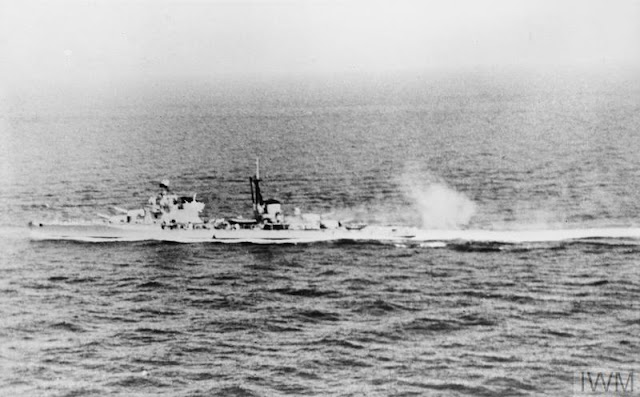
A British fleet defeats an Italian fleet in Battle of Cape Matapan; three Italian heavy cruisers and two destroyers are sunk, and a battleship and a destroyer damaged. 150 miles off Cape Matapan, Greece at 0635 hours, Italian seaplane spotted a group of four Allied cruisers, and three Italian cruisers moved in to attack, engaging in combat at 0812 hours, to be joined by the big guns of Italian battleships at 1055 hours; after the morning’s exchange of shellfire, all four Allied cruisers were damaged by near misses. At 1200 and 1509 hours, Allied torpedo bombers from HMS Formidable attacked, putting battleship Vittorio Veneto out of action for about 90 minutes at the cost of one aircraft. At 1936 hours, HMS Formidable’s aircraft returned, joined by land-based aircraft from Crete, Greece, putting cruiser Pola out of action, but failed to catch Vittorio Veneto as she had received temporary repairs and was already en route back to Taranto, Italy. After dark, British battleships HMS Barham, HMS Valiant, and HMS Warspite moved in within 3.5 kilometers of the Italian cruisers undetected, opening fire at 2330 hours on the unsuspecting Italians. The British creep up unobserved during the night, guided by radar. The three RN battleships open fire with their 15-inch (38,1 centimeter) guns crippling the Fiume, Zara, and the destroyers Alfieri and Carducci. They are finally sunk by four destroyers led by HMAS Stuart. The battleship Vittorio Veneto escapes and arrives at its base in Italy tomorrow.
The British find the disabled Pola and are bemused by its plight. It seems a pity to simply sink it. After considering simply sinking it with a torpedo, the British instead decide to board it and see what they can get from it. The Italians lose 2,303 in this battle. Cutlasses are used for the last time by the Royal Navy when the Italian heavy cruiser Pola is boarded by the gunners from ‘A’ Turret, HMS Jervis. The British boarding party makes off with some Breda anti-aircraft machine guns and captures 257 (very grateful) crewmen. Not long after, the British sink the Pola at 04:00. The British also sink destroyers Vittorio Alfieri and Giosue Carducci and damage destroyer Oriani.
While Iachino makes it back to port in his battleship, he loses three cruisers, two destroyers and hands the Royal Navy an absolute victory. The Italians lose about 3,000 men, the British barely any. Among the dead is Italian Admiral Cattaneo.
17-year old Peter II of Yugoslavia, considered by the new government to be of age to take the throne, took the oath of King of Yugoslavia in Belgrade as crowds cheered. King Peter makes a triumphal visit to the Serbian Orthodox Church cathedral in Belgrade, where he swears his fealty to the constitution, taking the oath of King of Yugoslavia in the presence of the Patriarch. This somewhat settles the populace after the coup of the 27th.
Anti-Axis demonstrations continued in Yugoslavia. Yugoslavia sped its army of 1,200,000 to battle stations today on the swift pace of an anti-Nazi, pro-British coup that overthrew the regency government for joining this kingdom to the axis, placed the boy King Peter II in full power, and held the deposed military leaders under arrest.
Turkish political quarters, cheering the Yugoslav army’s coup d’état which they called a heavy blow to Adolf Hitler’s prestige, said early today that immediate efforts may be made to bring Yugoslavia into an anti-axis Balkan defense bloc. Yugoslavia, it was predicted in these quarters, probably will consent to joining Turkey and Greece and Great Britain as well in a bloc aimed at halting Germany’s sweep through the Balkans. Such a move, sought by Britain and Turkey before the previous Yugoslav government’s capitulation to the Reich, will be dependent, however, on whether the Yugoslav army is able to resist any axis intervention which may be undertaken under the guise of “preserving order” in Yugoslavia.
German occupation forces In Bulgaria were rushing today toward the Yugoslav frontier, apparently as the result of the ouster there of the “axis” government of Regent Prince Paul. An Informed source In this capital said the Nazi southward movement of troops, under way since the occupation of Bulgaria, had been reversed suddenly and a rush of Nazi reinforcements was sent in the direction of defiant Yugoslavia. “The movement of the past several weeks in men and materials has beer completely reversed,” the source said. The general view here was that the Yugoslav coup which ousted the axis pact signers and installed a pro-British and pro-Greek government would sooner or later precipitate a general Balkan war.
The Italian Stefani News Agency reported: “This morning at 10:00 A.M., the members of Yugoslavian Premier Simovic’s new government were presented to the king. Shortly after that, King Peter Swore his fealty to the constitution in the presence of the Patriarch and high dignitaries of the Serbian Orthodox Church. King Peter’s motorcade from the royal palace to the cathedral, and the return trip to the palace, had the air of a genuine triumphal procession.”
British Field Marshal Sir John Dill, Chief of the Imperial General Staff, flies to Belgrade to determine the intentions of the new government headed by Air Force General Dusan Simovic. There is little Dill can offer the Yugoslavs and no agreements of any importance are reached. Dill has been stuck on Malta on his way back to London, much to his chagrin. However, this turns into somewhat of a serendipitous event due to the sudden coup in Yugoslavia. Dill flies to Belgrade to discuss the situation with new Prime Minister Dusan Simovic. The British, though, do not even have enough forces to defend Greece, much less Yugoslavia.
Daily Keynote from the Reich Press Chief: “Yugoslavia is not kindly disposed toward Germany. When you report events there, your news captions should be shaded so as to make this somewhat clearer but without taking on the form of a threat. Offer no commentary at any time.”
Before dawn in Berlin, Germany, General Franz Halder completed the German invasion plan for Yugoslavia. The military action is minimal in Albania on 28 March 1941, but the action behind the scenes has switched into overdrive. Pursuant to Adolf Hitler’s Fuhrer Directive No. 25, General Franz Halder, Chief of Staff of the OKH (army high command, spends all night putting together an invasion plan for Yugoslavia in addition to Greece. Normally, OKW — the military high command — would prepare such plans, but the army jealously protects its primacy in the East. This dichotomy — the OKW in command in western and southern theaters of operation, OKH in the East — is a brewing issue in the Wehrmacht. Some interpretations of Hitler’s command style, though, view him as actually favoring a dispersal of command authority and spheres of influence.
The Afrika Korps diary entry for today: “Nothing new.”
Operation LUSTRE, the British reinforcement of Greece, continues. Convoy AN 23 (six Greek and seven British ships) departs from Alexandria for Piraeus.
At Malta, the troops are placed on high alert in expectation of an Italian invasion on the 29th. There is an air raid alert during the night that hits numerous spots across the island, including airfields at Hal Far and Kalafrana.
Armored cars of Indian 4th Division and Indian 5th Division pursued Italian troops withdrawing from Keren, Eritrea, Italian East Africa. Italian rear guards fought a series of delay action engagements, slowing Allied advances by taking advantage of the terrain. The Italians have no intention of holding anywhere but do engage in some minor delaying actions when the local geography is favorable. The RAF also attacks the fleeing Italians.
The Italians abandon Dire Dawa, a town northwest of Harar, and withdraw towards Addis Ababa.
The novelist and essayist Virginia Woolf (born Adeline Virgina Stephen) drowns herself in the River Ouse because she fears another breakdown from which she might not recover. Novelist Adeline Virginia Woolf writes a suicide note addressed to her husband, then walks down to the River Ouse near her home. After filling her coat pockets with rocks, she walks into the river and drowns herself. Her body is not found until 18 April. Woolf has had a history of mental issues, and the destruction of her London home during the Blitz is thought to have contributed to her depression. She was 59. She suffered mental breakdowns in 1895 and 1915.
Visiting Australian Prime Minister Menzies attends a conference at the Department of Information, led by Minister Duff Cooper. Menzies records in his diary that they have a frank discussion about censorship, which among other things means making sure that the BBC does not scoop official government announcements. Menzies, always a bit catty, provides a capsule description of Duff Cooper:
“Duff Cooper presides with dullness and disinterest. A queer fellow, with a dead face and I should think great gifts of indolence.”
That, incidentally, is far from the least-flattering description of someone in Menzies’ diary.
In a ceremony that receives extensive coverage in the German media, Adolf Hitler awards test pilot Hanna Reitsch the Iron Cross Second Class. She is the first woman ever to receive the Iron Cross — and she isn’t even in the Wehrmacht, she is a private citizen.
German “racial theorist” Alfred Rosenberg gives a radio speech from Berlin. The occasion is the opening of the Institute for the Exploration of the Jewish Question in Frankfurt. This speech is entitled “The Jewish Question as a World Problem.” He views the solution as “Aussiedlung,” or resettlement. Rosenberg mentions Madagascar as a possible destination. He calls the current conflict a “war of encirclement of Jewish-British finance” and says that Germany must fight to abolish “indentured servitude and slavery [of the German Volk (people)] for the Jewish and non-Jewish financiers and world bankers.”
Estimating that Palestine could absorb between 2,000,000 and 2,500,000 Jews within the next fifteen years, Dr. Chaim Weizmann, president of the Jewish Agency for Palestine and the World Zionist Organization, said yesterday that land offered the only real hope for effective Jewish rehabilitation after the war.
Japanese Foreign Minister Yosuke Matsuoka again met with German Foreign Minister Joachim von Ribbentrop in Berlin, Germany.
En route to Brest, France, German cruisers Scharnhorst and Gneisenau were spotted by a British Spitfire fighter pilot.
South African Airways Lockheed Model 18-08 Lodestar, msn 18-2034, registered ZS-AST, crashes while en route from Windhoek, Namibia to Cape Town. The plane flies into the mountains at Elands Bay. All ten aboard (four crew, six passengers) perish.
The Luftwaffe conducts its usual fighter sweeps over England during the day, dropping a bomb here and there. The RAF, meanwhile, sticks to its own agenda of attacking shipping off the Dutch, Belgian and French coasts.
RAF Bomber Command: Day of 28 March 1941
18 Blenheims on coastal sweeps but no shipping seen.
The first of the RAF’s Eagle squadrons, No. 71 Squadron, composed of volunteer American pilots operating under the British flag, became fully operational.
Destroyer HMS Boadicea departed Scapa Flow at 0800 for Greenock to join the Western Approaches. The destroyer arrived at 0700/29th.
Destroyer HMS Liddesdale departed Scapa Flow at 1800 to meet steamer Amsterdam at 0200 off Aberdeen. The steamer was escorted to Lerwick, where they arrived at 1330/29th. The destroyer stood by to escort the steamer on its return to Aberdeen. The two ships departed at 2200 for Aberdeen. The ships parted company off Aberdeen at 1000/30th and destroyer Liddesdale arrived back at Scapa Flow at 1600.
Convoy OB.303 departed Liverpool, escorted by destroyers HMS Ambuscade, HMS Bulldog, HMS Ouragan, HMS Vanquisher, and HMS Veteran, corvettes HMS Amaranthus, HMS Campanula, HMS Freesia, HMS Heartsease, and HMS Pimpernel, and anti-submarine trawlers HMS Notts County and HMS St Apollo. Corvettes Pimpernel was detached later that day and destroyer Ouragan on the 30th. Destroyer HMCS Restigouche joined the escort on 1 April for the day. Destroyers Ambuscade and Vanquisher were detached on 2 April. The escort was detached on 3 April when the convoy was dispersed.
British flying boat depot ship HMS Manela departed Greenock at 0919, escorted by Canadian destroyer HMCS Restigouche, for Sullom Voe. Dutch cruiser HNLMS Heemskerk departed Greenock at 1000 and joined the escort. Destroyer HMS Avon Vale departed Scapa Flow at 0900/30th to join depot ship Manela fifteen miles west of Cape Wrath at 1400. The destroyer provided escort to Sullom Voe. Destroyer Avon Vale had completed her working up and was transferred to the Western Approaches. Destroyers HMS Echo and HMS Active departed Scapa Flow at 2100/31st for Sullom Voe, where they arrived at 0700 on 1 April. The destroyers departed at 1600 with depot ship Manela, Dutch cruiser Heemskerk, and Canadian destroyer Restigouche for Hvalfjord. On arrival at Hvalfjord at 0800 on 5 April, the Destroyers came under the direction of Flag Officer Iceland to escort cruisers in and out of Hvalfjord. Destroyer Restigouche returned to Greenock after the escort duty.
Destroyers HMS Intrepid, HMS Icarus, and HMS Impulsive, escorted by destroyers HMS Kelly, HMS Kashmir, HMS Kelvin, and HMS Jackal, laid minefield GX in the English Channel.
Submarine HMS Cachalot, which departed the Clyde on the 21st, laid mines off Bayonne in minefield FD 32.
Norwegian submarine HNoMS B.1 was damaged in a collision with anti-submarine trawler HMS Lady Elsa (518grt) near Campbeltown.
To man escort ships transferred from the United States, battleship HMS Resolution at Portsmouth was ordered to provide 15 officers and 34 ratings and battleship HMS Queen Elizabeth at Scapa Flow 27 officers and 26 ratings. In addition, battleship HMS Malaya, under repair at New York, provided officers and ratings to man these ships.
British steamer Olivine (929grt) was lost to unknown cause in the Irish Sea or Bristol Channel.
British trawler Kestrel (75grt) was near missed by German bombing north of North Lundy Light. The vessel was beached on Lundy Island on the 29th. Heavy weather pounded the ship and she became a total loss.
British steamer Staffordshire (10,683grt) was damaged by German bombing in 59-30N, 10-18W. Fourteen crewmen and fourteen passengers were lost. The steamer was beached at Loch Ewe on the 29th. On 23 April, the steamer sailed for the Tyne.
Dutch steamer Antwerpen (364grt) was sunk by German bombing in 51-16N, 4-21W. Three of the crew were lost.
The Battle of Cape Matapan:
Light cruiser HMS Gloucester experienced engine room problems prior to the battle, but they were corrected before Pridham Wipple engaged Iachino. Australian destroyer HMAS Vendetta had an engine room breakdown and was ordered to Alexandria.
Three Albacores and two Swordfish of 829 Squadron were launched from aircraft carrier HMS Formidable for an afternoon strike on the Italian force. Lt Cdr J. Dalyell-Stead, Lt R. H. Cooke DSC, and Petty Officer Airman G. L. Blenkhorn of 829 Squadron were lost during an afternoon strike on the Italian battleship Vittorio Veneto. The battleship was hit, but was able to proceed. An Albacore of 829 Squadron ditched southeast of Antikithera Island after the torpedo attack. Destroyer HMS Juno rescued Sub Lt G. P. C. Williams, Sub Lt G. L. Davis, and Leading Airman Booth. Aircraft carrier Formidable launched six Albacores of 826 Squadron and two Swordfish of 829 Squadron. Two Swordfish of the 815 Squadron joined from Maleme. The aircraft torpedoed that evening heavy cruiser Pola. The heavy cruiser was left dead in the water. Returning to Maleme, one of the Swordfish of 815 Squadron force landed in Suda Bay and its crew of Lt M. A. Torrens-Spence and Sub Lt P. Winter were rescued.
Battleship Veneto and heavy cruisers Trieste, Trento, and Bolzano proceeded to Taranto. Heavy cruisers Zara and Fiume with destroyers Gioberti, Alfieri, Oriani, and Carducci were ordered to assist heavy cruiser Pola.
Shadowing the Italian Fleet, a Swordfish of 826 Squadron from HMS Formidable failed to find Maleme on its return and forced landed in Suda Bay. Its crew of Sub Lt D. W. Phillips, Sub Lt G. Dormand, and Leading Airman A. Japp were picked up by trawler Moonstone.
The Pola group is detected by British radar. The group is attacked and all three heavy cruisers and destroyers Alfieri and Carducci are sunk by British gunfire. Destroyer Oriani is damaged. Only destroyer Gioberti escaped damage. Three thousand men, including Admiral Cattaneo, were lost.
Seven Greek destroyers proceeded through the Corinth Canal to await orders to join Cunningham. The order was never sent and they spent the battle cruising between Cephalania and Zante. Due to an error in deciphering, the Greek message stating they were awaiting “orders” was read as awaiting “oilers. “
Fifty five officers and 850 men are rescued by destroyers and the Greek destroyers.
Italian hospital ship Gradisca rescued 13 officers and 147 men later.
Convoy AN.23 of six Greek and seven British departed Alexandria escorted by destroyer HMS Hero and corvette HMS Salvia. Anti-aircraft cruiser HMS Coventry joined convoy AN.23. Destroyer HMS Decoy joined the convoy on the 29th. The convoy arrived at Piraeus on 1 April.
A convoy of steamers Adana (4205grt), Samos (2576grt), Ruhr (5954grt), Galilea (8040grt), and Heraklea (1927grt) departed Naples escorted by destroyers Folgore, Dardo, and Strale for Tripoli. Submarine HMS Utmost off Kerkenah sank German steamer Heraklea and damaged German steamer Ruhr twenty two miles south east of Kuriat. Steamer Ruhr returned to Trapani with destroyer Dardo and assisted by torpedo boats Circe, Sagittario, and Alcione and two MAS boats while the rest of the convoy proceeded to Tripoli, arriving on the 30th, with steamer Galilea, which was straggling.
Submarine HMS Upright torpedoed and severely damaged steamer Galilea on the 31st in 33-38N, 12-40E. The convoy departed Tripoli to return on 2 April with steamers Ankara (4768grt), Kybfels (7764grt), Marburg (7564grt), and Reichenfels (7744grt), and Galilea (8040grt), escorted by destroyers Vivaldi, Da Noli, and Malocello. The convoy arrived at Naples on 4 April.
Rear Admiral G. W. Hallifax, GMC?? (ret), Director of the Seaward Defense Force, was killed in an air crash at Capetown.
University of California at Berkeley professor Glenn T. Seaborg’s research group demonstrates that Plutonium-239 is fissionable and could theoretically be used in an atomic weapon. Since Plutonium-239 can be produced by neutron bombardment of Uranium-238 (the most common isotope of Uranium) in a nuclear reactor, this makes the large scale production of nuclear weapons possible.
President Roosevelt returned to the south Florida port of Port Everglades shortly before midnight tonight after a week’s cruise off the Florida coast in the White House yacht Potomac. Indications were the president would make his Jackson Day radio broadcast from the wardroom of the vessel tomorrow night. Workmen placed two telephone lines along the docks where the Potomac was moored when the chief executive boarded her a week ago. It was understood these lines would be used to bring the speech ashore for radio transmission over three national networks. The speech is scheduled for 9:30 PM EST.
Appropriations of nearly $4,400,000,000 more for Army and Navy expenses in the next fifteen months were approved today by the Senate Appropriations Committee when it approved the Fifth Supplemental National Defense Bill.
Rewritten to conform to President Roosevelt’s wishes, a bill to legalize government wiretapping in cases of sabotage, espionage, kidnaping and extortion was approved today by the house judiciary committee. In those four types of cases, the justice department could use wiretapping devices but only after the procedure had been approved by the attorney-general and he had issued a certificate authorizing it.
With aid to Britain now “a national duty,” Herbert Hoover said here tonight America had a “positive appointment” to sit at the world’s peace table, and, whether or not it entered active conflict, it must begin to think how it would shake off an inevitable “war socialism and fascism.”
One of the first groups of strikes turned over to the defense mediation board for settlement was lifted out of its hands last night when a C.I.O. committee and management agreed to end the five weeks’ work stoppage at the Universal-Cyclops Steel Corp., Bridgeville, Pennsylvania. C.I.O. workers also ended their strike at one Bethlehem Steel Co. plant, but walked out at another. A meeting of a C.I.O. union at Hoboken voted to empower its executive committee to call a strike of 1,500 workers in the shipyard of the Bethlehem company there.
The threatened C.I.O. strike at the Cambria works of the Bethlehem Steel Corporation started in Johnstown, Pennsylvania this morning two hours after John F. Riffe, field director for the S.W.O.C. in Bethlehem, had announced the settlement of the four-day tie-up there.
Work on vital defense orders was resumed today at the Milwaukee plant of the Allis-Chalmers Manufacturing Company as some of the workers, kept idle by a strike since January 22, went back to the plant in response to a plea by national defense chiefs.
Representatives of the United Mine Workers of America and the bituminous operators in the eight-State Appalachian region plan to continue contract negotiations here today and tomorrow in an effort to reach some decision before expiration of the current two-year agreement on Monday at midnight.
The Commanding Officer of the aircraft carrier USS Yorktown (CV-5) after five months operational experience with the CXAM radar, reported that aircraft had been tracked at a distance of 100 miles (160 km) and recommended that friendly aircraft be equipped with electronic identification devices and carriers be equipped with separate and complete facilities for tracking and plotting all radar targets.
President Roosevelt lifts an embargo of 30 Grumman F4F Wildcat fighters ordered by Greece.
Construction of Ford’s Willow Run, Michigan, Plant begins. Workers begin clearing trees from a large tract of land near Ypsilanti, Michigan. This is to be the site of the Ford Motor Company’s Willow Run plant. The factory will cover 3.5 million square feet and employ 42,000 people. Before the war, Henry Ford had boasted nonchalantly that Ford could produce 1,000 airplanes per day provided there was no interference from stockholders or labor unions. So when Ford was asked to build subassemblies for the Consolidated B-24 Liberator, it was no surprise that Ford pushed for a deal that would allow Ford to construct the entire bomber. The contract included US$200 million toward the construction of a new production facility. (With inflation, US$200 million in 1941 is equal to US$2.5 trillion in 2003 dollars.) Production got off to a slow start but by the middle of 1944, Willow Run churned out a B-24 every 63 minutes and by the end of the war, Willow Run had produced more than 8,500 B-24 bombers.
J. Warren Davis, 74-year-old retired judge who sat on the Federal Circuit bench in New York for nineteen years, was indicted by a Federal grand jury today on a charge of conspiring to obstruct justice and defraud the United States in return for financial favors.
Republic Pictures releases ‘The Adventures of Captain Marvel. The first superhero film, it is the first in 12 chapters and stars Tom Tyler as Captain Marvel and Frank Coghlan, Jr. as his mild-mannered normal self. The series follows the adventures of the title character as depicted in Fawcett Comics comic books Whiz Comics and Captain Marvel Adventures.
As the Japanese continue slowly withdrawing from Shanggao, the Chinese 19th Army Group of the 9th War Area recovers Kuanchiao.
That Yosuke Matsuoka, Japanese Foreign Minister, will seek German cooperation to bring the China Invasion quickly to a successful conclusion is regarded as a distinct possibility by high officials in Chungking tonight.
The dramatic turnabout of Yugoslavia at a moment when Germany is anxious to demonstrate to Yosuke Matsuoka, Japanese Foreign Minister, how united Europe is against Britain is being viewed in Japan with some dismay, but with all the greater attention. The press agrees that while the ultimate outcome is still in doubt, it might, in the words of the newspaper Asahi, produce unforeseen “some disaster in Southeastern Europe.”
U.S. Navy Admiral Thomas Hart informed by the Navy Department that he would be retained in command of the Asiatic Fleet beyond his retirement age: Hart turned 64 on June 12, 1941.
The U.S. Navy heavy cruisers USS Chicago (CA-29) (Rear Admiral John H. Newton, Commander Cruisers Scouting Force) and USS Portland (CA-33) and the destroyers USS Clark (DD-361), USS Conyngham (DD-371), USS Reid (DD-369), USS Cassin (DD-372), and USS Downes (DD-375), departed Brisbane, Australia, bound for Suva, Fiji Islands.
Dow Jones Industrial Average: 122.68 (-0.65)
Born:
Jim Turner, NFL kicker (NFL Champions, Super Bowl III Champions-Jets, 1968; AFL All-Star, 1968, 1969; New York Jets, Denver Broncos), in Martinez, California (d. 2023).
Alf Clausen, American orchestra leader and Emmy Award-winning film and television score composer (“Donny & Marie”; “The Simpsons”; “ALF”), in Minneapolis, Minnesota (d. 2025).
Charlie McCoy, American Grammy-winning session musician and harmonica player (“Hee Haw”), in Oak Hill, West Virginia.
Philip Fang, Chinese simultaneous interpreter and United Nations official, in British Hong Kong (d. 2013).
Died:
Virginia Woolf, 59, English writer (“Jacob’s Room”, “To the Lighthouse”), suicide by drowning.
Kavasji Jamshedji Petigara, 63, first Indian to become Deputy Commissioner of the Mumbai Police.
Naval Construction:
The U.S. Navy Aloe-class net tender USS Chinquapin (YN-12, later AN-17) [originally ordered as USS Fir] is laid down at General Engineering and Dry Dock Co. (Alameda, California).
The U.S. Navy Accentor-class coastal minesweeper USS Demand (AMc-74) is laid down by the Gibbs Gas Engine Co. (Jacksonville, Florida, U.S.A.).
The Royal Navy Bangor-class (Turbine-engined) minesweeper HMS Newhaven (J 199) is laid down by William Hamilton & Co. (Port Glasgow, Scotland); completed by Parsons. She will be transferred to the Royal Indian Navy before completion and commissions as HMIS Carnatic (J 199).
The Kriegsmarine (German Navy) Type VIIC U-boat U-336 is laid down by Nordseewerke, Emden (werk 208).
The U.S. Navy Benson-class destroyer USS Coghlan (DD-606) is laid down by the Bethlehem Shipbuilding Corp., (San Francisco, California, U.S.A.).
The Royal Navy LCT (Mk 1)-class landing craft, tank HMS LCT 21 is launched by Vickers Armstrong (Newcastle-on-Tyne, U.K.).
The Royal Navy Dance-class ASW trawler HMS Veleta (T 130) is launched by the Smith’s Dock Co., Ltd. (South Bank-on-Tees, U.K.).
The Royal Navy Fairmile B-class motor launch HMS ML 230 is commissioned.
The U.S. Navy coastal minesweeper USS Pipit (AMc-1), lead ship of her class of trawler conversions, is commissioned.
The U.S. Navy Pipit-class coastal minesweeper USS Magpie (AMc-2) is commissioned.
The Royal Navy Flower-class corvette HMS Armeria (K 187) is commissioned. Her first commanding officer is Lieutenant Commander William Nelson Mitchell Faichney, RNR.
 History Diaries