Coup in Yugoslavia
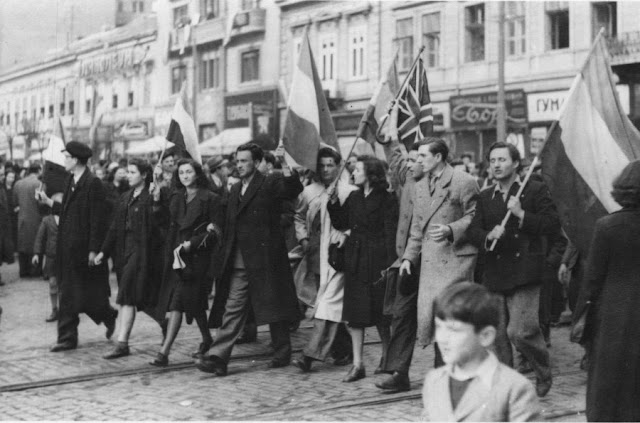
The Yugoslav coup d’état occurred. Dušan Simović and other Serb nationalist officers in the Royal Yugoslav Air Force overthrew Yugoslavia’s pro-Axis government and intended to back out of the Tripartite Pact. When Hitler learned of the coup he issued Directive No. 25 ordering an invasion of Yugoslavia.
General Dusan Simovic and other anti-German officers overthrew the pro-Axis government in Yugoslavia, placing Regent Prince Paul with King Petar II and intending to back out of the Tripartite Pact. At 02:15, a group of Royal Yugoslav Air Force (VVKJ) officers in Zemun, and Royal Guard officers in nearby Belgrade, strike. VVKJ deputy commander Borivoje Mirković oversees occupation of key installations in Belgrade such as the Zemun air force base, Belgrade bridges, government buildings, and army barracks. Exactly who initiated the coup is somewhat murky. Upon hearing the news, Adolf Hitler ordered an invasion of Yugoslavia; the German foreign ministry prepared messages to Hungary, Bulgaria, and Italy for them to join in the partition Yugoslavia.
At 2:30 this morning the Yugoslav regency council, headed by Prince Paul resigned; his nephew, King Peter, who is 17, took over and appointed as his prime minister General Dusan Simovich, the chief of the air staff. Simovich organized the coup after two days of anti-Nazi demonstrations. Soon after a radio announcement of the successful coup, King Peter was wildly cheered as he drove through Belgrade. A seething mass of people surged along the streets chanting “Now we are free”. Outside the Soviet legation the crowd were shouting “Long live Britain!”, “Long live Russia!” and “Down with Hitler!”
Regent Prince Paul was in Zagreb. He immediately returns by train to Belgrade. Upon arrival, he immediately is forced to sign papers abolishing his regency and is sent into exile in Greece. The British want him out of the way, so they send him first to Kenya, then to South Africa to sit out the war.
The British Reuters News Agency announced: “Prince Paul of Yugoslavia has fled. Former premier Cvetkovich, who signed Yugoslavia’s entry into the Tripartite Pact, has been imprisoned [by his own people in a coup d’état], as have other members of the former government.”
All of this turmoil and the alien-sounding names leads to some black humor abroad. As recorded by Australian Prime Minister Menzies in his diary, one common joke is “Ah! Robbing Paul to pay Peter!” Another is, “It’s hard to tell vitch vitch is vitch.”
International reaction is swift and deadly. In London, Prime Minister Winston Churchill piously announces that “Yugoslavia has found its soul” — which reinforces the feeling England was behind the whole thing all along. Menzies notes that “War Cabinet [meeting] more cheerful as a result.” He further writes, “we are all wishfully thinking that the tide has turned.” It hasn’t, at least not yet.
Adolf Hitler flew into a blind rage when he heard that the Yugoslavs had overthrown their pro-Axis government. He ordered military leaders to come to then chancellery in Berlin at once, and for several hours harangued them about the terrible punishment that would be visited on the Yugoslavs. Demanding an immediate invasion, he said that Yugoslavia must be destroyed with “merciless harshness”. Von Ribbentrop, the foreign minister, was sent off to tell Italy, Hungary and Romania that they would be given pieces of Yugoslav territory. Only the pro-German Croats would be allowed to survive with a puppet state. Hitler then dashed off a midnight letter to Mussolini:
“Today’s reports leave no doubts as to the imminent turn in foreign policy in Yugoslavia. Therefore I have arranged for all necessary measures … I consider it necessary, Duce, that you should reinforce your forces on the Italian-Yugoslav front with all available means and with the utmost speed.” In a preview of coming attractions elsewhere, Hitler vows an “Ohne Gnade,” or merciless invasion.
Hungary suddenly has become much more important in the German order of battle now that Yugoslavia is an enemy. Hitler and Ribbentrop meet with the Hungarian ambassador and remonstrate with him to cooperate in the dismemberment of Yugoslavia. As usual, Hitler offers his “partners” little chunks of the conquests should they help.
Hitler also meets with the Bulgarian ambassador. Bulgaria also has an expanded role to play now that German troops can use it to invade Yugoslavia as well as Greece.
German Chancellor Adolf Hitler issued Directive No. 25, ordering the military annihilation of Yugoslavia in retaliation for the military coup against the pro-Axis government:
The Führer and the Supreme Commander of the Armed Forces.
Führer Headquarters
27th March 1941
13 copies
DIRECTIVE No. 25
The military revolt in Yugoslavia has changed the political position in the Balkans. Yugoslavia, even if it makes initial professions of loyalty, must be regarded as an enemy and beaten down as quickly as possible.
It is my intention to break into Yugoslavia in the general direction of Belgrade and to the south by a concentric operation from the Fiume-Graz area on the one side, and the Sofia area on the other, and to deal an annihilating blow to the Yugoslav forces. Further, the extreme southern region of Yugoslavia will be cut off from the rest of the country and will be occupied as a base from which the German-Italian offensive against Greece can be continued.
The opening of the traffic on the Danube as soon as possible and the seizure of the Bor copper mines are important for the economic reasons.
Efforts will be made to induce Hungary and Bulgaria to take part in operations by offering them the prospect of regaining the Banat and Macedonia.
Internal tensions in Yugoslavia will be encouraged by giving political assurances to the Croats.
I issue the following detailed orders:
 As soon as sufficient forces are available and the weather allows, the ground installations of the Yugoslav Air Force and the city of Belgrade will be destroyed from the air by continual day and night attack.

 If possible simultaneously — but in no event earlier — "Undertaking Marita" will begin, with the temporarily limited objective of occupying Salonika basin and gaining foothold on the heights of Edessa. For this purpose, XVIII Army Corps can advance through Yugoslavia.
 Favorable opportunities will be seized to prevent the creation of an organized front between Olympus and the Edessa highlands.

 All forces still available in Bulgaria and Rumania will be committed to the attacks which will be carried out from the Sofia area to the North-west and from the Kyustendil-Gorna Dzhumaya area to the west, with the exception that a force of about one division, with air support, must remain to protect the Rumanian oilfields.
 The protection of the Turkish frontier will, for the present, be left to the Bulgarians. A German formation consisting if possible of one armored division will stand by in the rear in support.

 The thrust from the general direction of Graz towards the south-east will be made as soon as the necessary forces have been assembled. The Army is free to decide whether the Hungarian territory should be crossed in breaching the frontier.
 Security measures at the Yugoslav frontier are to be strengthened immediately.
 As on the Bulgarian frontier, important objectives can be occupied even before the general offensive, simultaneously with the air attack on Belgrade.

 The Air Force will support with two Groups the operations of the 12th Army and of the assault group now being formed in the Graz area, and will time the weight of its attack to coincide with the operations of the Army. The Hungarian ground organization can be used for assembly and in action.
 The possibility of bringing X Air Corps into action from Italian bases will be considered. The protection of convoys to Africa must however continue to be ensured.
 Preparations for the occupation of the island of Lemnos will be continued. I reserve the right to give orders for this operation.
 Care must be taken to ensure adequate anti-aircraft protection for Graz, Klagenfurt, Villach, and Leoben, and also for Vienna.
Basic agreement with Italy will be reached, for the time being, by the High Command of the Armed Forces. The Army will detail liaison staffs with Italian 2nd Army and with the Hungarians.
The Air Force is authorized to begin immediate discussions with the Italian and Hungarian High Commands in order to delimit the area of the air forces of the three powers. The build-up of Hungarian ground installations can begin at once.
Commanders-in-Chief will inform me, through the High Command of the Armed Forces, of their plans for the operation, and of related problems.
signed: Adolf Hitler
Adolf Hitler ordered Operation Barbarossa to be postponed due to changing political situations in the Balkan Peninsula.
Daily Keynote from the Reich Press Chief: “The sensational news from Belgrade, that King Peter has been placed on the throne by a military coup, should not be reported until the situation is clarified.”
Japanese Foreign Minister Yosuke Matsuoka met with German Foreign Minister Joachim von Ribbentrop in Berlin, Germany in the morning; Ribbentrop noted to Matsuoka that the United States was intimidated by the Axis alliance thus would not enter into the war even if Japan joined in to strike at British possessions in Asia. In the afternoon, Matsuoka met with Adolf Hitler.
The first transfers of prisoners out of Oflag IV-C camp at Colditz Castle in Germany took place; 27 Polish officers were moved to Oflag VII-B in Eichstätt, Germany.
Oberleutnant zur See Helmut Pöttgen of German submarine U-46 fell overboard from the submarine and was lost.
Ion Antonescu signed an anti-Jewish law providing for the segregation of Rumania’s Jews and expropriation of their urban property.
The Afrika Korps already is feeling the pinch from the movement of Luftwaffe units out of the North African theater. A proposed attack to take the Gialo Oasis (Jalu) to the south is shelved for the time being because it is considered accessible only by air — and no planes are available. In fact, to perform reconnaissance in that direction, the Germans must ask Italian air units to do it.
The German 8th Machine Gun Battalion is moved to El Agheila to free the 3rd Reconnaissance Unit for preliminary reconnaissance for the attack on Marsa Brega.
Allied tanks and infantry captured heights beyond the Dongolaas Gorge in Eritrea, Italian East Africa. By 1000 hours, Keren was captured without opposition as Italian troops fled toward Asmara. After a 52-day siege against Italian Bersaglieri, Alpini and Caribineri and Eritrean colonials, the British and Free French have won. The Italians have won much respect from those who defeated them. Swiss Radio spoke of the Italian’s “gallant resistance”. At first the Italians were outnumbered. Even after General Nicolangelo Carmineo brought in reinforcements, their numbers were only equal to the Allies, and they were far worse armed, but the Italian positions were rarely surrendered, and were usually only taken at great cost. Today the British broke through, leaving a route covered with the bodies of Cameron Highlanders and Savoia Grenadiers. It has cost 536 British lives and 3,229 wounded, and around 3,000 Italian lives and 4,500 wounded.
With Keren finally taken, General Wavell flies back to Cairo from East Africa.
The Battle of Cape Matapan began off the southwest coast of Greece. Battleship HMS Warspite, battleship HMS Barham, battleship HMS Valiant, carrier HMS Formidable, and nine destroyers of the British Mediterranean Fleet departed Alexandria, Egypt to hunt for an Italian fleet known to have departed bases in Italy. Four cruisers and four destroyers also departed from Piraeus, Greece, launching spotter planes to search for the Italian fleet, locating it at noon. A flying boat dispatched by Admiral Cunningham sights 3 Italian cruisers on a south-easterly heading approximately 320 miles southwest of Crete, and Ultra reports confirm the sighting. Cunningham orders British vessels in Alexandria to sail and then conspicuously leaves the port carrying his golf clubs in order to mislead enemy agents. He returns secretly and boards Warspite.
The Royal Navy under Vice-Admiral Pridham-Wippell is heading toward an epic clash with the Italian Fleet under Admiral Iachino. Pridham-Wippell has four cruisers and numerous destroyers. In addition, Admiral Cunningham is bringing battleships HMS Warspite, Barham and Valiant and aircraft carrier Formidable from Alexandria. The British aerial reconnaissance spots the Italians by noon, but the British already know from spies and Ultra decrypts what is going on. Despite misgivings, the Italians proceed with their somewhat pointless advance toward the convoy routes between Alexandria and Piraeus, Greece.
“I hope we’re signing Hitler’s death warrant,” Prime Minister Churchill said today as he wrote his name to the agreement whereby the Atlantic base sites in territories under British control will be leased to the United States for ninety-nine years, the quid pro quo being fifty United States destroyers now serving in the British Navy.
Germany sends about 500 Luftwaffe aircraft to Bulgaria and Rumania. The Luftwaffe’s transfers of units to Romania and Bulgaria switches into high gear. Hundreds of aircraft make the journey during the day. This necessarily dilutes Luftwaffe’s strength in North Africa, France and elsewhere.
The Luftwaffe continues its recent pattern of fighter sweeps during the day, with occasional bombs falling in the south and southeast.
RAF Bomber Command: Day of 27 March 1941
10 Blenheims on coastal sweeps; warships and a submarine were attacked but no hits were scored. No aircraft lost.
RAF Bomber Command: Night of 27/28 March 1941
Cologne
38 Wellingtons and 1 Stirling. 1 Wellington lost.
Dusseldorf
39 aircraft — 22 Hampdens, 13 Whitleys, 4 Manchesters. 1 Manchester and 1 Whitley lost.
Minor Operations: 13 aircraft to Brest, Calais and Dunkirk. No losses.
The British in Greenland spot Luftwaffe bombers overhead.
At Malta, the British observe that the Luftwaffe now is maintaining a continuous fighter patrol off the east coast. The RAF scrambles occasionally to confront them, but no interceptions are made. The purpose of this screen is unclear, but it may be to prevent reconnaissance missions over the convoy route from Naples to Tripoli.
U-98, commanded by Kapitänleutnant Robert Gysae, sank British steamer Koranton (6695grt) in 59N, 27W. At 1350 hours on 27 March 1941 the unescorted Koranton (Master Charles Edward Howard), a straggler from station #54 in convoy SC.25, was hit by a stern torpedo from U-98 and sank immediately about 320 miles south of Reykjavik, Iceland. The U-boat had spotted the ship two hours earlier in bad weather and temporarily lost contact before carrying out a submerged attack. The Germans investigated the sinking position but only found a large field of debris. The master, 38 crew members and two gunners were lost. The 6,695 ton Koranton was carrying general cargo and was bound for Hull, England, United Kingdom.
Light cruisers HMS Nigeria and HMS Fiji departed Scapa Flow at 1644 for Iceland Faroes passage duty. The cruisers were diverted on the 28th to join battlecruiser HMS Hood.
Anti-aircraft ship HMS Pozarica arrived at Scapa Flow to operate under the orders of Rear Admiral Destroyers, Home Fleet.
Submarine HMS Tribune departed Halifax escorting convoy HX.117. The submarine returned to Halifax after this duty on 15 April with engine defects.
P/T/Sub Lt (A) O. F. Wheatley RNVR, and P/T/Sub Lt (A) R. B. Hodgetts RNVR, of 807 Squadron from aircraft carrier HMS Furious were taken prisoners by the French when they landed at Dakar after a reconnaissance flight.
Sub Lt P. J. Hoad, in a Whitley of RAF 78 Squadron from Dishforth, was killed when his aircraft was shot down over the River Schelde.
British A/Leading Airman G. J. B. Kendall was killed when his Battle of 1 SFTS Netheravon crashed in fog at Shrewton RLG. Petty Officer H. J. Craig was also killed in the crash.
British depot ship HMS Alecto of the 7th Submarine Flotilla was damaged by the direct hit of a German bomb at the entrance to the English Channel.
British tanker Canadolite (11,309grt) was taken in prize by a German raider in 5N, 33W.
British steamer Meg Merrilies (642grt) was badly damaged by German bombing one mile south of St Govan’s Light Vessel. There were no casualties on the steamer. The ship was taken in tow. After the tow parted on the 27th, the vessel was abandoned and sank.
British trawler Kinclaven (178grt) was sunk to an unknown cause off the Faroes.
British salvage vessel Palmstone (430grt) was damaged by German bombing two miles southeast of St Govan’s Light Vessel. The vessel was beached at Milford Haven. She was later towed off and docked at Pembroke.
British trawler Fort Dee (212grt) was damaged by German bombing in 61-31N, 5-04W.
Dutch steamer Alioth (5483grt) was damaged by mining in 53-36N, 0-24E. The steamer returned to Hull.
Dutch steamer Oud Beijerland (396grt) was damaged by German bombing three miles south of St Govan. The steamer arrived Milford Dock on the 31st.
Italian battleship Veneto with her destroyers crossed the Straits of Messina and was joined by heavy cruisers Trieste, Trento, and Bolzano of the 3rd Cruiser Division escorted by destroyers Corazziere, Carabiniere, and Ascari of the 12th Destroyer Division. At 1000, the 1st Cruiser Division and escorts joined the Veneto force. At 1100, the 8th Cruiser Division and escorts joined the Veneto force.
The Veneto force, under the overall command of Admiral Iachino, was to sail in company until about 2000 which would bring them to the longitude of Crete. The 1st and 8th Cruiser Divisions, designated Force Z under Admiral Cattaneo, would go into the Aegean to the longitude of the eastern most end of Crete arriving about 0800/28th. Then Force Z would return to the Veneto arriving bout 1500 about ninety miles southwest of Navarino. Battleship Veneto and the 3rd Cruiser Division were to go to a point twenty miles west of Gavdos and if no contact was made by 0800/28th to turn back on the course. At 1220, Italian heavy cruiser Trieste sighted a British Sunderland seaplane which sighted and reported Sansonetti’s 3rd Cruiser Division.
The 1st and 8th Cruiser Divisions proceeded towards the Aegean at 1900 and the battleship Veneto and the 3rd Cruiser Division set off towards Gavdos. However, at 2200, the Supermarina ordered the 1st and 8th Cruiser Divisions to rejoin the Veneto force and go no further.
The British Mediterranean Fleet departed Alexandria in response to the Sutherland sighted of the Italian 3rd Cruiser Division. Cunningham departed Alexandria at 1900 with battleships HMS Warspite, HMS Valiant, and HMS Barham, aircraft carrier HMS Formidable, destroyers HMS Jervis, HMS Janus, HMS Mohawk, HMS Nubian, HMS Greyhound, and HMS Griffin of the 14th Destroyer Flotilla and destroyers HMAS Stuart, HMS Havock, and HMS Hotspur of the 10th Destroyer Flotilla. Pridham Wipple was at sea in the Aegean covering convoys AG.8 with light cruisers HMS Gloucester, HMS Ajax, HMS Orion, and HMAS Perth and destroyers HMS Hereward and HMAS Vendetta. The force was joined by destroyers HMS Ilex and HMS Hasty of the 2nd Destroyer Flotilla at 0630/28th. The cruisers and destroyer Vendetta were ordered to patrol Kithera Channel. Destroyers HMS Juno, HMS Jaguar, and HMS Defender departed Piraeus as Force D to patrol the Kithera Straits from dawn on the 28th. On 29 March, the Kithera Straits patrol was ceased. Destroyers Juno and Jaguar joined the Battle Force. Destroyer Defender was detached to Suda Bay for escort duties. Anti-aircraft cruiser HMS Bonaventure had very little ammunition, but she did possess radar. The cruiser and destroyers HMS Decoy and HMAS Waterhen departed Alexandria on the 28th to join the Battle Force.
Anti-aircraft ship HMS Carlisle was at Suda Bay.
Submarines HMS Rover and HMS Triumph were on patrol in the Aegean.
Convoy OG.57 departed Liverpool escorted by destroyers HMS Caldwell, HMS Valorous, HMS Volunteer, HMS Walker, HMS Wolsey, and HMS Woolston, sloop HMS Aberdeen, corvettes HMS Bluebell, HMS Hydrangea, and HMS Tulip, and anti-submarine trawler HMS Lady Hogarth. All, except sloop Aberdeen and trawler Lady Hogarth, were detached on 1 April. Dutch submarine HNLMS O.23 joined the convoy on 3 April. On 11 April, the convoy arrived at Gibraltar with sloop Aberdeen, trawler Lady Hogarth, and submarine O.23.
Convoy HX.117 departed Halifax, escorted by armed merchant cruiser HMS Rajputana, destroyers HMCS St Croix, corvette HMS Collingwood and submarine HMS Tribune. The destroyer and the corvette were detached on the 29th. The submarine was detached on 6 April. Destroyer HMS Niagara joined on 9 April and was detached later that day. On 10 April, destroyers HMS Achates, HMS Boadicea, HMCS Columbia, HMCS Montgomery, HMCS St Clair, HMCS St Francis, HMS Wanderer and corvettes HMS Marigold and HMS Trillium. Destroyers Achates, Boadicea, and St Francis were detached on 14 April. The remainder of the escort was detached when the convoy arrived at Liverpool on 15 April.
The White House today sent to the Senate a message from President Roosevelt transmitting the text of agreements and leases covering the transfer by Great Britain to the United States of military bases in Newfoundland, Bermuda and the West Indies.
The Senate completed Congressional action on the $191,478,544 first deficiency appropriation bill, passed bills authorizing federal inspection of mines, permitting marketing quotas for corn and wheat, setting up a revolving fund in the Treasury for dealing in strategic materials, permitting the Secretary of State to designate agents of foreign governments entitled to withdraw funds from Federal Reserve Banks and adjourned at 2:29 PM until noon on Monday. The Agriculture Committee approved the $1,000,000,000 agriculture appropriation bill recommending parity payments of $450,000,000.
The House passed the $22,272,228 War Department civil functions appropriation bill, approved the conference report on the $1,415,000,000 independent offices appropriation bill, approved a resolution extending the Bituminous Coal Act until 1943, heard discussion of the strike situation in defense industries and adjourned at 6:18 PM until noon on Monday.
U.S.-British-Canadian staff discussions in Washington, D.C. ended. The discussions resulted in the ABC-1 Staff Agreement and embodied the basic strategic direction of the war in the event of the entry of the United States. Plan ABC-1 posits placing the priority on the defeat of Germany over that of Japan, with a pronounced emphasis on securing the North Atlantic. There will be a combined Chiefs of Staff and US naval protection of convoys. These conclusions are summarized in “The United States British Staff Conversation, Report,” 27 March 1941. American participants include Rear Admiral Ghormley and Major General S.D. Embick, while British participants include Rear Admirals Bellairs and Danckwerts and Major General Morris. The agreement inextricably links the U.S. Navy in the effort against Germany.
Declaring that “these bases are for American defense against attack,” President Roosevelt today transmitted to Congress for its information the agreement signed today in London leasing sites for naval and air bases on Newfoundland, Bermuda and West Indian islands for ninety-nine years to the United States.
The U.S. Congress approved US$7,000,000,000 for the Lend-Lease program. The $7,000,000,000 appropriation to aid nations battling the axis was signed by President Roosevelt on his yacht in Florida waters, while in Washington there were indications the delivery of American airplanes to England has been accelerated in recent weeks. Secretary of War Stimson told reporters production of planes has shown a “very satisfactory” increase and this led to belief deliveries to Britain have been stepped up.
Aboard the presidential yacht USS Potomac, President Roosevelt signed the $7 billion wartime appropriation bill.
The United States, acting swiftly to bolster courage and axis defiance in Yugoslavia, today promised to give that country’s new leaders effective material aid in fighting off any aggression. Approving enthusiastically the overthrow of leaders who had aligned their country with the axis, the government here rushed assurances of American sympathy and support to the new cabinet installed in power under young King Peter II.
Four defense strikes were “certified” today by the Department of Labor to the new National Defense Mediation Board, and tonight the board, of which Clarence A. Dykstra is chairman, said that panels would begin consideration of the disputes tomorrow.
U.S. General Secretary of the Communist Party Earl Browder begins a four-year prison sentence at Atlanta Federal Penitentiary. He has been convicted of passport fraud.
Philip Murray tonight charged Representative Martin Dies, Texas Democrat, with “labor-baiting” and activities “truly subversive” in asking whether the C.I.O. is “willing to expel from its ranks and from positions of leadership members of the Communist party.” The C.I.O. chieftain telegraphed the congressman: “Since I have shown your charges against the S.W.O.C. to be distorted and without foundation, you are attempting to distort the facts as regards the C.I.O. in similar fashion. “Your activities are truly subversive, since you are trying to create confusion and hatred in the nation through your labor-baiting. It seems Strangely significant your groundless charges against the C.I.O. always come at a time when they can do the most harm.”
Members of the C.I.O. United Automobile Workers clashed with non-members tonight in the foundry of the Ford Motor Co.’s strike-threatened River Rouge plant in Michigan. Federal Labor Conciliator James F. Dewey said the union reported the incident to him and asked him to intervene. He said union spokesmen charged that a “goon squad” of about 200 men attempted to pull union buttons from the caps of workers. Knives were drawn, union representatives told Dewey, but they reported that there were no serious injuries. The union assembled several hundred members at the plant gate to escort the men from the plant when their shift was over.
Representatives of the C.I.O. Steel Workers union and Bethlehem Steel early today sat down to a conference intended to continue “until a settlement is reached” In a strike at the company’s huge parent plant. The conference began after the union had discussed the company’s counter proposals with a federal and state mediators in a two-hour session. The company and S.W.O.C. conferees were joined later by Thomas Lambert, of the U. S. conciliation service, and Charles Kutz, state mediator.
In the course of a House session today devoted principally to speeches about the defense labor situation, Representative Sumners, chairman of the Judiciary Committee, said his group would not hesitate “one split second” to recommend “the electric chair” for all enemies of the defense program, if this were needed to preserve the nation.
Japanese spy Takeo Yoshikawa arrived at the U.S. Territory of Hawaii aboard the passenger liner Nitta Maru, under the guise of a diplomat. Yoshikawa noticed that battleships were berthed in pairs and that the in-shore ship was protected from torpedo attacks by the outboard one.
Carrying a prototype centimetric air-interception radar, a USAAC B-18 Bolo makes the first air-to-air contact by a US radar system. Flying over the ocean off Cape Cod, the system showed that it could also register surface targets.
The Yankees sell pitcher Steve Sundra to the Senators. Sundra, 11–1, in 1939, slipped in 1940 to 4–6.
A Chinese military spokesman claimed today the complete repulse of the Japanese forces that recently launched an attack from Nanchang westward toward Shanggao in Northern Kiangsi Province.
The Chinese continue attempting to surround the advance elements of the Japanese Army at the Battle of Shanggao. However, the Japanese are alert to their peril and stay one step ahead of the Chinese as they retreat back to their bases. This will be a steady retreat that takes some time, but the Japanese have no need to occupy the territory in the area because it serves no strategic purpose if attacks further west are not going to be made. After reevaluating the situation, Japanese tacticians conclude that they could not afford to suffer any more losses from what was considered to be an inconclusive battle about the trivial matter of a Chinese headquarters, and on 1 April, they began to withdraw. In haste, the Japanese left behind many of their weapons and wounded troops. They would soon be captured by the Chinese. By 19 April the withdrawal was complete, and both sides now occupied their original positions.
The Australian Shipbuilding Board is established to begin a program of building “River” class frigates of 1,420 tons; these vessels are similar to the Royal Navy’s “River” class frigates. The intention is to built 60 ships at a rate of 12 a year but only six are commissioned during the war and two others in 1946.
U.S. Navy Task Group 9.2, under command of Captain Ellis S. Stone, comprised by the light cruisers USS Brooklyn (CL-40) and USS Savannah (CL-42) and the destroyers USS Case (DD-370), USS Shaw (DD-373), and USS Tucker (DD-374), departed Tahiti for Pearl Harbor, Hawaiian Territories.
Dow Jones Industrial Average: 123.33 (+0.63)
Born:
Charles Pashayan Jr., American politician, U.S. House of Representatives-Rep.-California (1979–1991), in Fresno, California.
Ivan Gašparovič, President of Slovakia (2004–2014), in Poltár, Czecho-Slovakia.
Liese Prokop, Austrian pentathlete (Olympic silver medal, 1968), in Tulln District, Austria (d. 2006).
Naval Construction:
The Royal Navy LCT (Mk 2)-class landing craft, tank HMS LCT 144 is laid down by Stockton Construction (Thornaby, U.K.).
The U.S. Navy SC-497-class (110-foot wooden hull) submarine chasers PC-530 (later SC-530) and PC-531 (later SC-531) are laid down by the Westergard Boat Works Inc. (Rockport, Texas, U.S.A.).
The Kriegsmarine (German Navy) Type VIIC U-boats U-607 and U-608 are laid down by Blohm & Voss, Hamburg (werk 583 and 584).
The Royal Feet Auxiliary Dale-class fleet tanker RFA Dingledale (X 44; B 511; postwar A144) is launched by Harland & Wolff (Govan, Scotland).
The U.S. Navy Aloe-class net tender USS Buckthorn (YN-9, later AN-14) is launched by the General Engineering and Dry Dock Co. (Alameda, California, U.S.A.).
The Royal Navy Isles-class minesweeping trawler HMS Mull (T 110) is launched by Cook, Welton & Gemmill (Beverley, U.K.); completed by Holmes.
The Kriegsmarine (German Navy) Type VIIC U-boat U-351 is launched by Flensburger Schiffsbau-Ges, Flensburg (werk 470).
The Royal Navy “P”-class destroyer HMS Petard (G 56) is launched by Vickers Armstrong (Newcastle-on-Tyne, U.K.); completed by Vickers Armstrong (Barrow-in-Furness, U.K.).
The Royal Navy Fairmile B-class motor launch HMS ML 193 is commissioned.
The Royal Navy Fairmile B-class motor launch HMS ML 201 is commissioned.
The U.S. Navy ammunition ship USS Lassen (AE-3), lead ship of her class of 4, is commissioned. Her commanding officer is Commander Russell S. Berkey, USN.
The Kriegsmarine (German Navy) Type VIIC U-boat U-563 is commissioned. Her first commanding officer is Oberleutnant zur See Klaus Bargsten.
The Royal Navy Flower-class corvette HMS Burdock (K 126) is commissioned. Her first commanding officer is Lieutenant Harold Geeves Chesterman, RNR.
 History Diaries