Anti-Axis demonstrations continued in Yugoslavia. Mass demonstrations and riots occurred throughout Yugoslavia in protest of the Tripartite Pact. Two Serbian generals, Bora Mirkovic and Dusan Simovic, led a British-assisted coup against the Cvetkovic government in Yugoslavia in the late hours of the 26th.
Daily Keynote from the Reich Press Chief: “Take care how you report world reaction to Yugoslavia joining the Tripartite Pact. Emphasize the opinions of the British and Americans who, on the one hand, do not hide their disappointment and on the other hand, are still desirous of stirring up trouble in Yugoslavia.”
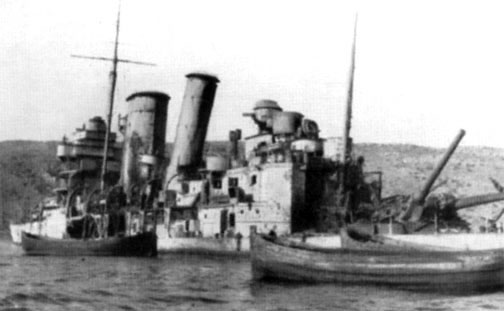
Six Italian explosive motor boats crippled Norwegian tanker Pericles and British cruiser HMS York (killing 2) in Suda Bay, Crete, Greece at 0446 hours; all six Italian boat drivers survived the attack, but all were captured. Six Italian one-man explosive speedboats (Barchini esplosivi) were deposited by destroyers Crispi and Sella about 10 miles off the coast of Crete late on the 25th. These are nothing special, basically, just tourist speedboats modified to hold torpedoes in the bows, but they are quite effective when handled properly. In the early morning hours, three manage to make their way into the harbor and make attacks. Suda Bay is full of British ships and supposedly is one of the most well-defended spots in the world.
The Italian motorboats have no difficulty entering the harbor around 05:00, and the boat pilots head straight for prime targets. After aiming the boats at their targets, the men jump off about 100 yards (meters) away. They seriously damage Royal Navy cruiser HMS York (two dead) and badly damages Norwegian tanker Pericles (it later sinks on its way to Alexandria). The York’s captain runs it toward shore, but it actually sinks before he makes it. Fortunately for the British, the water in the bay is very shallow and so the effect is essentially the same. The damage to York is particularly bad because the main damage is to her engine room area. There are simply no facilities or equipment at this bare-bones outpost to undertake the major operation required to restore the ship sufficiently to get it to a dry dock somewhere safe.
The Royal Navy makes the best of the situation, stiff upper lip and all that. On the bright side, many of the ship’s guns are still usable and can be worked with the assistance of power lines strung from submarine HMS Rover. What cannot be avoided is the ship’s vulnerability, stuck in the mud in an exposed position, making it a beacon for aerial attacks. This attack begins a chain of events that leads to its total destruction and abandonment, though that won’t happen for a while. The six Italian pilots are picked up by the British in the harbor and made POWs.
Vice Admiral Angelo Iachino screws up his courage amidst German pressure to do something with his big ships and takes the Italian fleet in the general direction of Greece. The objective is to attack supposedly vulnerable British convoys from Alexandria and Suda Bay bound for Piraeus. Iachino is aboard battleship Vittorio Veneto, which is protected by heavy cruisers Bolzano, Fiume, Pola, Trento, Trieste, and Zara. In addition, there is light cruiser Giuseppe Garibaldi and 17 destroyers of the 9th, 13th, and 16th Destroyer Divisions. This is the opening stage of the Battle of Cape Matapan.
Winston Churchill sent a message to Archibald Wavell, hinting at Wavell’s timidity in countering the recent Axis advances in Libya; he said “[w]e are naturally concerned at rapid German advance to El Agheila. It is their habit to push on wherever they are not resisted. I presume you are only waiting for the tortoise to stick his head out far enough before chopping it off. It seems extremely important to give them an early taste of our quality.”
Of course, “our quality” in the vicinity has been drastically undercut by Churchill’s decision to take out his best troops and sent them on a futile quest in Greece. The message rather clearly conveys Churchill’s lingering dislike of Wavell and hints that he is “not resisting” sufficiently — not something that military men like to be told. Wavell knows that he is better off staying in a defensive crouch, though, given all the dotty transfers north to Athens.
General Rommel, meanwhile, has the initiative, though no orders to advance. The OKH (army high command) notes in a situation report that its intelligence arm has been monitoring British radio traffic, giving a fairly clear picture of British dispositions around Agedabia, Slouch, and Magrum. A Junkers Ju 87 Stuka unit is withdrawn to Sicily, making a reconnaissance of Free French forces to the south sketchy. Greece is attracting forces from both sides like a magnet.
The opening stages of Operation PEDESTAL take place with departures of oiler HMS Cairndale from Gibraltar.
The campaign in Albania has hit a lull on 26 March 1941. Both sides are recuperating from the recent Italian Primavera Offensive. While the attacks accomplished no changes in territory, they did leave a lot of dead bodies, many of which remain to be buried.
Allied troops repaired the road running through Dongolaas Gorge in Eritrea, Italian East Africa. Italian troops at nearby heights only realized this after nightfall, by then it was too late to stop the Allied column that was starting to advance, thus the Italians began to withdraw to Keren. Meanwhile, in Abyssinia, The British Nigerian Brigade captured Harar unopposed.
Italian troops at Harar surrender to the British. The Italian forces and their local allies begin an attack on Major Orde Wingate’s Gideon force but they are beaten off despite their superior strength.
As a result of the call-up, there is a shortage of full-time firemen in the Auxiliary Fire Service, and of workers in the first-aid and rescue services. As a result of the National Service Bill introduced today, men called up will be able to state a preference to serve in Civil Defence instead of the armed forces. At present 90% of Civil Defence workers are volunteers. Compulsory Civil Defence service will apply equally to those registered “conditionally” as Conscientious Objectors — those required to continue their present jobs or work on the land, in hospitals or with the ambulance service. They can now be directed into Civil Defence but not into the Police War Reserve, which sometimes carries arms. Some have refused to take up the work imposed on them by the tribunals; Michael Tippett was sentenced to three months in jail for refusing to do full-time work for Civil Defence whereas Benjamin Britten, his fellow composer, was granted unconditional exemption from service. Since the call-up began, 31,000 men out of two million have registered as objectors.
Churchill outlines the Import Program for the next year, with an estimated 31 million tons of imports of which no less than 15 million tons shall be food. The army plans to increase its number to 59.3 “equivalent divisions” with 12 armoured divisions and 9 Army tank brigades. Visiting Australian Prime Minister Menzies notes in his diary that the plan is to increase the army by about 60,000 more men, which he calls a “stiff proposition.” Germany, of course, already has many more panzer divisions and is rapidly increasing this number, and each panzer division is of overpowering force — when fully equipped. The Naval Program retains the remaining King George V battleships, being completed at full speed, but with HMS Vanguard being the only ship that can be completed in 1943, and definitely in service by 1945.
Reflecting on the tight state of Great Britain’s manpower reserves, Parliament is working on a bill that will give drafted men a chance to state a preference for the armed forces or civil defense. Of course, there are no guarantees such preferences would be honored. Conscientious Objectors will be subject to compulsory civil defense.
Visiting Australian Prime Minister Menzies attends a “Battle of the Atlantic” conference. He notes that Winston Churchill looks “pale, unpleasant and strained.” His conclusion:
“The battle of the Atlantic looks lousy, & privately I wish I had more real faith in the navy (emphasis in original).”
The German Army High Command authorized the RSHA organization to operate death squads (Einsatzgruppen) in occupied Poland. Reinhard Heydrich and Wehrmacht Quartermaster General Eduard Wagner have produced a draft plan outlining a partnership between the Wehrmacht and the SS, setting up the operational procedure for what are called Einsatzgruppen (special task forces). The Einsatzgruppen are to take their orders from the SS, but otherwise, they are subject to military command. The army is to control their movements and furnish them with quarters, rations, gasoline and communications assistance. These small mobile groups are charged with ridding freshly acquired eastern territories of their “undesirable” civilian elements, and will be required to operate virtually on the front lines.
A scientific meeting takes place to mark the inauguration of the Institute for the Investigation of the Jewish Question in Frankfurt am Main. Professor Fischer and Professor Günther are guests of honor. Dr. Gross, head of the Race-policy Bureau of the Nazi Party says: “The definitive solution must comprise the removal of the Jews from Europe,” and he demands sterilization of quarter-Jews: “The reproduction of the quarter-Jews left behind in European countries must be reduced to a minimum.” Professor von Verschuer reports the meeting for his journal, “Der Erbarzt” (The Heredity-Physician).
German heavy cruiser Admiral Scheer has managed to slip past the British patrols and convoys as it heads back to Germany. It makes it through the Denmark Strait after dark and heads to Norway.
12 people were killed in food riots in Damascus and Aleppo, Syria. Martial law was declared in the region.
On Hitler’s orders, the Luftwaffe begins transferring hundreds of planes east to stock General Alois Löhr’s Luftflotte IV airfields in Rumania and Bulgaria. These will be used in the upcoming Operation MARITA. This will impinge air operations all across the Axis periphery, including North Africa. Some top fighter squadrons make the trip, including JG 27 and JG 51. Even units left behind have to consolidate their operations to take over some that had been handled by other units previously, so the pace of Luftwaffe operations all across the Western Front slows drastically.
The Luftwaffe sends a few scattered raiders over southern and western England during the day, but nothing major after dark.
RAF Bomber Command: Day of 26 March 1941
18 Blenheims on coastal sweeps. Several aircraft attacked small ships. No aircraft lost.
It is a fairly quiet day on Malta, with some Luftwaffe reconnaissance flights but no attacks. This is due at least in part to the transfer of Luftwaffe units east to support the invasion of Greece.
Destroyer HMAS Nestor departed Scapa Flow and destroyer HMS Anthony departed Loch Alsh to meet armed merchant cruiser HMS Circassia at 1500 nineteen miles west of Cape Wrath and escorted her to Reykjavik. At 1920/28th, the destroyers departed Reykjavik to join convoy HX.115 and act as an anti-submarine force until its arrival off the North Minch.
Destroyer HMS Mendip departed Scapa Flow at 1100 to meet steamer Amsterdam off the entrance to Aberdeen. Owing to bad weather, the escort was cancelled and destroyer Mendip returned to Scapa Flow, arriving at 0900/27th.
German heavy cruiser Admiral Scheer broke through the Denmark Strait during the night of 26/27 March. The cruiser evaded light cruisers HMS Fiji and HMS Nigeria on patrol there and arrived in the area of Bergen on the 30th. Heavy cruiser Scheer anchored at Grimstadfjord on the 30th and spent the day there before continuing on to Germany.
On 28 March, Battlecruiser HMS Hood and destroyers HMS Tartar, HMS Electra, and HMS Escapade departed Scapa Flow at 0600 to relieve Force H on the HG/OG convoy route. Light cruisers HMS Fiji and HMS Nigeria joined this force at sea before dark on the 28th. The destroyers were to proceed to the limit of their endurance, then proceed to Londonderry for refueling. Destroyers Electra, Escapade, and Tartar arrived at Londonderry to refuel on 2 April. At 1830, they sailed to rejoin the battlecruiser. The destroyers rejoined at 0800 on 4 April in 52-30N, 22W to escort the battlecruiser to Scapa Flow, where they arrived at 0800 on 6 April.
On 29 March, Battleship HMS King George V was approaching Bailey Bank on her return to Scapa Flow after leaving convoy HX.115. She rendezvoused with destroyers HMS Cossack, HMS Maori, and HMS Zulu, which departed Reykjavik at 2100/28th, in 61N, 25W at 0730/29th.
Battleship HMS Queen Elizabeth and destroyers HMS Inglefield and HMS Active were brought to one hour’s notice to steam at Scapa Flow at 0100. Light cruisers HMS Galatea, HMS Arethusa, HMS Aurora, and HMS Dido departed Scapa Flow at 0358 for position 64-00N, 1-00W east of Iceland-Faroes minefield.
At noon on the 30th, battleship HMS King George V and light cruisers HMS Dido and HMS Aurora were ordered to return to Scapa Flow. Battleship King George V and destroyers HMS Cossack, HMS Maori, and HMS Zulu arrived at Scapa Flow at 1500/31st. Light cruisers HMS Galatea and HMS Arethusa patrolled the northern part of the trawler line in the Iceland Faroes Passage from 31 March. They returned to Scapa Flow on 4 April.
Heavy cruiser HMS Exeter arrived at Scapa Flow to work up prior to proceeding overseas.
The 1st Minelaying Squadron of minelayers HMS Southern Prince, HMS Agamemnon, HMS Menestheus, and HMS Port Quebec, escorted by destroyers HMS Charlestown, HMS Lancaster, HMS Castleton and HMS St Marys departed Loch Alsh to lay minefield SN.4. Light cruisers HMS Galatea and HMS Aurora departed Scapa Flow on the 25th to cover the operation. En route to the minelay, minelayer force was attacked by German bombing. Minelayer Menestheus was hit by two bombs and damaged further by a near miss. She was repaired in the Clyde. The minefield was laid. Returning from the minelay, escorting destroyer Castleton was in a collision with minelayer Agamemnon. The destroyer was repaired in the Clyde from 2 April to 1 June. The ships all arrived back on the 27th. Light cruisers Galatea and Aurora arrived at Scapa Float at 0649.
Canadian armed yacht HMCS Otter (Lt D. S. Mossman, RCNR) was sunk by an accidental fire off Halifax Lighthouse. Lt A. M. Walker, RCNVR, Chief Skipper A. F. Parker, and seventeen ratings were lost on the yacht. Submarine HMS Talisman picked up four survivors. Eighteen more survivors were picked up by Polish steamer Wisla (3106grt).
Cable ship Faraday (5533grt) was badly damaged by German bombing three miles 38° from St Anne’s Head. Eight crewmen were lost on the ship. The ship sank on the 27th in West Dale Bay. Nearly all her cargo of cable was salved.
British steamer Somali (6809grt) was badly damaged by German bombing off Blyth. One crewman was lost on the steamer. The steamer sank on the 27th one mile east of Snoop Head, Sutherland.
British steamer Empire Mermaid (6381grt) was badly damaged by German bombing in 58-36N, 10-00W. Twenty crewmen and two displaced seamen were lost on the steamer. Destroyer HMS Achates rescued nineteen survivors. The steamer sank on the 28th in 57-33N, 12-43W.
Norwegian steamer Noll (1151grt) was damaged by German bombing eight miles west of Lundy Island. The steamer was beached at Lundy Island. Refloated and taken to Swansea arriving on the 29th, escorted by a tug.
British trawler Millimumul (287grt) was sunk on a mine in 33-34N, 151-56E near Newcastle, New South Wales. Seven crew members were missing.
Faroes fishing vessel Beinisvor (85grt) was sunk by German bombing in 61-40N, 4-37W. The crew was landed at Thorshavn.
Finnish steamer Carolina Thorden (3645grt) was badly damaged by German bombing at entrance to Thorshavn Bay. One passenger was missing. Eight passengers were taken aboard Swedish steamer Venezuela (6991grt) which was later sunk with no survivors. The steamer was grounded in 60-11N, 7-00W. She was later refloated, towed to Kirkwall, and later the Tyne. She was ultimately used as a blockship at Scapa Flow.
British trawler Kingsway (211grt) was damaged by German bombing ten miles east of Bell Rock.
British steamer The Lady Belle (331grt) was damaged by German bombing ten miles south of Grassholm Island.
British steamer Brier Rose (503grt) was lost to unknown cause in the Irish Sea.
Heavy cruiser HMS York was badly damaged by Italian explosive boats at 0515 in Suda Bay. Both engine rooms and boiler rooms were flooded. The cruiser was grounded in four and a half fathoms. Two ratings in B boiler room were killed and one officer and four ratings were injured. At the time of the attack, other ships in Suda Bay were Light cruiser HMS Gloucester, anti-aircraft ship HMS Calcutta, destroyer HMS Hasty, tankers Cherryleaf (5934grt), Desmoulea (8120grt), Marie Maersk (8271grt), Pericles (8324grt), and Doumana, and several small Greek cargo ships. Norwegian tanker Pericles, alongside York, was also damaged in the attack. Six Italian crewmen were picked up in the harbor. Destroyers HMS Ilex and HMS Hasty hunted off Suda Bay for the submarine. Most of the oil was salved from Pericles. However, returning to Alexandria, the tanker broke in two as a result of the damage in heavy weather on 14 April. Both halves were sunk by gunfire thirty miles northwest of Alexandria.
British steamer Baluchistan (6992grt) was damaged by German bombing in the Eastern Mediterranean.
British steamer Adige (1006grt), formerly Italian, was damaged by bombing at Malta. The steamer was beached in Malzara Creek and later repaired.
Italian battleship Veneto departed Naples with destroyers Granatiere, Fuciliere, Bersagliere, and Alpino of the 13th Destroyer Division. Italian heavy cruisers Zara, Fiume, and Pola of the 1st Cruiser Division departed Taranto escorted by destroyers Gioberti, Alfieri, Oriani, and Carducci of the 9th Destroyer Division. Italian light cruisers Abruzzi and Garibaldi of the 8th Cruiser Division departed Brindisi escorted by destroyers Da Recco and Pessagno of the 16th Destroyer Division.
Convoy AG.9 of one British, three Greek, and two other ships departed Alexandria for Piraeus escorted by Greek destroyer RHS Vasilevs Georgios I, Australian destroyers HMAS Voyager and HMAS Vampire, and destroyer HMS Wryneck. Anti-aircraft cruiser HMS Calcutta joined the convoy on the 28th. Light cruisers HMS Orion, HMAS Perth, HMS Ajax, and HMS Gloucester refueled in turn at Piraeus on the 26th. The cruisers departed Piraeus to support convoys AG.8 and AG.9 on the 27th. Convoy AG.9 was ordered on the 27th to reverse course for twelve hours to take it clear of the Italian units. The convoy arrived at Piraeus on the 29th.
British oiler RFA Cairndale departed Gibraltar escorted by corvettes HMS Fleur De Lys and HMS Coreopsis for operation PEDESTAL, the refueling British ships in 32-30N, 32-30W. Ocean boarding vessel HMS Registan accompanied this group en route to her Western Patrol station. Submarine HMS Pandora departed Gibraltar on the 29th to join the oiler and act as an anti-raider escort. Operation PEDESTAL was cancelled on 11 April and oiler Cairndale and submarine Pandora returned to Gibraltar, arriving on 17 April.
Destroyer HMS Velox departed Gibraltar to join destroyer HMS Wrestler to escort light cruiser HMS Sheffield, destroyers HMAS Napier and HMAS Nizam, aircraft carrier HMS Argus, submarine depot ship HMS Maidstone, and troopship Highland Monarch to Gibraltar.
Heavy cruiser HMS Dorsetshire arrived at Capetown.
The Senate was not in session in Washington today, but its Appropriations Committee approved the $1,150,000,000 Treasury-Post office Appropriation Bill, including an $800,000 subsidy for transatlantic airplane service by the American Export Air Lines, and an Appropriations subcommittee heard Sumner Welles, Undersecretary of State, oppose the ban on government purchases of Argentine beef.
The House approved revision of the Commodity Credit Corporation’s cotton-warehousing system and adjourned at 5:03 PM until noon tomorrow. A Military Affairs subcommittee heard Major General Brett on Air Corps expansion plans, and the Appropriations Committee reported the $221,272,228 bill for War Department civil functions.
An American answer to Germany’s extension of her sea blockade to the very border line of the western hemisphere, if not actually across it, was in preparation tonight. Whether it would take the form of a warning to Germany or more decisive measures to keep hostile operations out of hemisphere waters, officials would not say until they had completed a study of all aspects of the problem. Sumner Welles, acting secretary of state, said the whole question was under consideration and he probably would make a statement in a day or two. These possibilities were advanced unofficially:
- A warning to Germany to keep submarines and other war vessels out of the western hemisphere.
- An extension of the European combat zone to include Iceland, thus closing that British-occupied Danish colony to American shipping.
- An extension of the Pan-American neutrality zone to the easternmost limit of the western hemisphere. This would mean a widened patrol by American war vessels, a move which might at the same time relieve the British convoy problem by protecting supply ships half-way across the Atlantic.
The House Appropriations Committee today reported favorably a $221,272,228 bill to provide funds for continuing work on the third set of Panama Canal locks, flood control and river and harbor projects, and other civil activities of the army.
The entire question of sending American food supplies to unoccupied France was reopened today after a large barter deal between the occupied and unoccupied areas was reported from Vichy. The reported agreement was announced in the Paris newspaper Aujour d’Hul and was said here to be a complete surprise to the United States government. It called for a sweeping trade of livestock, vegetables and other supplies from the unoccupied zone for grain, sugar and potatoes from the German-occupied area.
In a radio broadcast to the American people, U.S. Colonel William Donovan said about the East African campaign, “The British have done a superb job, a better job than they have let the world discover”.
Wendell L. Willkie said tonight that China’s struggle against Japan would go down in history as one of the decisive battles in mankind’s long fight for freedom and for a better life and urged America’s moral and material support of the Chinese as a means to keep its own freedom. Willkie spoke at a dinner under auspices of United China Relief, which opened a nationwide campaign to raise $5,000,000.
Urging that the British Government permit the Jews of Palestine to establish a recognized Jewish volunteer military force “for service against the common enemy of mankind,” Dr. Chaim Weizmann, president of the Jewish Agency for Palestine and the World Zionist Organization, expressed confidence last night that the Jewish contribution to the victory of democracy “will not escape the attention of America’s statesmen.”
The New York Times reports on the racketeering during the construction of the new army camp at Fort George G. Meade in Maryland. “…the ‘take’ for two unions alone, carpenters and common laborers, was estimated at $400,000… Meade is 91% completed. The original estimate of its cost totals $18,882,128. The final cost will be around $23 million. Overtime to date totals $1,808,320. At the peak of the building operation, 30% of the money spent for labor ‘didn’t drive a nail’. That is, it was a premium payment for overtime. …great numbers of ‘Sears Roebuck carpenters’ got jobs. (They were called that because they get a Sears Roebuck outfit of tools for five dollars and instantly become carpenters.) …labor efficiency is estimated between 50% and 65%.”
An order for the immediate reopening of the strike-bound Allis-Chalmers plant at Milwaukee was given by Secretary Knox and William S. Knudsen, director-general of the OPM. To a company making supplies vital to the national defense, they said: “We can no longer wait for settlement of the strike by ordinary means.” The C. I. O. union was told that its full cooperation was expected.
From Milwaukee came word that Harold Christoffel, head of the union, said the strike would go on and that only a vote of the union could stop it. A meeting of the union was called for Saturday.
Picketing was resumed late in the day at the Bethlehem Steel Corporation’s plant in Pennsylvania. Some minor violence was reported. The C.I.O. insisted that the stoppage of production was almost complete, but the management asserted that work on defense orders was going forward on schedule. At Harrisburg Colonel Lynn G. Adams, Commissioner of State Police, told Governor James that order had been restored.
The threatened strike of C.I.O. unionists at the Cambria units of the Bethlehem Steel Company in Johnstown, Pennsylvania was averted when the Employees Representation Plan deferred the election it had called for to designate a collective bargaining agency. The C.I.O. leaders had ordered a strike if the election was held. The chiefs of the Employees Representation Plan, saying they had acted to avoid disruption of defense work, intimated the election would be held later in the week.
Officials of the International Harvester Company rejected a C.I.O. union suggestion, conveyed by Mayor Kelly, that its strike at the McCormick works in Chicago be submitted to the new National Defense Mediation Board. The company said that 4,200 employees out of 6,400 already had returned to the plant, reopened Monday, and that the new Federal board “was created to prevent strikes, not to settle them,” and therefore lacked jurisdiction in the matter.
German raider Pinguin and consort Adjutant are heading north for a rendezvous with German ships in the vicinity of Seychelles.
Minelayer HMS Kung Wo laid mines lines of a minefield off Singapore.
Japanese Foreign Minister Yosuke Matsuoka arrived in Berlin, Germany. He was not met by Joachim von Ribbentrop immediately as his German counterpart was busy with the recent political developments in Yugoslavia.
Efforts in political quarters to put life into the Imperial Rule Assistance Association, which is to take the place of dissolved political parties and rally the people behind Japan’s Greater East Asia program, today led to the retirement of the association’s entire organizational staff.
British 287 ton fishing trawler Millimumul (Captain Rixon) hits a mine and sinks near Newcastle, New South Wales. There are seven deaths. The mine had been laid months ago by German raider Pinguin.
Dow Jones Industrial Average: 122.7 (-0.08)
Born:
Richard Dawkins, British ethologist, evolutionary biologist and writer (“The God Delusion”), in Nairobi, British Kenya Colony.
Barclay Plager, Canadian NHL defenceman (NHL All-Star 1970, 1971, 1973, 1974; St. Louis Blues) and coach (St. Louis Blues 1977-1983), in Kirkland Lake, Ontario, Canada (d. 1988, from brain cancer).
Naval Construction:
The Royal Navy Flower-class corvette HMS Phlox (K 130) is laid down by Charles Hill & Sons Ltd. (Bristol, U.K.); completed by the Ailsa Shipbuilding Company Ltd. (Troon, Scotland) and N.E. Marine. She is renamed HMS Lotus (K 130) before commissioning.
The U.S. Navy Aloe-class net tender USS Mulberry (YN-22; later AN-27) is launched by the American Shipbuilding Co. (Cleveland, Ohio, U.S.A.).
The Royal Australian Navy Bathurst-class minesweeper-corvette HMAS Toowoomba (J 157) is launched by Walkers Ltd. (Maryborough, Queensland, Australia).
 History Diaries