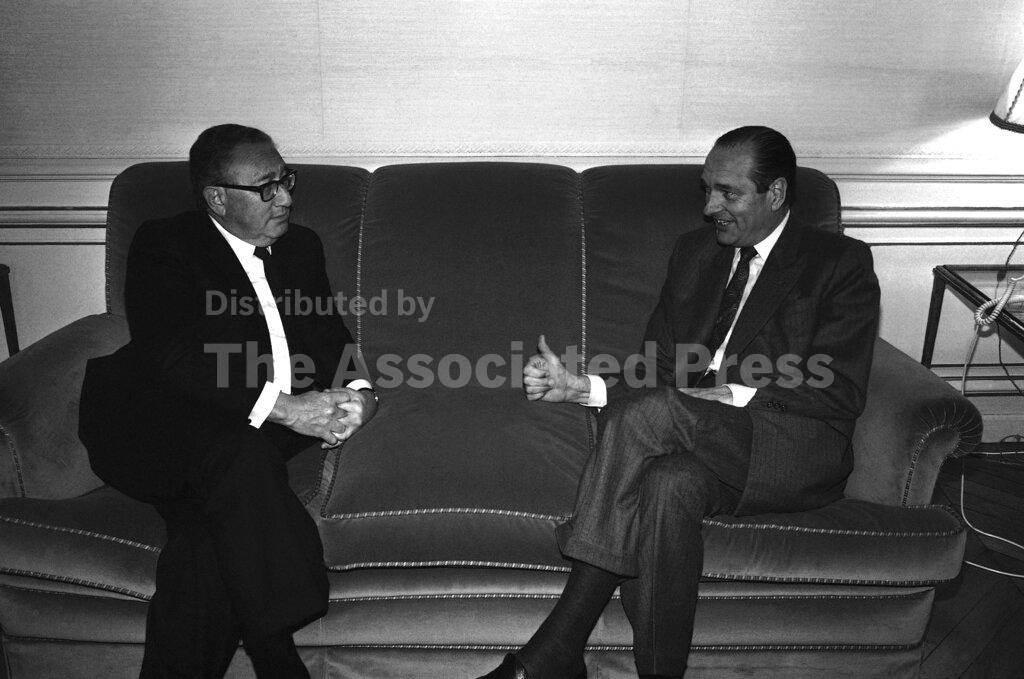
Reagan Administration officials said today that United States flight and naval operations in disputed waters near Libya may end before the scheduled conclusion next Tuesday provided that Libya did not resume armed opposition to the American maneuvers. A ranking White House official said late today that the withdrawal of the Navy’s 30-ship armada was tentatively scheduled to start on Thursday, but hinged on whether Libya restrained or resumed missile fire at Navy aircraft. Since American retaliation began Monday for what the United States has said were Libyan SAM-5 missile attacks, there has been no reported military response from the Government of Col. Muammar el-Qaddafi except for sorties by small naval craft. “We were over there to make a point and we’ve made our point,” said the official. “Regardless of what Qaddafi says, by international law we are allowed to go into international waters and we’ve stayed in those waters.”
Pentagon officials, sifting through after-action reports on fighting between American and Libyan forces in the Gulf of Sidra, today backed away from earlier statements that Navy aircraft and ship-to-ship missiles had destroyed three Libyan vessels. They said that they could confirm the destruction of only two ships: a French-made Combattante-class missile patrol boat that was attacked by Navy A-7 planes Monday at 2:26 PM Eastern standard time and a Soviet-made Nanuchka-class missile patrol vessel that was attacked by two Navy A-6 planes early Tuesday morning, at 1:07 AM. Officials also said that the Navy decided not to attack the Libyan SAM-5 radar facility at Sidra today because Navy aircraft and ships determined that the Libyans had not turned on a radar that enables the facility to direct SAM-5 missiles at United States aircraft. The Navy has determined that the Libyans are operating different radars that operate on other frequencies near the sites that track aircraft.
The Prime Minister of Malta met tonight with Colonel Muammar el-Qaddafi, the Libyan leader, in an effort to defuse the confrontation with the United States over the Gulf of Sidra. The Maltese leader, Karmenu Mifsud Bonnici, also said that he had sent a representative to Washington, his second in 10 weeks, to try to calm the situation. “We are directly involved in this region, and armed conflict is a question of life and death for us in the center of the Mediterranean,” Mr. Bonnici told reporters. “It is not a question of rights for us, it’s a question of life and death.” With no further clashes in the Gulf of Sidra today, there were tentative signs that both sides might be willing to step back from the crisis that began Monday as the American fleet tested Colonel Qaddafi’s assertion of territorial waters stretching 120 miles off the coast.
Mikhail S. Gorbachev proposed today that the Soviet and United States navies leave the Mediterranean Sea. The Soviet leader coupled the proposal, made at a dinner for President Chadli Benjedid of Algeria, with a denunciation of American military actions against Libya and expressions of support for Tripoli. Mr. Gorbachev said the Soviet Union was keeping its warships in the Mediterranean only because “the United States Sixth Fleet, armed with nuclear-missile weapons and threatening the security of the U.S.S.R., its allies and friends, is in the immediate proximity of our borders. If the United States, which is situated thousands on thousands of miles from the Mediterranean, pulled its fleet out of there, the Soviet Union would simultaneously do the same. We are prepared without delay to enter talks on the issue.”
The Reagan Administration is still divided over whether it should dismantle two Poseidon submarines this spring in order to continue to adhere to the provisions of the second treaty on limiting strategic arms, Administration officials said today. Unless the United States dismantles the submarines, it will breach limits set by the treaty when a new Trident submarine begins sea trials on May 20. The issue of continued compliance with the treaty and alleged Soviet arms control violations were discussed on Monday at a White House meeting. But officials said that no decisions have yet been made. Administration officials said that the State Department continues to oppose plans to drydock the submarines instead of dismantling them in accordance with treaty procedures, while the Defense Department proposes to simply drydock the vessels. Although the United States Senate has never approved the 1979 treaty, the Reagan Administration said it would not undercut it as long as Moscow did likewise. The Administration reaffirmed its commitment last June when it decided to dismantle a submarine to remain within the treaty limits.
More than 160 American religious leaders, including 53 Catholic and Protestant bishops and 17 rabbis, urged President Reagan to join the Soviet Union in suspending nuclear tests. In a letter to Reagan, they said one of those moments is at hand “when decisive action can change the course of history.” “And you,” the religious leaders told Reagan, “are the leader with the chance to take an action which can turn the world toward peace.” The most recent U.S. test was conducted last Saturday in Nevada.
Secretary of State George P. Shultz publicly and privately urged the Greek Government today to take a sterner line against what he called “the insidious threat of terrorism.” Warning that the overall state of relations would have a direct impact on tourist travel and other economic ties, Mr. Shultz sought backing from the Greeks for the American military action against Libya earlier this week. The Government of Prime Minister Andreas Papandreou avoided taking sides in a statement issued just before Mr. Shultz’s arrival here on Tuesday night, but today, Mr. Papandreou’s Socialist Party, known as Pasok, sharply condemned the United States for its military moves.
The U.S. Justice Department announced it will review the evidence a Jewish group has gathered on the World War II activities of former U.N. Secretary General Kurt Waldheim, a step that could lead to his being barred from the United States under a 1978 immigration law amendment. The department asked the New York-based World Jewish Congress for documents the private organization says demonstrate that Waldheim was involved in a Nazi massacre of thousands of people in Yugoslavia. In Vienna, Waldheim, who is running for the Austrian presidency, again denied any involvement in Nazi war crimes.
The Belgian Senate gave the deficit-plagued Brussels coalition government the power to rule by decree in order to swiftly impose new austerity measures, boost the economy and cut public spending. The Senate vote was 101 to 74, with one abstention. The lower house had already approved the special powers. The center-right coalition led by Premier Wilfried Martens has promised not to raise taxes, meaning it will have to make deeper cuts in spending. Martens had ruled by decree during most of his preceding four-year term.
Swedish newspapers reported today that the police hunting for Prime Minister Olof Palme’s killer had obtained several hours of videotape shot near his home before his assassination. The police hope to find pictures of a man who reportedly followed Mr. Palme on at least two occasions shortly before the assassination February 28, according to the reports. Police Superintendent Lars Richter declined to comment on the report, citing “investigative reasons.” The daily newspaper Aftonbladet, based in Stockholm, said Mariano Catan, an amateur cameraman, was filming the activity on the street close to Mr. Palme’s home during the six months before the killing.
A car packed with four hundred pounds of TNT exploded in Christian East Beirut today, killing 10 people, wounding 80 and damaging buildings in a half-mile radius, the police and witnesses said. The blast, which was heard in all parts of the capital, originated in a car that was parked in the vicinity of an office of the Christian Phalangist Party of President Amin Gemayel in the quarter of Ashrafiyeh. Two hours earlier, six people were wounded when a smaller explosion rocked a building where another Phalangist office is situated in Furn el-Chebbak, another neighborhood of the Christian section of town.
Attorney General Edwin Meese 3d of the United States accused the Soviet Union today of using torture, rape and genocide in Afghanistan as part of a drive to dominate the world. In one of the toughest speeches ever given by a visiting American official, he told over 300 refugees the United States supported their “heroic struggle against the Soviet empire.” Mr. Meese told the refugees, “We learned from you of the various physical and mental scars of torture, rape, toxic gas, of famine, of scorched earth and genocide which is the sign of the type of occupation engaged in by the Soviet army. The world asks why are the Soviets doing this in Afghanistan? The answer is in a way simple. It is part of their desire to dominate the entire world.”
Indian police in Punjab killed nine Sikhs and wounded 22 when militants firing guns and waving swords attacked the state’s chief minister, Surjit Singh Barnala, at a mass meeting. A Punjab government spokesman said Barnala had just started addressing about 100,000 people at a spring festival in the town of Anandpur Sahib when shots were fired from several directions, and more than 2,000 militants rushed the stage. Barnala and other leaders of his moderate Sikh political party, the Akali Dal, were rushed from the scene under police protection.
Deng Xiaoping, China’s 81-year-old leader, emerged from more than 14 weeks of seclusion Tuesday, saying that he had deliberately stayed out of view to demonstrate that the country’s economic and social policies “do not hinge on myself alone.” “The question I’m now considering is when I’m going to retire,” Mr. Deng told Prime Minister Paul Schluter of Denmark, during a meeting at the Great Hall of the People. A few hours later, Prime Minister Zhao Ziyang, the official primarily responsible for putting the policies into effect, went before the annual meeting of the nominal parliament, the National People’s Congress, with a vow to continue removing the economic structure developed under Mao Zedong. The first moments of Mr. Deng’s session with Mr. Schluter were open to reporters, and he used them to mock persistent reports in Hong Kong newspapers during his absence that he was ill or dying. The Chinese leader chuckled over reports that he had caused declines on the Hong Kong stock market.
A Japanese court today upheld a Justice Ministry decision to deny a re-entry permit to an American woman because she refused to be fingerprinted when renewing her alien registration card. The woman, Kathleen Morikawa of Pittsburgh, is married to a Japanese man. Without a re-entry permit, she cannot return to Japan if she leaves the country. Mrs. Morikawa, 36 years old, said she would appeal the decision by Tokyo District Court. It was the first court ruling on a 1982 Justice Ministry administrative decision to withhold re-entry permits from foreigners who refuse to be fingerprinted. Japanese law requires foreign residents over the age of 16 to be fingerprinted when they apply for renewal of their alien registration cards, which expire after five years.
President Corazon C. Aquino came under criticism today from former Marcos loyalists, who called her provisional constitution a “Magna Carta of enslavement.” Mrs. Aquino’s office replied that the Philippines was now a free country and that even supporters of Ferdinand E. Marcos could complain as they please. “God save the Republic of the Philippines,” declared a group of 65 pro-Marcus members of the now defunct National Assembly. Their statement came a day after the assembly was abolished as Mrs. Aquino claimed all legislative powers for herself, pending creation of a permanent new constitution. In so doing, she denounced the assembly’s pro-Marcos majority as a “cancer” that had “debased our politics” by siding with the former President on issue after issue, including the certification of his re-election after the controversial balloting on February 7. The former lawmakers accused President Aquino of arrogating to herself powers that are “more absolute, more authoritarian, more arbitrary than the powers gobbled up by the former President, Mr. Marcos.”
Swiss banking authorities took further steps today to freeze assets in Switzerland of Ferdinand E. Marcos, as Philippine officials began talks with Government representatives exploring ways to recover the funds. The Government announced after a cabinet meeting attended by officials of the Federal Banking Commission, a watchdog authority, that the commission had sent a letter to all Swiss banks, saying it would be “incompatible with the legal licensing requirements under Swiss banking law” to permit the movement of assets of the Marcos family “before the legal situation is clarified.” The unusual step came only one day after the Government, in an unparalleled move, froze all assets of the Marcos family, and persons and companies close to it, on deposit in Swiss banks.
A wealthy Filipino industrialist who has admitted serving as a secret financial adviser to Ferdinand E. Marcos bought property on Mr. Marcos’s behalf as early as 1967, according to documents discovered in the presidential palace. The new records also reveal that by 1970, two years before Mr. Marcos declared martial law, his wife, Imelda, took trips abroad with as much as $150,000 in cash and $200,000 in traveler’s checks. Canceled checks and bank records from the same period indicate that Mrs. Marcos had New York bank accounts under an assumed name with a balance that reached $272,437.14. Mr. Marcos first became President in 1965, and most Filipinos have believed that the Marcoses’ corruption developed only after Mr. Marcos assumed absolute power in 1972.
U.S. military authorities agreed to discuss demands of 24,000 striking Filipino employees if they dismantle blockades keeping another 20,000 workers away from U.S. bases in the Philippines. Thousands of strikers manned picket lines and blockades formed by vehicles and logs outside Subic Bay Naval Base, Clark Air Base and six smaller installations as the walkout entered its sixth day. The strike was called when the Pentagon rejected a demand for severance pay upon resignation. At the Subic Bay base, strikers reportedly threw rocks and bottles at Philippine soldiers escorting U.S. servicemen into the base.
Seven car-bomb blasts rocked Melbourne, Australia, seriously damaging the city’s central police station. There were six explosions within about ten minutes of the first blast at midday, police said. The first blast injured several people, including a magistrate and a police officer. Press reports said two people were badly injured and at least 15 others were taken to hospitals after they were hit by flying glass and debris. A police spokesman said there was no immediate claim of responsibility, but he said the station had received a warning telephone call before the explosions started. At least two of the bombs were believed to have been planted in police cars.
Fourteen United States Army helicopters today transported a battalion of Honduran troops close to an area where Nicaraguan Government forces were reported to be fighting anti-Government rebels. A United States Embassy spokesman here said the helicopter crews consisted of 50 American soldiers. He said the helicopters — 4 twin-rotor Chinooks and 10 UH-1’s — were not armed and would land at a secure airstrip well away from the fighting. The airlift, to a United States air base near the border, appeared to represent a major increase in American involvement in efforts to protect Nicaraguan guerrilla bases in Honduras.
The White House, moving to counter criticism that it had overstated the seriousness of a reported Nicaraguan attack on rebel bases in Honduras, today made public a Honduran Government request for United States military assistance. In an unusual move, Larry Speakes, the White House spokeman, read a letter from the Honduran President, Jose Azcona Hoyo, to President Reagan in which the the Honduran leader confirmed “the presence of Sandinista armed forces on Honduran territory.” On Tuesday, the Nicaraguan Foreign Ministry denied in a communique that Sandinista troops had carried out “any invasion” of Honduras, and Managua’s chief delegate to the United Nations, Nora Astorga, insisted that there had not been “any sort of incursion into Honduran territory or any sort of aggression against Honduran territory.” United States officials said today that American helicopters had begun carrying Honduran troops to the battle zone near the border and that Sandinista troops, seeking to withdraw from Honduras, were meeting stiff opposition from United States-supported rebels, known as contras. A Pentagon official said the fighting near the border was “fierce.”
Attempts to forge a bipartisan compromise on United States policy toward Nicaragua collapsed today as the Senate opened debate on President Reagan’s request to send $100 million in aid to the guerrillas fighting to topple the Managua Government. Democrats acknowledged that the White House “probably has enough votes for a narrow victory,” in the words of Senator Jim Sasser of Tennessee. But bargaining sessions continued, as the Republican leadership tried to accommodate a few wavering lawmakers from their own party. Senator Sasser said reports of a Nicaraguan advance into Honduras to attack a rebel base camp had probably helped the Administration’s case. But like other Democrats, he accused the White House of promoting and distorting those reports in an effort to influence the Senate vote.
Three Surinamese men, including a high-ranking military official, have been arrested in Miami on drug conspiracy charges. The South American military figure, Captain Etienne Boerenveen of the Surinamese Army, “sold his country to drug dealers for $1 million a shot” in offering a safe haven for cocaine smugglers, said William M. Norris, a prosecutor who argued for holding him in jail. The suspect was denied bail today by a Federal magistrate, Samuel J. Smargon, who ordered a hearing later this week on a defense motion to dismiss the charges against the 28-year-old officer on the ground that he has diplomatic immunity. In testimony today, Captain Boerenveen described himself as one of the military leaders of the former Dutch colony and said he was in charge of logistics for the Surinamese Army. Federal agents said he told arresting officers he was an adviser to the President, and the Federal prosecutor described him as the No. 2 man in ruling the country.
At least 30 people were reported killed by the police around South Africa today. It was one of the highest 24-hour death tolls in this country in a year. At least a third of the deaths were reported from Bophuthatswana, a nominally independent “tribal homeland,” where the police opened fire on a crowd of more than 5,000 people protesting the detention of black youths. Over all, the killings seemed to represent a further increase in violence since a seven-month state of emergency was lifted around major cities three weeks ago. Since then, the rate of killings has risen to five a day from fewer than four before the emergency was lifted. Almost 1,400 people, most of them blacks, have been killed since the latest cycle of nationwide turmoil began in September 1984. Since then, figures supplied by the South African Institute of Race Relations have shown a steady increase in daily fatalities.
New viruses linked to AIDS have been discovered, competing scientists from the United States and France reported independently. An American team from the laboratory of Dr. Max Essex, at the Harvard School of Public Health, announced the identification of a new virus found in three healthy West Africans that was related to both the AIDS virus and to a virus found in monkeys. Meanwhile, a team headed by Dr. Luc Montagnier, of the Pasteur Institute in Paris, announced it had found a new virus that is related to both the monkey virus and the virus that causes the deadly disease in humans.
The Senate voted today to authorize new water construction projects that could cost up to $11.5 billion and, for the first time, adopted a broad requirement that beneficiaries share the costs. The legislation was approved by voice vote without dissent. The legislation paves the way for a large-scale program to build and improve ports, harbors, inland waterways, dams and other water projects for the first time in nearly two decades. The last time a major water construction bill was passed was in 1970. The bill, which sets ceilings on funds to be provided in separate legislation, would allot up to $676 million for water projects in New York State, New Jersey and Connecticut. The Senate bill would authorize 181 projects by the Army Corps of Engineers; last year the House adopted legislation authorizing more than 300 projects, costing $20 billion. The House bill also called for somewhat lower rates of cost-sharing by beneficiaries of the projects. Conferees from the two houses will now meet to resolve differences between the two bills.
President Reagan participates in a photo opportunity for Newsweek and TIME magazines.
President Reagan hosts a luncheon meeting with a group of astronomers and physicists to discuss Halley’s Comet.
President Reagan begins an 11-day Easter vacation tomorrow with a two-hour stopover in New Orleans to campaign for Senate candidate W. Henson Moore. White House spokesman Larry Speakes said the President will speak on the current crises in Central America and Libya before departing for his ranch near Santa Barbara.
Representatives from the Reagan Administration, the insurance industry and the medical profession told a Senate panel that Congress should restrict civil damage awards. Testifying before the Senate Judiciary Committee, the representatives blamed the civil court system for producing large awards they said have left governments, professionals and businesses with two choices: high-cost insurance or none at all. They said that the system has assigned fault to those with “deep pockets” of money and allowed lawyers to reap huge contingency fees. Proposed legislation for federal courts includes a $100,000 cap on non-economic damages for pain and suffering.
Immigration officials unveiled a new tool to help keep terrorists, drug smugglers and other undesirables from entering the country-a computer system that gives access to nearly 60 million constantly revised files. The system, which is expected to be installed by October at the nation’s major points of entry, will replace a cumbersome book that names 40,000 inadmissible aliens, or people wanted by federal law enforcement agencies, and takes six weeks to update. The first terminals of the National Automated Immigration Lookout System went on line at Newark International Airport in New Jersey.
Attorneys on both sides in the espionage trial of Jerry A. Whitworth continued today to struggle with the task of making the world of secret cryptography understandable to the jury within the strictures imposed for discussing classified work. Prosecutors are using what looks like an innocuous gray metal box, actually a KW-7 cryptographic machine, to demonstrate the workings of similar machines to which Mr. Whitworth had access as a Navy radioman with a top-secret clearance. The machines hold the circuit boards containing the logic by which messages are encoded. A key card is used to reprogram the logic daily in the cryptographic machine before a message can be scrambled and unscrambled at the receiving end.
Negotiators for TWA and its flight attendants union met in New York for the first time in two weeks in an effort to end a 19-day-old strike, but talks recessed until later in the week, a mediator said. “The parties are going to be doing some caucusing and looking at various options,” said Robert Brown of the National Mediation Board. The 6,000 flight attendants walked out March 7 in a dispute over concessions on wages and work rules sought by TWA.
About 80 striking meatpackers and their supporters slowed, but failed to halt, traffic into the Geo. A. Hormel Co.’s flagship plant and corporate headquarters in Austin, Minnesota, and a union spokesman said contract talks have been postponed until next week. Local P-9 of the United Food and Commercial Workers union has ignored its parent union’s order to end a seven-month strike. The protest came one day after the parent union announced it would hold a hearing April 7 to determine whether the renegade local should be placed in trusteeship.
A radioactive gas buildup in the Unit 1 containment building at the Three Mile Island nuclear power plant resulted in 120 workers ingesting small doses of radioactive iodine, officials said. A spokesman for the Pennsylvania plant’s operator said half of the workers had detectable levels of iodine in their bodies.
Cities are increasingly stressing arts as means to more economic development and investing millions of dollars in cultural activities despite strained municipal budgets and fading Federal support. The competition for arts and culture has pushed cities to nurture existing institutions as well as to seek new ones.
A reputed Kansas City organized crime figure, Carl DeLuna, was sentenced today to 16 years in prison and was ordered to pay more than $120,000 in fines for conspiring to skim profits from Las Vegas casinos. Federal District Judge Joseph E. Stevens sentenced Mr. DeLuna to two years in prison and fined him $10,000 on each of eight counts. Mr. DeLuna was also ordered to pay the Nevada’s Gaming Control Board $30,750 in restitution and pay court costs totaling $11,807. Mr. DeLuna’s sentence came a day after a reputed Chicago underworld leader, John P. Cerone, received a 28 1/2-year prison term and was ordered to pay more than $143,000 in fines in the skimming conspiracy. Mr. DeLuna, 58 years old, pleaded guilty to the skimming conspiracy involving four casinos owned by the Argent Corporation. He was considered the conspiracy’s record keeper.
Eleven people in Tennessee, including a Grundy County deputy sheriff, were arrested today in an undercover investigation of narcotics and public corruption that has already led to the arrests of two sheriffs and a judge. The arrests, on drug and property crime violations, included Sheriff’s Deputy Ronnie King of Grundy County, said Frank Wilent, an agent of the Federal Bureau of Investigation. In addition, 12 Grundy County residents were being sought in the latest phase of a two-and-a-half year state and Federal investigation centering on drug trafficking and gambling. Since 1982, nine Tennessee sheriffs have been arrested. All but one of the arrests have involved drug charges, as mountainous eastern Tennessee has become a favorite drop point for drug-runners who have moved in the wake of a Federal crackdown on narcotics along the Gulf Coast. William Y. Doran, an F.B.I. agent. said he hoped the investigation would signal to public officials that the authorities were on the watch.
The presence of four state troopers in the front row at a Rhode Island robbery trial did not deny the defendants’ right to an unbiased jury, under a unanimous Supreme Court ruling. The decision overturned a Federal appeals court’s ruling that the presence of the uniformed, armed troopers, along with eight other guards, had created an unnecessary risk that jurors would assume the defendants to be dangerous criminals.
A federal jury in Philadelphia convicted George Stewart of violating a black family’s civil rights by setting fire to a house several weeks after 400 people had protested the family’s presence in the neighborhood. Stewart, 23, was also convicted of an arson-related charge in the December 12 fire, which destroyed the possessions of Marietta Bloxom and Charles Williams and slightly damaged the house and several other homes. Vincent Calahan, 20, and Thomas O’Donnell, 22, pleaded guilty in the case and testified against Stewart.
Philadelphia officials negotiated with the contractor today over the completion date and the cost of rebuilding the 61 homes destroyed last year in the police confrontation with the radical group Move. An agreement Tuesday night between the city and G&V General Contractors of Norfolk, Virginia, ended a one-day work stoppage called by G&V in a dispute over excess costs.
Six protesters were arrested today after storming into a Pensacola, Florida abortion clinic that was bombed twice in 1984. Equipment was damaged and two women were injured. “It looked like a hurricane had gone through that building,” said Lieutenant A. O. Godwin of the police. According to the police, a local anti-abortion activist, John Burt, knocked down the manager of the Ladies Center clinic and a clinic volunteer when they tried to block his path into the building. “They threw some equipment around and upended drawers,” said Pat Jones, president of the Escambia County chapter of the National Organization for Women. Linda Taggart, the manager, and Georgia Wilde, a member of the local NOW chapter, were in stable condition with minor injuries at the West Florida Regional Medical Center, said a hospital spokesman, Laurie O’Brien.
A Federal scientific panel recommended today that all surgery patients over the age of 40 years receive drugs to prevent blood clots, a common complication that kills more than 50,000 people annually. “We believe that the preventive measures are widely underused,” said Dr. Harold Roberts, chief of hematology at the University of North Carolina School of Medicine, who was chairman of the panel. The panel, convened by the National Institutes of Health, said the two conditions were responsible for the deaths of 50,000 to 100,000 people a year. Both conditions are often difficult to detect using current techniques and may cause no symptoms until it is too late. Those at highest risk are surgical patients 40 or older, Dr. Roberts said. Also, anyone undergoing neurosurgery or orthopedic, urologic, obstetrical or gynecological surgery is at risk and should receive preventive treatment, he said.
A popular shock wave treatment that breaks up kidney stones without surgery has been tested successfully on gallbladder stones, German doctors reported in the New England Journal of Medicine. The research team from the University of Munich said that “this new approach may resolve life-threatening conditions in selected patients.” But the doctors said that questions remain about potential side effects, adding: “It is difficult to make a prediction about the future role of shock wave treatment in therapy for gallstones.”
Geffen records signs Guns & Roses.
Stock prices rose sharply yesterday to record levels, as another steep decline in interest rates brought Wall Street back to life. The Dow Jones industrial average, which has been moving unpredictably since last Friday’s nearly 36-point drop, gained 32.20 points yesterday, to a record 1,810.70. Other broader indexes also moved to new highs. “Bonds exploded, and that’s when the stocks exploded,” said Joseph Feshbach, chief market analyst for Prudential-Bache Securities Inc.
Dow Jones Industrial Average: 1810.7 (+32.2)
Born:
Jessica McClure, American baby rescued after being trapped in a well in Texas (1987), in Midland, Texas.
Died:
Bartlett Robinson, 73, American actor (“Wendy & Me”, “Mona McCluskey”).
 History Diaries