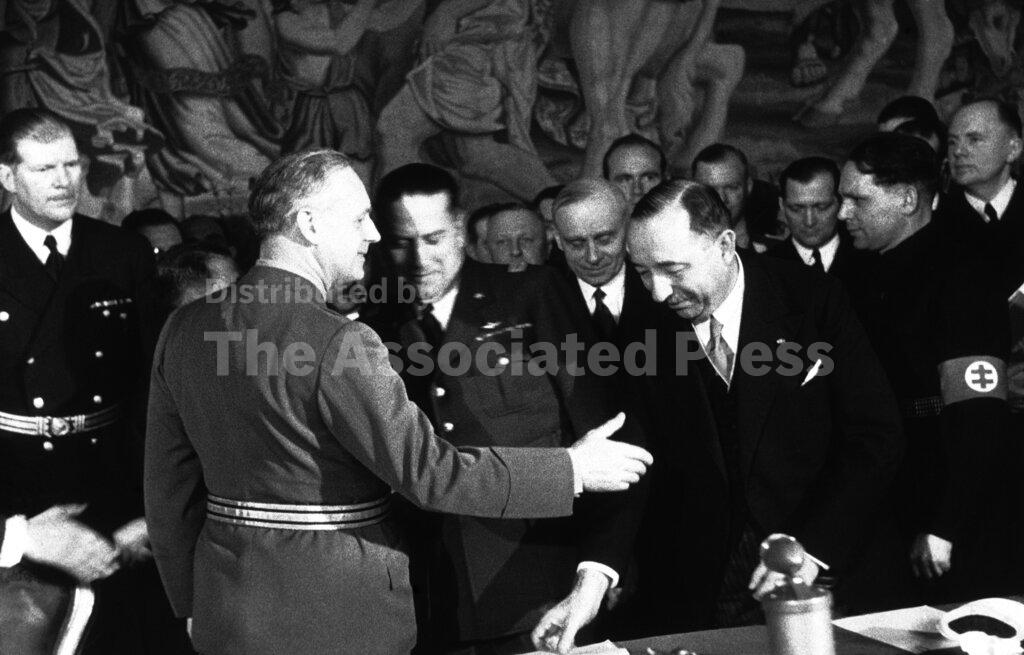
Prime Minister Dragiša Cvetković of Yugoslavia signed the Tripartite Pact at the ornate Belvedere Palace in Vienna, Austria; in secret, Yugoslavia had also allowed German troops to travel on Yugoslavian railroads for an attack on Greece. After the signing, the premier said that his chief aim was peace and security for the Yugoslav people. Von Ribbentrop welcomed Yugoslavia as a “new partner”, and promised that Germany would respect the country’s territorial integrity and not make military demands. Nobody believes him, least of all the Yugoslav premier. Upon hearing of the signing of this document, anti-Axis demonstrations escalated in Belgrade. Yugoslavia signs with the axis, and like a spark in a powder-house the act set off a series of violently explosive demonstrations in many parts of the country. Police strove to halt the serious repercussions by making mass arrests of hundreds of persons in provincial cities, but schoolboys, Serb peasants, Communists and the reincarnated Comitaji (committee of dissenters) stemming back to Ottoman Empire days gave rising vent to their anger. The gray-haired Kosca Pecanac, old-time Comitaji leader and hero of the Salonika campaign of 1918, was reported to have sped out of Belgrade for southern Serbia to recruit the sons of his World war revolutionary comrades for a new fight against the might of Germany. Young Serbs stormed the Greek and British legations, demanding uniforms and transportation to the Albanian and African fronts to battle against the axis forces.
Daily Keynote from the Reich Press Chief: “Your big front-page story today is Yugoslavia’s decision to join the [Axis] tripartite coalition. Besides giving a factual report of the event, you should add commentaries and articles which treat this as yet another significant victory for the concept of a new European order, over the destructive forces of the Anglo-Saxon world.”
Things have quieted down on land in Albania on 25 March 1941. The Italians finally have given up on their Primavera Offensive, which accomplished nothing but rack up casualties. Overall, Italian casualties for the Primavera Offensive number 11,800 dead and wounded, while the Greeks suffer 1243 dead, 4016 wounded and 42 missing.
On land in Libya, the German Afrika Korps continues consolidating its recent acquisition of El Agheila. The British have withdrawn to Mersa Brega, which occupies a narrow point between the coast and the rocky interior where larger operations are impossible. The Germans also note that the British have abandoned Maaten Bescer, too, with British patrols in the area west of Mersa Brega vastly reduced.
Operation LUSTRE, the British reinforcement of mainland Greece, continues. Convoy AG.8 departs Alexandria bound for Piraeus carrying troops and supplies, while Convoy AS.22 departs Piraeus bound for Alexandria. Norwegian 5062-ton freighter Hav departs from Piraeus bound for Alexandria.
Increasing Axis activity in the form of air reconnaissance was observed south and west of Greece and Crete and there are daily attempts to observe the harbor at Alexandria, Egypt. It was deduced from this additional interest in the activities and whereabouts of the Royal Navy’s Mediterranean Fleet that the enemy was planning some form of surface action. Secret intelligence intercepts confirmed that there would be attacks on British convoys but in planning the response it was most important to ensure that the Italians did not get any idea that this was known or suspected.
British and Indian troops attacked Italian positions on the heights above the Dongolaas Gorge on the Keren Road in Eritrea, Italian East Africa at 0300, capturing 2 small hills and 500 prisoners by 0530 hours, gaining control of the road through the gorge. The latest British 5th Indian Infantry Division attack on Keren continues today. Started late on the 24th, the attack quickly yields tactical successes. One objective of British General Heath is to capture the areas overlooking the Dongolaas Gorge that control access to Keren. Another is to neutralize Italian positions at the head of the gorge from which Italian troops can fire down on British sappers trying to clear the gorge of the obstacles placed there by Italian engineers.
As the day beings, the West Yorkshire and 3/5th Mahrattas advancing down the hill from Fort Dologorodoc to the right of the gorge seize some lower hills overlooking the gorge. The Italians resist fiercely, but the British occupy the entire southeastern side of the gorge by 07:30.
At 03:00, another attack is launched by the 2nd Highland Light Infantry and the 4/10th Baluch Regiment. They emerge from a railway tunnel that is to the left of the gorge in order to attack Italian troops at the head of the gorge. The British maintain heavy artillery fire on the Italian positions from the area around the Sanchil heights. Other troops (3/2nd Punjab Regiment) then enter the gorge itself to clear it. By 05:30, the entire gorge is cleared of Italian troops and the Italians can no longer fire down directly into it.
The Italians counterattack in the afternoon. Italian troops continue to hold out on Mount Sanchil on the left side of the gorge. The Indian troops use artillery to break up the Italian attempts to counterattack.
British engineers quickly begin clearing the Dongolaas Gorge of the obstacles placed there to prevent British vehicular traffic. On the surrounding rim, the Italians and British continue struggling for dominance. The British take 500 prisoners in the early morning hours.
The principal war aim of the British people and those fighting with them, Lord Halifax, British ambassador, said tonight, “is to win this life and death struggle for the cause of human freedom.” It was the ambassador’s first public address since arriving three months ago to succeed the late Lord Lothian and, following tradition, he made it before the Pilgrims society of the United States at a dinner at the Waldorf-Astoria hotel. It was broadcast over the three major radio networks. Halifax not only emphasized the nature of the struggle in Europe but sketched a post-war picture in which “every nation, great or small, will have its place and make its own contribution.” He touched briefly, too, on the question: “When will Hitler invade Britain?” a question he said he could not answer. “But if you ask me: ‘Can such an invasion succeed?’ Or in other words, ‘Will all the help we are planning to send to Britain arrive too late?’ Then both my head and heart join to tell you with all the conviction born of my knowledge of how British people feel, and of being a member of the war cabinet since its formation, that the answer is a confident and unhesitating ‘No’.”
Having completed their mission in Athens and Cairo, Foreign Secretary Anthony Eden and CIGS John Dill begin their journey back to London. Today, they lay over at Malta around midnight on the 24th from Athens. The original plan was for them to continue on to Lisbon immediately, but the weather forces a layover, so they spend the day playing billiards and visiting various highly placed individuals on the island. It is a memorable day for Malta, which does not get many highly placed visitors who stick around for any length of time.
Air Chief Marshal Hugh Dowding is in the United States inspecting aircraft factories. He has made some public statements with which British Ambassador Lord Halifax disagrees. Halifax requests Dowding’s recall.
The British learn through their decoding operations and spy network, along with “hard” intelligence such as observed Luftwaffe reconnaissance missions, that the Italians are planning a major operation at sea.
Jams and marmalade ration in Britain was reduced to 8 ounces per person per month and meat ration cut to 6 ounces per person per week.
German armed merchant cruiser Thor sank British liner Britannia 750 miles west of Freetown, Sierra Leone, British West Africa. 203 crew and 281 passengers (most of which were British military personnel) took to lifeboats. Thor began to rescue the survivors, but after taking on only one man, Thor detected British radio transmissions and fled the area before British warship arrived (which never came). 255 survivors of Britannia would be lost. Later on the same day, Thor sank Swedish merchant ship Trolleholm, capturing the entire crew of 31.
German armed merchant cruiser Kormoran captured empty Canadian tanker Canadolite in the Mid-Atlantic about halfway between British West Africa and Brazil; Canadolite was sent to Brest, France as a prize ship.
The British cable ship CS Faraday was sunk by a Heinkel He 111 in the Bristol Channel.
Italian destroyers Crispi and Sella departed Leros, Dodecanese Islands in Greece, each carrying three 2-ton motor assault boats loaded with 300-kg explosives. At 2330 hours, the destroyers released the motor boats 10 miles off Suda Bay, Crete, Greece to attack British warships.
Rodolfo Graziani stepped down as the Governor-General of Italian Libya, succeeded by Italo Gariboldi.
Petre Dumitrescu was named the commanding officer of Romanian 3rd Army.
The resettlement within the Reich of 60,000 Germans from Latvia, Lithuania and Estonia has been completed. The migrations were carried out in accordance with a German-Soviet agreement signed on 10 January, and in return Germany has sent 20,000 Lithuanians, Russians and White Russians into the USSR. Since 1936 the Nazis have planned ways of encouraging — or forcing — ethnic Germans outside the Reich to immigrate. In 1938 a resettlement agency was set up, under the direct authority of Hitler until 1939 when Himmler took over. So far over 400,000 ethnic Germans have been “repatriated”, the largest number 100,000 — in 1939 from the South Tyrol, a part of Austria given to Italy after the last war. Many of the Reich’s new citizens live in poor conditions in camps in Nazi-occupied Eastern Europe, and they have been promised farms and other possessions of deported Jews and Poles.
Archbishop Groeber, in a pastoral letter abounding in anti-Semitic statements, blames the Jews for the death of Christ and adds that “the self-imposed curse of the Jews “His blood be upon us and upon our children,” has come terribly true up until the present time, until today.”
Greenland long ago declared its independence from mother country Denmark due to German domination there. However, Greenland never declared war on Germany. Today, Germany declares that it will observe only a three-mile territorial limit around Greenland.
The Luftwaffe sends small raids against towns on the south coast. A fighter sweep over southern England with fighter-bombers (Jabos) produces few results.
The RAF switches strategic targets. Rather than attack factories in and around cities, for the time being, RAF Bomber Command will attack Axis convoys. These include the iron ore shipments flowing down the Norwegian coast from Narvik to Hamburg, convoys from Hamburg to occupation forces along the North Sea and Channel coast, and oil shipments coming up from Spain. Initiating this strategy, the British bombers attack shipping off of Ameland in the north of Holland.
RAF Bomber Command: Day of 25 March 1941
5 Blenheims off Holland and the Frisian Islands. Convoy attacked and 1 ship claimed as hit. No aircraft lost.
Two Swordfish aircraft squadrons of HMS Eagle were temporarily transferred to Port Sudan, Anglo-Egyptian Sudan.
Battleship HMS Prince of Wales, escorted by destroyers HMS Quantock, HMS Liddesdale, and HMS Avon Vale arrived at Scapa Flow to work up.
Light cruisers HMS Galatea and HMS Aurora departed Scapa Flow at 0859 to cover the laying of minefield SN.4.
Destroyer HMS Mendip departed Scapa Flow for Rosyth on completion of working up exercises.
Dutch light cruiser HNLMS Heemskerk departed Scapa Flow after working up for Greenock.
Armed merchant cruiser HMS Circassia departed the Clyde carrying troops to Iceland, escorted by destroyer HMS Anthony. The destroyer arrived at Loch Alsh at 1830/25th.
Anti-aircraft ship HMS Curacoa departed Scapa Flow at 1100 and met convoy WN.3 in Pentland Firth. The convoy was escorted to Buchan Ness where the ship transferred to convoy EN.91 at 2130. The ship transferred to convoy WN.4 in Pentland Firth at 1030 and provided cover until dark. Ship Curacoa arrived back at Scapa Flow at 1200/27th.
The Luftwaffe at 19:45 bombs and damages 5533-ton cable ship CS Faraday in the Bristol Channel. The Heinkel He 111 bombs and strafes the Faraday, causing a fire that forces the crew to abandon ship — after it shoots down the Heinkel. There are 8 deaths and 25 wounded. The blazing Faraday later grounds at St. Anne’s Head, and the cable on board is mostly recovered. However, the remains of the ship, such as they are, remain there and in fact have become a favored diving location in shallow water at Hooper’s Point, Pembrokeshire.
British steamer Rossmore (627grt) was sunk by German bombing twelve miles northeast of Godrevy Island. Six crewmen were lost on the steamer.
British steamer Beaverbrae (9956grt) was sunk by German bombing 60-12N, 09-00W. The entire crew of eighty six men was rescued by destroyers HMS Tartar and HMS Gurkha. Returning to Scapa Flow, destroyer Gurkha was involved in a collision with an unknown wooden drifter in Pentland Firth. The drifter sank with no survivors. The destroyer’s bow was badly damaged. Destroyers Tartar and Gurkha arrived at Scapa Flow at 0945/26th. Destroyer Gurkha departed Scapa Flow for repairs at Rosyth at 1530/29th.
British fishing vessel Alaskan (21grt) was sunk by a mine in 54-49N, 1-07W. The crew of five was rescued.
Surgeon Lt I. Mc N. A. Drysdale, MB ChB, en route to Fleet Air Arm base HMS Phoenix, T/Sub Lt J. R. Bebbington RNVR, en route to heavy cruiser HMS York, Gunner T. G. Cartwright, en route to heavy cruiser HMS Shropshire in the Indian Ocean, T/Electrician Lt K. McI. Dwyer RNVR, en route to destroyer depot ship HMS Woolwich, T/Lt D. W. Gibbon RNR, en route to submarine depot ship HMS Medway, T/Lt P. H. C. Hardy RNVR, of HMS Excellent, P/T/Sub Lt K. G. Harman, en route to HMS St Angelo, died of wounds on 7 April, P/T/Sub Lt (E) K. J. Kemp RNVR, en route to light cruiser HMS Gloucester, P/T/Lt F. M. Lyons RNR, en route to supply ship Breconshire, T/Lt W. R. Sobey RNVR, en route to base ship HMS Nile, T/Lt (Sp) A. H. Stableford RNVR, of HMS Excellent, P/T/Lt D. S. Wilkinson RNVR, en route to base ship Nile, Lt Cdr R. R. Wood, en route to Fleet Air Arm base HMS Grebe, P/T/Surgeon Lt H. Marks RNVR, en route to light cruiser HMS Liverpool, T/A/Sub Lt (A) S. R. S. N. Gosling RNVR, en route to Fleet Air Arm base HMS Grebe, Lt Cdr M. E. Welby, en route to base ship HMS Nile, Lt S. L. J. Bailey, RCNVR, en route to Fleet Air Arm base HMS Grebe, A/Gunner (T) C. F. Hallas, en route to destroyer HMS Griffin, and T/A/Gunner G. E. D. Marriott, en route to base ship HMS Canopus, were lost.
Boatswain D. G. Brown, en route to battleship HMS Barham, Paymaster Sub Lt H. D. Burge RNVR, en route to battleship HMS Warspite, Lt (E) A. Davidson (ret), of HMS Drake, Paymaster Lt J. P. Joisce RNVR, of base ship HMS St Vincent, Boatswain E. O. Keill, en route to repair ship HMS Resource, Sub Lt J. R. Hume RNVR, en route to light cruiser HMS Gloucester, Sub Lt (A) J. H. Leach RNVR, en route to Fleet Air Arm base HMS Grebe, Lt A. H. Rowlandson, of HMS Victory, A/Sub Lt A. D. T. Sangster, en route to battleship HMS Warspite, Lt R. J. Tadhunter, en route to sloop HMS Bridgewater in the South Atlantic, Cdr S. H. Spurgeon, of HMS Victory, Lt E. H. Thatcher RNVR, en route to battleship HMS Barham, A/Gunner T. Alfred, en route to base ship HMS Nile, Sub Lt (A) T. H. Blank RNVR, en route to Fleet Air Arm base HMS Grebe, A/Sub Lt I. S. McIntosh, en route to submarine depot ship HMS Medway, P/Sub Lt A. L. Soan RNVR, en route to base ship HMS St Angelo, P/Sub Lt (Sp) F. L. West RNVR, en route to Fleet Air Arm base HMS Grebe, Gunner (T) E. G. Westgarth, en route to battleship HMS Valiant, and Warrant Shipfitter W. F. M. Davies, en route to battleship HMS Valiant were rescued and interned at Tenerife. These personnel, and others totaling forty nine men, were released at the end of July 1941.
McIntosh and West received MBE’s for their conduct in the loss of the ship. Rowlandson, Spurgeon, and Tadhunter received commendations.
Dutch steamer Escaut (347grt) was damaged by German bombing twenty four miles southwest of Hartland Point. The steamer was abandoned and drove ashore near Bude. She was refloated and taken to Appledore on 7 September.
While German cruisers Scharnhorst and Gneisenau have made port at Brest, there remain many German raiders at sea. Today, they make their mark.
British steamer Canadolite (11,309grt) was captured by German raider Kormoran in 3-20N, 23-48W.
British steamer Britannia (8799grt) was sunk by German raider Thor in 7-24N, 24-03W. 122 crew and 127 passengers of 203 crew and 281 passengers were missing on the steamer. Spanish steamer Bachi (3091grt) rescued fifty one survivors, Spanish steamer Cabo De Hornos (12,599grt) rescued seventy seven survivors, and British Raranga (7956grt) rescued sixty seven survivors. Thirty three survivors reached Brazil in a lifeboat after twenty three days. The steamer departed Liverpool on the 11th, carrying a large draft of officers and ratings en route to the Mediterranean Fleet.
The Thor’s captain hears British radio transmissions and assumes they mean that the Royal Navy is nearby. He departs the scene after rescuing only one man from the 203 crew and 281 passengers on board. The Britannia is carrying a large number of Royal Navy officers heading to the Mediterranean Theater of Operations.
While almost everyone on board the Britannia survives the initial sinking, many perish after the Thor leaves. The weather may be warming up a bit, but the seas remain cold. A Spanish freighter, the Bachi, rescues 51 men, another, the Cabo De Hornos, rescues 77, and British freighter Raranga rescues 67 men. Another 33 men reach Brazil in their lifeboat, but it takes them 23 days. Two men on the Britannia, Lieutenant I. S. McIntosh and Frank L. West RNVR (who writes a book about the incident) receive MBEs for their service on the ship, while four others receive commendations. The Thor’s captain, Otto Kähler, acts correctly in terms of his legal wartime obligations; however, this is not the best moment of the Kriegsmarine.
Swedish steamer Trolleholm (5047grt) was sunk by German raider Thor in the South Atlantic. The crew was saved and interned.
Submarine HMS Rorqual laid mines off Palermo. Italian tanker Verde (2423grt) and steamer Helena (479grt) from the same convoy were sunk in this minefield on the 26th. Italian steamer Ticino (1470grt) was sunk in 38-06N, 12-31E north of Trapani in a torpedo attack by Rorqual also on the 26th. Italian torpedo boat Chinotto was sunk on this minefield off Palermo on the 28th.
Submarine HMS Rover departed Alexandria to patrol off Burat el Sun, Tripoli.
British troopship Waimarama (11,092grt) ran aground en route from Port Said to Alexandria. Tugs St Issey and Roysterer were able to refloat the steamer. However, two to three months repair were require before the steamer was operational again.
British gunboat HMS Aphis and anti-submarine whaler HMS Southern Sea departed Alexandria for the Inshore Squadron escorting cable ship Recorder to Tobruk.
Late on the 25th, Italian destroyers Crispi and Sella brought explosive motor boats from Leros to Suda Bay for an attack on Heavy cruiser HMS York which arrived at Suda Bay after duty covering convoy MW.6. It is fair to say that, at this stage of the war, the Italian military has not covered itself with glory. They have been forced back in Albania, East Africa, and North Africa, while the Italian fleet largely has stayed in port. However, there is one area of the military at which the Italians are ahead of everyone: small-scale attacks at sea which can produce big results. However, so far these operations have been canceled for various technical reasons. That changes today. Italian destroyers Crispi and Sella each carry three 2-ton motor assault boats from Leros in the Dodecanese Islands. They head for the vicinity of the major British naval base at Suda Bay, Crete. The destroyers release the boats from about 10 miles (18 km) offshore at 23:30. The small boats proceed toward the large Royal Navy ships at anchor in the bay for an attack on the 26th. The prime target is heavy cruiser HMS York.
Norwegian steamer Hav (5062grt) departed Piraeus on the 25th and arrived at Alexandria on the 28th. On the voyage, the steamer was damaged by German bombing.
Convoy AG.8 of supply ship Breconshire and British steamer Cameronia (16,297grt) departed Alexandria escorted by destroyers HMS Juno, HMS Jaguar, and HMS Defender. Anti-aircraft cruiser HMS Carlisle accompanied this convoy. The convoy arrived at Piraeus on the 27th.
Convoy AS.22 departed Piraeus with seven British ships and two Greek ships escorted by anti-aircraft cruiser HMS Coventry, destroyers HMS Decoy and HMAS Waterhen, and corvette HMS Hyacinth. Destroyers Decoy and Waterhen were detached from the escort on the 27th. The convoy arrived at Alexandria on the 28th.
Today in Washington, With the Senate in recess, the Agriculture Committee approved a bill to raise parity prices on five basic farm commodities, and conferees agreed on the terms of the first Deficiency Appropriation Bill.
The House completed Congressional action on the bill authorizing the Federal Housing Administration to insure $100,000,000 of defense housing mortgages, adopted the bill to make permanent the Office of Government Reports, sent to conference the $3,446,000,000 naval appropriation bill, and adjourned at 5:36 PM until noon tomorrow. The Committee Investigating Destitute Migrants heard Paul V. McNutt, Federal Security Administrator, and others.
The United States applauded Soviet Russia’s friendly attitude toward Turkey today and at the same time wrote off Yugoslavia as a possible British ally by freezing its assets in this country. These developments quickly followed Yugoslavia’s formal entry into the axis alliance and Russia’s promise of “comprehensive neutrality” in the event Turkey were attacked or entered the war to defend its territory. Meanwhile, it was learned authoritatively that months-long negotiations between the United States and Russia on trade and other questions had taken a distinct turn for the better. Russia was said to have about $50,000,000 worth of orders pending for goods in this country and $50,000,000 more projected. Most of these purchases were dependent upon the granting of export licenses.
The House approved on roll-call today the bill to make a permanent agency of the Office of Government Reports. The vote was 201 to 144, and was strictly along party lines. Before final action the Republicans assailed President Roosevelt and Lowell Mellett, head of the office, accusing them of making through this agency an attempt at censoring the press and radio and setting up in America something like the Gestapo of Germany.
Franklin D. Roosevelt Jr. dropped alongside the Presidential yacht Potomac today in a Navy patrol plane to spend a few hours fishing with his father. Young Mr. Roosevelt, who goes on active duty as ensign aboard the destroyer USS Mayrant April 3, planned to return to Miami late in the afternoon aboard the same plane, flown out by a naval pilot to deliver mall to the Chief Executive. The President divided the day between fishing and disposing of the contents of a heavy mail pouch before the plane’s departure.
A near-revolt of the Congressional farm group against President Roosevelt’s apparent unwillingness at present to boost agricultural prices by artificial means broke into the open today when the Senate Agriculture Committee unanimously reported the Bankhead bill to increase government loans on five basic commodities, corn, wheat, rice, tobacco and cotton, in return for further reductions in their production by the farmers of the country.
After Pennsylvania State Troopers had smashed picket lines at all nine gates of the Bethlehem Steel Corporation plant here, the striking C.I.O. workers were assembled in a hail early this morning and instructed by their district director, Howard T. Curtiss, to discontinue all picketing for twenty-four hours.
Two violent clashes between police and parading strikers and their sympathizers, with both sides suffering injuries, sluggings, automobiles set afire, one instance in which a police gas grenade was thrown, and the arrest of a dozen demonstrators today marked the back-to-work movement at the McCormick works of the International Harvester Company on Chicago’s Southwest Side.
The National Defense Mediation Board, appointed last week by President Roosevelt, held its first meeting here today, with Chairman Clarence A. Dykstra presiding and all eleven members present. William H. Davis of New York was chosen vice chairman, and E.P. Marsh of Portland, Oregon, temporary executive secretary.
A substantial majority of voters (68%) from coast to coast believe that labor union leaders are not helping the national defense production program as much as they should, a nation-wide survey by the American Institute of Public Opinion has shown, Dr. George Gallup, director of the institute, reports.
Chairman Dies of the House committee investigating un-American activities told the House today that the National Maritime Union was “a completely dominated Communist organization.” Mr. Dies, calling on the Federal Administration and unions “to drive Communists from their ranks, and employment,” inserted in the Congressional Record exhibits that he said proved his contentions.
Earl Russell Browder lost his freedom and his appetite today. The former general secretary of the Communist party in the United States surrendered in federal court to start a four-year prison sentence imposed on his conviction 15 months ago of using a fraudulently obtained passport. Taken a few minutes later to a cell already occupied by two small time mail fraud defendants, he said he wasn’t hungry and declined lunch. The place of Browder’s eventual confinement was not made public, but most federal prisoners convicted here of felonies are sent to the Lewisburg (Pennsylvania) penitentiary.
Taxes took a fifth of the national income of the United States in the year ended June 30, 1940, the Census Bureau reported today. The largest share went to local governments.
Carolina Paprika Mills in Dillon, South Carolina, incorporated.
The Chilean government announced tonight that former King Carol of Rumania and his red-headed companion, Magda Lupescu, have been given permission to live in Chile. The exiled monarch and his companion were expected to come here soon from Portugal with a party of two noblemen, the wife of one, and four servants.
At the Battle of Shanggao, the Japanese 11th Army has given the Chinese 19th Army Group of the Chinese 9th War Area its best shot — and come up short. Having used all of its resources to try to punch through the Chinese lines, the army gives up the fight as pointless given the high cost. The lines remain where they are for the time being, but the Japanese launch no more attacks. The city of Shanggao, though, is destroyed. This has been a very important Chinese defensive victory. The Chinese try to take advantage of this victory by moving to encircle the advanced Japanese positions, but the Japanese begin edging back toward their base.
Author Ernest Hemingway is in the Far East on a “tourist” visit which may be a little more than that. Today, he and his wife Martha Gellhorn depart from the British base in Hong Kong for China.
Captain Kiichi Hasegawa was assigned as the commanding officer of the Imperial Japanese aircraft carrier HIJMS Akagi.
The U.S. Navy heavy cruisers USS Chicago (CA-29), under command of Rear Admiral John H. Newton, Commander Cruisers Scouting Force, and USS Portland (CA-33) and the destroyers USS Clark (DD-361), USS Conyngham (DD-371), USS Reid (DD-369), USS Cassin (DD-372), and USS Downes (DD-375), arrived at Brisbane, Australia, beginning a three-day good-will visit.
U.S. Navy Task Group 9.2, under command of Captain Ellis S. Stone and comprised of the light cruisers USS Brooklyn (CL-40) and USS Savannah (CL-42) and the destroyers USS Case (DD-370), USS Shaw (DD-373), and USS Tucker (DD-374), arrived at Tahiti.
Dow Jones Industrial Average: 122.78 (+0.39)
Born:
Gudmund Hernes, Norwegian politician and academic, in Trondheim, Norway.
Naval Construction:
The U.S. Navy 77-foot Elco patrol motor torpedo boat USS PT-33 is laid down by the Electric Launch Company Ltd. (Elco), (Bayonne, New Jersey, U.S.A.).
The Kriegsmarine (German Navy) Type VIIC U-boat U-259 is laid down by Bremer Vulkan-Vegesacker Werft, Bremen-Vegesack (werk 24).
The Royal Navy Hunt-class (Type III) escort destroyer HMS Easton (L 09) is laid down by J.S. White & Co. (Cowes, U.K.).
The U.S. Navy Benson-class destroyer USS Meade (DD-602) is laid down by the Bethlehem Steel Corp. (Staten Island, New York, U.S.A.).
The U.S. Navy Accentor-class coastal minesweeper USS Cotinga (AMc-43) is launched by the Gibbs Gas Engine Co. (Jacksonville, Florida, U.S.A.).
The Royal Navy Fairmile B-class motor launch HMS ML 145 is commissioned.
The Royal Navy Fairmile B-class motor launch HMS ML 188 is commissioned.
The Royal Navy LCT (Mk 1)-class landing craft, tank HMS LCT 25 is commissioned.
The Royal Navy LCT (Mk 1)-class landing craft, tank HMS LCT 26 is commissioned.
The Royal Navy ocean boarding vessel HMS Ariguani (F 105) is commissioned. Her first commanding officer is Commander (retired) Robert Abercrombie Thorburn, RD, RNR. She is fitted out as fighter catapult ship.
The U.S. Navy patrol yacht USS Zircon (PY-16, formerly the yacht Nakhoda) is commissioned. Her first commanding officer is Lieutenant Commander Cornelius M. Sullivan, USN.
The U.S. Navy seaplane tender, destroyer USS Gillis (AVD-12, formerly a Clemson-class destroyer, DD-270) is commissioned. Her commanding officer is Lieutenant Commander John Postell Heath, USN.
The U.S. Navy “R”-class submarine USS R-17 (SS-94) is recommissioned as a training boat.
The Royal Navy Dido-class light cruiser HMS Hermione (74) is commissioned. Her first commanding officer is Captain Geoffrey Nigel Oliver, RN.
 History Diaries