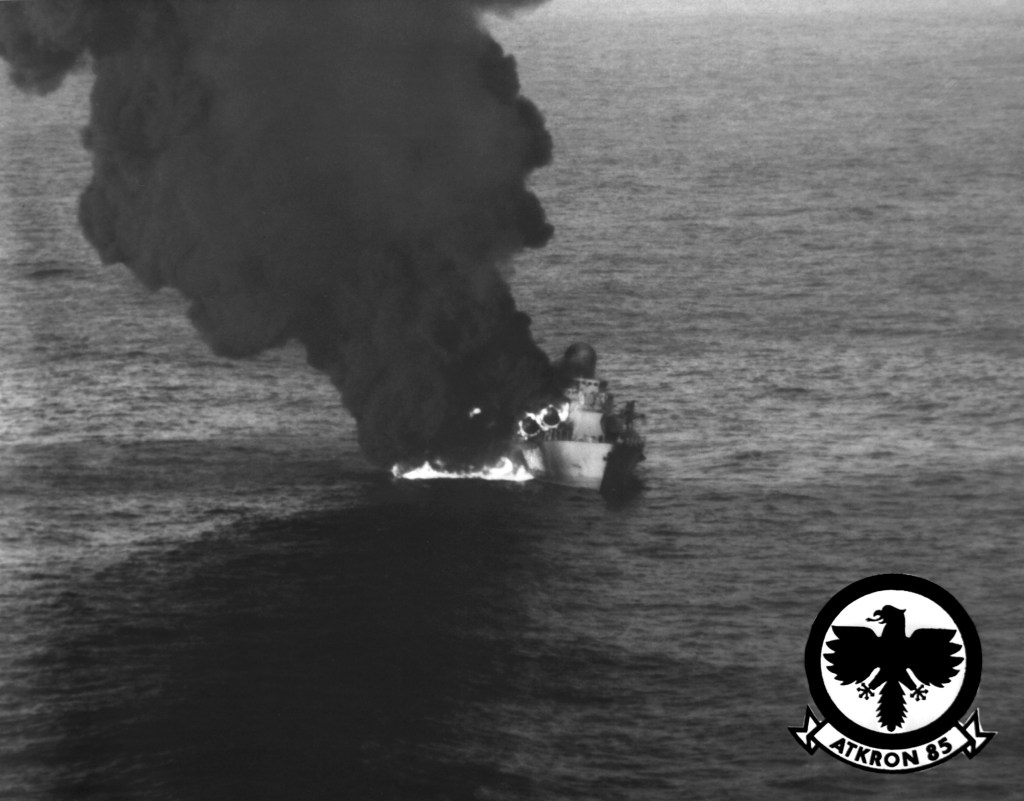
American Navy forces struck against Libya for a second day. American officials said the Sixth Fleet in the Mediterranean Sea had destroyed two Libyan missile patrol boats in attacks Monday evening and this morning and had struck a missile site on the coast Monday evening. The same site was attacked by American missiles earlier on Monday. One of the missile patrol boats was sunk by the Yorktown, a guided missile cruiser, after the Libyan vessel had approached to within 10 miles of the main body of the American task force, officials said. The new American attacks came after Libyan forces displayed what officials today described as “hostile intentions.” The officials said there had been no actual firing by the Libyans before the new American actions. The United States vowed to continue its operations in the Gulf of Sidra, a wide embayment that Libya claims as its territorial waters. The United States and most Western nations recognize only a 12-mile limit, and the United States says its warships are in the gulf to assert the right of free navigation in what it considers international waters.
On Monday, the United States said that Libya had fired missiles at American planes and that American forces had responded by sinking two vessels and attacking the coastal missile site, from which officials said the Libyan missiles had been fired. Defense Secretary Caspar W. Weinberger said Monday that the missile site, at Sidra, had been knocked out of action. But today he said a radar at the site had been replaced and turned on, so the site was attacked again later on Monday. American officials contended that the missile site and the Libyan missile patrol boats posed a threat to the 30-ship American task force, including three aircraft carriers, deployed in or near the Gulf of Sidra. Larry Speakes, the White House spokesman, said all Libyan ships and planes moving toward the Sixth Fleet were considered dangerous.
Libya is ready “for war” with the United States over the Gulf of Sidra, Colonel Muammar el-Qaddafi announced. If Washington wants to expand the struggle, the Libyan leader said, “we will carry it out all over the world.” The Vice President of Syria, Abdel Halim Khaddam, was reported to have arrived in the Libyan capital today after Colonel Qaddafi had conferred twice on the telephone with President Hafez al-Assad of Syria. In the past, Syrian pilots have been sent to Libya to fly some of the hundreds of fighter aircraft that Colonel Qaddafi received from the Soviet Union. As tensions mounted between the United States and Libya — which Washington accuses of supporting terrorists, including those responsible for last December’s attacks on airports at Rome and Vienna — thousands of Libyans staged anti-American rallies this morning. Colonel Qaddafi made a tumultuous appearance tonight at an international industrial trade fair, where he was mobbed by youths chanting, “With blood, with spirit, we will defend our revolution.” Asked by Western reporters what he had to say to President Reagan, the Libyan leader replied: “This is not the time for speaking. It is a time for confrontation, for war. “The Gulf of Sidra is ours,” he added.
President Reagan approved a plan to engage Libyan forces in the Gulf of Sidra after intelligence reports disclosed that Libya was trying to “pinpoint” American diplomats for possible terrorist attacks, White House officials said today. The reports from intelligence sources in the Middle East and southern Europe were cited by key White House officials as a reason that Mr. Reagan approved the American naval maneuvers in the Gulf of Sidra. They said Mr. Reagan decided to send Navy vessels into the gulf after being told it would almost certainly lead to a military confrontation with Libya. Aimed to Show Toughness The President took this action, the officials said, because he and his top aides felt the Libyan leader, Col. Muammar el-Qaddafi, was not getting the message that the Reagan Administration would not tolerate terrorist attacks and that the only way he would was through a demonstration of toughness by Mr. Reagan.
Although it comes as no surprise that Libya’s forces are no match for the United States Sixth Fleet, military analysts say its air, naval and air-defense forces are also inferior to those of many Middle Eastern nations. Some military officers pointed to the ineffectiveness of Soviet-built air-defense missiles against United States Navy fighter aircraft. “When you see that they’re 0 for 12 against us, they can’t be very good,” an officer said this morning, when the number of missiles fired by the Libyans was thought to have been a dozen. A Middle Eastern specialist noted that Israel, which is generally considered to have the best intelligence service in the region, devotes relatively little attention to Libya because the Libyans are not considered to be a threat.
The Soviet Union today condemned United States military actions against Libya, but stopped well short of threatening to intervene. The Government press agency, Tass, called the use of force against Libyan naval ships and against a missile site an act of piracy that violated international law. Tass said the conflict “aggravates the explosive situation in the area and may lead to grave consequences going beyond its boundaries.” Vladimir B. Lomeiko, a Foreign Ministry spokesman, said at a news conference that the Soviet Government “condemns the United States’ aggressive actions and demands that they be stopped.” When asked whether the American actions might hamper efforts to arrange a meeting between President Reagan and Mikhail S. Gorbachev, Mr. Lomeiko reiterated the Soviet position that any future summit meeting must produce concrete results. Western diplomats said that the Soviet response to the clashes off Libya appeared to be mild and that the Russians were evidently not eager to become directly involved in the conflict.
Prime Minister Bettino Craxi, today criticized the American naval activity off Libya, saying “Italy does not want wars on its doorstep.” But Mr. Craxi also strongly criticized Libya, saying the American naval maneuvers that preceded the outbreak of hostilities Monday took place in an area “almost universally considered international waters.” He called Libyan claims on the Gulf of Sidra “unilateral.” Mr. Craxi’s reaction was the toughest of the Western European leaders, who generally offered support tempered by anxiety over the fighting.
Defense Secretary Caspar W. Weinberger said today that the Soviet Union’s modernization of its weapons arsenal was continuing at such a pace that it was “challenging the technological edge” on which American security depends. “Soviet modernization has not abated,” Weinberger said in making public the Pentagon’s latest annual assessment of Soviet military power. The study included previously unreleased pictures of an intermediate-range SS-20 missile on its launcher; the newest version of the Delta missile submarine, now said to be on sea trials, and the SU-27 fighter, a look-alike of the American F-15 that the Pentagon says became operational early this year. It concludes that the Soviet Union has attained parity with the United States in the development of cruise missiles, has a crude but workable laser weapon capable of blinding spy satellites, and is continuing to outpace the Pentagon in building tanks, planes, helicopters and artillery. The Soviets are developing two or three new intercontinental ballistic missiles, the booklet states. “By the mid-1990s, the Soviet ICBM force will have been almost entirely replaced with new systems, a number of which may violate SALT II constraints,” it said. The report also said the Soviets have now deployed more than 70 mobile SS-25 ICBMs — a missile condemned by the United States as a violation of the strategic arms limitation agreement of 1979.
Soviet dissident Yelena Bonner left for a weeklong Caribbean vacation after criticizing Soviet authorities for secretly making a videotape of her banished husband, physicist Andrei D. Sakharov. It was the first time Bonner has spoken out, thereby breaking her agreement with the Soviet government not to talk publicly in exchange for a visa to receive medical treatment in the West. Bonner said she spoke out because of fears for her husband’s life. The videotape, obtained by a West German newspaper, showed Sakharov telling a doctor his nutrition was fine. He looked haggard, Bonner said.
The World Jewish Congress disclosed new documents today that it said showed that Kurt Waldheim, as an intelligence officer in the German Army, took part in campaigns against Yugoslav partisans in World War II. Mr. Waldheim, who later became United Nations Secretary General and is now a candidate in the Austrian presidential election, said in a recent interview that he had served as a German-Italian interpreter with the German forces in Yugoslavia. In recently published memoirs, he discusses his early service with the German Army on the Soviet front in 1941, but he does not mention his subsequent service in the Balkans.
At least 17 people were killed and 19 were missing after severe storms swept across Western Europe. Hurricane-force winds of up to 100 mph lashed western coasts, sinking ships off Spain, France and Sweden. Five members of one family were feared drowned after their trawler sank off the port of La Coruna in northwestern Spain.
A Madrid court ruled that Jorge Luis Ochoa, alleged to be Colombia’s top cocaine trafficker, will be extradited to Bogota on drug smuggling charges. Ochoa was arrested in Spain in November, 1984. U.S. authorities also sought his extradition on charges that he smuggled 3,300 pounds of cocaine from Colombia to the United States by way of Nicaragua. However, the Madrid court ruled that Colombia had the greater claim.
The American Israel Public Affairs Committee (AIPAC), the primary pro-Israel lobbying group in Washington, dropped plans to actively oppose the Reagan Administration’s proposed sale of $354 million in advanced missiles to Saudi Arabia. Congress has 50 working days from the Administration’s formal notification March 11 to stop the sale, which includes 1,666 Sidewinder air-to-air missiles, 200 Stinger ground-to-air missiles and 100 Harpoon ship-to-ship missiles. An official from the group said “the threat (to Israel) is not proportional to the fight that would have to be waged.” But a spokesman for Senator Alan Cranston (D-California), who opposes the sale, said efforts to block it will proceed.
A telephone caller, claiming to represent the Lebanese captors of kidnaped journalist Alec Collett, told a news agency that the 64-year-old Briton is dangerously ill and needs medicine. Collett, who is diabetic, was seized one year ago by gunmen from his U.N.-marked car just south of Beirut. The caller, who asked that Britain send the appropriate medicine, said he spoke for the revolutionary Organization of Socialist Muslims, which has demanded the release of “all Muslim freedom fighters” from British jails.
A key leader of the Pakistani opposition said today that she planned to end her exile in London and to return home for a series of political rallies. Benazir Bhutto, a leader of the once-outlawed Pakistan People’s Party and of the opposition to President Mohammad Zia ul-Haq, said she was “greatly encouraged” by United States support of the nonviolent overthrow of dictatorships in the Philippines and Haiti. The 32-year-old Miss Bhutto is the daughter of Zulfikar Ali Bhutto, the Prime Minister of Pakistan who was ousted by General Zia in an army coup in 1977 and hanged by the Zia Government in 1979.
Government officials called for tighter security measures today and the police established a special investigative unit after small homemade bombs were fired this afternoon at the United States Embassy and the Imperial Palace. A few hours after the crude bombs were launched from cars parked outside the American Embassy and the Imperial Palace, the police discovered three similar bombs in a car abandoned along a major expressway outside the neighboring city of Yokohama. The police said the car had been stolen, as had the two others used in the attacks. Investigations into the attacks, which caused no injuries or property damage, continued tonight as the police tightened security checks at airports and public buildings. No group claimed responsibility, although the police said they suspected left-wing extremist groups. These groups oppose both the meeting of the leaders of industrialized nations to be held in Tokyo in May and ceremonies scheduled for April to commemorate Emperor Hirohito’s 60-year reign.
President Corazon C. Aquino abolished the National Assembly and claimed all legislative powers for herself today. She promised a “swift and safe” return to democratic representative government within a year. Mrs. Aquino announced the imposition of a temporary “freedom Constitution,” including a bill of rights and, aides said, the possibility of judicial review through this uncertain interim period. This is to be the law of the land until a new constitution can be composed and submitted to “genuine and honest” plebiscite and a new legislature elected, Mrs. Aquino declared. In the meantime, the President, who deposed Ferdinand E. Marcos a month ago, will exercise wide-ranging powers, including the right to remove local government officials considered corrupt by Mrs. Aquino’s political advisers. “I am announcing an interim Constitution under which our battered nation can shelter after years of dictatorship in order to heal its wounds, restore its strength and enjoy the first fruits of its new-found freedom,” she declared.
Two of Ferdinand E. Marcos’s top financial advisers have agreed to cooperate with the Philippine Government’s efforts to recover the deposed President’s wealth, a senior Filipino official said yesterday. Jovito R. Salonga, the head of the commission investigating the Marcos holdings, said that Jose Y. Campos, a Filipino industrialist who had organized offshore corporations for Mr. Marcos’s benefit, had handed over affidavits detailing the financial arrangements. Mr. Salonga also said that Ronaldo C. Gapud, the president until last week of what he called the “Marcos bank” in the Philippines — the Security Bank and Trust Company — was talking to the commission.
Six Swiss banks must freeze deposits belonging to the family of Ferdinand E. Marcos, the Swiss Government announced. A spokesman said the government had issued the unparalleled order after officials received indications that some assets of the former Philippine President were being removed from the country. He declined to provide further details. The spokesman said the action was “a precautionary measure,” adding it was the first time Switzerland had ever taken such a measure.
Haiti has requested the extradition from Brazil of the former police chief of Port-au-Prince, Colonel Albert Pierre, who has been accused of murder, torture and other human rights abuses. Colonel Pierre, who took asylum in the Brazilian Embassy in Port-au-Prince days after President Jean-Claude Duvalier fled Haiti on February 7, was given a safe-conduct out of the country and was sent by Brazilian authorities to the island of Fernando de Noronha, off Brazil’s northeast coast.
American-piloted army helicopters are being readied to ferry Honduran troops today into the border area where Nicaraguan army units are said to have attacked Nicaraguan rebel bases, according to diplomats in Honduras. As many as 1,500 Nicaraguan troops entered Honduras three days ago to attack Nicaraguan rebel camps, diplomats said. They said that the Nicaraguans now appeared to be withdrawing back into Nicaragua and that fighting had died down this afternoon. The United States helicopters and pilots are being provided as part of $20 million in emergency military aid that President Reagan is sending to Honduras because of the reported Sandinista attack.
President Reagan ordered $20 million in emergency military aid for Honduras today. The action came as the White House asserted that 1,500 Nicaraguan Government troops had penetrated 12 miles into Honduran territory, apparently to attack Nicaraguan rebels. The Nicaraguan Government denied that it had invaded Honduras, saying the assertion was part of a “crude campaign” by the Reagan Administration to win passage of a $100 million aid package for the Nicaraguan rebels. Congressional leaders said the reported thrust into Honduras by Nicaraguan troops would strengthen President Reagan’s campaign for the aid, although some lawmakers expressed skepticism at Administration accounts of the raid. Others said the assault had been touched off by American support for the rebels, known as contras. But most legislators accepted the Administration’s report as accurate. Donald T. Regan, the White House chief of staff, said American military forces stationed in Honduras were being readied to airlift Honduran troops to the border area. “American pilots will fly, but they will go nowhere near where the Nicaraguan troops are,” Mr. Regan said.
U.S.-supported Angolan rebels said they attacked and severely damaged Chevron-Gulf oil installations in northern Angola, where more than 100 Americans work. A spokesman for the rebel National Union for the Total Independence of Angola said in Lisbon that the installations in Cabinda province were bombarded with artillery fire. But a spokeswoman in London for Chevron’s Gulf Oil subsidiary said its oil facilities were unaffected. “Quite categorically nothing happened,” the spokeswoman said.
Two policemen were killed in the black Crossroads shantytown near Cape Town as anti-government rioting flared again across South Africa, police and witnesses reported. An off-duty white policeman, on suspension for alleged drug-dealing, was shot to death in Crossroads and his body burned in a main street. Later, a black policeman was slain when he went to investigate one of several vehicles set ablaze by rioters.
In a dramatic loss for the Republican leadership and President Reagan, the Senate this evening barely defeated a constitutional amendment to require a balanced Federal budget. The vote was 66 to 34 in favor, one vote short of the required two-thirds majority. Senators on both sides of the issue said approval in December of the new budget-balancing law, whose main Senate Republican sponsors were Phil Gramm of Texas and Warren B. Rudman of New Hampshire, was the key factor in the debate. Senators agreed that the new law allowed several past supporters of the amendment to vote no. The Senate had approved a budget-balancing amendment in 1982 by a vote of 69 to 31. Supporters called the loss today a severe blow and said the voters will need to change the makeup of the Senate this fall to give a chance of winning in 1987. Bob Dole, the Senate majority leader, who like Mr. Reagan was a strong supporter of the amendment, shook his head in disappointment as the roll-call ended with him unable to switch the one vote he needed to win.
Other Republicans who supported the amendment immediately criticized two members of their leadership who voted no. They were John Heinz of Pennsylvania and John H. Chafee of Rhode Island, both of whom also voted no in 1982. Senator Orrin G. Hatch, Republican of Utah, said, “A lot of our senators who are up this year are very upset about it.” Ten Republicans joined 24 Democrats in defeating the proposal. The other 43 Republicans and 23 Democrats voted yes. Senator Dennis DeConcini, Democrat of Arizona, criticized Mr. Reagan as making too few phone calls in lobbying for the amendment. “Obviously he didn’t make enough,” Mr. DeConcini said after the vote. Mr. Reagan has had only limited success with other items on the conservative agenda that he began to push when he came into office, including abortion and school prayer. A supporter of the amendment, Senator Paul Simon, Democrat of Illinois, said, “Senators think Gramm-Rudman has passed and that will do the trick.”
Consumer prices fell four-tenths of 1 percent in February as the effects of the collapsing oil market made their first full impact at the retail level, the Labor Department reported today. The decline in the Consumer Price Index was the first since December 1982 and the biggest in more than 32 years. Food prices also fell sharply, with the largest one-month decline in the prices of fresh vegetables since the price index was first calculated in its current form in 1947. In the New York-northeastern New Jersey area, prices fell by two-tenths of 1 percent, about half the national decline. A drop in prices for fuel, clothing, transportation and food was offset by higher costs for electricity and medical care. The decline in the national index was somewhat greater than anticipated. This prompted new speculation that the Federal Reserve would take further action to ease monetary policy over the next several weeks, since the central bank seems to have considerable leeway to spur the economy without driving up inflation.
The U.S. Supreme Court rules Air Force could ban wearing of yarmulkes. Sustaining military discipline over constitutional rights, the Supreme Court upheld a Pentagon rule against wearing yarmulkes and other religious headgear indoors while in uniform. The Court ruled 5 to 4 that the military’s power to impose a uniform dress code prevailed over the religious duty of an Orthodox rabbi serving as an Air Force captain to keep his head covered. The decision upheld a reprimand and other disciplinary action in 1981 against S. Simcha Goldman, who was an Air Force captain working as a psychologist, for insisting on wearing his yarmulke while on duty. In another religion case, the Court left unresolved one of the most contentious constitutional issues before it this term: whether student religious groups may hold prayer meetings in school.
President Reagan participates in an Economic Policy Council meeting.
President Reagan places a call to Doug Gamble, joke writer for NBC’s Tonight Show.
Senator Pete Wilson (R-California), striking at what he called “congressional self-promotion at the taxpayers’ expense,” introduced a bill that would ban the newsletters members of the House and Senate mail to their constituents. Wilson’s bill would eliminate government funds for the newsletters, which are expected to cost $146.2 million this year. One supporter of the measure, Senator John C. Danforth (R-Missouri) called that sum a “scandal.” Wilson denied that his move was intended, at least in part, to embarrass his fellow California senator, Democrat Alan Cranston, who spent $1.6 million on newsletters in the three months ended last September 30, more than any other senator.
The director of a program aimed at exploring a high-technology defense against nuclear missiles said today that one of his goals was “to protect an option” for early deployment of a defense modeled on present antiballistic-missile technologies. The director, Lieutenant General James A. Abrahamson, and Richard N. Perle, a senior Pentagon official, also testified that it would save money and greatly increase confidence that antimissile defenses would work if what he called a “restrictive” interpretation of the 1972 treaty with the Soviet Union limiting defenses against ballistic missiles was cast aside. In its place, Mr. Perle called for what he said was “the only legal” interpretation of the treaty, permitting unlimited testing and development of equipment for the partly space-based antimissile research program sought by President Reagan. The technology first developed by both the United States and the Soviet Union in the 1960’s uses nuclear-tipped ground-based interceptor rockets. Assistants to General Abrahamson later made it clear that if an interim style of missile defense was ever deployed it would probably use not nuclear explosives but rather devices that would destroy incoming warheads by simple collision.
A search in the eastern half of the country for nuclear waste storage sites has generated angry opposition. The government, which has studied Western sites for years, is seeking repositories for the storage of thousands of tons of the wastes, which will be dangerously radioactive for thousands of years. Six hearing officers from the Department of Energy are in Portland, Maine to gather opinion on the possibility of storing highly radioactive nuclear waste here, but if they had any question it was answered on the way in from the airport. Utility poles are covered with signs reading “No!” Similar sentiments have become common in several cities in the Eastern half of the country in recent weeks as the Energy Department, which for years has been studying sites in salt beds and volcanic formations in the West, has begun to focus on a dozen underground granite structures in the East. The reaction, from here to Minnesota, is that the selection process is flawed, that the Department of Energy’s computer has made a mistake and that there may be a safe way to dispose of the waste, “but not here.”
A state appeals court in Trenton, New Jersey, struck down a state education department policy that requires schools to admit children with AIDS, saying officials failed to provide adequate time for public comment before adopting the regulation. The appeals court directed Education Commissioner Saul Cooperman to devise new administrative rules and to hold a public hearing on them. The decision means two school districts that have fought the policy in court do not have to admit children with the disease.
The Texas Democratic Party chairman is mailing 18,000 party officials copies of a list of candidates backed by extremist Lyndon LaRouche in an effort to prevent their winning nominations in the May primary. The message is simple, Chairman Robert Slagle said in Austin. “Unless you know who it is you are voting for against an incumbent, you better vote for the incumbent,” he said. Political observers were stunned last week when LaRouche followers in Illinois captured the Democratic nomination for lieutenant governor and secretary of state.
An explosion destroyed a Morton Thiokol Inc. building containing material used in Trident missile rocket propellant, but no one was injured, a spokesman said. The spokesman for Morton Thiokol’s Wasatch Division about 30 miles from Brigham City, Utah, said the explosion did $1.5-million damage to an “oxidizer dryer building” and its contents. Thiokol makes the solid-fuel booster rockets for the space shuttle program.
The United Food and Commercial Workers International Union today moved to take over a dissident local that has been waging a seven-month-old unauthorized strike against the Geo. A. Hormel & Company’s meatpacking plant in Austin, Minnesota. The union announced it would hold a hearing April 7 in Bloomington, Minn., on placing Local P-9 in trusteeship for “refusing to comply with the parent union’s direction to end the strike.” Jim Guyette, president of the local, responded by inviting union members to witness what he termed “this predetermined kangaroo court trial.”
An unattended oil leak prompted the Air Force to suspend Galaxy Airlines from further charter flights until inspectors are satisfied that the carrier has cleared up maintenance problems, a spokesman said. Galaxy, based in Fort Lauderdale, Florida, was running two regular supply routes, but carrying no passengers, and using Lockheed L-188 Electras, said Air Force spokesman Captain Thomas LaRock.
President Reagan and Governor Rudy Perpich have signed legislation providing property and money to Chippewa Indians for land illegally taken from them nearly 80 year ago and to clear up titles for present landowners. However, one member of the White Earth Reservation Tribal Council threatened a court challenge of the $22 million measure, which was signed Monday.
With the record of California’s top judge looming as the dominant issue in this year’s race for governor, the challenger, Tom Bradley, said today that he would neither support nor oppose her retention nor judge her performance on the bench. The chief justice of California’s Supreme Court, Rose Elizabeth Bird, is subject to reconfirmation by the voters and is on the ballot in November. One issue facing her is the death penalty. A recent public opinion poll showed a wide majority of Californians supported the death penalty, but Chief Justice Bird has opposed each of the 55 death penalty sentences reviewed by the court since she was appointed chief justice in 1977.
Wooden toy horses sold across the country are being recalled because of excessive lead in the paint, the Consumer Product Safety Commission announced. The recall involves the Woodworks Lace Up Horse, Item No. 203, sold by Reeves International of Pequannock, New Jersey. About 550 of the $5 toys have been sold since 1983, the commission said. Tests found that the paint on the toys contained 6.8% lead. Federal law limits lead content to 0.06%. Although no injuries have been reported because of the toy, lead can cause brain damage if ingested by children.
The pesticide heptachlor that contaminated thousands of gallons of milk in Arkansas, Missouri and Oklahoma has shown up in the consumer meat supply, the Agriculture Department said, but “there appears to be no widespread problem,” an official said. Of 196 meat samples tested, six had illegally high amounts of the chemical, officials said. The pesticide heptachlor was banned for most agricultural uses in 1978, after it was found to be a potential cause of cancer.
A person who suffers even one case of blistering sunburn in adolescence may double the risk of developing a serious skin cancer later in life, a Harvard researcher reported today. In one form of skin cancer, melanoma, which affects the pigment-producing skin cells, sunlight may nudge those cells or moles toward cancer. The disease is fatal in about one in four cases.
The use of snuff and chewing tobacco is increasing significantly, according to Surgeon General C. Everett Koop. He said that 12 million Americans now use smokeless tobacco, many of them after quitting cigarettes, and warned that the practice was increasing the users’ risk of cancer and other illnesses.
Everyone may be descended from a woman who lived in Africa about 200,000 years ago, according to scientists of the University of California at Berkeley. They said that studies of the changes that have taken place in human DNA over the millennia support the view that modern man originated in Africa.
Stock prices fell moderately yesterday on Wall Street in the quietest session in more than a week. “The excuse most people are using is a Qaddafi correction,” said Alfred Goldman of A. G. Edwards & Sons Inc. referring to the Libyan leader, Colonel Muammar el-Qaddafi, whose country has been battling the United States for the last two days in the Gulf of Sidra. But Mr. Goldman believes yesterday’s downturn in the stock market is nothing more than a “very normal, very healthy, very gentle correction that is long overdue.”
Dow Jones Industrial Average: 1778.5 (-4.43)
Born:
Kyle Lowry, American NBA point guard (NBA Championship-Raptors, 2019 ;NBA All-Star, 2015–2020; Memphis Grizzlies, Houston Rockets, Toronto Raptors, Miami Heat, Philadelphia 76ers), in Philadelphia, Pennsylvania.
Marco Belinelli, Italian NBA shooting guard and small forward (NBA Championship-Spurs, 2014; Golden State Warriors, Toronto Raptors, New Orleans-Charlotte Hornets, Chicago Bulls, San Antonio Spurs, Sacramento Kings, Atlanta Hawks, Philadelphia 76ers), in San Giovanni in Persiceto, Italy.
Pierre Walters, NFL linebacker (Kansas City Chiefs), in Forest Park, Illinois.
 History Diaries