Enter the Afrika Korps
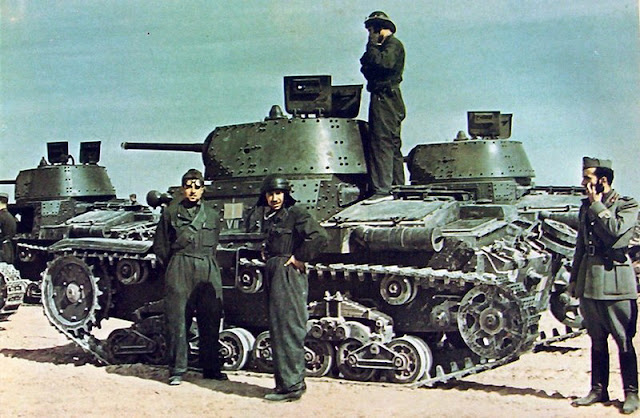
Erwin Rommel returned to Libya after a series of meetings in Germany and Italy.
Today is the first military success for the Afrika Korps.
German forces recaptured El Agheila, Libya. Axis forces opened Rommel’s offensive in North Africa at 0600 hours. Australian troops on the front line destroyed a leading German armored car, but they were soon overwhelmed by German tanks. By7:30, Axis forces would capture El Agheila, the furthest point of the British advance against the Italians. British 2nd Armoured Division fell back 30 miles to Marsa Brega. Against Chancellor Adolf Hitler’s explicit orders the Afrika Korps with components of the 3rd Reconnaissance Detachment, reoccupies El Agheila. Lieutenant General Erwin Rommel, commander of the Afrika Korps, records: “The garrison, which consisted only of a weak force, had strongly mined the whole place and withdrew skillfully in face of our attack.” but he is led to wonder if the British are as formidable as first thought. The British destroy the lead German armored car, then withdraw. The Germans do lose two tanks damaged to mines. Rommel uses one of his typical ruses, sending dummy tanks out on Volkswagen chassis to raise up a lot of dust and make it look like an entire panzer army is on the way. The green 2nd Armoured Division, which has replaced the veteran 4th Armoured Division due to the latter’s transfer to Greece, gives ground rapidly. To be fair, the British in El Agheila are under orders to retreat if attacked. Nobody thinks that a British armored division, no matter how green, is full of cowards: many such incidents on both sides are due to blind caution at the higher levels.
The Afrika Korps command squadron advances east of Nofaliya (Nawfaliya).
Axis convoys have been getting through from Naples to Tripoli without many incidents. Royal Navy submarines know the route well, but so far they have had few successes. Today, the streak continues, as Royal Navy submarine HMS Ursula attacks a convoy off Cape Bon — but misses. As Rommel well knows, his success in the desert depends upon the successes or failures of the Royal Navy off Tripoli, so advances in the coming days can be partially attributed to this failure.
The Italian Primavera Offensive continues on 24 March 1941, with heavy artillery bombardments followed by mass attacks. As on all the other days, the effort is futile and no gains of any significance are made. But, as on the other days, there is one tangible and lasting result: lots of bodies left in the crevices and crags and barren rocks.
Major-General Lewis Heath, in command of the 5th Indian Infantry Division, launches the latest British attacks at Keren just before midnight on the 24th. The objective is to neutralize Italian positions that overlook the Dongolaas Gorge and whose fire prevents British engineers from clearing the obstructions that the Italians have dropped to block its passage. In essence, the entire attack is a diversion, designed to draw Italian fire and allow the sappers to clear the gorge. However, there are diversions within diversions, making this a complex attack.
The diversion for the main attacks begins with an advance on Sanchil to the left of the gorge. After this progresses a bit, the main attack on the right of the gorge begins. This main attack is made by the West Yorkshires and the 3/5th Mahrattas, advancing from Fort Dologorodoc. They advance down the hill from the fort to take a lower feature that actually overlooks the gorge, Hillock A, as the day ends.
British forces drive the last Italian garrison from British Somaliland. The British Army completed the reoccupation of British Somaliland — whose conquest in August 1940 was the one real Italian military achievement of the war.
German and Italian ships continued to leave Massawa, Eritrea, Italian East Africa ahead of Allied advances, while Allied warships attempted to intercept them. British sloop HMS Shoreham intercepted German ship Oder, which was scuttled by her own crew to prevent capture. British Royal Navy aircraft detected Italian freighter India; to prevent capture by British warships that were sure to come, the crew entered the port of Assab nearby.
Yugoslavia’s leaders, called traitors and threatened with death for submission, departed by special train tonight for Vienna to sign up the country with the German-Italian-Japanese military alliance. The train, guarded by 50 secret agents, departed from a suburban station in an atmosphere of gravity, and upon the faces of the emissaries Premier Dragisa Cvetkovic and Foreign Minister Cincar-Markovic there were no smiles. There were no flags, no bands, and the public was barred from the platform. The Greek minister was understood to have informed Yugoslavia that Greece considers her adhesion to the axis “a hostile act” since such an alignment would provide the dispatch through Yugoslavia of war materials for the German and Italian armies if not actual troop transports. In Athens, the Greeks broadcasting in Serbian declared they were convinced Yugoslav citizens repudiated their government’s move.
The diplomatic center of the world has shifted to Belgrade. Both sides are trying to alternately cajole and threaten the Yugoslavs to side with them — or else. Today, London gives a warning.
Churchill to Roosevelt: “…It seems highly probable that 3 or 4 U-boats are working against our African trade route. A number of ships have been sunk in recent convoys, and the battleship Malaya has been torpedoed while escorting the latest convoy. We would be much obliged if she could be repaired in the United States yard. She is now steaming thither at 14 knots.”
Visiting Australian Prime Minister Robert Menzies describes the day as “routine,” but also comments:
War Cabinet [meeting] chiefly about Ireland, but also rendered gloomy by reports from Yugoslavia, Turkey and Spain. The Irish position grows intolerable. Winston summed up — “700 years of hatred, and six months of pure funk.”
It was announced that the Soviet Union had given Turkey an assurance that the USSR would stay neutral if Turkey found herself in conflict with a third power. Both the USSR and Turkey pledge to remain neutral if the other is attacked. The superficial fear by both is that the other will take advantage of German aggression to settle long-standing scores. The real underlying concern is by Turkey, which fears being attacked by Germany, but the treaty will come in very handy for the USSR.
RAF No. 82 Squadron of Bomber Command attacks shipping off the Norwegian and Dutch coasts during the day. They lose a Blenheim but sink a fishing trawler. Coastal Command raids Cherbourg right when a German military parade is in progress, somewhat spoiling the festivities as everyone has to scatter. The Luftwaffe remains quiet, with a few random attacks by lone raiders in Kent and South Wales.
James Lacey, flying a Spitfire fighter, damaged a German Fw 190 aircraft.
RAF Bomber Command: Day of 24 March 1941
9 Blenheims on coastal sweeps. 1 fishing vessel was sunk off the Dutch coast. 1 aircraft lost.
After dark, the RAF bombs Sirte. The attack kills 15, with 32 wounded, including 2 German soldiers.
At Malta, the convoy that arrived on the 23rd remains in port. This requires constant patrols at full strength above the island. Coupled with the heavy recent RAF losses, this is imposing a strain on both the equipment and the pilots. The situation also is affecting the local population, who are cautioned to cease looting downed Luftwaffe aircraft — of which there have been many recently. Over the past two days, the Luftwaffe has lost 14 planes (almost all Junkers Ju 87 Stukas) while the RAF has lost only 6 or 7 — but the RAF has far fewer planes at its disposal than the Germans.
The Luftwaffe bombs the dockyards at dawn, causing some damage. There is one fatality and three wounded among the antiaircraft gunners, no losses by the Luftwaffe. In the afternoon at 18:25, the Luftwaffe returns with a bombing run by 10 Junkers Ju 87 Stukas on Grand Harbour. The Germans lose a Stuka this time, with three reportedly damaged.
Italian submarine Veniero sank British steamer Agnete Maersk (2104grt), from dispersed convoy OG.56 in 49N, 22-55W. The entire crew was lost from the steamer.
U-97, commanded by Udo Heilmann, sank Norwegian steamer Horda (4301grt) in 49N, 23W. At 1643 hours on 24 March 1941 the Hørda (Master Osmund Lind), dispersed from convoy OG.56, was torpedoed and sunk with all hands by U-97. The 4,301-ton Hørda was bound for Halifax, Canada.
U-106, commanded by Kapitänleutnant Jürgen Oesten, sank the steamer Eastlea (4267 GRT). On 30 March 1941 the Eastlea (Master Malcolm Goudie Macpherson) was reported missing in the North Atlantic. The master, 33 crew members and three gunners were lost. At 2258 hours on 24 March, U-106 had observed one hit amidships on a steamer running north from a distance of 600 yards. The ship broke her back and sank within ten minutes about 130 miles west-northwest of San Antonia, Cape Verde Islands. For some time the vessel concerned was thought to have been the Brazilian steam merchant Santa Clara (2512 tons), but this ship radioed an SOS message on 14 March from 30°48N/68°42W following an explosion. The ship actually hit and sunk was more likely the Eastlea. The 4,267-ton Eastlea was carrying cotton seed and was bound for Newport News, Virginia.
Prime Minister Winston Churchill asks if damaged battleship HMS Malaya can be repaired in the United States. He adds, somewhat hopefully, “She is steaming thither at 14 knots.” As a supposedly neutral nation, technically the United States should be interning British warships that make port there — but that legal nicety has been completely ignored throughout the war.
The Royal Navy remains obsessed with German cruisers Gneisenau and Scharnhorst, which the Admiralty now realizes have made port in Brest. The British detail aircraft carrier HMS Ark Royal and battlecruiser Renown from Gibraltar to sit outside the port waiting for them to depart. A rotating cast of destroyers supports them.
The Commander in Chief Home Fleet transferred his flag from battleship HMS Nelson to battleship HMS Queen Elizabeth.
Battleship HMS Rodney departed convoy HX.114 and proceeded to Hvalfjord for refueling. Destroyers HMS Cossack, HMS Zulu, and HMS Maori of the 4th Destroyer Flotilla escorted the battleship to Hvalfjord, arriving at 1645/24th.
Minelayer HMS Abdiel, escorted by destroyers HMS Kipling and HMS Kashmir, laid minefield GV in the English Channel.
Destroyer HMS Mansfield suffered a complete engine room failure. The destroyer was towed by destroyer HMS Salisbury to port. The destroyer returned to service in ten days.
Anti-submarine yacht HMS Wilna (461grt, T/Lt L. W. Cleverly RNR) was abandoned after damage from German bombing at Portsmouth, 2400 yards 57° from the Nab. There were no casualties.
Italian steamer Nuraghe (633grt) was lost through lost in a marine accident off Capo Pali, Valona.
Aircraft carrier HMS Ark Royal and battlecruiser HMS Renown departed Gibraltar, escorted by destroyers HMS Foresight, HMS Fortune, and HMS Forester, to intercept German battlecruisers Scharnhorst and Gneisenau should they attempt to leave Brest. Destroyers Fortune and Foresight were detached on the 25th and destroyer Forester was detached on the 26th. The aircraft carrier and battlecruiser were joined on the 31st, by destroyers HMAS Napier, HMAS Nizam, and HMS Fortune, which departed Gibraltar on the 29th, and Force H arrived back at Gibraltar on 1 April.
Armed boarding vessel HMS St Day was in a collision with Spanish steamer Gayarre (3276grt) in the Straits of Gibraltar. The boarding vessel returned to Gibraltar.
Submarine HMS Ursula unsuccessfully attacked a convoy off Cape Bon.
Convoy OB.302 departed Liverpool, escorted by destroyers HMS Reading, HMS Sabre, and HMS Venomous, sloop HMS Wellington, corvettes HMS Alisma, HMS Dianella, and HMS Kingcup, and anti-submarine trawlers HMS Lady Elsa, HMS Man O’ War, and HMS Northern Dawn. The convoy dispersed on the 29th.
Convoy WS.7 departed the Clyde with steamers Duchess of York (20,021grt), Viceroy of India (19,627grt), Andes (25,689grt), Georgic (27, 759grt), Stirling Castle (25, 550grt), Denbighshire (9100grt), John Van Oldenbarneveldt (19,429grt), Dempo (17,024grt), Duchess of Atholl (20,119grt), Orion (23,371grt), Strathallan (23,722grt), Otranto (20,026grt), Empress of Canada (21,517grt), Stratheden (23, 722grt), Pasteur (29,253grt), Warwick Castle (20,107grt), Strathnaver (22,283grt), Strathmore (23,428grt), Strathaird (22,281grt), Glenorchy (10,000grt), and Orcades (23,456grt).
Steamer Strathaird collided with Stirling Castle and returned to the Clyde. Steamer Georgic was detached to Halifax.
The convoy was escorted by destroyers HMS Winchelsea, HMS Viceroy, HMS Rockingham, and HMS Leopard on 25 and 26 March. Destroyers HMS Legion and ORP Piorun escorted the convoy from 24 to 26 March. Destroyer HMS Broadwater escorted the convoy from 24 to 27 March. Light cruiser HMS Edinburgh and destroyers HMS Somali, HMS Bedouin, HMS Matabele, and HMS Mashona escorted the convoy from 24 March. The destroyers were detached on the 28th and the light cruiser on the 29th. Destroyer HMCS St Clair escorted the convoy from 25 to 27 March. Battleship HMS Revenge escorted the convoy from 24 to 28 March. When detached, she took liner Georgic to Halifax. Anti-aircraft cruiser HMS Cairo was with the convoy for anti-aircraft protection on 25 and 26 March. Battleship HMS Nelson and destroyers HMS Arrow, HMS Eclipse, and HMS Eskimo departed Scapa Flow at 1202 on the 24th to join the convoy south of Oversay Light at noon on the 25th and escort it to Freetown. Battleship Nelson escorted the convoy from 25 March to 4 April.
The destroyers were detached at the limit of their endurance on the 27th in 54N, 21W. The destroyers carried out an anti-submarine sweep north and south of Rockall returning to Scapa Flow. Destroyers HMS Arrow and HMS Eclipse refueled at Londonderry on the 29th en route to Scapa Flow. The destroyers departed Londonderry at 1100/30th and arrived at Scapa Flow at 0400/31st. Destroyers HMS Somali, HMS Bedouin, HMS Matabele, HMS Mashona, and HMS Eskimo arrived at Scapa Flow at 1430/31st. On 1 April, destroyers HMS Duncan and HMS Foxhound joined the convoy and destroyers HMS Wishart and HMS Vidette joined the convoy on 2 April. The convoy arrived at Freetown on 4 April with the four destroyers. The convoy departed Freetown on 7 April escorted by battleship Nelson and destroyers Foxhound, Duncan, Vidette, and Wishart. Destroyers Foxhound and Duncan were detached on 8 April. Destroyers Vidette and Wishart were detached on 9 April. Battleship Nelson remained with the convoy until 15 April when she was relieved by light cruiser HMS Newcastle.
Steamers Duchess of York, Strathmore, Stratheden, Orion, Duchess of Atholl, Andes, Strathallan, Empress of Canada, Orcades, Pasteur, and Dempo of the convoy arrived at Capetown on 16 April. The Durban section of steamers Viceroy of India, Warwick Castle, Stirling Castle, Johan Van Oldenbarnedveldt, Denbighshire, Strathnaver, Otranto, Otrontes, and Glenorchy continued escorted by light cruiser HMS Newcastle and they arrived on 19 April. Light cruiser Newcastle proceeded to Simonstown. Steamer Dempo proceeded to Durban from Capetown independently arriving on 20 April. On 20 April, the other Capetown ships sailed escorted by heavy cruiser HMS Hawkins. The Durban ships sailed on 23 April escorted by armed merchant cruiser HMS Carthage. The two groups rendezvoused on 24 April and the armed merchant cruiser was detached. Light cruiser HMS Glasgow and HMS Colombo departed Mombasa and relieved heavy cruiser Hawkins on 28 April in 4-00S, 42-06E. At 5N, 50E, steamers Duchess of York, Warwick Castle, Strathmore, and Johan Van Oldenbarneveldt was detached with light cruiser Colombo as WS.7X. They arrived at Bombay on 5 May. Convoy WS.7 was dispersed on 3 May and the ships arrived independently at Suez on 6 May.
Convoy HG.57 departed Gibraltar escorted by sloop HMS Rochester, destroyer HMS Wrestler, corvettes HMS La Malouine and HMS Verbena, and Dutch submarine HNLMS O.23. Destroyer Wrestler was detached on the 27th to join destroyer HMS Velox to escort light cruiser HMS Sheffield, destroyers HMAS Napier and HMAS Nizam, aircraft carrier HMS Argus, submarine depot ship HMS Maidstone, and troopship Highland Monarch en route to Gibraltar. Captured French ships Chantilly, Octane, and Cantal were in this convoy. Also in the convoy was troopship Empire Trooper, which was ordered to return to Gibraltar because she was carrying too many passengers. The submarine was detached on 3 April. Light cruiser HMS Nigeria joined the convoy on 3 April and continued with it until 9 April. On 4 April, corvette La Malouine was detached. On 6 April, destroyers HMS Broke, HMS Douglas, HMS Roxborough, and HMS Salisbury, corvette HMS Abelia, and anti-submarine trawlers HMS St Elstan, HMS St Kenan, HMS St Zeno, and HMS Vizalma joined the escort. These ships were all detached on 9 April. The convoy arrived at Liverpool on 11 April escorted by sloop Rochester and Verbena.
Today in Washington, the White House announced that President Roosevelt had issued executive orders establishing sea defense areas at Subic Bay, Philippine Islands, and Kodiak Island, Alaska.
The Senate completed Congressional action on the $7,000,000,000 Lend-Lease appropriation bill and the bill to include peanuts under the Agricultural Adjustment Administration Marketing Program, passed the bill to authorize the Federal Housing Administration to insure $100,000,000 of defense housing mortgages, approved the bill for regulation by the Interstate Commerce Commission on freight forwarders, voted to eliminate from the Treasury-Post office appropriation bill restrictions on the purchase of Argentine beef, and adjourned at 3:30 PM until noon on Thursday.
The House approved the bill increasing the enlisted strength of the Navy and adjourned at 1:31 until noon tomorrow. The Tolan Committee on Interstate Migration of Indigents opened hearings.
The U.S. Senate passed the president’s $7 billion war-aid appropriation bill. The Senate passed the $7,000,000,000 Lend-Lease appropriation bill today by a national-unity vote of 67 to 9 and plans were laid to fly it tomorrow to President Roosevelt, vacationing in the Caribbean. The action came after less than two hours’ discussions and the opposition did not so much as offer an amendment. The debate, in fact, consisted largely of statements of position from some of the many senators who had voted against the original Lend-Lease authorization bill, but for the appropriation. Among these were Senators Adams, Colorado Democrat; Vandenberg, Michigan Republican; Brooks, Illinois Republican; Willis, Indiana Republican, and Taft, Ohio Republican. For the most part they said that since helping England and other nations resisting the axis powers had been approved by congress, it was the duty of the’ national legislature to provide funds for giving that policy effect.
A bill increasing the Navy’s enlisted strength from 205,000 to 232,000 men for the fiscal year 1941, and to 300,000 men if the President so decrees, was passed by the House today after little debate and without a record vote. The measure also raises the strength of the Marine Corps from 39,400 to 46,400 men. The decision to make the statutory increase for only one year at a time was taken, the House was told by Chairman Vinson of the Naval Affairs Committee, on suggestion from the Navy that the rapid developments in the international situation made it desirable that the limit be fixed from year to year.
President Roosevelt today established by Executive orders new naval defensive areas in Alaska and the Philippine Islands by setting aside waters of Kodiak Island and Subic Bay. In addition, a naval airspace reservation was defined for Subic Bay in the Philippines.
Wendell L. Willkie received a thunderous ovation from 15,000 Canadians tonight when, in urging all-out aid to Britain, he declared that the United States should “give every ship, and more than every ship that is free and unnecessary, give ships until it hurts. Keep them going and victory then is sure.” “Every time we accomplish something,” he said, “either in the United States or Canada, quickly and unanimously, and with enthusiasm, every struggling man in Britain takes new cheer and every Nazi leader gets a chill.” Willkie said the war in Europe must end in eradication of Nazism, but declared that the ensuing peace “must not again lock 80,000,000 people in a prison wall of trade limits and economic degradation to spawn brutality, racial intolerance and war.”
The War Department said today it had chartered the luxury liner Washington from the United States lines for use as an auxiliary transport and it would be placed in immediate operation on an undisclosed schedule.
Secretary Frank Knox today asked newspapers, broadcasting companies and picture services to refrain from reporting the movements of damaged British warships that may come to United States ports to be repaired.
More than 1,000,000 man-days of work have been lost since January 1 on Army contracts, according to War Department estimates, it was learned today. The ratio of idleness attributable to strikes or jurisdictional disputes has been rising steadily since the first of the year, the figures indicate. The estimate, which is a conservative one, according to Army sources, puts the loss since January 1 at 1,059,791 man-days up to and including March 21.
Violence broke out late last night and continued into this morning at the Pennsylvania plant of the Bethlehem Steel Corporation as pickets attempted to keep 4,000 night employees from going to work. Pickets attacked and stoned automobiles containing workers and were reported to have tried to set fire to one of them. Reports also were current that men endeavoring to get through the picket line were clubbed by the strikers. According to the C. I.O. leaders, the picket line prevented 2,500 out of 4,000 night workers from entering the plant. A crowd of 2,000 pickets and onlookers were gathered before the main gate. Company officials made no estimate of the extent to which the strike, called early last evening, had affected production. The plant, largest of the Bethlehem chain, has been operating on a twenty-four-hour-a-day schedule in the production of armor plate for warships and tanks, airplane cylinders, shells and cannon forgings.
Los Angeles Superior Judge Emmet H. Wilson today enjoined two teamsters and truckers unions from interfering with the business of an El Centro produce dealer who refused to sign a closed shop agreement. The preliminary injunction was granted to Maggio Bros. Co., and was directed against the International Brotherhood of Teamsters and the Produce Drivers & Employees union. The produce company charged that the union had branded its products “hot cargo” because it refused to sign a closed shop contract, although it claimed no labor dispute existed between the company and its employees.
The McCormick works of the International Harvester Company in Chicago resumed operations this morning after a twenty-four-day shut down caused by a “sympathy strike” called by the Farm Equipment Workers Organizing Committee, affiliate of the C.I.O.
The Ford Motor Company’s Lincoln plant was forced to shut down today because of a shortage of automobile frames. Federal conciliators spurred efforts to settle a strike which has halted operations at the Midland Steel Products Corporation plant, which makes the frames.
With the expiration of the collective agreement in the soft-coal industry only a week away, representatives of the United Mines Workers and operators in the Appalachian area resumed their negotiations for a new contract at the Hotel Biltmore yesterday.
A classic report prepared by Robert R. Gilruth, which provided basis for subsequent aircraft development (NACA Report No. 755, “Requirements for Satisfactory Flying Qualities of Airplanes”), is published by NACA. Bob Gilruth will go on to be a major player in NASA and the Apollo Project, serving as the first director of NASA’s Manned Spacecraft Center in Houston.
British War Relief Benefit starring Gracie Fields at the Oakland Auditorium arena.
“Native Son,” written by Paul Green and Richard Wright, premieres at the St. James Theatre on Broadway. Orson Welles and John Houseman produce the play, which stars among many others Welles protege Ray Collins (of “Citizen Kane”) and Francis Bavier. You may recognize that latter name but not be sure where you know it from. Aunt Bee. Mayberry. Enough said.
Glenn Miller begins work on his first movie “Sun Valley Serenade”, starring Sonja Henie and John Payne, for 20th Century Fox.
LIU beats Ohio University 56-42 for NIT basketball championship.
Joe DiMaggio, a hold out and late arrival in spring training, plays his first Grapefruit League game.
Convoy BN.21 departed Aden, escorted by sloop HMS Flamingo. Light cruiser HMS Capetown joined on the 25th. Both escorts were detached on the 27th and the convoy arrived at Suez on the 31st.
Convoy BS.21 departed Suez, escorted by light cruiser HMS Caledon. The light cruiser was detached when light cruiser HMS Capetown and sloop HMS Flamingo joined on the 29th. Light cruiser Capetown was detached on the 30th and sloop HMS Shoreham joined. Sloop HMIS Hindustan joined on the 31st. The convoy was dispersed on 1 April.
Sloop HMS Shoreham intercepted German steamer Oder (8516grt) which had departed Massawa on the 23rd. The steamer scuttled herself in the Red Sea. Italian steamer India (6366grt), which departed Massawa at the same time, arrived at Assab.
The Battle of Shanggao heats up again after a very brief lull. The Japanese make an all-out assault on the Japanese lines, while the Chinese throw everything they have to stop them. There are tremendous casualties on both sides, with nobody really sure how many died or whose side suffered more. Last-minute Chinese reinforcements, brought in by Chinese General Zhu Xiang, turn the tide. As on the other side of the world in Albania, the lines remain the same at the end of the day, but the rivers of blood on the ground tell the tale.
In connection with the new blockade of the Eastern Kwangtung coast the Japanese officially assert that they occupied Swabue on Honghai Bay at dawn this morning after slight resistance. They are now moving fanwise toward the interior, they state, but it seems that a deep penetration is unlikely. At the same time Japanese forces, originally from Swatow, crossed the Tathow Channel and occupied Chaoyang. It appears that these moves are designed to close the remaining coastal route into Free China.
Attacks by and against Wang Ching-wei’s Japanese-controlled regime by undercover agents of both Nanking and Chungking are rapidly turning Shanghai into a battleground. The possibilities are becoming more and more dangerous for the usual “innocent bystander.”
Joseph Stalin had a surprise interview today with Foreign Minister Yosuke Matsuoka of Japan. During a two-hour conversation, it was reported, they discussed Russo-Japanese relations and the general international situation.
Dow Jones Industrial Average: 122.39 (+0.47)
Born:
Michael Masser, American pop music composer (“The Greatest Love of All”, “Theme from Mahogany (Do You Know Where Your Going To)”), in Chicago, Illinois (d. 2015).
Naval Construction:
The U.S. Navy Accentor-class coastal minesweepers USS Stalwart (AMc-105) and USS Summit (AMc-106) are laid down by the Snow Shipyards Inc. (Rockland, Maine, U.S.A.).
The U.S. Navy SC-497-class (110-foot wooden hull) submarine chaser USS PC-506 (later USS SC-506) is laid down by the Luders Marine Construction Co. (Stamford, Connecticut, U.S.A.).
The U.S. Navy Benson-class destroyer USS Caldwell (DD-605) is laid down by the Bethlehem Steel Co. (San Francisco, California, U.S.A.).
The U.S. Navy Arctic-class stores ship USS Boreas (AF-8) is commissioned. Her first commanding officer is Commander George McFadden O’Rear, USN.
The Royal Navy MMS I-class motor minesweeper HMS MMS 9 (J 509) is commissioned.
 History Diaries