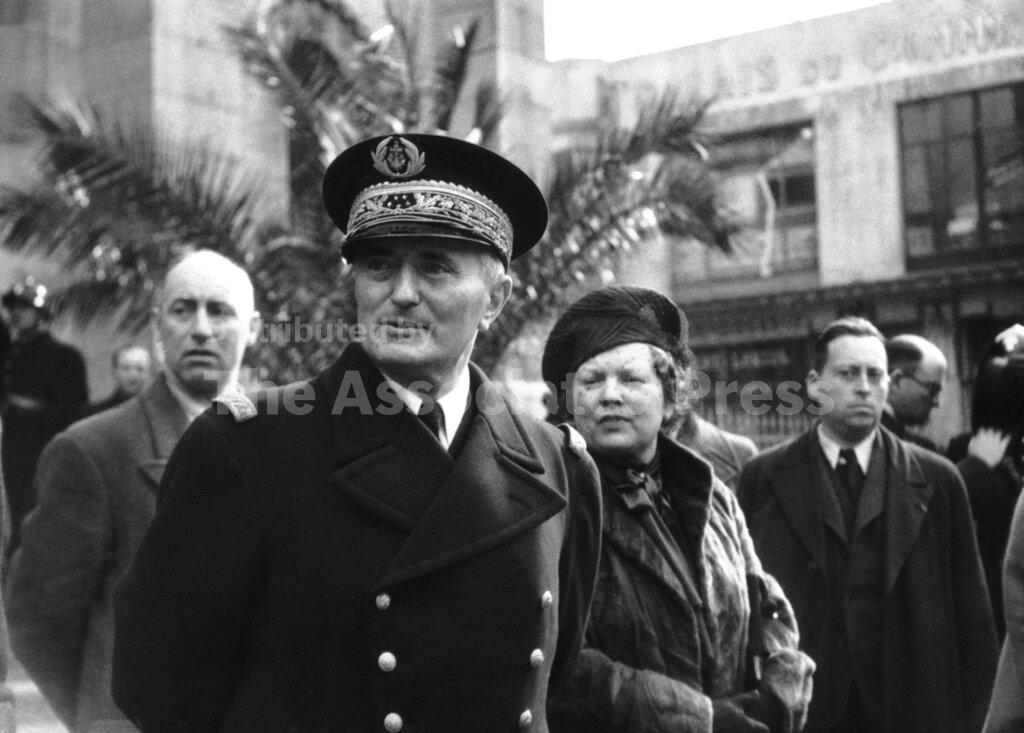
Lieutenant General Erwin Rommel, having received the Oak Leaves to the Knight’s Cross at the hand of Adolf Hitler, returns to North Africa. While under orders not to do anything major until he receives his full complement of troops, Rommel orders a small attack on the most advanced British positions west of El Agheila. His Afrika Korps troops in the vicinity of Marada run into British artillery, so they call in the Luftwaffe. Three Bf 110s (known as a Kette) shoot up an English armored car patrol, without much effect, while others attack Solluch.
The recently arrived Brescia Division takes up defensive positions west of El Agheila. Rommel’s convoys have been getting through, and the Afrika Corps is stocked with fuel and ready to rumble. The British, meanwhile, have been replacing experienced troops with well-armed but green troops which can charitably be described as garrison units. For instance, the battle-tested 4th Armoured Division has been pulled from the front and sent to Greece. In its place is the 2nd Armoured Division, which is new to the front line and manning a key stretch of the line near El Agheila.
The Athens news agency Athinaiko Praktoreio reports: “A Greek government spokesman says that the Italians have carried out three days of armoured attacks on the central front, but that lethal Greek artillery fire has forced them to retreat.”
The Italian Primavera Offensive has been a giant dud as of 23 March 1941. It has accomplished only local gains at the expense of massive casualties. However, the silver lining for the Italians is that at least they have stopped the Greek progress toward the key port of Valona. Given that the Germans are preparing to invade Greece within the next few weeks, that is sufficient to preserve an Italian presence in the country. The Italians, despite their failures, continue to believe they can make progress.
After dark an Italian night attack on the Bubesi front in Albania twice manages to break into the Greek positions, but both times the Italians are driven out with grenades and bayonets in fierce Greek counterattacks. This will be the last significant episode of the failed Italian “spring offensive.” Never in the two weeks of fighting was the Greek line in serious danger of being broken. In future days Cavallero, the Italian Chief of the General Staff and principal author of the abortive attacks, will attempt to portray this dismal failure as having saved Italian honour. But despite the terrible losses endured by the long-suffering Italian soldiers, the whole sorry affair will only serve to heighten impressions of Italian military ineptitude, and to make obvious their inability to defeat the Greeks without German help.
Major-General Lewis Heath, in command of 5th Indian Infantry Division, prepares his troops for the next British attack on Keren in East Africa. Specifically, Dongolaas Gorge is the keyhole that must be entered in order to take the strategic city, but it is heavily defended by Italian troops placed behind the entrance. While the British have made some progress on the flanks, most importantly taking Fort Dologorodoc to the right of the gorge, the gorge itself is as well-defended as ever. After dark, Heath sends reconnaissance patrols to the areas of East Gate Spur and Hillocks “A” and “B,” which are major objectives of the coming attack.
The Italians have blocked the gorge itself with boulders and other debris which the British must clear simply to enter it. Given this situation, Heath has decided to attack the Italian defenders of the gorge with a flank attack, which he hopes will give the sappers time to clear the boulders blocking the gorge. This will enable a thrust “up the gut” of the gorge which the Italians cannot stop. The attack is planned for the 24th.
South African 2nd Division arrived in the recently recaptured Berbera, British Somaliland by sea. In Abyssinia, Nigerian Brigade of British 11th African Division advanced 36 miles toward Addis Ababa to Babile Pass, where they were paused for several hours by Italian defensive positions.
Australian troops captured Giarabub (Jaghbub) in southeastern Libya. The commander of the Italian garrison, Lieutenant Colonel Castagna, was captured and would spend the rest of the war as a prisoner of war in India.
Anti-Nazi demonstrations sweep Yugoslavia as Hitler presses the government to join the Axis. The German Minister in Belgrade is summoned by the Prince Regent to be told that the Germans had now imposed a deadline after which the special terms for joining the Axis would be withdrawn. Yugoslav government leaders, beset by angry demonstrations throughout the kingdom, failed early today to complete a cabinet agreeable to capitulation to Adolf Hitler and thus their plans to sign with the axis in Vienna tomorrow were scrambled again. Regent Prince Paul, his premier, Dragisa Cvetkovic, and his foreign minister, Alksander Cincar Markcvic, retired shortly after midnight without issuing an expected communique announcing that the cabinet crisis had been solved. Instead, a spokesman said “there will be nothing tonight” and the lights and heat on the special train intended to carry the signatory delegation to Vienna were turned off.
Hitler meets with Hungarian Minister of Foreign Affairs László Bárdossy de Bárdos. Bardossy believes that Germany will win the war and works well with Hitler. In general, within the Hungarian government, there is less a sense of kinship with the Germans and more a sense of fatalism that there is no sustainable path other than falling into the German orbit. However, Bardossy is viewed within the Hungarian government as more in line with Hitler than most others and a true fascist.
Visiting Australian Prime Minister Robert Menzies visits recently bombed Plymouth, which he was barred from re-entering on the 22nd due to the catastrophic night attacks. He tours Admiral Nelson’s flagship HMS Victory, which Menzies notes has been hit by a bomb. He also witnesses a delayed-fuse bomb being dug up “and try to look as if I feel safe.” He then travels to Winston Churchill’s estate at Chequers for dinner.
Britain holds a National Day of Prayer at the request of the King.
British anti-submarine trawler HMT Visenda sank German submarine U-551 in the North Atlantic, killing the entire crew of 45.
U-110 (Kptlt. Fritz-Julius Lemp), on its first patrol out of Kiel, has a very bad day. It attacks 2468-ton Norwegian freighter Siremalm with three torpedoes — a lot for a relatively small ship. Two of the torpedoes miss, and the third hits but proves to be a dud (a common occurrence in northern waters at this stage of the war). Frustrated and unwilling to use any more torpedoes, Captain Lemp surfaces and has his men use the 105 mm deck gun. However, the crew is green, and this is their first time using the gun in action. They forget to remove the gun’s tampion (plug) from the barrel, which causes it to explode with the first round. Three men are wounded. Lemp then has his crew use the 37 and 20 mm antiaircraft guns against the ship, but these are like flea bites on an elephant. The Siremalm escapes and U-110 has to head to its new port of Lorient due to the gun incident.
Greek submarine RHS Triton attacked an Italian convoy 20 miles east of Brindisi, Italy. The transport Carnia was damaged; she would be towed to Brindisi where she intended to receive repairs, but she would ultimately be lost.
Himmler presents Hitler with a memorandum entitled: “Some thoughts about the treatment of foreign peoples in the eastern territories.” Himmler writes:
"I hope to see the very concept of Jewry completely obliterated."
Hitler tells Himmler to keep this top secret.
Polish automobile designer Tadeusz Tański, who among other things designed the first Polish armored car and the first Polish serially-built car, perishes today in the Auschwitz concentration camp.
“We must be ready to fight for our neutrality and it is self-evident that we are going to fight for it because it is to our vital interest,” Swedish Defense Minister Per Edvin Skoeld said today in Oerebro during a speech in which he endeavored to reassure Sweden, which was alarmed by last week’s calling up of army reserves.
The Luftwaffe apparently takes a rest after their major raids on London, Plymouth, and other cities recently. It launches only scattered lone-raider attacks both during the day and after dark.
RAF Bomber Command: Day of 23 March 1941
5 Blenheims on coastal sweep. 2 aircraft attacked 5 minesweepers and a destroyer off the Frisians but scored no hits. No aircraft lost.
RAF Bomber Command: Night of 23/24 March 1941
The Operations of this night were typical of those dispatched on nights of no moon and marginal weather conditions. Small forces of bombers were sent, more with the intention of causing general damage in German cities than of obtaining any outstanding bombing success.
Berlin
35 Wellingtons and 28 Whitleys; bombing results were not seen because of cloud and heavy Flak. No losses.
Kiel
31 Hampdens; none lost. Bombing was very scattered but one heavy bomb destroyed a house, killing 10 and injuring 6 people who were sheltering in the basement cellar.
Hannover
26 Blenheims; 1 lost. Bomb bursts and one big fire were seen in the target area.
Minor Operations: 7 aircraft to Calais and Rotterdam, 5 Hampdens minelaying off Kiel. No losses.
The RAF raids Berat in south-central Albania.
Luftwaffe Ju 87 Stuka dive-bombers, with a fighter escort, conduct a raid on Malta. A total of 13 German planes are shot down while the British lose two fighters. British authorities decide to withdraw all bombers and flying boats from Malta as a result of the raid. Four freighters of Convoy MW 6 arrive at Malta’s Grand Harbour as part of Royal Navy Operation MC-9. They make port in the mid-morning and quickly unload.
The Germans notice the convoy’s arrival (apparently) and within an hour the Luftwaffe arrives overhead with another major raid. A large formation of 15 Junkers Ju 88 Stukas attacks, prompting a large RAF response. As usual in these attacks, the Luftwaffe suffers heavily — the RAF and antiaircraft crews claim 13 planes — but the defensive forces on Malta are slight. The British observe that the Luftwaffe Stuka pilots do not attack as aggressively as they have in the past, releasing their bombs before completing a standard dive. There is another raid in the afternoon around 16:00 which damages freighters City of Lincoln and Perthshire, which is set on fire. There apparently is only one death, a sergeant manning an antiaircraft Bofors gun.
After losing 5 planes on the 22nd, the RAF loses another two today. It is becoming clear that the Germans can eliminate the British air defense if they are willing to continue sustaining such large losses. Based on today’s raid and the preceding ones, along with invasion fears, the British reach a decision to withdraw all bombers and flying boats from the island. This will vastly reduce reconnaissance capabilities and the ability to bomb Naples and other Italian targets, but the large planes are proving extremely vulnerable to the Luftwaffe attacks, with several recently destroyed and damaged.
The British now are moving troops to Gozo — the island northwest of the main Malta island — due to invasion fears. This is Operation Picnic, and it is disguised from the Italian spies on the island as simply normal troop exercises.
U-110, commanded by Kapitänleutnant Fritz-Julius Lemp, damaged Norwegian steamer Siremalm (2468grt) in 60-35N, 28-25W. At 0427 hours on 23 Mar 1941, the unescorted Siremalm (Master Haakon Svendsen) was hit on the port side amidships by a dud torpedo from U-110 (Lemp) en route from Reykjavik (left on 21 March) to Halifax with general cargo and mail in 60°35N/28°25W. The torpedo left a big indent in the vicinity of the boiler room. The ship had been spotted at 1200 hours the day before and the U-boat had lost contact temporarily due to aircraft that forced her to submerge. After spotting the ship again, a stern torpedo missed at 0314 hours and three minutes later a bow torpedo. 15 minutes after hitting the ship with the dud torpedo, Lemp attacked with all guns, but the barrel of the deck gun exploded on the first shot because the gun crew forgot to remove the water plug. The U-boat opened fire only with the 37mm and 20mm AA guns, scoring two hits in the hull on the port side of the ship, which was armed with one 4in gun and three machine guns. The Siremalm escaped zigzagging at full speed while the radio operator sent distress signals that were not answered and the crew manned the gun, but did not fire because they feared that this would give away their position and making the ship a target. No casualties among the crew of 25 Norwegians. When U-110 tried to chase the ship, they suddenly begun to dive and had to stop. An examination of the deck showed that splinters of the exploded barrel had damaged some pipelines, which led to the unintentional diving and the damage forced the U-boat to abort the patrol.
U-97, commanded by Kapitänleutnant Udo Heilmann, sank British tanker Chama (8077grt) in 49-35N, 19-13W. At 2326 hours on 23 March 1941 the Chama (Master Hubert Stanley Sivell), a straggler from convoy OG.56, was torpedoed and sunk by U-97 west-southwest of Fastnet. The master, 54 crew members and four gunners were lost. The 8,077-ton Chama was carrying ballast and was bound for New York, New York.
U-551, commanded by Kapitänleutnant Karl Schrott, was sunk by anti-submarine trawler Visenda, operating with the Northern Patrol, south of Iceland in 62-37N, 16-47W. The U-551 was sunk in the North Atlantic southeast of Iceland by depth charges from the ASW trawler HMS Visenda (FY 138). All of the ship’s complement of 45 died. During its under Kapitänleutnant Schrott career the U-551 sank or damaged no ships.
Battleship HMS Nelson, light cruiser HMS Nigeria, and destroyers HMS Boadicea, HMS Active, and HMS Escapade arrived at Scapa Flow at 0100. Battleship HMS Queen Elizabeth and destroyers HMS Inglefield, HMS Echo, HMS Electra, and HMS Eskimo arrived at Scapa Flow at 0700. Destroyers HMS Arrow and HMS Eclipse, which called at Lough Foyle to refuel, arrived at Scapa Flow later at 1145 and 1900, respectively.
Light cruiser HMS Dido arrived at Scapa Flow after repairs and stiffening.
Destroyer HMS Echo departed Scapa Flow at 1700 for Rosyth to clean boilers. The destroyer arrived at 0800/24th.
Destroyers HMS Liddesdale, HMS Avon Vale, and HMS Quantock departed Scapa Flow at 2030 for Rosyth to meet battleship HMS Prince of Wales during her passage to the Pentland Firth for trials and exercises.
Minelayer HMS Teviotbank, escorted by patrol sloop HMS Kittiwake and French torpedo boat La Melpomene, laid minefield BS.52 off the east coast of England.
Light cruiser HMS Kenya joined convoy HG.56 for support.
Destroyer HMS Richmond, which departed Londonderry on the 23rd for Liverpool, was grounded off Benbena Head at Holyhead. The destroyer received temporary repairs at Holyhead to 28 March. She was then taken to Southampton for repairs completed 28 May.
Destroyer HMS Lewes was damaged by the near miss of German bombing. The destroyer spent no time out of service.
P/T/Sub Lt (A) P. Mittell RNVR, was killed when his Gladiator of 759 Squadron crashed east of Camelford while returning from gunnery practices.
British trawler Elmira (197grt) was sunk by German bombing in 59-55N, 3-40W. Ten crew members were lost on the trawler. There was one survivor.
Italian steamers Carnia (5451grt), Anna Capano (1216grt), Vesta (3351grt), and Monstella (5211grt) departed Bari for Durazzo on the 22nd escorted by torpedo boat Castelfidaro. Greek submarine RHS Triton damaged steamer Carnia in 40-58N, 18-27E, thirty miles northeast of Brindisi in 40-58N, 18-27E. The submarine unsuccessfully attacked Anna Capano.
A Fulmar of 806 Squadron from aircraft carrier HMS Illustrious, flying into Maleme, crashed on landing. Sub Lt B. Sinclair and Naval Airman J. T. Beach were uninjured.
British trawler Samurai (221grt) was damaged by German bombing thirty miles north, northwest of St Kilda.
Convoy OB.301 departed Liverpool, escorted by destroyers HMS Burwell, HMS Sardonyx, HMS Scimitar, and HMS Watchman, sloop HMS Fleetwood, corvettes HMS Arabis and HMS Mallow, and anti-submarine trawler HMS Northern Wave. The corvettes were detached on the 26th. The escort was detached when the convoy dispersed on the 27th.
Convoy SL.69 departed Freetown escorted by armed merchant cruiser HMS Arawa to 14 April, light cruiser HMS Mauritius to 5 April, corvettes HMS Clematis and HMS Cyclamen to 29 March, and French sloop Commandant Domine to 14 April. Battlecruiser HMS Repulse was with the convoy on 27 to 30 March. Armed merchant cruiser HMS Bulolo was with the convoy on 28 and 29 March. Battlecruiser Repulse was joined by aircraft carrier HMS Furious and destroyers HMS Duncan and HMS Foxhound on the 27th. Light cruiser HMS Edinburgh, which departed Gibraltar on 2 April, escorted the convoy from 5 to 14 April. On 14 April, destroyers HMS Roxborough and HMS Sherwood, sloop HMS Weston, and corvettes HMS Clarkia and HMS Gladiolus joined the convoy. On 15 April, destroyers HMS Saladin and HMS Salisbury joined. The convoy arrived at Liverpool on 16 April.
An administration drive to get the $7,000,000,000 appropriation for the Lend-Lease program through the Senate tomorrow without change, and to get it to President Roosevelt off the Florida coast by Wednesday, was believed tonight to have far better than a fifty-fifty chance, since opposition Senators were said to be prepared only to restate their views briefly and not to prolong the consideration.
Meanwhile, sentiment apparently was rising in Congress for legislation outlawing strikes in defense industries. Continued tie-ups in armaments production are expected to give impetus to consideration in the House Judiciary Committee of such legislation. Friends of labor in Congress are rapidly being drawn, it was said, into a drive for remedial legislation due to the upswing of public protests against defense strikes. Bills considered by organized labor as inimical to its interests have been before the Judiciary Committee for several weeks. Labor’s friends have been watching the course of events with some perturbation, as evidenced by the letters of Senator Norris to the heads of the two labor organizations, warning them that public sentiment is fast approaching the stage where it will call for repressive legislation, Mr. Norris asked these leaders to condemn publicly the exaction of exorbitant union fees for the privilege of working on defense jobs.
Wendell L. Willkie said tonight he was “not the slightest interested at this time in the candidacy of anyone for any office in 1942 or 1944.” He made the statement when asked to comment on the assertion of an unidentified Republican national committeeman in Washington that the Republican 1940 presidential candidate was “not interested’ in running for president in 1944. The committeeman speculated that Willkie might support Gov. Harold E. Stassen of Minnesota for the nomination.
The Steel Workers Organizing Committee of the C.I.O. insisted tonight that plans for a strike at the Bethlehem Steel Company’s giant plant in Bethlehem, Pennsylvania would go through on schedule tomorrow if the Employees’ Representation Plan attempted to conduct an election of officers.
Idleness for an estimated 50,000 Detroit automobile workers is expected this week if a strike is not settled at the Midland Steel Products Company, which supplies most manufacturers with body frames and steering mechanisms.
The Machinists Union, A.F.L., today authorized a strike April 1 against San Francisco firms of the Pacific Coast Drydock Association and California Metal Trades Association. The companies hold half a billion dollars worth of national defense contracts.
An agreement was reached tonight to end the ten-day strike at the plant of the Harvill Aircraft Die Casting Corporation which had threatened to delay or halt production by eight Pacific Coast plane factories.
Brazil has large coffee surpluses as a result of the closing of the European markets to imports. Typically, Europe purchases 805 million pounds per year, but due to the war, it is purchasing essentially nothing. The U.S. is the only remaining large customer. The problem is exacerbated by the fact that the 1941 coffee crop is predicted to be the best in years. Coffee prices have collapsed.
Today, the government announces that new uses have been found for the 198,000,000-pound coffee bean surplus remaining from 1940 and an additional 1,436,160,000 pounds purchased by the government. Specifically, it states that plastics created by US scientist Herbert Spencer Polin on the 71st floor of the Chrysler Building called “cafelite” can be created from coffee beans. It is heat-resistant and noise-proof, has good insulating properties, and also is resistant to termites and other pests. The discovery gives hope to Brazilians that the warehouses full of aging coffee beans will prove useful and profitable.
Yosuke Matsuoka, Japan’s Foreign Minister, arrived in Moscow today for a one-day stopover en route to Berlin and Rome Axis conferences, and said he would like to stay longer “to meet leaders here” on his return trip to Tokyo.
New Zealand Division light cruiser HMS Leander captured Vichy French steamer Charles L. D. (5267grt) between Mauritius and Madagascar. The steamer was taken to Mauritius.
Italian sloop Eritrea and armed merchant cruiser Ramb II arrived at Kobe.
The Battle of Shanggao in China continues, with both sides regrouping after the latest Japanese attack. The Japanese are preparing for another surge to begin on the 24th, and today put in minor attacks around Shanggao.
China awaits American planes to launch a major counter-offensive against the Japanese forces, General Chiang Kai-shek told the writer in an interview here yesterday. “I am satisfied with our military
position,” the general said. “We have scored a series of successes in recent months and now our forces are organized and ready for a major drive. If we can get American airplanes we will be able to strike.” China’s wartime leader was interviewed following a luncheon at which the writer was a guest of the general and Mme. Chiang. Both appeared well and in high spirits though Mme. Chiang said she was still being treated for injuries to her spine, received when the automobile in which she was riding from Nanking to Shanghai skidded and overturned early in the war.
The heavy cruisers USS Chicago (CA-29), under command of Rear Admiral John H. Newton, Commander Cruisers Scouting Force, and USS Portland (CA-33) and the destroyers USS Clark (DD-361), USS Conyngham (DD-371), USS Reid (DD-369), USS Cassin (DD-372), and USS Downes (DD-375), departed Sydney, Australia, for Brisbane. Rear Admiral Newton takes his cruiser squadron out of Sydney Harbour after a highly successful visit. He heads to Brisbane for another three-day visit. There have been astonishing street demonstrations in Sydney, with residents acting as if the American ships are their own ships returning from some great, winning battle. Acting Prime Minister Arthur Fadden cables President Roosevelt:
“It is my privilege and pleasure to inform you personally that the visit of the squadron has been in every way an outstanding success and has, I am sure, done even more than we here had hoped to strengthen ties of friendship between Australia and the United States of America.”
The Australian Government and population remain highly apprehensive about Japanese aggression to the south, which no doubt contributes to all the warm feelings.
Born:
Jim Trelease, American educator and author (“The Read-Aloud Handbook”), in Orange, New Jersey (d. 2022).
Bucky Pope, NFL split end and flanker (Los Angeles Rams, Green Bay Packers), in Pittsburgh, Pennsylvania.
Died:
Tadeusz Tański, 49, Polish automobile designer (murdered at Auschwitz concentration camp).
 History Diaries