Adolf Eichmann, in a meeting at the Propaganda Ministry, refers to Reinhard Heydrich as being in charge of the “final evacuation of the Jews” to the Government General. (Note: There was only one way to have a “final evacuation of the Jews” and simultaneously to make the Government General free of Jews. — See March 17)
In Greece, British 1st Armoured Brigade reaches its forward positions in the plain between the river Axios and the Olympus-Vermion mountain range, with orders to fight a delaying action there, and to cover the preparation of demolitions.
Mussolini flies back to Italy from the Albanian front. His attempt to rally his troops and break the Greek lines in Albania has utterly failed. Mussolini essentially gives up on the stuttering Primavera Offensive. Even as his troops continue to attack, Mussolini leaves Tirana and flies back to Rome. The Italians continue battering against the Greek troops, supported by preceding artillery barrages, without success.
Roberto Farinacci, one of the 11 cabinet members and close associates Premier Mussolini sent to the front to set an example of Fascist valor for his soldiers, has been killed in hand-to-hand combat in Albania, it was reported at the border today. Farinacci was said to have met death from a sniper as he led his Blackshirt battalion over the top at Tepeleni, Italy’s Albanian “Verdun,” in a bayonet and grenade battle. The reports said his body was not recovered, despite efforts of his men to do so. A former secretary of the Fascist party and a member of the Fascist grand council Farinacci was reported to be one of Mussolini’s closest collaborators. Farinacci long ago had established a reputation as a duelist and a firebrand. He was one of Mussolini’s fighting politicians who went to Ethiopia. There he lost his right hand in a grenade explosion. Anti-clerical and anti-Semitic, Farinacci led all the Italian press in denunciation of the Jews in his extremist newspaper, II Regime Fasclsta at Cremona, in the days before the war. Farinacci had been at the front since about January 25 when it was announced in Rome that he was taking up active military service. Recent Greek reports, said to have been derived from talks with Italian prisoners, have told of the capture, death or injury of six high Fascist personalities in the major offensive which the Italians undertook on the Tepeleni front nearly two weeks ago reportedly under the eye of Premier Mussolini himself.
After laying siege to the Italian garrison at Giarabub in southeastern Libya for the past three months, Australian forces finally gathered enough strength to begin a large scale assault. After 15 weeks of observation by a small detachment of British and Australian troops, the Allies moved in and took Jarabub with little or no resistance. No damage was done to either the shrine or the sacred relics, according to Allied sources.
The Italian Brescia Division relieves the German 5th Light Division at its forward positions during the night.
Italian General Italo Garibaldi is named Governor-General of Libya and Commander in Chief of Italian forces in North Africa replacing General Rodolfo Graziani. Graziani had asked Mussolini on 8 February 1941 to be replaced.
The Allied convoys from Alexandria to Greece have been passing largely unmolested for weeks. Today, Luftwaffe Junkers Ju 88 bombers of III,/KG 30 operating southeast of Crete (off Gavdo Island) spot Convoy AS.21 returning to Alexandria. They sink 3798 ton Greek transport Embiricos Nicolaos and damage 8070-ton Norwegian tanker Solheim, killing two men on the former and one on the latter. The tanker stays afloat until early on 24 March. Another convoy departs today from Piraeus, Convoy ASF.21.
Having taken Jijiga, Nigerian troops of the 11th African Division moves west into the Marda Pass. At around noontime, they attack, but the Italians hold firm. The Italians withdraw after sundown, handing the easily defensible location to the British.
At Keren, Middle East Commander General Archibald Wavell makes a rare appearance to observe the proceedings. He sees the 3 Royal Garhwal Rifles move into Happy Valley. The move is purely defensive and diversionary, with the troops put there simply to protect other units and create the impression in the watching Italians that they are about to attack the Acqua Gap.
Hungarian Foreign Minister László Bárdossy met with Hitler and Joachim von Ribbentrop in Munich to discuss the Balkan situation.
Yugoslavians protested Prince Paul’s pact with Hitler. Prince Paul’s decision to sign up with the Axis powers led to a major cabinet crisis tonight, when three ministers resigned and a fourth threatened to do so. Paul, the regent of Yugoslavia, tried to refuse the resignations; but the ministers were adamant that in no circumstances would they accept Germany as an ally or agree to German military rail transports crossing Yugoslavia. The cabinet crisis threatens to delay the signing of the pact. Ministers who were due in Vienna today to meet Hitler have postponed the visit.
Prime Minister to Minister of Food: “I hope the term “Communal Feeding Centres” is not going to be adopted. It is an odious expression, suggestive of Communism and the workhouse, I suggest you call them “British Restaurants”. Everyone associates the word “restaurant” with a good meal, and they may as well have the name if they cannot get anything else.”
Prime Minister to First Lord of Admiralty: “…No effort to destroy the Focke-Wulfs should be spared. If we could employ Radar methods to find their positions and direct long-range fighters or ship-borne aircraft to the attack. …Might it not be feasible to place a Radar station on Rockall?”
German battlecruisers Scharnhorst and Gneisenau were detected by aircraft of the British Coastal Command. They were met by friendly aircraft at 1900 hours, escorting them as they headed for Brest, France. Admiral Lütjens brings his Operation Berlin cruisers toward Brest in a heavy fog. It clears at 16:30, permitting three Heinkel He-115s to depart to provide air cover. At 19:00, torpedo boats Iltis and Jaguar meet Gneisenau and Scharnhorst to escort them in. While this may all seem mundane, it gives a preview of what Lutjens would reasonably expect to happen while aboard the Bismarck in May. A Fairey Fulmar from the aircraft carrier HMS Ark Royal, which has left Gibraltar to search for Lutjens’ ship, spots them but experiences a radio malfunction and cannot report in time for any interception to be made today.
German submarine U-105 attacked Allied convoy SL.68 500 miles west of Cap Blanc, French West Africa at 0046 hours, sinking British ships Clan Ogilvy (61 killed, 24 survived) and Benwyvis (34 killed, 21 survived). At 2200 hours, U-105 attacked the same convoy again, sinking British ship Jhelum (8 killed, 49 survivors).
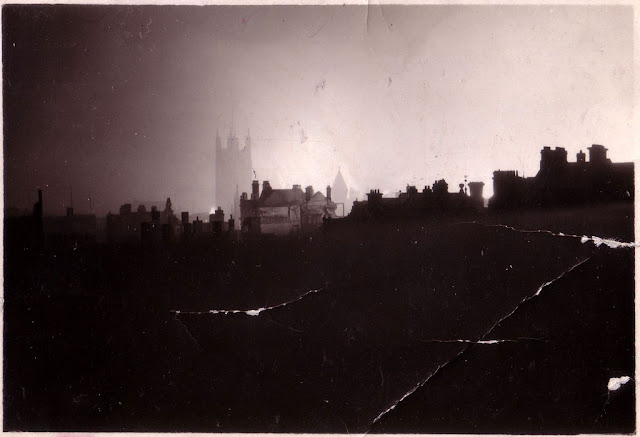
Opening of the Luftwaffe’s spring blitz on London: Buckingham Palace targeted; St Paul’s Cathedral survives.
Plymouth was also bombed. So many incendiaries were dropped during the city’s fiercest raid of the war that they sounded like hail bouncing off the roofs. The bombers arrived shortly after the King and Queen had completed a visit to the shipyards. The bombs wrought havoc in residential areas and shopping streets. Many fires are started and Plymouth is still burning the next day.
The pattern of the Luftwaffe bombing the same targets on successive nights has become common knowledge. Visiting Australian Prime Minister Robert Menzies arrives in Plymouth, which was heavily bombed on the 20th, and writes in his diary:
“At dinner we are warned that the Hun arrives two nights running. Sure enough, just as the port arrives we are hurried into the cellars…. A frightful bombing breaks out.”
He notes that the “all clear” sounds after midnight. Menzies then vividly records a trip downtown to view the damage:
“A frightful scene. Street after street afire; furniture litters the footpaths; poor old people shocked & dazed are led along to shelter. The Guild Hall is a beacon of fire. Buildings blaze and throw out sparks like a bush fire. There are few fire appliances and firemen…. Every now and then a delayed action bomb explodes (two were so close as to make me duck) or a building collapses…. I am all for peace when it comes, but it will be a tragedy for humanity if it comes before those beasts have had their own cities ravaged.”
At Clydeside in Scotland, the inhabitants are digging themselves out from the raids of a week ago — literally. Two men buried in a tenement basement finally are rescued.
RAF Bomber Command: Day of 21 March 1941
9 Blenheims to Frisian Islands. Many attacks made on ships and 1 tanker was claimed hit. No aircraft losses.
RAF Bomber Command: Night of 21/22 March 1941
Lorient
66 aircraft — 34 Wellingtons, 19 Blenheims, 12 Hampdens, 1 Stirling — to bomb the U-boat base but bad visibility caused poor bombing. 1 Blenheim and 1 Hampden lost.
Minor Operations: 6 aircraft to Ostend, 7 Hampdens minelaying off Bordeaux, 1 O.T.U. sortie. 1 Wellington lost on the Ostend raid.
At Malta, a single Junkers Ju 88 bomber escorted by seven Italian Macchi fighters and two German Bf 109s attack shipping off Dellmara Point. The bomber brackets destroyer HMS Defender, damaging it and wounding six sailors. HMS Defender makes it back to port but is full of holes above the waterline.
U-105, commanded by Kapitänleutnant Georg Schewe, made attacks on convoy SL.68. At 0046 hours on 21 March 1941, U-105 attacked the convoy SL.68 north of the Cape Verde Islands and sank the Clan Ogilvy and Benwyvis.
British steamer Clan Ogilvy (5802grt) was sunk at 20-04N, 25-45W. 33 crew members and three gunners from the Clan Ogilvy (Master Edward Gough) were lost. The master and 19 crew members were rescued by the Spanish steam merchant Cabo Villano and landed at Santos. The 5,802 ton Clan Ogilvy was carrying general cargo, including pig iron, groundnuts and tea and was bound for Glasgow, Scotland.
British steamer Benwyvis (5920grt) was sunk at 20N, 26W. The master, 32 crew members and one gunner from the Benwyvis (Master Henry John Small) were lost. 17 crew members and three gunners were picked up by the King Edgar and landed at Freetown. One crew member was rescued after 28 days in an open boat by a French ship and landed at Madagascar. The 5,920 ton Benwyvis was carrying rice, lead, timber and wolfram and was bound for Liverpool, England, United Kingdom.
British steamer Jhelum (4038grt) was sunk by 21N, 25W.At 2159 hours on 21 March 1941 the Jhelum (Master Leslie Walter Newman) in the scattered convoy SL.68 was torpedoed and sunk by U-105 about 500 miles west of Cabo Blanco, French West Africa. Eight crew members were lost. The master, 47 crew members and one gunner landed at St. Louis, Senegal and were interned by the Vichy French authorities. The 4,038 ton Jhelum was carrying general cargo, including boracite and figs and was bound for Oban, Scotland.
Aircraft carrier HMS Argus, light cruiser HMS Sheffield, depot ship HMS Maidstone, and troopship Highland Monarch escorted by destroyers HMAS Napier and HMAS Nizam, departed the Clyde for Gibraltar. The ships arrived at Gibraltar on the 29th.
Armed merchant cruiser HMS Derbyshire departed the Clyde carrying troops to Reykjavik. At 0700/22nd, destroyers HMS Tartar and HMS Gurkha departed Scapa Flow to meet her 19 miles 270° from Cape Wrath at 1500 and escort her to 17W. The destroyers then detached and carried out an anti-submarine search before returning to Scapa Flow.
Anti-aircraft ship HMS Curacoa departed Scapa Flow at 1200 to meet convoy WN.1 in the Pentland Firth and cover it until dark. The ship then covered convoy EN.89. At noon on the 22nd, ship Curacoa then transferred to convoy WN.2. On the 23rd, the ship then covered convoy EN.90. On the 24th, ship Curacoa parted company with convoy EN.90 in Pentland Firth and returned to Scapa Flow arriving at 1130.
Aircraft carrier HMS Ark Royal in the Bay of Biscay in 48-44N, 18-29W lost an aircraft in an operational accident. A Swordfish of the 818 Squadron with A/Sub Lt (A) P. E. Opdall, P/T/Sub Lt (A) C. R. Hearn RNVR, and Leading Airman B. C. Biggs crashed on taking off. The depth charges carried by the aircraft exploded under the ship, but did not cause damage requiring immediate repair. The crew of the aircraft were lost.
Minesweeping trawler HMS Asama (303grt) was sunk by German bombing at Plymouth. The trawler was beached at Torpoint.
British steamer London II (1260grt) was sunk by German bombing in 51-23N, 4-30W. Four crewmen were lost on the steamer. The steamer was abandoned on fire and sank six miles off Mumbles Head.
British steamer Millisle (617grt) was sunk by German bombing two miles east of Helwick L. B. , Bristol Channel. Nine crew members and one gunner were lost on the steamer.
British steamer Halo (2365grt) was damaged on a mine off Beckton Pier. Four crewmen were lost on the steamer. The steamer sank off Beckton No. 1 Pier. The ship was refloated and placed ashore at Royal Arsenal, Woolwich.
Convoy AS.21 of three Greek ships departed Piraeus escorted by corvette HMS Salvia and Greek destroyer RHS Vasilevs Georgios I and one other Greek destroyer. The convoy was attacked in the Aegean southeast of Gavdo Island by German aircraft. Greek steamer Embiricos Nicolaos (3798grt) was sunk by German bombing from this convoy in 34-30N, 24-45E.Two crewmen were lost. Norwegian tanker Solheim (8070grt) was badly damaged by German bombing from this convoy in 34-30N, 24-10E. One crewman was missing from the tanker. The tanker was abandoned on the 23rd and sank sometime during the night of 23/24 March. The survivors from both ships were picked up by the second Greek destroyer which took them back to Piraeus. The convoy arrived at Alexandria late on the 24th.
Convoy ASF.21 of British Breconshire, Chakla, and two other British ships, three Greek, and two other steamers departed Piraeus late on the 21st escorted by destroyers HMAS Voyager and HMAS Wryneck. The convoy arrived at Alexandria on the 23rd.
Destroyer HMS Kingston departed Port Sudan escorting steamer Ratnagiri with 300 French troops for Mersa Taclai, arriving on the 22nd.
Convoy HX.116 departed Halifax, escorted by armed merchant cruiser HMS Ausonia. Battleship HMS Royal Sovereign was with the convoy from 23 to 31 March. The armed merchant cruiser was detached on 4 April. On 4 April, destroyers HMS Ambuscade, HMS Bulldog, and HMS Vanquisher and corvettes HMS Campanula, HMS Freesia, HMS Heartsease, and HMS Pimpernel, and anti-submarine trawler HMS St Apollo joined. Destroyer HMS Winchelsea joined on 5 April and destroyer HMS Whitehall and corvette HMS Orchis joined on 6 April. Corvette Orchis was detached on 7 April. The escort was detached when the convoy arrived at Liverpool on 9 April.
The White House sent to Congress the text of an agreement with Canada on the St. Lawrence waterway and a statement by President Roosevelt that he will ask for legislation to implement it.
With the Senate in recess, an Appropriations subcommittee approved the $7,000,000,000 bill to effectuate the Lend-Lease program.
The House passed the $4,073,810,074 Fifth Supplemental Defense Appropriation Bill, sent to conference the First Deficiency Appropriation Bill; received the Rankin bill for the creation of seven regional power authorities; and adjourned at 4:54 PM until noon on Friday.
The U.S. House of Representatives, maintaining swift tempo in handling defense measures, approved with virtual unanimity today a $4,073,810,074 appropriation to speed the armament program and provide sufficient new plants to supply a 4,000,000-man army “on a combat status.” Meantime the chamber was informed that the army was planning to ask funds for a huge expansion of the air corps. The aim is to train 30,000 pilots a year, as compared with the 12,000 a year called for under a training program inaugurated last October. Final passage of the huge fund, which now goes to the senate, came on a roll call vote of 327 to 0, but Representative Marcantonio, New York American Labor, sole opponent of numerous other defense measures, announced he was “paired” against the bill and voted “present.”
The proposed $7,000,000,000 appropriation for the British-aid program won unanimous approval of a senate appropriations subcommittee today with even Senator Nye, North Dakota Republican, one of Senate’s severest critics of President Roosevelt’s foreign policy, voting for it. Nye, in fact, was one of three members of the subcommittee who had voted against the Lend-Lease bill, but then today cast a ballot for the record-breaking appropriation intended to implement it. The others were Senators Holman, Oregon Republican, and Brooks, Illinois Republican.
Navy Secretary Frank Knox writes to President Roosevelt — who is fishing off the Florida coast — with recommendations for aiding the British. These are both based upon requests previously made by Winston Churchill:
— Seize interned German/Italian ships and use them in convoys to England;
— Begin convoy operations using US Navy ships.
Knox is working on Secretary of War Henry L. Stimson to agree to the use of US Navy ships in convoys.
Democratic Leader Barkley announced today an administration effort would be made Monday to reverse the senate’s decision to forbid navy purchases of Argentine canned beef. An administration proposal to permit such purchases was defeated on a tie vote of 32 to 32 yesterday when Vice-President Wallace, entertaining at a duck luncheon, failed to appear and break the tie.
Representative Knutson, Minnesota Republican, told the house today it was faced with a “squatter problem” in its own office building. He referred, he said, to the failure of former Representative Kent Keller, Illinois Democrat, to move out of quarters in the building, despite the fact he was defeated in the last election and his successor has taken office. Suggesting “suitable action” to increase Keller’s comfort, Knutson told his colleagues, “think how the cafeteria would contribute.”
The War and Navy Departments today were reported to be seriously considering taking over the Allis-Chalmers plant in Milwaukee unless the company and the United Automobile Workers, C.I.O., hasten settlement of their long-standing dispute.
The naval construction report made public today discloses that more than 300 combatant and auxiliary vessels for the Navy were under construction on March 1 in Navy yards and privately owned shipyards.
President Roosevelt rode salt water tonight, but he was not getting far on a fishing trip. The White House yacht Potomac lay at anchor behind the harbor breakwaters here, still waiting favorable weather before nosing into the open Atlantic. She left her berth at slip one this morning to let a car ferry from Havana dock, but moved only a few hundred yards. A coast guard patrol boat was sent out to test the sea and reported it rough. The weather cleared considerably this afternoon and word came from the Potomac tonight that unless unforeseen developments occur the voyage will begin tomorrow morning.
The Liberty Badge Campaign began in the U.S. as part of the drive to aid Greece.
The seventeen-day jurisdictional strike of building trades workers on the Army’s $1,550,000 expansion project at Wright Field was called off this afternoon, after Robert P. Patterson, Under Secretary of War, had appealed to union officials to act as “patriotic Americans” and warned that further delay would seriously cripple the defense program.
The New York City bus strike is settled after an 11-day walkout.
An implied threat of a strike in July on the unified transit lines owned and operated by the city, unless Mayor La Guardia agreed to negotiate new closed-shop contracts to replace those expiring on June 30, was made yesterday by Michael J. Quill, international president of the Transport Workers Union, C.I.O. affiliate.
A few hours after a Federal labor conciliator, James F. Dewey, said that tension in the Ford Motor Company-United Automobile Workers (C.I.O.) strike threat was easing, the National Labor Relations Board today cited the company on charges of continued unfair labor practices.
Captain George D. Murray was named the commanding officer of USS Enterprise (CV-6).
Japanese freighter Tatsuta Maru, which arrived in San Francisco yesterday, departs again for Japan. It carries Werner Thiel, a long-time resident of the United States who is heading back to Germany to attend a school for saboteurs (see Operation Pastorius).
The motion picture “The Sea Wolf” premieres aboard the SS America cruising off the California coast. Directed by Michael Curtiz, the psychological drama based on a Jack London novel stars Edward G. Robinson, John Garfield, Ida Lupino, Gene Lockhart and Barry Fitzgerald.
In a hard fought 15th title defense Joe Louis TKOs Abe Simon in the 13th round at Olympia Stadium, Detroit to retain NYSAC heavyweight boxing crown
There is evidence of the increasing Soviet Russian interest in the penetration of China in the revelation that the Soviets will reopen the consulate general in Shanghai after a long term of closure.
A lull in the Battle of Shanggao continues today, with the Japanese 11th Army capturing Shangchichia. Both sides are bringing up reinforcements. The Japanese also are stocking up with poison gas.
Dow Jones Industrial Average: 122.47 (-1.13)
Born:
Dirk Frimout, Belgian cosmonaut and first Belgian astronaut (ESA Payload Specialist; STS-45, Atlantis, 1992), in Poperinge, Belgium.
Ed Rutkowski, AFL wide receiver, halfback, and quarterback (AFL Champions-Bills, 1964, 1965; AFL All Star, 1965; Buffalo Bills), in Kingston, Pennsylvania.
John Boylan, American record producer (Pure Prairie League; Commander Cody; Little River Band), in New York, New York.
Naval Construction:
The Royal Navy MMS I-class motor minesweeper HMS MMS 4 (J 504) is commissioned.
The Royal Navy Shakespeare-class minesweeping trawler HMS Fluellen (T 157) is commissioned. Her first commanding officer is T/Lieutenant Denys Philip Richardson, RNVR.
The Royal Navy Flower-class corvette HMS Dahlia (K 59) is commissioned. Her first commanding officer is T/Lieutenant Magnus Spence Work, RNR.
 History Diaries