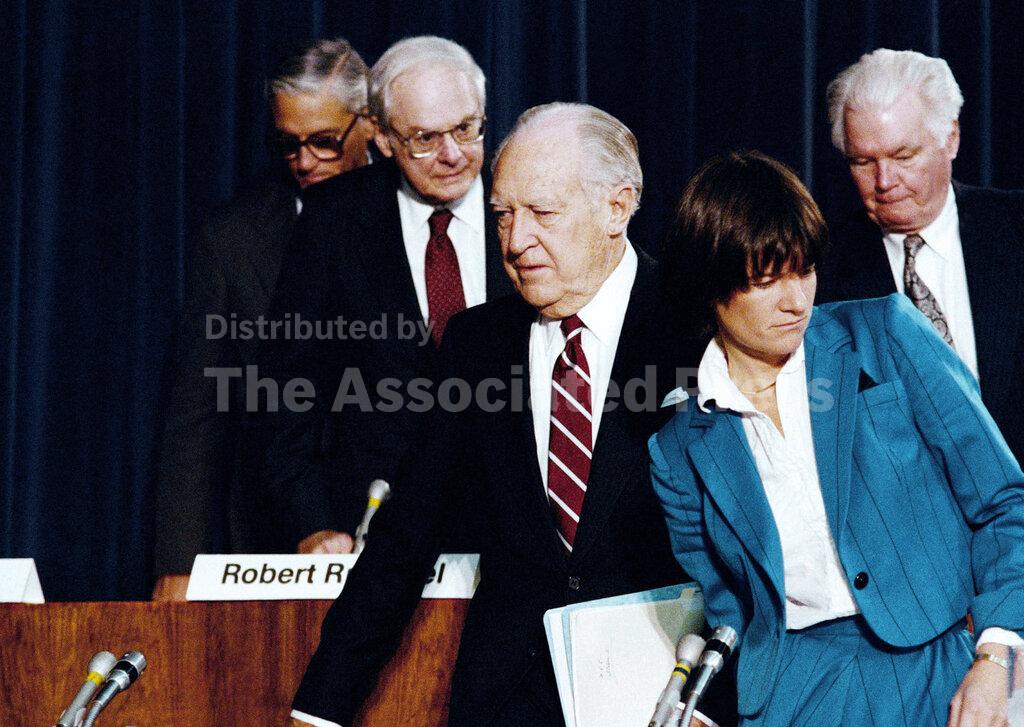
NASA officials testified today that a failure in a joint on a solid-fuel booster rocket was the probable cause of the explosion that destroyed the shuttle Challenger on January 28, killing its crew of seven. The officials told a Presidential investigating commission that they had eliminated all other likely causes of the disaster and were conducting tests to determine precisely which components within the joint had failed, and why. The National Aeronautics and Space Administration thus formally acknowledged, for the first time, that the root cause of the disaster almost certainly lay in a joint that has been known to suffer technical defects for at least four years. Only two weeks ago agency witnesses told the commission that other possible causes were still under consideration. But today, reporting on the results of the most recent analyses in industry and Government laboratories, agency officials ruled out everything but the joint as a probable initiating cause.
The commission also saw a film that provided more detailed views of the flight from more angles than had the films previously released. The film, and an accompanying “time line” that specified precisely when various plumes and flickerings and puffs of smoke were first seen, were the latest refinements in a continuing process of pinpointing the sequence of events. The film showed a puff of gray smoke seeming to emerge form the right-hand booster rocket, and later a bright flame growing ever larger until it seemed to set off the explosion. Such smoke was not seen on films of previous flights, according to Dan Germany, chairman of NASA’s photography and television support team. Other members of the team include George McDonough, John Erickson and Charles Stevenson. The puffs emerged very early in the flight at about three puffs a second, which is also the rate at which the vehicle vibrates when the rockets and shuttle engines first fire. Officials said that could be significant, or merely a coincidence. Dr. Wayne Littles, associate director for engineering at the Marshall Space Flight Center in Huntsville, Ala., summarized the last two weeks of testing and analysis for the commission, saying, “I believe we have eliminated all the other possibilities” except those that “deal with the joint.” In an interview, he was even more emphatic, asserting that all the remaining factors still under investigation as likely causes involved the joint and its components.
The United States will conduct an underground nuclear test on Saturday, its first in nearly three months, Reagan Administration officials said today. Mikhail S. Gorbachev, the Soviet leader, recently said the Soviet Union would not conduct underground tests until the United States did so. The American test, scheduled for 11 AM Eastern standard time, will be the first American nuclear blast since December 28. The Soviet Union has not conducted any tests since last July 30, when it announced a six-month moratorium. It has extended the moratorium twice.
Secretary of State George P. Shultz said today that to compete with the West in computer and communications technology, the Soviet bloc might be forced to expand the liberties of its peoples. This in turn, he suggested, could lead to a dramatic easing in East-West relations. In a speech devoted to what Mr. Shultz called “the information revolution,” he said the leaders of closed societies fear that the information technologies — such as computers, satellite transmissions, videotape machines, direct dial phones and photocopiers -would “undermine the state’s control over its people, what they read, watch, hear and aspire to.” Asserting that science and technology of the future will be tied to access to information, he said Soviet bloc Governments “face an agonizing choice: They can either open their societies to the freedoms necessary for the pursuit of technological advance, or they can risk falling even farther behind the West.” Mr. Shultz, addressing a meeting sponsored by the Stanford Business School Alumni Association and the Stanford Alumni Association, predicted that the Communist nations would choose more freedom out of economic necessity. Shultz said the develop of information technology “not only strengthens the economic and political position of democracies; it provides a glimmer of hope that the suppressed millions of the unfree world will find their leaders forced to expand their liberties.”
President Reagan meets with his Secretary of Defense and Ambassador to the U.S.S.R. to discuss recent developments in U.S.-Soviet relations.
White House officials decided against a meeting between President Reagan and Yelena G. Bonner, wife of the Soviet critic, Andrei D. Sakharov, because such a session could set back United States efforts to win freedom for Soviet dissidents, Administration officials said today. Instead, Miss Bonner, who is in the United States for medical treatment, met recently with Vice Admiral John M. Poindexter, the White House national security adviser, officials said. Larry Speakes, the White House spokesman, said today that he was unsure whether Miss Bonner or her family had made a specific request to see Mr. Reagan. Miss Bonner was reported resting at Massachusetts General Hospital today after doctors cleared a clogged artery in her right leg. She entered the hospital Thursday upon her return from Washington.
Defense Secretary Caspar W. Weinberger said today that he had told NATO defense ministers assembled here that the Reagan Administration’s space defense research program would not be abandoned in order to reach an arms control agreement with the Soviet Union. “I advised my colleagues that strategic defense is one of the very highest priorities of our Government and one of the highest priorities of our President, that it is not a bargaining chip; it will not be set aside in response to any demand in connection with any arms reduction agreement,” Mr. Weinberger said at a news conference. The Defense Secretary’s remark appeared to exclude any concession to the Soviet Union’s demand that the Strategic Defense Initiative be jettisoned as a precondition for reaching an overall arms reduction accord in Geneva.
The new conservative coalition French Government led by Prime Minister Jacques Chirac has taken office already committed to a far-reaching program of economic and electoral change. At the same time, officials have made clear, the government plans to continue the shift already under way toward closer cooperation with West Germany and other European nations on military matters. These commitments, including a pledge to reverse France’s centuries-old tradition of tight government regulation of industry and banking, are contained in the joint platform drawn up before the election by Mr. Chirac’s Rally for the Republic, the senior party in the coalition, and the Union for French Democracy, led by former President Valery Giscard d’Estaing. In the economic sphere, the right’s aim is to speed growth and create more jobs by “supply side” measures similar to those favored by President Reagan in the United States, which seek to free industry from bureaucratic controls and reduce the role of the state in the economy.
An Arab group demanding the release of three terrorists from French prisons took responsibility today for a bombing that killed 2 people and wounded 28 at a shopping center on the Champs-Elysees. Prime Minister Jacques Chirac, who took office moments before the bomb exploded Thursday evening, said he had ordered increased security in public places. “I am horrified by the animal character and inhumanity of these attacks,” Mr. Chirac, who is also the Mayor of Paris, said at a news conference. He called for an “important reinforcement of coordination of efforts of democratic nations that are victims of these acts.” The bomb exploded in a packed mall of luxury boutiques on the Champs-Elysees. A second bomb, found on a subway train, was defused by police demolition experts before it could explode.
Michele Sindona, the jailed Sicilian financier who fell into an irreversible coma on Thursday, is the victim of cyanide poisoning, the Justice Minister said today. The official, Mino Martinazzoli, told Parliament that it was not clear whether someone tried to kill Mr. Sindona or if he had tried to commit suicide. He said tests on Mr. Sindona’s blood had confirmed a lethal dose of cyanide. Mr. Sindona, who was near the center of many of Italy’s most important recent financial and political scandals, had been under constant guard at a specially constructed wing of the Voghera women’s prison. The prison is considered one of the most secure in Italy.
The United Nations Security Council today issued a statement in which it strongly condemned the continued use of chemical weapons by Iraq. The statement, delivered by the Council’s President, Ole Bierring of Denmark, also condemned the “prolongation of the conflict which continues to take a heavy toll of human lives.” That condemnation is considered to be a reference to Iran, which has refused to obey Council resolutions calling for a ceasefire by both parties and their withdrawal to internationally recognized borders. The statement noted that “the Government of Iraq has expressed its willingness to heed the call for the immediate cessation of hostilities.”
The Navy intends to fly combat aircraft on training exercises over the Gulf of Sidra near Libya during a 10-day period beginning Saturday night, a Pentagon spokesman disclosed tonight. The spokesman left open the possibility that the Navy would also order warships into the gulf that Libya claims as territorial waters, but which the United States and other nations contend are international waters. The Reagan Administration has periodically ordered the Navy to fly over the Gulf of Sidra as a show of warning the Libyan Government against aggression toward its neighbors or terrorist activity abroad. When Navy planes cross an imaginary line in the sea drawn by the Libyan leader, Colonel Muammar el-Qaddafi, it will be the 18th time since 1981 that such flights have been made. The Pentagon spokesman said the Navy had published what is known as a “Notice of Intent” to inform civilian and military aircraft of other nations that the Navy would fly in the region on specified dates. Such notices are required by international agreement as a safety precaution. The Navy has three aircraft carriers, an unusually large force, converging in the central Mediterranean for this training operation. The carrier USS America has just arrived there, while the departure of the carrier USS Saratoga, already at sea there, has been delayed. The third aircraft carrier on station is the USS Coral Sea.
In India, at least three people were killed and 25 wounded today in the capital of Punjab State, where the police battled hundreds of militant Sikhs who tried to march on the state legislature. Many arrests were reported. A spokesman for the militants said six people were shot to death by the police in Chandigarh, 120 miles north of here. The clash was one confrontations between extremists and the government of Sikh moderates, which is led by the chief minister Surjit Singh Barnala. The government was installed after a statewide election last September. The militants said they were protesting the state government’s failure to release thousands of imprisoned Sikhs and to rehabilitate Sikh soldiers who deserted after the attack on the Golden Temple in Amritsar, the Sikhs’ holiest shrine, in 1984.
China and the Soviet Union formally agreed today on an exchange of engineers and technicians. The move clears the way for the assignment of the first Soviet experts to work here since the two Communist powers fell into dispute a quarter of a century ago. Officials of both countries signed a protocol covering the exchange at the end of a weeklong visit here by Ivan V. Arkhipov, a Soviet First Deputy Prime Minister. The signing was a personal landmark for Mr. Arkhipov, a 78-year-old economic expert who supervised Soviet programs here in the 1950’s that involved about 11,000 Soviet scientific and technical personnel. By the middle of 1960, all of them had been withdrawn.
American banks and financial institutions played a modest role in the finances of former Philippines President Ferdinand E. Marcos and his family, according to documents brought to Hawaii by the Marcos party. The documents, which were made public Thursday, also shed new light on New York City real estate purchases by the Marcoses and deals involving American corporations and Mr. Marcos and his associates. Several prominent institutions, such as Chase Manhattan Bank and the Irving Trust Company, are named in the documents and some of the transactions involve tens of millions of dollars. But the United States connection in the Marcos family holdings, based on the various documents and reports on the papers so far, appears to be small relative to the Marcos dealings with Swiss banks and Japanese companies.
The Aquino Government announced today that it is investigating reports of mass graves containing the bodies of foes of former President Ferdinand E. Marcos or his allies. Jose Diokno, chairman of the Presidential Commission on Human Rights, said his committee had evidence of such mass graves. He declined to describe the evidence. Mr. Diokno said the graves reportedly contained the remains of some of about 500 people believed to have been abducted during Mr. Marcos’s rule by the military or by the private troops of provincial commanders. “We believe most mass graves are near the ‘safe houses’ where political dissidents were interrogated or tortured,” he said. “But we don’t know where the safe houses are. Of the five or six hundred people who disappeared, we believe at least 90 percent are dead.”
A shakeup in Haiti brought the ouster of three top officials with links to former President Jean-Claude Duvalier. The move by the leader of the ruling council, Lieutenant General Henri Namphy, followed by a day the angry resignation of Gerard Gourgue, the Justice Minister and most popular member of the six-member council that took over when Mr. Duvalier fled February 7. General Namphy announced the changes in a terse statement as violence was reported around the capital. Gunfire was heard through the afternoon and mobs set up roadblocks in some shantytown areas, burning garbage and tires. Witnesses reported seeing at least one man shot dead by the police. Flights into the international airport were canceled. In his statement, General Namphy announced the resignations of two members of the ruling council — Alix Cineas, Minister of Public Works, and Colonel Max Valles, Minister of Information — and of Colonel Prosper Avril, counselor to the group. He said the new council would be made up of himself, Colonel William Regala, a member of the original council and a close Namphy associate, and Foreign Minister Jacques Francois.
Congressional leaders agreed today that lawmakers would eventually approve some form of military aid to the Nicaraguan rebels. But they said major battles remained to be fought in the weeks ahead over how the aid would be used, and what restrictions would be placed on the Administration’s actions in Central America. In the aftermath of a vote Thursday in which the House of Representatives rejected President Reagan’s proposal for $100 million in aid, legislators in both parties were busy drafting alternatives to the Administration’s plan. Many were searching for a formula that would apply pressure on both the White House and the Nicaraguan Government to pursue negotiations more seriously.
There were no cheers in Nicaragua over the rejection by the House on Thursday of President Reagan’s proposal to renew aid to the rebels fighting the Sandinista Government. “The fact that a certain vote has been taken does not mean the war will end,” President Daniel Ortega Saavedra said. He said the United States was acting as if it was preparing to heighten the conflict.
Citing national security concerns, Panama formally rejected a request for asylum from former Philippine President Ferdinand Marcos today. Government officials would not explain the security issue, but they apparently felt that the presence of Mr. Marcos would further inflame the domestic political situation. In a meeting with reporters in which the rejection was announced, the presidential press secretary, Guillermo Antonio Adames, denied that the United States had pressured Panama to accept Mr. Marcos.
A French diplomat in Uganda was shot dead today by intruders who broke into his home, a French Embassy spokesman said. The spokesman identified the diplomat as Andre Dalpra, an administrative attaché at the embassy. Several European embassies in Kampala did not open today in response to the killing.
Winnie Mandela and other black leaders called today for increased defiance of the white authorities. Their statements came as the police clashed with protesters in several places around the country, on a day on which South Africans marked the anniversaries of two earlier violent confrontations. Before the commemoration got under way, the police reported that 10 blacks had been killed overnight in what was depicted as internecine feuding in segregated black townships near Cape Town, East London and Johannesburg. During the day, policemen chased demonstrators through the city centers of Johannesburg and Durban. The marchers in Durban, estimated by witnesses at 1,000, said they were heading for the United States Consulate. It was apparently a show of displeasure at Reagan Administration policies that the authorities’ foes have depicted as supportive of white minority rule.
The Senate today passed and sent to the White House stopgap legislation to salvage a toxic waste cleanup program that is fast running out of money. “The money is necessary” to prevent an almost total shutdown of the program after April 1, Senator Frank R. Lautenberg, Democrat of New Jersey, said shortly before the House-passed measure was approved on a voice vote. “The trust fund is virtually depleted,” he added. The legislation to give the program $150 million to spend through May 31 is not expected to run into any trouble at the White House, according to Russ Dawson, an aide to Lee Thomas, Administrator of the Environmental Protection Agency.
The Environmental Protection Agency will take action against a California biotechnology company that it has accused of violating Federal policies on the release of genetically altered farm chemicals into the environment, a spokesman said today. This morning three scientists who investigated the incident turned their report over to lawyers in the environmental agency’s Office of Compliance Monitoring. Late this afternoon an agency spokesman, Dave Cohen, said the agency had reached a decision on action against the company, Advanced Genetic Sciences, based in Oakland.
Bob Dole, the Senate majority leader, today told the White House chief of staff, Donald T. Regan, that he wanted to open discussions on the 1987 budget approved in the Senate Budget Committee this week. Mr. Dole, according to his staff, also decided not to begin debate on the budget next week so as to allow time for him and the White House to discuss and study the budget. Debate, which had been scheduled to begin Tuesday, would now not start until after the Easter recess, which ends April 7.
President Reagan participates in an interview with R.W. “Johnny” Apply, Washington correspondent for the New York Times.
The House Armed Services Committee, seeking to induce experienced people to remain on duty, has voted to reduce the pensions of future military personnel who retire after 20 years of service, Representative Les Aspin announced today. Mr. Aspin, a Wisconsin Democrat who is chairman of the committee, said at a news conference that a 17 percent reduction in benefits was approved Thursday for those who would enter the services after the bill became law. The measure would not apply to people in the services now, or to those drawing retirement pay now. The Defense Department has vigorously opposed any change in the retirement plan, contending that it encourages careers in the service.
Traces of rat poison in capsules led to an immediate recall for three popular over-the-counter drugs. The SmithKline Beckman Corporation recalled Contac cold medicine, Teldrin, an allergy remedy, and Dietac, an appetite suppressant. SmithKline said six capsules found by investigators in Houston and Orlando, Fla., contained trace elements of warfarin, an anti-coagulant contained in rat poison, but that the amount of poison was too small to harm humans.
Consent decrees are to be curtailed in Government litigation, the Reagan Administration announced. The Government has often entered such decrees in cases relating to civil rights, environmental protection, housing, mental hospitals and prisons to avoid costly trials. Assistant Attorney General Charles J. Cooper said that such decrees had, in some cases, improperly restricted the discretion of officials in the executive branch to set policy or spend money. Under guidelines issued today, it would be much more difficult for Federal agencies to enter into such consent decrees if they require new or revised regulations or the spending of money not yet appropriated by Congress.
A Liberian tanker spilled up to 84,000 gallons of crude oil into the Delaware River today after hitting a pier in Marcus Hook, Pennsylvania and putting a 30-foot gash in its hull, the Coast Guard said. The Intermar Alliance, carrying 21 million gallons of crude, was traveling upriver when it lost control and hit a pier at the British Petroleum refinery, said a Coast Guard spokesman, Lieutenant Robert Mitchell. The Coast Guard used a boom to contain about half of the spill, but the remainder reached as far as the Christina River in Delaware, seven miles down river, he said. Oil from the damaged tank was pumped into other tanks aboard the vessel, Lieutenant Mitchell said. The incident left the vessel with a hole 2 feet by 30 feet, he said.
Arkansas Governor Bill Clinton says he will release up to $10,000 from the state’s emergency fund to pay for mothers to have their breast milk tested for traces of a banned pesticide. Thousands of gallons of dairy products in Arkansas and seven other states have been recalled after the pesticide heptachlor, which is suspected of causing cancer, was found in them. In another development related to the tainted milk, the State Health Department said the Food and Drug Administration had cleared nine dairy farms from quarantine, leaving 50 quarantined.
The fear of AIDS among heterosexuals may be hastening an end to the “sexual revolution” that began in the 1960’s and imposing a new ethic of restraint and abstinence. Interviews around the country indicate that heterosexual men and women are asking questions that seem destined to dominate the dialogue between the sexes for the rest of the decade. The eyes of Ellen Parks scanned C. J. Bretts, a popular singles bar and restaurant in the Hermosa Beach section of Los Angeles: soft rock music, schooners of beer, sports stars framed on the walls. Her gaze drifted over tables filled with clean-cut men, mostly in their 20’s, some in their 30’s, picking at $4.95 platters of Cajun chicken wings and nachos magnificos. “One of those guys could be infected with AIDS and I would never know it, and he may not even know it,” said Miss Parks, a 28-year old insurance company secretary recently divorced. “There’s no clue, none whatsoever. It’s strictly a roll of the dice.”
Inmates shouted and clanged on prison bars today as Arthur Lee Jones Jr. was led to the Alabama electric chair and executed for shooting a cab driver to death in a robbery. Mr. Jones, 47 years old, whose first arrest occurred 30 years ago and who came within 16 hours of execution in 1984, was pronounced dead at 12:15 AM, seven minutes after receiving a 30-second surge of electricity.
Two college students fell from hotel balconies to their deaths in separate incidents. On Thursday, a 20-year-old woman, Laurain Day Buffington of Griffin, Georgia, lost her grip climbing from one outdoor hotel balcony to another, officials said. She was trying to cross a sixth-floor balcony railing on the return trip to a room she shared with three friends, the police said. Less than seven hours later, Rory Savas, 19, of Wauwatosa, Wisconsin, died in Sanibel, a Gulf Coast town, when he fell from a hotel balcony there, the authorities said.
The bird-watching pastime has created a multibillion-dollar industry for scores of companies that run birding field trips and produce varied specialized equipment that includes software programs that display bird shapes and markings on computer screens at home. About 21 million Americans participate in bird watching, which has become the nation’s second-most popular passive recreation, topped only by gardening.
Like many public hospitals, the R. E. Thomason General Hospital in El Paso, Texas is trying to provide health care to a population increasingly unable to pay for it, but the difficulties it faces are more complicated than those of most public hospitals. Thomason’s problems come in three layers. El Paso’s population is one of the poorest in the United States. Like other American cities on the Mexican border, El Paso also has a large number of poor illegal aliens. But, unlike other border cities, it is neighbor to a Mexican metropolis, Juarez, which has a million residents, and Thomason officials say some people from Juarez go to Thomason Hospital pretending to be El Paso residents when they need medical care.
Mayor Koch proposed yesterday that smoking be outlawed in a wide range of public places in New York City and that private employers be required to provide no-smoking work areas for employees who want them. The Mayor said the bill he was proposing for City Council action would be the most stringent in the nation, providing more protection for nonsmokers than similar ordinances on Long Island and in several California communities. It was not clear why the Mayor, who has opposed similar rules in the past, decided to present his plan now. It comes, however, shortly after a report by the United States Surgeon General that said workers who smoke are a health hazard to their co-workers.
Harvard University, under pressure from students and faculty, has dropped a $1 million program to send students to study and work at South African schools. “Our strong interest in working with South Africans to help bring about the end of apartheid and create a new and better society would not be well served by initiation at this time of an internship program,” Daniel Steiner, vice president and general counsel, wrote in a report to President Derek C. Bok Thursday.
A University of California Regents’ committee voted today to sell the university’s stock in the Eaton Corporation of Cleveland, saying the company failed to meet the university’s standards for doing business in South Africa.
Karin Enke-Kania skates a ladies world record 500 meters (39.52 sec) & 3 km (4:18.02).
Pittsburgh Associates, a coalition of 13 public and private investors, purchases the Pirates from the Galbreath family for $21.8 million.
The Yankees announce that their most celebrated off-season acquisition, 26-year-old pitcher Britt Burns, will not pitch at all this season because of a chronic deteriorating hip condition.
Debi Thomas, an American pre-med student at Stanford University, won the women’s world figure skating championship tonight with an elegant, cleanly executed program that took the title from Katarina Witt, the Olympic gold medalist and two-time defending champion from East Germany. The 18-year-old Miss Thomas actually placed second in the long program to Miss Witt, who stumbled during Wednesday’s short program and was fourth coming into tonight’s finals. Miss Witt, who won the silver medal, performed a flawless, heart-stopping ice dance to “West Side Story” in a furious but ultimately futile attempt to outpoint the American, who had been in first place following Wednesday night.
Wall Street expected a wild session and got it. The Dow Jones industrial average, after rising above the 1,800 barrier for the first time on Thursday, dropped in its fourth worst decline ever, falling 35.68 points, to 1,768.56. The 199.2 million shares that traded represented the fourth heaviest volume in the New York Stock Exchange’s history. The reason for the tumult was an occurrence known on Wall Street as a “triple witching hour,” when contracts for three types of trading instruments — stock index options, stock index futures and individual stock options — expire simultaneously. This event, which occurs four times a year, is an opportunity for the big institutions that trade in those instruments — those with at least $5 million to invest — to profit from price discrepancies in those types of investments.
Dow Jones Industrial Average: 1768.56 (-35.68)
Born:
Scott Eastwood [as Scott Clinton Reeves], American actor (“Suicide Squad”), son of actor Clint Eastwood, in Monterey, California.
Rob Bruggeman, NFL center (Atlanta Falcons), in Cedar Rapids, Iowa.
Carlos Monasterios, Venezuelan MLB pitcher (Los Angeles Dodgers), in Higuerote, Venezuela.
 History Diaries