Troops continue to arrive in Tripoli. Among the men arriving today are members of a medium tank battalion of the Ariete Division. The local commanders send OKH (the German army command) an assessment of the strategic situation late in the day which places the German line as follow:
“Forward forces still southwest of Agedabia. Defensive line Mersa el Brega (security patrols at Bescer) – southern tip Sebeha es Seghira and mobile tank security at Uadi Faregh from Bettafal to Ain en Naga, security in Haselat, reserves around Bilal, Gtafia.”
Tentatively, the Germans plan to launch an offensive to take Mersa el Brega and then Gialo with battalion troops stationed at Marada (Major Appel commanding). The Germans request that the Italian Commando Supremo set aside troops to guard the rear, flanks, and gaps of any offensives.
Operation COMPASS was a phenomenal success for the British. However, it is still easy to overstate this success. While the British removed the Italians from Egypt and took several key Italian ports and bases, they still only occupied a thin coastal slice of Libya. On 20 March 1941, Australian 2/9th soldiers begin trying to expand this strip of occupied land to the south, attacking Giarabub (Jarabub) Oasis, located about 225 km (140 miles) to the south of Bardia. The Germans set aside two Junkers Ju 88 bombers for support against the attacks.
The desultory Italian Primavera Offensive continues today without any progress on 20 March 1941. Italian 11th Army attacks the Greek Epirus Army near Klisura. Meanwhile, Operation LUSTRE, the British reinforcement of Greece to oppose an expected German invasion, continues. The Tommies take up positions on the Aliakmon Line facing Bulgaria.
The British at Keren make one last attempt to clear the Dongolaas Gorge in order to ram a column through it despite strong Italian defensive positions. The attempt fails, with the British taking 19 casualties, and a later attempt with two I tanks also fails. After this, the British spend their time repositioning their forces for flank attacks on the gorge, so ground activity is light. However, RAF and South African RAF planes bomb the Italian positions in the hills that overlook the key Dongolaas Gorge.
British forces to the south are proceeding practically unimpeded. The British troops that landed at Berbera make more good ground and link up with the 11th African Division at Hargeisa. British troops took Hargeisa. Indian troops captured Hargeisa in Italian-occupied British Somaliland. That said… the ground being occupied in this region is largely worthless — only the ports and major cities have any strategic value, and that only slight.
The Yugoslavian cabinet voted 16–3 to accept Hitler’s proposals and join the Tripartite Pact. Yugoslavian Regent Prince Paul convened the final meeting of the Crown Council to discuss the proposals made by German Chancellor Adolf Hitler at Berchtesgaden on March 4, 1941. The Crown Council voted unanimously to accept Hitler’s proposals and join the Tri-Partite Pact. The Yugoslavian cabinet voted to accept the pact. Rather than accepting dictated German terms, four Yugoslavian ministers resign their posts. Prince Paul is ready to sign on the dotted line and gets a vote of 16-3 in favor of signing. However, there is extreme disagreement within the government and military about this path. In fact, disagreement about allying with the Germans within the Royal Council (and perhaps over Prince Paul’s strongarm tactics in getting the outcome that he desires) causes four ministers to resign.
Prince Paul takes some direct action, too. In a murky incident, he hands over Premier Milan Stoyadinovich to the British, who will keep him in Cairo “for safekeeping.” Stoyadinovich apparently has attempted to regain power with a much more pro-Axis agenda than Prince Paul. Some accounts state that British agents kidnap Stoyadinovich, but press reports at the time suggest this was a voluntary move by the legitimate Yugoslav government.
The Royal Navy has begun another elaborate supply operation to Malta. The Admiralty instructs Admiral Cunningham, Commander-in-chief of the Mediterranean Fleet, to assist aircraft carrier HMS Argus to deliver a dozen Hurricanes and two Skuas to the embattled island. As per standard practice, the Hurricanes will fly off in two groups, each group led by a Skua.
Telegram from Admiralty to C-in-C Mediterranean:
A. Argus is embarking 2 Skuas and 12 Hurricanes for Malta.
B. These are to transferred to Ark Royal at Gibraltar.
C. A signal will follow giving … flying-off plan from long. 6 degrees 30 minutes east.
There is a resumption of invasion jitters on Malta. “Sources” suggest that Germans are accumulating flat-bottomed landing craft in Sicily. However, this time the rumors have a unique twist: rather than the main island of Malta, the target is said to be Gozo, the second-largest island in the group just to the northwest. The Royal Army begins preparing defenses on Gozo, which apparently has been undefended until now.
Daily Keynote from the Reich Press Chief: “The remarks of Colonel Lindbergh stating that the United States has barely as many combat-ready aircraft as Germany produces in a single week, would (we are told) lend itself well to commentary by the German press and the translating and interpreting service.”
Heinrich Himmler, Rudolf Heß, Fritz Todt, Reinhard Heydrich, and other top Nazi German official met in Berlin, Germany to discuss plans for resettling Eastern Europe with Germans. Exhibition “Planning and Construction in the East” opens in Berlin to showcase Generalplan Ost (plan for the East) German rural settlements after planned deportation of millions of Slavs. Along with this meeting, racial theorist Alfred Rosenberg becomes “Delegate for Central Planning for Questions of the Eastern European Area.” Rosenberg has definite ideas about how captured territories in the East — those to be acquired during Operation Barbarossa — should be organized. This will involve organizational units called Reichskommissariats. This is not an original idea — Reichskommissariats are used in Norway, the Netherlands, Belgium, and France — but the ones in the East will cover vast tracts of land and be notorious for their exploitative agendas.
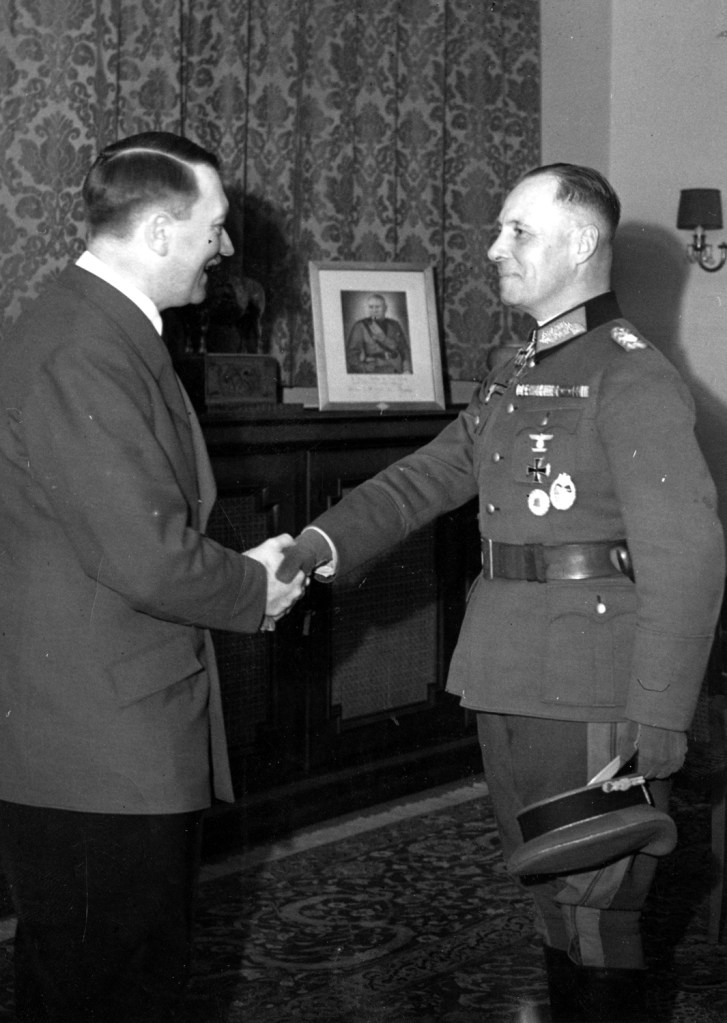
Lieutenant General Erwin Rommel becomes the 10th person in the Wehrmacht to receive the Oak Leaves to his Knight’s Cross.
The German deadline for all Jews to be inside the Polish ghettos expires.
The Propaganda Ministry’s Reich Press Chief instructs his media outlets to highlight recent comments by Charles Lindbergh that the USAAC produces as many combat-ready planes as Germany produces every week. This actually is roughly true… now.
German battlecruisers Scharnhorst and Gneisenau were detected by aircraft of the British Coastal Command; they were met by German aircraft at 1900 hours, escorting them as they headed for Brest, France. Meanwhile, two ships that they had captured 5 days prior, tankers Bianca and San Casimiro, were spotted by British aircraft from carrier HMS Ark Royal; battleship HMS Renown would advance in an attempt to recapture them. The German crew scuttled both tankers before surrendering themselves along with the 46 prisoners of war aboard the two ships.
Soviet Red Army General F. I. Golikov, chief of army intelligence, assures Stalin that while Britain remains undefeated, Hitler will never attack the USSR. Meanwhile, the United States shared the intelligence of a possible German invasion of the Soviet Union with Soviet Ambassador Konstantin Umansky.
Peace “feelers” are being broached throughout the world on orders of the Vatican in a new effort to end the European war, International News Service is able to reveal today. The new peace campaign is being conducted quietly, but it is extending even to the United States. Roman Catholic ecclesiastical organizations have been instructed to canvass the opportunities for peace and carry out a discreet but comprehensive investigation of how the idea of a negotiated peace agreement would appeal to the people of the world at large. On the basis of reliable information which has reached London it can be stated that King Victor Emmanuel of Italy and Pope Pius XII have been in contact with each other.
The King and Queen of England spent the day in Plymouth as guests of Lord Mayor Waldorf Astor and his wife, Lady Nancy Astor, MP. They talked to citizens, visited headquarters of various services, inspected defenses, and made a tour of the city. After tea with the Astors at their home at 3 Elliot Terrace, the King and Queen left on a train at 6 p.m. As they were boarding, the alert sounded. Nobody paid much attention, because until then Plymouth had only seen occasional bomb damage. At 8:30 p.m., the Astors and their remaining guests, including Robert Menzies, Australian Prime Minister, heard the guns start. After a bomb smashed the whole of one side of the street, an air raid warden ordered everybody into basements, where the party spent the rest of the night. An incendiary bomb fell on the roof, and everybody started going up and down the stairs to dump sandbags on it. Most of the central city was destroyed. What was left of the city center was destroyed the next night. Heavy raids continued until October. The colorful Lady Nancy Astor is unhurt and makes some inspirational comments to the press. Some reporter asked Lady Astor on March 21 what was the strangest sight she saw during the raid. She said she saw very little because she was in the basement most of the time, but once on the stairs she looked out a window: “At the height of the raid I saw a man who walked along calmly exercising two dogs.”
Some Luftwaffe bombers hit Bristol during the night, where visiting Australian Prime Minister Menzies is spending the night. He makes an interesting comment in his diary about how the RAF now can predict the location of attacks before they occur:
“Air raid warnings from London. They study beams from Germany, and where they cross is the place. Loud noises from the city after dinner, but we talk, as usual, until midnight.”
A flight of three Manchester bombers from RAF Waddington in England, United Kingdom set out to bomb German submarines at Lorient, France. Less than thirty minutes into the mission one aircraft developed an engine fire which forced its captain to order the crew to abandon the stricken aircraft. Four crewmen jumped but only two survived and two others were killed. The pilot (with one other crewman still aboard) then attempted to bring the aircraft home but in attempting to land struck a tree and crashed, killing both airmen. Aircraftsman Charles Leonard Wheatley, seeing that the fire threatened to explode the high-explosive bombs still aboard, bravely fought the fire, from only two yards away, and successfully prevented any further damage to the base. For this gallant action Wheatley would be awarded the George Medal from the King on 4 Nov 1941.
RAF Bomber Command: Day of 20 March 1941
10 Blenheims to enemy coast; many trawlers and small vessels bombed. No losses.
RAF Bomber Command: Night of 20/21 March 1941
Lorient
21 Whitleys and 3 Manchesters to attack the U-boat base. 42 Hampdens on minelaying operations off Brest, Lorient, and St-Nazaire. 1 aircraft lost. 1 Blenheim attacked Le Bourget airfield.
U-106, commanded by Kapitänleutnant Jürgen Oesten, damaged the Royal Navy battleship HMS Malaya and the merchant Meerkerk.
At 2323 hours on 20 March 1941, U-106 attacked the shadow of a merchant ship with a spread of two stern torpedoes in bad light from the port side of the convoy SL.68 about 250 miles west-northwest of the Cape Verde Islands. Oesten heard hits after 2 minutes 37 seconds and 3 minutes 35 seconds. One torpedo damaged HMS Malaya (01) and the other the Meerkerk.
HMS Malaya (01) (Capt A.F.E. Palliser, DSC, RN) was hit by the torpedo on the port side, causing considerable damage. Due to the flooding of some rooms the ship took a list of 7 degrees and was forced to leave the convoy and head for Trinidad, escorted by HMS Crocus (K 49) (LtCdr E. Wheeler, RNR) until 23 March. On 29 March, the battleship arrived at Port of Spain and after temporary repairs continued to the New York Navy Yard, where the battleship was docked for 4 months. On 9 July, the ship left for the Clyde, arriving on 28 July.
Apparently the Meerkerk was only slightly damaged by the torpedo and returned to Freetown under own power. The Meerkerk left Freetown in late April 1941 with the survivors of Almkerk on board, which had been sunk on 16 March by U-106 and arrived in Oban on 3 May. The 7,995 ton Meerkerk was bound for the United Kingdom.
Heavy cruiser HMS Suffolk arrived at Scapa Flow at 1515 after damage repair from her April 1940 bombing. One turbine was still defective. Full power trial was completed on the 26th.
Auxiliary anti-aircraft ship HMS Helvellyn (642grt, T/Lt P. D. Baker RNVR) was sunk by German bombing in the London Docks.
Submarine HMS Sturgeon unsuccessfully attacked a steamer off Obrestad. The claim she sank Norwegian tanker Drafn (8205grt) under German control off Stadlandet is incorrect.
Destroyers HMS Intrepid, HMS Icarus, and HMS Impulsive laid minefield GU in the English Channel.
British requisitioned motor fishing vessel Dox (35grt) was by German bombing at Plymouth.
British requisitioned motor fishing vessel Gloaming (21grt) was sunk by mining in the vicinity of Burcom Shoal off the Humber.
Naval drifter HMS Soizic (72grt) was lost in enemy action.
Tug Sir Bevois (338grt) was sunk by German bombing at Plymouth. Nine were lost from a crew of fourteen.
Polish steamer Cieszyn (1386grt) was sunk by German bombing three miles 55° from Manacle Point. The entire crew was rescued.
British fishing vessel Joan Margaret (25grt) was lost on a mine in the vicinity of Cleeness Lightfloat, River Humber. Five crewmen were killed.
British trawler Bianca (174grt) was sunk in the Irish Sea when she picked up a German aerial torpedo or bomb in her nets. Five crewmen were lost.
Hulk Mackay Bennett was sunk by German bombing at Plymouth. It was refloated on 26 July and docked on 28 July.
Tug Elan II was sunk by German bombing at Plymouth, and refloated about 1 October 1941.
Tug Charlight (40grt) was damaged by German bombing off Le Bas Wharf, Milwall.
British steamer Mari II (1395grt) was damaged by German bombing at Plymouth. The ship was sunk. She was refloated on 27 June and repaired at Plymouth.
Greek submarine RHS Triton made unsuccessful attacks on a steamer and a torpedo boat off Valona. This was possibly German steamer Brummer and torpedo boat Altair.
British tanker San Casimiro (8046grt) and Norwegian tanker Bianca (5688grt), captured by German battlecruiser Gneisenau on the 15th, were sighted by Aircraft carrier HMS Ark Royal aircraft. The tankers were scuttled by the German prise crews when approached by Battlecruiser HMS Renown.
Convoy OB.300 departed Liverpool, escorted by destroyers HMS Achates and HMS Boreas, corvettes HMS Heather, HMS Hepatica, and HMS Picotee, and anti-submarine trawlers HMS Arab, HMS Ayrshire, and HMS Lady Madeleine. The escort, less the destroyers, was detached on the 25th. The destroyers were detached on the 26th when the convoy was dispersed.
Convoy SC.26 departed Halifax, escorted by armed merchant cruiser HMS Worcestershire, submarine HMS Porpoise, and escort ship HMCS Cobalt. The escort ship was detached later on the 20th, the submarine on the 29th, and the armed merchant cruiser on 3 April. On 3 April, destroyers HMS Veteran and HMS Wolverine joined the convoy. On 4 April, destroyers HMS Chelsea, HMS Verity, and HMS Vivien and corvette HMS Convolulus joined. This group, which joined on 4 April, was detached on 5 April and destroyer HMS Havelock and sloop HMS Scarborough joined on 5 April. The escort was detached when the convoy arrived at Liverpool on 8 April.
The Senate today completed Congressional action on the bill authorizing $242,373,500 for work on naval bases in the Atlantic and Pacific and on the bill authorizing $110,502,883 for work at naval shore establishments. It approved the $3,116,384,144 Navy Appropriation Bill for 1942, passed the $191,803,544 First Deficiency Bill, confirmed the nomination of Jerome N. Frank as a judge of the Second Circuit Court of Appeals and adjourned at 2:18 PM until noon Monday. The Banking and Currency Committee approved a bill authorizing the Federal Housing Administration to insure $100,000,000 of housing mortgages and an Appropriations subcommittee heard Secretaries Knox and Stimson and General Marshall on the $7,000,000,000 Lend-Lease appropriation bill.
The House considered the Cotton Warehousing Bill and adjourned at 5:18 PM until noon tomorrow. The Judiciary Committee received Attorney General Jackson’s recommendation for legislation to empower him to authorize wiretapping in certain cases.
In a two-hour session today the Senate approved appropriations and authorizations amounting to $3,950,000,000, of which $3,866,000,000 was intended to build up the home defenses of the United States. Immediately the floor session had ended, the Appropriations Committee started work on the $7,000,000,000 appropriation intended to carry out the purposes of the lease-lend act in extending aid to governments resisting aggression by the Axis powers.
Secretary of the Navy Frank Knox reportedly told a congressional committee today that the navy has “no plans” to convoy merchant ships to belligerent waters. Knox, Secretary of War Henry L. Stimson and Army Chief of Staff George C. Marshall testified secretly as a Senate Appropriations subcommittee began considering President Roosevelt’s request for $7,000,000,000 to finance the British-aid program scarcely 24 hours after the house approved the money measure. The trio pleaded for swift enactment of the bill, which they termed vital to the nation’s defense, Senate leaders predicted that chamber would pass the measure Monday or Tuesday with no substantial change.
Vice-President Henry A. Wallace’s appetite and an apparent error by a Senate clerk today cost the administration a big chance to advance its South American “good neighbor” policy. As presiding officer of the senate, one of Wallace’s chief functions is to cast the deciding ballot in rare cases of a tie vote. Today, Wallace had his big chance and muffed it. The Senate voted 32-to-32 on an appropriations committee amendment to the 1942 naval supply bill that would have removed the ban on U. S. naval purchases of foreign foodstuffs, including canned Argentine beef. The tie vote, automatically killed the effort to remove the restriction. Had Wallace been present he could have cast the deciding vote in favor of the administration, which has long sought to remove the ban and thereby implement its “good neighbor” policy. Instead, Wallace, who learned Spanish so he could preach the “good neighbor” doctrine in tours of South America, was having lunch in the Senate restaurant where Argentine canned beef is served. But for an apparent error by a clerk, Wallace might have escaped the embarrassing experience.
Colonel Charles A. Lindbergh declares in an article appearing today in Collier’s that the United States is “being led toward war with ever-increasing rapidity, and with every conceivable subterfuge.”
Senator Wheeler of Montana tonight called upon those who opposed passage of the lease-lend British aid bill to give “continued support in a crusade against war.
High winds and heavy seas prevented President Roosevelt from starting his vacation cruise on the yacht Potomac this evening. All was in readiness, however, to get under way as soon as the weather abated.
With only one union demand still at issue, Manhattan’s 11-day-old bus strike which has discommoded 900,000 passengers a day passed into the hands of an arbitrator tonight. Union and company spokesmen announced in separate statements that service would be resumed Saturday morning. The agreement came 24 hours aft er Mayor La Guardia appointed a three-man fact-finding board which swung into action shortly after noon today and met almost continuously until 8:30 p.m. with representatives of the Transport Workers union (C.I.O.), the Fifth Avenue Coach Co., and the New York City Omnibus Corp. The sole remaining Issue was a wage scale for the Fifth Avenue Coach Co. employees. Terms of the settlement of the other issues were not immediately revealed.
The first national labor agreement prohibiting strikes and lockouts on defense jobs was signed yesterday by the Painting and Decorating Contractors of America and the Brotherhood of Painters, Decorators and Paperhangers, A. F. of L.
U.S. Undersecretary of State Sumner Welles informed the Soviet Ambassador to the United States Constantine A. Umansky that the U.S. had additional information in confirmation of the report that Germany intended to attack the Soviet Union. Welles’ source, which he cannot reveal, is top secret decrypts of Japanese coded transmissions to and from Baron Oshima, the Japanese ambassador to Germany. It is unclear if the Americans decoded these, or the British — for the British cracked the Japanese diplomatic code some time ago. See below for the beginnings of Japanese recognition that at least some of their codes have been broken.
The United States quickly takes up Winston Churchill’s suggestion that interned Italian and German vessels in US ports be put to some kind of use. The US Coast Guard begins surveying these ships and finds some evidence of sabotage on an Italian ship being held at Wilmington, North Carolina. For the record, there are 28 Italian, 2 German and 35 Danish such vessels available. The US does not yet requisition these vessels, but the idea of doing so is being bruited about in the highest levels of the US government.
A Gallup poll published today shows that 17% of the American people would vote for war, and that 83% would vote to stay out.
Admiral Bloch, the commandant of the Fourteenth Naval District, replies to a 15 February 1941 letter from Admiral Stark concerning defenses at Pearl Harbor. Bloch notes that the depth of Pearl Harbor is 45 feet, which is far less than the minimum depth of 75 feet required for air-launched torpedoes. He agrees with Admiral Kimmel’s previously expressed view that, for this reason, anti-torpedo baffles (nets) are unnecessary there. The Japanese, meanwhile, are well aware of the mechanics of air-launched torpedoes and are studying if these minimum depths can be made compatible with an attack on the US Fleet anchored at Pearl Harbor.
The ship Tatsuta Maru arrived at San Francisco, California, United States; among the disembarked passengers was Colonel Hideo Iwakuru, who was dispatched by Prime Minister Hideki Tojo to Washington D.C. to help the Japanese Embassy in reconciling relations with the United States.
Naval experts in the House said today the next five battleships to be constructed under the two-ocean fleet program would be from 60,000 to 65,000-ton dreadnoughts, the world’s largest war vessels. These were to be the ships of the Montana-class, which would never be completed.
Conversion of the Panama Canal from a high-level lock “trough” to a sealevel canal was proposed in a joint resolution introduced in the House today by Representative Mansfield of Texas, chairman of the Rivers and Harbors Committee. Mr. Mansfield said he offered the proposal primarily to make the canal as nearly invulnerable to air attack as possible, citing the success of the British and Germans in keeping open the Suez and Kiel Canals, both sea-level passages, despite many attacks from the air. The Panama Canal, the highest point of which is eighty-five feet above sea level, is especially vulnerable to attack, Mr. Mansfield said. He held that with a third set of locks, authorized last Summer by Congress and expected to be in operation within three years, the canal could be reduced to sea-level without interruption to traffic. Mr. Mansfield in his resolution specifically made the third set of locks a part of his proposal.
U.S. Navy heavy cruiser USS Vincennes (CA-44) departs Pernambuco, Brazil, for Simonstown, South Africa (see 20 March).
Convoy BN.22 departed Bombay, escorted by armed merchant cruiser HMS Antenor. The escort was detached on the 26th. On 31 March, sloops HMS Auckland and HMIS Indus joined. Sloop HMS Flamingo joined on 1 April and light cruiser HMS Capetown and destroyer HMS Kingston on 2 April. Light cruiser Capetown and destroyer Kingston were detached on 3 April, sloops Flamingo and Indus on 4 April, and sloop Auckland on 7 April when the convoy arrived at Suez.
The Battle of Shanggao continues, but there is a lull in the battle. The Japanese retain a penetration into the first of three Chinese defensive lines. Both sides are bringing up reinforcements. There are some Japanese attacks near the Chin River at Szehsi and Kuanchiao.
Chinese officials said today that only complete withdrawal of Japanese forces from China could lead to peace negotiations between China and Japan. Political quarters said that it was felt here that peace was out of the question, especially since President Roosevelt’s speech of last Saturday in which he specifically mentioned China as one of the nations which might expect aid from the United States.
Japanese Ambassador to the United States, Admiral Nomura Kichisaburō responded to the foreign ministry in Tokyo: “Though I do not know which ones, I have discovered that the United States is reading some of our codes. As for how I got the intelligence, I will inform you by courier or another safe way.”
Foreign military observers said today that Japan’s next military move would be the establishment in Northern Thailand of air bases from which to blast Chinese supply trucks off the Burma Road.
The U.S. Navy heavy cruisers USS Chicago (CA-29) (Rear Admiral John H. Newton, Commander Cruisers Scouting Force) and USS Portland (CA-33) and the destroyers USS Clark (DD-361), USS Conyngham (DD-371), USS Reid (DD-369), USS Cassin (DD-372), and USS Downes (DD-375), arrived at Sydney, Australia, beginning a three-day goodwill visit. The cruiser squadron arrives in Sydney Harbor. The government in Canberra has adjourned so that the ministers can watch the arrival and subsequent parade. While little-noted on the U.S. side, the arrival is feted by the Australian press and it is a watershed moment in U.S./Australian relations. An estimated half-million Australians watch the fleet arrive. Tellingly, the event completely overshadows the arrival of the first Japanese ambassador, Tatsuo Kawai, to Australia on the 19th. The fleet’s arrival is recounted in an official government summary:
“Owing to misty rain the entry of the detachment into the harbour, originally scheduled for 8 a.m., was delayed until about 8:45 AM. A salute of 21 guns was accorded to the ships as they passed the Heads, and public enthusiasm expressed itself in the hooting of sirens and motor horns and the cheering of the dense crowds lining the foreshore as the detachment proceeded up the Harbour.”
After the parade, there is a luncheon for the U.S. sailors at the Sydney Town Hall. Later, there is a dinner at which Acting Prime Minister Arthur Fadden toasts “our guests” and noted that this visit “signified a new and higher plane of friendship” between the two countries.”
U.S. Navy Task Group 9.2, under command of Captain Ellis S. Stone and comprised of the light cruisers USS Brooklyn (CL-40) and USS Savannah (CL-42) and the destroyers USS Case (DD-370), USS Shaw (DD-373), and USS Tucker (DD-374), concluded its port visit to Auckland, New Zealand and set sail for Tahiti. Captain Stone and his TG 9.2 cruiser squadron departs from Auckland, New Zealand after a three-day visit.
Dow Jones Industrial Average: 123.6 (+0.05)
Born:
Pat Corrales, MLB catcher (Philadelphia Phillies, St. Louis Cardinals, Cincinnati Reds, San Diego Padres) and manager (Texas Rangers, 1978–1980, Philadelphia Phillies, 1982–1983, Cleveland Indians, 1983–1987), in Los Angeles, California (d. 2023).
Karl Kassulke, NFL safety (NFL Champions-Vikings, lost Super Bowl IV, 1969; Pro Bowl, 1970; Minnesota Vikings), in Milwaukee, Wisconsin (d. 2008).
Bob Warlick, NBA and ABA shooting guard (Detroit Pistons, San Francisco Warriors, Milwaukee Bucks, Phoenix Suns; Los Angeles Stars [ABA]), in Hickory, North Carolina (d. 2005).
Kenji Kimihara, Japanese long-distance runner (Olympics, silver medal, marathon, 1968), in Kitakyushu, Japan.
Naval Construction:
The Royal Navy LCT (Mk 2)-class landing craft, tank HMS LCT 143 is laid down by Stockton Construction (Thornaby, U.K.).
The Royal Canadian Navy Bangor-class (Diesel-engined) minesweepers HMCS Digby (J 267) and HMCS Truro (J 268) are laid down by the Davie Shipbuilding and Repairing Co. Ltd. (Lauzon, Quebec, Canada).
The Royal Australian Navy Bathurst-class minesweeper-corvette HMAS Geraldton (J 178) is laid down by Poole & Steel Pty. Ltd. (Sydney, New South Wales, Australia).
The Kriegsmarine (German Navy) Type VIIC U-boat U-258 is laid down by Bremer Vulkan-Vegesacker Werft, Bremen-Vegesack (werk 23).
The U.S. Navy Aloe-class net tender USS Gum Tree (YN-13; later AN-18) is launched by the Marietta Manufacturing Co. (Point Pleasant, West Virginia, U.S.A.).
The Royal Navy Shakespeare-class minesweeping trawler HMS Romeo (T 10) is launched by A & J Inglis Ltd. (Glasgow, Scotland); completed by Aitchison Blair.
The Kriegsmarine (German Navy) Type VIIC U-boat U-205 is launched by F. Krupp Germaniawerft AG, Kiel (werk 634).
The Kriegsmarine (German Navy) Type VIIC U-boats U-569 and U-570 are launched by Blohm & Voss, Hamburg (werk 545 and 546).
The Royal Navy Shakespeare-class minesweeping trawler HMS Juliet (T 136) is commissioned. Her first commanding officer is Lieutenant Leonard Bentley Moffatt, RNR.
The Kriegsmarine (German Navy) Type VIIC U-boat U-562 is commissioned. Her first commanding officer is Oberleutnant zur See Herwig Collmann.
 History Diaries