Adolf Hitler gave Prince Paul of Yugoslavia an ultimatum, asking him to join the Tripartite Pact within five days, or face invasion. Hitler is running up against some hard deadlines. Spring is approaching and with it the campaigning season. The Wehrmacht needs to know what role Yugoslavia and its military will play in the events that are about to unfold in the Balkans. Accordingly, Hitler tells the Yugoslav Regent, Prince Paul, that he wants Yugoslavia to sign the Tripartite Pact by the beginning of next week, five days hence.
Erwin Rommel met with Adolf Hitler, Generalfeldmarschall Walther von Brauchitsch, and Chief of Staff General Franz Halder. Rommel is itching to get started with his offensive, but this supposedly is not yet the time. During this visit, Hitler makes Rommel the 10th recipient of the Oak Leaves to the Iron Cross for his service in command of the 7th Panzer Division. Rommel was told to expect no reinforcements in Libya until May, when the German 15th Panzer Division would be assigned to him. Field-Marshal von Brauchitsch told him that there was no intention of striking a decisive blow in Africa in the near future, and he could expect no reinforcements. After the arrival of the 15th Panzer Division at the end of May, he was to attack and destroy the British units around Agedabia. Benghazi “might perhaps be taken.”
An Italian convoy carrying troops and supplies for the Afrika Korps departs from Naples bound for Tripoli.
British Middle East Commander General Archibald Wavell now is receiving Ultra decrypts. He learns from them that Luftwaffe leaves have been canceled and the Germans are planning an offensive.
Following a three-day pause, the Italian Primavera Offensive in Albania resumes on 19 March 1941. The Italian Sienna Division attack Height 731 for the eighteenth time. As in the preceding 17 times, nothing comes of it except more dead soldiers on both sides. Operation LUSTRE, the British reinforcement of Greece, continues. The Australian 16th Infantry Brigade and General Blamey arrive at Piraeus.
Good weather allows the Italians to mount fresh attacks, supported by armor, artillery, and some of the heaviest tactical air strikes yet experienced in this theatre. But the Greeks are ready and these new efforts have no success. The continued Italian assaults are apparently an effort to keep the Greeks on the defensive, bolstering Cavallero’s assertion that this failed offensive has somehow saved Italian “honor” and forestalled further Greek advances.
The British Military Mission to Greece reports that Greek morale is high and fortifications are well prepared although there is a severe shortage of reserves with the oldest class of reservists about to be called up.
The Admiralty makes the difficult decision to pull the remaining Sunderland flying boats from their base at Kalafrana and send them to Alexandria. The Luftwaffe has destroyed or damaged several of them recently, and they are too vulnerable lying at anchorage when the Luftwaffe has a dominance of the skies. Weather is poor today, and there are no bombs dropped on the island though there are some close approaches to the island.
In East Africa, Major-General Lewis Heath, in command of the Indian 5th Infantry Division, is planning a thrust straight up the Dongolaas Gorge that controls access to Keren. The Italians rather unhelpfully have dumped rocks and other debris into the gorge to make travel through it impossible except by hikers. The Italians are sitting at the head of the gorge with clear fields of fire against anyone attempting to advance through it. Heath’s plan is to neutralize those Italian positions via diversionary flank attacks which draw their fire elsewhere, giving the Royal Engineers time to clear a path through the gorge. This will require taking positions overlooking the gorge. Heath begins assembling his entire division, which will take some time. Thus, the Battle for Keren once again goes into abeyance for a few days while the British build up their troop strength and logistics.
The Italian attacks on Fort Dologorodoc continue. At 04:00, the 10th Alpini Battalion attacks and gets to within 70 yards of the fort. However, the British defenders beat them back, pursuing them with bayonets and grenades. The British reshuffle their forces, with Indian 3/5 Mahratta occupying the fort and the 2nd West Yorkshire Regiment taking up positions outside the walls.
The British forces at Jijiga begin advancing further. They now are about eight miles beyond the town. Indian troops continue advancing from Berbera and are about 100 miles past it.
An authorized Nazi spokesman asserted Wednesday that Germany alone would decide if a state of war existed between the Reich and the United States. He said the Monroe doctrine assumed that the United States would not “meddle” in the affairs of Europe, but that if the United States did not recognize this principle “then we must protect ourselves.”
Following up on discussions he has had with Hitler, Admiral Raeder floats the idea of attacking Singapore with the Japanese ambassador.
The entire coal-mining industry and the coal trade in Germany have been amalgamated into a giant cartel known as the Reich Coal Union. it is hoped that, with centralized control, this vital industry will be able to increase its production beyond the 246 million tons achieved this year. A significant boost is necessary if the increase in arms production demanded by the government is to be possible and the German people are to be able to buy fuel.
Scharnhorst and Gneisenau began their return voyage to Brest, France. Following orders, Admiral Lütjens sets a course toward Brest for Brest, France for his Operation Berlin cruisers, Gneisenau and Scharnhorst. Steaming at 23 knots, he has timed it so that the ships will make the final approach during the early morning hours and reach Brest — and Luftwaffe and destroyer protection — at dawn on the 22nd. The Royal Navy is completely unaware of Lütjens’ location or destination.
The French government-in-exile in Britain established a central bank.
Exiled German socialist groups in London join together to form the Union of German Socialists, pledged to work for a “democratic and socialist future for Germany.”
Prime Minister Winston Churchill asks President Roosevelt, who is about to go fishing off the Florida coast, to extend the U.S. Navy’s patrols to cover more of the Atlantic. It is common knowledge that the US Navy is helping the Royal Navy by quickly alerting the British when they spot any German ships. Churchill wants the U.S. Navy’s eyes everywhere that the Royal Navy’s eyes are not, though they don’t have to do anything other than locate German ships:
“It would be a very great help if some American warships and aircraft could cruise about in this area as they have a perfect right to do.”
Churchill, of course, would like a great deal more than this, but feels this is both helpful and fairly benign in terms of U.S. neutrality. In addition to this, Churchill wants the U.S. Navy to seize interned Axis ships and use them as Allied shipping, and also to begin convoys of their own. Roosevelt and his team, such as Navy Secretary Frank Knox, are very sympathetic and looking into some other ways to help, too, including having U.S. Navy aviators fly British search aircraft. However, it will take a little time before everyone in the U.S. government has meetings about this and actual steps are taken.
The ‘Battle of the Atlantic’ Committee of all Ministers and heads of the armed services has its first meeting.
London: Churchill’s fears of the havoc which German raiders could cause on the North Atlantic sea lanes causes him to ask Roosevelt for assistance in tracking German ships. Although Churchill refrains from asking the President to escort American supply convoys to Britain, he does say: “It would be a very great help if some American warships and aircraft could cruise about this area [central North Atlantic] as they have a perfect right to do without any prejudice to neutrality.”
Visiting Australian Prime Minister Robert Menzies is in the north visiting manufacturing plants. He is in Sheffield and notes:
“Sheffield has suffered gravely. 60,000 out of 180,000 houses affected — But Industries going magnificently. Spirits superb. No surrender. No compromise (emphasis and punctuation in original).”
The factories in Sheffield, Menzies notes, are manufacturing 14″ plates and 14″ gun barrels.
Woolton Pies — mass-produced vegetable casseroles — go on sale for 8 pence per pound in the UK. They are composed primarily of potatoes, onions and other foods in plentiful supply. Cheese rationing is to begin next week.
The Vichy French government in the form of Admiral Darlan announces that “vowing that Frenchman shall eat. Serves notice that its naval ships would convoy merchantmen if the British persist in their blockade of France. “If the British continue this blockade… I will be obliged to ask permission to provide arms and protection for our merchantmen. I will let nothing stand in the way of the French People’s eating. The Germans are more generous and more comprehensive of the needs of humanity than the English.”
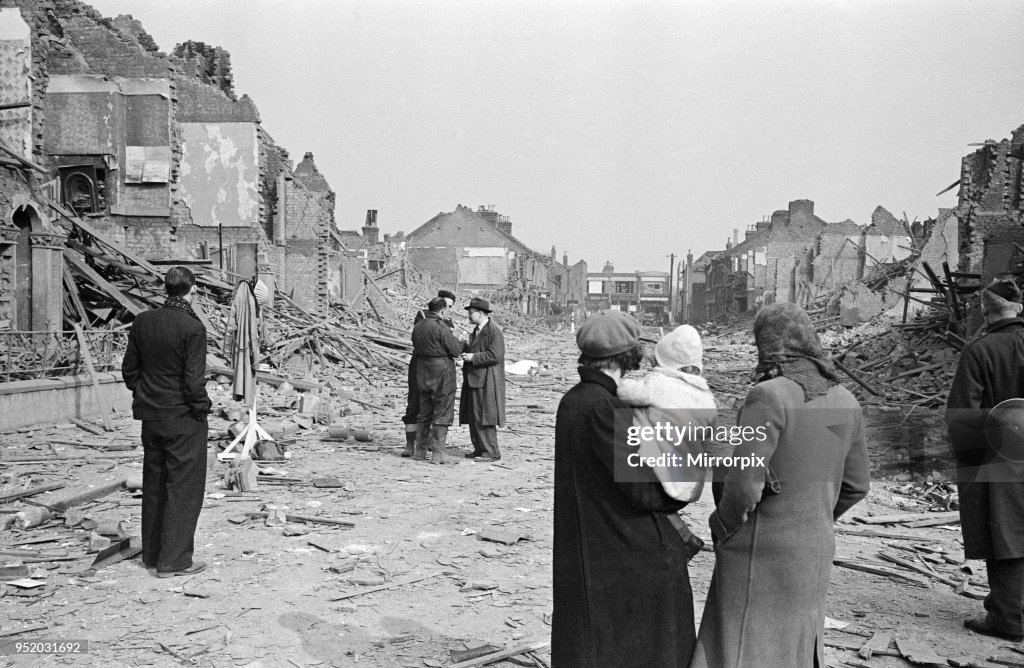
The Luftwaffe has been ramping up its raids this month after essentially a two-month lull. Most of the attacks have been against secondary city targets such as Bristol and Glasgow. Tonight, the Luftwaffe returns to its primary target, London, in a major way. About 370-479 bombers drop 122,292 incendiaries. The weekly Home Security Situation report states:
“On the 19th/20th March : Bombing was concentrated on East London and the London Docks, where there were more major fires than on any date since the 29th December, causing considerable damage.”
The fires and other damage kill about 750 people. In addition, many ships in the harbor are damaged or sunk. Several freighters and auxiliary anti-aircraft ship Helvellyn were sunk or damaged in London docks.
RAF Bomber Command: Day of 19 March 1941
4 Blenheims on an uneventful sea sweep to Brest and the Channel Islands.
RAF Bomber Command: Night of 19/20 March 1941
Cologne
36 Wellingtons; none lost. Cologne records 2 industrial buildings damaged, 4 houses destroyed, 6 people injured.
1 Wellington and 1 Stirling to Rotterdam without loss.
U-105, commanded by Kapitänleutnant Georg Schewe, made attacks on convoy SL.68. Dutch steamer Mandalika (7750grt) was sunk at 18-16N, 21-26W. Between 0024 and 0029 hours on 19 March 1941, U-105 fired torpedoes at the convoy SL.68 from within the convoy columns and reported two ships sunk and another probably damaged. However, only the Mandalika (Master Leonardus Theodorus Marie Ouwerkerk) was hit on the port side near the engine room by one torpedo. The crew abandoned ship in several lifeboats as the ship slowly sank about 100 miles northeast of Cape Verde Islands. Three crew members were lost. The survivors were picked up by HMS Marguerite (K 54) (LtCdr A.N. Blundell, RNR). The 7,750-ton Mandalika was carrying sugar and was bound for Belfast, Ireland.
The submarine attacked another steamer on the 19th without success.
Destroyer HMS Liddesdale departed Scapa Flow at 1500 to meet British steamer Amsterdam off Aberdeen at 2230 and escort her to Lerwick. The ships departed Lerwick at 2000/20th. The destroyer lost touch with the steamer in bad weather during the night and returned to Scapa Flow, arriving at 0830/21st.
Light cruiser HMS Kenya, relieved Force H escorting convoy SL.67. The light cruiser arrived at Greenock on the 31st.
P/T/Sub Lt (A) W. Darbyshire RNVR, and Leading Airman J. W. J. Howes were killed when their Roc of 760 Squadron crashed near North Cadbury in air firing practice exercises.
British steamer Benvorlich (5193grt) was sunk by German bombing from convoy OB.298 in 54-48N, 13-10W. Four crew members and one gunner were lost on the steamer. The survivors were rescued by convoy rescue ship Zamalek.
Battleship HMS Malaya, escorting convoy SL.68 with armed merchant cruiser HMS Canton and corvettes HMS Calendula, HMS Marguerite, and HMS Crocus, was torpedoed in the bows by U-106 at 2323 on the 20th at 20-02N, 25-50W. The submarine thought she had torpedoed a merchant ship.
Destroyers HMS Foresight and HMS Fortune were ordered to join the damaged battleship. Destroyers HMS Fearless and HMS Wrestler of the group intending to join HMS Ark Royal and HMS Renown were ordered to return to Gibraltar. On the 21st, destroyers Fearless and Fortune departed Gibraltar to join, but soon they and destroyers Foresight and Fortune were ordered to return to Gibraltar.
Battleship HMS Malaya was escorted towards Trinidad by corvette HMS Crocus, which was detached on the 23rd. The battleship arrived at Trinidad on the 29th. The battleship arrived on 6 April in New York for repairs.
British steamer Clan Macnab (6076grt) was lost in convoy SL.68 when she collided with Norwegian motor tanker Strix.
British steamer Nailsea Meadow (4962grt) was damaged by German bombing at Victoria Dock, London. Two crewmen were lost. The ship was struck by a bomb in the afterpeak tank.
British steamer Tottenham (4762grt) was damaged on a mine in the Southend Anchorage. The ship was damaged by a near mine explosion. The ship was towed to Gravesend on the 20th.
Norwegian steamer Leo (1367grt) was sunk by German bombing 75 miles NW of the Butt of Lewis. The entire crew was rescued by destroyer HMS Echo.
Dutch tanker Mamura (8245grt) was damaged by German bombing in 54-42N, 13-20W. The tanker was able to continue to Halifax.
British steamer Juno (642grt) was damaged by German air attack in Surrey Commercial Dock. The steamer was considered a constructive total loss.
During the night of 19/20 March, British steamers Telesfora De Larringa (5780grt) and Lindenhall (5248grt) were damaged in Victoria Dock, London. One crewman was killed on the Telesfora De Larringa. Steamer Lindenhall caught fire and sank. She was drydocked at Millwall on 23 April.
German tanker Nordmark replenished German raider Kormoran at 2-52N, 30-58W.
British operation MC.9 began on the 19th. British steamers City of Manchester (8917grt), Clan Ferguson (7347grt), and Perthshire (10,496grt) departed Haifa escorted by destroyers HMS Hotspur and HMS Griffin and steamer City of Lincoln (8039grt) departed Alexandria escorted by destroyer HMS Greyhound as convoy MW.6. The convoy was designated Force C. T/A/Sub Lt (A) R. C. Kay and Leading Airman D. R. Stockman were killed when their Fulmar of 805 Squadron from Maleme was shot down over Suda Bay on the 19th.
On 20 March, battleships HMS Warspite, HMS Barham, and HMS Valiant, aircraft carrier HMS Formidable, and destroyers HMS Jervis, HMS Janus, HMS Juno, HMS Jaguar, HMS Nubian, HMS Mohawk, HMS Ilex, HMS Hero, and HMS Havock departed Alexandria as Force A. Anti-aircraft cruiser HMS Bonaventure joined the convoy escort on the 20th.
Anti-aircraft cruisers HMS Coventry, HMS Calcutta, and HMS Carlisle and destroyer HMS Havock joined Force C on the 21st. The convoy was covered by heavy cruiser HMS York, light cruisers HMS Orion, HMAS Perth, HMS Gloucester, and HMS Ajax and destroyers HMAS Stuart, HMS Hereward, and HMS Hasty, and Hereward after refueling at Suda Bay. This group, designated Force B, rendezvoused with Force A at 1600/21st.
The destroyers of Force B joined Force A.
Exercising following her refitting, destroyer HMS Defender was damaged by splinters from a near miss of an air bomb off Dellimiara Point, Malta, on the 21st.
Force B rejoined Force A at 0740/22nd.
The fleet parted company with the convoy at 2000/22nd to stay out of the range of German bombers.
A Fulmar of 809 Squadron ditched near the Fleet. Lt A. J. E. Howey and Leading Airman L. J. Stevens were rescued by destroyer HMS Jervis.
Anti-aircraft cruisers HMS Coventry and HMS Carlisle left the convoy at 2030 and proceeded to Alexandria. Destroyer HMS Defender departed Malta at 1945 to join Force B. Force B and destroyers HMS Mohawk and HMS Nubian covered Force C from the northward during the night of 22/23 March. Convoy MW.6 arrived at Malta on the 23rd.
Force B rejoined Force A during the morning of 23 March and destroyer HMS Defender joined shortly thereafter.
Force C and the convoy were attacked by German bombers at Malta on the 23rd. British steamers Perthshire (10,496grt) and City of Lincoln (8039grt) were damaged. Light cruiser HMS Bonaventure was damaged on her port bow by splinters from near misses. One rating was killed and seven were wounded. Destroyer HMS Griffin was damaged by a near miss which holed her forward fuel oil tanks with no casualties.
Force B and destroyers HMS Ilex and HMS Hasty parted company with Force A to cover Force C. The cruisers and destroyers of Force C departed Malta at 1930. At 1930, destroyer HMS Hereward departed Force B to join Convoy AN.22 on the 24th. Force C and Force B merged at 0730/24th and proceeded to the Aegean.
Anti-aircraft cruiser HMS Calcutta and destroyers HMS Ilex and HMS Hasty arrived at Port Said on the 24th. Force B covered convoy AN.22 from west of the Kithera Channel. Force A arrived back at Alexandria at 2230/24th. Anti-aircraft cruiser HMS Bonaventure and destroyers HMS Greyhound, HMS Griffin, HMS Hotspur, and HMS Havock from Force C proceeded to Alexandria, arriving on the 25th. The cruiser carried a replacement propeller shaft and bracket bearing for cruiser HMS Carlisle. Heavy cruiser HMS York and light cruiser HMS Gloucester arrived at Suda Bay during 25 March. Light cruisers HMS Orion, HMAS Perth, and HMS Ajax and destroyer Ilex remained in the Aegean to cover convoy AN.22 and AS.22 on the 25th.
Greek destroyer RHS Aetos reported being unsuccessfully attacked by Italian torpedo bombers north of Candia.
Submarines HMS Utmost and HMS Ursula departed Malta to patrol the east Tunisian coast.
Submarine HMS Truant fired torpedoes at a barge at Buerat el Sun. The torpedoes missed and passed underneath Italian tanker Labor (510grt) without doing damage.
Destroyers HMS Fearless, HMS Foresight, HMS Fortune, and HMS Wrestler departed Gibraltar to meet aircraft carrier HMS Ark Royal and battlecruiser HMS Renown which had been relieved in convoy SL.67 by light cruiser HMS Kenya.
Submarine HMS Otus arrived at Gibraltar after departing Portsmouth on the 8th. The submarine had been refitting at Portsmouth in February completing on the 1st.
Convoy OB.299 departed Liverpool, escorted by destroyer HMS Montgomery. On 20 March, destroyers HMS Chesterfield, HMS Vanity, and HMS Wanderer, sloop HMS Weston, and corvettes HMS Nasturtium, HMS Periwinkle, and HMS Primrose joined. The escort was detached when the convoy dispersed on the 24th.
Today in the U.S. capital, President Roosevelt conferred with defense advisers and left Washington by train at 3 PM for Florida, where he will inspect naval facilities at Jacksonville and then board ship for a cruise.
The Senate was in recess. Its Appropriations Committee approved the $3,446,384,144 Navy Department Appropriation Bill and the $191,753,544 First Deficiency Bill. Its Mines and Mining Committee approved a bill for federal inspection of mines against human hazards; its Agricultural Committee heard Secretary Wickard on the bill for price-pegging government loans on farm commodities, and its Military Affairs Committee heard General Lewis B. Hershey, the Assistant Selective Service Director, speak opposing a bill for draft deferment of medical and dental students.
The House passed, 337 to 55, the $7,000,000,000 bill to implement the lease-lend law. It approved conference reports on two bills authorizing construction of naval bases, received President Roosevelt’s request for a $2,447,000 appropriation to improve air route radio systems and adjourned at 6:48 PM until noon tomorrow.
By a vote of 336 to 55, the U.S. House of Representatives approved the $7,000,000,000 appropriation for help to England tonight and sent it to the Senate where the leadership has hopefully arranged for its passage by next Tuesday. Voting for the bill were 232 Democrats, 104 Republicans and Farmer-Laborite; against it were six Democrats, forty-five Republicans, one American-Labor party member and three Progressives. Before passage, the House by a roll-call vote refused to recommit the bill to provide that all plants built with the money appropriated be located in the United States, or that collateral, “if available,” be required of any country obtaining arms or materials under the leaselend act.The vote against recommital was 258 to 132, with the Republicans furnishing most of the votes for changing the bill. Under the spur of the Democratic leadership the House rejected one after another of the changes offered, which included two amendments by Representative Smith, Virginia Democrat, to outlaw specific labor practices in the defense program.
“Wild Bill” Donovan has just returned from his extended fact-finding mission in Europe. He meets with President Roosevelt to discuss his findings.
President Roosevelt’s order establishing a defense mediation board was received with mixed reactions tonight, Senator Byrd, Virginia Democrat, terming it inadequate to stop “unnecessary strikes,” and William Green, A.F.L. president, calling it a “constructive step” toward uninterrupted defense production. William S. Knudsen, director of the office of production management, told reporters he welcomed the board, but later expressed the belief in response to questions that there should be a “cooling off” period to the calling of strikes. The board, headed by Dr. Clarence A. Dykstra, will mediate labor disputes which might threaten the progress of national defense production.
President Roosevelt traveled southward by train tonight for a short vacation cruise in southern waters after making a final check on foreign affairs, defense and labor problems in a series of White House conferences. He left Washington in the mid-afternoon for an overnight trip to Florida and is expected to board the presidential yacht Potomac some time tomorrow at Port Everglades. A destroyer or two will accompany the Potomac. The president will be gone about 10 days. With him on the cruise will be Secretary Ickes, Attorney-General Jackson, Harry L. Hopkins, Stephen T. Early, White House press secretary; Major General Edwin M. Watson, military aide-secretary, and Rear Admiral Ross T. Mclntire, surgeon-general of the navy and the president’s personal physician. Early said no business would be transacted on the trip.
Roosevelt responds to Churchill’s protest about leaks in the blockade of Germany. He is deliberately vague in an attempt to walk a tightrope between British problems and America’s conciliatory policy toward Vichy.
While the House of Representatives was voting the $7,000,000,000 appropriation to finance lease-lend activities, the Senate Appropriations Committee moved to expedite consideration of supply bills for the defenses of the United States.
Frank Knox, secretary of the navy, stated the British had asked permission to use American navy yards to repair their ships damaged in war, but that no action had been taken. He added the United States’ first naval aid to Britain would be to supply such vessels as submarine chasers, motor torpedo boats and other mosquito ships.
General Motors Corp. went over the heads of officials of the local C.I.O. United Automobile Workers’ union today and demanded the international union order its striking members at the Fisher body works and the Chevrolet assembly plant in Oakland to return to work immediately. In a telegram to R. J. Thomas, president of the U-A.W., Vice-President B. D. Kunkle of General Motors also insisted the strikers, be required to handle their grievances as provided in their agreement with the Fisher company.
Superior Judge Emmett H. Wilson issued a temporary order today restraining a United Rubber Workers local from acts of violence at two plants of the Darnell Corp. in Long Beach and limited the number of pickets. It was made returnable March 28. The company filed suit demanding $60,000 damages from the union, declaring it had been forced to cancel many orders because of picketing.
The navy’s new 35,000-ton battleship USS South Dakota (BB-57), under construction at the New York Shipbuilding yards here, was slightly damaged by fire today for the third time. The blaze centered in the welding department two levels below the main deck. One welder was overcome by smoke. Officials said the fire apparently started from a short circuit.
A total of 3,470 high-powered airplane engines were delivered by American manufacturers in February, an increase of 343 over the previous month, William S. Knudsen, Director General of the Office of Production Management, said today.
New York Mayor La Guardia tonight named a three-man fact-finding board to formulate and make public the issues in the bus strike that ought, in their opinion, to be submitted to arbitration by the Transport Workers Union, C.I.O. affiliate, and the managements of the Fifth Avenue Coach Company and the New York City Omnibus Corporation.
The U.S. Army Air Corps 99th Pursuit Squadron was activated at Chanute Field in Rantoul, Illinois. Over 250 African-American enlisted men were trained at Chanute in aircraft ground support trades. This small number of enlisted men became the core of other black squadrons forming at Tuskegee and Maxwell Fields in Alabama.
U.S. Navy destroyers USS Aylwin (DD-355) and USS Farragut (DD-348) are damaged by collision during night tactical exercises in Hawaiian Operating Area, 23°35’N, 158°14’W. One man dies on board Aylwin.
Jimmy Dorsey and his Orchestra record one of their biggest musical successes, “Green Eyes” featuring vocalists Helen O’Connell and Bob Eberly. The record became one of Decca Records’ all-time greats. This record was on the Pop Charts for 21 weeks and was Number 1 for four weeks.
With the signing at Ottawa today of an agreement by the United States and Canada to carry through the St. Lawrence seaway and power program, the development of the long-projected deep waterway with facilities and installations for both navigation by ocean-going vessels and production of hydro-electric power in huge quantities was regarded by officials in Washington as virtually assured.
At the Battle of Shanggao, the Japanese now are in possession of the first line of Chinese defenses. Both sides call in reinforcements, the Japanese from their bases, the Chinese from the third line of their defenses. Basically, this is the beginning of a short lull in the battle.
A reception is held for the first Japanese minister to Australia, Tatsuo Kawai, in Canberra. The Australian parliament adjourns so that members can make their way to Sydney to welcome US Admiral Newton’s cruiser squadron at 08:00. The government welcomed Japanese Minister Tatsuo Kawai at a luncheon at which acting Prime Minister A.W. Fadden, toasting his health, said the duty of preventing the spread of war to the Pacific lay equally on all Pacific nations.
Acting Prime Minister A.W. Fadden dispatched a message of welcome today to Rear Admiral John Henry Newton, commanding the American Squadron that will arrive here tomorrow, saying that the Australians have the happiest recollections of former American visits and the part that the United States Navy has played in furthering friendly relationships between the two countries.
Dow Jones Industrial Average: 123.55 (-0.37)
Born:
Lord Samuel Vestey, British food magnate (Vestey Holdings) and Master of the Horse to the Royal Household (1999-2018), in England, United Kingdom (d. 2021).
Died:
Nikolai Semenovich Kurnakov, 80, Russian chemist.
Naval Construction:
The Royal Navy Bangor-class (Reciprocating-engined) minesweeper HMS Parrsboro (J 117) is laid down by the Dufferin Shipbuilding Co. (Toronto, Ontario, Canada); completed by Montreal-Loco.
The U.S. Navy 77-foot Elco patrol motor torpedo boat USS PT-32 is laid down by the Electric Boat Co., Elco Works, Bayonne, New Jersey.
The Royal Australian Navy Bathurst-class minesweeper-corvette HMAS Deloraine (J 232) is laid down by the Morts Dock & Enginering Co. Ltd. (Sydney, New South Wales, Australia).
The Royal Canadian Navy Flower-class corvette HMCS Dundas (K 229) is laid down by the Victoria Machinery Depot Co. Ltd. (Victoria, British Columbia, Canada).
The Royal Canadian Navy Bangor-class (VTE Reciprocating-engined) minesweeper HMCS Thunder (J 156) is launched by the Dufferin Shipbuilding Co. (Toronto, Ontario, Canada); completed by Montreal-Loco.
The Royal Navy Fairmile B-class motor launch HMS ML 190 is commissioned.
The Royal Canadian Navy auxiliary minesweeper (ex-whaler) HMCS Suderoy VI (J 05) is commissioned. Her first commanding officer is Lieutenant Roderick John Cornell Pringle, RCNVR.
The U.S. Navy submarine tender USS Otus (AS-20), formerly the SS Fred Morris, is commissioned. Her first commanding officer is Commander Joel Newsom, USN.
 History Diaries