Lieutenant General Erwin Rommel sent a message to the besieged Italian garrison at Giarabub in southeastern Libya, asking the troops to hold on for a few more weeks and promising that his forces would arrive in relief in that time.
British 11th African Division captured Jijiga, Abyssinia, Italian East Africa unopposed. The 11th African Division under Lt-Gen. Cunningham captures Jijiga in central Ethiopia, having advanced 744 miles up the Italian built Strada Imperiale in just 17 days. They are 1,000 miles from the Kenyan border. The attackers at Keren pause to re-group.
In Britain, jam and marmalade rationed to 8 ounces per person per month.
Ernest Bevin, Minister of Labour, calls on ‘The Women of Britain’ to man the factories and invites 100,000 volunteers to come forward. His basic rule is that no man will do any job in the services or industry which could be done by a woman. Next month all women aged 20 and 21 will be registered. Thousands of women will then take jobs in new munitions factories, fill positions vacated by men who will soon be de-reserved under new regulations, and provide enough labor to work continuous three-shift systems in shell-filling factories.
Hans Frank meets with Hitler in his private rooms in the Reich Chancellery. Hitler tells him that the Government General will be the first territory to be made free of Jews.
Relief of the bread shortage in unoccupied France was in sight tonight through an arrangement for French grain ships from the United States to pass through the British blockade.
Frenchman Francois Scornet, 22, became the only civilian to be executed by firing squad in Jersey of the Channel Islands throughout the German occupation. Scornet was one of 16 young Army Cadets who had fled France in a small boat with the intention of joining the Free French forces in England, United Kingdom. Lost in rough weather, they sailed into Guernsey, Channel Islands believing it to be the Isle of Wight and were captured. As an example to other escapees, Scornet was picked out as the ringleader and shot. After the war his remains were reinterred in his home village in Brittany, France.
Richard Saul was made Companion of the Order of the Bath.
Plans are sent to the C-in-C Med. concerning the intended sailing of the SS Parracombe early in April carrying about 12 Hurricanes, a number of Harvey projectors with their ammunition and other stores direct to Malta. The SS Parracombe will be disguised as Vichy French, unescorted and manned by picked crew. It will be scuttled if captured.
A daily report by the SS on the mood of the German people pays attention to anti-Nazi feeling, especially spread by the church. It notes: “Even a foreign-language prophecy which admits of no ambiguity has been used in church circles, saying that the time has come for Germany to be called the most warlike nation of the world … the most dreadful warrior will rise from her ranks to spread war throughout the world and the peoples of the world will bear weapons and call him the Antichrist.”
German submarines U-99 and U-100 attacked Allied convoy HX.112 250 miles southeast of Iceland; U-99 sank 2 freighters and three tankers, while damaging another tanker. At 0318 hours, destroyers HMS Walker and HMS Vanoc depth charged U-100, forcing her to surface, then HMS Vanoc rammed U-100; as U-100 sank, 38 were killed, including commanding officer Kapitänleutnant Joachim Schepke. At 0343 hours, HMS Walker dropped 6 depth charges on U-99, killing 3 and forcing her to surface from heavy damage. U-99 was scuttled by her crew. 6 U-100 and 40 U-99 officers and men were captured by the British, including U-99’s commanding officer Korvettenkapitän Otto Kretschmer. This was the first successful use of radar by surface units against U-boats, a factor in the ending of Germany’s First Happy Time.
Schepke’s and Kretschmer’s losses to the U-boat fleet, along with Guenther Prien’s loss ten days ago, are devastating to the U-boat fleet. The German military is based on stars and supporting players — there are “experten” and everyone else. In other words, the quality of the services depends upon a broad but very thin layer of aces who excel far beyond others. Prien, Schepke, and Kretschmer are impossible to replace, not because the U-boat doesn’t have other good captains — it does — but all three have that “something special” that can’t be taught. Kretschmer, in particular, has been like a quarterback on a good football team, directing other U-boats in attacks even when his boat is out of torpedoes and simply observing. Some put today as the end of the first U-boat “Happy Time,” when the going is good and U-boat losses are low.
German submarine U-106, after tracking Allied convoy SL.68 for the past two days, struck 250 miles west of Dakar, French West Africa at 2107 hours, sinking British ship Andalusian and Dutch ship Tapanoeli.
The German battleship Bismarck departs Kiel and arrived in Gotenhafen (Gdynia), Poland. Through April the Bismarck continued to conduct trials in the Baltic.
German armed merchant cruiser Kormoran and submarine U-124 made rendezvous with cruiser Admiral Scheer 1,150 miles southwest of Cape Verde Islands. U-124 transferred quartz aboard Admiral Scheer for her radar; although planned, the transfer of torpedoes from Kormoran to U-124 was canceled due to rough seas.
162 planes of the Luftwaffe bombed the Avonmouth district of Bristol.
RAF Bomber Command: Day of 17 March 1941
9 Blenheims to bomb oil tanks and shipping at Flushing. All bombed but cloud prevented observations. No losses.
RAF Bomber Command: Night of 17/18 March 1941
Bremen, Wilhelmshaven
57 Hampdens, Wellingtons, Whitleys and 1 Stirling (the first Stirling to attack a German target) to Bremen; 21 Blenheims to Wilhelmshaven. No aircraft lost over Germany but 1 Wellington shot down by an Intruder. Good bombing results reported at both targets. 2 Blenheims and 1 Stirling to Rotterdam. No losses.
U-99, commanded by Korvettenkapitän Otto Kretschmer, was sunk by HX.112 escort destroyer HMS Walker northwest of the Hebrides in 61-16N, 12-56W. After having had just successfully attacked convoy HX.112 several times and sinking five ships and damaging another the previous day the U-99, commanded by Korvettenkapitän Otto Kretschmer, was scuttled by its crew southeast of Iceland after being damaged by after a depth charge attack by the destroyer HMS Walker (D 27). During its career under Korvettenkapitän Kretschmer the U-99 sank 35 ships for a total of 198,218 tons, captured 1 ship for a total of 2,136 tons, and damaged 5 ships for a total of 37,965 tons. Kretschmer was considered one of Germany’s top U-boat aces. Of the ship’s complement, 3 died and 40 survived and spent the war in captivity.
U-100, commanded by Kapitänleutnant Joachim Schepke, was sunk by HX.112 escort destroyer HMS Vanoc northwest of the Hebrides in 61N, 12W. The U-100 was sunk after rammed and depth charged by the destroyers HMS Walker (D 27) and HMS Vanoc (H 33). Of the 44 man crew, 38 died including the captain. During its career under Kapitänleutnant Schepke the U-100 sank 25 ships for a total of 135,614 tons, damaged 4 ships for a total of 17,229 tons, and damaged 1 ship beyond repair a total of 2,205 tons. Kapitänleutnant Schepke was considered one of Germany’s top U-boat aces.
During the night of 17/18 March, destroyer HMS Cattistock in convoy FN.33 off Lowestoft unsuccessfully attacked German motor torpedo boats. Destroyers HMS Vesper and HMS Cottesmore were also in the escort.
U-106, commanded by Kapitänleutnant Jürgen Oesten, made attacks on convoy SL.68. Between 2107 and 2110 hours on 17 March 1941, U-106 fired four single torpedoes at ships in the convoy SL.68 about 110 miles east of the Cape Verde Islands and claimed three ships with 21,000 grt sunk and another with 7000 grt damaged after hearing four detonations, although only one hit could be observed in the very dark night. In fact, only two ships, the Tapanoeli in station #12 and Andalusian in station #45 were hit by one torpedo each and sank.
British steamer Andalusian (3082grt) was sunk at 14-33N, 21-06W. Andalusian (Master Harry Bourne McHugh) was struck on the port side between #1 and #2 holds by the third torpedo fired by the U-boat while steaming at 6 knots and preparing to carry out an emergency turn after they had witnessed the hit on Tapanoeli. The ship immediately listed heavily to port at an angle of approx. 40° and began to settle by the head. The crew of 40 men and two gunners (the ship was armed with one 4in, one 12pdr and three machine guns) abandoned ship in two lifeboats in a moderate to rough sea about 15 minutes after being hit and without sending a distress signal or firing rockets as everything had been thrown into confusion on the bridge. Andalusian had slowly righted herself to a list of about 10° before being abandoned and was last seen well down by the head and water pouring over her deck amidships, but she apparently sank about 2215 hours because flares from rafts that floated free were seen at that time. Afterwards the survivors saw the silhouette of a merchant vessel nearby that was evidently trying to locate the lifeboats in the darkness, but was seen to leave after two burst from a machine gun were heard. Fearing being targeted by the U-boat the occupants in the boat in charge of the chief officer crouched low under cover. The lifeboats had lost contact to each other as soon they were launched and the starboard boat in charge of the master with 23 occupants hoisted sail and steered towards Bathurst, but after making about 130 miles they were picked up by the Portuguese steam passenger ship Nyassa and landed at Funchal. The port boat with the chief officer and 18 men remained on the scene until daylight and then encountered the lifeboats from Tapanoeli, exchanging greetings and directions to the Cape Verde Islands with them. They reached Boa Vista on 19 March, but were unable to find a suitable landing place and rode to a sea anchor for the night before trying to land on a sandy beach in the afternoon of 20 March. The boat was swamped by the very high surf, but all hands jumped clear and pulled the boat in. They removed all gear and made a camp to dry their clothes and blankets, eat some food and rest. The following morning two parties went to search for habitation and they soon found settlers, who were very hospitable and brought the survivors on donkeys to an anchorage 10 miles away, where they boarded the Portuguese steam merchant Vinte e Oito de Maio and found some of the Dutch survivors they had met earlier already on board. The ship brought them to St. Vincent on 23 March after proceeding to San Nicholas to pick up survivors from the British steam merchant Clan Macnab, which had also been in convoy SL.68 and foundered after a collision with the Norwegian motor tanker Strix on 17 March. The 3,082-ton Andalusian was carrying cocoa and was bound for Oban, Scotland.
Dutch steamer Tapanoeli (7031grt) was sunk at 15-56N, 20-49W. Tapanoeli (Master Nicolaas Baggus), armed with one 4.7in and one machine gun, was hit on the port side in #1 hold by the first torpedo fired by the U-boat while steaming at 7 knots in a moderate sea. The explosion destroyed the forecastle, collapsed the port bridge wing, blew off the hatch covers and scattered parts of the cargo all over the ship. The crew abandoned ship in three lifeboats after stopping the engines and sending a distress signal as the ship began to quickly settle by the bow, sinking about 20 minutes after being abandoned. Due to a misunderstanding between the chief officer and the master the confidential documents had been left behind in the cabin of the latter. The boats remained at the sinking position until dawn the following morning and then set sail towards the Cape Verde Islands. On route they encountered a lifeboat from Andalusian and exchanged greetings and directions with the other survivors. The next night one of the lifeboats got separated from the others and made landfall on Boa Vista on 19 March. Its occupants were joined two days later by the British survivors they met earlier. The Portuguese steam merchant Vinte e Oito de Maio brought them to St. Vincent on 23 March after proceeding to San Nicholas to pick up survivors from the British steam merchant Clan Macnab, which had also been in convoy SL.68 and foundered after a collision with the Norwegian motor tanker Strix on 17 March. On St. Vincent the crew of Tapanoeli was reunited as the other two lifeboats had made landfall there on 21 March. The 7,034-ton Tapanoeli was carrying general cargo and passengers and was bound for Glasgow, Scotland.
The submarine attacked two other steamers in the convoy without success.
Minelayers HMS Southern Prince, HMS Menestheus, HMS Agamemnon, and HMS Port Quebec of the 1st Minelaying Squadron, escorted by destroyers HMS St Marys, HMS Lancaster, HMS Castleton, and HMS Charlestown departed Loch Alsh to lay minefield SN.69. Light cruisers HMS Aurora and HMS Galatea departed Scapa Flow on the 17th to cover. Battleship HMS Nelson, light cruiser HMS Nigeria, and destroyers HMS Boadicea, HMS Active, HMS Escapade, HMS Cossack, HMS Zulu, and HMS Maori operating south of Iceland supported the operation. The mines were laid on the 19th. The ships arrived back on the 20th.
Destroyers HMAS Nestor, HMS Whaddon, and HMS Eridge departed Scapa Flow for Rosyth at 2100 to escort battlecruiser HMS Hood to Scapa Flow. The four ships departed Rosyth at 1700/18th for Pentland Firth, where the battlecruiser joined the battle fleet at sea and the destroyers were detached to Scapa Flow, arriving on the 19th.
Anti-aircraft ship HMS Curacoa departed Scapa Flow at 1100 to meet convoy WN.99 in the Pentland Firth providing cover until convoy EN.68 A was met. At 0500/18th, the ship transferred to convoy EN.68 A and remained with it until its arrival in Pentland Firth. Ship HMS Curacoa arrived at Scapa Flow 1745/18th.
Minelayer HMS Teviotbank, escorted by sloop HMS Kittiwake and French torpedo boat La Melpomene, laid minefield BS.51 off the East coast of England.
Anti-submarine yacht HMS Mollusc (597grt, T/Lt N P Doyle RNR) was sunk by German bombing 2½ miles 115° from Blyth Port War Signal Station. There were no casualties.
British steamer Cormead (2848grt) was damaged by German bombing in 52-20N, 2-00E.
British pilot cutter Pioneer (281grt) was damaged by German bombing at B 3 Buoy, Thames Estuary.
Norwegian steamer Einar Jarl (1858grt) was sunk on a mine in 56-17N, 2-18W. One crewman was lost on the steamer.
Light cruisers HMAS Perth, HMS Ajax, and HMS Orion departed Alexandria carrying troops as convoy AG.6 A to Piraeus. The cruisers arrived at Piraeus on the 18th.
Light cruiser HMS Gloucester was recalled from the Aegean to Alexandria, arriving on the 18th.
Destroyer HMS Griffin departed Alexandria for Haifa for escort duty in convoy MW.6.
Convoy OG.56 departed Liverpool escorted by sloop HMS Enchantress, corvettes HMS Erica and HMS Snapdragon, and anti-submarine trawler HMS St Kenan. On 18 March, the convoy was joined by destroyers HMS Broke, HMS Douglas, HMS Saladin, HMS Salisbury, and HMS Vivien and corvette HMS Clarkia. Destroyers Broke, Douglas, Saladin, Salisbury, and Vivien were detached on the 21st. on the 22nd, corvette Clarkia and trawler St Kenan were detached. Submarine HMS Olympus joined the convoy on the 26th. The convoy arrived at Gibraltar on 2 April, escorted by sloop Enchantress, corvettes Erica and Snapdragon, and submarine Olympus.
Convoy BN.20 departed Aden, escorted by sloop HMS Auckland. Destroyer HMS Kingston joined on the 18th. Both escorts were detached on the 21st. The convoy arrived at Suez on the 25th.
Convoy HX.115 departed Halifax, escorted by armed merchant cruiser HMS California, destroyer HMCS St Croix, and corvette HMS Orillia. The destroyer and the corvette were detached the next day. Battleship HMS King George V and submarine HMS Thunderbolt joined the escort on the 20th and were detached on the 28th. The armed merchant cruiser was detached on the 28th. Destroyers HMS Reading, HMS Sabre, and HMS Venomous, sloop HMS Wellington, and corvettes HMS Alisma, HMS Dianella, and HMS Kingcup joined on the 29th. The escort was detached when the convoy arrived at Liverpool on 3 April.
President Roosevelt delivered an address at the opening of the National Gallery of Art. He conferred with legislative leaders, with Gaston Henry-Haye, the French Ambassador, on the question of food for unoccupied France, with Sumner Welles, Undersecretary of State, and with Secretary Perkins and Sidney Hillman on the proposed mediation board to handle labor disputes in defense industries. The President and Mrs. Roosevelt observed their thirty-sixth wedding anniversary.
The Senate confirmed the nomination of Ray C. Wakefield to be a member of the Federal Communications Commission, heard Senator Johnson of Colorado advocate shipments of food to occupied European countries, received the President’s message and the report of the National Resources Board recommending a six-year public works program and recessed at 1:43 PM until noon on Thursday. The Senate Judiciary Committee approved the nomination of Jerome Frank as judge of the Second Circuit Court of Appeals and the Banking and Currency Committee approved the bill to authorize the Federal Housing Administration to insure $100,000,000 of defense housing mortgages.
The House passed a bill to authorize the Maritime Commission to negotiate contracts and adjourned at 1:23 PM until noon tomorrow. The Judiciary Committee heard Attorney General Jackson advocate restriction on the legalization of wire tapping.
Any prospect of formidable opposition to President Roosevelt’s $7,000,000,000 Lend-Lease appropriation was believed to have vanished today on the eve of the House’s consideration of the measure. After a three-hour conference devoted to study of the proposal, House Republicans declined to take a partisan stand on it, while Representative Taber of New York, ranking minority member of the Appropriations Committee and hitherto prominent critic of the Administration’s fiscal policies, announced he would support it as a means “to crush Mr. Hitler.” Mr. Taber voted against passage of the Lend-Lease bill. Meanwhile, a six-year program of public works as “a reservoir” of construction projects was outlined in a report of the National Resources Planning Board which was commended to Congress by President Roosevelt as preparation for “post-emergency adjustments.”
With Senate isolationists intimating that they would make no drawn-out fight on the lease-lend appropriation, Senator Wheeler, who led the opposition to the Allied aid program, said that he would leave it to “the conservatives who have consistently opposed large appropriations” to lead the attack on this measure. The bill, therefore, was poised for apparently certain passage by a huge majority in the House when the vote is taken Wednesday by previous agreement. The Democratic Steering Committee, meeting this afternoon with Speaker Rayburn and Representative McCormack of Massachusetts, majority leader, decided to stand against any and all amendments. Senator Barkley, majority leader of the Senate, prophesied meanwhile that the bill would reach the upper body a week from today and passed “in a couple of days.” He obtained the unanimous consent of the Senate to have it referred automatically to the Appropriations Committee immediately upon passage by the House, without the formality of receiving and referring it in open session of the Senate. Congressional leaders anticipated no further far-reaching preparedness legislation in the near future, but some of them have warned the Administration, as well as spokesmen of labor, that unless something is done to curb strikes in defense industries Congress may decide to act on its own responsibility. Agitation for action was said to be spreading rapidly in Congress as a result of pressure from the country.
Vital defense industries were reported officially today to be facing a rapidly dwindling supply of skilled labor at the very moment the government is preparing to give effect to the British aid program by increasing armament orders more than 60 percent. To forestall an actual shortage of capable workmen, management and union representatives were urged by high administration officials to add a vast program of apprentice training to the routine of work-jammed factories. William S. Knudsen, director of defense production, urged, too, that every manufacturing plant, large or small, which has suitable machinery now idle, be enlisted in the defense program.
President and Mrs. Roosevelt observed their thirty-sixth wedding anniversary today, and St. Patrick’s Day as well, by calling in and shaking hands with James Sloan of the Secret Service, who was present at their wedding in 1905 as chief of the detail which guarded President Theodore Roosevelt. Sloan now guards the entrances to the Executive Office. “I’m very happy that you still are with us, the President said.
A six-year program of public works which would constitute a “shelf” or “reservoir” of construction projects for use in time of need was outlined by the National Resources Planning Board in a report transmitted to Congress today by President Roosevelt, who commended the program as a means of maintaining “a strong and healthy national economy” and of preparing for “post-emergency adjustments.”
At one of the longest meetings in its history the New York Board of Higher Education broke all precedent last night by making membership in any Communist, Fascist or Nazi group sufficient grounds for discharge from the faculty of any city college.
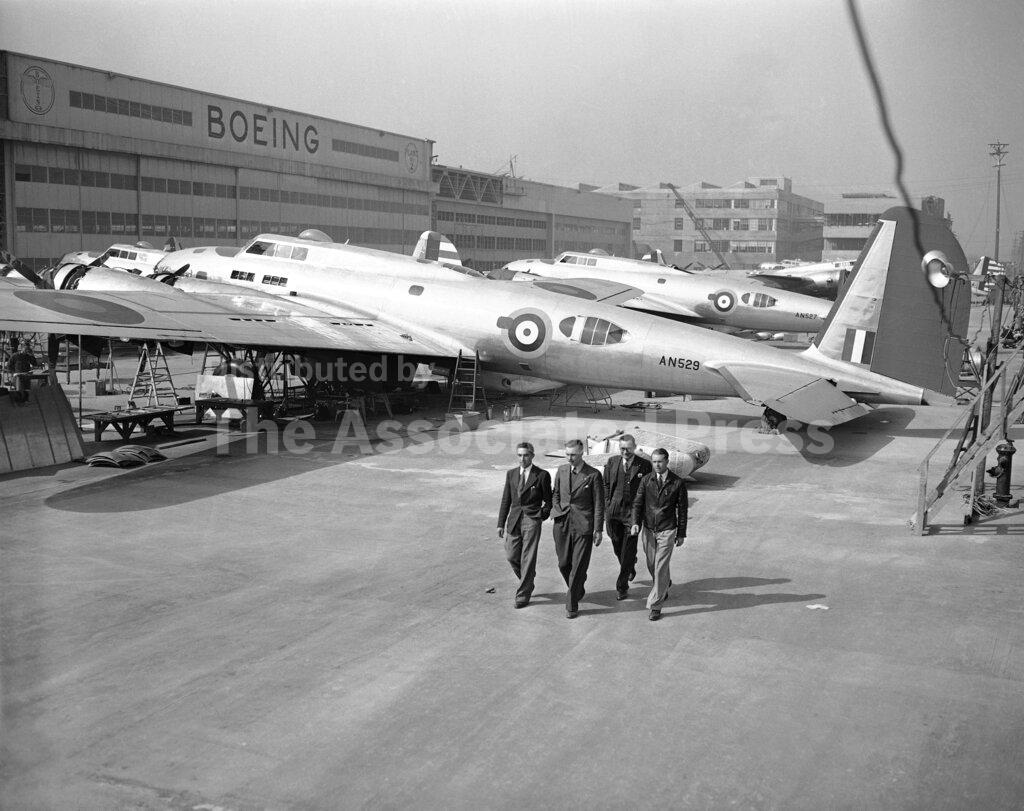
A four-motored B-17 flying fortress bomber. with British airmen at the controls, left McChord field in Washington state late today for Dayton, Ohio, first of 22 Boeing planes scheduled for delivery to the Royal Air Force.
The USN Chief of the Bureau of Aeronautics approved a proposal for establishing a special National Advisory Committee for Aeronautics (NACA) committee to promptly review the status of jet propulsion and recommend plans for its application to flight and assisted takeoff.
The National Gallery of Art in Washington, D.C., is officially opened by President Franklin D. Roosevelt. Nearly 6,000 of the nation’s notables in the fields of scholarship, art and politics walked by invitation through the twelve-ton bronze doors of the new National Gallery of Art tonight to hear President Roosevelt accept it, and the magnificent Andrew W. Mellon and Samuel H. Kress collections, as “symbols of the human spirit and of the world the freedom of the human spirit made.”
U.S. Navy Task Group 9.2, under command of Captain Ellis S. Stone and comprised of the light cruisers USS Brooklyn (CL-40) and USS Savannah (CL-42) and the destroyers USS Case (DD-370), USS Shaw (DD-373), and USS Tucker (DD-374), arrived at Auckland, New Zealand, beginning a three-day goodwill visit.
Heavy cruiser USS Vincennes (CA-44) arrives at Pernambuco, Brazil, en route to her ultimate destination of Simonstown, South Africa (see 20 March).
Coast Guard cutter USCGC Cayuga departs Boston, Massachusetts, with South Greenland Survey Expedition, composed of State, Treasury, War, and Navy Department representatives, embarked. The expedition’s mission is to locate sites of airfields, seaplane bases, radio and meteorological stations and aids to navigation on Greenland’s soil (see 31 March).
Convoy BM.5 departed Bombay with steamers Neuralia (9182grt) and Devonshire (11,275grt), escorted by armed merchant cruiser HMS Hector from 17 to 20 March. Light cruiser HMS Emerald joined on 20 march and was detached on the 23rd. Light cruiser HMS Durban joined on the 22nd. Steamers Jalakrishna (4991grt) and Japapadma (3035 (tons) departed Bombay on the 16th and proceeded independently with lorries, petrol, ordnance, and other stores for the personnel in convoy BM.5. The convoy arrived at Singapore on the 25th.
Dow Jones Industrial Average: 123.46 (+0.06)
Born:
Paul Kantner, American rock singer and guitarist (Jefferson Airplane — “White Rabbit”, “Somebody to Love”; Jefferson Starship — “Miracles”), in San Francisco, California (d. 2016).
Clarence Collins, American doo-wop singer The (Imperials — “Tears On My Pillow”), in Brooklyn, New York, New York.
Wang Jin-pyng, Taiwanese politician, President of the Legislative Yuan, in Rochiku Village, Taiwan.
Died:
Joachim Schepke, 29, German U-boat commander (died in the sinking of U-100).
Nicolae Titulescu, 59, Romanian diplomat and former President of the League of Nations (1930-1932).
Naval Construction:
The U.S. Navy PC-461-class (173-foot steel hull) submarine chaser USS PC-489 is laid down by the Sullivan Dry Dock and Repair Co. (Brooklyn, New York, New York, U.S.A.).
The Kriegsmarine (German Navy) Type VIID U-boat U-218 is laid down by F. Krupp Germaniawerft AG, Kiel (werk 650).
The U.S. Navy Aloe-class net tender USS Buckeye (YN-8; later AN-13) is launched by the Commercial Iron Works (Portland, Oregon).
The Royal Navy LCT (Mk 1)-class landing craft, tank HMS LCT 29 and HMS LCT 230 are launched by Hawthorn Leslie & Co. (Hebburn-on-Tyne, U.K.).
The U.S. Navy Barnegat-class small seaplane tender USS Humboldt (AVP-21) is launched by the Boston Navy Yard (Boston, Massachusetts, U.S.A.).
The Royal Navy Hunt-class (Type II) escort destroyer HMS Badsworth (L 03) is launched by the Cammell Laird Shipyard (Birkenhead, U.K.). She will be transferred to the Royal Norwegian Navy on 16 November 1944 and renamed HNoMS Arendal.
The Royal Navy Fairmile B-class motor launch HMS ML 218 is commissioned.
The Royal Navy Flower-class corvette HMS Dianthus (K 95) is commissioned. Her first commanding officer is Lieutenant Commander (retired) Clement Edward Bridgman, RNR.
The Royal Canadian Navy Flower-class corvette HMCS Kamloops (K 176) is commissioned. Her first commanding officer is T/Lieutenant James Mitchell Gillison, RCNR.
 History Diaries