The Italian Spring Offensive ended in complete failure for the Italians. The Italian Primavera Offensive was called off after 8 days after the Italians had suffered 12,000 casualties. The Italian attack in the sector between the Aoos and Osumi rivers, which had been going on for ten days, is called off. The Italians have lost 12,000 men, and had not gained an inch. However, the Greeks have been compelled by the Italian offensive to do nothing to strengthen their forces which face the German threat elsewhere. The decision to halt the offensive is announced to senior Italian commanders.
The main effect of the Italian attacks so far have been to force the Greeks to keep their troops in Albania rather than transfer them to the Bulgarian frontier, with no ground gained. However, the Italians have not given up their plans, and the silver lining is that the Primavera Offensive at least has stopped the erosion of the front in the center of the line. The Italian attacks at the Trebeshinë heights have made local gains but nothing of strategic value. The Italians regroup and prepare to launch additional attacks in the coming days.
An Axis convoy departs from Naples bound for Tripoli. There are five troopships/freighters with a heavy escort.
At Keren, Eritrea, Italian East Africa, British 2nd West Yorkshire Regiment climbed up the steep mountain to attack Italian positions at Fort Dologorodoc overnight; to the British troops’ advantage, some of the Italian troops had departed from the fort to attack Indian 5th Mahratta Light Infantry Regiment at the base of the mountain, allowing the fort to be captured at 0630 hours after about 2 hours of combat, yielding 400 prisoners of war.
The rest of the day consists of furious Italian counterattacks to recover the fort that gets nowhere, while renewed British attacks to advance beyond the fort also achieve nothing. The valiant attacks by the Alpini, Bersaglieri, and Grenadiers battalions cost the Italians thousands of casualties that they cannot afford.
At Engiahat, two companies of 4/16 Punjab attack the Italian defenders at 13:00, supported by artillery fire. The attack fails when the Indian troops run out of ammunition. Nearby, the 1st Royal Sussex also fails to make any progress with an attack. Engiahat is very well defended with fortifications. The British now suspend operations on the mountain.
In British Somaliland, 2 Indian battalions conducted an amphibious landing at Berbera; the port was defended by only 60 Italian troops, who surrendered without resisting. This is Operation APPEARANCE.
Adolf Hitler gave a Heldengedenktag speech at the Berlin Zeughaus, reviewing Germany’s battlefield performance over the past twelve months and declaring that England would be defeated. Hitler predicted that the United Kingdom would fall by 1942, no matter how much aid it gets from the U.S. Hitler declared that no amount of additional outside help for Britain can wrest final victory from the axis. Germany’s armed forces, he said in a memorial day speech in the historic Zeughaus, or army museum, will take the lead during the spring and summer from the Italians, who bore the brunt through the winter, in wearing Britain down and winning ultimate victory. Facing some 150 field marshals, generals, admirals, higher staff officers and about 100 cabinet members, Reich leaders, gauleiters, black-shirt and brownshirt chiefs and party bigwigs, the fuehrer spoke not in his usual fervent manner, of a man trying to win the German people over to his viewpoint. Instead he spoke calmly, almost monotonously. Hitler grasped both sides of the reading desk and with one exception changed position only to turn the pages of his manuscript. That exception was when, with an emphatic gesture of his right hand and in a raised voice, he said: “No power and no support coming from any part of the world can change the outcome of this battle in any respect. England will fall.” Except for reference to some remarks he said were made before a United States congressional committee that British Prime Minister Churchill had declared in 1936 that Germany was growing too strong and must be destroyed, Hitler did not mention the United States directly.
Berlin and Rome broadcasters, heard by the C.B.S. shortwave listening station in New York last night, denounced President Roosevelt as “one of the worst dictators” and said he was leading the American people into war. In language stronger than any the axis radio stations have broadcast since the presidential campaign last fall, the commentators, speaking their native tongues, said the president was called a dictator “even in his own country.” The Berlin broadcaster said the president “in his speech last night only gave a new edition of his baseless attacks on Germany, Italy and Japan. Roosevelt has embarked on a dictatorial policy of expansion.”
The American embassy in Berlin reported to the State Department today that it had been unable to learn any details of the arrest of Richard C. Hottelet, 23-year-old American newspaperman, in the German capital.
President Roosevelt’s speech in Washington last night was regarded in Italian circles today as one of the strongest against the totalitarian powers ever made by the President. It was so strong that Ezlo Maria Gray, a National Councilor, that is, a member of the Italian Parliament, broadcasting this evening, stated flatly that “regardless of juridical fiction the United States is now at war with the Axis.”
In discussing how he would like to communicate with the U.S. government, Churchill tells Ambassador to the U.S. Lord Halifax that he feels it inappropriate to communicate with any of Roosevelt’s underlings — that is for his ambassador. He refers to the Gallup polls showing that aid to Britain is boosting Roosevelt’s popularity and notes that “although they may not all realize it, their lives are now in this business too.”
Winston Churchill sends a memo to Permanent Secretary to the Treasury Sir Horace Wilson that Ministers should not be “conversing freely” with the Irish De Valera government. This is because “It must be remembered that the German Legation in Dublin is in close touch with several of the Southern Irish Ministers.” In essence, Churchill is accusing the Irish government of being nothing but a nest of spies.
Russian composer and pianist Dmitri Shostakovich receives the Stalin Prize.
Convoys OB.293 and HX.112, heading in opposite directions, are passing each other and essentially have merged for the time being. One of the U-boats that responds to BdU’s signal is U-99 (Otto Kretschmer). Arriving well after dark, Kretschmer initiates one of his classic surface attacks from the middle of the convoy at about 22:00. Firing all eight of his remaining torpedoes at the targets all around him, Kretschmer hits six ships and sinks five:
8,136-ton Norwegian freighter Beduin (sunk, Convoy HX 112, four men perish)
6,593-ton Norwegian tanker Ferm (sunk, convoy HX 112, everyone survives, the tanker breaks in two and the two halves are later sunk by gunfire)
7,375-ton Canadian freighter J.B. White (sunk, two dead)
6,673-ton Swedish freighter Korshamn (sunk, Convoy HX 112, 26 dead)
5,278-ton British freighter Venetia (sunk, Convoy OB 293, everyone survives)
9,314-ton British freighter Franche-Comté (damaged, Convoy HX 112, makes it to Rothesay Bay)
U-99’s attack of 16 March 1941 is one of the classics of U-boat history, and also one of the most successful. However, as soon as he fires the last of his torpedoes, Kretschmer is informed by his Watch Officer that an escort is nearby. The Watch Officer, contrary to standing orders, immediately orders the U-boat to dive. This enables the escorts to locate the U-boat using their ASDIC and close for an attack after midnight on the 17th.
German submarine U-100 became the first submarine to be tracked by radar. It was sunk by HMS Vanoc with depth charges. Only 6 of the 44 crew survived; commanding officer Joachim Scepke went down with U-100. In the same action, U-99 would be scuttled very early the next day after being damaged by HMS Walker; most of the crew survived, including the captain Otto Kretschmer.
A fire broke out on the docked German ocean liner SS Bremen, causing such extensive damage that the ship would be scrapped. Initially thought to be the work of raiders, the arsonist was later said to have been a cabin boy avenging a punishment.
German battlecruisers Scharnhorst and Gneisenau attacked an Allied convoy 950 miles east of Nova Scotia, Canada between 0428 and 1550 hours, sinking or capturing 10 ships. Danish ship Chilean Reefer sent distress signals and returned fire with her deck gun, and was sunk by Gneisenau’s 11-inch shells, killing 9. British battleship HMS Rodney received the distress signals, but arrived only after the German ships had already departed the area.
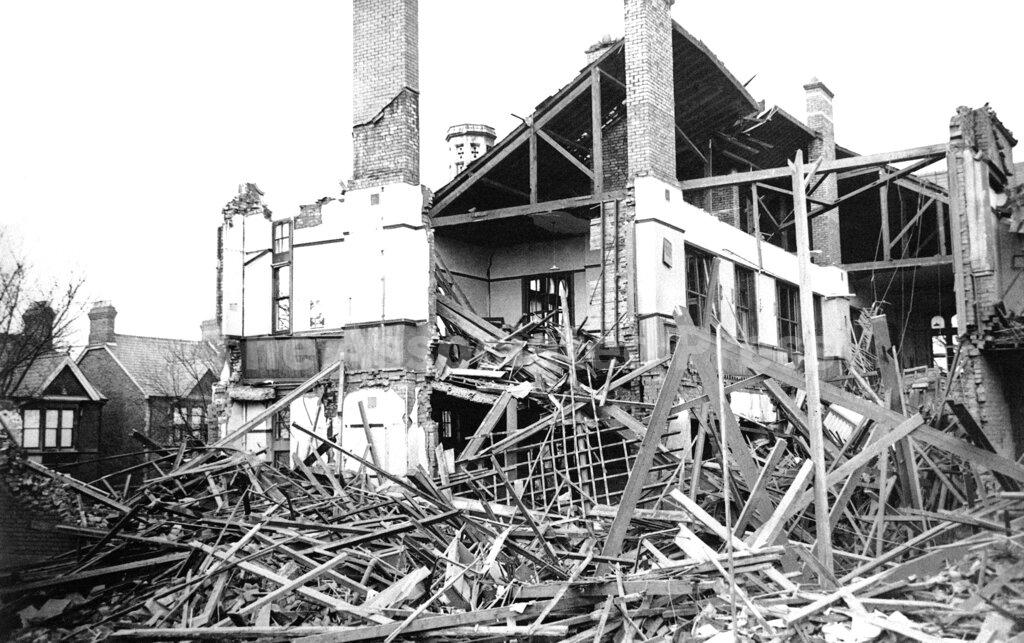
The Luftwaffe shifts its attention from Glasgow in the north to favored target Bristol in the south. It puts 162 bombers over the city, with the heaviest attacks hitting the center of town and Avonmouth docks. There is great damage throughout the city. An estimated 257 perish and 391 are seriously wounded. Fire-watchers dealt with the incendiaries, but there were heavy casualties, many of them caused by a bomb which hit a crowded public shelter.
RAF Bomber Command: Day of 16 March 1941
5 Blenheims to Brittany coast returned because of fog.
U-110, commanded by Kapitänleutnant Fritz-Julius Lemp, in three attacks on convoy HX.112, damaged British tanker Erodona (6207grt) in 61-20N, 17W. Between 0018 and 0022 hours on 16 March 1941, U-110 fired three torpedoes at ships in the convoy HX.112 and reported one tanker sunk and a possible hit on a steamer. In fact, the Erodona in station #11 was hit by a torpedo and exploded when the cargo in tank #4 caught fire. 34 crew members and two gunners were lost. The surviving crew members had to abandon ship but the tanker did not sink. After the fire burnt out the Erodona was taken in tow by HMS Thames to Edisvik near Reykjavik, arriving on 30 March. Due to the extensive damages the temporary repairs lasted until August 1942, when she was towed to Blyth to be fitted with a complete new stern section. The tanker returned to service in February 1944.
U-106, commanded by Kapitänleutnant Jürgen Oesten, sank Dutch steamer Almkerk (6810grt) at 13-40N, 20-30W. On 16 March 1941, U-106 was chasing the convoy SL.68, when the unescorted Almkerk (Master A. Romijn) crossed the path of the convoy and the U-boat. The ship was hit near the bridge by two torpedoes fired from a distance of about 500 metres at 1636 and 1637 hours. The ship sank by the stern after about 15 minutes, witnessed by the ships of the convoy. One lifeboat was picked up by the British steam merchant Martand on 18 March. The other boat landed in Vichy-French Guinea. After some time in captivity, the lifeboat was allowed to depart for Freetown, where it arrived on 30 March.
U-99, commanded by Korvettenkapitän Otto Kretschmer, attacked convoy HX.112, escorted by destroyers HMS Walker, HMS Vanoc, HMS Volunteer, HMS Sardonyx, and HMS Scimitar, and corvettes HMS Bluebell and HMS Hydrangea. Norwegian tankers Ferm (6593grt) and Beduin (8136grt) were sunk by 60-42N, 13-10W. Canadian steamer J. B. White (7375grt) was sunk in 60-57N, 12-27W. British tanker Venetia (5728grt) was sunk in 61-00N, 12-36W. U-99 sank Swedish steamer Korshamn (6673grt) from convoy HX.112 in 61-09N, 12-20W. British tanker Franche Comte (9314grt) was damaged in 61-15N, 12-30W. On 16 March 1941, U-99 attacked the convoy HX.112 several times and sank five ships, Venetia, J.B. White, Ferm, Beduin and Korshamn and damaged the Franche Comte. The U-boat was lost after these attacks very early on the 17th of March.
The Ferm (Master Bernt A. Thorbjørnsen) caught fire after she was torpedoed. All crew members abandoned ship and were picked up by HMS Bluebell (K 80) (LtCdr R.E. Sherwood, RNR). The floating tanker was taken in tow the next day, but she sank in 61°30N/09°30W on 21 March. The 6,593-ton Ferm was carrying fuel oil and was bound for Avonmouth, England, United Kingdom.
Four crewmen from tanker Beduin was lost. The Beduin (Master Hans Hansen) was hit by one torpedo aft of the pump room and later broke in two in 61°20N/11°55W. The forepart was shelled and sunk by a British trawler in 61°02N/11°53W on 19 March, while the afterpart was taken in tow by the tug HMS St. Olaves (W 40) on 18 March but sank two days later in 61°07N/10°50W. On 18 March, 20 survivors were picked up by the British steam trawler River Ayr and landed at Thorshavn the next evening. Ten others were put ashore at Fleetwood by the Icelandic trawler Hilmir on 23 March. The 8,136-ton Beduin was carrying petrol and was bound for Clyde, United Kingdom.
The J.B. White (Master J.W.R. Woodward) was first torpedoed and then sunk by a coup de grâce from U-99 west-southwest of the Faroes. Two crew members were lost. The master and 37 crew members were picked up by the British destroyer HMS Walker (D 27) (LtCdr A.A. Tait) and landed at Liverpool. The 7,375-ton J.B. White was carrying steel and newsprint and was bound for Ellesmere Port, England, United Kingdom.
The master, 37 crew members and two gunners from Venetia (Master Alexander Mitchell) were picked up by HMS Bluebell (K 80) (LtCdr Robert E. Sherwood) and landed at Greenock. The 5,728-ton Venetia was carrying maize and was bound for London, England, United Kingdom.
Twenty five of the crew of the Korshamn were lost. The 6,673-ton Korshamn was carrying general cargo and was bound for Liverpool, England, United Kingdom.
Corvette HMS Bluebell stood by the damaged Franche Comte. The tanker arrived at Rothesay Bay on the 21st.
Heavy cruiser HMS Norfolk arrived at Scapa Flow after convoy escort duties with convoy HX.112.
Destroyer HMS Anthony while under repair at Glasgow was damaged by the near miss of a German bomb. The destroyer spent no further time out of service.
Anti-submarine trawler HMS Lady Lilian (581grt, T/Lt W. K. Rous RNVR) was sunk by German bombing 150 miles west by south of Bloody Foreland.
Anti-submarine trawler HMS Angle (531grt, P/T/Lt R. Wolfenden RNR) was damaged by German bombing 150 miles west by south of Bloody Foreland. The trawler arrived Belfast in tow on the 22nd.
Corvette HMS Aubretia, en route from Greenock to Londonderry, was damaged in a collision with British trawler Goosander (238grt). The corvette was repaired at Dundee from 21 March and completing on 7 April.
Norwegian steamer Elna E. (1174grt) was sunk on a mine eighteen miles southwest of Lundy Island. One crewman was lost on the steamer.
Submarine HMS Parthian torpedoed Italian steamer Giovanni Boccaccio (3141grt) near Palmi in 35-57N, 15-40E. The submarine claimed hitting a second ship, but did not.
Force A was unsuccessfully attacked by two Italian torpedo planes at dusk west of Elaphonisos, thirty miles west of Crete. The Italian bombers reported hitting two large units, probably battleships. No ship was hit.
Anti-aircraft cruiser HMS Bonaventure was detached from the 3rd Cruiser Squadron to arrive at Alexandria at 0600/18th.
Aircraft carrier HMS Formidable departed Alexandria for exercises on 16 and 17 March escorted by destroyers HMS Juno, HMS Jaguar, and HMS Hasty. Destroyer HMS Ilex joined the aircraft carrier from Force A. The British ships returned to Alexandria on the 17th.
Australian destroyer HMAS Voyager departed Alexandria escorting British troopship Ulster Prince (3791grt) and armed boarding vessel HMS Rosaura to Tobruk.
In air operations in the Atlantic, Sub Lt (A) D. M. Ferguson RNVR, and Sub Lt (A) J. K. M. Watt of 818 Squadron from HMS Ark Royal were lost when their Swordfish failed to return from patrol.
Light cruisers HMS Glasgow and HMS Caledon, destroyers HMS Kandahar and HMS Kingston, armed boarding vessels HMS Chakdina and HMS Chantala, Indian patrol boats HMIS Netravati and HMIS Parvati, motor launch ML.109, and two transports landed troops brought from Aden at Berbera in Operation APPEARANCE.
Corvette HMS Asphodel arrived at Gibraltar with two steamers formerly of convoy SL.67.
Corvette HMS Delphinium departed Gibraltar for Freetown en route to Simonstown and the Eastern Mediterranean.
Convoy OB.298 departed Liverpool, escorted by destroyers HMS Chelsea, HMS Mansfield, HMS Vanity, HMS Verity, HMS Veteran, and HMS Wolsey, and corvette HMS Arbutus. Destroyer Vanity was detached on the 28th. On 18 March, destroyers HMS Havelock, HMS Hesperus, and HMS Hurricane joined. The escort was detached on the 20th when the convoy was dispersed.
Action to implement the “all-out” Lend-Lease law with a $7,000,000,000 appropriation is expected to take most of the attention of Congress in the present week. The House will debate the appropriation bill Tuesday, according to present plans. On that day, the House Appropriations Committee, where such appropriations must originate, is expected to report the bill in essentially the form recommended by President Roosevelt and the House will take it up at once. Representative Woodrum, Democrat of Virginia, who will manage the bill on the House floor, expects passage by Wednesday evening. Working on this basis, the Senate Appropriations Committee has planned to begin hearings on the bill Wednesday with the hope of bringing it to the Senate floor the following Monday. Under the looser rules of the Senate opposition to the appropriation can be expressed more extensively than in the House, but Senate leaders tonight felt that such moves would be futile. Senator Taft was expected to lead in the opposition drive with a proposal to cut the appropriation in half. Others who fought the Lend-Lease bill in the Senate were talking about seeking to reduce the direct appropriation to $4,000,000,000 and approving the additional $3,000,000,000 only in the form of contract authorizations.
Eighty-four American religious leaders, in a statement supporting the Hoover plan to provide food for Europe’s conquered democracies, asserted today that “if we produce another generation of shriveled bodies and distorted minds there will be again an unbalanced future.” Expressing belief that the Hoover plan safeguarded the interests of Great Britain and would contribute nothing to Germany, the clergymen added: “There is no Christian reason for continuing among these friendly people the tragedies of famine and epidemic.
Philip Murray conferred with President Roosevelt at the White House today and agreed to present the names of two candidates from the Congress of Industrial Organizations for a new national defense mediation board. The C. I. O. president came here from New York clinging tenaciously to his contention that such a board was the wrong approach to the problem and hoping he might be able to persuade Mr. Roosevelt that the creation of industry councils made up of representatives of labor and management was a better way. The American Federation of Labor has endorsed the idea of a mediation board. Mr. Murray was said to have found the President determined to name a labor mediation defense body. He bowed to the inevitable and promised to have the C. I. O. names at the White House shortly.
A Blizzard hits North Dakota & Minnesota killing 60 people. One of the winter’s worst storms lashed the American Midwest unmercifully over the weekend, killing 60 persons and endangering the lives of an estimated 30 fishermen adrift on ice floes in Lake Superior. The known victims were in eastern North Dakota and western Minnesota where the icy blasts tossed cars from highways Saturday night and yesterday and froze many persons to death as they struggled to find shelter. The winds reached a near hurricane velocity of 85 miles an hour, in some sections.
Sabotaged rails on the main line of the Pennsylvania Railroad one mile east of Baden, Pennsylvania catapulted a five-car eastbound passenger train into the swirling waters of the Ohio River tonight, killing at least four persons, trapping an undetermined number in two partly submerged coaches and injuring at least fifty.
Charging that the Fifth Avenue Coach Company and the New York City Omnibus Corporation had forced the present strike upon their 3,500 employees by refusing to grant any part of their just demands, Michael J. Quill, international president of the Transport Workers Union, C.I.O. affiliate, called upon New York Mayor La Guardia yesterday to withhold police protection if the companies attempted to operate their buses with the aid of strike-breakers.
Legislation providing for a cooling-off period in industrial disputes and standardization of deferment procedure among draft boards for trained men in defense industries were advocated yesterday by Warren H. Atherton, chairman of the national defense committee of the American Legion, in an interview at the Hotel Lexington, Lexington Avenue and Forty-eighth Street in New York.
A force of military pilots, the like of which the world has never seen, is in the making today in the United States. American born, college-trained, physically and mentally the cream of today’s generation, they are flowing in increasing numbers through hundreds of civilian schools and the great Army and Navy air training centers to take their place in the defense lines being set up on this hemisphere’s frontiers.
The non-military expenditures in the Federal budget for the fiscal year 1942 represent an increase of $3,665,197,000 over civil expenditures in 1932, according to a statement issued yesterday by the National Association of Manufacturers in its current News Letter. The statement covered the results of a study of 114 separate categories of Federal spending in non-defense fields.
The National Gallery of Art opens in Washington, D.C.
At the continuing Battle of Shanggao, the Chinese are busy building defensive lines. The Japanese 11th Army prepares to attack on the 17th.
Aided by heavy aerial bombing and strafing, Japanese forces were reported today by Domei, official Japanese news agency, to have launched an offensive on two fronts in Northern Kiangsi Province in an effort to smash an army of 80,000 troops comprising the cream of Generalissimo Chiang Kai-shek’s central forces in the Ninth War Zone. Six columns of Japanese, the agency said, began a westward drive from Nanchang at dawn yesterday and by this afternoon were reported to have captured Fengsin, a stronghold forty miles away. Other Japanese detachments were said to be advancing rapidly along the Chin River Valley, routing Chunking units concentrated in the Ninth Zone. This was the first major activity by Japanese troops in the Nanchang area since October, 1939, when an advance on Changsha was repulsed.
Chinese pilot Wong Sun-sui passed away from wounds sustained during the aerial engagement two days prior at in Sumatou district, Chengdu, Sichuan Province, China.
Born:
Robert Guéï, 3rd President of Ivory Coast, in Kabakouma, Man, French West Africa (d. 2002).
Chuck [Charles Herbert] Woolery, American game show host (“Wheel of Fortune”), in Ashland, Kentucky (d. 2024).
Bernardo Bertolucci, Italian director (“Last Tango in Paris”, “The Last Emperor”), in Parma, Emilia-Romagna, Italy.
Naval Construction:
The U.S. Navy Aloe-class net tender USS Chestnut (YN-6; later AN-11) is launched by the Commercial Iron Works (Portland, Oregon, U.S.A.).
The Nihon Kaigun (Imperial Japanese Navy) destroyer HIJMS Yūgumo (夕雲; “Evening Clouds”), first of her class of 19 (19 more cancelled), is launched by the Maizuru Naval Arsenal (Maizuru, Kyoto Prefecture, Japan).
The Royal Navy Fairmile B-class motor launch HMS ML 172 is commissioned.
The U.S. Navy patrol yacht USS Jade (PY-17, formerly the yacht Athero II, Caroline, and Dr. Brinkley) is commissioned. Her first commanding officer is Lieutenant Commander George L. Hoffman.
 History Diaries