The first phase of the Italian Primavera Offensive ends today, 15 March 1941. At Mussolini’s insistence, ground attacks continue, but the main effort now is Italian artillery barrages. The offensive is a failure, but at least it is not a catastrophe like the opening offensive of the war in October, when the Italians not only failed to advance but were forced to retreat (“We are advancing to the rear!”). The Italian lines hold while the Generals bring up reinforcements and plan new attacks. Responding to recent strong Regia Aeronautica activity, the RAF attacks Italian airfields at Berat and Valona.
Very heavy Italian artillery fire against the Greek positions in Albania conceals the fact that only a few limited initiatives are being made on the ground. Over the following two days, there will be artillery fire only, and no ground attacks. Every Italian assault launched under Premier Mussolini’s newly spurred Albanian campaign to pass the Ides of March with a successful spring offensive was declared beaten back by the Greeks tonight, and in Athens he was called a “bogus Caesar.” This was the day Mussolini had set, according to the stories of captured Fascist prisoners as given out by Greek government spokesmen, as the deadline for his generals in Albania to “do something” so that he could go home and announce a victory. Instead, said Greek military dispatches from the front, a week-long general Italian attack had been smashed with heavy losses for the Fascists, despite their use of fresh troops from Italy and the heaviest concentrations of weapons.
Mussolini knows by this point that he cannot lose this war because the Wehrmacht is just over the horizon and the weather is improving. However, if he is to regain any semblance of equality with Hitler, Mussolini must pull off some kind of military achievement in the few weeks that remain before the German tide washes over the battlefield. Thus, he has every incentive to throw his men into further pointless battles that wash the mountain crags and gullies with their blood, in the vague hope that suddenly his troops will find some weakness in the Greek lines and turn a disaster into an honorable campaign.
The Indian 4th and 5th Divisions attacked Italian positions at 0700 hours near Keren, Eritrea, Italian East Africa, capturing hilltops on either side of the gorge after an entire day of fighting in which both sides suffered heavy casualties.
Lieutenant-General William Platt finally has his forces arranged to attack the Italian strong point of Keren again. At 07:00, the 4th Indian Infantry Division begins attacking from Cameron Ridge, on the left side of Dongolaas Gorge. Their objectives are Sanchil, Brig’s Peak, Hog’s Back and the three peaks of Mount Sammana — essentially, the heights overlooking the gorge. The main problem for the Indian troops is that there is no cover — they are exposed to Italian fire from above, and often from all sides. Both sides take heavy casualties in this attack. The RAF sends Blenheim and Wellesley bombers over the battlefield, but bombs do little against the rocks and gravel.
On the right side of the Dongolaas Gorge, the 5th Indian Infantry and 2nd Highland Light Infantry also attack. As on the left, the problem for the British is the fact that the Italians have the high ground and can shoot down on soldiers advancing over bare rock. The British forces make little progress on this site, either. However, after dark, the 9th Brigade makes progress and attacks the Pimple and Pinnacle features. After a vicious battle, the Indian troops take the Pinnacle. However, the Italian forces at Fort Dologorodoc remain intact and plan a counterattack in the morning.
While Platt attacks the strong Italian defenses at Keren, he also wants to flank the strong point and cut its lines of communications. The Indian troops of 4/16 Punjab probe the Italian defenses on Engiahat and find them to be very strong. The British bring up artillery for an assault on Engiahat, while a Foreign Legion battalion moves up to occupy Mount Gegghiro and free troops for the assault on Engiahat.
Winston Churchill to the Admiralty controller: “Give me a report on the progress of the ships to carry and disgorge tanks. How many are there? What is their tonnage? How many tanks can they take in a flight? When will each one be ready? Where are they being built? What marks of tank can they carry?”
President Roosevelt’s latest personal representative to England, Averell Harriman, arrives in London (via Lisbon) and greets Churchill. Harriman knows Churchill since 1927, and they also met at the New York Stock Exchange during the Wall Street Crash of 1929 when Churchill was on a tour of the United States and Canada (Churchill lost a relatively small sum of money in the crash). Harriman tells Churchill that requested war supplies might not necessarily be forthcoming “unless our military chiefs were persuaded that Britain could make better use of the material” than the US military. Thus, “Washington would need a lot more information about Britain’s war plans and prospects” because assistance could see a “large increase.”
Prime Minister Winston Churchill writes a memo to the Foreign Office in which he says of Vichy France’s No.2 man, “Darlan is a bad man, with a narrow outlook and a shifty eye. A naval crook is usually a bad kind of crook.”
British actress Doris Hare marries Dr. J. Alexander Fraser Roberts at St. Paul’s Church, Convent Gardens.
Belgian politicians formed the cross-party resistance organization Independence Front at Liege.
The Vichy French government considers its North African possessions to be solid. In fact, today they announce plans to finish train tracks between Algeria and Dakar.
The Allies began Operation SAVANNA, with the goal of landing Free French paratroops into German-occupied France to ambush and kill as many pilots of the Kampfgeschwader 100 as possible.
The American journalist Richard C. Hottelet was arrested by the Gestapo in Berlin on suspicion of spying. The arrest in Berlin of Richard C. Hottelet, an American employee of the United Press, “on strong suspicions of espionage” in favor of “an enemy power” was announced today by DNB, the official’ German news agency. The United States, said authorized sources, “naturally is not an ‘enemy power,’” and they added that “the alleged espionage activities were not in connection with journalistic work.” As to the specific accusation, they said, “the trial will bring that out.” Hottelet, who is in his early 20’s, came from Brooklyn, and had taken a year of graduate work at Berlin University. There were indications that a preliminary hearing would be held tomorrow. Authorized sources declared that Hottelet’s arrest should not be regarded as in reprisal for the arrest of representatives of Trans-Ocean (a German world-wide news service) in New York. They said that action against him had been taken in connection with personal and private activities in no way connected with his work as a newspaperman.
On personal instructions of President Roosevelt, the State Department today ordered the United States Embassy in Berlin to investigate the arrest by German officials of Richard C. Hottelet of the United Press staff in Berlin and to take any appropriate action on the case.
As part of the command shuffle before Operation Barbarossa, Field Marshal von Witzleben replace Field Marshal Gerd von Rundstedt as OB West. Von Rundstedt, highly respected by Hitler, is set to command the southern thrust of the German invasion of the Soviet Union.
Many historians believe that plans for the systematic murder of the Jews was first decided on, or about, this date, in preparation for the invasion of Russia.
Adolf Hitler has sent Reichsmarschall Hermann Göring to the west for the time being. There is a minor strategic reason for this: Hitler wants the Reichsmarschall’s presence there to reinforce among the British the impression that the Wehrmacht still is planning an invasion — when, in fact, Hitler’s eyes have drifted in the opposite direction entirely. The Allies will use the same technique in 1944 when they use General George Patton, Jr. as a decoy for the Normandy landings.
Göring has no problem with serving as a decoy. In fact, he revels in it. Göring spends his time in Paris, The Hague, and Amsterdam, essentially doing nothing of importance to the war effort. He is not particularly interested in his command, the Luftwaffe, which actually is benefiting from his absence and making some progress in the Blitz with massive raids against smaller cities. Instead, Göring whiles away his days in art galleries, buying marked-down art from Jews nervously looking over their shoulders and hoping that their “assistance” to the Reichsmarschall can get them exit visas to neutral Switzerland.
Paris art collectors have had the dubious honor of receiving Göring. He is here to pick for himself the best of the privately owned works of art which Hitler has ordered to be considered as war booty — to be used as a bargaining weapon in future peace negotiations with France. He has already chosen works by Rembrandt, Rubens and Goya from the stock of stolen art work stored at the Louvre and the Jeu de Paume. They will be taken to Karinhall, his mansion near Berlin. Soon after the German occupation Alfred Rosenberg, the Nazi Reichsleiter for home affairs, set up a special organization to bring works back to Germany. By the autumn, Rosenberg estimated that some 22,000 objects of value had been “collected”, including 5,281 paintings and 2,477 pieces of furniture. Special care has been taken to seize Jewish-owned works of art. The assets of the Rothschild banking family, whose members fled the country when the Nazis came, have been rushed to Germany in special trains.
Battleship Bismarck received two aircraft at Scheerhafen, Kiel.
Italian Navy’s Special Weapons Section of 1a Flottiglia MAS, based at La Spezia in Italy, was renamed 10th MAS Flotilla, which served only as a cover name as the special forces function of the unit would not change.
Lisbon has become the clearinghouse of Europe. As referenced in the classic Humphrey Bogart movie “Casablanca,” it is the neutral waystation for travel between Occupied Europe and Great Britain or the Americas. Lisbon is a place packed with agents from both sides, one of the few places that German officials and British agents can watch each other directly. While there are other routes out of Europe, Lisbon is the main embarkation point, both by ship and plane. As such, it is a highly desired destination for people hoping to book travel to far-off climes, either permanently or for business or other personal purposes. This demand is putting a tremendous strain on the city’s infrastructure, with refugees having to wait long time periods for tickets out or even to find primitive lodgings while they wait.
Today, American Export Lines, one of the main shipping lines able to pass through the blockade being imposed by both sides, announces that it is fully booked for the foreseeable future. It will no longer take reservations.
German submarine U-124 made rendezvous with armed merchant cruiser Kormoran 650 miles southwest of Cape Verde Islands and received 7 torpedoes and other supplies.
German submarine U-110 detected Allied convoy-112, consisted of 41 merchant ships escorted by 7 warships, and shared the finding with U-37, U-74, U-99, and U-100. Overnight, U-110 set British tanker Erodona on fire with a torpedo, killing 36, but she would be towed to Iceland for repairs.
German battlecruisers Scharnhorst and Gneisenau attacked an Allied convoy 950 miles east of Nova Scotia, Canada, sinking 3 tankers (killing 7, most of the survivors were captured) and capturing 3 tankers.
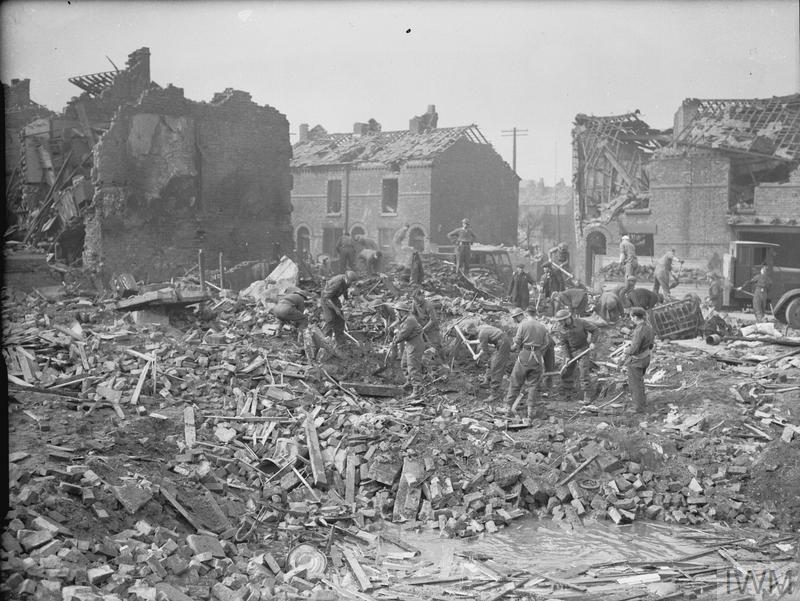
Glasgow and Clydebank begin recovering from the Clydebank Blitz of 13-15 March. The authorities later calculate that 528 people have been killed and 617 seriously injured in Clydebank, and 1200 killed and 1100 seriously injured in all of Clydeside. Glasgow is calculated as having about 650 people killed. The massive number of people made homeless in Clydebank are dispersed to surrounding localities.
The Luftwaffe attacks London with 101 bombers, losing two Heinkel He 111s.
RAF Bomber Command: Day of 15 March 1941
4 Blenheims on coastal sweep; shipping bombed off Think-irk and Ostend. No losses.
RAF Bomber Command: Night of 15/16 March 1941
Lorient, Dusseldorf
37 Wellingtons and Whitleys to Lorient submarine base but haze prevented accurate bombing. 21 Hampdens to Dusseldorf 5 Blenheims on a ‘special operation’, probably airfield Intruder work. 4 of them bombed Vannes airfield. There were no aircraft losses on this night.
Operating in the Atlantic shipping lanes near the Cape Verde Islands, German heavy cruisers Gneisenau and Scharnhorst only have a few days left to find targets. Scheduled to head to Brest on the 18th, they have little time to find more victims. Normally, a few days at sea in the vast Atlantic would pass without incident, and the ships would make a quick run to the coast. However, Admiral Lütjens gets lucky. With his two tankers trailing him, Lütjens spots a dispersed convoy and decides to go to work. German battlecruisers Scharnhorst and Gneisenau sank British ships from dispersed convoy OB.294, which had departed Liverpool on the 5th and dispersed on the 9th.
Tanker British Strength (7139grt) was sunk in 42N, 43W by Scharnhorst. Two crewmen were killed on the tanker. The rest were taken prisoner.
Tanker Simnia (6197grt) in 40-28N, 43-30W was sunk by Gneisenau. Three crewmen were killed. The rest were taken prisoner.
Tanker San Casimiro (8046grt) in 39-58N, 43-19W was captured by Gneisenau and scuttled on the 20th at position 45-12N, 19-42W. The Master and the gunners were taken prisoner. The rest of the crew remained on the tanker. On 20 March, when sighted by British aircraft and battlecruiser HMS Renown, the tanker was scuttled by the German prize crew. in 45-12N, 19-42W.
Steamer Royal Crown (4388grt) in 42N, 43W by Gneisenau. The entire crew was rescued.
Steamer Myson (4564grt) in 42N, 43W by Gneisenau. The entire crew was rescued.
Steamer Rio Dorado (4507grt) in 42N, 43W by Gneisenau. The entire crew was lost.
Tanker Athelfoam (6554grt) in 42-00N, 43-25W by Scharnhorst. One crewman and one gunner were lost, the rest taken prisoner.
Norwegian tanker Polykarp (6405grt) was captured by Gneisenau in 45-40N, 23-26W on the 15th, and reached the German-occupied Gironde on the 24th.
Norwegian tanker Bianca (5688grt) was captured by Gneisenau on the 15th. The entire crew was rescued. On 20 March, the tanker was intercepted by battlecruiser HMS Renown in 44-16N, 19-21W. The tanker was scuttled by the German prize crew.
The attacks continued on the 16th on further ships of the dispersed convoy OB.294 and two ships of dispersed convoy OB.292 which had departed Liverpool on 27 February and dispersed 6 March.
Steamer Sardinian Prince (3491grt) in 44N, 43W by Scharnhorst. The entire crew was taken prisoner.
Dutch steamer Mangkai (8298grt) in 44N, 43W by Scharnhorst. Some of the crew was taken prisoner.
Steamer Silverfir (4347grt) in 42N, 43W by Scharnhorst. One crewman was lost. The rest were taken prisoner of war.
Steamer Empire Industry (3721grt) of OB.272 in 42N, 43W by Gneisenau. The entire crew was taken prisoner.
Norwegian steamer Granli (1577grt) of OB.292 was sunk by Gneisenau 300 miles east of Newfoundland. The entire crew was rescued.
Steamer Demeterton (5251grt) in 45-58N, 44-00W by Scharnhorst. The entire crew was taken prisoner.
Independent steamer Chilean Reefer (1739grt) 46-13N, 44-45W by Gneisenau. Seven crew and two gunners were lost from the steamer. Three crewmen were taken prisoner. The rest were rescued by British ships.
Steamer Chilean Reefer was able to send off an SOS which was picked up by Battleship HMS Rodney. Battleship Rodney turned convoy HX.114 over to battleship HMS Royal Sovereign, which was in the area in transit, and made for the position of the SOS.
Minesweeper HMS Britomart (Lt Cdr J. M. S. Cox DSC) was damaged by German bombing in Rye Harbour. Cox and Lt P A Block RNR were killed on board. She was escorted to Portsmouth by minesweeper HMS Sharpshooter and repaired there from 16 March to 29 May.
Monitor HMS Marshall Soult was damaged by German bombing while berthed in Portsmouth Harbour, but remained in service.
Submarine HMS Thunderbolt, which departed Halifax on the 10th, and armed merchant cruiser HMS Laconia of convoy HX.115 and SC.25 were sent to investigate.
Submarine HMS Severn, which departed Halifax on the 11th for Freetown, was also in the area. After unsuccessful searching, submarine Severn proceeded on her voyage to Freetown.
Battleship HMS Rodney, escorting convoy HX.114, sighted battleship Gneisenau which made off at high speed and no action ensued.
German cruiser Admiral Hipper, meanwhile, has been at Brest for a month. It requires a major overhaul in Germany. Taking advantage of the attention drawn by Operation Berlin to the south, the Germans send it on its way during the day. It is bound for the Denmark Strait, then Norway. The British are completely aware of its departure.
German battleship Bismarck continues receiving supplies for its highly anticipated Atlantic raiding expedition. Today, it takes on board its two Arado Ar-196 scout planes at Scheerhafen, Kiel.
The German supply network in the Atlantic remains functional and highly useful for operations. Today, U-124 (Kptlt. Georg-Whilhelm Schulz), operating about 1000 km southwest of the Cape Verde Islands, meets German raider and supply ship Kormoran. The ship wants to give U-124 seven torpedoes and other supplies such as food and fuel. This will enable U-124 to remain at sea when otherwise it would have to return to port. These lengthened voyages are a boon to the U-boat fleet, greatly magnifying its effectiveness. This particular exchange, though, is prevented for the time being by rough seas, so the ships head south looking for tranquility.
U-110 (Kptlt. Fritz-Julius Lemp) spots a convoy south of Iceland. It is Convoy HX.112. Lemp alerts U-boat command, BdU, which begins assembling a Wolf Pack.
Battleship HMS Nelson, light cruiser HMS Nigeria, and destroyers HMS Boadicea, HMS Escapade, and HMS Active were dispatched to the south of Iceland to attempt to intercept the German battlecruisers as they attempted to return home. On 16 March, destroyer Boadicea lost a rating overboard. Light cruiser Nigeria located armed merchant cruiser HMS Alaunia, en route to Reykjavik on the 16th.
Destroyers HMS Boadicea, HMS Escapade, and HMS Active were sent to Reykjavik at 0900/17th to refuel after destroyers HMS Cossack, HMS Maori, and HMS Zulu rejoined the HMS Nelson group. Destroyer Boadicea, Escapade, and Active rejoined at 1447 on the 18th. The Nelson group were joined on the 21st by battleship HMS Queen Elizabeth, heavy cruiser HMS London, and destroyers HMS Inglefield, HMS Electra, HMS Arrow, HMS Echo, HMS Eclipse, and HMS Eskimo which departed Scapa Flow at 0515/19th. Battlecruiser HMS Hood departed Rosyth on the 18th and joined this force off Dunnett Head at 0630. Heavy cruiser London was detached after radio direction finding tests.
Light cruisers HMS Nigeria of the 10th and HMS Edinburgh of the 18th Cruiser Squadrons operated to the south of the Battleships. Light cruiser Edinburgh and destroyers HMS Somali, HMS Bedouin, HMS Matabele, and HMS Mashona departed Scapa Flow for Greenock at 1100/20th for escort duty with convoy WS.7.
Destroyer HMS Arrow was detached to Londonderry to refuel on the 21st.
Submarine HMS L.27 departed Portsmouth to attempt to intercept the German ships. Dutch submarine HNLMS O.24 and Submarine HMS Oberon departed Rothesay to patrol off Wolf Rock.
Destroyers HMS Cossack, HMS Maori, and HMS Zulu were detached from the Commander in Chief’s force in 59W, 20W to refuel in Reykjavik.
Light cruiser HMS Edinburgh and destroyers HMS Somali, HMS Bedouin, HMS Matabele, and HMS Mashona arrived in the Clyde at 0751 on the 22nd. Light cruiser HMS Nigeria arrived at Scapa Flow at 1938 on the 22nd. Battleship HMS Nelson and destroyers HMS Active, HMS Boadicea, and HMS Escapade arrived at Scapa Flow at 0031 on the 23rd. Battlecruiser HMS Hood, battleship HMS Queen Elizabeth, and destroyers HMS Inglefield, HMS Electra, HMS Eskimo, and HMS Echo arrived at Scapa Flow at 0658 on the 23rd.
On 19 March, ocean boarding vessels HMS Hilary and HMS Corinthian on Western Patrol were ordered to attempt to intercept the captured whale factory ships as they proceeded to French ports.
Tug Warrior (249grt), towing Norwegian tanker Ferncourt (9918grt), was damaged on a mine at the entrance to River Cart in the Clyde. The tug beached at Renfrew. The tug was later refloated and taken to Glasgow for repair.
Belgian steamer Eminent (500grt) was sunk on a mine in 52-32N, 5-37W. The entire crew was rescued.
British Force A arrived at Suda Bay to refuel at dawn on the 15th. Destroyers HMS Mohawk and HMS Nubian rejoined Force A. Force A departed Suda Bay later that day. During the night of 15/16 March, Force A covered convoys GA.5, ASN 20, and AS.19 passing through Kithera Straits.
Heavy cruiser HMS Dorsetshire arrived at Simonstown.
Tug Chabool, manned by Lt J. L. Mumford RNR and crewed by seven ratings from light cruiser HMS Glasgow, departed Aden for Berbera. She was never found and all hands lost.
Convoy HX.112 was escorted by destroyers HMS Walker, HMS Vanoc, HMS Volunteer, HMS Sardonyx, and HMS Scimitar and corvettes HMS Bluebell and HMS Hydrangea.
Convoy GA.5 (there was no GA.3 or GA.4) of five British and three Greek ships departed Piraeus for Alexandria and Port Said escorted by destroyers HMS Decoy and HMS Wryneck. Steamer Cingalese Prince departed this convoy on the 16th and joined anti-submarine whaler HMS Southern Maid for Tobruk to embark motor transport. The convoy arrived at Alexandria on the 17th.
At the White House Correspondents’ Dinner, President Roosevelt made a speech promising aid to the British and their allies “until total victory has been won..” At a crowded dinner of the White House Press Correspondents Association, President Franklin Roosevelt, in a trenchant speech that was beamed to Europe in fourteen languages, promised America would supply the needs of the British and Greeks with ships, planes, and food. This was fighting talk but somewhat specious fighting talk, for that he was making public promises that he was powerless to keep at the moment. Roosevelt said here tonight that there is no longer the slightest doubt that the American people have demanded a policy of all-out, unqualified aid for Britain, Greece, China and the governments of the democracies in exile. Prussian autocracy was bad enough, the President told the White House correspondent’s dinner in a key address, but “Nazism is far worse.” Mr. Roosevelt spoke of the “vital bridge across the ocean, the bridge of ships” carrying good and arms to “those who are fighting the good fight.” He promised that the US will supply Britain and the Allies “aide until victory” and that there will be an “end of compromise with tyranny.” Warning that sacrifice and inconvenience lie ahead for all, Roosevelt made a “total victory” over the dictators the objective of an American sustained, to place the implements of warfare in the hands of nations resisting aggression. “You will feel the impact of this gigantic effort in your daily lives,” he said in an address before the White House Correspondents association. “You will feel it in a way that will cause you many inconveniences.” The nation must be prepared for lower profits and longer hours of labor, he said. The arms program must not be obstructed by “unnecessary strikes.” The idea of “normalcy” and “business as usual” must be abandoned. There must be “no war profiteering.” As the president spoke, he stood between two flags the American flag and the blue flag that symbolized the highest office in the land. He was frequently interrupted by applause, and particularly when he said that arms production should not be obstructed by “unnecessary strikes” or “by short-sighted management.” Reaching the middle portions of his address, his voice began to rise, in contrast with the previous portion which had been delivered in & low intimate tone.
He promises, among other things, that the British and Chinese will get what they need to fight aggression, that is, “aid until victory” with no compromise. It is quite a bellicose speech for the leader of a nation that is not at war — at least militarily. The speech is recorded for rebroadcast by the BBC and ultimately is translated into over a dozen languages. He promises “total victory.”
Wendell Willkie called President Roosevelt’s address tonight an enunciation of the “aspirations of America,” but said the chief executive could better attain his objectives “if he could now bring himself to delegate authority to a real defense commission.’ “The real need now,” the 1940 Republican presidential candidate said, “is organization and work carried on in the spirit of national unity “total effort,” unflaggingly Lend-Lease bill by congress as a decision ending “any attempts at appeasement in our land; the end of urging us to get along with the dictators; the end of compromise with tyranny and the forces of oppression.”
A $7,000,000,000 cash outlay to finance the British- aid program won quick approval today of a House Appropriations subcommittee intent on demonstrating that an aroused democracy can act swiftly. Frankly dispensing with protracted hearings because of the psychological effect that speedy action might have abroad, the legislators stamped their okay on the huge fund after only two days of secret hearings in which they received testimony from cabinet officers and other high-ranking government officials.
A proposal for the United States to supervise distribution of food in unoccupied France was discussed today in a series of conferences between American, British and French officials. Disclosing this, informed sources emphasized that the United States was acting only as a “friendly intermediary,” was advancing no proposals of its own and was exerting no pressure on either of the other governments. Viscount Halifax, the British ambassador, and Gaston Henry-Haye, the French ambassador, conferred with Secretary Hull on the food problem for an hour, each presenting the viewpoint of his government on French proposals that the British relax their blockade and permit wheat to be purchased here and transported to unoccupied France. The French ambassador, after his talk with Hull, told newspapermen he was hopeful there was now “a realization of the true situation” and that an agreement might soon be achieved.
In a world in turmoil, Attorney General Jackson told Congress today, the policy of the United States for deportation of undesirable aliens must be radically changed by legislation. He said that, although deportation warrants had been issued against more than 8,000 aliens, more than 6,000 of these cannot be ejected “because of conditions beyond our control.” In the period of “world disorder,” he declared, the government must cease to rely solely upon deportation for protection of society against the unwanted aliens and must instead adopt a “realistic” policy based on conviction that deportation is now “impracticable.” He asked that criminal aliens be confined pending deportation, while those deportable on technical grounds be released on parole. He urged that an independent government board of “dignity and standing” be created to examine the cases of all those subject to deportation. Mr. Jackson’s views were expressed in a letter to Chairman Sumners of the House Judiciary Committee, which has before it a bill covering detention and deportation changes.
The American Legion’s national executive committee today urged “all practicable aid” to embattled Britain, the feeding of German-occupied countries and laws to settle labor disputes and prevent profiteering in United States defense work. These recommendations were in resolutions adopted at the close of a two-day special meeting of the 58-man group at national headquarters, at which reports were heard from the Legion’s mission to England and its defense committee.
The battleship North Carolina, first of its class to be completed in this country in eighteen years, will be commissioned at the Navy Yard in Brooklyn April 9, it was learned today.
A blizzard hits North Dakota and Minnesota after a day of mild temperatures. It results in about 68 deaths. The storm comes under the category of “Alberta Clippers,” which are fast-moving storms of brief duration.
“Song Of The Volga Boatmen” by Glenn Miller and his Orchestra reaches Number 1 on the Billboard Pop Singles chart in the U.S. This song, which debuted on the charts on 22 February 1941, was charted for 8 weeks, was Number 1 for 1 week and was ranked Number 10 for the year 1941.
In Monterrey, Mexico, 6,000 fans watch the St. Louis Browns top the Boston Bees, 6–3. Chet Laabs, fighting to win the right field spot, hits a 400-fit homer in the 7th.
Tug Chabool departs Aden bound for Berbera. It is never seen again. No survivors.
Japanese troops launched an offensive towards Shanggao, Jiangxi Province, China. Japanese forces take Fengxin, in Kiangsi province. The Japanese have begun a new offensive toward Shanggao, Jiangxi Province, China. Today, the Japanese 11th Army attacks and takes the headquarters of the Chinese 19th Army, occupying Fengshin and heading toward Tucheng and Kaoan. The Chinese launch a vicious airstrike against the Japanese, destroying their supplies of food and ammunition. This slows the Japanese down and gives the Chinese defenders time to dig trenches, build concrete bunkers and form a solid new defensive line. There now are 65,000 Japanese troops facing 100,000 Chinese.
The outcome of a dispute between Japanese and British-American interests in the once thriving China coast port of Amoy, now made moribund by the Chinese-Japanese war, may determine whether the Japanese will attempt soon to gain complete control of the foreign concessions in Shanghai, Tientsin and elsewhere in China.
Convoy ZK.1 departed Brisbane with two coastal steamers escorted by armed merchant cruiser HMS Manoora. The convoy arrived at Port Moresby and Rabaul. In April and July to September, three more convoys were run.
Wirraway A20-132 of 12 Squadron RAAF crashes and bursts into flames at the Adelaide River Railway Station. There are two deaths. The cause of the crash is unexplained, or, as the Australian review board puts it, “obscure.” The remains of the crash are on display at the Adelaide River Railway Station Museum.
The British and Australian governments agree to a visit to Australia by the cruiser squadron being led by Rear Admiral John H. Newton in USS Chicago. The U.S. cruisers will arrive at Sydney on 20 March 1941.
Dow Jones Industrial Average: 123.4 (+0.65)
Born:
Mike Love, American vocalist and co-founder (Beach Boys — “Fun, Fun, Fun”; “California Girls”), in Los Angeles, California.
Bob Petrich, AFL defensive end (AFL champions-Chargers, 1963; San Diego Chargers, Buffalo Bills), in Long Beach, California.
Johnny Baker, AFL linebacker and tight end (Houston Oilers, San Diego Chargers), in Coy, Alabama.
Died:
Alexej von Jawlensky, 77, Russian expressionist painter.
Naval Construction:
The Royal Navy Algerine-class (Turbine-engined) minesweepers HMS Alarm (J 140) and HMS Algerine (J 213) are laid down by Harland & Wolff Ltd. (Belfast, Northern Ireland).
The Kriegsmarine (German Navy) Type IXC/40 U-boat U-168 is laid down by Deutsche Schiff und Maschinenbau AG, Bremen (werk 707).
The Kriegsmarine (German Navy) Type IXD2 U-boat U-181 is laid down by AG Weser, Bremen (werk 1021).
The Kriegsmarine (German Navy) Type VIIC U-boat U-210 is laid down by F. Krupp Germaniawerft AG, Kiel (werk 639).
The Royal Navy Flower-class corvette HMS Vetch (K 132) is laid down by the Smiths Dock Co., Ltd. (South Bank-on-Tees, U.K.).
The Nihon Kaigun (Imperial Japanese Navy) Akizuki-class destroyer HIJMS Suzutsuki (涼月, “Clear Moon (in Autumn)”) is laid down by the Mitsubishi Nagasaki Shipyard (Nagasaki, Japan).
The U.S. Navy Aloe-class net tender USS Chestnut (YN-6; later AN-11) is launched by the Commercial Iron Works, (Portland, Oregon, U.S.A.)
The U.S. Navy Aloe-class net tender USS Mimosa (YN-21; later AN-26) is launched by the American Shipbuilding Co. (Cleveland, Ohio, U.S.A.).
The Royal Navy Isles-class minesweeping trawler HMS Rysa (T 164) is launched by Cochrane & Sons Shipbuilders Ltd. (Selby, U.K.); completed by Amos & Smith.
The Royal Navy MMS I class motor minesweeper HMS MMS 40 (J 540) is launched by the Richards Ironworks Ltd. (Lowestoft, England, U.K.).
The Royal Navy Bangor-class (Reciprocating-engined) minesweeper HMS Sidmouth (J 47) is launched by Henry Robb Ltd. (Leith, U.K.); completed by Plenty.
The Royal Navy Dance-class ASW trawler HMS Quadrille (T 133) is launched by Hall, Russell & Co. Ltd. (Aberdeen, Scotland).
The Kriegsmarine (German Navy) Type VIIC U-boat U-82 is launched by Bremer Vulkan-Vegesacker Werft, Bremen-Vegesack (werk 10).
The Kriegsmarine (German Navy) Type VIIC U-boats U-433, and U-434 are launched by F Schichau GmbH, Danzig (werk 1474 and 1475).
The Royal Navy “U”-class (Third Group) submarine HMS Umbra (P 35) is launched by Vickers Armstrong (Barrow-in-Furness, U.K.) .
The Royal Navy Flower-class corvette HMS Bryony (K 192) is launched by Harland & Wolff Ltd. (Belfast, Northern Ireland).
The Nihon Kaigun (Imperial Japanese Navy) Kagerō-class destroyer HIJMS Maikaze (舞風, “Dancing Wind”) is launched by the Fujinagata Shipyards (Osaka, Japan).
The Royal Navy Fairmile B-class motor launch HMS ML 202 is commissioned.
The Royal Navy Higgins 70 foot-type motor gunboat HMS MGB 70 is commissioned.
The Royal Navy Bar-class boom defense vessel HMS Barmill (Z 67) is commissioned.
The Royal Navy Bar-class boom defense vessel HMS Barrymore (Z 73) is commissioned.
The Kriegsmarine (German Navy) Type VIIC U-boat U-371 is commissioned. Her first commanding officer is Oberleutnant zur See Heinrich Driver.
 History Diaries