The Italian offensive in Albania continues, as new attacks on Monastery Hill meet the same fate as earlier attempts. Two Allied planes strafe the mountain on which Mussolini is observing the battle. Though never really in danger (as the bullets fall hundreds of yards away) he is the last man to enter the shelter. Renewed attempts by the Giulia alpini division on the Golico heights south of the Vojussa river suffer heavy casualties, so much so that in the coming week there will be instances of the Giulia alpini refusing to advance on further attacks. The Giulia Division was involved in some of the toughest fighting of the Greek campaign, from the very first day, and proved their mettle in difficult circumstances, but they have also demonstrated an alarming independence of thought when they disagreed with Fascist policies or Army orders. On the other flank of the offensive, the Pusteria alpini also sustain painful losses in a fresh push. In five days of fighting, the Italians have lost 12,000 men killed or wounded while gaining nothing. This forces Mussolini to consider ending the offensive, a course urged by his Chief of the General Staff, Cavallero. On the same day, 5 British Swordfish torpedo bombers from Paramythia, Greece struck Valona (Vlorë), Albania, sinking Italian hospital ship Po and ship Santa Maria at the loss of one aircraft.
Mussolini, watching the activity from a mountain with a good view of Monastery Hill in the center of the line, is frustrated. However, things could be much worse for him than simply feeling bad about his troops’ difficulties. Two Allied airplanes suddenly strafe the mountain that he is standing on. Everyone rushes to the shelter — and leave Mussolini behind to enter last. It is both a lucky escape and a commentary on the people surrounding him and their view of their leader.
Italian Chief of the Supreme Command General Ugo Cavallero has seen enough. He urges Mussolini to end the offensive and go over to the defensive. Mussolini, however, urgently wants to have some sort of Italian victory before the start of the German offensive from Bulgaria.
An Axis convoy of three freighters and three Italian destroyers departs from Tripoli bound for Naples. A five-transport convoy also departs from Naples bound for Tripoli.
Lieutenant-General William Platt has been stymied in front of Keren and its narrow entrance, the Dongolaas Gorge, for over a month. He has used that time to prepare his troops and wait for other British forces to put pressure on the entire Italian position in East Africa. Now, he is ready to attack on the 15th in a classic set-piece sequence of battles that focus on the Italian weak spots. He meets with his commanders on the 14th and warns them that it is going to be a bitter battle:
“Do not let anybody think this is going to be a walkover. It is not. It is going to be a bloody battle: a bloody battle against both enemy and ground. It will be won by the side which lasts longest. I know you will last longer than they do. And I promise you I will last longer than my opposite number.”
This is a standard inspirational speech. However, for those who like to cast everything that Adolf Hitler ever did as eccentric and weird and revealing of his mental deterioration and so forth, compare its language to speeches Hitler makes around the time of the Ardennes Offensive in late 1944 and early 1945. He easily could have said those words. In fact, he actually did say some of them, such as the bit about lasting longer than his opposite number. This is simply how commanders under stress talk, whether they are winning or losing.
Some patrol actions take place around Mount Gegghiro. Two companies of the 4/16 Punjab climb 5000 feet up the mountain and displace some Italians who also are patrolling in the area. Punjab troops occupy the heights and install artillery, which can reach Engiahat.
Major Orde Wingate and Haile Selassie establish new headquarters at Burye in Ethiopia. The main Italian force in their area is now at Debra Markos. The Italians are negotiating with a local chief called Ras Hailu and are preparing an attack with him.
British Prime Minister Winston Churchill has been zealously guarding the information received from the Ultra decryption service. However, he allows Middle East Commander General Archibald Wavell to share in this intelligence beginning today.
The British are considering multiple courses of action in the Mediterranean basin — but none of them involve looking to the west. The obsession with the Wehrmacht forces in Bulgaria is at a fever pitch. The latest issue is whether or not to bomb infrastructure in Bulgaria. While a legitimate target due to the presence of German troops there, Bulgaria isn’t at war with anyone. However, nobody is really too concerned about the rights of neutrals at this stage of the war.
On Malta, Lt. General William Dobbie, the island’s governor and commander in chief, is knighted. He is now Lt. General Sir William Dobbie.
Churchill orders Eden to remain in the Middle East until the deepening crisis has ‘matured’. British Prime Minister Winston Churchill asks Foreign Secretary Anthony Eden to stay in Cairo until there is more clarity. Given that the British (and, unknown to the British, the Germans) are preparing radical departures in their activities in the region, this may be some time.
Battleship Bismarck began embarking supplies at Scheerhafen, Kiel.
The Nazi occupiers of Holland forbid Jewish-owned companies.
Fifteen persons were killed and 300 injured this morning when a powder machine in a factory at Seville, Spain blew up. Hundreds of houses in a workers’ district were destroyed. Most residents of the district were away at jobs.
General Charles Bartha, Hungarian national defense minister, tonight ordered a series of air raid drills in western Hungary in which civilians and soldiers will collaborate for several days in exercises described as “routine.”
General Rodion Malinovsky becomes commander of Soviet 48th Rifle Corps.
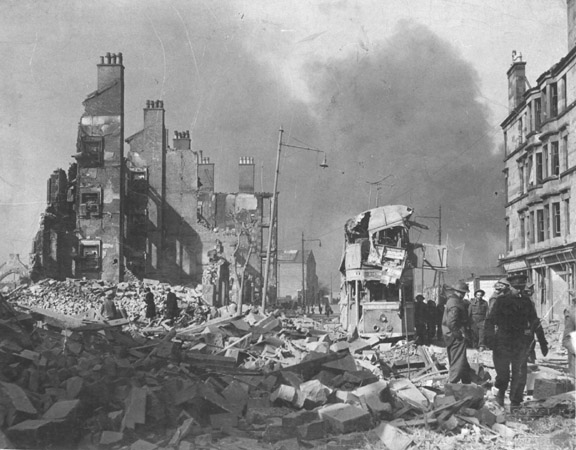
The weather has improved enough for the Luftwaffe, after a two-month absence, to resume major bombing raids. The Germans put 451 bombers in the sky over Great Britain, and they cause tremendous damage to several locations. The largest bombing raid of the Leeds Blitz took place. 203 German bombers bombed Glasgow and Clydebank, Scotland, United Kingdom for the second night in a row, damaging shipyards and the Rolls Royce aircraft engine factory.
The Luftwaffe, as is its tendency, returns to the same city that it creamed on the previous night. Having devastated Glasgow and the surrounding area on the night of the 13th, the Luftwaffe returns tonight. Just over 200 bombers attack Glasgow and Clydebank again, dropping 231 tons of high explosives. Further damage results to the shipyards and to the Rolls Royce engine factory there. This is known as the second night of the Clydebank Blitz.
It also is the night of the largest Luftwaffe attack of the war on Leeds. Tonight’s raid begins at 21:00 when about 40 bombers attack the city and drop about 25 tons of bombs on it. The bombers aim for the city center, destroying about 100 houses and damaging 4600 others. In all, about 65 people are killed. Many historical buildings are destroyed or damaged, and you can see some bomb damage to this day in various structures. The antiaircraft defenders in the region down about five Junkers Ju 88 and Dornier Do-17 bombers, but it is unclear if they are involved in the Leeds raid, which is known as the Leeds Blitz.
The bombers also target surrounding towns, which likewise take a beating. This includes Huddersfield, near the site of a David Brown factory making Supermarine Spitfire parts, and Castleford. Sheffield receives special attention, with 117 bombers dropping 83 tons of high explosives and 328 incendiary bombs. This raid receives a blackout in the British media and is usually referenced as a “North East Inland Town.”
RAF Bomber Command: Day of 14 March 1941
4 Blenheims on sea sweep; 2 bombed ships off Ostend but scored no hits. No losses.
RAF Bomber Command: Night of 14/15 March 1941
Gelsenkirchen
101 aircraft — 61 Wellingtons, 21 Hampdens, 19 Whitleys — to bomb oil plants. 1 Wellington lost. Gelsenkirchen reports its wont raid of the war so far. The city itself was not badly hit; the wont damage was caused by Flak shells exploding on descent! But one of the oil plants, the Hydriewerk Scholven, was hit by an estimated 16 aircraft bomb loads. Much damage was caused, 5 fires started and 5 workmen killed. The company housing estate nearby was also bombed. Total casualties were 9 killed. Production at the plant stopped completely but it is not stated for how long.
Dusseldorf
24 Blenheims. No losses.
Rotterdam
7 Whitleys and 5 Blenheims attacked the oil-storage tanks and fires were started. No losses.
Air battles over the ground fighting in Albania are intense. The Italians are making a major effort to support the ground troops, and the RAF joins the party. The RAF claims eight Italian aircraft downed.
A handful of British Swordfish torpedo planes of RAF No. 815 Squadron based in Paramythia, Greece attack Valona (Vlorë), Albania. They sink an Italian hospital ship, the Po, and 3539-ton freighter Santa Maria at the cost of one aircraft (the Santa Maria is later raised and repaired). Needless to say, hospital ships are off-limits to attacks. Technically, this is a war crime. However, like many other such incidents throughout the war (on both sides), nothing comes of it. The British lose a plane, and the three airmen become POWs.
HQ RAF Middle East to Air Ministry: “…we consider that air attacks now on vulnerable points on L of C Bulgaria would not have far-reaching effect on immediate military situation. … Air effort we could produce would be far less than enemy retaliation against air bases.”
Italian submarine Emo sank British steamer Western Chief (5759grt), which was straggling behind convoy SC.24, in 58-52N, 21-13W. Twenty two crewmen were lost on the steamer.
Heavy cruiser Admiral Hipper has been at Brest, France for a month. It has had to be repaired after hitting some submerged objects in the harbor. It also needs a major refit which can only be done in Germany. In any event, Brest is becoming too “hot” for it to remain there indefinitely. The Germans ready it today for a return voyage to Germany via the Denmark Strait for a departure on the 15th.
German battleship Bismarck is preparing for its own sortie into the Atlantic. Tied up at Scheerhafen, Kiel, the warship is taking on supplies.
Battleship HMS Nelson, light cruiser HMS Nigeria, and destroyers HMS Boadicea, HMS Escapade, and HMS Active departed Scapa Flow at 1903 to operate south of Iceland. The ships rendezvoused at 0900/15th with destroyers HMS Cossack, HMS Zulu, and HMS Maori which were submarine hunting after escorting convoy OB.297. The Tribal destroyers were sent to Reykjavik to refuel on the 16th. The destroyers sailed from Reykjavik at 2245/16th. They rejoined on the 17th at 0800 and destroyers Boadicea, Active, and Escapade were detached at 0900 to Reykjavik to refuel.
Destroyer HMS Punjabi departed Scapa Flow at 1715 to escort British steamer Walmer Castle (906grt) to the Firth of Forth. After the escort, the destroyer proceeded to Rosyth for refitting, arriving at 1100/15th.
Minesweeper HMS Franklin was damaged by four near misses from German bombing in the North Sea.
Destroyers HMS Holderness and HMS Vanessa in convoy FS.35 drove off German S-boats attempting to attack the convoy.
Naval drifter HMS Jeannie Leask (95grt) was mined in 51-44N, 1-07E. The drifter was beached in Brightlingsea Harbour. She was bombed on the 25th. The drifter was refloated on 13 April and taken to Wivenhoe.
British steamer Herport (2633grt) was sunk on a mine in 53-15N, 1-05E. Four crew members were lost on the steamer.
British steamer Stanleigh (1802grt) was sunk by German bombing 12 miles 288° from Bar Light Vessel, Mersey. Sixteen crewmen and the gunner were lost on the steamer.
British steamer Artemisia (6507grt) was sunk by German bombing in 52-53N, 1-39E. One crewman and one gunner were lost on the steamer.
Tug Minegarth (179grt), tanker Scottish Chief (7006grt), and steamer Empire Simba (5691grt) were damaged by German bombing at Liverpool. Tanker Scottish Chief was struck by a direct hit. She left Liverpool on 29 April for Manchester.
Norwegian steamer Tyr (4265grt) was damaged by German bombing off the Humber Light Vessel. The steamer arrived at Immingham on the 15th, assisted by tugs.
British steam drifter Peaceful Star (94grt) was sunk by German bombing seventeen miles east, southeast of Rockabill Light House. The entire crew was rescued.
Finnish steamer Rainer (2609grt) was sunk by a submarine between Emden and Cuxhaven.
Australian destroyers HMAS Vampire and HMAS Voyager were ordered to Alexandria from Piraeus and Force A, respectively. The destroyers arrived at Alexandria on the 16th.
Submarine HMS Olympus departed Gibraltar was part of the escort for convoy HG.54. The submarine returned to Gibraltar on 2 April in the convoy OG.54 escort.
Italian hospital ship Po (7289grt) was sunk at Valona by five Swordfish of 815 Squadron flying from Paramythia. Italian steamer Santa Maria (3539grt) was sunk also by 815 Squadron at Valona in this raid. The steamer was later salved and restored to duty. Lt Cdr J. De F Jago, Lt J. A. Caldecott-Smith, and Leading Airman P. N. Beagley in the lead plane were shot down. They were picked up by an Italian MAS boat and made prisoners of war
Convoy HG.56 departed Gibraltar escorted by sloop HMS Folkestone and submarine HMS Olympus with destroyer HMS Velox and corvettes HMS Geranium and HMS Verbena as local escorts, detached on the 16th. Light cruiser HMS Kenya was with the convoy on the 23rd. The submarine was detached on the 26th to OG.56. On 27 March, destroyers HMS Legion, HMS Sardonyx, HMS Scimitar, HMS Watchman, and HMS Burwell, Polish destroyer ORP Piorun, sloop HMS Fleetstone, corvettes HMS Arabis, HMS Mallow, and HMS Violet, and convoy rescue ship Zaafaren joined the convoy. French destroyer Leopard was also involved in the escort of the convoy in Home Waters. Destroyer Burwell was detached on the 31st. The convoy arrived at Liverpool with the remaining escort ships on 2 April.
Convoy ANF.20 of five British and two other ships departed Alexandria late on the 14th escorted by destroyers HMAS Stuart and HMS Hereward and corvette HMS Salvia. Anti-aircraft cruiser HMS Calcutta departed Alexandria on the 15th to join the convoy. The convoy arrived at Piraeus on the 17th.
Convoy AS.19 of nine British, two Greek, and one other ship departed Piraeus escorted by destroyers HMS Hotspur and HMAS Waterhen and corvette HMS Hyacinth. The convoy was dispersed at 1800/16th. Destroyer Hotspur proceeded to Haifa. Destroyer Waterhen and the fast ships proceeded to Alexandria, arriving on the 17th. Corvette Hyacinth and the slow ships proceeded to Port Said, arriving on the 19th.
In Washington today, President Roosevelt announced that he would outline his war aid program in a speech at the White House Correspondents Dinner tomorrow night, which will be broadcast. He conferred with Secretary Morgenthau on tax returns, with William Green, president of the American Federation of Labor, on plans for new mediation machinery to prevent labor disputes from hampering the defense program, and with Sidney Hillman and the Labor Defense Advisory Committee on labor matters.
The Senate was in recess.
The House approved the $3,446,585,144 Naval Supply Bill and adjourned at 2:26 PM until noon on Monday.
President Roosevelt decided today to make a major radio address tomorrow night in an apparent move to cement public support for the $7,000,000,000 Lend-Lease program and to help steel the British and other foes of the axis against anything Hitler may launch in the way of a spring blitzkrieg. He made the surprise announcement that the 30-minute address, dealing with defense and aid to nations battling aggressors, would be given at the annual dinner tendered him by the White House Correspondents association. For 20 years, speeches have been taboo at these dinners, but Mr. Roosevelt asked newsmen’s permission to make one on this occasion, and it was readily granted. The speech, to begin at 9:30 PM (6:30 PM P.S.T.) will go out over the major broadcasting companies, and will be transmitted abroad in at least six languages.
President Roosevelt said today that, under the Lend-Lease law, only countries resisting aggression with armed force could count upon obtaining arms and munitions in the United States. Since the aid legislation was completed this week war supplies have been released only to Great Britain and Greece. In reply to a question at his press conference as to other possible recipients, the President said he thought that the law was fairly explicit. Without giving names he made it plain that countries A, B, C, and D, which were not resisting aggression by armed force, could expect no American material support. On the other hand, countries which were compelled to resist aggression or decided to do so could expect aid.
In record time for a measure of its size, the House passed and sent to the Senate today the Navy’s 1942 supply bill carrying a total of $3,446,685,144 and providing for continuation of the building of the “two-ocean” fleet, which, it developed today, will include battle cruisers, a type new to the United States Navy.
The C.I.O. came out tonight in opposition to the proposal by administration labor and defense production chiefs for an 11-member federal board to mediate labor disputes in defense industries. After William Green, president of the A.F.L., had backed the plan at a White House conference, Philip Murray, president of the C.I.O. made public a memorandum to President Roosevelt which said the proposal was “wholly unrealistic, will not further the program of national defense, and will operate to the complete detriment of labor.” Murray conferred recently with Mr. Roosevelt, but has not seen the chief executive since the mediation board proposal was formally advanced yesterday by Secretary Perkins, William S. Knudsen, director of defense production, and Sidney Hillman, associate director.
Tatsuta Maru arrived at Honolulu, U.S. Territory of Hawaii; among the passengers disembarked was Kita Nagao, the newly appointed Japanese Consul General to Hawaii. Kita was also the coordinator of espionage in Hawaii.
Orders for planes for delivery to the Army, the Navy and Great Britain may be approximately doubled, it was learned today. Plans now prepared call for the production of a grand total of about 75,000 planes of all military types by mid-1943, three fifths of them for Britain. Less than half of this number would be trainers. Planes already on order total about 40,000. Of these 19,000 are for the Army, 7,000 for the Navy and 14,000 for Britain. It has been known for some time that this program was to be materially increased and reports have been published that 20,000 more planes were to be procured for the Army.
Having established an industry-wide priority on aluminum to preserve first call on this vital metal for defense purposes, the Office of Production Management decided today to institute a strict rationing system to spread a diminishing supply for civilian use among the various industries manufacturing cooking utensils, automobiles, refrigerators and many other non-defense articles.
The Gallup Organization has been tracking public opinion about the war throughout the conflict. While polling techniques are primitive, the data does provide some information about feelings among ordinary Americans about the distant wars in places many couldn’t even locate on a map. Today, in Public Opinion New Service, 14 March 1941, Gallup finds that a small majority of voters with an opinion feel that preventing the Japanese from occupying Singapore and the Dutch East Indies is worth a potential U.S. war.
Surveys during the last six weeks by the American Institute of Public Opinion have shown that President Roosevelt’s personal popularity rose in that period to the highest figure ever recorded since the institute began taking Presidential index tests of popularity (72% positive).
The combined efforts of Mayor La Guardia and Arthur S. Meyer, chairman of the State Board of Mediation, to settle the New York City bus strike at the conference table collapsed at 6:30 o’clock tonight, leaving the dispute to be settled, in the words of Mr. Meyer, “by power instead of by reason.”
Communist leaders on New York’s City College faculty have resorted to intimidation and threats in an attempt to deter witnesses subpoenaed by the Rapp-Coudert committee investigating subversive activities in the local school system from giving damaging evidence, it was charged yesterday as the open hearings were resumed at the County Court House.
Future ace Francis S. ‘Gabby’ Grabreski graduates from flight school.
Xavier Cugat & His Orchestra record “Babalu”.
“Amapola (Pretty Little Poppy)” enters the Billboard singles chart.
The Axis ships in East Africa have been fleeing for safety as British troops approach. It has been an infallible signal of Italian-held ports about to fall. Today, 9000-ton German freighter Coburg, which had been at anchor in the port of Massawa, is intercepted off the island of Mauritius. The crewmen scuttle the ship and are taken as prisoners.
German raider Komet, which has been meeting with fellow raider Pinguin in the Kerguelen Islands, departs today. Pinguin remains in the islands to receive supplies and to have its crew scrape barnacles from the hull and the like.
The Battle of Shanggao (a county in the northwest of Jiangxi province) begins today when the Japanese 11th Army attacks the headquarters of the Chinese 19th Army.
A Chungking government communique tonight said the Japanese had suffered 7,000 casualties in a sanguinary five-day battle in the Yangtze River valley near Ichang, an important port and air base taken by the Japanese two years ago.
Japanese Mitsubishi A6M “Zero” fighters have been dominant over China. Today, they score another major success. Chinese ace (seven victories) Wong Sun-sui, flying a Polikarpov I-15III fighter, was shot down by a Japanese A6M Zero fighter over Chengdu, Sichuan Province, China. He made a successful crash landing, but sustained a head wound which would later prove fatal.
That isn’t all. In addition, ace pilot Cen Zeliu (five victories), also flying an I-15III fighter, is shot down apparently in the same engagement, also by a Zero, over Shuangliu Airfield, Chengdu, Sichuan Province, China. Cen is remembered as someone who did not pursue medals but was a fine combat pilot (and also deputy commanding officer of the 5th Pursuit Group). The Chinese have great difficulties in the air against the Japanese, and these victories cement the superiority of the Zero over the second-rate import fighters the Chinese use.
The territorial difficulties between Siam and Indochina have been settled. French Indochina handed over one of her largest rice-producing areas under a Japanese-mediated peace. It is stated that Siam acquired over 21,000 square miles of territory in Cambodia and Laos, areas she lost to Indochina in 1904 and 1907.
Momentous political and governmental changes for Japan are expected April 3, the newspaper Asahi reported today, with Premier Prince Fumimaro Konoye heading a “Great East Asia league” in a program described as distinctively Japanese although based on models originated by Germany and Italy.
Dow Jones Industrial Average: 122.75 (+0.19)
Born:
James R. Clapper, U.S. government official (Director of National Intelligence, 2010–2017), in Fort Wayne, Indiana.
Wolfgang Petersen, German director, screenwriter and producer (“Das Boot”; “Air Force One”; “The Perfect Storm”), in Emden, Germany (d. 2022).
Ira Harge, ABA center (ABA Champions-Oaks, 1969; Pittsburgh Pipers, Oakland Oaks, Washington Capitols, Carolina Cougars, The Floridians, Utah Stars), in Anguilla, Mississippi.
Died:
C. R. M. F. Cruttwell, 53, British historian and academic.
Naval Construction:
The British Admiralty placed an order for a new battleship (to a design by Sir Stanley Goodall) to be built at Clydebank, Scotland, United Kingdom. This would eventually be completed as HMS Vanguard.
The Royal Navy Isles-class minesweeping trawler HMS Kerrera (T 200) is laid down by Fleming & Ferguson Ltd. (Paisley, Scotland).
The Royal Navy “R”-class destroyer HMS Rocket (H 92) is laid down by the Scotts Shipbuilding & Engineering Co. (Greenock, Scotland).
The U.S. Navy 77-foot Elco patrol motor torpedo boat USS PT-20 is launched by the Electric Launch Company Ltd. (Elco), (Bayonne, New Jersey, U.S.A.).
The Royal Australian Navy Bathurst-class minesweeper-corvette HMAS Mildura (J 207) is launched by the Morts Dock & Enginering Co. Ltd. (Sydney, New South Wales, Australia).
The Вое́нно-морско́й флот СССР (ВМФ) (Soviet Navy) “S” (Stalinec)-class (3rd group, Type IX-modified-2) submarines S-19 and S-20 are launched by Sudomekh (Leningrad, U.S.S.R.) / Yard 196.
The Kriegsmarine (German Navy) Type IXC U-boat U-130 is launched by AG Weser, Bremen (werk 993).
The Royal Navy “T”-class (Second Group) submarine HMS Trusty (N 45) is launched by Vickers Armstrong (Barrow-in-Furness, U.K.).
The U.S. Navy “R”-class submarines USS R-7 (SS-84) and USS R-9 (SS-86) are recommissioned as training boats.
The Royal Navy minesweeping whaler HMS Thorodd (FY 1905) [formerly Norwegian whaling ship Thorodd, is commissioned.
The Royal Navy Douwe Aukes-class minelayer HMS Van Meerlant (M 36), formerly the Royal Netherlands Navy minelayer HrMs Van Meerlant, is commissioned into British service. Her first Royal Navy commanding officer is Lieutenant Commander (retired) Arnold Howard Piggott, RNR.
The U.S. Navy Gleaves-class destroyer USS Monssen (DD-436) is commissioned. Her first commanding officer is Lieutenant Commander Roland Nesbit Smoot, USN.
 History Diaries