Erwin Rommel moved his headquarters to Sirte, Libya and orders the occupation of Mirada, about 60 miles (97 kilometers) south of Aghelia. General Erwin Rommel has returned from Berlin with orders to attack the British as soon as his forces can be brought over from Italy and assembled. He already has sent many units of the 5th Light Division forward to a line built west of El Agheila, the westernmost British outpost. Today at 14:00, Rommel himself moves to a new forward headquarters at Sirte, but the flight is grounded at Melaha. Rommel continues to Sirte by car. During the day, Rommel orders his men to occupy Mirada, which is about 100 km south of El Agheila.
Another Italian troop convoy carrying German and Italian troops arrives in Tripoli without incident.
At Malta, a curfew on lights has been imposed for the military. They are to be off by 23:00 and not turned on again until daylight. This is due to recent Luftwaffe attacks on power stations. There also has been looting following Luftwaffe raids which the government is taking measures against.
The Italian Primavera Offensive is getting nowhere on 13 March 1941. At best, it has forestalled Greek attacks and at least (unlike earlier Italian offensives) has not lost ground. Mussolini continues to monitor the fighting from his headquarters in Tirana. He orders renewal of the attacks on the 15th despite their lack of success to date. Monastery Hill in the center of the Italian attacks continues to remain solidly in Greek hands. The defeated Puglie Division has been pulled in favor of the elite Bari Division, but the latter’s attacks prosper no more than the former’s had done. The Bari men do reach the peak of Monastery Hill with heavy air support, but they have no staying power and are quickly driven off it again.
Germany repeated demands for Yugoslavia to join the Axis alliance.
Lieutenant-General William Platt continues preparing for his next assault on the small gorge that controls entry to the strategic crossroads of Keren. There are British patrols which sometimes have fierce firefights with Italian outposts. One such fight occurs in the early morning hours. British troops of the 4/16 Punjab attack an Italian observation post on Mount Gegghiro, and the entire British force is killed or captured. Another patrol by the 1st Royal Sussex on a ridge known as Pt. 2084 runs into Italians and is turned back. Effectively, this blocks British attempts to infiltrate in that direction, but there are other routes to take.
In Abyssinia, deposed Emperor Haile Selassie enters Burye. He is escorted by Orde Wingate and his Gideon Force.
Visiting Australian Prime Menzies Robert Menzies flies to an airfield in the northwest of the UK to view new aircraft which are new to service or about to enter operational units: the Tornado, Typhoon, Halifax, Manchester, and Stirling.
A reliable Balkan source said today that Russia has assured Ankara she will remain neutral in case Germany, with or without Italian aid, attacks Turkey. The form this assurance took, this source said, was a Soviet promise to respect strictly the Russian-Turkish non-aggression treaty of 1925.
Adolf Hitler appointed Alfred Rosenberg the minister of the eastern occupied territories, while further conquests would be assigned to Heinrich Himmler. Hermann Göring was given the responsibility of exploiting the resources in conquered Soviet territory.
Egmont Prinz zur Lippe-Weißenfeld was wounded in combat.
With the Duce himself present in Tiranë the Italian High Command ordered his soldiers to attack at all costs. The costs were high, despite the courage of Mussolini’s blackshirts who fought furiously to regain vital heights in the Tepeleni region. They attacked the heights in close-packed waves, but tonight their offensive stopped leaving thousands dead on the mountainside. A Greek statement insisted that no ground had been taken. The Italians dropped leaflets among their own men, stressing the presence of the Duce to maintain flagging morale. Bari Division replaces the Puglie in renewed heavy assaults on Monastery Hill. Despite a sophisticated artillery fire plan featuring a rolling barrage, the first attack suffers severe losses without reaching its objective. After dark the Bari tries again with a night attack that reaches the summit briefly but is quickly driven back.
The Amis du Grand Reich Allemand (Friends of the Greater German Reich) was founded in Belgium by Alfonse Bougne. This collaborationist organization was funded as a cultural organization and set as its goal the fostering the principles of Nazism in Belgium. AGRA was comprised of a youth group, a protection service, and the Service d’Information Politique (Political Information Service,) which paralleled the Gestapo.
Having been convicted of crimes against the state eighteen members of the illegal Communist resistance organization called De Geuzen are read their sentences at the Hague in the Netherlands, which in all cases was death to be carried out at 5 PM. At the last moment the youngest three are spared and given prison sentences. The others are taken by truck to Waalsdorpervlakte, a plain beach with sand dunes near the North Sea and shot. Waalsdorpervlakte is the site of the main memorial in the Netherlands to resistance fighters in WWII.
Dutch radio societies are disbanded on orders of the German occupation forces.
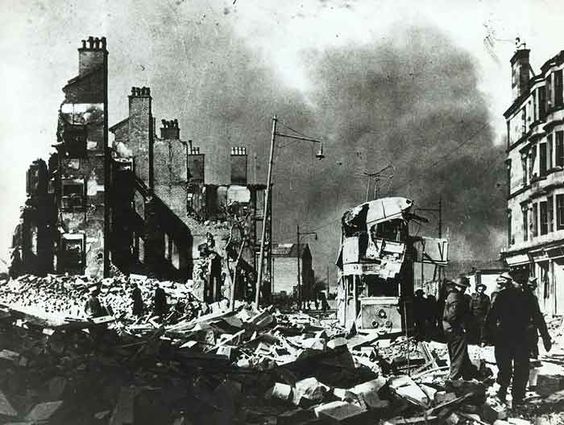
Clydebank Blitz: The Luftwaffe bombed the Scottish shipbuilding town of Clydebank for the first of two nights. The RAF staged major raids on the night of the 12th, and tonight the Luftwaffe begins repaying the deed. Glasgow is hit, with devastating power. Shipbuilding center Clydeside in the Central Belt of Scotland is devastated by 59,400 incendiary bombs and 272 tons of high explosives dropped by 236 bombers. Out of 47,000 inhabitants, 35,000 are left homeless. By one reckoning, only seven houses in the entire city are left untouched. Estimates of the dead vary wildly but apparently are between 500-1000 people. Subsidiary targets include Merseyside again and Cardiff, where a hospital is damaged. The main RAF defenses are oriented in the south to protect London, so northern cities are particularly vulnerable.
The raid on Clydeside provides evidence for one part of an enduring question throughout the war: is it better to damage a great city, or wipe out a small one? Clydeside is destroyed in only one night, whereas Liverpool and London stand up against many nights of massive raids. There is no easy answer to that question, but both sides must address it.
The Luftwaffe also launches secondary attacks against Liverpool with 65 bombers, causing more damage and casualties to the already battered city. A bomb hits a shelter on Adlington Street, killing 65 people. However, Liverpool is a large city and can sustain numerous bombings while continuing to function. Damaged are British freighters Wearwood (4597 tons), Mountstewart (1099 tons) and Myrmidon (6278 tons). Hull also is hit with 78 bombers.
RAF Bomber Command: Day of 13 March 1941
6 Blenheims on a Circus operation to Calais/Marck airfield; all bombed. No Blenheims lost. The RAF conducts Circus Operations during the day over Calais. This is half a dozen Blenheim bombers with a heavy fighter escort. Kommodore Major Werner Mölders of JG 51 gets another victory, shooting down British ace Squadron Leader Aeneas ‘Donald’ MacDonald of RAF No. 64 Squadron.
RAF Bomber Command: Night of 13/14 March 1941
Hamburg
139 aircraft — 53 Wellingtons, 34 Hampdens, 24 Whitleys, 21 Blenheims, 5 Manchesters, 2 Halifaxes. 6 aircraft — 2 Wellingtons, 2 Whitleys, 1 Blenheim, 1 Hampden — were lost and 1 Manchester was shot down soon after take-off by an Intruder, the first Manchester lost on operations. There was only one survivor from the Manchester crew, which was captained by Flying Officer Hugh Matthews of 207 Squadron. In Hamburg, the Blohm & Voss shipyard was again hit and there was much other damage including a large fire in a timber-yard and a direct hit on the main fire station which damaged the reserve fire-hose store. A total of 119 fires — 31 large — were started; 51 people were killed, 139 injured and 95 bombed out. This was the heaviest death toll in Hamburg so far in the war.
Minor Operations: 14 aircraft to oil-storage tanks at Rotterdam, 3 O.T.U. sorties, 1 Hampden minelaying at Ameland. No losses.
Coastal Command is active off Jutland. It claims several successes that are unverified.
The Luftwaffe bombs El Adem with fifteen Junkers Ju 87 Stukas and nine Junkers Ju 88 bombers.
Rear Admiral A. T. B. Curteis CB, was ashore sick at Scapa Flow from 13 to 21 March.
Anti-aircraft ship HMS Curacoa departed Scapa Flow at 0945 to meet convoy EN.85 off Tod Head and provide cover as far as Cape Wrath. The ship arrived back at Scapa Flow at 0745/15th.
Sloop HMS Scarborough, escorting convoy HG.55, intercepted Norwegian whalers Star XIX and Star XXIV, which had been captured by German raider Pinguin on 15 January, in the North Atlantic in 45N, 23W as they attempted to return to German waters. Both whalers were scuttled by the German prize crews. The German crews were picked up by sloop Scarborough.
Destroyer HMS Worcester off Southwold, escorting convoy FS.34, drove off German S-boats attempting to attack the convoy.
British steamer Tacoma City (4738grt) was sunk on a mine 2½ cables 104° from Rock Ferry Light, Mersey. Four crewmen were lost on the steamer.
British steamer Ullapool (4891grt) was sunk on a mine off Princess Stage, Mersey. Fourteen crew members and one gunner was lost on the steamer.
Tug Bullger (270grt) was sunk on a mine in Druridge Bay, sixteen miles north of the Tyne. The entire crew was rescued.
British steamer Ngatira (523grt) was damaged on a mine in 51-21N, 3-17W. The steamer was beached with the engine room flooded. She was later refloated and towed to Barry.
British steamers Wearwood (4597grt), Mountstewart (1099grt), and Myrmidon (6278grt) were damaged by German bombing at Liverpool. The bomb which struck steamer Mountstewart exploded in the lower hold. Steamer Myrmidon was sunk in dock. She was refloated and drydocked on the 27th.
British smack Two Brothers (17grt) was sunk by German bombing in Bentick Dock, Kings Lynn. The smack was raised and placed on a mud bank.
During the night of 13/14 March, British steamer Clermiston (1448grt) was damaged by German bombing in Rothesay Dock at Glasgow. The steamer was sunk. She was refloated in October 1941 and beached in Rames Bay. The steamer was towed to Ardrossan in 1942.
During the night of 13/14 May, in German bombing raids on the Clyde, escort destroyers HMS Goathland and HMS Haldon, under construction, were damaged.
During the night of 13/14 March, British steamer Trevarrack (5270grt) was sunk by German bombing at the Dalmuir Basin, Clyde. Steamer Trevarrack was refloated at the end of March and repaired. British collier Belhaven (1498grt) was sunk by German bombing at the Clyde during the night of 13/14 March.
Dutch steamer Perseus (1307grt) was sunk by German bombing twelve miles northwest of Bardsey Island. The entire crew was rescued.
Norwegian steamer Samlanes (842grt) was sunk on a mine two miles 180° from The Lizard. The entire crew was lost.
Heavy cruiser HMS York and light cruisers HMS Bonaventure and HMS Gloucester arrived at Suda Bay at 0600/13th. Destroyers HMS Nubian and HMS Mohawk, detached from Force A, joined these cruisers at Suda Bay. The British ships departed again later that day to cover convoys through the Kaso Straits. During the night of 13/14 March, the force swept ahead of convoy AS.19 in Kaso Straits. Destroyer Nubian reported three Italian S-boats in 35-32N, 26-42E. The S-boats were able to escape. Destroyers Nubian and Mohawk proceeded to Suda Bay to refuel after the sweep. This sweep was covered by Force A.
Convoy SL.68 departed Freetown escorted by armed merchant cruiser HMS Canton to 21 March, light cruiser HMS Mauritius to 15 March, corvettes HMS Calendula, HMS Crocus, and HMS Marguerite to 20 March, and anti-submarine trawlers HMS Kelt and HMS Turcoman to 15 March. Destroyer HMS Wishart escorted the convoy on the 15th only. Battleship HMS Malaya joined on the 15th and departed after being torpedoed on the 21st. The convoy was dispersed due to submarine activity on the 21st and the ships were ordered to Halifax, Bermuda, or Trinidad.
In Washington, President Roosevelt signed an executive order freezing all Hungarian credits in this country, appointed a committee to endeavor to coordinate campaigns to raise funds for foreign and domestic relief, accepted the resignation of Max O’Rell Truitt as a member of the Maritime Commission and conferred with Secretary Perkins, William S. Knudsen and Sidney Hillman on plans for a mediation board to handle labor disputes in defense industries.
The Senate completed Congressional action on the $1,533,439,702 Fourth Supplemental Defense Appropriation Bill, passed the bill to include peanuts under the Agricultural Adjustment Administration marketing program and adjourned at 2:06 PM until noon Monday.
The House passed a bill providing for federal inspection of mines, passed the $150,000,000 defense housing bill, accepted the conference report on the Fourth Supplementary Defense Appropriation Bill and adjourned at 5:17 PM until noon tomorrow.
Congressional fiscal experts, casting about for new revenue sources to help pay for the $7,000,000,000 British aid program, were reported considering today the possibility of imposing a 5 percent tax on the weekly pay of most of the nation’s workers. If such a 5 percent “earned income” tax should be levied, that amount would be deducted for the government each week from the pay envelopes of a large proportion of jobholders. Thus a worker now receiving $40 weekly would get, instead, $38 and a tax receipt for $2. Small wage earners possibly those receiving $25 weekly or less would be exempted.
A $3,446,585,144 bill to help finance the two-ocean navy started on its way through Congress today spurred by an official warning that the axis nations possess greater potential sea power than the United States and that the already dangerous world situation may grow worse. The House Appropriations Committee stamped its approval on the bill containing funds to carry the naval expansion program forward during the year starting July 1, and administration leaders said it was scheduled for house passage tomorrow. At the same time, the committee made public testimony from Secretary Knox and other members of the naval high command delivered during secret hearings on the measure which started February 3. Admiral Harold R. Stark, chief of naval operations, told the group “The international situation may continue to grow worse for some time to come” and added that while no one could predict the future with accuracy, “it is imperative that we arm ourselves as rapidly as possible.”
President Roosevelt conferred at the White House today with Rear Admiral Emory S. Land, chairman of the Maritime Commission, and Captain H.L. Vickery, a member of the commission. It was believed that the gravity of the British shipping situation and the need for the early transfer of American-owned or controlled tonnage to overcome Britain’s war losses in ships were discussed.
Mobilization of national manpower resources to speed production of essential defense goods will begin Saturday with the opening of a country-wide registration of workers at State employment offices. Paul V. McNutt, Federal Security Administrator, said today that all unemployed workers who may be available for work or for training in defense jobs, and all who have needed skills which they are not using in their present jobs, were urged to register.
It is reported that at present there are 32 strikes going-on in the U.S. defense industries. This does not include the number in the allied industries. Chairman of the House naval affairs committee, Carl Vinson, estimated that 1940 strikes wasted enough labor to manufacture 325 bombers. Vinson is urging the government to bring in a measure to curb strikes in plants producing defense materials. He reported that the loss during 1940 and to the middle of last February totaled 7,817,360 man-hours.
Soft coal operators of the eight-State Appalachian region rejected yesterday the demand of the United Mine Workers of America for a flat $1 a day pay rise and other proposals affecting 450,000 bituminous miners, and voted down a resolution offered by John L. Lewis, president of the union, that mining operations continue without interruption in the event no accord is reached by April 1, the date when the agreement in the industry expires.
Agreement on a specific plan for a national defense labor mediation board was placed on President Roosevelt’s desk today by Secretary Perkins, and William S. Knudsen and Sidney Hillman, of the Office of Production Management.
The combined efforts of Mayor La Guardia and Arthur S. Meyer, chairman of the State Board of Mediation, failed last night to settle the strike of the 3,500 employees of the Fifth Avenue Coach Company and the New York City Omnibus Corporation.
Continuing his aggressive posture toward neutral nations that definitely are leaning away from Great Britain, President Roosevelt freezes Hungarian assets. President Roosevelt signed an order today adding Hungary to the list of German or Russian controlled countries whose financial assets in the United States have been “frozen.” Hungary is the twelfth.
A slight majority in favor of risking war with Japan if necessary to keep Japan from taking the Dutch East Indies and Singapore is recorded in the latest nation-wide survey completed by the American Institute of Public Opinion, Dr. George Gallup, its director, reports.
Rear Admiral John H. Newton has taken a flotilla led by two cruisers, USS Chicago and Portland, to Samoa on an exercise. The voyage, while undoubtedly useful for training and “show the flag” purposes, has no discernible purpose. However, today it gets one. An adviser to the U.S. Department of State, Stanley Hornbeck, asks Australian Minister to the United States R.G. Casey — who is Australia’s first minister to a foreign country — a question: whether Australia would agree to an informal visit by Newton’s force. Hornbeck proposes that the cruiser force arrives at Sydney on 20 March 1941 and Brisbane on 25 March 1941. Australian approval is quickly granted.
Ginger Rogers, who just won an Academy Award for Best Actress, divorces Lew Ayres after a brief marriage.
German raider Pinguin, with captured converted minelayer Adjutant, enter the Kerguelen Islands. They anchor at Port Couvreux along with raider Komet. Supply ship Alstertor is there to transfer supplies to Pinguin, including an Arado Ar-196 seaplane. Alsterstor also will be used to lay mines. The Pinguin’s crew is put to work scraping the hull free of barnacles and doing the usual things that are necessary for ships that are at sea for long periods.
Chinese Nationalist forces have successfully repulsed Japan’s latest offensive in western Hupeh (Hupei) after a week of heavy fighting in which the Japanese are thought to have suffered at least 4,000 casualties. The Western Hupeh Offensive continues to peter out and basically ends. The Japanese have achieved their objective, pushing the main Chinese forces back on Chunking and then devastating that occupied area. This is intended to create a lifeless buffer zone between the Chinese and Japanese. Satisfied with the results of the operation, the Japanese forces have returned to the main base/airfield at Ichang along the Yangtze.
The Chinese Nationalist (Kuomintang) forces re-occupying the lost ground without opposition claim a great victory. Naturally, who achieved what from the operation is a matter of both interpretation and national(ist) pride. However, it appears clear that the Japanese are not defeated in pitched battles, though there is an argument to be made that they retreat due to fear of being outflanked and infiltrated.
Further tightening of the Japanese blockade of the Chinese coasts and new restrictions on foreign trade were reported here today when it was revealed that Japanese military authorities in South China had established an office in the Portuguese colony of Macao, where all sea-borne traffic must obtain permits.
Dow Jones Industrial Average: 122.56 (-0.63)
Born:
Mahmoud Darwish, Arab prominent poet and writer, in al-Birwa, Galilee, British Mandate of Palestine (d. 2008).
Died:
Bernard Ijzerdraat, 49, Dutch resistance fighter, executed by Nazi regime with 14 others.
Elizabeth Madox Roberts, 54, American poet and novelist (The Time of Man).
Naval Construction:
The U.S. Navy 77-foot Elco patrol motor torpedo boat US PT-31 is laid down by the Electric Launch Company Ltd. (Elco), (Bayonne, New Jersey, U.S.A.).
The U.S. Navy Aloe-class net tender USS Nutmeg (YN-28, later AN-33) is launched by the American Shipbuilding Co. (Lorain, Ohio, U.S.A.).
The Nihon Kaigun (Imperial Japanese Navy) Type B (B1 sub-class; I-15-class) submarine I-31 is launched by the Yokosuka Naval Yard (Kanagawa Prefecture, Japan).
The Royal Navy Fairmile B-class motor launch HMS ML 224 is commissioned.
The U.S. Navy transport USS Catlin (AP-19, former SS and USS George Washington) is recommissioned. She will soon be found unsuitable by the Navy, and ends up spending much of the war as the U.S. Army Transport USAT George Washington.
The Kriegsmarine (German Navy) Type VIIC U-boat U-79 is commissioned. Her first commanding officer is Kapitänleutnant Wolfgang Kaufmann.
The Kriegsmarine (German Navy) Type VIIC U-boat U-561 is commissioned. Her first commanding officer is Kapitänleutnant Robert Bartels.
The U.S. Navy Gleaves-class destroyer USS Ericsson (DD-440) is commissioned. Her first commanding officer is Lieutenant Commander Geoffrey Ellingwood Sage, USN.
 History Diaries