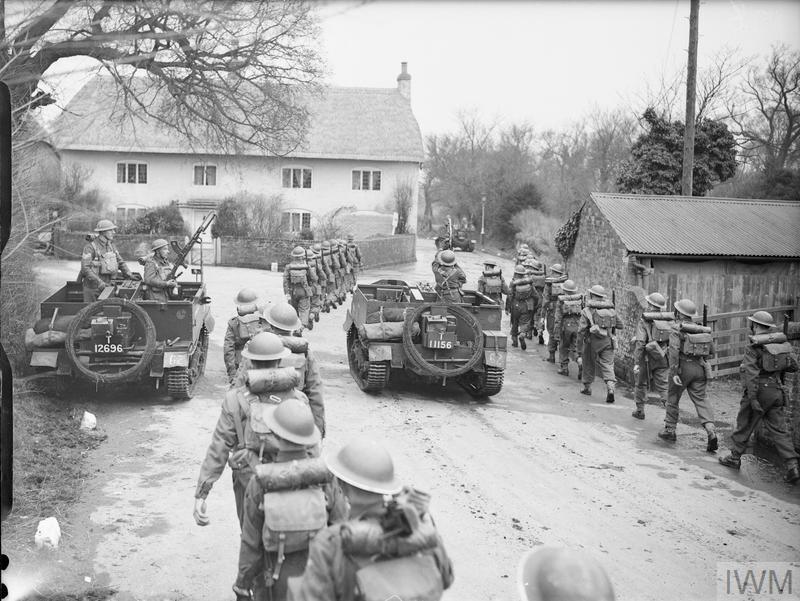
Winston Churchill thanked the U.S. for “a new Magna Carta”, referring to the Lend-Lease Act signed into law on the previous day. Prime Minister Churchill, voicing the “deep and respectful appreciation” of Britain, told the United States today the British aid bill constituted a “new Magna Carta … a monument of generous and far-seeing statesmanship.” The House of Commons was Churchill’s sounding board and repeated bursts of cheering interrupted his statement. A United States military mission of eight uniformed men the only persons present except house members looked on from the gallery. Churchill indicated later that he might expand his words in a special broadcast to the United States, explaining that “I must choose the exact moment for such a broadcast.”
Considering that many in the US simply want the British soldiers to fight Hitler and die rather than US boys, it’s a little murky how much “faith” has to do with it. But, quibbles aside, it indeed is a war-winning law that directly addresses Churchill’s perpetual paranoia about supplies getting through. There is no question that this is a decisive moment in the war and that Churchill appropriately celebrates it.
Germany’s most accurate semiofficial reflector of foreign office opinion, the Dipomatisch Politische Korrespondenz, bitterly denounced the new American British aid law tonight as “the most flagrant North American meddling” in an affair which is none of its business. “The time is past,” said Korrespondenz, “when unauthorized powers can concern themselves in regions foreign to them. Attempts In this direction have strengthened fitting counter-measures because it is no accident that the Japanese foreign minister now is coming to Europe to consult with his allies on measures to protect the interests of the three powers in their living spaces.”
The British War Office suggests to Wavell that the RAF bomb the German lines of communication from Danube to Graeco-Bulgar frontier.
The final elements of the 5th Light Division of the Africa Korps arrived in North Africa. The entire 5th Light Division now is active in Tripolitania. General Rommel returns from Berlin, where he was engaged in planning the first offensive of the Afrika Korps. A parade, apparently in Rommel’s honor, is staged at 17:00 in front of the Castle in Tripoli by the German 5th Panzer Regiment and the tank battalion of the Ariete Division. The German panzers head out toward Sirte directly after the parade.
British expeditionary forces have landed in Greece and are setting up a base at strategic Salonika, barely 60 miles from where German mechanized troops are massed along the Bulgarian-Greek frontier, according to the United Press. The British arrived both at Salonika, at the top of the Aegean sea, and at Piraeus, the port of Athens, after secretly crossing the Mediterranean from Egypt aboard convoyed troopships.
Benito Mussolini visited Italian troops in Albania to bolster morale. The Italian Primavera Offensive continues on 12 March 1941. However, the Italian 11th Army gains no new ground. The Greek defenses hold firm, while the Italians incur heavy casualties while attacking the Greek 1st Division in the center of the line. Mussolini demands that the offensive be continued.
Lieutenant-General William Platt continues preparing his troops for another assault on Keren. He is planning a set-piece attack for the middle of the month. The Italians also are reinforcing the area, particularly on Dologorodoc east of the Dongolaas Gorge which serves as a choke point. Fort Dologorodoc dominates Happy Valley and is the critical feature of the entire defensive position. Further south, British troops are about 600 miles north of Mogadishu.
Churchill writes to Roosevelt: “Admiral Darlan’s declaration and threat make me wonder whether it would not be best for you to intervene as a friend of both sides and try to bring about a working agreement. … We fear very much a prolongation of the war and its miseries which would result from breakdown of blockade of Germany.”
Darlan has recently stated that he views it as his responsibility to feed 40 million people, and he will use force to do so if necessary. The only thing standing between US humanitarian aid and Vichy French possessions in North Africa is the comprehensive British blockade. In this telegram, Churchill states that “Dealing with Darlan is dealing with Germany,” which is quite inaccurate.
Churchill suggests allowing a ration of wheat to go through from America to Vichy and French Africa. The Germans need not know and perhaps a French warship or two may make its way from Toulon to Casablanca or Dakar.
“Would you therefore consider coming forward on the basis of how shocked you were at the idea of fighting breaking out between France and Great Britain, which would only help the common foe. Then you might be able to procure Vichy assent to a scheme allowing a ration of wheat to go through, month by month to unoccupied France and something for French Africa as long as other things were satisfactory. These other things might form the subject of a secret arrangement of which the Germans will not know, by which German infiltration into Morocco and French African ports would be limited to the bare armistice terms, and by which an increasing number of French warships would gradually be moving from Toulon to Casablanca or Dakar.”
It is difficult to see how the Germans “would not know” of food shipments to Vichy French areas. Churchill also bemoans the possibility “any large number of ships which are needed for our life and war effort were used up in food carrying.”
The original incident used in Compton Mackenzie’s “Whisky Galore” occurs in the Hebrides when a cargo ship (Politician) runs aground with her holds full of whisky. Islanders hide the quarter of a million bottles from Customs officers.
Adolf Hitler, arriving in Linz unexpectedly tonight for ceremonies tomorrow commemorating the third anniversary of the Anschluss linking his native Austria with the Reich, declared the war of 1870 ended with tremendous success and “the end of today’s struggle will not differ a hair’s breadth.” Praising the Nazi party and people, he promised, “the hour of our final victory will come, whereupon we will develop very thoroughly the plans we have made.” The fuehrer said, “Then (after the war) we will work harder and more and more to give the greater Reich the character of a nation of endeavor, the character of a strong social community life. We are not obligated to any class or to any group; we bow to no human being, before us is the recognition of the German people. . . Before us is the greater Germany.”
German occupiers confiscate AVRO studios in Netherlands.
The rationing of food and some other goods was introduced in Vatican City today, affecting all residents including Pope Pius XII. The allotments are slightly more generous than those in effect in Italy. Vatican City residents, for ex ample, will be allowed a pound of coffee a month; Italians can’t have any coffee.
German heavy cruisers Gneisenau and Scharnhorst complete their refueling from tankers Uckermark and Ermland and resume patrolling the sea lanes near the Cape Verde Islands. Admiral Lütjens now is under orders to continue his attacks until the 18th, and then proceed to Brest, France to conclude Operation BERLIN.
German bombers attacked Merseyside (containing the city of Liverpool), England, United Kingdom, United Kingdom. 8 merchant ships were sunk, one floating crane was destroyed, and 174 people were killed in the town of Wallasey. The Luftwaffe (KG 55) uses the clear night to attack the Liverpool area. The dock areas of Birkenhead and Wallasey in Wirral in the Merseyside area (174 dead) suffer heavy damage. The effect on shipping is particularly devastating with 8 small ships sunk and a floating crane destroyed. The Germans lose two bombers to night fighters. These continuing raids on Liverpool are killing hundreds of civilians and wounding hundreds more.
The weather over northwestern Europe improves dramatically today, and RAF Bomber Command takes advantage. It sends large raids against Berlin, Bremen, and Hamburg. A total of 244 RAF bombers fly over the Reich, including Stirling and Manchester bombers. Even some of the new Handley Page Halifax four-engined heavy bombers participate despite only having seen their first combat ever a couple of nights ago over Le Havre. This is the first major raid on Berlin during 1941, and there will be nine more.
RAF Bomber Command: Day of 12 March 1941
6 Blenheims to Holland; 2 aircraft bombed a merchant ship near Ijmuiden but no hits reported. No losses.
RAF Bomber Command Operational Statistics, 10/11 February to 12 March 1941 (30 days/nights)
Number of days with operations: 21 Number of nights with operations: 16 Number of daylight sorties: 94, from which 2 aircraft (21 percent) were lost Number of night sorties: 1,635, from which 26 aircraft (L6 percent) were lost Total sorties: 1,729, from which 28 aircraft (L6 percent) were lost, but 70 further aircraft crashed in England Approximate bomb tonnage in period: 1,517 tons Avenges per 24-hour period: 57.6 sorties, OS aircraft lost, 50.6 tons of bombs dropped.
RAF Bomber Command: Night of 12/13 March 1941
Hamburg
88 aircraft — 40 Hampdens, 25 Whitleys, 16 Wellingtons, 4 Manchesters, 3 Halifaxes — to attack the Blohm & Voss U-boat yards and other industry. This was the first time that Manchesters and Halifaxes had been sent to a target in Germany. No aircraft were lost from this raid. Hamburg reports that 20 high-explosive and 300-400 incendiary bombs fell in the Blohm & Voss yard, causing damage to the main office block and other parts of the premises, including two slipways on which U-boats were being built. 4 other shipbuilding firms were hit and a large harbour warehouse and its contents were burnt out. A total of 205 fires (18 classed as large) were started; 8 people were killed, 96 injured and 414 bombed out.
Bremen
86 aircraft — 54 Wellingtons, 32 Blenheims — dispatched, the Wellingtons to attack the Focke-Wulf aircraft factory and the Blenheims the town centre. 2 Wellingtons and 1 Blenheim lost. Photographic reconnaissance showed that 12 high-explosive bombs hit the aircraft factory.
Berlin
72 aircraft — 30 Hampdens, 28 Wellingtons, 14 Whitleys — to two targets. 3 aircraft, one of each type, lost. The bombing was very scattered with more bombs in the southern districts of the city than elsewhere. 60 buildings of many kinds were hit, though none was classed as destroyed and only 3 as being severely damaged. 11 people were killed, 24 injured and 80 bombed out.
Minor Operations: 8 aircraft to Calais and Boulogne. 2 O.T.U. sorties, 1 Hampden minelaying in the Elbe. 1 Wellington from the Boulogne raid was lost.
Total effort for the night 257 sorties, 7 aircraft (2.7 percent) lost.
The Hamburg and Bremen attacks appear to have been targeted to implement British Prime Minister Winston Churchill’s “Battle of the Atlantic” priority scheme. The Focke Wulf factory in Bremen manufactures Fw 200 Condors which have been operating with devastating effects against British shipping in the Northwest Approaches and St. George’s Channel. Blohm & Voss, meanwhile, is a major shipbuilder that has branched out into manufacturing flying boats and seaplanes.
The Italian Regia Aeronautica flies numerous sorties and loses many planes. The RAF, meanwhile, bombs Valona airfield and Sazan (Saseno) Island off Valona (Vlorë).
In Malta, the Luftwaffe is switching to night raids, just as it has on the Channel front in northwest Europe. Many of the night-time raids are nuisance raids, lone planes designed simply to strain the nerves of the island’s residents. However, the residents of Sliema have had their homes destroyed in the previous night’s raid, and the defending RAF fighters have been greatly reduced in number by recent attacks on Luqa and Hal Far airfields.
U-37, commanded by Kapitänleutnant Asmus Nicolai Clausen, sank Icelandic trawler Pertrusey (91grt) by gunfire south of Iceland. At 1805 hours on 12 March 1941, U-37 opened fire with the deck gun and the 37mm AA gun from a great distance at the Pétursey (Master Þorsteinn Magnússon) south of Iceland, but first missed her many times, giving the crew time to abandon ship. After some heavy hits they went closer, saw the Icelandic flag painted on the side of the vessel and immediately ceased fire, but the trawler soon sank. The U-boat had observed how the crew abandoned ship, but they were never seen again. The 91-ton Pétursey was carrying fish.
Light cruiser HMS Fiji arrived at Scapa Flow at 1658 following her repair of the September 1940 torpedo damage.
British steamer Empire Frost (7005grt) was badly damaged by German bombing in 51-36N, 5-40W. Six crewmen were lost. The steamer in tow was again attacked on the 13th and sank.
British steamer Camroux I (324grt) was damaged on a mine three miles east of Blyth. The steamer was towed to Blyth.
British steamer Essex Lance (6625grt) was damaged by German bombing in 51-03N, 1-38E. The steamer was taken in tow and beached on the 13th two miles northwest of Cromer. She was refloated on the 14th and anchored off Immingham Dock on the 18th.
Swedish steamer Buenos Aires (5646grt) was sunk by German bombing at Liverpool. The engines were removed from the vessel which was used as a supply ship at Scapa Flow. British crane ship Mammoth (1542grt) was sunk in dock by German bombing at Liverpool. The crane was raised during 1941. During the night of 12/13 March, British flat Excelsior (122grt) was sunk at the east end of the south side of Trafalgar Branch Dock, Liverpool and British steamers Catrine (5218grt), Imperial Star (12,427grt), and Elax (7403grt), and British tankers El Mirlo (8092grt) and Delphinula (8120grt) were damaged by German bombing at Liverpool. Steamer Elax’s machinery was smashed. She was anchored in the River Mersey and used as a storage ship until a new engine was installed. The bomb which struck steamer Imperial Star penetrated three decks before exploding.
Battleships HMS Barham and HMS Valiant and destroyers HMS Jervis, HMS Janus, HMS Jaguar, HMS Hotspur, HMAS Voyager, and HMAS Waterhen departed Suda Bay to cover movements of convoy AG.5. Destroyers HMS Ilex and HMS Greyhound joined this force from Piraeus. Destroyer Hotspur, relieved of escort of tanker Desmoulea, and destroyer Waterhen from Force A were ordered to Piraeus to escort convoy AS.19.
Italian troop convoy departed Naples with troopships Conte Rosso, Marco Polo, and Victoria escorted by destroyers Camicia Nera and Geniere, joined by destroyer Folgore from Palermo. Distant cover was provided by heavy cruisers Trieste, Trento, Bolzano, destroyers Carabiniere, Corazziere, and Aviere, torpedo boat Dezza, and three MAS boats. The convoy arrived at Tripoli on the 13th.
Convoy OB.297 departed Liverpool, escorted by destroyers HMS Cossack, HMS Keppel, HMS Lincoln, HMS Maori, HMS Sabre, HMS Shikari, HMS Venomous, HMS Woolston, and HMS Zulu, corvette HMS Sunflower, and anti-submarine trawlers HMS Northern Dawn and HMS Wellard. Destroyers Cossack, Maori, and Zulu were detached on the 14th. The remainder of the escort was detached when the convoy dispersed on the 17th.
Convoy AG.5 of Greek personnel ships Corinthia (3701grt), Ionia (1936grt), Hellas (2295grt), and Marie Maersk (8271grt) departed Alexandria escorted by destroyers HMAS Vampire and HMS Wryneck. Destroyer HMS Decoy departed Alexandria at 2100 to overtake the convoy at daylight on the 13th and join the escort. Tanker Marie Maersk lost touch with the convoy and proceeded to Suda Bay. The convoy arrived at Piraeus late on the 14th.
In Washington today, President Roosevelt sent to Congress a request for immediate appropriations of $7,000,000,000 to finance the defense aid program authorized by the Lend-Lease bill and conferred with Secretaries. Hull, Morgenthau and Stimson, James V. Forrestal, Under-Secretary of the Navy; General George C. Marshall, Chief of Staff, and Rear Admiral R. E. Ingersoll, Assistant Chief of Naval Operations. He also conferred with Will Hays on the relation of the motion-picture industry to the world situation.
With the Senate in recess, the Interstate Commerce Committee. approved the nomination of R. C. Wakefield to the Federal Communications Commission, and an appropriations subcommittee heard Juan Trippe on ocean mail subsidies in the Treasury-Post office Appropriation Bill.
The House heard the late Representative Pius Schwert eulogized and adjourned in respect at 12:44 PM until noon tomorrow.
President Roosevelt asked Congress for $7 billion in Lend-Lease aid. U.S. Congressional leaders prepared tonight to speed action on a request from President Roosevelt for $7,000,000,000 with which to provide “the tools of defense for all democracies fighting to preserve themselves against aggression.” Acting under the Lend-Lease bill, the president asked for this sum in a letter to Speaker Rayburn. Hearings were scheduled to begin tomorrow before a house appropriations subcommittee under the chairmanship of Representative Woodrum, Virginia Democrat. By Monday or Tuesday, at the latest, Rayburn said, the appropriation bill, biggest in the nation’s peace time history, will be under debate in the house itself.
High drama in Washington marked completion of the American aid-for-Britain legislation, and President Roosevelt’s quick request for a seven-billion-dollar appropriation to carry it out. Even before the first American-made plane, ship or gun under the program goes forward to test the Nazi bomb and U-boat challenge at sea, White House technique has definitely scored. It has notched British morale to a new high at a critical hour. It has also stirred obvious apprehension in Berlin as to its effect upon Balkan neutrals sweating under Nazi power-politics pressure; and upon Japanese and Russian policy-making. That President Roosevelt had such objectives in mind goes without saying.
United States farms are ready and able to meet any demands for food aid in Britain’s defense, Agriculture Department officials said today as President Roosevelt announced that of the $7,000,000,000 he is requesting for British aid under the Lend-Lease Law something like $1,000,000,000 would be used for foodstuffs and allied products.
As separate Senate and House special committees made ready today to investigate recent commercial airplane accidents, Robert H. Hinckley, assistant secretary of commerce, stated that commercial airline heads had renewed to him their pledge to cooperate in every way possible to prevent such accidents in the future.
Archbishop Francis J. Spellman of New York in a sermon delivered today at a mass celebrating the anniversary of the coronation of Pope Plus XII, declared that, despite the multiplication of arms throughout the world, the desire of all people for peace never had been greater than at present.
Secretary Knox and Admiral Harold R. Stark, Chief of Naval Operations, who have been on inspection tours of the Caribbean and the new Gulf naval air stations for two weeks, are scheduled to return to Washington tomorrow, and the naval part of the British aid program will begin to take definite shape.
The Commander-in-Chief, U. S. Pacific Fleet, Admiral Husband E. Kimmel, sends the following message to the Chief of Naval Operations, Admiral Harold R. Stark: “In view of [your letter of 15 February], the Commander-in-Chief, U. S. Pacific Fleet, recommends that until a light efficient net, that can be laid temporarily and quickly is developed, no anti-torpedo nets [for protection against torpedo plane attacks] be supplied this area.”
The Japanese at this time are working on their attack plans against Pearl Harbor which would be compromised by such nets. This will be an exhibit for the Hart Inquiry in 1942.
The U.S. Navy heavy cruiser USS Chicago (CA 29), under command of Rear Admiral John H. Newton, Commander Cruisers Scouting Force, and USS Portland (CA 33) accompanied by the destroyers USS Clark (DD 361), USS Conyngham (DD 371), USS Cassin (DD -372), USS Downes (DD 375), and USS Reid (DD 369) departed Samoan waters for Sydney, Australia.
Task Group 9.2, under command of Captain Ellis S. Stone, comprised by the light cruisers USS Brooklyn (CL 40) and USS Savannah (CL 42) and the destroyers USS Case (DD-370), USS Shaw (DD-373), and USS Tucker (DD-374), departed Samoan waters for Auckland, New Zealand.
The oiler USS Sangamon (AO-28), that had accompanied the aforementioned cruisers and destroyers from Pearl Harbor, departed Samoa to return to Hawaiian waters.
Naval Air Station, Corpus Christi, Texas, is established. The Corpus Christi Naval Air School opens. It is a pet project of Representative Lyndon B. Johnson, President Roosevelt’s primary Texas supporter during the 1940 election, and Roosevelt directly intervenes with the War Department by asking it to listen to Johnson. One could consider Naval Air Station a “political payoff” to Johnson for his support. Industrialist Henry Kaiser, another big Roosevelt supporter, helps to build the base. That’s just how things get done. NAS Corpus Christi’s first commander is Captain Alva Berhard. The school ramps up quite quickly and soon is training hundreds of students.
The motion picture “Meet John Doe” premieres in Hollywood and New York City. Directed by Frank Capra, this social drama stars Gary Cooper, Barbara Stanwyck, Edward Arnold, Walter Brennan, Spring Byington, James Gleason and Gene Lockhart. “Meet John Doe” is a prestige production from Warner Bros. continuing Hollywood’s cynical take on politics and the media (such as in Jimmy Stewart’s “Mr. Smith Goes to Washington”). It also is an early “populist political phenomenon” film which arguably reaches its peak with Warren Beatty’s 1998 “Bulworth.”
Convoy US.9/2 departed Bombay with Danish steamer Amerika (10,218grt), British Empress of Australia (21,833grt), Wairangi (12,436grt), and Windsor Castle (19,141grt), Dutch Indrapoera (10,825grt), Johan De Witt (10,474grt), and Nieuw Zeeland (11,069grt), and Turkish minelayer Yuzbashi Hakki.
German raider Pinguin rendezvouses with fellow raider Komet 120 miles east of the Kerguelen Islands. They proceed to the islands and anchor at Port Couvreux. Accompanying Pinguin is captured whaler Pol IX, which is converted to an auxiliary minelayer and renamed Adjutant.
With the Japanese Western Hupei Operations terminated, the Chinese River Defense Force pursues the withdrawing enemy. The Japanese leave behind a scene of burnt-out villages and many dead civilians.
There is a Thai-Soviet exchange of notes establishing diplomatic relations.
The foundations of a wide agreement assuring Japan that Indo-China and Thailand never will join any hostile combination were laid by letters exchanged yesterday between Foreign Minister Yosuke Matsuoka, French Ambassador Charles Arsene-Henry and Prince Varvarn of Thailand.
Foreign Minister Yosuke Matsuoka left Tokyo last night for his trip to Europe, but the first formal act on his pilgrimage to Berlin, Rome and Moscow began at 10 o’clock this morning when at the small country town of Yamada he visited the national grand shrines sacred to the Sun Goddess and prayed for the success of his mission.
There are many who continue to keep an eye on how all this will affect business in the post-world. Australian Prime Minister Menzies, who is visiting London, dines with famous economist John Maynard Keynes. Menzies writes in his diary:
“Keynes advocates a partnership in disposal of primary products, e.g. wool, and on the importance of blending war effort with an eye on post war world — e.g., aeroplanes & motor cars in Australia.”
The way that Australia currently is “blending the war effort and the post-war world” is by sending its men to defend Greece from the Wehrmacht.
Dow Jones Industrial Average: 123.19 (-0.08)
Born:
Jake Kupp, NFL guard and tight end (Pro Bowl, 1969; Dallas Cowboys, Washington Redskins, New Orleans Saints, Atlanta Falcons), in Pasadena, California.
Erkki Salmenhaara, Finnish composer and musicologist, in Helsinki, Finland (d. 2002).
Naval Construction:
The Royal Indian Navy Basset-class minesweeping trawler HMIS Karachi (T 262) is laid down by Alcock Ashdown & Co.Ltd. (Bhavnagar, India).
The Royal Navy Hill-class ASW trawler HMS Birdlip (T 218) is laid down by Cook, Welton & Gemmill (Beverley, U.K.); completed by Holmes.
The U.S. Navy submarine chaser USS PC-498 (later USS SC-498) is laid down by the Westergard Boat Works Inc. (Rockport, Texas, U.S.A.).
The Kriegsmarine (German Navy) Type IXC/40 U-boat U-167 is laid down by Deutsche Schiff und Maschinenbau AG, Bremen (werk 706).
The Kriegsmarine (German Navy) Type VIIC U-boats U-605 and U-606 are laid down by Blohm & Voss, Hamburg (werk 581 and 582).
The Kriegsmarine (German Navy) Type VIIC U-boat U-661 is laid down by Howaldtswerke Hamburg AG, Hamburg (werk 810).
The Royal Fleet Auxiliary Ranger-class fleet support tanker RFA Gold Ranger (A130) is launched by the Caledon Shipbuilding Co Ltd. (Dundee, Scotland).
The Royal Navy MMS I-class motor minesweeper HMS MMS 33 is launched by J & G Forbes & Co. Ltd. (Sandhaven, England, U.K.).
The Royal Navy Dance-class ASW trawler HMS Valse (T 151) is launched by the Smith’s Dock Co., Ltd. (South Bank-on-Tees, U.K.).
The Royal Navy corvette HMS Vervain (K 190) is launched by Harland & Wolff Ltd. (Belfast, Northern Ireland).
The Royal Navy Hunt-class (Type II) escort destroyer HMS Exmoor (L 08) is launched by Swan Hunter and Wigham Richardson Ltd. (Wallsend-on-Tyne, U.K.); completed by Wallsend.
The Sjøforsvaret (Royal Norwegian Navy) Fairmile B-class motor launch HNoMS ML 208 is commissioned.
The U.S. Navy general stores issue ship USS Castor (AKS-1), lead ship of her class of 3, is commissioned. Her first commanding officer is Commander Felix Leslie Johnson, USN.
 History Diaries