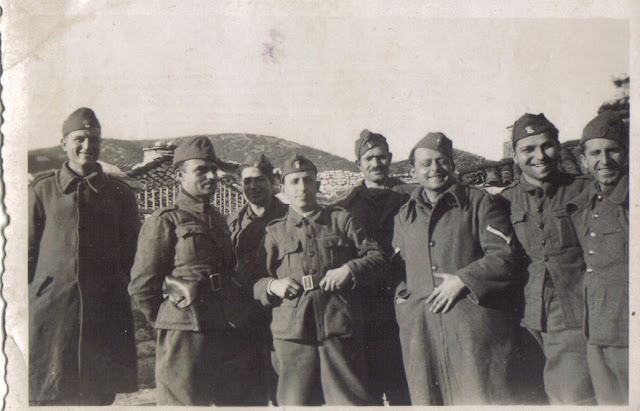
The Italian Spring Offensive began in the Greco-Italian War. Benito Mussolini, in a radio address from Albania, announced that he was personally commanding the offensive. Benito Mussolini visited Tiranë, Albania; he announced on radio that he would personally lead a renewed offensive against Greece. On cue, 12 Italian divisions attacked Greek lines through the Trebeshinë heights between Osum and Vjosë Rivers, but the Greek First Army was generally able to hold the lines. The Italians will employ nine divisions (including one armoured and two alpini), plus many smaller units of up to regimental size, against about 20 miles of front straddling the Vojussa river. The Greeks defend with the 1st and 15th Divisions in the line, and the 6th Div and half the 17th Div in reserve. The Italian preparations have long been detected, and the Greeks are established in well-hidden hilltop positions with interlocking fields of fire for their machineguns, mortars, and highly effective mountain artillery. The Italian attack is preceded by a two-hour barrage in which 300 guns fire off 100,000 shells, but these are mostly light field pieces (100mm or smaller) and their effect on the deeply dug-in Greeks is minimal. There are also air attacks by Italian Stukas. The main push will be north of the Vojussa in the 6.5-mile sector of Gastone Gambarra’s 8th Corps. On Gambarra’s left wing the Cagliari Division is to break through the pass over Mt. Trebessina at Bubesi. But with its commander General Gianni sick in bed the Cagliari makes no progress. On the 8th Corps right De Stefanis with the Pinerolo Division twice reaches his objective, the Qafa Lusit pass, but is driven back both times by Greek counterattacks. In Gambarra’s center, the Puglie Division advances half a mile over uncontested ground, but then meets a bloody repulse at Monastery Hill, which will become a focal point of the battle. Cavallero tells Mussolini, “Our troops are not suitable for making a break in the front of the enemy, who has used the time that we used in forming the front to build up a very effective defense system. Facing a well consolidated defense system with centers of fire, troops are necessary who are capable of using infiltration tactics, and are well-supplied with officers. We do not have those conditions, and therefore, instead of using infiltration tactics, we apply weight and wear the enemy down… If success is not in sight, we must not continue to feed the struggle, but break it off…”
General Erwin Rommel, commanding the Afrika Korps, sends a message to the German High Command suggesting that it might be possible to go on the offensive before the hot weather begins. He suggests three objective, (1) the re-occupation of Cyrenaica, (2) the occupation of northern Egypt, and (3) the capture of the Suez Canal. He proposes 8 May to begin the campaign.
An officer who took part in the fighting from Sidi Barrani to Benghazi stressed the fact that the Italians fought well and chivalrously … “The regulars often held out unexpectedly until they knew it was hopeless. Then amazing scenes occurred as our cavalrymen stepped out of their tanks. Fraternization between the two forces was instantaneous, cigarettes were exchanged, and the greatest good humor prevailed.” Instances of Italian chivalry were many. On one occasion when a British colonel was captured he was allowed to write a letter which was at once taken back to our line and dropped by an Italian airplane. Another instance occurred when a British airman crashed and got killed behind the Italian lines. They sent over another airplane with a message that he had been buried with full military honors, stating place.
Minesweeping work completed in the Suez Canal in Egypt, and British Royal Navy commanders gave aircraft carrier HMS Formidable the go ahead to sail through from the Red Sea into the canal.
South African troops continue advancing along the road to Mogadishu.
Britain’s Labor Minister Ernest Bevin declared yesterday that U.S. Senate passage of the lend-lease bill with its promise of “overwhelming” American material aid to Britain would be a “psychological” blow to Germany’s war effort. The Greeks and Chinese, fighting wars against the Italian and Japanese members of the tripartite pact, hailed the measure. Official quarters in Berlin, Rome and Tokyo were silent.
In a joint report on the role of Coastal Command and the Royal Navy it is decided that “the predominance of the naval element in the existing operational partnership for the production of a sea-borne trade, but preserving the right of direct command of Coastal Groups to their own officers and the C-in-C.”
Australian Prime Minister Robert Menzies, visiting London, records his view of last night’s big air raid on London:
“Last night London has its first real blitz since I arrived, and I missed it [Menzies was at Churchill’s Chequers home]. Bombs & incendiaries all round my hotel & the West End generally — Cafe de Paris, where a bomb cam right through into the ballroom. Curzon St. incendiaries on roof of No. 10 [Downing Street] & so on. There is no pretence of a military objective.”
Menzies also has dinner today with Sir Alan Brooke, in charge of the United Kingdom Home Forces. Brooke explains in detail the predicates for areas where conditions favor a German invasion of England:
— Adequate Luftwaffe fighter cover for bombers;
— Restricted waters to minimize Royal Navy defense.
According to Brooke, these conditions mean an invasion must occur somewhere between Plymouth and The Wash, where Norfolk meets Lincolnshire.
In a speech in Newcastle today, Ernest Bevin asked for 100,000 women to sign up for munitions work within the next fortnight. He said the women were needed desperately — primarily in shell filling factories — and he asked them not to wait for instructions or registrations but simply to come forward. “I cannot offer them a delightful life,” he said. “I want them to come forward in the spirit that they are going to suffer some inconvenience, but with a determination to help us through. We are anxious that the children shall be looked after properly and to assist them we are subsidizing the cost of minding. We have left the woman to pay only what she would have paid before the war, which is about sixpence a day, and we are paying the additional sixpence.” Instructions for management in companies which are not used to employing women are to be issued, and new terms of employment and wages for women employed in war work will also be announced soon. Both the British and German war economies are both becoming more reliant on women workers. In Germany, the Nazis have been forced by circumstances to relax their ideological standpoint that women are good only for housework and maternity.
The Netherlands government in London breaks diplomatic relations with Bulgaria.
The Vichy government continues restricting the freedom of Jewish citizens. It now requires government authorization before Jews can sell or rent their companies. The Germans have noticed that many Jews who wish to flee the Continent are apt to “rent” their companies to Gentiles for the duration of the conflict while they escape to England or the United States.
Polish Jews from the city of Oswiecim (Auschwitz) began to be deported to the town of Chrzanow in southern Poland. The German Occupation authorities begin deporting the Jews of Oswiecim to Chrzanow in southern Poland. Oswiecim is the home to the Auschwitz concentration camp, and also is the location of synthetic oil and other plants which are to make use of slave labor.
A few Jewish survivors of the violence in Bucharest reach Palestine aboard the S.S.Darien.
Soviet Russia was said in diplomatic quarters tonight to be concentrating troops in the Caucasus, near the Turkish frontier, as a precaution against German forces which appeared ready to smash into Greece and perhaps Turkey. These reports said Soviet action, closely following strengthening of red army forces on the Prut river frontier with German-occupied Rumania, is explained by a desire of the Moscow government to make sure of its defenses if Germany goes through Turkey. Some diplomats expressed belief that the reported Caucasus concentrations might mean a Russian attempt to bluff Germany out of trying a move toward the Dardanelles by suggesting that the red army would move in to help Turkey in case of such a Nazi drive.
The attitude of Turkey herself, however, still was obscure. Some of the Turkish press, which usually reflects government opinion, stressed the nation’s will for peace at all costs while other newspapers, equally subject to editorial direction by the government, continued a violent anti-German campaign. Diplomatic sources interpreted this as meaning that Turkey has not yet made up her mind what to do in the face of Nazi armies massing in Bulgaria. There have been persistent reports from Ankara that the Turkish government is divided, with some members holding out for appeasement and acceptance of Adolf Hitler’s assurances. Others have been reported fighting stubbornly for assistance to Greece.
Four persons were killed and scores injured in Damascus, Syria, as police and troops broke up street demonstrations against the French government’s new food distribution regulations. High Commissioner-General Henri Dentz came here personally to direct suppression of the outbreaks here and at Aleppo. At Beirut strong detachments of troops patrolled the streets and preserved quiet. Authorities in Syria remain loyal to the Vichy government, but dispatches have told repeatedly of efforts by De Gaullist sympathizers to swing Syria and the French troops there over to the “Free French” side as allies of Britain.
Admiral Lütjens continues taking his two ships in Operation BERLIN, Gneisenau and Scharnhorst, west into the Atlantic. As it retreats from the shipping lanes, Scharnhorst comes across 6352-ton independent Greek collier Marathon. Scharnhorst takes the entire crew prisoner.
Portsmouth is heavily bombed by the Luftwaffe tonight. The Luftwaffe is quiet during the day, with its usual scattered raids by lone raiders in southern England. After dark, the German bombers once again attack London and Portsmouth. The docks burn throughout the day from the attacks that began late on the 8th.
As part of Prime Minister Winston Churchill’s “Battle of the Atlantic,” RAF Bomber Command switches bombing target priorities in favor of U-boat bases and construction yards. Throughout the war, tension will arise over what parts of the German war effort are targeted — each service has its own preferences, such as tank factories, aircraft factories, and U-boat pens.
In Malta, the first Luftwaffe attack is at 06:27. Four Bf 110s escort a lone bomber across the coast at wavetop level, evading the island’s radar. They come in so low that one of the Bf 110s hits a ridge and crashes. The remaining planes strafe Ta Qali airfield, destroying a Hawker Hurricane and damaging two others. About two hours later, a single Junkers Ju 88 bomber drops bombs on the Grand Harbour area. Late in the afternoon, at 18:08, another lone Ju 88 drops four bombs near St. Clements Bastion. The first attack continues the Luftwaffe’s gradual destruction of the defending RAF fighter forces which is becoming a real problem.
Destroyers HMS Zulu and HMS Maori departed Scapa Flow at 1630 and destroyer HMS Cossack departed Scapa Flow at 1800 to rendezvous with the 1st Minelaying Squadron in the Minches for escort duty. 1st Minelaying Squadron of minelayers HMS Southern Prince, HMS Agamemnon, HMS Port Quebec, and HMS Menestheus departed Loch Alsh to lay minefield SN.68 B, escorted by destroyer HMS St Marys. Light cruisers HMS Edinburgh and HMS Nigeria departed Scapa Flow at 2335 the same day to cover. They rendezvoused with the minelayers on the 10th. The mines were laid on the 11th. The ships arrived back on the 12th. Cruisers Edinburgh arrived at 1919 and Nigeria at 2105 at Scapa Flow. Destroyers Cossack, Maori, and Zulu refueled at Loch Alsh on the 13th. Destroyers Cossack, Zulu, and Maori departed Loch Alsh at 0835/14th and joined convoy OB.297 at 1100 in the Minches.
Battleships HMS King George V and HMS Rodney escorted by destroyers HMS Somali, HMS Bedouin, HMS Punjabi, HMS Tartar, HMS Matabele, and HMS Eskimo departed Scapa Flow at 0740 to cover the convoy route. The destroyers arrived back at Scapa Flow at 1130/13th. Battleship King George V proceeded to Halifax arriving on the 15th. The battleship departed Halifax on the 17th escorting convoy HX.115. She arrived at Scapa Flow on the 31st. Battleship Rodney escorted convoy HX.114. She then proceeded to Reykjavik to refuel arriving on the 24th. Battleship Rodney proceeded to Halifax arriving on the 31st.
Destroyers HMS Mashona and HMS Active departed Scapa Flow at 0600 to rendezvous with armed merchant cruiser HMS Ausonia in 61N, 15W and escort her to the Minches. After this duty, both destroyers arrived back at Scapa Flow at 1715/11th.
Anti-aircraft cruiser HMS Curacoa departed Scapa Flow at 1100 to meet convoy WN.95 in Pentland Firth and provide cover. The ship after this duty transferred to convoy EN.83.
On arrival in Pentland Firth on the 10th, ship HMS Curacoa transferred to convoy WN.96. Off Aberdeen, the ship parted company and arrived back at Scapa Flow at 0330/11th.
German battleship Scharnhorst sinks the Greek merchantman Marathon (6,350 tons).
Anti-submarine trawler HMS Gulfoss (730grt, T/Skipper A. Hill RNR) was sunk on a mine in the English Channel. T/Sub Lt G. K. Swindells RNVR, and nine ratings were missing on the trawler. Hill was wounded.
Minesweeping trawler HMS Hatsuse (295grt, Skipper G. Stewart RNR) was mined 1.2 miles 180° from Penlee Point. She was beached in Cawsand Bay in a sinking condition, salved and taken to Plymouth on the 11th for repair.
Greek steamer Marathon (7296grt) was sunk by German battlecruiser Scharnhorst at 21N, 25W. The entire crew was taken prisoner.
In German bombing attacks on convoys EN.83 and WN.95, British steamer Esmond (4976grt) was damaged off Buchan Ness in 57-21N, 1-38W. She sustained seven casualties.
British steamer Sylvia Beale (1040grt) was damaged by German bombing five miles ENE off Dungeness.
British cruisers HMS York, HMS Bonaventure, and HMS Gloucester departed Alexandria at noon as convoy AG.4. The cruisers arrived at Pireaus on the 10th. After disembarkation, the cruisers sailed to arrive at Suda Bay at 0630/11th to take over the Aegean patrol duties. British cruisers HMS Orion and HMS Ajax and Australian light cruiser HMAS Perth arrived at Suda Bay at 0630/10th for fuel. They sailed that day for Alexandria. Cruisers Orion and Perth arrived at Alexandria to fit additional anti-aircraft weapons. Cruiser Ajax was detached to Port Said, to arrive at 0630/12th, to have her catapult removed prior to anti-aircraft gun installations. Destroyers HMS Nubian and HMS Mohawk, formerly of convoy AG.2, oiled at Suda Bay and then joined the British Force A west of the Kithera Channel.
A German supply convoy of steamers Ankara (4768grt), Kybfels (7764grt), Marburg (7564grt), and Reichenfels (7744grt) escorted by destroyers Vivaldi, Da Noli, Malocello, Folgore, and Lampo, which departed Naples on the 5th and arrived at Palermo on the 8th, departed Palermo on the 9th. Italian steamers Sebastino Venier (6311grt) and Andrea Gritti (6338grt) which departed Naples on the 6th escorted by torpedo boat Alcione, arrived at Palermo on the 8th. The convoy was joined by torpedo boats Pallade and Polluce from Palermo. Both convoys were joined by torpedo boats Clio and Centauro from Tripoli. The German convoy arrived at Tripoli at noon on the 10th and the Italian convoy at 1330/11th.
An Italian convoy of steamers Tanaro, Caffaro (6476grt), Fenicia (2584grt), and Capo Vita (5683grt) escorted by torpedo boat Papa and armed merchant cruiser Deffenu, departed Palermo, via Trapani, for Tripoli. When the convoy departed Trapani, it was escorted by merchant cruiser Deffenu only. Steamer Caffaro was detached with mechanical problems and returned with steamer Tanaro to Trapani.
Submarine HMS Utmost sank Italian steamer Capo Vita in 36-09N, 11-07E in the Gulf of Hammanet.
Submarine HMS Utmost made an unsuccessful attack on Deffenu.
Italian steamer Fenicia was sunk by submarine HMS Unique on the 10th in 34-19N, 12-40E, sixty miles southeast of Kerkenah.
Two Greek destroyers patrolled between Santorin Island and Kaso Straits during the night of 9/10 March.
Destroyer HMS Vendetta departed Alexandria for Port Said for escort duties in convoy AN.19.
Aircraft carrier HMS Formidable and destroyers HMS Juno and HMS Griffin departed Port Said at 1900 for Alexandria, arriving on the 10th. Anti-aircraft cruiser HMS Carlisle, which traveled through the Canal with the aircraft carrier, accompanied the ships from Port Said to Alexandria. Sloop HMS Grimsby, which also traveled with these ships through the Canal, remained at Port Said for convoy AN.19 duties.
French submarine depot ship Jules Verne, escorted by destroyers Albatros and Tempete passed Gibraltar westbound on the 9th. Both escort ships had come from Casablanca. Destroyer Tempete arrived at Oran with convoy K 28 on the 1st and destroyer Albatros with convoy K 29 on the 3rd. The submarine depot ship departed Bizerte on the 4th and arrived at Casablanca on the 10th.
Convoy GA.2 of empty personnel ships departed Piraeus escorted by destroyers HMS Jaguar, HMS Wryneck, and HMAS Vampire. The convoy arrived at Alexandria on the 11th.
While administration leaders arranged to speed final congressional action on the British aid bill, opponents announced today a nationwide speaking campaign aimed at arousing public sentiment against possible involvement of this country in war. Senator Wheeler, Montana Democrat, one of the leaders of the opposition to the measure, said he had asked colleagues of like views to meet at his office early this week to map an extensive speaking drive. “We have lost a battle but we haven’t lost the war,” Wheeler told reporters in commenting on the senate’s passage of the bill by a 60 to 31 vote last night. “We are going to carry on a crusade from one end of this country to the other to counteract the propaganda that is going to be unloosened right away for ‘all-out’ aid to Britain that would take us into war.” The Montana senator said he expected a dozen of those who joined in the three-week fight in the senate against the bill to respond to his invitation. Opponents should feel free to leave Washington and stump the country, he contended.
The British government, declaring that it would be “false humanitarianism” to admit foodstuffs into any German-occupied territory, announced rejection tonight of Herbert Hoover’s new proposal to establish soup kitchens in Belgium as an experiment in European relief. The British embassy in a statement in Washington said the government had “considered afresh the whole problem of relief, including the proposal for the institution of soup kitchens in Belgium” and still was determined not to weaken or undermine the blockade “by the admission of supplies from overseas into any territory under enemy control.” In reply, the former president said, “the stark fact is that millions of children, and the weak, are threatened with stunted bodies and death in the occupied lands unless relief is brought to them. It is no false humanity which saves the lives of countless children.”
Anthony J. Drexel Biddle Jr., Ambassador to the exiled governments in England, and W. Averell Harriman, ordered to London by President Roosevelt as special defense liasion official, will leave by Clipper tomorrow morning from La Guardia Field for Lisbon, instead of on Tuesday morning, as they originally had planned.
Three of the thirteen members of the national executive committee of the Socialist party have resigned in protest against the party’s continued policy of isolationist opposition to large-scale material aid to Great Britain, as presented to the public by Norman Thomas, national chairman, and the official publications and statements of the party.
Officials of the United Automobile Workers, C.I.O., announced completion today of plans for a strike of 1,700 workers at the Midland Steel Products Company in Detroit starting at 11 AM tomorrow.
The program for the coordination of American ocean shipping, designed to make the most efficient possible use of available tonnage, is now under way as the Division of Emergency Shipping, created this past week, has begun to function.
The U.S. Navy heavy cruiser USS Chicago (CA-29), under command of Rear Admiral John H. Newton, Commander Cruisers Scouting Force, and USS Portland (CA 33), the light cruisers USS Brooklyn (CL-40) and USS Savannah (CL-42), the destroyers USS Clark (DD-361), USS Conyngham (DD-371), USS Cummings (DD-365), USS Cassin (DD-372), USS Case (DD-370), USS Shaw (DD-373), USS Tucker (DD-374), USS Reid (DD-369), and USS Downes (DD-375), and the oiler USS Sangamon (AO-28), that departed Pearl Harbor, Territory of Hawaii on March 3, 1941, arrived in Samoa.
The Chinese Communist party has presented two sets of demands to the People’s Political Council, which Generalissimo Chiang Kai-shek has described as “just like the demands served on the government and the Kuomintang [Nationalist party] by the Japanese” prior to the opening of the Chinese-Japanese conflict in July, 1937, it was revealed tonight.
The Western Hupei Operation continues. The Japanese 11th Army’s 13th Infantry Division captures Kaolingpo. The Chinese defenders continue withdrawing toward Chunking.
Japanese military headquarters at Canton announced today the withdrawal of the Japanese forces from the entire area of the south Kwangtung coast that they occupied last week, including the treaty port of Pakhoi. The announcement did not disclose the place to which the troops had withdrawn but it is believed that they are returning to Hainan. The Japanese announcement asserts that the objective of the landings was achieved and that the occupation of the coastline is no longer necessary. It states that the operation will be repeated whenever necessary to cut off supplies destined for Chungking.
Chinese troops in vigorous counter-attacks recaptured the Kwangtung Province cities of Tinpak and Shuitung from Japanese soldiers, Chinese sources reported today in direct opposition to Japanese reports that the area had been evacuated quietly by their men yesterday. The Chinese version was that the Japanese fled to their warships, suffered some 200 casualties and lost a large quantity of war material.
Chinese military planes yesterday bombed Japanese troop concentrations and military objectives at Ichang, important Yangtze River port between Chungking and Hankow, a War Office communique said today. All the Chinese planes returned safely, it was stated.
French Ambassador Charles Arsene Henry announced today a formal peace agreement between Thailand and French Indo-China on their Japanese-mediated border dispute would be signed by tomorrow night, His announcement was made after a conference with Foreign Minister Yosuke Matsuoka.
A Japanese intelligence network was established in San Diego, California, United States to observe the transportation of war materials. At around this time, the Japanese begin coordinating their spying efforts within the United States. Spying is to be done both by official Japanese government officials, such as embassy personnel and by ethnic Japanese with or without American citizenship. A meeting is held at the Japanese Embassy in which it is decided to request $500,000 to purse these spying activities. The Nichibei Kogyo Kaisha propaganda/espionage organization in Los Angeles is reorganized as the Nichibei Kinema Company, Inc., and it is suspected by the US government as acting as a front for other suspect organizations and firms. A spy ring in San Diego, a major naval port, also is organized around this time.
Born:
Ernesto Miranda, American criminal, litigant, appealed conviction on kidnapping, rape, and armed robbery charges (“Miranda Warning”), in Phoenix, Arizona (d. 1976).
Delphine Medjo, Cameroonian politician, in Douala, Cameroon (d. 2016).
Jim Colbert, American golfer (8 PGA Tour titles; Senior Players Championship, 1993), in Elizabeth, New Jersey
Naval Construction:
The U.S. Navy coastal patrol yacht USS Aquamarine (PYc-7, former yacht Vasanta, then named Seawolf) is commissioned. Her first commanding officer is Lieutenant George A. Lange, USN.
 History Diaries