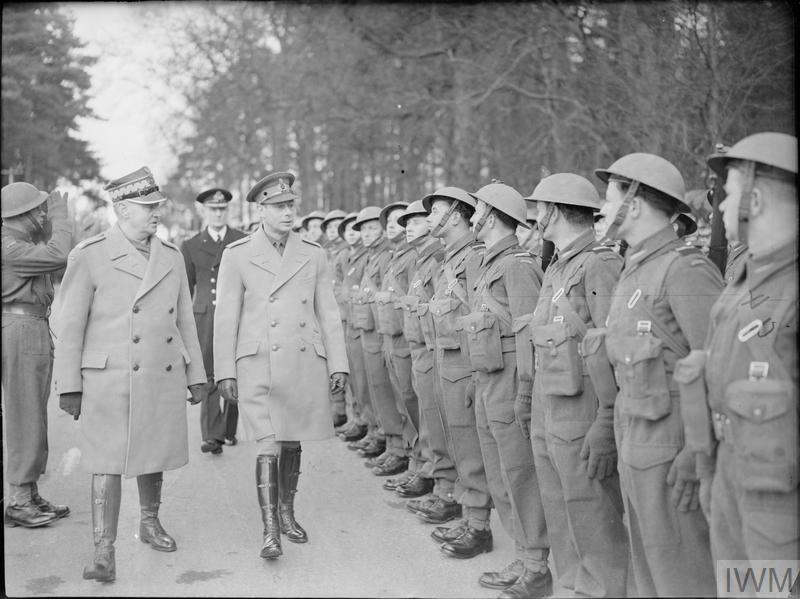
Telegram from the British Military Mission, Athens to Wavell: “General Papagos yesterday have impression of greater optimism. He states indications led him to hope Yugoslavia might yet fight. He therefore reverted to question of holding Nestos position if Yugoslav collaboration at last moment made this possible. From the point of view of morale he emphasised fact that troops in Eastern Macedonia were recruited locally, and that, if fighting in forward positions would be defending their own homes. He remains anxious about lorry situation in view new supply difficulty, and urges that every available lorry be sent as early as possible.”
Recent Greek attacks continue on 8 March 1941, but the impetus of the Greek counteroffensive definitely is petering out. Mussolini is in Tirana, Albania and has ordered an offensive in the same region where the Greeks have been attacking. It is set to begin on the 9th — something that Mussolini actually announces on the radio. Telling your opponent your strategy in advance is… a very odd strategy. A dozen Italian divisions (50,000 men) are in position to attack at the Trebeshinë heights between Osum and Vjosë Rivers. Italian artillery and 2000 warplanes are poised to launch the attack.
Greek Commander-in-chief Papagos believes that Yugoslavia will join the fight against the Axis. He therefore holds to his position of defending against a German attack through Bulgaria in the forward Nestos line.
Greek soldiers pressing the Italians in Albania despite the presence of masses of German troops on their Bulgarian border captured 2,200 prisoners in two days and occupied new positions in “fierce fighting,” it was reported tonight. A delayed dispatch from the central Albanian front reported Greek shock troops in a bayonet charge behind a curtain of artillery fire rounded up 1,200 Italians yesterday. The Greek high command late tonight reported the capture of 1,000 more Fascists today, plus the new ground, and announced capture of “many automatic arms and abundant other materials.”
Greece has asked the Turks to say flatly whether or not they propose to fulfill mutual assistance treaties and come to the aid of the Greeks if the Germans loose their expected offensive from Bulgaria upon Thrace and eastern Macedonia, Balkan diplomats were informed tonight. The Greek minister to Ankara, these informants added, has requested an aye or nay answer from the Turkish foreign office, pointing to a pact of September, 1933, under which Turkey and Greece mutually pledged themselves to defend their frontier in Thrace by arms if necessary. Too, by the Balkan entente treaty of 1934 signed by Yugoslavia and Rumania ag well as Greece and Turkey the Greeks and Turks promised mutual aid. The Turks went on quietly with defense preparations storing gasoline and other inflammables underground and ordering air-raid tests for various cities.
The Panzer Regiment of German 5th Light Division departed Naples, Italy aboard freighters Alicante, Arcturus, Wachtfels, and Rialto bound for Tripoli, Libya in two convoys.
British freighters Clan Macauley and Cingalese, escorted by destroyers HMS Nubian, HMS Mohawk, and HMS Wryneck Prince arrived in Piraeus, Greece with tanks and equipment from North Africa.
The German mines in the Suez Canal claim another victim. This time it is a minesweeping boat, HMS Dart. There are two deaths, with the other two men badly wounded.
The operations in Italian Somaliland continue, with the British heading along the road to Mogadishu. The RAF is active throughout the region, including over Keren.
In London, Australian Prime Minister Robert Menzies meets with the Admiralty leadership at Whitehall. He confides to his diary the general attitude of the officers there regarding the reinforcement of the Far East:
“The real truth, which we are all beginning to see, is that air reinforcements to Singapore and the Far East is the great deterrent (apart from USA) to Japan. The [Japanese pilot] is reported to be a poor airman. Even on the naval side, the Second Sea Lord (Phillips) said British fleet would be happy to attack with only 60% of the Japanese Force. The Japanese experience in China seems to point to a similar state of affairs in the Army!”
The “Phillips” mentioned by Menzies is Rear Admiral Sir Tom Phillips, Vice Chief of the Naval Staff. He will lose his life on 8 December 1941 when the “poor Japanese airmen” sink his battleship.
In addition, Menzies gives the Admiralty leave to place priority on the Mediterranean Theater at the expense of the Far East should the Japanese attack. This is due to the major commitment of Australian and New Zealand ground forces in the region.
Cpl James Patrick Scully (1909-74), Royal Pioneer Corps, worked solidly for seven hours to rescue people trapped under a bombed building in Liverpool. For this he receives the George Cross.
The German occupation forces continue clamping down on the Dutch citizenry following the February General Strike. They proclaim martial law.
Battleship Bismarck exited the Kiel Canal and entered Dock C of Deutsche Werke Kiel where she took on supplies and the ship was painted with a camouflage pattern.
Admiral Lütjens turns his heavy cruisers Gneisenau and Scharnhorst west, away from the convoy he has stumbled upon near the Cape Verde Islands. The presence of battleship HMS Malaya has prevented Lütjens from attacking an otherwise vulnerable convoy (Convoy SL.67). However, the contact is not to no purpose: Lütjens has contacted the Kriegsmarine U-boat command (BdU), which has vectored in U-boats in the vicinity to attack Convoy SL.67.
Malaya’s aircraft is the first to spot the German ships; it runs out of fuel and the crew is picked up by a passing Spanish freighter and interned. The Royal Navy dispatches Force H, led by battlecruiser HMS Renown and the aircraft carrier HMS Ark Royal from Gibraltar toward the Cape Verde Islands to search for the German cruisers, but they are long gone into the vastness of the Atlantic.
Off Western Africa, German submarines U-105, U-106, and U-124 received sighting reports of Allied convoy SL.67 from surface ships Scharnhorst and Gneisenau. They searched for the escorting battleship HMS Malaya in failure; instead, U-105 sank British ship Harmodius at 0341 hours and U-124 sank four ships between 0547 and 0608 hours. U-105 received damage from depth charges as she was counterattacked. A total of 62 British sailors were killed; 300 survivors were picked up.
Erich Raeder warned Adolf Hitler of a possible American landing in northwest Africa should the United States enter the war.
The Stavka orders mobilization of 900,000 Soviet reservists from 15 May 1941 to 20 October 1941.
The Luftwaffe sends a large raid (125 bombers) against London after dark. Among the places hit are Buckingham Palace (front courtyard quadrangle and the chapel in the south wing), The Garland’s Hotel SW1, a block of London County Council (LCC) flats, and the Cafe de Paris (34 deaths and many casualties as the bomb hits during the evening performance). There is a total of 34 deaths and 60 seriously injured from the attack. Fortunately for the residents, many of the bombs fall harmlessly in Green Park. The Queen Consort almost perishes in the attack on the Palace.
Paul R. Anderson, member of the American Eagle squadron in Britain, was waiting to return to hit home to Sacramento, California, when he was killed in tonight’s bombing raid on London. Letters his widow received from the 27-year-old pilot indicated that he expected to be sent home in about a month due to injuries which impaired his eyesight. The injuries had been suffered when a Hurricane pursuit ship he was flying crashed. Anderson was a former airplane crop duster, law student and bus driver in Sacramento, where his widow is a state employee. He was the second Sacramento pilot to be killed in Britain. First was Edwin E. Orbison, 23, a private pilot who joined up with the Eagle squadron and became one of its outstanding fliers. He was killed in combat, being shot down in flames February 9. A third Sacramento pilot Is still with the squadron. He is Dean H. Saterlee, 24. Anderson, Orbison and Satterlee had enlisted together. A letter Anderson wrote home on the day of Orbison’s death said in part: “We lost Bud Orbison today. . . He was one of our best pilots and went down fighting for what he thought was right. He only wished he could have done as much for his country as he has done for this one.
The Luftwaffe also raids Plymouth. The dockyards are hit hard.
RAF Bomber Command: Day of 8 March 1941
8 Blenheims to Holland and German islands; 2 aircraft bombed Den Helder. No losses.
The Regia Aeronautica is very active in Albania, while the RAF bombs the port of Durazzo.
Axis aircraft drop 76 tons (70 metric tonnes) of bombs on the 122 square mile (316 square kilometer) island of Malta today.
German submarines U-105 and U-124 attacked convoy SL.67 on the 8th.
U-105, commanded by Kapitänleutnant Georg Schewe, sank British steamer Harmodius (5229grt) at 20-35N, 20-40W. At 0341 hours on 8 March 1941 the Harmodius (Master Robert James Parry) in convoy SL.67 was torpedoed and sunk by U-105 north-northeast of the Cape Verde Islands. 13 crew members and one gunner were lost. The master, 59 crew members and one gunner were picked up by HMS Faulknor (H 62) (Capt A.F. de Salis, RN), transferred to HMS Forester (H 74) (LtCdr E.B. Tancock, DSC, RN) and landed at Gibraltar on 16 March. The 5,229 ton Harmodius was carrying pig iron and general cargo and was bound for Glasgow, Scotland.
U-124, commanded by Kapitänleutnant Georg-Wilhelm Schulz, sank British steamer Nardana (7974grt) at 20-51N, 20-32W, the British steamer Hindpool (4897grt) at 20-51N, 20-32W, the British steamer Tielbank (5084grt) at 20-51N, 20-32W and the British steamer Lahore (5304grt) at 21-03N, 20-38W. Submarine U-124 also claimed two more ships hit by torpedoes. Between 0547 and 0608 hours on 8 March 1941, U-124 fired six single torpedoes at the convoy SL.67 north of the Cape Verde Islands and observed four ships going down. Schulz reported five ships with about 33,000 grt sunk and another ship damaged. In fact four ships were sunk in the attack, the Nardana, Hindpool, Tielbank and Lahore.
19 crew members from the Nardana (Master Cyril Edward White) were lost. The master, 104 crew members and two gunners were picked up by HMS Faulknor (H 62) (Capt A.F. de Salis) and HMS Forester (H 74) (LtCdr E.B. Tancock DSC) and landed at Gibraltar on 16 March. The 7,974 ton Nardana was carrying general cargo, including linseed, palm kernels, pig iron, and seeds and was bound for London, England, United Kingdom.
The master and 27 crew members from the Hindpool (Master Malcolm Vernon Allt Tinnock) were lost. Six crew members were picked up by HMS Faulknor (H 62) (Capt A.F. de Salis, RN) and landed at Gibraltar on 16 March. Four crew members and two gunners were rescued by the Guido. The 4,897 ton Hindpool was carrying iron ore and was bound for Middlesbrough, England, United Kingdom.
Four crew members from the Tielbank (Master William Broome) were lost. The master, 59 crew members and two gunners were picked up by HMS Forester (H 74) (LtCdr E.B. Tancock, DSC) and landed at Gibraltar on 16 March. The 5,984 ton Tielbank was carrying groundnuts, groundnut cake and manganese ingots and was bound for Oban, Scotland.
The Lahore (Master Geoffrey Scott Stable) caught fire, was abandoned the next day and sank in 21°03N/20°38W. The master and 81 crew members were picked up by the British destroyer HMS Forester (H 74) (LtCdr E.B. Tancock DSC) and landed at Gibraltar on 16 March. The 5,304 ton Lahore was carrying general cargo, including timber, tea, pig-iron, and mail and was bound for London, England, United Kingdom.
Destroyers HMS Faulknor and HMS Forester rescued over three hundred survivors from the various sunken merchant steamers. The destroyers arrived at Gibraltar on the 16th. Force H escorted convoy SL.67 until Light cruiser HMS Kenya relieved them on the 19th for the final leg to England.
U-A torpedoed British steamer Dunaff Head (5258grt) from convoy OB.293 in 60-33N, 18-50W. At 0119 hours on 8 March 1941 the Dunaff Head (Master R. Dicks) in convoy OB.293 was hit by one of two torpedoes from UA and sank south of Iceland. Five crew members were lost. The master, 34 crew members and four gunners were picked up by HMS Verity (D 63) (Cdr R.H. Mills, RN) and landed at Loch Ewe.
Destroyer HMS Matabele departed Scapa Flow at 0815 for Scrabster to embark the body of the late Air Vice Marshal Breese and provide facilities for a burial at sea. The destroyer arrived back at Scapa Flow later in the day.
Destroyer HMS Gurkha arrived at Scapa Flow at 1400 from Greenock to carry out working up exercises.
Destroyers HMS Inglefield, HMS Electra, and HMS Echo departed Scapa Flow at 2200 to join convoy OB.295 at 1440/10th in 58-08N, 5-43W. The destroyers returned to Scapa Flow at 1300/15th.
Destroyer HMS Beverley, operating in the Western Approaches, broke down with her port engine inoperative. The destroyer was assisted by destroyer HMS Harvester. Destroyer Beverley proceeded to the Tyne for repairs completed on 31 May.
Aircraft from Battleship HMS Malaya, escorting convoy SL.67 with armed merchant cruiser HMS Cilicia and corvette HMS Asphodel, sighted German battlecruisers Gneisenau and Scharnhorst 350 miles north of Cape Verde Islands. Later the battleship sighted the German ships herself. Destroyer HMS Forester patrolling nearby also reported the warships.
A Swordfish from HMS Malaya ran out of fuel on the 8th shadowing the German ships and its crew of Lt G. R. Brown DSC, Sub Lt R. G. Drake, and TAG R. H. George were picked up by Spanish steamer Cabo de Buerna Esperanza and interned in the Spain.
Battleship HMS Malaya and destroyer HMS Faulknor joined destroyer HMS Forester and proceeded towards the German ships, but no action ensued as the German ships withdrew. Battlecruiser HMS Renown, aircraft carrier HMS Ark Royal, light cruiser HMS Arethusa, and destroyers HMS Velox and HMS Wrestler departed Gibraltar at 2115/7th towards SL.67. Destroyers HMS Fearless, HMS Foresight, HMS Fortune, and HMS Foxhound met battlecruiser HMS Repulse and aircraft carrier HMS Furious. The battlecruiser and aircraft carrier were placed under the command of Force H. Liner Strathmore was detached and Fearless, Fortune, and Foresight escorted her to Gibraltar, arriving on the 10th. Battlecruiser Repulse and aircraft carrier Furious with destroyer Foxhound arrived at Gibraltar on the 10th. Light cruiser Arethusa also arrived back at Gibraltar on the 10th.
German tanker Nordmark replenished German heavy cruiser Admiral Scheer at sea.
Norwegian steamer Nurgis (700grt) was sunk by German bombing seven miles west by north of Lizard. The entire crew was rescued.
Dutch steamer Prins Frederik Hendrik (128grt) was sunk by German bombing in 52-20N, 5-37W. Eight crewmen were lost on the steamer.
Battleships HMS Barham and HMS Valiant and destroyers HMS Jervis, HMS Janus, HMS Jaguar, HMS Hotspur, HMAS Voyager, and HMAS Waterhen departed Suda Bay to cover movements of convoys through Kithera Straits. Destroyer Hotspur rescued Lt R. A. Brabner and Lt J. A. Shuttleworth from a Fulmar of 806 Squadron which had force landed in Suda Bay on the 10th. The British ships arrived at Suda Bay late on the 10th.
Egyptian steamer Star of Mex (1116grt), en route to Tobruk from Alexandria with petrol, ran aground near British steamer Knight of Malta off Ras Assaz at 0650. Corvette HMS Peony was sent to assist the tanker. The corvette was able to tow the tanker off successfully. Steamer Star of Mex was sailed to Alexandria for repairs, escorted by anti-submarine whaler HMS Southern Isle.
Minesweeping boat HMS Dart was sunk on a mine in the Suez Canal. Two crewmen were killed and two were seriously wounded.
Convoy OB.295 departed Liverpool, escorted by corvette HMS Heliotrope and anti-submarine trawler HMS Northern Dawn. On 9 March, destroyers HMS Echo, HMS Electra, HMS Inglefield, HMS Sardonyx, HMS Scimitar, and HMS Valorous, corvettes HMS Arabis, HMS Mallow, and HMS Violet, and anti-submarine trawlers HMS Northern Gem, and HMS Northern Wave joined the escort.
Convoy AS.17 of four British ships departed Piraeus escorted by anti-aircraft cruiser HMS Coventry and destroyers HMAS Stuart and HMS Hereward. The convoy arrived at Alexandria on the 12th.
Convoy ANF.18 of five British ships departed Alexandria escorted by destroyer HMS Greyhound. The convoy joined convoy AN.18 escorted by anti-aircraft cruiser HMS Calcutta and destroyer HMS Ilex. The convoy arrived at Piraeus on the 11th. Convoy ANF.18 with destroyers Ilex, Greyhound, and HMS Havock at 0750. Convoy AN.18 with anti-aircraft cruiser Calcutta and destroyer Ilex at 1800.
A German supply convoy of steamers Alicante (2140grt), Arcturus (2596grt), Wachtfels (8467grt), and Rialto (6099grt), escorted by destroyers Fulmine, Baleno, and Turbine, departed Naples for Tripoli, arriving on the 12th without event. On 12 March, steamers Arcturus and Wachtefels and destroyers Lampo and Fulmine departed Tripoli to return to Naples, arriving on 14 February.
The U.S. Senate passes the “Lend-Lease” bill by a vote of 60 to 31. The House of Representatives had passed the bill by a vote of 260 to 165 on 8 February 1941 but there are differences in the two bills and it is sent to a joint committee to resolve the differences. Worn down by three weeks of oratory and dispute, the senate tonight finally passed the Lend-Lease bill authorizing President Roosevelt to mobilize industrial America and throw its products into England’s battle against Germany. Then it sent the measure to the House with a request that the latter concur in the series of administration-approved amendments which had been added. All indications were that the House would agree to do so Tuesday, or by Wednesday at the latest, with the bill going to the White House immediately thereafter for President Roosevelt to sign.
President Roosevelt declared in a radio address tonight that “the democratic way of life” in the United States could not survive “the death of democracy over the rest of the earth.” Speaking to an estimated 2,000,000 attending anniversary farm dinners to commemorate the eighth year of the New Deal agricultural program, he said: “We cannot escape our collective responsibility for the kind of life that is going to emerge from the ordeal through which the world is passing today. We may discharge that responsibility unwisely, but we cannot escape the consequences of our choice. We would have it the kind of a world in which we may live in peace, freedom and security.”
Military authorities in the U.S. disclosed today the army intends to double its new armored force early this fall, and it was reported the move might entail retention of some selective service trainees as well as national guardsmen in service beyond a single year. Along with a possible request to congress for authority to keep the National Guard in service for an additional 6 to 12 months, the war department was reported to have under consideration a request to expand the land forces beyond the total of 1,418,000 set for June 15. Selective service trainees could be retained, military men said, by placing them on duty as reservists after completion of their initial one-year training. However, authorization would have to be voted by congress.
The War Department awards contracts for the construction of aircraft plants to Fort Worth, Kansas City, and Tulsa. One of the government’s primary considerations is that all three cities are well inland, as required by the military. Consolidated will take over the plant in Fort Worth. It states that the plant in Fort Worth, where it has been mulling building for some time, would be adequate to build a plane that would dwarf the B-24. Construction at all three sites is rushed.
A strike of 2,400 employees working on national defense orders at the South Plainfield plant of the Cornell-Dubilier Electric Corporation was voted last night by members of the International Brotherhood of Electrical Workers, an A.F. of L. affiliate.
Henry Ford said today that he believed unions were “losing ground” and that he had no intention of recognizing them as bargaining agencies for employees of the Ford Motor Company.
The Grand Coulee Dam in Washington state, the greatest structure ever built by man, will begin to furnish power for the national defense March 22, when the first of a battery of generators is to be set in operation. John C. Page, Commissioner of the Bureau of Reclamation, announced today that thus the dam would go into use two years ahead of schedule.
Wind-borne snow approaching in depth the blizzard of 1888 whipped the eastern seaboard yesterday and appeared inclined to lash it spasmodically until late today. Enveloping the coastal areas from Virginia to Maine and extending from 100 to 200 miles inland, the storm encrusted several areas with 16 inches of snow and sleet, took at least six lives and generally impeded transportation and communication. Light snow or freezing rain today in the New York City area was predicted by the Weather Bureau last night as the city and the Eastern Seaboard, from Virginia north, shoveled to get out from under the biggest snowstorm of the Winter.
Television is cutting-edge technology, and the government is at the stage of setting basic standards for purposes of uniformity. The National Television System Committee (NTSC) adopts 525 lines of resolution and 30 frames per second as the standard. This recommendation now goes to the Federal Communications Commission (FCC) for consideration. While Germany is continuing its development of television broadcasts using the public airwaves, Great Britain has suspended all broadcasts for the duration of the war. This is because the British fear the signals will serve as homing beacons for Luftwaffe bombers. For comparison, the pre-war British standard was 405 lines and the French standard was 455 lines. In Germany, where broadcasts continue during the war, the standard is 441 lines. Thus, the US standard is the highest at this point among the early television pioneers.
Warner Bros. releases “Footsteps in the Dark,” directed by Lloyd Bacon and starring Errol Flynn, Brenda Marshall and Alan Hale. While the critics like it, “Footsteps in the Dark” does poorly at the box office.
In baseball, the Philadelphia Phillies’ pitcher Hugh Mulcahy becomes the first major leaguer drafted and is inducted in the Army today. Mulcahy, an All Star in 1940 while leading the National League in losses for the second time, serves in the Army including a year in New Guinea and the Philippines. He was known as the “Losing Pitcher”, with a career total of 45 wins, 89 losses, and an ERA of 4.49. He returns on July 11th, 1945 but he will pitch only 96 innings in 23 games before ending his career in 1947. More than 100 major leaguers will be drafted within the next two years, and two — Elmer Gedeon who played five games for the Washington Senators in 1939 and Harry O’Neill who played one game for the Philadelphia Athletics in 1939 — will be killed in action.
Chet Ross of the Braves injures his ankle in a spring training game against the Browns. He will be out till May 25.
Generalissimo Chiang Kai-shek bitterly denounced Communist demands that special areas be created in China along Soviet lines and said the government must take steps to subdue insubordination, it was disclosed tonight. Chiang made the speech two days ago before the people’s political council, China’s nearest approach to a representative government. It was regarded as the most open declaration of the government’s stand against the Communist party since the war began but the press ban was lifted only tonight.
The Western Hupei Operation continues along the Yangtze River. The Japanese 13th Infantry Division of the 11th Army continues expanding from its bridgehead south and west of the river. As desired by the Japanese, the Chinese (Kuomintang) are withdrawing back on Chungking.
The Japanese have virtually completed their occupation of all strategic points of the coastline from the vicinity of Macao to the Indo-China frontier. They have also cut off Kwangcho, the French holding on the coast. The Chinese apparently made very slight resistance and most of it was in the neighborhood of Toishan. The Pakhoi customs station has been seized and is now operated by the Japanese.
A peace treaty settling the Thailand-French Indo-China frontier dispute will be signed provisionally tomorrow, reliable quarters predicted today. The signing, these sources said, is being held up pending final word from the French Government at Vichy. Agreement on the “principal points” of a Japanese mediation plan was announced last Thursday after a conference between Foreign Minister Yosuke Matsuoka and French Ambassador Charles Arsene-Henry on the final details.
Dow Jones Industrial Average: 121.47 (-0.12)
Born:
Andrei Mironov, Soviet stage and screen actor (“A Man from Boulevard des Capucines”, “Twelve Chairs”), in Moscow, Russian SFSR, Soviet Union (d. 1987).
Ivana Loudová, Czech composer (Vocal Symphony), in Chlumec nad Cidlinou, Bohemia, Czecho-Slovak Republic (d. 2017).
Yvar Mikhashoff [Ronald Mackay], American contemporary classical pianist, composer, and educator (University of Buffalo, 1973-1993), in Troy, New York (d. 1993).
Bobby Edmonds, ABA small forward (Indiana Pacers), in Indianapolis, Indiana.
Died:
Sherwood Anderson, 64, American writer.
Naval Construction:
The Kriegsmarine (German Navy) Type XIV U-boat U-463 is laid down by Deutsche Werke AG, Kiel (werk 294).
The U.S. Navy Aloe-class net tender USS Boxwood (YN-3, later AN-8) is launched by the Lake Washington Shipyards (Houghton, Washington, U.S.A.).
The U.S. Navy Accentor-Class coastal minesweeper USS Chimango (AMc 42) is launched by the Gibbs Gas Engine Co. (Jacksonville, Florida, U.S.A.).
The Вое́нно-морско́й флот СССР (ВМФ) (Soviet Navy) “K” (Katjusa)-class submarine K-54 is launched by Baltiyskiy Zavod (Leningrad, U.S.S.R.) / Yard 189..
The Kriegsmarine (German Navy) Type VIIC U-boat U-372 is launched by Howaldtswerke AG, Kiel (werk 3).
The Kriegsmarine (German Navy) Type VIIC U-boat U-204 is commissioned. Her first commanding officer is Oberleutnant zur See Walter Kell.
 History Diaries