Operation CLAYMORE
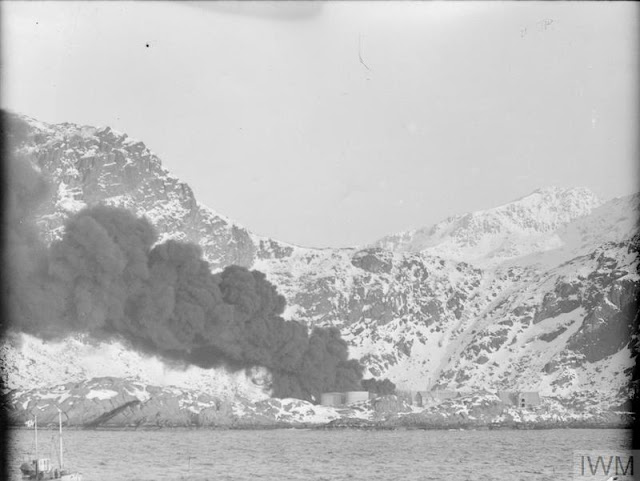
Operation CLAYMORE: British Commandos conducted a raid on the Nazi-occupied Lofoten Islands in Norway. They achieved their objective of destroying fish oil factories and some 3,600 tons of oil and glycerin, and also captured German code information. British commandos raided the Norwegian Lofoten Islands in an undertaking codenamed Operation CLAYMORE. 500 men of #3 and #4 Commandos were carried in the assault ships Queen Emma and Prinses Beatrix and were escorted by the destroyers HMS Somali (G 33), HMS Legion (G 74), HMS Eskimo (F 75), HMS Tartar (F 43), and HMS Bedouin (F 67). The attack primary objective was the destruction of the Norwegian fish oil processing plants, the destruction of which would have struck a severe blow to the German production of glycerin which was used in aircraft engines. The dawn raid was very successful and the commandos were ready to leave by midday. In all 11 fish-oil factories and oil dumps were blown up, 225 Germans and 60 “Quislings” taken prisoner, 314 Norwegian volunteers were recruited, and the auxiliary patrol boat Krebs and seven freighters were sunk. An unexpected bonus was the discovery of vital papers that contained the daily Enigma cryptographic system settings for February, 1941, found aboard the trawler Krebs. The raiders withdrew without a single casualty along with 228 German captives. The success of this first major Special Forces operation raised the morale of the commandos and the British public alike.
Prince Paul, Regent of Yugoslavia, arrived in Berchtesgaden in Germany where Hitler applied further pressure for Yugoslavia to join Tripartite Pact. German Chancellor Adolf Hitler and Yugoslavian Regent Prince Paul met at Berchtesgaden. In return for Yugoslavia joining the Axis Pact Prince Paul demanded that Salonika be ceded to Yugoslavia after the war, Yugoslavia’s territorial integrity be protected against invaders, that Yugoslavia would not be obligated to enter the war, that no troops, including wounded soldiers would transit Yugoslavia, and that the terms of the agreement be published. Hitler agreed to all the terms except the last. Paul, aware that joining the Axis will be unpopular at home, has arranged for the signing of the treaty to take place in great secrecy in ten days’ time.
The Bulgarian government breaks diplomatic relations with Belgium, the Netherlands and Poland.
The Greeks remain in their forward positions along the Bulgarian border. The British wish them to retreat to the Aliakmon Line, but the Greeks claim that any such move would damage the country’s morale. Local British commander Sir Henry Maitland Wilson for Operation Lustre cannot even leave the British Embassy, as the Greeks fear that his appearance alone will incite the Germans to attack.
Four British freighters departed Alexandria and Port Said, Egypt with men and equipment, escorted by destroyers HMS Hereward and HMS Stuart, for Greece; it was codenamed Operation LUSTRE. Meanwhile, British General Wilson arrived in Athens, Greece to take command of all Allied ground forces; he discovered the Greek troops were still manning the Metaxas Line on the Bulgarian-Greek border rather than the agreed upon Aliakmon Line. From the sea, Italian warships bombarded Greek coastal positions in Albania.
General Sir Henry Maitland Wilson, who is to command the British expeditionary forces being prepared for Greece, arrives in Athens to arrange the final details with the Greek general staff. A major convoy is about to leave Alexandria, Egypt, with the first large contingent. The British have only just discovered that the Greek forces in Macedonia have not retired to the Aliakmon Line and will not be able to persuade them to do so because of the damage to morale that would result if territory is obviously given up without a fight after the German move into Bulgaria. Wilson is further hindered by the Greek insistence that he remains incognito inside the British Embassy in order not to provoke the Germans. In fact the German consulate in Piraeus overlooks the port area which is being used to land the British forces for Operation LUSTRE, so they are well aware what is happening.
The Italians, meanwhile, are blissfully unaware of most of what the British and Greeks are doing. However, Mussolini is determined to salvage Italian pride by showing that his troops can achieve success against the Greeks before the Germans invade. Accordingly, he is reinforcing his garrison in Albania, both in terms of fighting men and air units. An offensive is planned by Italian VIII Army Corps in less than a week’s time, with the preliminary objective the recapture of Klisura and a further advance south toward Ioannina.
The Greeks also are blissfully unaware of what the other side is up to. They continue to mount minor offensive operations by II Corps in the Klisura section. These are not major operations, but simply line-straightening attacks and the like.
The British cancel a planned attack on the large Italian base at Rhodes due to the failure of Operation ABSTENTION.
The British are preparing another attempt to force their way past the firm Italian defenses at Keren. However, the strategy now is to bypass the narrow gorge which controls entry to Keren and instead secure other, nearby passes. The 7th Indian Infantry Brigade moves toward Cogai Pass, while the British troops at the Mescelit Pass expand their reconnaissance. Unfortunately for them, the British find that, while Keren is relatively close, another mountain range lies between them and the town. To get to Keren, they will have to force their way through another pass at Mendad. The Italians occupy the high ground in all of these places, and they also have mined the approaches to Keren. The actions at this point are patrol activity, with the British having some success taking isolated Italian outposts which really don’t advance the overall strategic agenda.
The Afrika Korps continues digging defensive lines near El Agheila in Libya. The British remain unconcerned, their entire focus now on Greece.
Richard O’Connor was made a Knight Commander of the Order of the Bath. O’Connor, the victorious commander of XIII Corps which captured Bardia, Tobruk, and Benghazi, is made a Knight Commander of the Order of the Bath. This belies Australian Prime Minister Robert Menzies’ cynical conclusion that Middle East Commander General Archibald Wavell would win all the plaudits for the successful campaign, but there is one salient fact which apparently eluded him: British Prime Minister Winston Churchill deeply dislikes Wavell and feels much more favorably toward O’Connor. There is no question that O’Connor deserves recognition for his troops’ stunning accomplishments. Historians, however, actually adjudge Wavell one of the premier generals of the entire conflict — the British are blessed with an abundance of talent in the theater despite Churchill’s misgivings.
In Malta, the government tightens curfew regulations. They now are from 21:00 to 06:30. The morning curfew is the hardest for many to bear because many people typically like to start the day well before sunrise.
At the War Cabinet meeting today, British Prime Minister Winston Churchill (apparently recovered from his cold) uses the term “Battle of the Atlantic” to describe the naval conflict. The term, noted by attending Australian Prime Minister Robert Menzies in his diary, sticks.
King George received General Charles de Gaulle, leader of the free French, in an audience for the first time today, They had met previously when the king inspected the free French forces in England.
The government of Turkey turns down Hitler’s personal plea to join the Axis powers. The Turkish President replies that he is grateful for the assurance that German troops would be kept a safe distance from the Turkish border; and he tells the German ambassador that Turkey will do everything in her power to avoid war with Germany. Turkish President İsmet İnönü tells the German ambassador, Franz von Papen, that German troops should stay well clear of the Turkish border and that Turkey views Bulgarian military mobilization as a threat to its own integrity. He purported, however, to be deeply concerned about Bulgaria’s mobilization, which it seemed could be directed only against Turkey. von Papen, the German ambassador in Ankara, hastened to tell him that this was not so.
The repercussions from the failed Dutch General Strike continue. The Germans sentence 18 of Bernardus IJzerdraat’s De Geuzen rebels to death in The Hague. The Dutch resistance is very brave, but there are many informants looking for a little favoritism from the occupying authorities. There also are many ethnic Germans living in Holland who have more allegiance to Germany than to Holland (the Kaiser, of course, still lives in Holland, though that is a special case).
The Swedish newspaper, Svenska Dagbladet reports: “Further severe damage has been caused in western Sweden by drifting British barrage balloons. At the moment approximately 20 British barrage balloons are drifting over Sweden. In Uckluma a balloon pulled down a factory chimney with its 1,875-foot-long trail rope. Other balloons have destroyed the rigging of fishing boats with their trail ropes. In the rock island-strewn Goteborg area, a number of islands were left completely without electricity because one of the barrage balloons had destroyed the power transmission line.”
Germany today rejected Russia’s strong rebuke over the Nazi armed occupation of Bulgaria with an assertion that Adolf Hitler “can tolerate no restrictions” on his means to crush Great Britain. Authorized quarters disputed what they called Russia’s “allegation” that the occupation of Bulgaria threatens “extension of the sphere of war.” It was added that Moscow’s attitude was understandable because the Soviet Union was a neutral. An official spokesman admitted for the first time that Germany’s relations with Greece “are not good,” although it was denied that any Nazi demands had been served on the Greeks to conclude a speedy peace with Italy. With “division after division” of German mechanized troops forming what is identified here as Hitler’s ‘Balkan security army” pushing down across Bulgaria to the Greek frontier, the spokesman said: “We are prepared for all eventualities in the Balkans.” Russia’s surprise warning, delivered to Bulgaria but containing an implied rebuke to Germany, was answered by Nazi spokesmen with the statement: “After the occupation of Bulgaria it is technically no longer possible that Bulgaria will become a theater of war.”
The Luftwaffe continues attacking Cardiff, one of its favorite targets recently. The Germans send 61 bombers over the city. RAF Coastal Command raids an airfield near Brest. After dark, RAF Bomber Command raids railway infrastructure at Calais. German bombers came over South Wales in successive waves again last night and showered a town with thousands of incendiary bombs in raids that lasted into the morning.
RAF Bomber Command: Day of 4 March 1941
1 Blenheim to Ghent turned back.
Australian fighter ace Nigel Cullen is shot down near Himarë, Albania during an attack on Italian shipping.
Operation CLAYMORE, a raid on the Lofotens, was carried out. Submarine HMS Sunfish acted as a beacon for landing craft. Destroyer HMS Somali (Captain Caslon, D.6) remained at sea. Landing ship Queen Emma escorted by destroyers HMS Bedouin and HMS Tartar proceeded to Svolvaer. Landing ship Princess Beatrix escorted by destroyers HMS Eskimo and HMS Legion proceeded to Stamsund.
The destroyer HMS Somali chanced upon a German patrol boat. The Germans opened fire, which the British returned. The German crew leapt out and the German boat, the Krebs, beached itself on a nearby islet. A British boarding party rescued vital papers that contained the daily Enigma settings for February, 1941.
German steamers Eilenau (1404grt), Bernhard Schulte (1058grt), and Felix Heumann (2468grt) were sunk by demolition charges near Solaer.
Destroyer HMS Tartar sank German steamers Hamburg (5470grt) and Pasajes (1996grt).
German steamer Gumbrinnen (1381grt) was sunk by with demolition charges by the Army landing party.
Norwegian steamer Mira (1152grt) was sunk by destroyer HMS Bedouin.
Norwegian fishing vessel Myrland (321grt) joined the British force and proceeded to the Faroes, arriving on the 7th. The destroyers and landing ships returned to Scapa Flow on the 6th at 1300 without damage. They returned with 314 Norwegian volunteers, 213 German prisoners, and twelve Quislings. Battleships HMS Nelson and HMS King George V, light cruisers HMS Edinburgh and HMS Nigeria, and destroyers HMS Inglefield, HMS Echo, HMS Eclipse, HMS Maori, and HMS Punjabi arrived at Scapa Flow at 1400/6th. At 2100/6th, troopships Queen Emma and Princess Beatrix with destroyer HMS Legion departed Scapa Flow for Greenock.
Destroyer HMS Arrow departed Scapa Flow at 0830 to meet steamer Ben My Chree off Aberdeen at 1630 and escort her to Thorshavn. The ships arrived at Thorshavn on the 5th. After this duty, destroyer Arrow arrived back at Scapa Flow at 1300/7th.
Destroyer HMS Electra departed the Humber at 1030/completion of repairs. The destroyer proceeded to Aberdeen where she rendezvoused with steamer Amsterdam at 0600/5th. Destroyer Electra escorted the steamer to Lerwick. At 2000/6th, both ships departed to return to Aberdeen. Destroyer Electra arrived back at Scapa Flow after this duty at 1600/7th.
Minelayer HMS Plover laid minefield ZME.21 in the Irish Sea. The minelaying continued on the 6th with ZME.22, ZME.23 on the 14th, ZME.24 on the 20th, ZME.25/26th, and ZME.26 on the 30th laid by minelayer Plover. The series continued in April, completing on 21 April.
British steamer Anonity (303grt) was sunk on a mine at one and a half miles southeast of Skegness Pier. Four crewmen were lost of a six man crew.
British steamer Ruth II (321grt) was damaged on a mine two cables NNE of Bar Light Vessel.
British trawler East Coast (192grt) was damaged by German bombing off Fastnet.
British steamer Anglian Coast (594grt) was damaged on a mine two cables 75° from Bar Light Vessel.
British pilot carrier Lyndis Kitwood (20grt) was damaged on a mine off Skegness.
U-105 refueled from the German supply ship Charlotte Schliemann in Las Palmas, Canary Islands. The Charlotte Schliemann is refueling multiple U-boats — yesterday, U-124 refueled from her. The German maritime supply network is what keeps their raiders in operation, and amplifies the reach of the U-boats.
British cruisers HMS Orion, HMS Ajax, HMAS Perth, and HMS Gloucester departed Suda Bay with troops for Piraeus. The troops were disembarked at Piraeus on the 5th. The cruisers then operate in the Aegean with four destroyers to cover other troop convoys.
British troopship Ulster Prince (3791grt), escorted by destroyer HMS Hotspur, arrived at Suda Bay from Piraeus. The troopship, after unloading stores and Fleet Air Arm personnel, embarked the ABSTENTION Commando Unit.
Submarine HMS Utmost arrived at Malta after an operation in the Gulf of Hammamet.
Light cruiser HMS Sheffield arrived at Gibraltar and was docked for repairs after convoy SL.65 duties.
Convoy AN.17 of four steamers (British City of Norwich (6726grt) and Arabistan (5874grt), two others) departed Alexandria escorted by destroyer HMS Hereward and from Port Said escorted by destroyer HMAS Stuart. Anti-aircraft cruiser HMS Coventry departed Alexandria on the 5th and joined the convoy at daylight on the 7th. This convoy carried the first LUSTRE Force. The convoy arrived at Piraeus on the 8th.
Convoy AN.16 of British steamer Alavi (3566grt) arrived at Piraeus during the forenoon with destroyer HMS Greyhound.
Convoy AS.16 of four British, fourteen Greek, and one other ship departed Pireaus escorted by anti-aircraft cruiser HMS Calcutta and destroyers HMS Greyhound and HMS Havock. Light cruisers HMS Ajax and HMAS Perth departed Piraeus to cover the passage of convoy AS.16 and then proceeded to Alexandria, via the west of Crete. Convoy AS.16 arrived at Alexandria on the 7th. The Port Said units arrived on the 8th.
President Roosevelt, still suffering from a cold, conferred with Harold D. Smith, Director of the Budget, and Anthony J. Drexel Biddle Jr.; signed three proclamations putting sixteen more articles under the export licensing system and held his regular press conference. Today marked the beginning of his ninth year in office.
The Senate debated the Lend-Lease bill and recessed at 5:34 PM until 11 AM tomorrow.
The House considered the Department of Agriculture Appropriation Bill and adjourned at 5:50 PM until noon tomorrow. The Dies committee began hearings on activities of American Peace Mobilization. Inc.
Attacking Great Britain as “the ace aggressor of all time,” Senator Nye, North Dakota Republican, simultaneously disclosed today that his was the last speech of the Senate’s general debate on the Lend-Lease bill and that the opposition was willing to consider amendments tomorrow. What this meant in terms of hastening a final vote on the measure, however, leaders of neither side could say, It pushed the bill into a new stage in its journey through congress, but nevertheless left speechmaking unlimited in a situation which many conceded could easily develop into a filibuster. Nye spoke of the possibility of a final ballot at the middle of next week, but in private conversations some senators allied with the opposition were doubtful.
Congressional resentment over War Department silence on many aspects of the defense program crystallized today when the House Military Committee voted secretly to summon Secretary Stimson and General George C. Marshall, chief of staff, for questioning Thursday. Specifically, members said, the group was anxious for details on the progress being made in rearming the land forces and on the amount of equipment already sent to Great Britain. Informed sources said the refusal last week of Secretary Stimson to furnish such information to committee members prompted the introduction of today’s resolution which, it was learned, was adopted unanimously.
President Roosevelt today said the world crisis presents a greater threat to the future of the United States than the economic collapse at the time he took office eight years ago today. He did not attempt to minimize the scope of the economic debacle of 1933 when he moved into the White House with a promise that he would act promptly to combat it. But he explained at a press conference that the situation has changed drastically since then. The present crisis is worldwide and as such carries a more severe threat to the future of this government, he said. He flatly refused to be drawn into a discussion about the protracted debate in the senate on his bill to provide all-out aid to Great Britain. He said it was open to question whether foes of the measure are filibustering it. He declined comment on pending amendments. Likewise, he would not amplify an earlier statement by White House Secretary Stephen T. Early that sources related to opponents of the aid-bill are seeking to “confuse, mystify and inject poison into the defense set-up.”
President Roosevelt made it clear today that he expects to personally conduct the accelerated program of national defense and allied aid which he will be empowered to put into force upon enactment of the Lend-Lease bill. He confirmed reports that he would depend on a group in his Cabinet for advice on broad policies but emphasized that he would continue to look to the Office of Production Management to get out the materials. The President passed off as nothing unusual the procedure which he is following as regards the defense and British-aid programs. Other White House sources denied that a group of high-ranking OPM officials intended to resign when the Chief Executive took over more personal direction following passage of the Lend-Lease measure. Stephen T. Early, the President’s secretary, characterized as “silly” a published report that a proposed new defense set-up would mean the elimination of William S. Knudsen and Sidney Hillman, director general and associate director general of the OPM, and Edward R. Stettinius Jr. and John D. Biggers, key men in the organization. “It is very natural that the President, when the Lend-Lease bill passes, will act with an advisory group of his Cabinet,” Mr. Early said. There is nothing new in that. He has acted up to the present time with the Cabinet group and will continue to meet with them.
Mrs. Sara V. Montgomery, head of the Washington Chapter of the American Peace Mobilization, defied the Dies Committee’s subpoena today to produce minutes of meetings, financial records and membership and mailing lists on the ground that the request was an invasion of her constitutional privileges.
C. M. Tappen of New York City, oil company executive, tonight died of injuries suffered in the crash of an Eastern Airlines sleeper plane near here last Wednesday night. Seven other persons were killed in the accident. Nine others, including Tappen and Captain Eddie Rickenbacker, president of E.A.L., suffered injuries.
The War Department is engaged in a showdown with the American Federation of Labor unions at Wright Field, Dayton. Yesterday it ordered a contractor employing five members of the Congress of Industrial Organizations to proceed with work on a small contract, and as a result the American Federation of Labor unions at the field struck in a body today.
Philip Murray, president of the Congress of Industrial Organizations, has informed Sidney Hillman, associate director general of the Office of Production Management and head of the labor section of the National Defense Advisory Council, that the C.I.O. strongly opposes creation of a labor defense mediation board to handle disputes in defense industries.
A die casting workers’ union, affiliated with the C.I.O., walked out today at the plant of Pressure Castings, Inc., halting work on British and United States orders for aircraft, truck and binocular parts. Alex Balint, organizer for the union, said 120 production employees quit work in protest against contract negotiation delays. George H. Ralls, president of the company. said the union was “impetuous” and called the walkout because “they can’t have everything their own way. Balint said the union sought wage increases, paid vacations and a union shop.
Jackie Coogan, former motion picture star, today won his fight for the right to don an army uniform and enter the service for training within few days. To grant his request, telephoned to the selective service headquarters here, acting Adjutant-General Joseph O. Donovan increased the Los Angeles draft quota now being inducted from 48 to 50 men. Coogan had been 49 on the list. Donovan, who is director of the state’s selective service and acting adjutant general during the absence for field training of Adjutant-General Mittelstaedt said the “special dispensation given Coogan was one of his first official acts. “Anybody else who wants to get into the army,” he said, “will have my help.”
Three U.S. Navy fliers were rescued by a destroyer today after their torpedo plane sank in the ocean five miles west of Mission Bay, San Diego. The crew of three took to a rubber lifeboat and were later taken aboard the destroyer Williamson. The plane was attached to torpedo squadron two. The cause of the accident was not released by the navy. Aboard the plane were Lieut. W. A. H. Howland, R. Rogers, aviation ordnanceman, and O. A. Carter, aviation machinist’s mate.
Grace Comiskey, widow of J. Louis Comiskey, is elected president of the Chicago White Sox. Her husband died on July 18, 1939.
The Boston Bruins took 83 shots on goal during a 3–2 win over the Chicago Black Hawks. Two NHL single-game records were set that still stand: number of shots on goal by one team, and number of saves by a goaltender (Sam LoPresti with 80).
Registration of all Japanese Canadians begins.
Mexico and the United States are discussing means of coordinating their defenses and plans for mutual assistance “in the event of an aggression against either of them,” the state department revealed tonight. Announcement that military, naval and air experts of the two countries are holding such conversations was made simultaneously here and at Mexico City. It confirmed recurrent reports which had been denied repeatedly. The announcement indicated the discussions will serve as the basis for future negotiations looking toward a joint policy of defense collaboration “observing always the greatest regard for the principle of the national sovereignty of the two states.”
Argentina defeated Chile 1–0 to win the South American Championship of football.
Convoy BS.18 departed Suez, escorted by sloop HMS Clive. Destroyer HMS Kingston and sloop HMS Yarra joined on the 8th. The convoy was dispersed on the 12th.
Convoy BM.4 departed Karachi on the 4th with steamers Talma (10,000grt) and Varela (4651grt), escorted by armed merchant cruiser HMS Antenor from 4 March to 12 March. Further units departed Bombay on the 8th with steamers Egra (5108grt), Santhia (7754grt), El Madina (3962grt), Felix Roussel (17, 083grt), Neuralia (9182grt), Rajula (8478grt), and Rohna (8602grt) and joined the convoy. Light cruiser HMS Emerald escorted the convoy from 12 to 15 March. Light cruiser HMS Dauntless escorted the convoy from 13 to 16 March. The armed merchant cruiser was detached on the 16th. Steamers Bahadur, Japayamuna, and Jaladuta departed Bombay on the 7th for Penang, independently, carrying lorries, petrol, ordnance, and stores. The convoy arrived at Penang on the 18th. All but Talma departed on the 24th, escorted by armed merchant cruiser Antenor and light cruiser HMS Durban. The convoy arrived at Singapore on the 26th.
HMS Hermes arrived at Colombo, Ceylon.
French Ambassador Charles Arsene Henry failed to appear at the foreign office in Tokyo before the second deadline given France to submit a “final answer” to Japanese terms for settlement of the Thailand-French Indo-China border dispute, but officials said there were definite indications an important interview would be held this afternoon. It was said the Japanese were prepared then to accept any reply from the Vichy government. A deadline of noon had been set for an answer but by 12:30 p.m. the French ambassador neither had appeared at the foreign office nor requested an appointment. Diplomatic circles said the situation remained “critical.” Cabinet circles confirmed the new time limit which Foreign Minister Yosuke Matsuoka set in a 40-minute interview with Henry yesterday. “The final French answer must be received by noon,” it was said, because of the necessity of communicating with front-line troops on the Thai-Indo China border before expiration of the twice-extended armistice Friday night.
Another conference between Prime Minister Winston Churchill and the Japanese Ambassador, Mamoru Shigemitsu, was held today in London. Unofficial sources said the visit was satisfactory to both sides and indicated that Mr. Shigemitsu apparently had asked for the conference. It was reported that the Japanese Ambassador stressed the contention that Japan does not threaten British interests in the Far East and does not want to see the European war spread there.
Norwegian tanker Ketty Brovig (7031grt), captured by German raider Atlantis on 2 February 1941, was sighted by an Australian cruiser seaplane off the Dutch East Indes. The tanker scuttled herself when she was intercepted by cruiser HMAS Canberra. German supply ship Coburg (7400grt), company with the tanker, was pursued by the heavy cruiser’s Walrus aircraft. The Walrus landed alongside the steamer. The British pilot boarded the steamer and some ship’s papers were captured.
German ship Coburg scuttled herself at 8-40S, 61-25E before the heavy cruiser arrived on the scene.
New Zealand Division light cruiser HMS Leander had departed heavy cruiser HMAS Canberra earlier on the 4th, but returned to assist in rescue of the survivors from the German ships. Australian heavy cruiser Canberra and light cruiser Leander arrived at Mauritius on the 8th with the crews of the German ships.
Dow Jones Industrial Average: 121.16 (+0.28)
Born:
Adrian Lyne, film director (“Fatal Attraction”, “Indecent Proposal”), in Peterborough, Northamptonshire, England, United Kingdom.
John Aprea, American actor (“Another World”, “The Godfather Part II”), in Englewood, New Jersey (d. 2024).
John Hancock, American actor (“Black Marble”, “Traxx”, “Houston Knights”), in Hazen, Arkansas (d. 1992).
Died:
Nigel Cullen, 23, Australian fighter ace (shot down near Himarë, Albania).
Naval Construction:
The U.S. Navy yard motor minesweeper YMS-1, first of her type of 494 for both the U.S. and Royal Navies, is laid down by Henry B. Nevins Inc. (City Island, New York, U.S.A.).
The Royal Fleet Auxiliary Dale-class fleet tanker RFA Echodale (X 70; A170 postwar) is commissioned. Her first commanding officer is Captain Bertram Tunnard, RFA.
The Royal Navy (ex-French) British Power Boat 70 foot-type motor gun boat HMS MGB 65 is commissioned.
 History Diaries