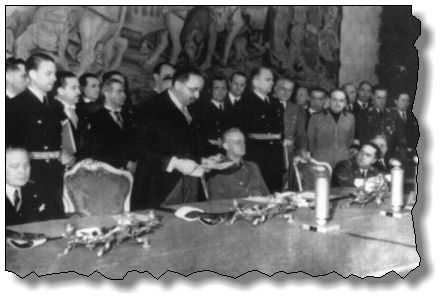
Bulgaria joins the Axis. Bulgarian Prime Minister Bogdan Filov signed the Tripartite Pact, which gave Germany the option of invading Greece through Bulgaria. Bulgaria was promised territories lost to Yugoslavia and Greece after WW1. Germany occupied Bulgaria today the eleventh sovereign state she has overrun since 1938 and tonight the entire country doused its lights in fear that Britain might make good at any moment on a threat to bomb Bulgaria if Nazi soldiers were allowed in her borders. The coming of Adolf Hitler’s legions In gray-green battle dress by plane, armored car and truck raised grave questions as to the future of Greece in her war with Italy, and of Turkey under her still passive alliance with Britain. But the first and gravest questions to Bulgarians were the fear of internal disturbances as a result of the Germans’ entry and of British bombardment from the dark skies without further notice.
Hitler writes to the Turkish president that Turkey was in no danger from Germany. German troops would be kept well away from the Turkish frontier. Germany’s sole purpose was to stop the British.
Free French forces from Chad captured Kufra in southeastern Libya. The Italians suffered 3 killed (all 3 were Libyan colonial troops), 4 wounded, and 282 captured (29 Italians, 273 Libyan colonial troops); the French suffered 4 killed and 21 wounded. Colonel Leclerc and his Free French forces accept the submission of the Italians at El Tag fortress at Kufra Oasis. The Italians are allowed to retreat to Italian lines, while the French keep all of their supplies and equipment. Surrendering are 11 officers, 18 NCOs, and 273 Libyan soldiers according to Italian sources, while the survivors of 70 members of the Saharan Company outside the fort also could have been used to break the blockade. The Free French victors have about 350 soldiers, but, most importantly, they have the only effective artillery in the engagement. Total casualties are three deaths on the Italian side and four dead on the French side. The Free French get a windfall of equipment never used by the Italians, including eight SPA AS.37 trucks, half a dozen lorries, four 20 mm cannon and 53 machine guns.
Royal Navy minesweeping drifter HMT Ploughboy detonates three mines in quick succession at Malta. The skipper has to beach the drifter. There is one death and nine wounded. This is a serious loss for the British because the Ploughboy is the only minesweeper of its type available.
Another major convoy departs from Naples for Tripoli with reinforcements and supplies for the Afrika Korps. It has four freighters and a heavy escort.
Briggsforce, a loose assembly of troops under the command of Brigadier Briggs of the 4th Indian Division’s 7th Indian Infantry Brigade, takes Mescelit Pass from the Italian 107th Colonial Battalion. This is a key road about 24 km north of Keren, where the British have been blocked by the Italians for weeks. Briggsforce now has the opportunity to attack the Italian defenders from the rear, or to advance on Massawa on the coast. However, the actual effect of this success is somewhat mitigated by the fact that Briggsforce does not have artillery.
With Mogadishu in the bag in Eritrea, the British continue mopping up the remaining Italian resistance. The 11th African Division pursues the Italians north along the Juba River towards the Ogaden Plateau and Abyssinia. The Italians are evacuating all of Italian Somaliland, according to General Cunningham.
Mogadishu is proving a very mixed blessing for the British. The port is in terrible shape, and no ships will be able to enter any time soon. The city is a sanitary disaster, full of unburied corpses and shallow graves.
HMS Formidable, still awaiting clearance to transit the Suez Canal after recent Luftwaffe mining, is stuck in Port Sudan. Its aircraft, which have transferred for the time being to land bases, attack Massawa. The attack achieves little.
Repeating a familiar pattern, the naval forces in Massawa see the approaching British land forces and realize that time is limited. Accordingly, some begin to escape. Today, Italian submarines Gauleo Ferraras, Perla, and Archimede leave to return to Europe. While they can evade the Royal Navy, the submarines are not large, ocean-going submarines, and thus cannot carry enough supplies for long journeys. Italian freighter Himalaya also attempts to escape.
There are few friendly ports left between Massawa and Europe. Thus, the crews will be faced with deep privation during this journey. What makes these journeys possible is the well-maintained chain of German tankers and supply ships in the Indian and Atlantic Oceans which also have been aiding the German raiders.
Cunningham reports on the East African front to Wavell: “Enemy evacuating whole of Italian Somaliland. Force at Ischia Baidoa apparently withdrew via Neghelli. South African Div. was unable to cut it off through lack of petrol. Light forces are moving to occupy Lugh Ferrandi and Dolo. Bardera has been occupied… Force at Mogadishu has outrun supplies. Harbour cannot be entered for some days pending sweeping operations. Movement of MT by ship to Mogadishu not possible, and rains beginning to render road from Kenya precarious.”
Churchill tells Eden that in the light of the Turkish reluctance to join in the war, he should concentrate his efforts on Yugoslavia and encourage her to attack south to produce an Italian disaster in Albania. On 1 March 1941, British Prime Minister Winston Churchill’s new plan is to convince the Yugoslav government to join the Allies. He instructs Foreign Minister Anthony Eden to meet with them to see if they will attack the Italians in Albania. Otherwise, the front is quiet today as both sides gear up for renewed offensives.
Mr. John Winant, the new United States Ambassador to the United Kingdom, was greeted by the Duke of Kent on his arrival by air. On his way to London by rail he was met and welcomed by His Majesty the King. King George VI swept stiff diplomatic formality aside today and went halfway across England to greet the new United States ambassador to his court, John G. Winant, with a hearty handshake.. The meeting place was a windswept railroad platform between London and Bristol. Winant, the shaggy ex-governor of New Hampshire, landed at Bristol after flying across the Atlantic to his new post. With Winant came his assistant, Benjamin Cohen, and President James Bryant Conant of Harvard University, who is on a government mission to collect scientific information for American defense needs.
Heinrich Himmler visits Auschwitz for the first time, accompanied by Gauleiter Fritz Bracht and local senior police chiefs. Because nearby factories used prisoners for forced labor, Himmler was concerned about the prisoner capacity of the camp. On this visit, he ordered the commandant, SS-Obersturmbannführer Rudolf Höss, to both the expand the Auschwitz I camp facilities to hold 30,000 prisoners and to build a camp near Birkenau for an expected influx of 100,000 Soviet prisoners of war. Himmler also ordered that the camp supply 10,000 prisoners for forced labor to construct an I.G. Farben factory complex at Dwory, about a mile away.
The Luftwaffe is getting tired of losing pilots in the English Channel after they wind up in the water. They very stealthily and pragmatically have created and placed Rettungsboje (Rescue Buoys) about ten miles off the coast of France, or very roughly halfway to England. These are known casually as Generalluftzeugmeister or Udet-Bojen after the Luftwaffe’s head of equipment, Generaloberst Ernst Udet. Basically, these are anchored submarines with small entryways that extend above the surface. Downed airmen who can make their way to these devices have a way to survive until they are spotted. Each 10-meter-long object — mounted on floats — contains four bunk beds and a cupboard with provisions. It is an ingenious solution to a very real problem. When occupied, the Luftwaffe men are to hoist the Red Cross flag and await rescue. Apparently, there also is a wireless station aboard.
Today, the British spot two of these hospital floats and tow them into Newhaven Harbour. These Rettungsboje later will feature in two films, “We Dive At Dawn” (1943) and “One Of Our Aircraft Is Missing” (1942).
Without getting moralistic about it, these craft technically are hospital ships. The British violate international rules of war by “capturing them” — though, by this point, the Germans are well aware that the British are pushing the envelope when it comes to disrespecting the Red Cross flag (due to many 1940 RAF shootdowns of German search and rescue planes). However, there are many of these at sea, and it appears the British are able to find only a few. It is unclear how useful they are in practice, but it likely gives many Luftwaffe pilots some comfort knowing that they are there. Incidentally, they also could be used by downed RAF pilots, too, and even the crews of sunk ships.
Bread rations in Italy were halved in order to increase food export to Germany.
Larissa, Greece suffered a 6.3 magnitude earthquake, leaving 10,000 people homeless.
In Port Sudan, Anglo-Egyptian Sudan, as HMS Formidable waited for mine clearing operations to complete in the Suez Canal, she launched 5 Albacore aircraft to bomb Massawa, Eritrea, Italian East Africa, causing little damage.
The German military authorities fined the city of Amsterdam 15,000,000 guilders (nominally $8,000,000) today as a penalty for the recent disorders against the Nazi occupation. The city must pay the money within a week and then collect within six weeks from inhabitants who are in the $5,000-a-year class. Thus approximately 3,000 of Amsterdam’s 800,000 citizens will pay the bill.
Thousands of able-bodied Jews are rounded up in Upper Silesia this month and sent to work in German mining, metallurgical plants, textile mills, and factories in the region.
General Zhukov, appointed Chief of the General Staff on 1 February, takes over this position. He replaces the temporarily disgraced (in Stalin’s eyes, anyway) Meretskov.
U.S. Undersecretary of State Sumner Welles passes along information in his possession about a coming German attack on the Soviet Union. Soviet leader Joseph Stalin is receiving several of these warnings from various sources and discounts them all.
German heavy cruiser Admiral Scheer re-enters the South Atlantic from the Indian Ocean.
First experimental carrier-fighter conversions of the Hawker Hurricane appear this month. These have a deck-landing hook and catapult spools attached.
RAF Bomber Command: Night of 1/2 March 1941
Cologne
RAF Bomber Command dispatches 131 Blenheims, Hampdens, Wellingtons and Whitleys overnight to 2 targets in Cologne. 5 Whitleys and 1 Wellington lost; 14 further aircraft were abandoned and crashed in fog over England with 12 crew members killed, 2 missing and 5 injured. Cologne reports a sharp raid, particularly in the dock areas on both banks of the Rhine near the city center. A military stores and fodder depot and 13 warehouses and other commercial buildings were burnt out. 2 Rhine passenger steamers were sunk and 3 more damaged. 6 assorted commercial premises suffered serious damage. 80 — 90 houses were destroyed and 160 badly damaged. 21 people were killed and 35 injured.
Boulogne
RAF Bomber Command dispatches 3 Wellingtons overnight to Boulogne. No losses.
The Luftwaffe mounts some minor raids along the east coast. He.111H-5 (1H+BK/wnr. 3774 ) of 2./KG26 ditches in the Moray Firth and paddles ashore. Oblt. Hatto Kuhn(FF), Uffz Friedrich Großhardt (BO), Gefr. Manfred Hänel (BF) and Uffz Ferdinand Mänling (BS) are captured and interrogated at Banff. This becomes a fairly well-known incident due to various accounts told by the Luftwaffe men over the decades.
The Junkers Ju 87 Stuka remains the workhorse of the Luftwaffe for precision ground attacks. While they are proving increasingly vulnerable to fighter attacks, there is no better alternative available or in the offing. Thus, development continues. Today, five prototypes (Ju 87 V21-25) converted from B-1 to D-1/D-4 make their first flights. The Ju 87 D switches the placement of the oil cooler and two coolant radiators and, more strikingly, has a more aerodynamically sculpted cockpit which gives the pilot better visibility. The pilots also receive increased armor protection, while a better machine gun (dual-barrel 7.92 mm MG 71Z) is placed in the rear of the cockpit. The engine now delivers 1401 hp, and maximum bomb-carrying ability increases from 500 kg to 1800 kg.
These incremental changes do not improve the survivability of the aircraft very much against the RAF. However, the increased power eventually will make the Stuka (in a still later version, the G) more effective at what will become its primary task: tank destruction.
A Junkers Ju 52/3m of IV,/JG z b V 1 lands at Skopje, Yugoslavia due to a navigational error. The government interns the plane and crew.
Hans-Joachim Marseille of JG 27 is promoted to the rank of Oberfähnrich, effective this date. This promotion is long overdue, occurring after all the other pilots from his original Geschwader, LG 2, have reached this rank or higher. Marseille is seen as undisciplined and a playboy, a pilot who refuses to follow orders and constantly endangers his wingman by freelancing.
Dietrich Peltz, a promising bomber pilot, is promoted to Hauptmann (Captain) in KG 77.
Erich “Bubi” Hartmann progresses to the Luftkriegsschule 2 (Air War School 2) in Berlin-Gatow. He still has not flown solo.
U-552, commanded by Oberleutnant zur See Erich Topp, sank tanker Cadillac (12,062grt) from convoy HX.109 in 59-44N, 11-16W. On 13 Feb 1941 the Cadillac (Master John Fraser Jefferson) left Halifax in station #91 of convoy HX.109, but the tanker was separated from the other ships when the convoy was scattered by a strong gale with heavy snow showers during the night of 26/27 February. The next day, she met another straggler and the two ships were sighted by U-552 at 1023 hours on 1 March. However, the U-boat could not get into a favourable attack position because they were forced to dive twice during the day to evade a Sunderland aircraft patrolling the area. HMS Malcolm (D 19) (Cdr C.D. Howard-Johnston, DSC, RN) was directed to the stragglers by the aircraft and led them to a group of three others ships from the scattered convoy. The five ships then continued in an ad hoc convoy proceeding in a line abreast formation with Cadillac as the outermost ship on the port side, escorted by the destroyer and HMS Mallow (K 81) (LtCdr W.B. Piggott, RNR). At 2356 hours on 1 March 1941 the Cadillac was struck on the port side amidships and further aft in the cross bunker by two G7e torpedoes from U-552 while steaming at 9 knots in fine weather about 150 miles north-northeast of Rockall. The tanker vibrated violently, took a list to starboard of 10-15° and the highly flammable cargo immediately caught fire, causing a massive explosion when the #8 tank blew up on the port side after about four minutes and illuminating all ships in the vicinity. With the ship settling by the bow and blazing furiously on the port side, the survivors tried to abandon ship on the starboard side. However, the small emergency lifeboat swamped during the launch as the forward fall was let go too quickly and its three occupants were thrown into the sea. The large rafts stored on the after deck proved to be far too cumbersome and heavy to launch them. 26 survivors managed to abandon ship in the starboard aft lifeboat, but it was surrounded by burning fuel and most men panicked as they could hardly breathe and see nothing except a wall of flame all around them. Some began calling for help, others were praying and then most jumped over the side and perished. Only five men stayed and took cover in about one feet of water at the bottom of the boat, which slowly drifted clear of the flames in the slight swell and the men frantically began to row away for about a mile with the only four oars left until they were completely exhausted. They then attracted the attention of HMS Malcolm by firing a rocket and were picked up at about 0130 hours. The crew of the destroyer had seen a number of men swimming close to the flames but were unable to help them as they had lost their boats in the gale and stopping was too dangerous because the destroyer would have been an easy target being illuminated by the burning tanker. Unseen by the escorts, U-552 had remained on the surface nearby and Topp allowed his crew to come up to the bridge one at a time to have a look at the sea of flames before the U-boat subsequently left the area. The 12,062-ton Cadillac was carrying aviation fuel and was bound for Avonmouth, England, United Kingdom.
Anti-aircraft ship HMS Curacoa departed Scapa Flow at 1130 to cover convoy WN.91 from Pentland Firth. The convoy was attacked by German aircraft from 1935 and 2014.
Steamer Forthbank (5057grt) was damaged by German bombing in convoy WN.91 in 57-53N, 1-57W. Four crewmen were lost. She arrived at Invergordon on the 3rd, and on 13th, left under tow for Leith. The steamer went ashore on the 15th, but was refloated and arrived at Leith on the 17th.
Steamer Pennington Court (6098grt) in convoy WN.91 was also damaged by the German bombing, but was able to continue.
Tanker Atheltemplar (8949grt) was damaged by German bombing in convoy EN.79 in 57-04N, 1-50W.
Destroyer HMS Eridge departed Rosyth at 1800 for Scapa Flow and en route, was diverted to assist the damaged tanker. Burnt out, she arrived in tow of Eridge and minesweeper HMS Speedwell at Methil Roads on the 3rd. Eridge arrived at Scapa Flow for working up exercises on the 3rd.
HMS Curacoa transferred to convoy EN.79 off Buchan Ness at 2300/1st to cover this convoy to Pentland Firth.
Destroyer HMS Quantock departed Scapa Flow at 1800 to meet steamer Ben My Chree and escort her to Kirkwall.
Minesweeping trawler HMS St Donats (349grt, T/Skipper F. L. A. Atkinson RNR) was lost in a collision off the Humber with destroyer HMS Cotswold, which had departed Rosyth on 28 February. The destroyer was repaired at Chatham from 4 to 31 March.
Dutch tanker Rotula (7981grt) was badly damaged by German bombing in 52-15N, 5-33W. Sixteen crew were killed and the wreck was sunk by a British trawler.
Steamer Empire Simba (5691grt) was damaged by German bombing in 52-21N, 5-23W, and abandoned with engine room and stokehold flooded. She was towed to Liverpool on the 4th.
Light cruiser HMS Arethusa arrived at Gibraltar.
Destroyer HMS Firedrake ran aground on the Spanish coast in the Mediterranean east of Gibraltar, in 36-28N, 4-45W, and was under repair at Gibraltar from 1 March to 24 April. She was sent to Portsmouth for repairs, departed on 24 April and arrived at Portsmouth on 1 May. Firedrake departed immediately for Chatham arriving on 2 May. Repairs were completed on 27 June.
Ocean boarding vessel HMS Registan departed Gibraltar for Western Patrol.
A supply convoy for the Afrika Korps departed Naples with steamers Amsterdam (8673grt), Castellon (2086grt), Ruhr (5954grt), and Maritza (2910grt), escorted by torpedo boats Clio, Pegaso, and Orione. The convoy arrived without event at Tripoli on the 3rd. The return convoy was steamers Alicante (2140grt), Arcturus (2596grt), Wachtfels (8467grt), and Leverkusen (7386grt) escorted by destroyer Vivaldi and torpedo boats Procione, Orsa, and Calliope which also passed uneventfully, arriving at Naples on the 3rd.
Minesweeping drifter HMS Ploughboy was severely damaged by the explosion of three mines close aboard at Malta. One rating was missing and nine were wounded. The drifter was beached.
Aircraft carrier HMS Formidable, escorted by destroyers Juno and Griffin, had arrived at Suez on 23 February, but was unable to enter the Suez Canal due to mining. They were sent to Port Sudan to await reopening of the Canal. On 1 March, her aircraft, based ashore, attacked Massawa.
Greek submarine RHS Papanicolis made an unsuccessful torpedo attack off Saseno.
Italian submarine Gugliemotti departed Massawa on the 3rd, and with submarines Archimede and Galileo Ferraris, which departed Massawa about the same time, refueled from German tanker Nordmark on 16 and 17 April. Gugliemotti was the first Italian submarine from Massawa to arrive at Bordeaux on 6 May after 64 days at sea.
Italian submarine Perla departed Massawa during the night of 1/2 March, and refueled from German raider Atlantis on the 29th. She was the last Italian submarine from Massawa to arrive, after 80 days at sea, on 20 May 1941.
Heavy cruiser HMS Cornwall intercepted Vichy French steamer Ville De Majunga (4972grt) in 34-08S, 10-18E. The steamer was taken to Capetown.
Convoy HX.112 departed Halifax, escorted by armed merchant cruiser HMS Ranpura and corvettes HMS Bittersweet and HMS Fennel. The corvettes were detached later that day.
Convoy BHX.112 departed Bermuda on 27 February escorted by ocean escort armed merchant cruiser HMS California. The convoy rendezvoused with convoy HX.112 on the 4th and the armed merchant cruiser was detached.
On 5 March, heavy cruiser HMS Norfolk joined the escort. The armed merchant cruiser and the heavy cruiser were detached on the 14th. Destroyers HMS Sardonyx, HMS Scmitar, HMS Vanoc, HMS Viceroy, and HMS Walker, corvette HMS Bluebell, and anti-submarine trawler HMS Syringa joined on the 15th. Destroyer Viceroy was detached later that day. On 16 March, destroyer HMS Volunteer joined. Corvette Bluebell and trawler Syringa were detached on the 18th and destroyers Sardonyx, Scimitar, and Walker on the 19th. Destroyers Vanoc and Volunteer were detached when the convoy arrived at Liverpool on the 20th.
Convoy SL.67 departed Freetown escorted by armed merchant cruiser HMS Cilicia to 19 March, corvette HMS Asphodel to 11 March, and anti-submarine trawlers HMS Kelt, HMS Spaniard, and HMS Turcoman locally. Due to German activity in the area, from 3 March battleship HMS Malaya to 10 March and destroyers HMS Faulknor and HMS Forester to 11 March escorted the convoy. Aircraft carrier HMS Ark Royal and battlecruiser HMS Renown joined the convoy on the 10th and continued to 19 March.
Light cruiser HMS Kenya escorted the convoy from 19 to 21 March. Destroyers HMS Havelock to 24 March, HMS Hesperus, HMS Hurricane, HMS Mansfield, and HMS Salisbury to 26 March, HMS Verity to 24 March, HMS Veteran to 25 March, and HMS Wolsey to 26 March, corvettes HMS Arbutus and HMS Camellia to 26 March, and catapult ship HMS Pegasus to 26 March joined the convoy on the 21st. On the 22nd, destroyers HMS Chelsea and HMS Douglas joined to 24 March. Corvette HMS Begonia joined on the 23rd to 26 March. The convoy arrived at Liverpool on the 26th.
The U.S. Navy established the Support Force Atlantic Fleet, under command of Rear Admiral Arthur L. Bristol, composed of destroyers, patrol plane squadrons, and supporting auxiliaries for the protection of convoys in North Atlantic.
Destroyer Tender USS Praire (Flagship Rear Admiral A L Bristol Jr)
Destroyer Squadron 7 (Captain J L Kauffman) — USS Plunkett
Division 13 — USS Niblack (DesDiv.13), USS Benson, USS Gleaves, USS Mayo
Division 14 — USS Madison (DesDiv.14), USS Lansdale, USS Hilary P. Jones, USS Charles F. Hughes
Destroyer Squadron 30 (Captain M Y Cohen) — USS Dallas
Division 60 — USS Ellis (DesDiv.60), USS Bernadou, USS Cole, USS Dupont
Division 61- USS Greer (DesDiv.61), USS Tarbell, USS Upshur, USS Lea
Destroyer Squadron 31 (Captain W D.Baker) — USS MacLeish
Division 62 — USS Bainbridge (DesDiv.62) USS Overton, USS Sturtivant, USS Reuben James
Division 63 — USS McCormick (DesDiv.63), USS Broome, USS Simpson, USS Truxton
Today in Washington, President Roosevelt met today in conference with four Cabinet officers most concerned with plans to speed American aid to Britain. Despite a head cold confining him to the mansion, the President felt it essential to confer with Secretaries Hull, Stimson and Morgenthau and Acting Navy Secretary Forrestal in his only engagement of the day.
The Senate heard Senator Wheeler oppose and Senator Lucas support the Lend-Lease bill, approved the Truman resolution for a special committee to investigate defense contracts and recessed at 5:54 PM until 11 AM on Monday.
The House was in recess. Republican members of the Committee on Expenditures in the executive department filed a report opposing the bill to make permanent the Office of Government Reports.
The Roosevelt Administration resorted to the radio tonight to call for an end to “this delay… this dawdling” as Senator Burton K. Wheeler, Montana Democrat, continued his speech against the British aid bill on the Senate floor. “This is the most loosely drawn piece of legislation I have ever seen,” Wheeler shouted during the course of the second day of delivery of his 17,500-word speech. “It is so full of holes a horse and buggy can be driven through it.” Obviously smarting under the two-week barrage of opposition oratory which already has delayed enactment of the bill a week beyond schedule, the administration sent Senator Lister Hill, Alabama Democrat, to the networks with a charge the leading opponents were “false prophets” who make “ridiculous and absurd statements.”
Signs of growing impatience on the part of many Senators at the long speeches by opponents of the Lend-Lease bill in the past two weeks, caused the Senate to decide late today to convene every day at 11 o’clock, instead of noon, as usual, until the bill is disposed of. The step, taken on motion of Senator Barkley of Kentucky, the Majority Leader, is expected to speed consideration of the measure. A similar suggestion by Mr. Barkley last Saturday drew immediate threats of a filibuster from Senators Wheeler of Montana and Clark of Missouri, two of the opponents’ floor leaders, but today there was not a dissenting vote when the motion was put just before the recess was taken. Opponents of the bill have spoken about three times as long as the bill’s supporters during two weeks of debate, according to unofficial statistics compiled tonight by Senate officials.
Foes of the Lend-Lease bill insisted in the Senate today that, despite restrictive provisions, President Roosevelt could “give” any portion of the navy to the British, and, moreover, could consolidate the American and British fleets. With these statements they coupled an attack on William C. Bullitt, former ambassador to France, for, they said, making propaganda speeches in this country and for asserting in a recent address that the opponents of the bill were suffering from “political dementia praecox.”
The United States Senate voted unanimously to establish a special committee to find and correct problems in American war production. This bipartisan committee became known as the Truman Committee, named for its head Harry S. Truman. The bipartisan special committee was formed in March 1941 to find and correct problems in US war production with waste, inefficiency, and war profiteering. The Truman Committee proved to be one of the most successful investigative efforts ever mounted by the U.S. government: an initial budget of $15,000 was expanded over three years to $360,000 to save an estimated $10–15 billion in military spending and thousands of lives of U.S. servicemen. For comparison, the entire cost of the simultaneous Manhattan Project, which created the first atomic bombs, was $2 billion. Chairing the committee helped Truman make a name for himself beyond his political machine origins and was a major factor in the decision to nominate him as vice president, which would propel him to the presidency after the death of Franklin D. Roosevelt. Truman stepped down from leadership of the committee in August 1944 to concentrate on running for vice president in that year’s presidential election. From 1941 until its official end, in 1948, the committee held 432 public hearings, listened to 1,798 witnesses and published almost 2,000 pages of reports. Every committee report was unanimous, with bipartisan support.
Secretary of State Cordell Hull indicated today that this government would freeze Bulgaria’s credits and balances in the United States as soon as German troops occupy that country. The Secretary said the Treasury would take up the matter as it did when German troops occupied Rumania.
A nation-wide survey by the American Institute of Public Opinion indicates that Wendell Willkie has probably now achieved a wider degree of popularity with the rank and file of American voters than he did at any time during the Presidential campaign of last Fall, Dr. George Gallup, the institute’s director, reports.
The present defense effort of the United States will be threatened as was that of the World War, by serious power shortages if power needs continue to be underestimated as they have been within recent months, the Federal Power Commission said today.
Towering snow piles lined slippery highways in the Middle Atlantic states tonight in the wage of a blizzard that took at least 27 lives and extended over a 1,000-mile front. Clearing skies brought a forecast of continued cold weather. Generally fair but unseasonably cold weather extended into the deep south, dropping the mercury to 44 at Miami, while the middle west enjoyed balmy weather with temperatures as high as 62 in Nebraska and Iowa. New Jersey, with a snowfall of 19 inches in some sections; eastern Long island, Pennsylvania, and Delaware were hardest hit. Hundreds of motorists were forced to abandon automobiles stuck in drifts as high as 12 feet and gale-force north winds raised havoc with communications.
As the gale swept out to sea with its snow-laden clouds thousands of men and machines went into action along the Eastern Seaboard from Maryland to Maine to clear the snowdrifts that brought death to twenty-seven persons and disrupted transportation and communication facilities.
March came in like a lion yesterday, on the radio as well as the weather. A severe black-out of overseas and transcontinental short-wave circuits, which began about 9 o’clock in the morning, continued throughout the day to block long-distance communication channels.
Ten alien-owned fishing sampans were seized by customs officials today in Honolulu’s harbor, center of the United States mid-Pacific Navy and Army defenses.
The U.S. Army 133rd Infantry Regiment arrived at Camp Claiborne, Louisiana for intensive training.
NACA this month established Special Committee on Jet Propulsion to review early British reports on the Whittle engine, which subsequently aided development of TG-100 turboprop engine by GE and the 19-B turbojet by Westinghouse. Dr. W. F. Durand was called out of retirement to head this committee.
The first radio station in the country to receive a license for Frequency Modulation (FM) transmission, W47NV in Nashville, Tennessee, begins broadcasting. The station started its FM broadcast with a commercial for Nashville’s Standard Candy Company.
“Duffy’s Tavern,” where “the elite meet to eat,” debuts on CBS radio on this Saturday night between 2030 and 2100 hours Eastern Time sponsored by Schick Razors. The show remained on the air until January 1952.
In New York City, the National Broadcasting Company’s experimental TV station W2XBS broadcasts a track meet from Madison Square Garden at 2030 hours local.
“Captain America” appeared for the first time in a comic book dated today. “Captain America,” created by cartoonists Joe Simon and Jack Kirby, is first published by Timely Comics (premiere issue, dated today, released on December 20, 1940).
The book “Germany Must Perish!” by Theodore N. Kaufman was published in the United States. Nazi propaganda would use this book to support the claim that Jews were plotting against Germany.
Rangers’ goalie Dave Kerr becomes the 5th goaltender in NHL history to record 200 career victories when New York wins, 3-1 over the Canadiens at Montreal.
Former University of Notre Dame star fullback Elmer Layden is named first Commissioner of the NFL.
The Battle of South Henan ended in Chinese victory. In January 1941, the Japanese 11th Army split into three routes to attack the Chinese positions. Their main objective was to eradicate Chinese control of the Ping-Han Railway’s southern section. Li Zongren, commander of the Chinese 5th War Area, avoided frontal contact with the Japanese as much as possible. Instead, he fought conservatively, diverting his main forces towards the two flanks. Outflanked, the Japanese retreated after taking heavy casualties, and their attack was repelled.
Nationalist (Kuomintang) leader Chiang Kai-shek gives an address to the People’s Political Council.
Hiroshi Nemoto was named the commanding officer of the 24th Japanese Army Division in China.
Lieutenant General Hiroshi Takahashi was named the chief of staff of the Japanese Chosen Army in occupied Korea.
Lieutenant General Takaji Wachi was named the chief of staff of the Japanese Taiwan Army. Wachi previously served in Taiwan until his present position on the staff of the Central China Expeditionary Army. Wachi also heads its Research Division, considering techniques for land warfare in Southeast Asia.
52 Seversky P-35A fighters are delivered to Nichols airfield on Luzon, Philippine Islands. The flying strength of the 3 squadrons in the 4th Composite Group is 42 P-35A’s and 22 P-26A’s.
New Zealand’s first fighter squadron, No. 485 Squadron RNZAF, forms.
Dow Jones Industrial Average: 121.86 (-0.11)
Born:
Dave Marcis, American auto racer (NASCAR Winston Cup Series 1975 runner-up; 5 career wins, 94 top-fives and 222 top-tens), in Wausau, Wisconsin.
Jeff Slade, NBA forward (Chicago Zephyrs), in Chicago Heights, Illinois (d. 2012).
Michael Lampton, American astronaut (payload specialist; backup on STS-9 and STS-45) and founder of the optical ray tracing company “Stellar Software”, in Williamsport, Pennsylvania (d. 2023).
Joo Hyun, South Korean actor, in Hyesan, Kankyōnan Province, Korea, Empire of Japan.
Died:
Ruby Laffoon, 72, 43rd Governor of Kentucky.
Naval Construction:
The U.S. Navy Gato-class submarine USS Grunion (SS-216) is laid down by the Electric Boat Co. (Groton, Connecticut, U.S.A.).
The Kriegsmarine (German Navy) Type VIIC U-boat U-766 is laid down by Kriegsmarinewerft (KMW), Wilhelmshaven (werk 149).
The Royal Navy Hunt-class (Type III) escort destroyer HMS Catterick (L 81) is laid down by Vickers Armstrong (Barrow-in-Furness, U.K.).
The mercantile Rio de la Plata is launched by the Sun Shipbuilding & Drydock Co. (Chester, Pennsylvania, U.S.A.). She is converted to an Escort Carrier (BAVG-4) and commissioned as HMS Charger (D 27)on 2 October 1941. Transferred to the U.S. Navy on 4 October 1941. Commissioned as USS Charger (CVE-30) on 3 March 1942.
The U.S. Navy Aloe-class net laying ship USS Rosewood (YN-26, later AN-26) is launched by the American Shipbuilding Co. (Cleveland, Ohio, U.S.A.).
The Royal Navy Dance-class ASW trawler HMS Minuet (T 131) is launched by Ferguson Bros. Ltd. (Port Glasgow, Scotland).
The Royal Australian Navy Bathurst-class minesweeper-corvette HMAS Bendigo (J 187) is launched by the Cockatoo Docks and Engineering Co. Ltd. (Sydney, New South Wales, Australia).
The Kriegsmarine (German Navy) Type IXC U-boats U-161 and U-162 are launched by Deutsche Schiff und Maschinenbau AG, Bremen (werk 700 and 701).
The Royal Navy Fairmile B-class motor launch HMS ML 146 is commissioned.
The U.S. Navy PT-5-class (81-foot) Higgins patrol motor torpedo boat USS PT-5 is commissioned.
The U.S. Navy Gar-class submarine USS Grayling (SS-209) is commissioned. Her first commanding officer is Lieutenant Eliot Olsen, USN.
The Royal Navy Flower-class corvette HMS Anchusa (K 186) is commissioned. Her first commanding officer is T/Lieutenant Philipp Everett-Price, DSC, RNR.
The U.S. Navy Gleaves-class destroyer USS Meredith (DD-434) is commissioned. Her first commanding officer is Lieutenant Commander William Kavanaugh Mendenhall, Jr., USN.
 History Diaries