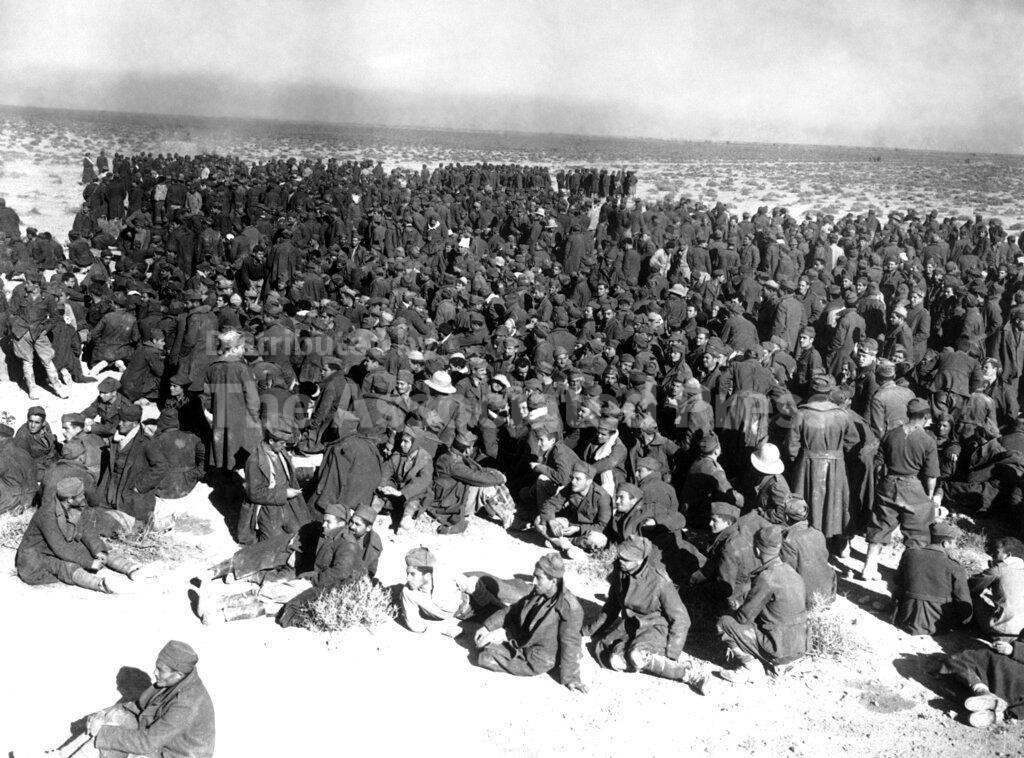
Operation ABSTENTION ended in Italian victory when the last remaining British commandos surrendered. The Italians reinforced the two torpedo boats in the area, Lupo and Lince, with destroyer Crispi, destroyer Sella, and two more torpedo boats, the British decided to cancel Operation Abstention; 40 British commandos were left behind and captured in the hastened retreat. To the north, German troops began to across into Bulgaria. Meanwhile, one squadron of RAF Hurricane fighters and one squadron of RAF Gladiator biplane fighters shot down 27 Italian aircraft over the Albanian mountains in support of Greek troops on the ground.
Churchill later comments, “I am completely mystified at this operation.” The ultimate cause of defeat is the British tendency to underestimate Italian military ability. This is also going to become an issue in North Africa.
An imminent Balkan explosion threatened tonight with reports of massive Nazi troop movements up to Bulgaria’s frontier with Rumania and British assertions that joint Anglo-Turkish action against Germany has become “a distinct possibility.” The Bulgarian capital of Sofia was said in press reports reaching London to be completely encircled by troops, on advice of military leaders, and for 24 hours, until 6:45 p.m. today, was cut off from all communication with the outside world.
The Greek Epirus Army launches some minor attacks on 28 February 1941 against the Italian 11th Army west of Klisura. They accomplish little in the terrible weather.
While the front has become static recently, there are vicious artillery duels and air battles. The RAF shoots down four planes today (according to Italian records), including three CR 42 fighters (the RAF pilots claim 27 planes shot down). According to the RAF records, this is its most successful day during the Greek campaign — but, according to the Italian records, it is not nearly as successful as the British think. These are the kinds of contradictions historians must deal with.
The British War Cabinet picks General Sir Henry Maitland Wilson from the Middle East Command to lead the expedition destined for Greece.
Italian forces at Kufra, Libya began surrender negotiations with Free French and British forces. The Free French forces have been besieging the Italian fortress of El Tag at Kufra Oasis for ten days. No relief has been forthcoming from the large Italian forces further north. Today, the Italians begin surrender negotiations.
After many days of raids, Malta has a quiet day. The damage from the Luftwaffe attacks after dark on the 27th, however, is extensive. Particularly devastating has been damage from parachute mines. Almost all of the planes at RAF Hal Far airfield are destroyed or out of operation, leaving no effective air defense for the island.
A final British assault on the heavily defended town of Keren (Cheren), which protects the Eritrean capital of Asmara 35 miles southward, has begun from two sides with heavy attacks upon the 15,000 Italian defenders, a British communique reported tonight. Attacks are in progress by Briggsforce (primarily 7th Indian Brigade under Brigadier Briggs) at Mescelit Pass about 24 km northeast of Keren. The attacks are carried out in the evening by 4/16 Punjab and two companies of 1st Royal Sussex. The attack is both a frontal and flank attack. British and “Free French” forces striking down from the north against the 6,000-foot Keren plateau were said by the British middle east command to be “in contact” with Italian troops holding covering positions outside the town. Meanwhile, British Empire forces, steadily closing in on Keren from the Agordatt and Barentu districts on the west for three weeks, were said in the communique to have “improved their positions.”
The arrival in Vienna of Adolf Hitler’s foreign minister and the Japanese envoy was announced tonight amid a deepening feeling among authorized military and other observers that important axis military and political events were imminent. Vienna was alive with rumor that Bulgarian leaders would turn up there tomorrow to put their country into the German-Italian-Japanese alliance. The communique disclosing that Joachim von Ribbentrop, the Nazi foreign minister, and Lieutenant General Hiroshi Oshima, the Japanese ambassador to Germany, had reached Vienna gave no details.
Japanese Ambassador Oshima meets with Adolf Hitler at Berchtesgaden.
Vain and fun-loving Alfonso XIII, under whose long reign Spain fell from her place as a great world power, died in exile at noon today with a deathbed message to his son and heir that “kings must suffer and be brave.” The 54-year-old fallen monarch, who had been gravely ill for two weeks, died at 11:50 AM, propped up in an armchair with purple cushions. A fur coverlet is wrapped around his lean, always frail body. Alfonso was stricken with angina pectoris on February 21, aggravating an asthmatic condition and bringing on series of heart attacks that proved too much for a man whose health had been delicate all his life. Only seven weeks ago Alfonso formally renounced all claims to the Spanish throne from which he fled on the night of April 14, 1931, as revolution broke out in Spain after republican election victory. This leaves his son Juan as the heir apparent and also theoretically heir to the thrones of France and Navarre.
German military authorities said today they were helping to solve Belgium’s food shortage by permitting Belgian fishermen to fish farther out. Heretofore, fishermen have been restricted to areas under the protection of German patrol boats.
Bread ration was reduced from 350g to 280g in Vichy France. By comparison, residents of Jewish Ghettos often are allocated 3 grams.
British Prime Minister Winston Churchill (and former First Lord of the Admiralty) writes a note to President Roosevelt’s envoy Harry Hopkins thanking him for some weapons and ammunition that have arrived thanks to Hopkins’ intercession. In the message, Churchill writes that he is:
“…increasingly anxious about high rate of shipping losses in North-Western Approaches and shrinkage in tonnage entering Britain. This has darkened since I last saw you…. The strain is growing here.”
Churchill evidences his concern with a separate memo to First Lord Admiral Pound and Minister of Transport A.V. Alexander. Referencing a specific ship, the City of Calcutta, Churchill writes:
“This ship must on no account be sent to the East coast. It contains 1,700 machine guns, 44 aeroplane engines, and no fewer than 14,100,000 cartridges. These cartridges are absolutely vital to the defence of Great Britain…. That it should be proposed to send such a ship round to the East coast with all the additional risk, is abominable.”
Previously, Churchill has chided the Admiralty for not taking more care of specific ships with valuable cargo. This memo shows that he continues to keep a very close eye on important shipments.
Australian Prime Minister Robert Menzies, visiting London, gives his unique view into the conditions in London during the Blitz. He writes:
“New Black-out features keep directing attention to themselves. There are plays and revues and films running, but the performances are confined to the day. You cannot take a stroll either before or after dinner, because the black-out renders it utterly impossible if there is the least cloud (as there has been since I arrived). At each doorway you see a little bag of sand for the proper treatment of incendiary bombs.”
He also notes a certain fatalism in London residents, along the lines of “I stay in bed. If the bomb’s meant for me it’ll hit me; if it isn’t, OK.” Menzies claims to feel the same way, though he is secure on a lower floor of the well-built Savoy.
German heavy cruisers Gneisenau and Scharnhorst are east of the Azores. They complete their refueling from tankers Ermland and Friedrich Breme at 07:00. Their objective is to interdict the convoy route between Freetown and Great Britain. The next objective is in the vicinity of the Cape Verde Islands.
Soviet leader Joseph Stalin has been receiving isolated warnings about a coming German invasion of the Soviet Union. He has discounted all of them, including one at the end of 1940 by Richard Sorge (code name Ramsay) in Japan. Today, he receives another warning.
This warning is from Soviet agent Rudolf von Scheliha (code name Ariets). Von Scheliha is a German diplomat who became radicalized by the horrors he witnessed while serving with the German Embassy in Warsaw. He is a leading member of the “Red Orchestra,” a group of highly placed German dissidents who funnel military information to the Soviets via Switzerland.
Von Scheliha/Ariets warns about an upcoming invasion. He even supplies a firm date for the invasion, 20 May 1941, which is only a month off (this actually is around the 15 May 1941 date that Hitler has ordained at this time, though it later will be postponed). Stalin ignores this warning, too, viewing it as “English provocation.”
Iraqi politician Rashid Ali confers with the Grand Mufti and four colonels (known as the “Golden Square”). They discuss a coup against the pro-British government. Rashid Ali and the Grand Mufti are pro-Axis. The British have a large base at Habbaniyah but are vulnerable in other parts of the country.
The Luftwaffe is fairly quiet both during the day and after dark. There is a small raid against London during the night.
While the Battle of Britain technically is over, the Blitz continues. During February 1941 in Great Britain, there are 78 dead and 1,068 badly wounded civilians. So far in 1941, through the end of February, there have been 2,298 killed and 3,080 wounded.
RAF Bomber Command dispatches 8 Blenheims during daylight on widespread cloud-cover raids; 7 aircraft bombed at Flushing, Den Helder and Lorient. No losses.
RAF Bomber Command dispatches 116 Blenheims, Hampdens, Wellingtons and Whitleys overnight in an attempt to bomb the battleship Tirpitz in Wilhelmshaven harbour. 75 crews reported bombing but Wilhelmshaven has no diary report. 1 Blenheim lost. Only four of the bombers even spot the target. As usual, the Tirpitz emerges unscathed. It is the 16th raid so far against the Tirpitz, with absolutely no success and many British bomber losses. The RAF also launches other attacks against facilities at several Channel ports (Lorient, Boulogne, Emden).
RAF Bomber Command dispatches 6 Blenheims to Boulogne overnight but only 2 bombed. No losses.
The RAF claim 27 Italian aircraft destroyed today. Italian records show the loss of four bombers and four fighters. Flt. Lt. Montague T St. John “Pat” Pattle of 80 Sqn. claims three CR42s although Italian records show only two are lost.
The RAF sends Blenheim and Wellesley bombers against Asmara in Eritrea.
Italian submarine Bianchi sank British steamer Baltistan (6803grt) from convoy OB.290 in 51-52N, 19-55W. Two crew were killed, forty five crew missing and four passengers missing. The passengers were P/T/A/Sub Lt (A) G. G. Isaacs RNVR, P/T/Sub Lt (A) T. Dibble, en route to HMS Grebe, Lt Cdr (A) J. H. Sender and P/T/A/Sub Lt (A) E. C. Atkinson RNVR, en route to aircraft carrier HMS Eagle. Fourteen crew and four passengers were rescued.
U-108, commanded by Kapitänleutnant Klaus Scholtz, sank the Effna (6461grt) in 61-30N, 15-45W. At 2332 hours on 28 Feb 1941 the unescorted Effna (Master Robert Penney Robertson) was hit amidships by one torpedo from U-108 south of Iceland. The U-boat had spotted the ship about five hours earlier and waited for the night to attack, but a G7e torpedo fired at 2247 hours became a surface runner and missed ahead while a G7a torpedo malfunctioned after being fired at 2328 hours. After the third torpedo eventually hit, the ship was identified by her emergency messages and the crew was seen to abandon ship in the lifeboats. However, at least one boat went alongside again after half an hour when the ship did not settle further and some men reboarded the Effna. At 0036 hours on 1 March, U-108 fired a coup de grâce that hit aft and caused the ship to sink quickly by the stern after a boiler explosion. The master, 32 crew members and one gunner were lost. The 6,461 ton Effna was carrying steel and trucks and was bound for Newport, England.
U-99 attacked British steamer Holmelea (4223grt), from dispersed convoy OB.290 without success. The steamer was soon sunk by U-47, commanded by Kapitänleutnant Günther Prien, with artillery in 54-24N, 17-25W. In the early morning on 28 February 1941 the Holmelea (Master John Robert Potts), a straggler from convoy HX-109, was damaged by gunfire by U-47 and sunk by a coup de grâce southwest of Rockall. The ship had been missed by a torpedo from U-99 (Kretschmer) earlier that night. The master, 26 crew members and one gunner were lost. On 5 March, ten crew members in one lifeboat were picked up by the Icelandic trawler Baldur and landed at Fleetwood. On the same day, the trawler had picked up 39 survivors from the Dutch merchant Simaloer, which had been bombed and sunk by a German aircraft 60 hours before. The 4,223 ton Holmelea was carrying grain, linseed and maize and was bound for Hull, England.
Rear Admiral L. H. K. Hamilton DSO, succeeded Rear Admiral R. H. C. Hallifax as Rear Admiral Destroyers, Home Fleet.
Destroyer HMS Boreas departed Scapa Flow at 0930 for Greenock to join destroyer HMS Arrow escorting destroyer depot ship HMS Tyne. Destroyer Boreas arrived at Greenock at 1000 on 1 March. On 1 March at 1400, destroyer depot ship Tyne and destroyers Arrow and Boreas departed Greenock for Scapa Flow, where they arrived at 1800 on 2 March. Depot ship Tyne relieved depot ship HMS Maidstone. Rear Admiral Hamilton transferred his flag to depot ship Tyne at 0900 on 3 March. Depot ship Maidstone departed Scapa Flow at 1815 on 3 March escorted by destroyers Boreas and HMS Mendip for Greenock. The ships arrived at Greenock at 0830 on 5 March. Destroyer Mendip departed Greenock and arrived back at Scapa Flow at 0800 on 6 March. Depot ship Maidstone was docked at the Clyde for refitting prior to departing for Gibraltar on 21 March.
Destroyers HMAS Napier and HMS Zulu departed Scapa Flow at 2100 for Rosyth to escort battlecruiser HMS Repulse from Rosyth. Battlecruiser Repulse, escorted by destroyers Napier, Zulu, and HMS Boadicea departed Rosyth at 1030 on 3 March. On 4 March, destroyer Zulu was detached with engine room defects and arrived at Scapa Flow at 1245 on 4 March. Battlecruiser Repulse and destroyers Napier and Boadicea arrived at Greenock late on 4 March. Destroyer Boadicea then sailed again and arrived back at Scapa Flow during the morning of 5 March.
Destroyers HMS Somali (Captain Caslon), HMS Bedouin, HMS Tartar, HMS Eskimo, and HMS Legion and landing ships Queen Emma and Princess Beatrix departed Scapa Flow at 2345 to participate in Operation CLAYMORE. Tovey departed Scapa Flow at 1445 on 2 March in battleship HMS KING George V with battleship HMS Nelson, light cruisers HMS Edinburgh and HMS Nigeria, destroyers HMS Inglefield, HMS Maori, HMS Punjabi, HMS Echo, and HMS Eclipse. Destroyer Maori attacked a submarine contact on 3 March. On 4 March, the two light cruisers were detached to close support for the Caslon force.
Anti-aircraft ship HMS Curacoa arrived at Scapa Flow at 2100 from Rosyth after boiler cleaning and repairs.
Light cruiser HMS Kenya departed Gibraltar to join convoy SL.66.
In a special tragedy among many others, 2,085-ton Egyptian freighter Memphis founders in heavy weather northwest of Ireland. Everybody on board perishes, as often is the case during these cold winter months (it is not the Germans who kill all of these people, except indirectly; it is the climate and weather). The deaths include 28 crew pulled out of the water after the recent sinking of the 7034 ton Benjamin Franklin.
German Focke-Wulf Fw 200 Condors finish off damaged 3197-ton Swedish freighter Rydboholm. The Rydboholm is one of the last Convoy OB 290 victims.
Drifter New Comet, originally damaged by a mine and beached at the mouth of the Tyne on 23 November 1940, was refloated but today finally sinks.
Finnish cargo ship Bore VIII (now in German service) founders and is lost bad weather in the Hubertgat.
Belgian 5382-ton freighter/passenger ship Persier has been driven ashore on the Icelandic coast after losing a hatch and its steering and electrical systems in a bad storm. Aground east of Vik in Myrdalur, she survives and is refloated in April. Persier ultimately is repaired and returned to service.
British steamer Cabenda (534grt) was lost on a mine in 51-34N, 3-54W. One crewman was lost.
Light cruiser HMS Orion departed Alexandria for Port Said where her catapult was removed to make way for additional close range anti-aircraft weapons.
Motor anti-submarine boat MA/SB.3 was beached after damage by a mine in the Suez Canal. There were no serious personnel casualties and she was refloated and towed to Suez on 3 March.
Convoy OB.292 departed Liverpool.
Convoy SC.24 departed Halifax, escorted by armed merchant cruiser HMS Wolfe and corvette HMS Collingwood. The corvette was detached on 1 March and the armed merchant cruiser on 15 March. On 15 March, destroyers HMS Vanquisher, HMS Whitehall, and HMS Winchelsea joined the convoy. On 16 March, corvettes HMS Campanula, HMS Freesia, and HMS Pimpernel joined the escort, and arrived at Liverpool on 19 March.
In Washington, President Roosevelt conferred with Senator George and Representative Woodrum, held his regular press conference, at which he stated that steel production capacity was adequate to supply civilian and defense needs, canceled other appointments and retired to his study suffering from a cold.
The Senate heard Senator Wheeler oppose and Senator Maloney support the Lend-Lease bill, received an amendment by Mr. Maloney to prohibit use of American ships as convoys and recessed at 5:33 PM until noon tomorrow. The Temporary National Economic Committee heard recommendations of Securities and Exchange Commission officials for regulating insurance companies.
The House passed the bill authorizing the Federal Housing Administration to insure defense housing projects, passed the bill authorizing marketing quotas for peanuts, received the Randolph and Rogers resolutions for an investigation of the Eastern Air Lines plane crash near Atlanta, and recessed at 6:05 PM until noon on Monday. The Judiciary Committee received the Knudsen recommendations for reducing strikes in defense industries.
An angry charge that the opposition to the Lend-Lease bill was resorting to a filibuster was flung into the senate debate today by Senator George, Georgia Democrat, chairman of the foreign relations committee, and was quickly denied by Senator Wheeler, Montana Democrat. The two had fallen into a furious argument as to whether President Roosevelt could arbitrarily undervalue existing military equipment to keep transfers to England within a $1,300,000,000 limitation prescribed by the bill. Standing a few feet apart, both talking at once, Wheeler maintained that the president could; George that he could not. “I don’t think the senator wants to make a foolish spectacle here on the floor,” George said. “He can if he wants to.” Again both senators began talking at once, with Wheeler finally asserting that: “I have the floor.” “Yea,” George retorted, “and you’ve had it for almost two weeks.” “I’ll have it for two weeks more, if I want it.” “Then it’s a filibuster.” This Wheeler denied, but the two were off again, with Senator Murdock, Utah Democrat, presiding, finally gaveling them to silence and remarking that the debate had grown “disorderly.” The struggle over the bill had reached another climax a short time before when Wheeler told the senate that the measure covers “an insensate program to strip the United States of its defenses for the benefit of foreign nations” and then plunge it into war “at the whim of the chief executive.” “This bill is not for the defense of the United States,” the Montanan shouted. “That is apparent on its face. It was not drafted by anyone who is afraid that Hitler will attack the United States in 30 days or at any other time. It was drafted by persons who, regardless of cost in lives, liberty or dollars, want desperately to help Great Britain and unspecified other nations.”
Senator Burton Wheeler in a speech in the Senate also says Jews are attempting to involve America in the war against Germany. Senator Wheeler, starting a prepared address against the Lend-Lease bill today, reiterated his previous charges that it was the beginning of a dictatorship and that it gave blanket authority for the President to commit many and varied acts of war any place in the world. The Montana Senator, floor leader of the opposition, had completed only about one-fourth of his address when the Senate recessed late today, and it was indicated that he might require two more days to finish it. At one point Senator George, chairman of the Foreign Relations Committee, angrily accused Mr. Wheeler of filibustering. Mr. Wheeler denied the charge in one of the most heated exchanges the debate has yet provoked. Mr. Wheeler held the floor during most of the day, delivering what was originally intended to be the closing speech of the general discussion on the part of the opponents, to clear the way for consideration of amendments next week. It developed today, however, that a number of opposition Senators who already have spoken want to make second speeches before the amending stage is reached, and some Administration supporters were not sanguine about realization of the predictions made by Senator Barkley of Kentucky, the majority leader, that the bill would reach a final vote on March 8.
Quietly and within his official family President Roosevelt has been setting up machinery for cooperative rearmament efforts of the United States and Great Britain to follow enactment of the lease-lend bill.
President Roosevelt gave assurances today that there was no present need for rationing steel, the most vital war material. In fact, he said, steel production facilities for the fiscal year beginning July 1 are such that there will be plenty of steel not only for America’s defense and civilian needs, but for the fighting democracies and good neighbor nations.
The U.S. government ships the last gold reserves from New York City to Fort Knox, Kentucky. Fort Knox is the center of U.S. armored forces and home to the 1st Armored Division.
A far-reaching plan to head off strikes in defense industries and to deny the protection of the Wagner act to unions or employers considered recalcitrant was laid before congress today by William S. Knudsen, director of the office of production management. He wrote a memorandum to Chairman Sumner, Texas Democrat, of the house judiciary committee, endorsing a provision in a bill by Representative Smith, Virginia Democrat, calling for federal conciliation when it appears that a defense strike is imminent. Then he added these suggestions, in case conciliation failed: “Notice of intent to strike on a defense contract shall be given only after all the employees in the plant have given their consent through a secret ballot conducted on the premises, under supervision of the conciliator service of the department of labor with a majority of not less than 60 percent. After notice of intent to strike is served on the management and the labor department, a committee of fact finding members of O.P.M. will study the issue and give a report within 10 days. Strike must be deferred until 30 days after report is submitted. Failure to comply will make strike unauthorized and will forfeit the manufacturer’s and the union’s rights before the national labor relations board, until reinstated by the board.”
The US Army Air Corps (USAAC) impounds ten NA-69 light attack aircraft ordered by Thailand. These will be redesignated A-27 (serials 41-18890/18899) and be assigned as trainers to the 24th Pursuit Group at Nichols Field in the Philippines.
Continuance without change of the American system of broadcasting was recommended yesterday to the National Broadcasting Company by its advisory council, which met at Radio City to discuss radio’s role in national defense. NBC established the council fourteen years ago to guide it in matters of public policy.
North winds laden with snow lashed the New York area last night as storms of much greater intensity struck the Atlantic Coast from Southern Maine to Northern Virginia. While New York was being spared from the full force of the blizzard that was centered 150 miles south of Block Island, coastal areas in New England and Southern New Jersey were being battered by a gale of almost hurricane proportions.
The Dodgers and Giants open the spring training schedule with a 4–3 Brooklyn win in Havana. Paul Dean takes the loss.
The Vichy French cabinet accepts Japan’s proposed settlement of the border war between French Indochina and Thailand. The Thais get all of their territorial aims, including all land west of the Mekong River and part of northwest Cambodia. There is no question that Japan has favored Thailand in the settlement.
The French government, “in the interest of peace,” has sent a conciliatory reply to the compromise plan proposed by Japan for settlement of the border conflict between French Indo-China and Thailand, it was understood tonight. France has capitulated to Japan’s ultimatum to accept its proposals for settlement of the border dispute between its colony in Indochina and Thailand. The Vichy cabinet’s decision in the early hours of this morning came only hours after the Japanese ultimatum expired. Throughout yesterday Japan made it clear that it was ready to implement its proposals by force if necessary. When the agreement is signed Indochina will cede to Thailand all of Laos west of the Mekong and an important part of north-western Cambodia. Japan wants military bases in southern Indochina and Thailand, and expects to capitalize on its intervention by making a military pact with Thailand.
Carefully avoiding any alarmist tone that might create war hysteria here, High Commissioner Francis B. Sayre today disclosed that American authorities have been planning a civilian defense program since last October for use if war should strike the Philippines.
Dow Jones Industrial Average: 121.97 (+0.1)
Born:
Suzanne Mubarak, First Lady of Egypt, wife of Hosni Mubarak, in Minya Governorate, Egypt.
Marty Sanders [Kupersmith], American rock guitarist (Jay and the Americans — “This Magic Moment”), in Brooklyn, New York, New York.
(Ramón) “Palito” Ortega, Argentine ‘la nueva ola’ singer, actor, and politician (National Senator, 1995-1999; Governor of Tucumán, 1991-1995), in Lules, Argentina.
Alice Brock, American restauranteur, visual artist, and inspiration for Arlo Guthrie’s song “Alice’s Restaurant”, in Brooklyn, New York, New York (d. 2024).
Died:
Alfonso XIII of Spain, 54, King of Spain from 1886 to 1931, of a heart attack.
Naval Construction:
The U.S. Navy Accentor-class coastal minesweeper USS Lorikeet (AMc-49) is laid down by the Greenport Basin and Construction Co. (Greenport, Long Island, New York, U.S.A.).
The U.S. Navy 77-foot Elco patrol motor torpedo boat USS PT-29 is laid down by the Electric Launch Company Ltd. (Elco), (Bayonne, New Jersey, U.S.A.).
The Royal Canadian Navy Flower-class corvette HMCS Kitchener (K 225) [ex-HMCS Vancouver] is laid down by George T. Davie & Sons Ltd. (Lauzon, Quebec, Canada).
The Royal Navy Flower-class corvette HMS Potentilla (K 214) is launched by William Simons & Co. Ltd. (Renfrew, Scotland). Commissioned into the Royal Norwegian Navy as HNoMS Potentila on 16 January 1942. Returned to the Royal Navy on 13 March 1944.
The Royal Navy Hunt-class (Type IV) escort destroyer HMS Brissenden (L 79) is laid down by Thornycroft (Southampton, U.K.).
The Kriegsmarine (German Navy) Type IXC U-boat submarine U-129 is launched by AG Weser, Bremen (werk 992).
The Nihon Kaigun (Imperial Japanese Navy) Type A1 (I-9-class) submarine I-11 is launched by Kawasaki, Kobe, Japan.
The Royal Navy Flower-class corvette HMS Woodruff (K 53) is launched by William Simons & Co. Ltd. (Renfrew, Scotland).
The Royal Navy Hecla-class destroyer depot ship HMS Tyne (F 24) is commissioned. Her first commanding officer is Captain George Arthur Scott, DSC, RN.
The Royal Australian Navy Bathurst-class minesweeper-corvette HMAS Gouldburn (J 167) is commissioned. Her first commanding officer is Lieutenant Basil Paul, RANR(S).
The Royal Navy Flower-class corvette HMS Marigold (K 87) is commissioned. Her first commanding officer is T/Lieutenant James Renwick, RNR.
The Royal Navy Hunt-class (Type II) escort destroyer HMS Eridge (L 68) is commissioned. Her first commanding officer is Lieutenant Commander William Frank Niemann Gregory-Smith, RN.
The Royal Navy Hunt-class (Type I) escort destroyer HMS Whaddon (L 45) is commissioned. Her first commanding officer is Lieutenant Commander Peter Gordon Merriman, RN.
The Royal Navy Hunt-class (Type II) escort destroyer HMS Liddesdale (L 100) is commissioned. Her first commanding officer is Commander Arthur George West, RN.
For the month of February 1941, U-boats sank 44 ships (211,885 tons) and damaged 3 more ships (28,340 tons).
Total Allied shipping losses remained at a high level during February 1941. The losses totaled:
95 ships of 368,759 tons in the Atlantic
34,634 tons in other areas (Mediterranean, Indian Ocean)
In the Atlantic, the Allies lose:
196,783 tons of shipping to U-boats
89,305 tons to aircraft
89,096 tons to surface raider
16,507 tons to mines
The U-boat sinkings jump over 50% from January’s 126,782 tons, while those sunk by the Luftwaffe and by surface raider also both rise a more modest 10+%. The bulk of the increase of U-boat sinkings is from two convoys late in the month, OB 289 and OB 290.
The U-boat fleet remained intact, with no losses. There are 22 U-boats available in the Atlantic, plus many Italian submarines (1 lost during February).
Shipping losses are of extreme importance to Churchill, and he analyzes them closely. He notes in another memo to Pound and Alexander today that the risk of loss during inward voyages in the Northwest Approaches is over double those of outward voyages (a ratio of 5:2). He also notes that there appears to be no difference in losses between those in convoy and faster ships operating independently. He questions a proposal to lower the speed limit of the independents, presumably to save fuel.
 History Diaries