The situation in Manila and around the country remained quiet, with business and social life more or less normal. The mood continued to be one of collective relief and quiet celebration in the wake of the fall of the Government of Ferdinand E. Marcos, the former President who fled the country Tuesday night after a military breakaway move and rising unrest in the streets. “The whole nation is rejoicing,” a civil servant said Thursday.
President Aquino appealed publicly to Mr. Marcos, who ruled this nation for 20 years, to ask his supporters not to stir up trouble against her Government. Interviewed on the ABC television program “Good Morning America,” she said, “Let me ask Mr. Marcos that if he still has any loyalists here who intend to do the Filipinos harm, then Mr. Marcos do your very best. “Think of your countrymen who have already been hurt, who have already suffered so much under your regime,” she said. “The time is now to make amends, and so whatever you can do to discourage your loyalists from inflicting more harm on our people should be your concern.” In an isolated act of violence Thursday, two Communist rebels were reported killed in an attack on a provincial police commander in Bataan, 40 miles west of Manila.
Twelve hours before the White House publicly called on President Ferdinand E. Marcos to step down, President Reagan sent a message to the Philippine leader that said that he, his family and close associates would be welcome to live in the United States, Administration officials said today. Mr. Reagan’s message Sunday afternoon, reflected a consensus that emerged among key policy makers at a previously undisclosed meeting Sunday morning at the home of Secretary of State George P. Shultz. At that time, State, Central Intelligence Agency and Defense officials agreed Mr. Marcos had to go, but could not be left in limbo as the Shah of Iran had been. Mr. Reagan’s personal message was designed to assure Mr. Marcos that he would not become an international wanderer if he left the Philippines without bloodshed, and was believed by American officials to be a major role in persuading a very reluctant Mr. Marcos to finally leave on Tuesday. Amplifying and in some cases correcting the record on what happened in the hectic few days leading up to Mr. Marcos’s departure from the Philippines Tuesday, the officials said Mr. Reagan sent two personal messages to Mr. Marcos on Sunday. The first, disclosed that day by the White House, was sent by Mr. Reagan from Camp David and said “I appeal to you” not to use force to try to remain in power.
The new Manila Government freed 34 prisoners who had been detained on political charges by the Marcos Government. The group included five prominent civil rights lawyers and a poet. Government and human rights spokesmen said the former prisoners were the first of at least 400 whose cases are being reviewed. Detention centers around the country are thought to hold between 500 and 700 such prisoners. Early this morning, a leading Filipino politician and former senator who has been in exile in the United States returned to Manila for the first time since 1972. On arriving at Manila International Airport, the politician, Raul Manglapus, said he appreciated American support for democracy in the Philippines, but that “it took such a long time for them to do it.”
In the capital, the Defense Ministry said a mayor from Mr. Marcos’s home province, Ilocos Norte, was arrested along with eight bodyguards a day after they were found with guns hidden in their cars in a military camp where Defense Minister Juan Ponce Enrile had an office.
Six members of the New People’s Army, the Communist fighting force, were waiting for Colonel Gilfredo Geolingo, the police chief here, when he drove from his house Tuesday. The gunmen, members of a recently formed unit called the Armed City Partisans, riddled his car with automatic weapons fire, killing the colonel and his driver. Then they calmly drove off down the main street in a truck. “He owed a blood debt to the people,” said Ka Joyce, or Comrade Joyce, the senior Communist Party political commissar for the island of Negros, of which Bacolod is the capital. ‘Repressing the People’ “He persisted in repressing the people despite repeated warnings and was responsible for many salvagings,” Ka Joyce said, using a Filipino term for atrocities by Government soldiers and the police.
A cache of new Philippine currency worth $1,179,000 has been found by Federal customs officials in Hawaii on a plane carrying private possessions of Ferdinand E. Marcos and the party that fled with him, Reagan Administration officials said. They said the money, packed in 22 crates, had not been declared.
In one of his first acts as the new chief of the armed forces, General Fidel V. Ramos has taken a step toward the military changes long sought by Reagan Administration critics of the former Marcos Government. The general, who was field commander of the small force that sparked the nation to oust Ferdinand E. Marcos, sent a message to the troops announcing that he was demoting some of the strongest Marcos supporters among command officers. Among the first to ascend in the post-Marcos command are some of the field officers who defected with their troops to his side early, when the risk of a pro-Marcos attack seemed greatest. Signaling the change was the choice of Brigadier General Ramon J. Farolan as chief of the air force. This reflected the fact that among the first to change sides were air force pilots who landed by helicopter gunships at the camp of General Ramos and Juan Ponce Enrile, the Marcos official who began the resistance Saturday and has become the new Government’s Minister of Defense, his former post.
The ascension of Corazon C. Aquino as the Philippine’s leader has left many people almost giddily hopeful that she will be able to improve economic, political and social problems that were neglected and, in good measure, deepened by the Marcos Government. When Corazon Aquino announced her candidacy for president three months ago, she made it clear she was campaigning on one issue: the ouster of President Ferdinand E. Marcos. In the course of the campaign, however, Mrs. Aquino evolved broad policies that she must now begin to put into effect. The Cabinet she named Wednesday is drawn from the same managerial class as that of Mr. Marcos, and indeed includes some of his own former Cabinet ministers. But Mrs. Aquino has said there will be a major difference between her administration and that of Mr. Marcos. She says her Government will be free of the political patronage and corruption that bogged down the nation in recent years.
On a vote of 79 to 70, the Dutch Parliament gave final approval to a treaty with the United States calling for the deployment of 48 cruise missiles beginning in 1988. Prime Minister Ruud Lubber’s Cabinet decided in favor of deploying the missiles last November after postponing any decision for most of its four-year term in an attempt to neutralize widespread domestic opposition. Deployment of the missiles, under a North Atlantic Treaty Organization program, has been proceeding in Britain, West Germany, Italy and Belgium.
In a performance that would have been unimaginable a few years ago, a member of the Politburo held a wide-ranging news conference today, fielding questions on everything from the black market to the size of his salary. The Politburo member, Geidar A. Aliyev, who is a First Deputy Prime Minister, met with Soviet and foreign reporters for two hours on the third day of the Communist Party congress. Although Mikhail S. Gorbachev has held news conferences in the West, it is unusual for a member of the Soviet leadership to meet with Western reporters. Andrei A. Gromyko, also a Politburo member, held occasional news conferences while he was Foreign Minister, but they were generally confined to foreign policy.
A Soviet satellite broke up as it plunged into the Earth’s atmosphere over Australia, and at least two chunks of debris continued in orbit before falling into the Atlantic off the U.S. coast, U.S. officials said. One of the pieces fell into the ocean several hundred miles east of New York, while another fell hundreds of miles east of Miami, the North American Aerospace Defense Command in Colorado Springs, Colorado, said. Some of the debris from the Cosmos 1714 apparently crashed into a desert in Australia, the command said. The spacecraft, launched December 28, never attained its planned orbit.
ABC News, responding to a strong White House protest, said tonight that it erred Wednesday night by allowing a Soviet reporter to rebut without challenge President Reagan’s nationally televised speech on his plans for increased military spending. The ABC statement came after Mr. Reagan’s director of communications, Patrick J. Buchanan, told the network in a letter that the White House was “astonished” that ABC had allowed “a trained propagandist” from the Soviet Union to discuss at length Mr. Reagan’s appeal for Congressional support for his military program. Mr. Buchanan’s letter, approved by the White House chief of staff, Donald T. Regan, followed the appearance Wednesday night on ABC of Vladmir Posner, a commentator for Radio Moscow. Mr. Posner, in his comments from Moscow, responded for eight minutes to questions from David Brinkley about Mr. Reagan’s speech on the military budget and national security. In a statement, Richard C. Wald, senior vice president of ABC News, said: “Reluctantly, I tend to agree that Vladimir Posner was allowed too much scope on our program last night. There is nothing wrong with asking a Soviet spokesman for his views of a Presidential speech concerning American posture in relation to the Russians. It is part of what we do. Our production error was in letting him push on at too great a length without an opposing voice to point out the errors and the inconsistencies in what he said.”
A Rome prosecutor urged the acquittal of three former Bulgarian officials accused of plotting to assassinate Pope John Paul II. But the prosecutor, Antonio Marini, also argued that the court had not allowed him to argue his case fully, and he seemed to urge the jury to ignore his recommendation and convict the Bulgarians anyway. He also asked for life sentences for two Turkish defendants in the case and shorter sentences for two other Turks. Next month, the case will go the jury, composed of two judges and six lay jurors. Five votes are required for a verdict.
Tens of thousands of workers went on a one-day strike today to protest the Greek Socialist Government’s austerity policies. The strike grounded all Olympic Airways flights and disrupted other transportation. Several thousand strikers, including bank employees, builders, electricity, telecommunications and factory workers, marched through Athens. But witnesses said the protest was smaller than two similar demonstrations held last year. The Government introduced austerity measures last October. They include mandatory wage curbs to deal with a foreign deficit. The deficit rose to $3.3 billion last year from $2.1 billion in 1984, according to figures issued Wednesday. Labor Minister Evangelos Yannopoulos called the strike “abusive and illegal.”
Danes solidly approved a disputed package of Common Market revisions in a national referendum today that cleared the way for their enactment by the European Economic Community. “We have a truly clear decision,” Prime Minister Poul Schluter said after completion of the national tally showed 56.2 percent for the measures and 43.8 percent against. Mr Schluter said it would have been a “historic catastrophe” if the referendum on the European Common Act had not reversed parliamentary opposition to the package, which phases out some trade barriers and gives more power to the European Parliament. The package has already been signed by the nine other Common Market member nations.
An Israeli corporal was killed and four soldiers were wounded during a clash with guerrillas in Israel’s border security zone in southern Lebanon, Israeli military officials said. There was no mention of guerrilla casualties. The 19-year-old corporal was the third Israeli soldier slain in the region in just over a week. Meanwhile, three U.N. refugee employees disappeared on the road between the northern port of Tripoli and Beirut and are believed kidnaped.
Israeli forces bombarded several Muslim Shiite villages in southern Lebanon today, hours after the Israeli Army Command announced that one of its soldiers had been killed and four wounded in a clash with Lebanese guerrillas. The state-run Lebanese radio said the village of Yater was hardest hit.
After a third day of fierce street clashes in Cairo, the Egyptian Government said today that it had put down a rebellion by paramilitary police. Later, however, there were reports of renewed violence. Osama el-Baz, an adviser to President Hosni Mubarak, said 36 people had been killed and 321 wounded since Tuesday, none of them foreigners. He said the dead included two civilians, two soldiers and 32 police mutineers. Of the 321 people wounded, 36 were said to be civilians, 12 soldiers and the others mutineers, Mr. el-Baz said. Western diplomats said they believed the toll was higher. Army troops and special police units battled the mutineers today with tanks, mounted machine guns and automatic rifles. Residents in Giza, a suburb near the Great Pyramids where the rebellion erupted Tuesday, said shooting could still be heard.
Iraqi troops, jets and helicopter gunships attacked Iranian forces on the Faw Peninsula in southern Iraq after a two-day lull, caused by bad weather, in the 52-year-old war. Iran said it captured an Iraqi colonel and inflicted heavy casualties on the attackers. In the north, Iran said it overran 16 more Iraqi villages and six military bases. Meanwhile, the insurance firm Lloyd’s of London said Iraqi warplanes damaged a Liberian supertanker in the Persian Gulf as it approached Iran’s Kharg Island oil terminal.
Despite overwhelming superiority in firepower and equipment and almost complete mastery of the air, the Iraqi Army is being ground down by Iran, its tenacious enemy, because it lacks motivation and the will to fight, Western military analysts and diplomats here say. “They are nonachievers,” a Western military attaché said of the Iraqi Army. “Although they’ve theoretically got the weapons, the equipment, the flag-waving and tub-thumping, they just don’t produce results. The evidence is in.” The war began in September 1980. It entered a crucial new stage, many analysts here say, when on the night of February 9 one of several Iranian probing attacks in the southern sector broke through long-entrenched Iraqi defenses near the city of Al-Faw on the strategic peninsula near Kuwait on the Persian Gulf.
An Indian judicial investigation into the crash of an Air-India jumbo jet last year was reported today to have concluded that the disaster was caused by a bomb. According to the Press Trust of India, a news agency, the conclusion was contained in a report of more than 200 pages prepared by Justice B. N. Kirpal for the Government. The report was not made public. The commission was empaneled by Prime Minister Rajiv Gandhi after the plane crashed off Ireland in June. The crash killed all 239 people on board. From the beginning of the investigation, the suspicions of experts have focused on the possibility of a bomb planted by Sikh extremists. After the crash, a person identifying himself as a member of a Sikh group took responsibility for having placed a bomb on the plane. Last November, two Sikhs were arrested in Canada in connection with the crash. The conclusion of Justice Kirpal’s report was apparently consistent with testimony by a team of five Indian scientists who said in January that they believed a “chemical detonation” had ripped through the cargo hold.
A Maori anti-royalist tried to ram a car into Queen Elizabeth II’s motorcade but was intercepted by police, officials in Wellington, New Zealand, said. The Maori, Dun Mihaka, was taken into custody. The man had been held in preventive detention earlier because of a protest during a 1981 visit by Prince Charles and Princess Diana. The Maoris have protested the ceding of Maori rights to Britain more than a century ago, when they fought European settlers.
Jean Chretien, who held key Cabinet posts in a 23-year career that almost made him Canadian Prime Minister, resigned today as a member of Parliament in a feud with John Turner, the Liberal Party leader. Mr. Chretien, 52 years old, was unable to resolve differences with Mr. Turner, who narrowly defeated him at the Liberal leadership convention in 1984 that chose a successor to Prime Minister Pierre Elliott Trudeau.
The interim Government of Haiti announced tonight that it will ask for the extradition of former President Jean-Claude Duvalier who surrendered power and fled to France on February 7. The announcement was read on television by Justice Minister Gerard Gourgue, who said, “The former President will shortly be the object of an extradition demand presented in the name of the Haitian state.” The seven-point communique also called for the extradition of Colonel Albert Pierre, the former head of Mr. Duvalier’s notorious political police, who left last Sunday for asylum in Brazil. The communique also said that the Government would bar Duvalier officials “who are authors or co-authors of crime committed during the Duvalier regime” from leaving the country.
Denouncing the Nicaraguan Government as “a cancer, right here on our land mass,” Secretary of State George P. Shultz faced a skeptical Senate Foreign Relations Committee today as he urged approval of President Reagan’s request for $100 million to help the Nicaraguan rebels. The authorization would include $70 million in military and $30 million in nonlethal aid to the guerrillas, known as contras. Congress cut off covert military aid to the rebels in 1984 and approved $27 million in the current fiscal year for food, medical supplies and other nonlethal support. Under close questioning by dubious senators, Mr. Shultz conceded that only $18 million of that had been spent so far, mainly because of resistance by Honduras to its territory being used as a conduit for supplies.
About 19 million Africans desperately need food even though there has been ample rain in much of the continent, the United Nations relief coordinator said today. The official, Bradford Morse, said, “The crisis has gone out of peoples’ consciousness despite all we have done to keep it alive.”
President Reagan, meeting in Washington with President Paul Biya of Cameroon, said it is becoming clear to the countries of Africa that Marxism produces “nothing but deprivation, tyranny and conflict.” Reagan praised the West African nation for being largely self-sufficient in feeding itself, and congratulated Biya for having a balanced budget.
South Africa said today that its nonaggression accord with Mozambique was “alive and well” after negotiations between senior figures from the two countries yesterday. But reports from Maputo, Mozambique’s capital, said a rebellion that was expected to wither as a result of the 1984 treaty seemed to have revived in recent months, with antipersonnel mines exploding on the city’s beaches and attacks on suburbs. South Africa acknowledged supporting the rebels before the nonaggression pact was signed but insists it is no longer backing them. In South Africa, meanwhile, the police, in what has become a daily litany, chronicled the deaths overnight of two more blacks in the township violence that has claimed more than 1,130 lives since September 1984.
Black South African miners who struck the world’s second-largest gold mine ended a three-day walkout and returned to their jobs, Anglo American Corp., the mine owner, said. The company added that the strike at Vaal Reefs mine, 100 miles west of Johannesburg, ended with no concessions to the strikers’ demand for the release from jail of nine miners arrested last week in an attack on eight senior black employees at one of the mine’s residential hostels. Four of the supervisors died, and Anglo American said it was “determined to see that the due course of the law is followed.”
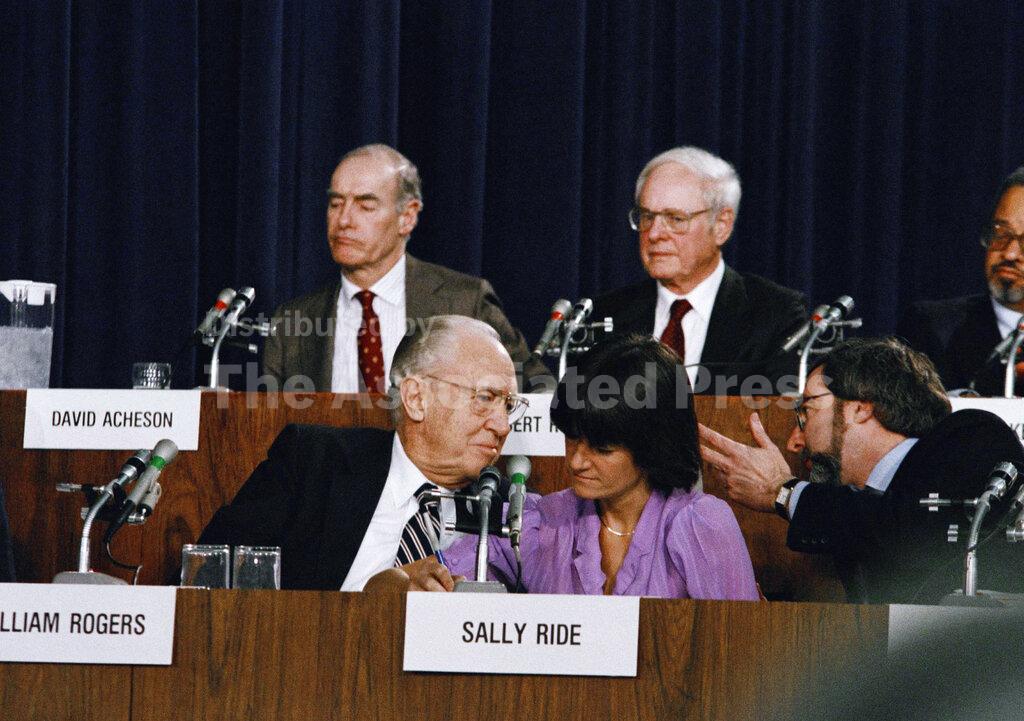
The shuttle inquiry chief charged that the national space agency had abandoned “good judgment and common sense” in handling critical safety issues. William P. Rogers, the chairman of the Presidential commission, made the exasperated comment near the end of a third successive day of testimony indicating that warnings about the safety of the Challenger were not fully understood or acted upon or brought to the attention of top officials who made the decision to launch the shuttle on January 28, only to have it explode soon after liftoff and kill all seven astronauts aboard. Today’s session marked the close of public hearings on the decision-making process before the launching. Officials of Rockwell International, which builds the orbiter capsule that carries the astronauts, testified today that they had explicitly warned key officials of the National Aeronautics and Space Administration that it was unsafe to launch the Challenger because ice on the pad might damage the spacecraft.
However, NASA officials insisted that they had received no such explicit recommendation against launching, but simply an expression of concern from Rockwell over the ice, which further analysis by the space agency’s engineers showed not to be a problem. As it turned out, a NASA ice specialist testified on Wednesday, films of the flight showed no evidence of any ice damage to the shuttle. Although cold weather is under investigation as a possible factor in causing the disaster, the chief theory is that cold temperatures might have weakened the synthetic-rubber seals that prevent hot gases from escaping from the shuttle’s booster rockets; the gases could have caused the shuttle’s giant fuel tank to explode. Photographs released at today’s hearing by NASA provided further evidence of a large puff of smoke emerging from an area near the seals shortly after the engines ignited.
The President and First Lady participate in a photo opportunity with the 1986 National Easter Seal Child.
Trial televising of Senate sessions, beginning next June 1, was approved by the senators by a vote of 67 to 21. Radio coverage will begin as soon as the necessary equipment is installed, perhaps as early as next week. The Senate is to vote in midsummer on whether to make broadcasting permanent. The vote tonight followed more than three weeks of sometimes stormy discussion, as senators argued over television’s potential effects on the customs of their institution and the quality of their lives.
Presidential hopeful Howard H. Baker Jr. appointed Tennessee Governor Lamar Alexander to a committee studying whether Vice President George Bush already has the Republican nomination “locked up.” Baker, in Nashville, Tennessee, for the Southern Republican Leadership Conference, said Alexander would be chairman of the committee and that former New Hampshire Attorney General Tom Rath would be the director. “Shortly after the November, 1986, elections, I will gather together my political advisers and make a final decision on whether to run for President or not,” said the former Senate Republican leader, who retired in 1984.
Attorney General Edwin Meese 3d said tonight that independent Federal regulatory agencies constituted a “politically unaccountable fourth branch of national government.” In remarks before a college audience in Irving, Texas, Mr. Meese said the United States Supreme Court, in its sympathetic treatment of independent federal agencies, had “created what some have called a sanctuary for bureaucratic domination.” Mr. Meese was speaking on the principle of separation of powers at the University of Dallas bicentennial lecture series.
John W. Hinckley Jr., who shot and wounded President Reagan in March, 1981, asked a federal judge to permit him to leave St. Elizabeths mental hospital in Washington for one day a month and spend it in the city. Hinckley also asked U.S. Judge Barrington D. Parker to move him from the maximum security ward where he has been to a less restrictive ward at the hospital. Hinckley has been confined by reason of mental illness.
Trying to head off an attempt by the gun lobby to bypass the House Judiciary Committee, the chairman, Rep. Peter W. Rodino Jr. (D-New Jersey) wrote House members he would “schedule prompt, full committee action” on any legislation approved by the crime subcommittee. Rodino last year declared that a Senate-passed bill to ease gun controls would be dead on arrival in the House. Controversy has erupted over the Senate bill, which would permit now-banned interstate sales of firearms, ease record-keeping requirements for licensed dealers and allow interstate transportation of unloaded firearms.
The Senate Judiciary Committee approved a proposal to allow farm families to remain on property acquired by the federal government through foreclosure. The proposal, sponsored by Senator Edward M. Kennedy (D-Massachusetts), would permit farmers to rent their house and an adjoining 10 acres for up to five years after their land was lost through foreclosure of a Farmers Home Administration or Small Business Administration loan.
The government cleared the way for making public 40 million pages of former President Richard M. Nixon’s White House papers and 4,000 hours of taped conversations that have been impounded since Nixon resigned as President on August 9, 1974. Jill Merrill, spokeswoman for the National Archives, said tapes and documents already screened by archivists could be released this spring, unless new barriers are erected. “We have 2 million pages ready to go,” she said. More will be available as archivists weed out sensitive materials.
An alleged Nazi war criminal ordered extradited to Israel to face charges that he murdered thousands of Jews at a Polish death camp was deported, authorities said. John Demjanjuk, 65, a retired auto worker whose legal battles began a decade ago, will be tried on charges stemming from his alleged role at the Treblinka death camp in Poland. Demjanjuk faces a possible death sentence if convicted of the World War II atrocities, said Israeli Justice Minister Moshe Nissim.
Three police officers and a former officer in tiny North Bay Village, Florida, were charged with accepting payoffs to protect cocaine deliveries, the FBI said. The three officers were being held at the Miami FBI office and were expected to appear before a U.S. magistrate today, said FBI agent-in-charge Joseph V. Corless. North Bay Village consists of several islands in Biscayne Bay near Miami and has a police force of 21 officers, said City Manager Jim DiPietro.
The wife of a convicted drug smuggler today was found guilty a second time of conspiring with her husband and his brother to assassinate a Federal district judge. Elizabeth Chagra, whose husband, Jamiel, is serving a 47-year sentence, was convicted in the 1979 slaying of the judge, John Wood of San Antonio. The judge was scheduled to hear Mr. Chagra’s drug case when he was killed. Mr. Chagra was convicted of drug smuggling and conspiring to obstruct justice in the slaying, and his brother Joe was sentenced to 10 years after pleading guilty of conspiracy. The jury returned its verdict today after deliberating for 10 hours over two days. A sentence hearing for Mrs. Chargra was scheduled for March 10. Much of the testimony and evidence presented in the new trial was used in a 1982 trial in San Antonio in which Mrs. Chagra was convicted on conspiracy charges. An appellate court overturned the conviction because of improper instructions to the jury.
A two-star Air Force general has been removed as European command surgeon, a position he was elevated to less than a month ago, the Defense Department said Wednesday. In speeches, the European command surgeon, Major General William H. Greendyke, has frequently castigated Dr. William Mayer, the Assistant Secretary of Defense for health affairs, for questioning the capacity of medical facilities in Europe and as subjecting military medicine to greater civilian oversight. The Pentagon would say only that General Greendyke “is in receipt of official military orders which assign him as a special assistant to the U.S. Air Force surgeon general.” The Pentagon said the orders directed the general to report for duty in Washington no later than February 28.
About 200 students at Smith College in Northampton, Massachusetts, continued their occupation of the administration building for a fourth day today to protest their college’s holdings in companies doing business in South Africa, and four students at Brown University in Providence, Rhode Island, began a hunger strike in a college chapel for the same reason. At Smith the chairman of the board of trustees, Euphemia H. Steffey, said she would ask the board to reconsider the criteria for making investments in South Africa.
America’s Jewish religious leaders have been locked in an impassioned argument over basic questions of Jewish identity, with some leaders warning that the dispute could result in deep and lasting divisions among American Jews. The tensions arise from a growing dispute among Orthodox, Conservative and Reform Jews over the validity of each group’s standards for marriage, divorce and conversion.
Many of the same Roman Catholics who placed a 1984 advertisement advocating the right to hold diverse views on abortion have reserved a second full-page advertisement in The New York Times Sunday that criticizes the church hierarchy for its “reprisals” against those who dissent. The new advertisement, signed by more than 1,000 Catholics, including five priests and 40 nuns, says some of the 97 signers of the first advertisement have been threatened with dismissal from religious orders and have lost teaching positions and speaking engagements at Catholic institutions. “We believe that Catholics who in good conscience take positions on the difficult questions of legal abortion and other controversial issues that differ from the official hierarchical positions act within their rights and responsibilities as Catholics and citizens,” it says. The new advertisement is regarded as provocative even by some liberal Catholics. The editors of The National Catholic Reporter, for instance, warned Catholics not to sign it because it was a “deceitful, dishonest and divisive effort” that could exacerbate conflict. The first advertisement, which some saw as clouding the church’s unequivocal prohibition against abortion, touched off a furor. The Vatican demanded that the 24 nuns and four priests who signed it “publicly repair the scandal” or face expulsion from the priesthood or their religious orders.
After decades of losing battles, from the local school board to the United States Supreme Court, conservative Christians have returned the issue of religious instruction in the public schools to the Federal courts. The Supreme Court has repeatedly said that no religion can be advanced in the public schools. But in two cases of potential national impact, one in eastern Tennessee and the other in Mobile, Alabama, fundamentalist parents have won the right to press their assertion that the reading materials their children are exposed to in school are colored by anti-Christian themes. In Church Hill, Tennessee, where the school board has stood firm against them, the parents are seeking the Federal District Court’s sanction to shield their children from such books. In Mobile, where the plaintiffs seem to have found a sympathetic federal district judge, they are asking his court to remove from the curriculum the influence of “secular humanism,” which to them, is a godless religion that is profoundly antithetical to biblical morality.
Nine days after being arrested on drug possession charges for the 2nd time in a month, LaMarr Hoyt checks into a drug rehabilitation program and will miss most of the Padres’ spring training. Hoyt was 16-8 with a 3.47 ERA last season.
The stock and credit markets soared amid increasing optimism that inflation has been checked and that interest rates are returning to the normalcy of single digits. The Dow Jones industrial average closed above 1,700 for the first time in the fifth-busiest session in New York Stock Exchange history. The Dow finished at 1,713.99, for a gain of 17.09.
Dow Jones Industrial Average: 1713.99 (+17.09)
Born:
Yovani Gallardo, Mexican MLB pitcher (All-Star, 2010; Milwaukee Brewers, Texas Rangers, Baltimore Orioles, Seattle Mariners, Cincinnati Reds), in Penjamillo, Mexico.
James Parr, MLB pitcher (Atlanta Braves), in Albuquerque, New Mexico.
Daniel Gibson, NBA point guard and shooting guard (Cleveland Cavaliers), in Houston, Texas.
Nicky Anosike, WNBA forward and center (WNBA All Star, 2009; Minnesota Lynx, Washington Mystics, Los Angeles Sparks), in Brooklyn, New York, New York.
J.T. Wyman, NHL right wing (Montreal Canadiens, Tampa Bay Lightning), in Edina, Minnesota.
 History Diaries