British and South African forces captured Mogadishu, the capital of Italian Somaliland. This evening Lieutenant General Cunningham’s British Nigerian troops of the 11th African Division have begun to occupy Mogadishu after a day’s lightning advance up the coast from Brava, 120 miles away. They also capture the 400,000 gallons of fuel in its stores. Operation Canvas is turning into a roaring success. South African and colonial troops have been advancing toward the main objective of Mogadishu for about two weeks. The Italians briefly made a stand on the Juba River line, but when that fell, their entire strategic position in Italian Somaliland collapsed. There remains little resistance anywhere. Today, The Italians declare Mogadishu an open city, and Nigerian troops capture nearby Afgoi with enormous stockpiles of supplies. Facing virtually no opposition, East African armored cars of the British 11th African Division drive 20 miles into Mogadishu, unmolested, during the day. Three specialist South African field security policemen parachute into the port to secure important communications equipment such as the telephone exchange.
The official handover of the city will be tomorrow, but today is when it actually changes hands. The capital of Italian Somaliland, Mogadishu is important for several reasons, not least the support that it can give to naval operations in the Indian Ocean.
Meanwhile, the 12th African Division pushes up the river Juba towards the Abyssinian border town of Dolo. Its aim is to clear all Italian opposition to the Abyssinian border, with the objective being the border town of Dolo. In Eritrea, the South Africans continue advancing south of Cub Cub, supported by the South African Air Force.
British Foreign Secretary Anthony Eden and CIGS General Sir John Dill, in the eastern Mediterranean to arrange British protection for Greece, travel on 25 February 1941 from Athens to Ankara for talks.
Churchill confides in a telegram to Middle East Commander General Wavell that the “Australian and New Zealand Governments have already been informed as was necessary” about the plans for an expedition to Greece. This buttresses the impression that Australian Prime Minister Menzies was not informed about the project in any detail until his arrival in London — at which point he was not enthusiastic about it.
The Free French attack on the Italian fort of El Tag at Kufra Oasis continues. The French are shelling the fortress with a 75mm field piece and several mortars. The Italians in the fort, though numerous, do not respond with any effectiveness — though they have four 20mm cannon, 53 machine guns and over two dozen trucks in parked in the fort.
Operation ABSTENTION: At dawn hundreds of British commandos landed on the Italian-held island of Kastellorizo off the coast of Turkey. The Regia Aeronautica began bombing the British positions immediately, while four warships were sent to shell the positions and land reinforcements. About 200 British Commandos, the subjugation and occupation of the island of Kastellorizo in the southeast Mediterranean, are at sea as the day begins. The Commandos land at dawn and quickly ambush an Italian patrol between Capt Nifti and the port. This landing operation is Operation Mar2, a naval support operation from Suda Bay involving destroyers HMS Decoy and Hereward. The landing is botched, as there actually are 500 men on board, but eight of the ten boats from Hereward get lost in the darkness and return to Decoy. They eventually land after daylight.
The commandos successfully occupy the port and take the Italian radio station there. The Italians manage to get off a radio message to Rhodes before surrendering, however. This draws airstrikes by the Regia Aeronautica within a few hours. The Italians bomb gunboat HMS Ladybird, damaging it, wounding three sailors, and forcing it to retreat to Famagusta, Cyprus along with its 24 Marines. Armed boarding vessel HMS Rosaura, operating out of Alexandria, arrives late and is unable to land the troops it carries due to Italian air attacks. Light cruisers HMS Bonaventure and Gloucester patrol offshore but can offer little assistance to the shore party.
The situation for the British grows worse throughout the day, as the commandos lose radio communications and are punished by the airstrikes. Italian torpedo boats arrive after dark and attack the Royal Navy ships, but neither side manages any hits. With the Admiralty uncertain about the situation on the island, a secondary landing from Cyprus is canceled and diverted to Alexandria.
The Italian light cruiser Armando Diaz was torpedoed and sunk off the Kerkennah Islands by the British submarine HMS Upright. British submarines have been lying in wait along the convoy lanes east of Tunisia between Naples and Tripoli, but with only middling success. There have been several unsuccessful attacks, a few minor sinkings, but nothing really significant. Today, though, they finally claim a major victim. HMS Upright (Lt. Edward Dudley Norman, DSC, RN) spots Italian light cruiser Armando Diaz east of Sfax (off the Kerkennah Islands) at 03:43 and sinks it. There are 464 deaths and 147 survivors. However, the silver lining for the Axis is that the vital transports that the cruiser was escorting, loaded with reinforcements for the Afrika Korps, continue on their way without interference.
At Tobruk, the Luftwaffe continues its incessant attacks. The Germans bomb and damage 5856-ton British tanker Tynefield. One man is lost. The ship is badly damaged, losing its forecastle, and eventually heads to Alexandria.
Wild rumors circulate on Malta that Mussolini has placed Marshal Graziani, the former commander of Libya, under house arrest. However, the information on the island is the product of speculation and assumptions, not facts. Graziani remains free, though he has not been the commander in Libya since January — something the British do not yet know.
Great Britain has informed Japan that this nation wants no peace in Europe “by compromise or parley,” the House of Commons was officially informed today. Word to this effect was given by Prime Minister Winston Churchill to Japanese Foreign Minister Yosuke Matsuoka, according to Richard Austen Butler, foreign undersecretary. Butler told of Britain’s refusal to accept a compromise peace in an attempt to clarify the confused situation which resulted after a Japanese press spokesman announced Japan’s willingness to mediate the war “anywhere in the world.”
Australian Prime Minister Menzies spends an hour with the Queen. He finds her “as wise as possible, and has the shrewdest estimate of all the Cabinet.” She agrees with Menzies about Churchill surrounding himself with “Yes-men,” which no doubt confirms her intelligence to him. Menzies also confides to his diary that the Duke of Kent confides to him that Churchill “has 6 ideas a day; they can’t all be right.”
Sir Basil Newton, British Ambassador to Baghdad, sends Foreign Secretary Anthony Eden a letter about developments in the Arab world. Newton states that the Grand Mufti of Jerusalem is prepared to initiate a rebellion in Iraq in support of Germany. His condition is that Germany issue a declaration against Zionism, specifically any Jewish homeland in Palestine, and in favor of a pan-Arab state. There have been some low-level contacts between the Mufti and German Foreign Minister Joachim Ribbentrop, and the Mufti is preparing an office in Berlin to conduct propaganda and espionage operations.
Prime Minister Winston Churchill sends a congratulatory note to the Import Executive for their success in salvaging damaged ships. He notes that there now are 30 salvage organizations, as opposed to 10 in August 1940. He also states that, while 340,000 gross tons of shipping were built in the final five months of 1940, 370,000 was recovered by salvage operations. He urges an increase in repair facilities.
After March 10 it will be illegal to have a meal in a British hotel, restaurant or other catering establishment consisting of more than one of the following: Meat, fish, poultry and game, eggs or cheese. Lord Woolton, Minister of Food, today issued an order which, he said, aimed to “protect food supplies and to achieve social equality.”
The American Junior Red Cross has sent 10,000 boxes of gifts to British children suffering as a result of the Blitz. Today, film star Mary Clare hands out some of the gifs to children at the Regal Cinema in Streatham.
British escort destroyer HMS Exmoor is the first of the ‘Hunt’ class to be lost. Exmoor either hit a mine and sank or was sunk by German motor torpedo boat S-30 12 miles off Lowestoft, England, United Kingdom; 105 killed, 32 survived.
German battleship Tirpitz is commissioned. Its first skipper is Kapitän zur See Friedrich Karl Topp. The Kriegsmarine now has two true battleships commissioned, the Tirpitz and Bismarck, but the former will require extensive working-up and equipping. Despite being commissioned, it is not yet ready for combat. Topp (no relation to Erich) is an officer in the Kriegsmarine’s shipbuilding department and not really suited to the command of a battleship. However, he does have combat experience: during World War I, he served as the first officer of SM UC-67 under the command of Martin Niemöller — a name you may recognize, but, if not, not really germane to this day’s events. Two men who took vastly different paths in life after working together.
A German military court today sentenced 10 Norwegians to death and imposed prison sentences on seven others for espionage activities in behalf of Britain. An official announcement said the leader of the group used radio apparatus to transmit to England great quantities of data, including 80 military reports.
A German military court heard evidence here today against 40 Dutch citizens accused of leading an organization formed to sabotage German army institutions, terrorize Nazi soldiers, and communicate information to “the enemy.” The defendants were charged with endangering The Netherlands and her population, but no further details of the organization or the trial were discussed. The organization was said to have been “dissolved.”
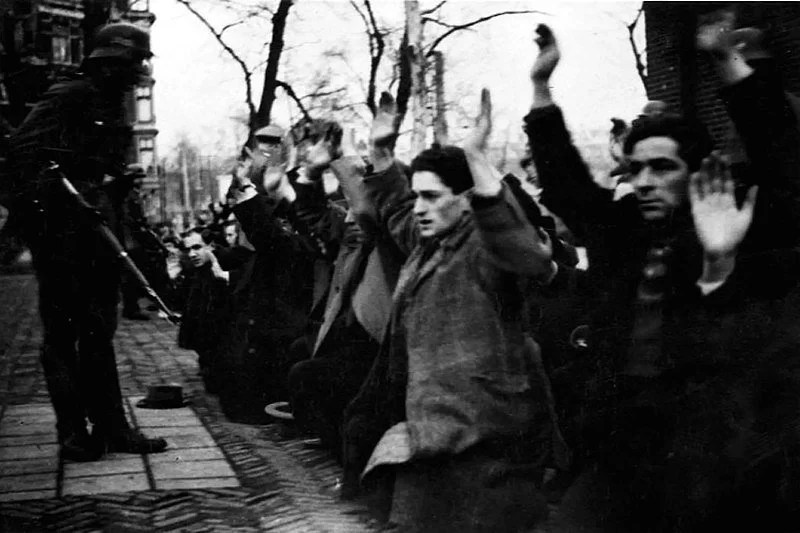
The February strike began in the Netherlands protesting the anti-Jewish measures of the Nazi occupiers. In occupied Amsterdam, a general strike began in response to increasing anti-Jewish measures instituted by the Nazi occupation administration. The anti-Nazi “Februari Strike” in Amsterdam, organized to protest against the pogrom against the Jews as well as the forced labor in Germany, began with the city’s tram drivers refusing to work. Their action was soon followed by other city services as well as companies like De Bijenkorf and schools. Most of the strikers were non-Jews. Though the Germans immediately took measures to suppress the strike, which had grown spontaneously as other workers followed the example of the tram drivers; it still spread to other areas, including Zaanstad, Kennemerland and Utrecht. The head of the SS in Holland, Hanns Albin Rauter, ordered SS troops and German police to open fire on the strikers; 11 were killed. This is the only direct action against the German treatment of Jews in Occupied Europe during World War II. The strike is in full effect when the day ends.
The Jews, 389 in all, were deported to Buchenwald. There 25 died from brutal treatment, or were shot; two months later, the rest were sent to the stone quarries of the Mauthausen camp; by the autumn there were no survivors. The strike is now remembered each year on 25 February, with a march past the De Dokwerker, the memorial made for the strike in 1951 and first revealed in December 1952. This statue was made by Dutch sculptor Mari Andriessen. All political parties, as well as the city public transport authorities and organizations of Holocaust survivors participate in the remembrance.
Viktor Abakumov was named the NKVD deputy commissar. Viktor Abakumov, who returned to Moscow NKVD headquarters on 12 February for reassignment, officially becomes a deputy to Lavrentiy Beria, the People’s Commissar for Internal Affairs.
Soviet Russia revealed Tuesday night that she is racing frantically to bolster her war machine, which showed amazing flaws in its only real test, in fear that she may be drawn into the “second imperialist war” against Adolf Hitler or with him. The Supreme Soviet approved a $53,850,000,000 budget for 1941, of which an unprecedented total of one-third goes for war preparations, including the fortifying of the frontiers of the Soviets’ newly-absorbed territories facing Germany on the west and the Nazi-intimidated Balkans on the south. It would be sheer guesswork to speculate on the actual fears underlying Josef V. Stalin’s defense measures because he remains the No. 1 enigma of the world. But there are growing indications that Russia feels she will be in the war before it is over. Adolf Hitler has never retracted, despite his pact with Russia in August which gave him a “go ahead” signal to war on Britain, his statements in “Mein Kampf” that Germany must obtain the Ukraine and the Urals. Moscow knows this but the Russians also know, from the lessons learned in Finland, that the Red Army and Red Air Force, despite their tremendous size, are no match for Germany and her axis partners, particularly so long as Hitler is lined up with Japan. That probably explains why Stalin is understood to have informed the Balkan governments, in the past two or three days, that he has given Hitler a free hand in southeastern Europe and intends to do nothing which might bring Russia into the war.
During the day, the RAF conducts a Circus sweep over the opposite shore, attacking the submarine pens at Flushing. RAF Bomber Command attacks Dusseldorf after dark with 80 planes.
The Luftwaffe bombs Hull again, this time with 25 bombers beginning at 17:50 and lasting until just before midnight. The docks are hit, as well as railway lines.
While daylight operations are light, JG 51 Kommodore Major Mölders shoots downs a Spitfire of RAF No. 611 Squadron. It is his fifty-ninth kill and second in about a week after a long lull.
RAF Bomber Command dispatches 4 Blenheims during daylight; 1 bombed Flushing docks. No losses.
RAF Bomber Command dispatches 80 aircraft overnight — 43 Wellingtons, 22 Hampdens, and 15 Whitleys — to Dusseldorf. 1 Wellington lost 64 aircraft bombed through complete cloud cover. A detailed report from Dusseldorf lists the results of approximately 7 loads of bombs which fell in the city. 4 small fires were soon put out; the only claim for compensation was by a fanner for 1,000 Reichsmarks (£100) damage to a barn. 1 civilian was slightly hurt fighting a fire and 2 Flak gunners slightly injured when a high-explosive bomb fell near their position.
RAF Bomber Command dispatches 17 Blenheims to airfields, 4 Blenheims and Wellingtons to Boulogne and 2 O.T.U. sorties. No losses.
There is an air raid on Malta at 09:30 by the Luftwaffe. The Germans lose two Dornier Do 215s (similar to the Do 17, only for export), while the British lose a Hawker Hurricane offshore to “engine trouble,” according to RAF sources. Oblt. Müncheberg of 7./JG 26 takes credit for the downed plane.
The RAF raids Tripoli.
Battleship HMS Queen Elizabeth departed Scapa Flow at 0500 escorted by destroyers HMAS Napier, HMS Nizam, HMS Bedouin, and HMS Matabele for gun and full power trials. The ships arrived back later in the day. Turbine defects developed in the battleship on the 27th. These were repaired and trials were completed on 14 March.
Destroyer HMS Brilliant departed Scapa Flow at 2100 for Portsmouth to undergo repairs prior to transferring to the Western Approaches.
Destroyer HMS Mendip arrived at Scapa Flow at 1030 from the Tyne to complete working up after repairs.
Escorting convoy FN.417, destroyer HMS Exmoor ( Lt Cdr R. T. Lampard) was sunk by German S.30 off the Lizard. Lampard, Sub Lt C H M Beckwith, T/Sub Lt A A H Weeks RNVR, Commissioned Engineer S H Young, one hundred and one ratings were lost with the destroyer. Thirty two survivors, including Lt J. K. Hamilton, A/T/Sub Lt D. S. Thorp RNVR, Surgeon Lt J. F. Hughes MRCS, LRCP, Gunner E. Whiteside, Midshipman H. D. Barr RNR, were rescued by patrol sloop HMS Shearwater and patrol trawler HMS Commander Evans (344grt).
British sailing barge Globe (54grt) was sunk on a mine 6100 yards 79° from Garrison Point, Sheerness. Two crewmen were lost.
German torpedo boats Iltis and Jaguar laid minefield AUGSBURG A off Eastbourne.
Battlecruiser HMS Renown and aircraft carrier HMS Ark Royal arrived at Gibraltar, escorted by destroyers HMS Foresight, HMS Foxhound, HMS Firedrake, and HMS Fortune, after escorting convoys in the Atlantic. The destroyers had departed Gibraltar on the 22nd to escort the battlecruiser and aircraft carrier.
In Operation ABSTENTION and Operation MAR 2, a special assault force of 500 men were embarked on destroyers HMS Decoy and HMS Hereward at Suda Bay. The main garrison for Kastellórizo was embarked in armed boarding vessel HMS Rosaura, which departed Alexandria on the 23rd for Famagusta. Gunboat HMS Ladybird departed Famagusta at 2230/23rd. Submarine HMS Parthian acted as a beacon for the landing. After an attack on the island during the night of 24/25 February, destroyers Decoy and Hereward landed the commandoes before dawn on the 25th. However, eight of the ten boats from Hereward lost their bearings and returned to destroyer Decoy. They were later landed in daylight. Gunboat Ladybird arrived at daylight on the 25th and landed a party of twenty four Marines. This operation was covered by light cruisers HMS Bonaventure and HMS Gloucester.
Gunboat HMS Ladybird was damaged by a bomb hit during the morning while in harbor. The Marines from Ladybird were reembarked on the gunboat. The gunboat then proceeded to Famagusta, Cyprus. The attempt to take the island was unsuccessful, due to delays of armed boarding vessel HMS Rosaura. In response to the landing, Italian destroyers Sella and Crispi and torpedo boats Lupo and Lince took on 240 men at Rhodes and left for Castelorizzo. During the night of 25/26 February, destroyer HMS Hereward contacted the Italian torpedo boats, but tried to concentrate with destroyer HMS Decoy before attacking. Destroyer Decoy, escorting Rosaura, did not make contact. Destroyer Hereward lost touch with the Italian ships and made no attack.
Italian torpedo boat Lupo arrived at Castelorizzo soon after 0001/26 February and entered the harbor. However, a storm blew up before disembarkation had progressed very far. At 0230/26th, the British ships involved in ABSTENTION were ordered to return to Alexandria. Light cruiser HMS Gloucester, anti-aircraft cruiser HMS Bonaventure, and destroyer HMS Decoy arrived at Alexandria at 2000/26th. Destroyer HMS Hereward and armed boarding vessel HMS Rosaura arrived at 0400/27th. The garrison on Rosaura was transferred to destroyers Decoy and Hereward.
Destroyers HMS Hotspur and HMAS Vampire departed Alexandria for Port Said to escort convoy AN.16. British troopship Ulster Prince also departed Alexandria for Port Said to embark military personnel for Greece and Crete.
British tanker Tynefield (5856grt) was damaged by German bombing at Tobruk. One crewman was lost. The forecastle was wrecked. Tanker Tynefield, escorted by anti-submarine trawler HMS Wolborough, arrived at Alexandria on 6 March. After repairs, the tanker sailed for Aden on 30 June.
Naval whaler HMS Sarna (268grt, T/Skipper C. Sarel RNR) of the 142nd Minesweeping Group was sunk on a mine in the Suez Canal. The Skipper of the whaler was able to beach his ship clear of the channel. One rating was missing and one crewman was injured.
Convoy OG.54 departed Liverpool, escorted by destroyer HMS Lincoln. Destroyers HMS Keppel, HMS Shikari, and HMS Venomous, sloop HMS Rochester, corvettes HMS Dianella, HMS Kingcup, HMS La Malouine, and HMS Sunflower, and anti-submarine yacht HMS Philante joined the convoy on the 26th. Corvette HMS Coreopsis joined on the 27th. Corvette Kingcup was detached on the 27th and corvette Coreopsis on the 28th. On 2 March, yacht Philante and corvettes Dianella and Sunflower were detached. Destroyers Keppel and Venomous were detached on 3 March. On 4 March, destroyers Lincoln and Shikari were detached. On 6 March, Dutch submarine HNLMS O-21 joined the convoy escort, and the convoy arrived at Gibraltar on 14 March with sloop Rochester, corvette La Malouine, and the Dutch submarine.
This day in Washington, President Roosevelt conferred with Congressional leaders on the legislative situation as it concerns the lend-lease bill and at a press conference expressed his opposition to peace negotiations until the war is won. He received Sidney Hillman, co-director of the Office of Production Management, and other visitors.
The Senate debated the lend-lease Mill and recessed at 5:46 PM until noon tomorrow. The Naval Affairs Committee approved the $242,000,000 Naval Base Authorization Bill; the Appropriations Committee approved the $1,415.991,838 Independent Offices Appropriation Bill and the Temporary National Economic Committee heard recommendations of the Securities and Exchange Commission for aiding small businesses.
The House passed the bill revising the Excess Profits Tax Act, passed the bill authorizing $84,302.883 in naval base projects, sent to conference the $395.000,000 argent deficiency bill and adjourned at 4:08 PM until noon tomorrow.
President Roosevelt said today that peace terms in the European war must wait until the war is won and he opposed any change in the pending lend-lease bill which might curtail all-out aid to Great Britain. Mr. Roosevelt said that while he cannot publicly discuss any proposed amendments to the legislation, it is obvious that he does not want any amendment which would change the government a policy in sending all possible aid to Great Britain. This was generally interpreted as striking at the Ellender amendment, which would restrict the use of American armed forces outside the Western Hemisphere. Secretary Hull also made known that, in discussions with several members of Congress, he had vigorously expressed his opposition to the amendment. The President had discussed amendments to the bill with Congressional leaders earlier in the day.
As the U.S. Senate went through its eighth day of tense debate on the lend-lease bill today, the measure’s advocates asserted it was the best way to keep America at peace, and Senator Wheeler, Montana Democrat, hotly replied that a member of the British parliament had predicted the United States would enter the war soon. The unnamed M. P. had said, Wheeler added, that our entry into the struggle would probably be by way of the Orient. The Montanan added that he would not be “surprised any morning to learn that American troops had been sent to Singapore,” England’s far eastern bastion. He said he could submit to the senate later a pamphlet written by a member of the British House of Commons.
President Roosevelt told reporters today there was no possibility he knew of that George H. Earle, United States minister to Bulgaria, might be recalled. Representative Rich, Pennsylvania Republican, demanded in the house today the recall of Earle, declaring that the envoy “got into a drunken brawl” at Sofia. (Earle reported to the state department that he was in a restaurant when “resenting the playing of Tipperary,’ a German threw a bottle at me.” Earle added: (“I warded it off and retaliated by injuring his features. The incident was regrettable but I saw no other course.”) “An act like that might lead us into war,” Rich shouted. “He ought to be recalled and sent back to the farm in Pennsylvania.”
President Roosevelt favors the use of wire tapping to combat sabotage or espionage against the United States, and kidnapping and consequent extortion, but only when the Attorney General deems it necessary, and he “would confine such legislation to the Department of Justice.”
Secretary of Interior Harold L. Ickes asserted tonight that the United States contains “an indeterminable number of dangerous fifth columnists who are serving the avowed purposes of Hitler and Goebbels, some of them for pay.” He spoke at a “Protestantism Answers Hate” dinner forum sponsored by the Protestant Digest Associates. “There is a widely disseminated and ably conducted movement in this country,” Ickes said, “that draws together such men as Merwin K. Hart, Father Coughlin, Colonel Lindbergh, Lawrence Dennis, and Major Al Williams, and many others who might be mentioned, who could sacrifice democratic ideals and Christian civilization to alien economic and social predispositions.”
Fanned by reports of administrative delays in speeding up of the defense program and of continuing labor strife in some of the country’s leading war industries, the movement for a wholesale investigation of defense preparations gained sudden headway in the House today. Behind this new impetus was some of the staunchest supporters of President Roosevelt’s foreign policy, including some champions of the lease-lend bill when it was before the House. After a meeting of the House Rules Committee to consider a dozen or more resolutions calling for an inquiry into the defense situation the view of members tonight was that it would approve later this week some form of investigation, possibly to be conducted by the Rules Committee itself and possibly to be continued indefinitely as a means whereby Congress could keep a constant watch on the conduct of the expanding rearmament program.
The Naval Affairs Committee rushed through the House today an $84,302,883 bill for the expansion of naval shore stations and announced that the United States now had the right under certain circumstances to assume military control over British islands where it is establishing bases. Reading to the House the Navy Department’s summary of provisions under which the United States, in the recent destroyer deal with Great Britain, leased for ninety-nine years the naval base at Bermuda, Representative Vinson, chairman of the Naval Affairs Committee, said that “if necessary for the protection or safeguarding” of the American base there, the United States had the “right to assume military control and conduct military operations within any part of Bermuda.” He stated that the Bermuda agreement was similar to the agreements covering the other bases leased from the British.
One in a long series of conferences is held in the Office of the Chief of Staff (George Marshall) at 10:00 in Washington, D.C. The topic is the status of the fleet in Hawaii and its potential vulnerability to attack. Besides Marshall, in attendance are General Delos Emmons, General “Hap” Arnold, General Brett, General Spaatz, General Gerow, Colonel McNarney, Colonel Anderson, and Colonel Twaddle. Marshall begins the meeting by stating, “In view of the Japanese situation the Navy is concerned with the security of the fleet in Hawaii.” Marshall notes that Admiral Kimmel at CINCPAC is worried that “the sea power of the United States might be jeopardized” due to “a surprise or trick attack.” Marshall is concerned that there is not “a single squadron of modern planes in the Philippines” or in Panama. He also is concerned about the P-40 fighter planes, which “have some engine trouble which makes them dangerous flying over water.”
The minutes state that “in view of the Japanese situation the Navy is concerned with the security of the fleet in Hawaii, and apparently the new commander of the fleet there has made a check and reported it to Washington and the Secretary of the Navy has outlined the situation to the Secretary of War. Their particular point is the type of air force in Hawaii, particularly Pursuit. They are in the situation where they must guard against a surprise or trick attack. It is necessary for the fleet to be in anchorage part of the time and they are particularly vulnerable at that time. I do not feel that it is a possibility or even a probability, but they must guard against everything. We also have information regarding the possible use of torpedo planes.”
Marshall’s concerns, along with some others, are quite prescient. However, that is all they are — concerns. Marshall ticks off some plans to send some P-36 fighters to Hawaii but notes that delivery of other planes is delayed. Lieutenant General Emmons then ticks off several reasons why “We have little means to accomplish our plans in GHQ Air Force.” These include officer shortages, plane shortages, and shortages of spare parts. He downplays the shortage of pursuit planes in Hawaii due to the “peculiar situation in Hawaii,” where night attacks are effective due to “phosphorescence in the water.” He concludes the conference by stating:
“They will have no warning service until they get detectors and pursuit would be useless. I would have long range bombers and not send pursuit, but bombers.”
The conference is striking in the way that everyone makes excuses for the Hawaiian islands not having sufficient fighters or other planes. The issue of aerial surveillance of the waters around Hawaii does not even come up.
C.I.O. workers at the Bethlehem Steel Corporation’s Lackawanna mill set a strike deadline for 9 P.M. tomorrow and heard a leader assert that the union was well enough organized to “close every plant Bethlehem has.”
Paramount Pictures releases “The Lady Eve,” written and directed by Preston Sturges. Starring Henry Fonda and Barbara Stanwyck, “The Lady Eve” is about romance on an ocean liner. In 1994, the film will be selected for preservation in the United States National Film Registry by the Library of Congress as being “culturally, historically, or aesthetically significant.”
Columbia Pictures releases “Meet Boston Blackie,” directed by Robert Florey and starring silent film star Chester Morris and Rochelle Hudson. While largely forgotten by the 1950s, the character of “Boston Blackie” is a popular cinematic jewel thief with, you guessed it, a heart of gold. This B movie proves strikingly successful with audiences, if not with critics, and leads to a long string (14) of “Boston Blackie” films that stretches throughout the 1940s.
Boston Bruins set NHL record of 23-game unbeaten streak (15-0-8).
Days after the start of spring training, the Yankees sell Babe Dahlgren, the man who took over first base from Lou Gehrig in 1939, to the Braves. The deal is questioned since no replacement seems apparent. McCarthy claims they would have won another pennant had not Babe Dahlgren made a costly error at first late in the season against Cleveland. He also intimated years later that the Babe had a marijuana problem. Joe Gordon will initially be moved from second base to first base.
Leighton G. McCarthy of Toronto, a former member of Parliament, has been named Canadian Minister to Washington to succeed Loring Christie, who has been compelled by ill health to seek leave of absence, Prime Minister W.L. Mackenzie King announced in Parliament this afternoon.
Chilean Government instructions to all provinces continued today to direct the adoption of all measures, under the military control already decreed, to maintain order during the general elections to be held next Sunday.
German raider Orion gets supplies from captured supply ship Ole Jacob and heads from the Pacific to the Indian Ocean.
The Royal Navy abandons its search for German heavy cruiser Admiral Scheer in the Indian Ocean. Captain Krancke has disappeared into the vastness of the ocean to the southeast. After a long and very successful cruise, Captain Krancke is instructed to return to Germany via the Denmark Strait and Norway.
Gen. Ho Ying-Chin, Chinese war minister and chief of the general staff, said today that Chinese troops would go to the assistance of Britain in Burma or Malaya against Japan any time such aid is requested. Chinese units are in China’s southwestern province of Yunnan, in readiness to go into action in event of a Japanese Invasion of Burma and should Britain ask China’s cooperation, he said. Chinese troops are similarly prepared, he added, if the Japanese attack in Malaya, along the road to Singapore.
Japanese Foreign Matsuoka is reported by United Press as calling for:
“…the white race to cede Oceania — the vastly more than thousand mile square region South Pacific — to the Asiatics.”
The press reports today are full of other bombastic statements from obscure Japanese sources. One, from a bellicose editorial in “Nichi Nichi,” calls US and British efforts to strengthen their positions in the Pacific an “unwarrantable challenge to Japan” and that Japan could easily conquer Singapore and Guam in the event of a conflict. The Japanese Vice Foreign Minister Ohashi also denies that Matsuoka ever offered to mediate an end to the European conflict, instead claiming that it was simply an expression of love for peace, as indicated by Japanese mediation of the Indochina border war.
Acting Prime Minister A.W. Fadden said today that Australia was fully prepared to defend herself and warned that “the further south certain people move, the further north Australia will move.”
Dow Jones Industrial Average: 122.4 (+0.91)
Born:
Susan Browning, American actress (“Mary Hartman, Mary Hartman”), in Baldwin, New York (d. 2006).
David Puttnam, English film producer/CEO (Columbia Pictures), in London, England, United Kingdom.
Stewart Sutherland, Baron Sutherland of Houndwood, Scottish philosopher of Religion and Vice-Chancellor of Edinburgh University, in Scotland, United Kingdom (d. 2018).
Danny Brabham, AFL linebacker (Houston Oilers, Cincinnati Bengals), in Magnolia, Mississippi (d. 2011).
Fran Mallick, NFL defensive tackle (Pittsburgh Steelers), in McKeesport, Pennsylvania (d. 2025).
Dave Vineyard, MLB pitcher (Baltimore Orioles), in Clay, West Virginia.
Zelig Eshhar, Israeli cancer researcher and immunologist known for his work on T-cells, in Petah Tikva, British Mandate of Palestine (d. 2025).
Ramon Pagayon Santos, Filipino contemporary classical composer, etno-musicologist, and pedagogue, in Pasig, Philippines.
Naval Construction:
The Kriegsmarine (German Navy) Type IXD1 U-boat U-180 is laid down by AG Weser, Bremen (werk 1020).
The Royal Navy “U”-class (Third Group) submarines HMS United (P 44) and HMS Unruffled (P 46) are laid down by Vickers Armstrong (Barrow-in-Furness, U.K.).
The U.S. Navy Accentor-class coastal minesweeper USS Fulmar (AMc-46) is launched by the Greenport Basin and Construction Co. (Greenport, Long Island, New York, U.S.A.).
The Royal Navy Fairmile B-class motor launch HMS ML 151 is commissioned.
The U.S. Navy patrol gunboat USS Vixen (PG-53) is commissioned. Her first commanding officer is Commander Pal Lamar Meadows, USN.
The U.S. Navy PT-7-class (81-foot Philadelphia Navy Yard) patrol motor torpedo boat USS PT-7 is commissioned.
The U.S. Navy PT-7-class (81-foot Philadelphia Navy Yard) patrol motor torpedo boat USS PT-8 is commissioned.
The Royal Navy Flower-class corvette HMS Nigella (K 19) is commissioned. Her first commanding officer is T/Lieutenant Thomas Willis Coyne, RNR.
The Kriegsmarine (German Navy) battleship Tirpitz is commissioned at 1140 hours. Her first commanding officer is Kapitän zur See Friedrich Karl Topp.
 History Diaries