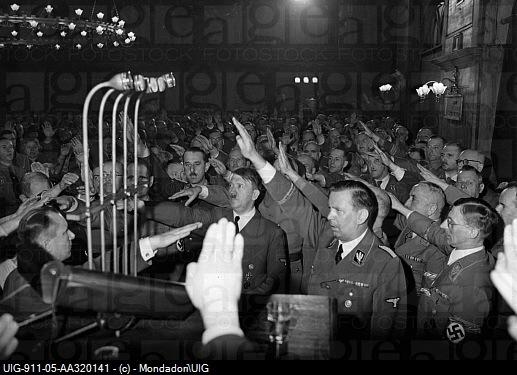
Hitler gave a speech in Munich on the 21st anniversary of the founding of the Nazi Party declaring that the U-boat offensive would intensify in the coming months. “Now our sea warfare can begin in earnest,” Hitler told a hand-picked audience in Munich today. He was speaking in a charged atmosphere at the beer hall where what became the Nazi Party was founded in 1919. He pulled no punches. “Our Nazi methods were unattractive to many,” he said. “But I was a soldier and had come from the front, where I had got used to a rough tongue.” Hitler reported on the progress of the intensive training of U-boat crews to man the new boats streaming out of his shipyards. His claim that U-boats have sunk 190,000 tons of shipping in the last two days may be exaggeration; that is more like the month’s total. Nevertheless it is far more than the Allies can afford.
Continuing a theme extended by Mussolini in a speech in Rome on the 23rd, Hitler assumes a typical defensive tone at some points.
“My opponents may believe that they can terrify me with the threat of time, but I have learned to wait, and I have never been idle while waiting… It is for this reason that such threats do not frighten us.”
He also adopts an offended attitude about the Allies’ rejections of his previous half-hearted peace overtures:
“I have made proposal after proposal to Britain; likewise to France. These proposals were always ridiculed-rejected with scorn. However, when I saw that the other side intended to fight, I naturally did that which as a National Socialist of the early days, I did once before: I forged a powerful weapon of defense.”
Thus, despite his repeated decisions to invade other countries, Hitler portrays himself (and presumably Germany, though the speech is all about him and his decisions) as the victim of bullies. Another oddity in hindsight is when he catalogs a list of reasons offered by his enemies why his rule would collapse quickly. Among them is the following:
“Then they said: “Winter, General Winter is coming, and he will force Germany to her knees.” But, unfortunately, the German people are “winter-proof.” German history has passed through I do not know how many tens of thousands of winters. We will get through this one, too.”
This, of course, is not a claim he would be able to make at the next anniversary.
At a meeting of British and Greek political and military leaders, Foreign Secretary, Anthony Eden, said Britain could offer three infantry divisions to help Greece, the Polish Brigade and an armoured brigade, a total of 100,000 men.
Meanwhile, one of the most momentous decisions of the Greece campaign is being made a thousand miles away. At 17:00, the War Cabinet meets along with Australian Prime Minister Robert Menzies, in London after his long flight from Melbourne. The minutes show that Eden and Dill (in Athens) and General Wavell (who, as noted, remains in Cairo):
had recommended that we should send armed forces to Greece to help the Greeks meet a German advance through Bulgaria.
Menzies is a little more doubtful. He says at the War Council meeting that he would like to be “reassured” about things such as tactics and the composition of the expedition. He says that he would rather not commit Australian troops to a “forlorn hope,” in which case “it had better not be undertaken.” Another complicating factor is that “Wild Bill” Donovan has told President Roosevelt about the proposed operation, and canceling it now “would have a bad effect in the United States.” Menzies later comments in his diary that he is the only one to ask questions, and the whole thing “would have been finished in ten minutes, but for some queries raised by me regarding air support, problems of equipment, of shipping and of time.” History shows that Menzies had quite valid concerns, but the room is full of Churchill supporters, and the outcome of the deliberation is certain.
After everyone speaks, the War Council votes. It unanimously approves “sending military assistance to Greece.”
A troop of guns of the British 16th Anti-Tank Company and two troops of the King’s Dragoon Guards are ambushed near El Aghelia by a patrol of German tanks, armored cars and motorcycles. This is the first significant contact on the ground between British and German forces. The Germans take 3 prisoners. While there have been several claims of “first” in terms of firing between the Germans and British in Libya, this incident has a better claim than some others: it involves tanks, armored cars, and motorcycles. While the Germans ambush a British/Australian patrol, thereby unequivocally confirming their presence, the British in Cairo take little notice of this; instead, they remain bound and determined to take troops out of North Africa for the campaign in Greece. This, of course, is happening at precisely the wrong moment, with yet another convoy of German troops about to arrive in Tripoli.
Three German He 111 bombers attacked British destroyers HMS Dainty and HMS Hasty in Tobruk harbor, Libya at 1900 hours. HMS Dainty was sunk by a 500kg bomb, killing 16.
The Free French siege of El Tag fortress in Kufra continues. The French are raining artillery and mortar shells on the Italians, who have no weapons with which to respond.
Operation ABSTENTION begins. This is a British commando operation to seize the strategically useful island of Kastellorizo from the Italians. By seizing it, the Royal Navy essentially could seal off the southeast Mediterranean from Italian shipping. The British remain preoccupied with the Greek islands throughout the war, perhaps a holdover from Winston Churchill’s experiences during World War I and the failed Gallipoli campaign. About 200 commands at Suda Bay, Crete board destroyers HMS Decoy and Hereward, accompanied by 24 Royal Marines on gunboat HMS Ladybird. Another force sails from Cyprus. They plan to land on Kastellorizo at dawn on the 25th and wrest it from the Italians.
The British are on the move in East Africa, both along the Juba River and toward Mogadishu. Middle East Commander General Wavell, who is busy worrying about what troops to transfer to Greece, cables General Cunningham to press on to Harar and cut communications between Addis Ababa and Djibouti. The 12th African Division continues pressing north along the Juba, while the 11th Division continues toward Mogadishu against very light Italian resistance. It reaches Goluin, only about 50 miles from the important port.
West African troops capture Brava, a port 160 miles up the coast from Kismayu. Indian 7th Indian Brigade moves south of Cub Cub and takes Chelamet.
The Greek army in almost four months of war has captured 20,000 Italians and “will not cease fighting until the Italians are out of Albania,” a government spokesman said tonight. The statement was a detailed reply to the speech Sunday by Premier Mussolini, who represented Greek losses as heavy and minimized Italy’s casualties. In view of German hopes of forcing Greece to sue for peace with Italy, observers expressed interest in the statement that the Greeks will not rest until they drive the Italians out of Albania.
The British diplomatic corps withdrew from Sofia, Bulgaria. The British legation today began destroying confidential records and evacuated members of its staff to Turkey as signs multiplied rapidly that the German army is ready to begin its large-scale occupation of Bulgaria, possibly within a matter of hours. The Bulgarian government ordered nation-wide air-raid black outs, presumably against the threat of British bombings, to begin tomorrow or Wednesday night. Bulgarian army officers in uniform studied maps in Sofia’s largest hotel tonight with mysterious German-speaking visitors garbed in civilian clothes. Nearly 200 villas in the exclusive Bulgarian resort of Tcham Koria, 43 miles from Sofia, were reported to have been requisitioned for officers of the German general staff. The situation and spreading expectation of big developments was made tenser by reports that Russia has informed all the Balkan governments, through ordinary diplomatic channels, that she has given Germany a free hand in southeastern Europe.
Bulgarian Tsar Boris III stated in a speech from the throne at the opening of the Naradno Subranie (the National Assembly of Bulgaria) that there was to be no change in Bulgaria’s policy of neutrality.
The British, who have been monitoring secret Japanese communications via decrypts and thus have a very good idea of Japanese intentions, deliver a diplomatic reply to the Japanese Ambassador about his offer of mediation in the European conflict. It notes in passing that “All the preparations which are being made in oriental regions by Great Britain and the United States are of a purely defensive character.” The British government rejects the offer of mediation because:
“[I]n a cause of this kind, not in any way concerned with territory, trade or material gains, but affecting the whole future of humanity, there can be no question of compromise or parley.”
This reply bears the unmistakable hand of Prime Minister Winston Churchill. Many in Great Britain, including some highly placed personages, feel that negotiations with Germany should at least be tried. However, Churchill is absolutely adamant that no talks of any kind should occur.
Admiral Darlan, the new Vice Premier, names his cabinet. General Huntziger becomes Minister of War. Darlan himself takes the key spots of minister for foreign affairs, defense, and the interior. As Marshal Petain’s hand-picked successor, Darlan basically will run the government — as long as he does not personally offend Petain like Laval.
An open air meeting was held on the Noordermarkt in Amsterdam, the Netherlands to organize a strike to protest against the pogrom against the Jews as well as the forced labor in Germany. The Communist Party of the Netherlands, made illegal by the Germans, printed and spread a call to strike throughout the city the next morning.
43 Geuzen resistance fighter trial opens in the Hague.
Italian forces repel a British attempt to capture the island of Kastellórizo in the Dodecanese.
RAF Bomber Command dispatches 57 aircraft overnight — 30 Wellingtons, 18 Hampdens, 6 Manchesters, 3 Stirlings — to bomb warships at Brest. No losses. The Manchester sorties, from 207 Squadron from Waddington, Lincolnshire, England, were the first operational flights by this type of aircraft; 1 Manchester crashed in England. 1 Wellington bombed Boulogne docks. While the damage is fairly average for such a raid, it is notable as being the first operation mission by the Avro Manchester twin-engine bomber. Half a dozen Manchester bombers of RAF No. 207 Squadron participate, and one crashes upon returning to RAF Waddington from undercarriage failure. Tactically, the raid is a failure because German heavy cruiser Admiral Hipper, the primary target, is not hit despite claims by the bomber crews that they bracketed it in dry dock. In addition, their Vulture engines display a tendency to overheat. These are Mark I Manchesters with the original triple tail fin, no dorsal turret and an inability to carry the 2000lb bombs that they partially had been designed to deliver. The crash today is an omen, for the Manchester will wind up with the highest combat-loss-to-sorties ratio and the highest accident rate in the RAF.
The Luftwaffe bombs Cambridge after dark. There is little damage and few or no casualties.
A terrible day at sea for the Royal Navy as convoys OB.288 and OB.289 are savaged by the Kriegsmarine. The destruction of Convoy OB.288 by a large Wolf Pack continues today (see 23 February 1941 for more details). U-95 (Kptlt. Gerd Schreib) joins the action. Sunk today (sources vary, and all are British except as indicated):
8685-ton Dutch transport Grootekerk (U-123)
1908-ton Norwegian freighter Svein Jarl (U-96)
4542-ton Marslew (U-96)
5468-ton Sirikishna (U-96)
3385-ton Linaria (Italian submarine Bianchi)
4260-ton Waynegate (U-73)
3807-ton Cape Nelson (U-95)
4427-ton Temple Moat (U-95)
5360-ton HMS Manistee (U-107 and Bianchi, 140 deaths)
They join some of their fellow convoy members already on the bottom. The ordeal is not yet over for OB.288, though.
Convoy OB.289, which is following OB.288 fairly closely about 500 km northwest of Cape Wrath, Scotland, also comes under attack. U-boat U-97 (Kptlt. Udo Heilmann), on its first patrol out of Kiel, has an awesome start to its career. Heilmann makes repeated attacks and sinks three ships from the convoy and damages a fourth:
6894-ton British freighter British Gunner (sunk)
4973-ton British freighter Johnathon Holt (sunk, 52 dead)
4894-ton British freighter Mansepool (sunk, two dead)
9718-ton Norwegian tanker G.C. Brøvig (damaged).
The tanker has its bow blown off, but the bulkheads hold and it makes port at Stornoway in the Outer Hebrides. It later is fully repaired. The convoy escorts are noticeably jittery due to all the recent U-boat attacks, and this manifests itself in an order by corvette HMS Petunia for the crew of the British Gunner to abandon ship despite the master’s belief that the ship can be towed to port. A total of three ships of 16,761 tons are sunk.
U-123, commanded by Kapitänleutnant Karl-Heinz Moehle, sank Dutch steamer Grootekerk (8685grt) in the Atlantic. The entire crew was lost. The Grootekerk (Master Barend Albert Veen) was reported missing after leaving Swansea on 18 February 1941. At that time it was assumed that she had been sunk by the German battleships Scharnhorst and Gneisenau in approx. 56°N/25°W. In fact, U-123 came across Grootekerk during the morning of 23 February while heading for the convoy OB.288, but misidentified her as Nestor or Ulysses of the Blue Funnel Line. Moehle began to chase the ship which steamed on a zigzag course at 14 knots and soon noticed that it is difficult to overtake her as the U-boat was only marginally faster. However, after a chase of nine hours the ship turned southward and slowed down, giving Moehle the opportunity to fire a first G7e torpedo at 2335 hours, which missed. At 0053 hours on 24 February, the U-boat fired a second G7e torpedo that hit the Grootekerk amidships after a running time of two minutes. She stopped and was then hit underneath the bridge by a coup de grâce at 0105 hours, which was a surface runner that struck close to the area where the crew was lowering the lifeboats. The ship capsized to starboard and sank after 12 minutes about 330 miles west of Rockall. There were no survivors, all 18 Dutch and 35 Chinese crew members and 13 British passengers were lost. The 8,685-ton Grootekerk was bound for the British West Indies.
U-48, commanded by Kapitänleutnant Herbert Schultze, sank British steamer Nailsea Lass (4289grt), which was straggling behind convoy SLS.64, sixty miles southwest of Fastnet. At 2143 hours on 24 Feb 1941 the Nailsea Lass (Master Thomas Llewellyn Bradford), a straggler from convoy SLS.64, was hit under the bridge by one torpedo from U-48 and sank by the bow at 2219 hours 60 miles southwest of Fastnet. Five crew members were lost. The master and the chief officer Alfred Hodder were taken prisoner, landed at St.Nazaire on 27 February and taken to the German POW camp Milag Nord. The second officer E.J. Knight and 18 crew members landed at Ballyoughtraugh, Co. Kerry and the third officer and nine crew members near Berehaven, Co. Cork. The 4,289-ton Nailsea Lass was carrying charcoal, 1 pig iron, iron ore, tea, hemp, and jute and was bound for London, England.
U-73, commanded by Kapitänleutnant Helmut Rosenbaum, sank British steamer Waynegate (4260grt), from dispersed convoy OB.288, in 58-50N, 21-47W. At 0419 hours on 24 Feb 1941 the unescorted Waynegate (Master Sydney Gray Larard), dispersed from convoy OB-288, was hit on the starboard side between #1 and #2 bulkhead by one torpedo from U-73 south of Iceland. The U-boat had spotted two ships from the recently dispersed convoy during snow squalls and at 0351 hours fired one torpedo on the second ship, the Waynegate. This torpedo proved to be a dud, so a second torpedo was fired that hit. The crew immediately abandoned ship in two lifeboat as she quickly settled by the head. At 0438 hours, the U-boat fired one G7e torpedo as coup de grâce to hasten the sinking and the ship sank by the bow five minutes after being hit on the starboard side in #2 hold. The lifeboats were about 100 feet away and were missed by a plate from the ship’s side blown away by the second explosion. The Germans left without questioning the crew in an attempt to catch the other ship. The master, 38 crew members and two gunners (the ship was armed with one 4in, one 12pdr and two machine guns) were picked up after about six hours by FFL Léopard and landed at Greenock on 28 February. The 4,260-ton Waynegate was carrying coal and was bound for Freetown, Sierra Leone.
U-95, commanded by Gerd Schreiber, sank the British steamer Cape Nelson (3,807 tons). At 0046 hours on 24 Feb 1941 the unescorted Cape Nelson (Master Kenneth Malcolm Mackenzie), dispersed from convoy OB.288, was hit by a torpedo from U-95 and sank by the bow within 7 minutes southwest of Iceland. The master and three crew members were lost. 34 crew members were picked up by the British steam merchant Harberton and landed at Halifax on 4 March. The Cape Nelson was in ballast, bound for New York.
U-95 sank British steamer Temple Moat (4427grt), which was straggling behind convoy OB.288, in 59-27N, 20-20W. At 0145 hours on 24 Feb 1941 the Temple Moat (Master Thomas Ludlow, MBE), dispersed from convoy OB.288, was hit by one torpedo from U-95 and sank fast by the bow about 240 miles south of Iceland. The master, 39 crew members and two gunners were lost. The 4,427-ton Temple Moat was carrying coal and was bound for Buenos Aires, Argentina.
U-96, commanded by Kapitänleutnant Heinrich Lehmann-Willenbrock, sank Norwegian steamer Svein Jarl (1908grt) in 59-30N, 21W. At 0027 hours on 24 Feb 1941, U-95 fired one torpedo at a ship from the dispersed convoy OB.288 and missed the intended target, but Schreiber thought that he hit another ship beyond. This is not confirmed from Allied reports. At 0028 hours, the U-boat fired a second torpedo and observed a hit in the stern of a ship and its sinking. The victim was probably Svein Jarl (Master Martin Marsteen) which was reported missing after the convoy had been dispersed. The master and 21 crew members were lost. The 1,908-ton Svein Jarl was carrying ballast and was bound for Halifax, Nova Scotia.
U-96 next sank British steamer Linaria (3385grt), from dispersed convoy OB.288, in 61N, 25W. At 0116 hours on 24 Feb 1941 the unescorted Linaria (Master Henry Theodore Speed) was hit by one G7e torpedo from U-96 and sank by the stern about 265 miles south of Reykjavik, Iceland. The ship had been reported missing in approx. 61°N/25°W after being dispersed from convoy OB-288. The master, 32 crew members and two gunners were lost. The 3,385-ton Linaria was carrying coal and was bound for Halifax, Nova Scotia.
U-96 also sank British steamer Sirikishna (5458grt), from dispersed convoy OB.288, in 58N, 21W. Convoy Commodore Rear Admiral R. A. A. Plowden Rtd was lost in the steamer. At 0220 hours on 24 Feb 1941 the Sirikishna (Master Robert Paterson), dispersed from convoy OB.288, was hit on the port side amidships by one torpedo from U-96 south of Iceland and was abandoned by the crew. The U-boat first had to load a torpedo from an upper deck container into the boat because all other torpedoes had been spent. At 0836 hours, a coup de grâce was fired that hit amidships and caused the ship to sink rapidly after breaking in two. She was the ship of the convoy commodore Rear Admiral R.A.A. Plowden, DSO. The master, the commodore, five naval staff members, 34 crew members and two gunners were lost. The 5,458-ton Sirikishna was carrying ballast and was bound for Halifax, Nova Scotia.
U-97, commanded by Udo Heilmann, sank from convoy OB.289 British steamer Mansepool (4894grt) in 61-01N, 12-00W and British steamer Jonathan Holt (4973grt), in 61-10N, 11-55W. At 0212 hours on 24 February 1941, U-97 fired two torpedoes at the convoy OB.289 southwest of the Faroe Islands and reported one ship sunk, but in fact the Mansepool and Jonathan Holt were hit and sunk.
Two crew members from Mansepool (Master Harry Raymond Clark) were lost. The master 19 crew members and two gunners were picked up by the British merchant Thomas Holt, later transferred to HMS Petunia (K 79) (LtCdr G.V. Legassisk), which had earlier rescued 17 other crew members from the same vessel and brought them all to Stornoway. The 4,894-ton Mansepool was carrying ballast and was bound for Halifax, Nova Scotia.
The master, 38 crew members, two gunners and ten passengers (including four SOE agents) from the Jonathan Holt (Master William Stephenson) were lost. Two crew members and one passenger were picked up by HMS Petunia (K 79) (LtCdr G.V. Legassisk, RNR) and landed at Stornoway. Two crew members and one passenger were picked up by the British rescue ship Copeland (Master J. McKellar, OBE) and landed at Greenock. The 4,973-ton Jonathan Holt was carrying general cargo and was bound for West Africa.
U-97 also sank British tanker British Gunner (6894grt) from convoy OB.289 in 61-09N, 12-04W. At 0624 hours on 24 Feb 1941 the British Gunner (Master James William Kemp) in convoy OB.289 was hit by one G7a torpedo from U-97 273 miles northwest of Cape Wrath. Four hours later, HMS Petunia (K 79) (LtCdr G.V. Legassisk, RNR) ordered the crew to abandon ship in 61°16N/12°20W, even though the master reported that his ship can be towed to port. Three crew members were lost. The master, 38 crew members and two gunners were picked up by the corvette and landed at Stornoway, Hebrides. The 6,894-ton British Gunner was carrying ballast and was bound for Aruba.
U-97 finally damaged Norwegian tanker G. C. Brovig (9718grt) from convoy OB.289 in 61-04N, 14-24W. At 0818 hours on 24 Feb 1941, U-97 attacked the convoy OB.289 for the third time and damaged the G.C. Brøvig with one torpedo. The tanker lost its bow, but the bulkhead held and the engines remained intact. She continued her voyage at slow speed with steering tow assistance by HMS Petunia (K 79) (LtCdr G.V. Legassisk, RNR), arriving at Stornoway on 27 February. With permanent repairs made in Falmouth, she returned to service after three months. The 9,718-ton G.C. Brøvig was carrying ballast and was bound for New York, New York.
Italian submarine Bianchi sank British steamer Huntingdon (10,946grt) from convoy OB.288 in 58-25N, 20-23W. The entire crew was rescued by Greek steamer Papalemos (3478grt) of the convoy.
Destroyer HMS Kelvin arrived at Scapa Flow from the Tyne at 1200 to carry out degaussing range trials. Following the trials, the destroyer departed Scapa Flow at 1830 for Plymouth.
Destroyer HMS Atherstone departed Scapa Flow at 2000 for Rosyth following her working up exercises.
Destroyers HMS Intrepid and HMS Impulsive laid minefield GT in the English Channel.
Minesweeping trawler HMS Erimo (265grt, Skipper T. Catchpole RNR) was seriously damaged in the approaches to Swansea.
Minesweeper HMS Blackpool was machine gunned by German aircraft off the northeast coast of Scotland. The minesweeper had no time out of action.
Destroyers HMS Dainty (Cdr M. S. Thomas DSO) and HMS Hasty were leaving Tobruk at dusk when destroyer Dainty was sunk in an air attack. P/T/Surgeon Lt W. G. Cuthbertson RNVR, T/Lt (E) E M. McAllister and twelve ratings were killed. One rating died of wounds. A/Gunner (T) R. G. Humphreys and seventeen ratings were wounded. Destroyer Hasty and trawler Maria Giovanni rescued Dainty’s survivors. The destroyer arrived at Alexandria with 140 survivors, including the Commanding Officer and four officers on the 25th. Destroyer Hasty was relieved in the Inshore Squadron by destroyer HMAS Waterhen, which departed Alexandria on the 26th.
Destroyers HMS Encounter and HMS Isis departed Gibraltar for a trip around the Cape to Alexandria to join the Mediterranean Fleet. Ocean boarding vessel HMS Marsdale, en route to Western Patrol, sailed in company. The destroyers arrived at Freetown on 3 March. Destroyer Isis departed Freetown on 5 March for St Helena. The destroyer departed St Helena on 9 March. Destroyer Encounter departed Freetown on 9 March and joined destroyer Isis at sea. The destroyers arrived at Simonstown on 13 March and departed on 16 March. They arrived at Durban on 18 March and departed on 25 March. The two destroyers arrived at Mombasa on 29 March and departed on 31 March. Destroyers Encounter and ISIS arrived at Aden on 4 April and departed on 5 April. They departed Suez on 8 April and arrived at Alexandria on 9 April.
Italian convoy of troopships Esperia (11,398grt), Conte Rosso (17,879grt), Marco Polo (12,272grt), and Victoria (13,098grt) departed Naples escorted by destroyers Baleno and Camicia Nera and torpedo boat Aldebaran. Light cruisers Bande Nere and Diaz and destroyers Ascari and Corazziere covered the convoy. Italian light cruiser Diaz (flagship of Admiral Moriondo) was sunk by Submarine HMS Upright on the 25th off Sfax in 34-33N, 11-45E. Submarine Upright unsuccessfully attacked a destroyer in this force.
Convoy BN.17 departed Suez, escorted by sloops HMS Shoreham and HMS Yarra. The convoy was dispersed on the 27th.
Convoy BS.17 departed Suez. Sloops HMS Clive and HMIS Hindustan joined the convoy on the 25th. The sloops were detached that night. Sloops HMS Flamingo and HMS Yarra joined the convoy. The convoy was dispersed on 3 March.
President Roosevelt was at Hyde Park today. The White House sent to Congress the President’s report and recommendations of a special committee studying the civil service; and messages requesting $3,812,311,197 for additional Army appropriations and authorizations, and for $150,000,000 for community facilities in towns and cities adjacent to defense projects.
The Senate continued the debate over the Lend-Lease bill, hearing Senators Clark of Idaho, La Follette and Danaher oppose the measure, and received from its Appropriations Committee the $1,515,000,000 Independent Offices Supply Bill. The Senate recessed at 6:20 PM until noon tomorrow.
The House received the Doughton bill to remove inequalities of the 1940 Excess Profits Tax Act, received the Vinson bill to authorize $50,000,000 for small craft naval bases; received the Boren resolution for a House inquiry into the motion-picture industry; received the Tinkham bill to oppose sending the Pacific Fleet to Singapore, and adjourned at 1:31 PM until noon tomorrow.
Senator Johnson, California Republican, making his first speech on the Lend-Lease bill, said tonight that he wished “most ardently for Britain to win” and would give all aid “short of war,” but that “this bill is war.” “In every line, though cloaked and hidden, it shrieks its presence, and soon will burst forth in all its fury,” Johnson said in a speech on the Washington Star’s N.B.C. radio forum.
Looking beyond the forthcoming senate action on the Lend-Lease bill, Senator Wheeler, Montana Democrat, declared today that if the measure were passed, its opponents would conduct a campaign from coast to coast in an effort to keep the United States out of war. “I am going to stump the country, and I am going to try to get other senators to do likewise,” he told reporters. He said that some other senators had already agreed to address mass meetings “from Boston to California.” Meantime, warnings that the bill means war were shouted to the Senate by Senators LaFollette, Wisconsin Progressive, Clark, Idaho Democrat, and Danaher, Connecticut Republican, in the seventh day of tense debate on the measure.
The Administration took two far-reaching steps today toward speeding the production and procurement of weapons for the United States and Great Britain. In a special communication to Congress President Roosevelt asked for immediate additional appropriations and contract authorizations of $3,812.311,197 for the Army, the greater part of which is understood to be intended for the purchase of planes for this country and England. In an order of its own, issued under authority delegated by the President, the Office of Production Management invoked the first mandatory industry-wide priorities to date on producers of aluminum and machine tools, in order to reserve first call on these vital items for the rapidly expanding defense program. Both steps were directed primarily at speed. About one-half of the additional amount proposed by the President for the Army is contained in the 1942 budget, but he asked that it be granted now in an urgent deficiency bill.
Recommendations made by an eight-man committee headed by Supreme Court Justice Stanley Reed that classified civil service be extended to all Federal Government positions except “policy-determining” jobs and those requiring Senate confirmation were transmitted to Congress today by President Roosevelt.
Associated Press reports from Washington: “OPM plus ACCND equals maze. That is not an algebraic formula but statement of fact. OPM is the Office of Production Management. ACCND is the Advisory Commission to the Council of National defense. Maze is what their variety of overlapping functions add up to. So complicated is the labyrinth of committees, commissions, and co-ordination offices encircling the defense organization that men long experienced in drawing charts of government agencies have been baffled. It defies mapping. Officials spent several weeks trying to prepare a chart, but each tentative draft struck a snag when official approval was sought. The government is still without a blueprint of its defense machinery.
The results of a Gallup poll were published asking Americans, “Do you think the United States should try to keep Japan from seizing the Dutch East Indies and Singapore?” 56% said yes, 24% said no, 20% expressed no opinion. A different version of the question asked, “Do you think the United States should risk war with Japan, if necessary, in order to keep Japan from taking the Dutch East Indies and Singapore?” 46% said no, 39% said yes, 15% gave no opinion. The results are interesting in that they appear to support President Roosevelt’s policy of economic, but not military, warfare against Japan.
Japanese Vice-Consul (acting Consul General) Ojiro Okuda in Hawaii has been spying for the Japanese on the US fleet docked in Pearl Harbor. Okuda picks out quiet spots overlooking the harbor and uses his binoculars to see what ships are in port. Armed with a copy of “Jane’s Fighting Ships,” he provides detailed information on ship movements and locations. Today he sends another message to Tokyo, which reads in part:
“The Enterprise came into port from the continent on the 21st, having transported 31 Army pursuit planes of the Curtiss-Hawk P36 classification. She immediately returned to the continent; (there is a rumor that she went on to Manila). I have observed the following ships in Pearl Harbor:
6 battleships, two of the New Mexico, two of the Pennsylvania, one of the Oklahoma, and one of the California type.
4 heavy cruisers, two of the New Orleans, and two of the Portland class.
7 light cruisers, three of the Honolulu and four of the Omaha type.
The aircraft carrier Yorktown.”
Naturally, if the Americans knew that Okuda was spying, he would be expelled from the country instantly and a major diplomatic row would ensue. However, ignorance is bliss, and the U.S. military is unaware that the most obvious spies of all are openly traveling around the island scouting out U.S. Navy assets.
The U.S. has ruled out the possibility of the dispatch of U.S. Navy capital ships to Singapore. The U.S. view is that the loss of Singapore, while it would be unfortunate, would not have a decisive effect on the outcome of the war but could imperil the U.S. Pacific Fleet. The U.S. announced its decision at the Anglo-American staff conversations which opened here (Singapore) last month. The U.S. Representative at these talks is RADM “Speck” Purnell, Chief of Staff of the US Asiatic Fleet.
Diplomatic conversations between the Soviet Union and the United States are not going as well as usual from all indications today. Whether this points to a fundamental coolness in relations could only be conjectured, but it was considered significant, if not serious, that Russia now suspects the good faith of the United States in the negotiations.
A score of men and women, protesting the Seattle municipal defense blackout test scheduled for the night of March 7, picketed the County-City building today. They were led by Mrs. Marion Camozzi, who said they were sponsored by the Washington Commonwealth federation and the Seattle council of the American Peace Mobilization. She recently led a party of women who were ejected from the state legislature galleries at Olympia while demonstrating against Lend-Lease aid for Britain.
Auxiliary USS Bear (AG-29) and Interior Department motorship North Star rendezvous off Adelaide Island to begin evacuation of East Base of U.S. Antarctic Service. Heavy pack-ice south of this area, however, prevents the ships from reaching East Base. The two vessels retire north to Dallman Bay. The time spent in the Mechior Archipelago, however, is not unfruitful, as North Star’s people conduct surveys, make soundings, and make a geological study of the island group, in addition to collecting further examples of flora and fauna. Bear, meanwhile, gets underway soon thereafter to attempt to find a way through the pack ice to reach East Base. She is unsuccessful. Amid growing concern over whether or not a full or partial evacuation can take place since mid-March, and the shortening of the polar days, is approaching, North Star, running short of supplies and fuel, is sent to Punta Arenas, Chile, to replenish and return if required (see 22 March).
Lieutenant Colonel Omar Nelson Bradley, an assistant to U.S. Army Chief of Staff George Marshall, is promoted to a wartime temporary rank of brigadier general. This is done to enable him to become the commandant at the US Army Infantry Training School at Fort Benning, Georgia.
New Zealand Division light cruiser HMS Leander joined a convoy en route from Colombo to Bombay.
Sir David J. Owen submits a report of this date entitled “Future Control and Development of the Port Of Hong Kong.” It is considered a seminal work on the port’s evolution. In the short term, Hong Kong’s development will be drastically affected by events of which Sir Owen can have no inkling at the time.
In the clearest statement yet on Japan’s expansionist policy and the ideology behind it, foreign minister, Yosuke Matsuoka, today declared Japan’s belief in its “natural right” to Oceania — the western Pacific, including Australia. Speaking to the Japanese parliament he said: “I believe the white race must cede Oceania to the Asiatics.” Mr Matsuoka said that the region has sufficient natural resources to support 600-800 million people. “I believe we have a natural right to migrate there,” he said. The name Oceania usually refers to the islands of the Pacific, but an Oceania for 600 million would also have to include Australasia.”
New Zealand Division light cruiser HMS Achilles departed Auckland. On the 26th, the cruiser joined convoy AP 13 and escorted it to 450 miles northeast of Chatham Island. The cruiser returned to Wellington arriving on 2 March.
Dow Jones Industrial Average: 121.49 (+1.25)
Born:
Joanie Sommers [Drost], American pop and jazz singer (“Johnny Get Angry”). and actress, born in Buffalo, New York.
Died:
Lothar von Arnauld de la Perière, 54, German U-boat commander (plane crash).
Naval Construction:
The U.S. Navy SC-497-class (110-foot wooden hull) submarine chaser USS PC-499 (later USS SC-499) is laid down by the Fisher Boat Works (Detroit, Michigan, U.S.A.).
The U.S. Navy SC-497-class (110-foot wooden hull) submarine chaser USS PC-505 (later USS SC-505) is laid down by the Luders Marine Construction Co. (Stamford, Connecticut, U.S.A.).
The Royal Navy Isles-class minesweeping trawler HMS Shiant (T 170) is laid down by the Goole Shipbuilding & Repairing Co. Ltd. (Goole, U.K.); completed by Amos & Smith.
The U.S. Navy Accentor-class coastal minesweepers USS Jacamar (AMc-47) and USS Limpkin (AMc-48) are laid down by the Greenport Basin and Construction Co. (Greenport, Long Island, New York, U.S.A.).
The Kriegsmarine (German Navy) Type IXC U-boat U-512 is laid down by Deutsche Werft AG, Hamburg (werk 308).
The Royal Canadian Navy Flower-class corvettes HMCS Brantford (K 218) and HMCS Midland (K 220) are laid down by Midland Shipyards Ltd. (Midland. Ontario, Canada).
The Royal Navy Bangor-class (Turbine-engined) minesweeper HMS Cromarty (J 09) is launched by the Blyth Shipbuilding & Drydock Co. Ltd. (Blyth, U.K.); completed by Whites M.E.
The Kriegsmarine (German Navy) Type 1936A (Mob) destroyer Z37 is launched by Germaniawerft Kiel (werk 627).
The Royal Navy “I”-class destroyers HMS Ithuriel (H 05) and HMS Inconstant (H 49) are launched by Vickers Armstrong (Barrow-in-Furness, U.K.).
The Royal Navy Fairmile B-class motor launch HMS ML 197 is commissioned.
The Royal Navy Fairmile B-class motor launch HMS ML 221 is commissioned.
The Royal Navy harbor defence motor launch HMS HDML 1015 is commissioned.
The Вое́нно-морско́й флот СССР (ВМФ) (Soviet Navy) “M” (Malyutka)-class (3rd group, Type XII) submarine M-35 is commissioned.
 History Diaries