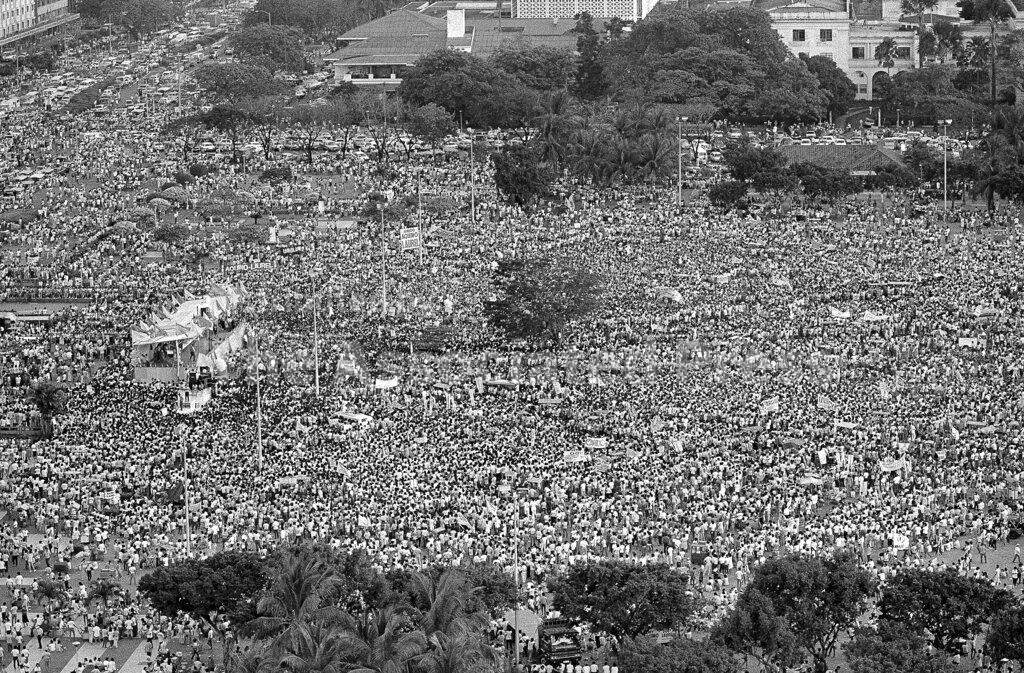
The “People Power” revolution in the Philippines gathers momentum. In the early morning hours of February 24, helicopters manned by the 15th Strike Wing of the Philippine Air Force, led by Colonel Antonio Sotelo, were ordered from Sangley Point in Cavite, south of Manila, to head to Camp Crame. Secretly, the squadron had already defected and instead of attacking Camp Crame, landed in it with the crowds cheering and hugging the pilots and crew members in response to what has been referred to as the “Sotelo landing,” considered a key turning point where the military circumstances turned against Marcos.
A Bell 214 helicopter piloted by Major Deo Cruz of the 205th Helicopter Wing and Sikorsky S-76 gunships piloted by Colonel Charles Hotchkiss of the 20th Air Commando Squadron joined the rebel squadron earlier in the air. The presence of the helicopters boosted the morale of Enrile and Ramos who had been continually encouraging their fellow soldiers to join the opposition movement. In the afternoon, Aquino arrived at the base where Enrile, Ramos, Reform the Armed Forces Movement (RAM) officers, and a throng were waiting.
At around that 6:30, June Keithley received reports that Marcos had left Malacañang Palace and broadcast this to the people at EDSA. The crowd celebrated and even Ramos and Enrile came out from Crame to appear to the crowds. This would be disproven when Marcos went on MBS 4 a few hours later, so it was later speculated that the false report was a calculated move against Marcos to encourage more defections.
At dawn on Monday, February 24, Marines marching from Libis towards the east of Camp Aguinaldo lobbed tear gas at the demonstrators, who quickly dispersed. By 8:30 AM, some 3,000 Marines entered and held the east side of Camp Aguinaldo, and the Fourth Marine brigade under the command of Colonel Braulio Balbas positioned howitzers and mortars to strike against Camp Crame.
Despite the fact that civilians would be killed in such an attack, General Josephus Ramas gave the “kill order” against Camp Crame at around 9 AM. Although the artillery was ready to fire, Balbas stalled, telling Ramas that they were “still looking for maps.” Ramas then told Balbas that “The President is on the other line waiting for compliance!” Ramas repeated his orders to Balbas at 9:20, to which Balbas replied they were “still positioning the cannons.” Balbas would eventually refuse to follow Ramas’ orders each of the four times he was ordered to fire on Camp Crame, leading historians to point to this moment as the point at which Marcos lost control of the Philippine Marine Corps.
The jubilation resulting from the rumor that Marcos had fled was short-lived, as Marcos appeared on television on the government-controlled MBS-4 at around 9:00, (using the foreclosed ABS-CBN facilities, transmitter and compound in Broadcast Plaza, now ABS-CBN Broadcasting Center) declaring that he would not step down.
During the broadcast, Marcos announced that he had lifted the policy of “Maximum Tolerance” which that government had previously put in place. This gave armed forces permission to use force to defend government installations, as well as communications facilities, from Enrile and Ramos’ forces. In addition, he told radio and TV stations not to broadcast news about military movements without permission – which was exactly what Radyo Bandido had been doing.
At one point during the broadcast, General Ver approached Marcos and informed him that the AFP was ready to mount an airstrike on Camp Crame, but Marcos ordered them to halt. The actual dialogue on TV between Marcos and then AFP Chief of Staff Gen. Ver went as follows:
Fabian Ver: The Ambush there is aiming to mount there in the top. Very quickly, you must immediately leave to conquer them, immediately, Mr. President.
Ver: Just wait, come here.
Ver: Please, Your Honor, so we can immediately strike them. We have to immobilize the helicopters that they’ve got. We have two fighter planes flying now to strike at any time, sir.
Marcos: My order is not to attack. No, no, no! Hold on. My order is not to attack.
Ver: They are massing civilians near our troops and we cannot keep on withdrawing. You asked me to withdraw yesterday–
Marcos (interrupting): Uh yes, but ah… My order is to disperse without shooting them.
Ver: We cannot withdraw all the time…
Marcos: No! No! No! Hold on! You disperse the crowd without shooting them.
At about 9:50 AM MBS-4 suddenly went off the air during Marcos’ broadcast. A contingent of rebels, under Colonel Mariano Santiago, had captured the station. MBS-4 was put back on the air shortly after noon, with Orly Punzalan announcing on live television, “Channel 4 is on the air again to serve the people.” By this time, the crowds at EDSA had grown to over a million, but some sources estimated that the crowd number went up to 2 million people.
The ensuing marathon broadcast was considered the “return” of ABS-CBN on air because this was the first time that former network employees were inside the complex after 14 years of closure since Marcos sequestered the property during the declaration of martial law in September 1972. “Radyo Bandido” ended broadcasting that afternoon, while Radio Veritas resumed transmissions, this time from the Broadcast Plaza’s radio studios. Among the various personnel that appeared alongside Orly Punzalan in its first few hours were Maan Hontiveros and Dely Magpayo.
In the late afternoon of February 24, helicopters of the 15th Strike Wing, commanded by Sotelo, attacked Villamor Airbase, destroying presidential air assets. Sotelo had radioed ahead to the pilots and crews of the air assets, telling them to stay away from the aircraft. As a result, the assets were disabled without any human casualties. Sotelo had sent another helicopter to Malacañang, where it fired a rocket on the palace grounds and caused minor damage.
Later, most of the officers who had graduated from the Philippine Military Academy (PMA) defected. The majority of the Armed Forces had already changed sides.
Ferdinand E. Marcos ignored pressure from President Reagan and members of his own Government and military to resign, declaring he was still in control of the Philippines. Mr. Marcos said he planned to proceed with his scheduled inauguration tomorrow, although there was a growing consensus within the country that his proclaimed election victory had been fraudulent.
The U.S. urged President Marcos to surrender power and virtually offered an American plane to take him to political asylum in the United States. As Administration officials met through the day in a crisis atmosphere, the White House said it would be futile for Mr. Marcos to prolong his rule through violence. “A solution to this crisis can only be achieved through a peaceful transition to a new government,” the White House spokesman, Larry Speakes, said in a statement shortly after a telephone call at 5 A.M. between Mr. Reagan and his ranking advisers. Congressional leaders of both parties and key Reagan Administration officials made it clear later in the day that a consensus was emerging that Mr. Marcos faced little choice but to leave the Philippines after 20 years in power. Mr. Speakes said the United States would be “of assistance” to Mr. Marcos should he seek asylum.
The Reagan Administration has dangled the possibility of safe haven in the United States before President Ferdinand E. Marcos if he agrees to leave the Philippines promptly, Administration officials said today. But the officials said this informal offer of asylum could be withdrawn if troops loyal to Mr. Marcos opened a major attack against the forces seeking his ouster. They said the granting of political asylum or safe haven depends on the circumstances and these can change. One official noted that the United States as a rule does not provide a haven to someone suspected of human-rights abuses or other crimes, like Jean-Claude Duvalier, the former ruler of Haiti, but sometimes bends the rule to accommodate national interests.
Commanders at two large United States military installations in the Philippines told military men and women today to stay on the bases through the country’s political crisis. But military spokesmen said that the naval and air bases had not been put on alert and that there was no sense of danger. They said military personnel could leave base if they insisted, although they were strongly advised against it.
White House officials said today that President Reagan had decided to respond to Mikhail S. Gorbachev’s arms control proposal with a detailed version of a 1981 offer to eliminate Soviet and United States medium-range missiles from Europe and Asia. Mr. Reagan said in a statement that the proposal was being introduced today at the Geneva arms talks. He said the plan called for the elimination of all medium-range weapons “from the face of the earth by the end of this decade.” The American proposal on medium-range weapons is part of a broader reply to Mr. Gorbachev’s offer on January 15 to eliminate all nuclear weapons by the year 2000. In addition to medium-range weapons, he outlined steps for eliminating strategic, or longer-range, nuclear weapons and chemical arms. In Moscow, the Soviet Government’s press agency Tass said that, judging from initial press reports, the response to Mr. Gorbachev was a repetition of “the United States’ well-known nonconstructive stand.” Administration officials said that the plan being revived by the United States envisioned reducing medium-range missiles in Europe on each side to a force of 140 during the first year of a three-year process. At the same time, the Soviet Union would be obliged to make proportionate cuts in its SS-20 missile force in Asia. During the second year, the remaining missile forces would be cut in half. By the end of three years, Soviet and American medium-range missiles in Europe and Asia would be eliminated.
The Communist Party’s 27th congress opening in Moscow Tuesday is expected to endorse the new leaders and programs selected by Mikhail S. Gorbachev to guide the Soviet Union through the rest of the century. More than 5,000 delegates from party cells around the country, ranging from regional party leaders to Siberian model milkmaids, have assembled in banner-bedecked Moscow for the rite and spectacle associated with the ruling party’s quinquennial convention. The congress, which will convene in the modernistic Palace of Congresses within the Kremlin walls, is expected by Western diplomats to be the most significant and interesting since the 20th congress of 1956 and the 22d of 1961, at which Nikita S. Khrushchev denounced Stalin’s rule. The diplomats said they would not be surprised if Mr. Gorbachev and other leaders made a break with the past, criticizing Leonid I. Brezhnev for condoning corruption and stagnation during his 18 years as party leader. Mr. Brezhnev, who died in 1982, was leader during the last congress, in 1981.
Washington’s consultations on a response to the Moscow proposal to eliminate nuclear arms by the year 2000 have disclosed a decline in Western European enthusiasm for a reduction of American medium-range missiles, according to officials in several capitals. The shift is most discernible among the West Germans, who three years ago were urging the United States to reach an accord that would limit, or avoid, the deployment of medium-range weapons in West Germany. Despite street demonstrations against the missiles, the weapons ultimately began to arrive in late 1983 and, after a time, the antimissile movement disbanded. In the calmer atmosphere prevailing now, Chancellor Helmut Kohl’s center-right Government has hedged its support for an accord that would banish the Soviet Union’s SS-20 medium-range missiles and the United States’ Pershing 2 and cruise missiles from Europe, according to American and West German officials. One condition is that any agreement must also deal with the Soviet Union’s shorter-range SS-12, SS-22 and SS-23 missiles, which were emplaced in Eastern Europe in 1984 as so-called countermeasures after the United States began deploying its medium-range missiles in Western Europe.
The official campaign period began today in legislative elections that many in France see as the most important political event in this country in many years. The formal opening of the campaign was largely a technical step, given that the contest has been informally waged with ferocity for nearly two years already. During the 21 days of the formal campaign, political advertising is banned, television and radio time are strictly regulated, and lists of candidates are posted on billboards throughout the country. Nonetheless, formality though it may be, the official opening of the campaign promises to intensify an already bitter and sharply fought contest that, by all accounts, is unusual and even unprecedented in many ways.
So many American travelers have apparently decided to avoid Italy this year that the Italian Government has hurriedly begun developing a promotional campaign to lure them back. Advance bookings for spring, which usually brings the year’s first waves of tourists, was described as a major disappointment by hotel executives, tour operators and travel agents gathered for Milan’s International Tourism Exchange, a five-day trade fair. Mediterranean cruises have been hit particularly hard because of the hijacking last fall of the Achille Lauro cruise ship and because the liners usually travel to Italy, Greece and the Middle East, all places that have been the scene of recent terrorist operations. Mario Martini of the Genoa-based Costa lines said his company had lost about half of its American bookings for Mediterranean cruises, while there had been no losses for the Caribbean.
Senior Israeli officials said today that they expected King Hussein of Jordan to mount a major effort to mobilize support among the Palestinians of the occupied West Bank for his position on Middle East peace talks. In a three-and-a-half-hour speech last Wednesday, the King announced that he was ending negotiations with the leadership of the Palestine Liberation Organization on a joint strategy for talks with Israel. He said the P.L.O. had not kept its word. The Israeli officials said they were aware of strong pro-P.L.O. feelings occasioned by the King’s speech. An official close to Prime Minister Shimon Peres said he did not rule out outbreaks of violence among Palestinians. This would heighten Israel’s problem of maintaining peace in the occupied territories, he said.
The Jordanian Government has officially notified the Palestine Liberation Organization that it will be allowed to keep its offices open here despite the termination of political coordination between the two sides, according to well-informed Jordanian and Palestinian sources. The sources said that the message was conveyed to the P.L.O. during a meeting between Prime Minister Zaid al-Rifai of Jordan and Abdel Razzak al-Yahya, a P.L.O. executive committee member, on Sunday. It was the first high-level meeting between the two sides since King Hussein’s speech Wednesday in which he announced that his one-year effort with the P.L.O. chairman Yasser Arafat to find a negotiated settlement of the issue of Palestine had failed.
A car-bomb blast in East Beirut killed five people and wounded 30. One official said that a team of French truce observers, in a nearby truck, may have been the intended victims but that they were unhurt. No group claimed responsibility. A car packed with what the police said were explosives, mortar shells and a mine was detonated outside a supermaket in a residential district of East Beirut. The blast occurred at midmorning when the area was crowded with people shopping. Witnesses said the casualties could have been higher if a 15-year-old boy had not seen smoke coming from a car. The boy shouted to people nearby only moments before the bomb went off. In West Beirut, the Muslim part of Lebanon’s capital, two political activists were slain after all-night street gun battles between Iranian-backed Shiite fundamentalists of the Hezbollah (Party of God) and Soviet-oriented Communists. Gunmen assassinated Issam Arab, leader of a small, little-known Sunni Muslim militia called the Nasser Forces. And West Beirut police found the body of Suhail Tawileh, editor of the Lebanese Communist Party’s magazine, who was abducted Sunday.
Iran said today that its forces had wiped out two Iraqi infantry battalions in repelling a counterattack north of the occupied Iraqi oil port of Fao. In Baghdad, the Iraqi press agency said Iraqi troops had recaptured a point near the port, United Press International reported. There was no independent confirmation of either claim. Both Iran and Iraq are known to have made exaggerated assertions in the past. The Iranian radio said the Iraqi battalions were destroyed in overnight battles near Fao as Iraq continued efforts to dislodge Iranian troops from positions captured in their 15-day-old offensive. The head of Iran’s war volunteer organization, Hojatolislam Rahmani, issued a fresh call for volunteers, the radio said. “Those provinces which have not yet sent volunteers should make preparations to send them as soon as the other provinces have done so,” Mr. Rahmani said.
A key Iraqi field commander backed off earlier predictions of a quick victory in a counterattack against Iranian troops holding the southern tip of Iraq’s Faw Peninsula. Speaking to Western reporters in Basra, Lieutenant General Maher Abdel-Rashid, commander of the 3rd Army Corps, conceded that the water-logged terrain of salt marshes and flooded plains made for “slow and difficult going.” Meanwhile, the U.N. Security Council unanimously called on Iran and Iraq to cease fire immediately and withdraw to internationally recognized borders.
Five French nationals, including the third secretary at the French Embassy, were detained in Tehran, a senior French official said. He said no reason was given for the arrests, and Iranian Foreign Ministry officials were not available for comment. Third Secretary Philippe Tissot was taken from his car while carrying the embassy’s diplomatic pouch, the French official said. The action follows the expulsion of four Iranians from France in connection with a recent wave of bombings in Paris.
The Security Council unanimously passed a resolution today calling for an immediate cease-fire in the Iran-Iraq war and for a troop withdrawal to internationally recognized borders. The resolution also “deplores the initial acts which gave rise to the conflict” and its continuation, and “deplores the recent escalation of the conflict, especially territorial incursions, the bombing of purely civilian population centers, attacks on neutral shipping or civilian aircraft, the violation of international humanitarian law and other laws of armed conflict, and in particular, the use of chemical weapons contrary to obligations under the 1925 Geneva Protocol.” It urges a comprehensive exchange of prisoners of war and calls on Iran and Iraq “to submit immediately all aspects of the conflict to mediation or to any other means of peaceful settlement of disputes.” A number of speakers in the Security Council called for the end to the conflict, but it was the American delegate, Herbert S. Okun, who most clearly blamed Iran for its continuation.
South Korea’s President appeared to retreat from a crackdown on opposition politicians. In a sudden shift, the President, Chun Doo Hwan, held a nearly three-hour luncheon meeting with key opposition leaders and allowed them to convene a party meeting that the police forcibly blocked a few days ago. South Korean President Chun Doo Hwan promised to halt a police crackdown on the opposition and said the constitution could be revised in 1989 to allow for direct presidential elections. Chun made the statements during a meeting attended by the leaders of the two main opposition groups, the New Korea Democratic Party and the Korea National Party, and by the second highest ranking member of his Democratic Justice Party. Chun’s remarks appeared to reflect a desire to settle differences with the opposition before the 1988 Summer Olympic Games in Seoul. At the 2-hour-50-minute meeting at the presidential residence today, President Chun Doo Hwan told the presidents of South Korea’s ruling party and the two major opposition parties that he believed the police had overreacted in cordoning off entrances to opposition party headquarters and placing nearly 300 opposition party members under house arrest last Thursday. According to a high-ranking official in the President’s office, Mr. Chun said that in the future such “frictions” should not be repeated.
The Chinese Government, responding to accusations that it has tolerated nepotism, has given major publicity to a case in which the sons of three prominent Shanghai officials were executed for rape. Television reports showed scenes at a Shanghai basketball stadium last Wednesday at which a crowd of 3,000 people watched the death sentences confirmed. The three young men, their arms bound and their heads forced down by policemen, were shown being led from the stadium for the drive to the execution grounds in the city’s outskirts. The three were shot there.
The new ruling junta of Haiti has permitted the former head of the secret police, one of the country’s most feared men, to leave for political asylum in Brazil. The move, bitterly resented by Haitians, is likely to affect the credibility of the Government, which has already been criticized because of the high number of officials of the deposed Duvalier regime in its ranks. Escorted by soldiers and policemen, the police chief, Colonel Albert Pierre, and his wife boarded a private Lear jet for Panama on Sunday night. A spokesman at the Brazilian Embassy said Colonel Pierre had been granted political asylum in Brazil.
Neighboring Nicaragua and Costa Rica, trying to normalize diplomatic relations, agreed to set up an international peacekeeping commission to monitor the common border that has been a source of friction in recent years. The two nations asked officials of Mexico, Venezuela, Colombia and Panama — the so-called Contadora Group, which is seeking peace in Central America — to provide personnel, equipment and financing for a permanent border commission.
CIA objections held up release of a secret document purporting to illustrate the Marxist Nicaraguan government’s “disinformation” campaign in Washington, State Department officials said. The officials, requesting anonymity, said the CIA objected to plans to release a declassified version of the document on grounds that “sources and methods” used to obtain it might be compromised. Negotiations were under way within the Administration toward agreement on a way to release the document, by making deletions that would meet the CIA objections. The White House disclosed the existence of the document last week, calling it evidence of the Sandinista government’s “sophisticated campaign of disinformation” in the United States.
Eleven Indians, including the town Governor and judge, were killed Friday in the most violent Maoist rebel attack this month, the Lima newspaper El Comercio said today. It said 80 Shining Path rebels also wounded nearly a dozen more villagers in the assault on Toroya, a town of about 3,000 people. Military sources in the nearby city of Ayacucho said their first report was that eight unidentified people died in Toroya. The attack coincided with a surge of guerrilla violence since Friday, including the bombing of 6 embassies and 13 other targets in Lima on Friday. The police said they arrested about 500 people here over the weekend.
Information Minister Mahamat Soumalia accused Libya today of massing troops in rebel-held northern Chad for a new offensive. Fighting in Chad’s 20-year-old civil war flared this month south of the 16th parallel, which had been an unofficial truce line between the pro-Western Government and the Libyan-backed rebels for two and a half years. Mr. Soumalia said Libya now had about 7,000 men in a string of northern bases, including Faya-Largeau, Fada, Bardai and the Aouzou strip, which borders Libya. Libya was also said to be recruiting mercenaries from African countries to make up for losses suffered by the rebels in the recent fighting, in which President Hissen Habre’s troops lost, then recaptured, several outposts south of the so-called Red Line.
Talks aimed at unifying the political parties of Prime Minister Robert Mugabe and his arch rival, Joshua Nkomo, and ending four years of civil unrest have become stalled amid longstanding suspicions and animosities, according to Western diplomats, and human rights activists. The impasse has come amid what some sources characterize as systematic and sometimes brutal persecution of Government opponents in Mr. Nkomo’s tribal fiefdom of Matabeleland in an effort to crush the opposition leader’s Zimbabwe African People’s Union. The Government insists that it is trying to quell what it calls the insurgency of dissidents backed by Mr. Nkomo, who have long been accused of terrorizing and killing innocent civilians and members of the governing Zimbabwe African National Union. Regardless of who is at fault, diplomatic and human rights sources say, failure to bring peace to this nation could allow the Government of South Africa to exploit the situation in its continuing effort to show that majority rule always leads to instability in Africa.
The Supreme Court said today that it would expedite challenges to the constitutionality of the new budget-balancing law, setting the stage for a major decision by early July. The Court approved without comment a request by all parties in the case that it act quickly to resolve doubts hanging over the budget-cutting process Congress mandated when it passed the law in December. Those doubts were intensified February 7 when a special three-judge Federal District Court panel held unconstitutional a key provision of the law, widely known as the Gramm-Rudman-Hollings Act after its three Senate sponsors. The Supreme Court said it would hear oral argument on appeals from that decision on April 23. It allotted two hours for arguments, double the usual time, in tacit recognition that this is one of the most important cases to come before it in years.
President Reagan thanks a group of staff at the Office of Management and Budget for their efforts in the preparation of the budget.
President Reagan addresses the Governors of the States/Territories attending the Mid-Winter Conference of the National Governors’ Association (NGA).
The nation’s governors, meeting in Washington, told President Reagan that they are willing to take their share of Gramm-Rudman budget cuts, but not the big Medicaid costs he wants shifted to the states. Instead, the governors told Reagan, they want Washington to pay all Medicaid costs in exchange for the states taking over all highway programs except the interstate program. That would mean assigning the states revenue from the 9-cents-a-gallon federal tax on gasoline.
Half of Americans back more farm assistance by the Federal Government, according to the latest New York Times/CBS News Poll. The support of 50 percent for more Government spending, up from 36 percent a year ago, was underlined when 55 percent of the public said they were willing to pay more taxes if an increase would help troubled farmers save their land.
Responding to complaints that elderly Medicare patients are being dumped from hospital beds before they are well because their pre-set Medicare payments have run out, the government released a “bill of rights” spelling out how to fight premature hospital discharges. The statement, which gives a telephone number for making emergency appeals, will be given to each of the 9 million Medicare beneficiaries hospitalized each year, the Health and Human Services Department said.
A law that defined pornography as discrimination against women is unconstitutional, the Supreme Court held. The decision, which was issued without an opinion, affirmed lower Federal court decisions that the widely publicized Indianapolis law violated the First Amendment right of free speech. It was a sharp defeat for an unusual coalition including some feminists, religious groups and conservatives who seek to suppress many sexually explicit materials that now fall outside the Supreme Court’s established definition of obscenity, which requires that a work must, as a whole, appeal to prurient interests and have no serious artistic or political value. Today’s decision does not change that definition or alter the Constitution’s broad protection of sexually explicit books, magazines and movies. It may prove an obstacle to Attorney General Edwin Meese 3d, who has called for finding new ways to control pornography and has a special commission studying it.
Texas Air buys Eastern Airlines for $676 million. Eastern Airlines agreed to a takeover by the Texas Air Corporation. If carried out, the sale could bring vast changes to the troubled airline and many of its competitors. The move came at a four-hour meeting of Eastern’s board of directors that ended just after 3 AM. It would give control of the airline to Frank Lorenzo, the chairman of Texas Air, whose tough measures in turning around Continental Airlines won him the dislike of many union leaders and members. Despite the opinion of Mr. Lorenzo held by unions, it was Charles E. Bryan, the president of the largest union at Eastern and a board member himself, who forced the directors to consider and approve the Texas Air bid. To win Government approval of the acquisition, antitrust lawyers and analysts said, Texas Air would have to sell either the Eastern or New York Air shuttle routes between New York, Washington and Boston. Sources at unions and those close to the company said the offer amounted to $10 a share in both cash and securities, or a total of close to $600 million.
Just four weeks after history’s worst space disaster, much is already known about the events and circumstances preceding the space shuttle Challenger’s explosive end. Suspect components, cold weather and some apparent lapses in human judgment all seem to be implicated. The pieces of the puzzle, when fitted together, begin to tell of the roles of key engineers and managers in critical shuttle decisions, the knowledge available to them and withheld from them and the pressures under which they worked and made the decision to launch the Challenger on its last mission — a mission that would bring the American space enterprise to an indefinite halt. With public hearings into the disaster set to resume today, a cascade of new disclosures is likely to expose other flaws in shuttle systems and in the decision-making process leading up to the launching on January 28 that killed all seven aboard the Challenger. More questions will undoubtedly be raised about malfunctions in the right booster rocket. New evidence will be presented about serious safety concerns that, for reasons that are still mysterious, were not called to the attention of top space agency managers.
Gerber Products Co. filed a $150-million federal lawsuit in Baltimore, charging that Maryland state officials are creating a “climate of fear and confusion” by banning sales of Gerber strained peaches in response to reports of glass fragments in the jars. Gerber called the action on Sunday arbitrary and excessive, and accused the state of making false statements. Of 13 states in which people have reported finding glass particles in Gerber baby foods, Maryland is the only one to suspend sales of Gerber products. Some supermarkets, however, have removed Gerber jars since they received complaints from customers.
John A. Zaccaro Jr., son of former vice presidential candidate Geraldine A. Ferraro, was described as the “major dealer” of cocaine at the exclusive Middlebury College in Middlebury, Vermont. “He was certainly the major dealer at the college,” police Sgt. David J. Wemette said. Zaccaro, 22, was charged with drug possession after he allegedly sold one-quarter of a gram of cocaine to an undercover agent. He was released on his own recognizance, pending court action March 24.
The developer hired to rebuild 61 homes destroyed last May 13 in the police raid on MOVE was declared in default and fired from the $6.7-million project, Philadelphia Housing Director Julia Robinson said. She said that Ernest Edwards was dismissed because he failed to give adequate assurance that he was financially able to complete the job. The houses were destroyed by a fire that started when police dropped a bomb on the roof of the group’s row house headquarters in the West Philadelphia neighborhood. Eleven members of the radical, back-to-nature cult died in the blaze.
The first U.S. Roman Catholic bishop of American Indian descent, now stationed in Cleveland, was named for the Diocese of Gallup, New Mexico, where nearly half of the church members are Indians. The Rev. Donald E. Pelotte, a descendant of the Abenaki tribe of the Algonquin people, will be ordained coadjutor bishop in Gallup on May 3. Pelotte, who will be 41 on April 13, will be one of the youngest American bishops. The appointment was announced by Pope John Paul II.
The remains of all 248 soldiers killed in an air crash in Gander, Newfoundland, in December have been identified, thus precluding the need for a group burial, Army officials said. Some officials said in early January, after military pathologists and dentists had been able to identify only 113 victims, that the Army was considering a group military burial of those that could not be identified. Over the past weekend, however, the last bodies were identified, the officials said. The officials declined to provide details of how the identification was achieved other than saying that it took painstaking forensic pathology.
An 11-year-old believed to be a carrier of AIDS virus returned to class in California without incident today after a court order lifted a school ban against him. Judge Harmon Scoville of Orange County Superior Court ruled last week that the boy, Channon Phipps of El Toro, should be allowed to return to class because he was not suffering from the disease and the virus was not contagious in a school setting. “There were absolutely no incidents,” said Jeff Herdman, a spokesman for the Saddleback Valley Unified School District, after the boy, a hemophiliac, returned to classes today.
In Kokomo, Indiana, the attorney for Ryan White, a 14-year-old boy with acquired immune deficiency syndrome, filed a petition that would require parents trying to keep the boy from attending school with their children to post a bond to cover possible legal damages. Judge Alan Brubaker of Howard County Circuit Court is to rule on the petition Tuesday.
A municipal judge refused today to close preliminary hearings in a series of killings that have become known as the “night stalker” case. He found that Los Angeles had enough potential jurors to insure a fair trial for the defendant, Richard Ramirez. Mr. Ramirez, 25 years old, is accused of 14 murders and 54 other felonies over 18 months.
Two new California mothers went home from the hospital with the wrong babies in a mistake discovered by accident. Linda Boggeri of Rohnert Park was shocked when she glanced at her daughter’s hospital identification band after taking it off to give her a bath. The name read, “Amzallag.” A call to Marin General Hospital led to the disclosure that she had the wrong baby. An unknown nurse had somehow put her newborn child, Meagan, in the wrong cart after weighing the infant. Mrs. Boggeri ended up with a Sausalito couple’s infant. The two babies were born 12 hours apart last Wednesday. The discovery was not made until Saturday, a day after the couples returned home with the wrong babies. The mix-up was a “human error,” the first such incident in 47,000 births at the hospital, a hospital spokesman said.
Blacks narrowed the economic gap between themselves and whites over the last 40 years, according to an analysis by the Rand Corporation of Santa Monica. It ascribed the gains mainly to better education that led to better paying jobs. Another factor cited was black migration to Northern cities, which accounted for 15 percent of the relative growth in wages for black men.
The San Diego City Clerk is predicting a voter turnout of only 25 percent to 28 percent for the special mayoral primary here Tuesday, a fact that alone may tell the tale of the race to succeed Roger Hedgecock. Of a crowded field of 13 contenders in the nonpartisan race, three are considered the leading contenders to succeed Mr. Hedgecock, a moderate Republican who stepped down last December after his conviction on charges of perjury and criminal conspiracy in connection with illegal campaign contributions. Enough has happened on the city’s political scene to make voters weary of scandal, and many cite that as a major factor in the voters’ lukewarm attitude toward the mayoral race. Another factor is that there are no new faces in the race. All three of the major contenders are past or present members of the City Council and long familiar to the voters.
Idaho creeks and rivers swelled as record-high temperatures hastened the melting of snow, flooding downtown Boise and turning mountainsides to mush. Weary crews worked to clear slides that trapped hundreds of people, and further flooding was predicted on the Snake River, along the Idaho-Oregon border. Flooding and mud slides closed roads and forced scattered evacuations from Lewiston in the north to Mountain Home in the south.
High-tension Dick Williams resigns as manager of the Padres. He will be replaced by low-key Steve Boros.
The Dow Jones industrial average inched slightly closer to the 1,700 level yesterday, but stock prices were generally lower as the market was hit by a moderate dose of profit taking. At its best point yesterday, the Dow reached 1,704. Then sellers took control and dragged the blue-chip index to a close of 1,698.28, a 0.57-point gain on the day.
Dow Jones Industrial Average: 1698.28 (+0.57)
Born:
Benny Safdie, American actor, screenwriter and director (“Uncut Gems”, “Good Time”), in New York, New York.
Wojtek Wolski, Polish NHL left wing (Colorado Avalanche, Phoenix Coyotes, New York Rangers, Florida Panthers, Washington Capitals), in Zabrze, Poland.
Died:
Tommy Douglas, 81, Canadian politician and “Father of Medicare”, of cancer.
 History Diaries