British Foreign Secretary Anthony Eden and CIGS Anthony Dill inter alia continue their discussions with the Greek government throughout the day of 23 February 1941. The Greeks feel that putting insufficient British troops on the Greek mainland (the British already are on Crete) would merely invite an invasion that could not be repelled. Finally, with great reluctance, Greek Prime Minister Alexandros Koryzis agrees to accept a British expeditionary force projected at 100,000 well-armed troops. The disagreement about tactics lingers, however: the Greeks want to defend the Bulgarian frontier along the Metaxas Line, while the British prefer positions (along the Aliakmon River) further back.
Prime Minister Alexandros Koryzis of Greece accepted British offer of aid, but British and Greek commanders debated on the defense strategy against a German invasion through Bulgaria. The Greeks preferred to dig in along the Metaxas Line, while the British argued for a line further southwest along the Vermion Mountains and the Haliacmon River.
Prime Minister Churchill, the most ardent backer of a British presence in Greece, is under no illusions about possible success in the Balkans. He notes in a message to Eden that the “odds seem heavily against us in Greece.” Australian Prime Minister Menzies discusses the question of a campaign in Greece “largely with Australian & New Zealand troops” with the heads of RAF Bomber Command (Air Marshal Sir Richard Pearse) and Fighter Command (Sholto Douglas) and comes away with more questions than answers. He notes that committing his men to an uncertain campaign in Greece “is not easy.” A big War Cabinet meeting is scheduled for the 24th to discuss the issue, and Menzies is a troubled man.
Wavell decides against the projected bombing of the Ploesti oilfields as 1. it would necessitate violating Turkish airspace, and 2. it would attract the attention of the Germans to a British presence in Greece that we are trying to keep secret. Neither of those reasons, however, has a particularly strong foundation (Hitler should know about RAF activity in Albania already, and the bombers could avoid Turkey). However, there is another reason that would make any attack on the oil fields explosive in more ways than one. While the British don’t know this, one of Hitler’s greatest fears (he confesses to Marshal Mannerheim at their meeting in June 1942 that he has nightmares about it) is the Allied bombing of the Romanian oil fields. RAF attacks on the oil could force Hitler’s hand early before the British are even on mainland Greece. Thus, Wavell makes the proper decision from mistaken premises. Great weight is placed upon Wavell’s support since it is common knowledge (as noted in the minutes) that he would prefer to finish off the Axis forces in North Africa first.
British monitor HMS Terror sank off the Libyan coast at 0420 hours after receiving fatal damage from German aircraft on the previous day. The Royal Navy monitor HMS Terror was badly damaged by Junkers Ju 88 dive bomber attacks and abandoned to sink off Derna, Libya.
Governor Lt. General William Dobbie issues a statement about conscription on Malta, which as created many hard feelings among the locals:
“We must be as strong as possible in order to ensure that all attacks are decisively beaten off, should they be attempted. The Government must, therefore be in a position to utilise the resources of Malta (including the manpower) to the best advantage, and it is for that reason that conscription of manpower is being brought into being.”
Mussolini made a speech in Rome in which he admitted that Italy had experienced “gray days” in the war so far, but maintained that such things happen “in all wars” and that “the final result will be Axis victory…” While admitting the loss of 200,000 troops in Ethiopia, Mussolini says victory is assured, and that Italy will fight “to the last drop of blood.” Premier Mussolini, in an unheralded broadcast today to the Italian people, defended the Fascist regime’s handling of the Libyan campaign, announced the arrival of German air and armored detachments in Sicily and Libya, and declared that “Italy, whatever happens, will march with Germany to the end.” He promised a new Italian offensive against the Greeks, scoffed at United States fears of an axis invasion of America, and assailed what he called the small minority of Italian “weepers, grumblers and snakes” left over from the Masonic lodges “who we will smash when and as we wish.” Italian morale, he declared, cannot be broken. Il Duce spoke for 45 minutes to Rome Fascist leaders who had been notified only a few hours earlier to come to the Adriano Theater. The rest of the nation heard the speech from loudspeakers in public squares.
German tanks and motorized columns have been infiltrating Bulgaria from their bases in Rumania over a remote crossing of the Danube at Cernavoda in Dobruja. At the same time they have ostentatiously made no attempt to cross the main bridges over the river. This piecemeal invasion seems to indicate that Hitler means to increase his pressure by degrees and wait for Britain to serve an ultimatum on Bulgaria before moving into the country openly to “save it from the British.” The secrecy surrounding these moves is helped by the rigid censorship of the Bulgarian press. All military news is banned and domestic news is replaced by foreign dispatches. Ordinary Bulgarians have no idea that German Panzers are rolling through their land.
Police halted all automobile traffic in the Sofia district early this afternoon and began a nationwide hunt for Bulgarians spreading anti-German leaflets. These were among accumulating signs of impending Nazi military entrance into this country. There was no explanation for the orders to clear the highways. Bulgarian military transports were reported on the move but the necessity for a police permit for even a short trip outside the Sofia city limits prevented first-hand investigation. Reports from Hungary said German troops still were continuing the movement begun last Dec. 27 across that country into Rumania, just across the Danube River from Bulgaria. These reports said 45 German pursuit planes were based on Hungarian airports near the railway lines, presumably to protect the movement which is reported to have maintained an average of about 40 military trains a day.
U.S. Minister George H. Earle said tonight that a German army major “threw a champagne bottle which just missed my head” in a Sofia, Bulgaria, cafe skirmish last night when the Nazi officer objected to the orchestra striking up his requested number, “Tipperary,” a British World war marching song. “The trouble began,” Earle said at a special press conference, while exhibiting arm injuries suffered in the scuffle, “when the German cornered me in a washroom and demanded to know why I had given the orchestra ten bucks to play Tipperary. “I told him that was my business, and that Bulgaria was a neutral country.”
Operation CANVAS begins. It is a two-pronged advance to take Mogadishu and other Italian forces in Italian Somaliland (Somalia). Having pocketed Jelib (Somalia), General Cunningham begins sending his forces on the road northeast to Mogadishu. British 12th African Division marched up the Juba River in Somaliland, Italian East Africa toward the Abyssinian border while the motorized British Nigerian Brigade of the 11th African Division drove up the coastal road toward Mogadishu. The main Italian forces defending the line of the Juba River have been defeated. The troops of General Alan Cunningham, Commander in Chief East Africa Command, are now advancing very rapidly toward Mogadishu.
Indian 7th Infantry Brigade and Free French Brigade d’Orient capture Cub Cub. The British capture 436 prisoners, four guns and many supplies.
An attack by crack Sudanese archers using “incendiary arrows” was reported today to have set ablaze the Italian military base of Asosa on the Blue Nile in western Ethiopia. Billowing smoke rising above the town was said to be visible for 30 miles after the night attack by the Sudanese native bowmen. They are attached to Britain’s forces driving deeper into Ethiopia with the aid of R.A.F. planes, units of “free French” forces and Ethiopian rebels.
In a somewhat cryptic note sent to Foreign Secretary Anthony Eden (currently in Athens), British Prime Minister Winston Churchill rejects a suggestion (coming from Sir Richard Stafford Cripps, a Socialist who specializes in relations with the USSR) that Eden should visit Moscow. Churchill does not trust Stalin, feels that he could arrest Eden, and muses that the “Best way of gaining Russians (favor) is a good throw (success) in the Balkans.”
Churchill to Sir Alexander Cadogan: “…we should continue to give increasing support to de Gaulle. I cannot believe that the French nation will give their loyalty to anyone who reaches the head of the state because he is well thought of by the Germans. We should reason patiently with Washington against giving any food to unoccupied France or North Africa. …I am sure Darlan is an ambitious crook. His exposure and Weygand’s weakness will both … inure to the credit of de Gaulle.”
Extreme unction was administered late last night to Alfonso XIII, former king of Spain, as his condition grew worse. A person close to Alfonso’s suite said death “may be a question of minutes It may be a question of hours.” Alfonso, 54, sat in a chair in his hotel room, awaiting the crisis. He was too weak to be moved to his bed. At the ex-king’s own request, the Spanish Jesuit priest, Ulpiano Lopez, was summoned to administer the last rites of the church.
Joachim Von Ribbentrop hosted Hiroshi Oshima in his home in Germany, where Ribbentrop attempted to persuade the Japanese ambassador that it was the time for Japan to strike British territories in Asia. Ribbentrop argued that there was little worry regarding the United States as American possessions in Asia could be bypassed easily, but should the Americans decide to go to war, the Japanese Navy was vastly superior to the U.S. Navy.
Russia’s armed forces stand ready at a moment’s notice to “annihilate any one violating our sacred frontiers,” Marshal Semyon Timoshenko, Defense Marshal, warned today in an order of the day celebrating the twenty-third anniversary of the Red Army. The Red Army’s new Chief of Staff, General Georgy Konstantinovich Zhukov, admitted that “a series of shortcomings and defects” had weakened the army, but said they had been remedied in 1940 in a general reorganization that placed army generals in undisputed authority and reduced the role of political commissars.
A German Fw 200 Condor aircraft led German submarines U-69, U-73, U-96, U-107, and U-123 and Italian submarines Bianchi and Barbarigo to Allied convoy OB-288 300 miles south of Iceland. Just before midnight, U-69 sank British ship Marslew (13 killed, 23 rescued) and U-96 sank British ship Anglo-Peruvian (29 lost, 17 rescued). U-107 and Bianchi damaged and chased British ocean boarding vessel HMS Manistee through the night.
RAF Bomber Command dispatches 3 Blenheims during daylight; 1 bombed Boulogne docks. No losses.
RAF Bomber Command dispatches 35 Wellingtons and 17 Blenheims overnight to Boulogne. The Blenheims were recalled but 26 Wellingtons bombed. 1 Wellington lost.
RAF Bomber Command dispatches 16 Whitleys and 1 Blenheim overnight to Calais, 3 Blenheims to Den Helder and 6 O.T.U. sorties to Paris. No losses.
The Luftwaffe attacks Skaalefjord, missing British tanker War Pindari. It also sends 49 bombers against Hull just after dark at 19:30. There are 13 deaths and 27 injured, including the death of a six-month-old baby, and 36 are left homeless. Right at midnight, an aerial mine hits the Alexandra Dock and sinks lighters “Brakelu” and “Monarch.”
A classic Wolf Pack operation unfolds against outbound Convoy OB 288 south of Iceland. It is a textbook operation of how the Luftwaffe can work in combination with the U-boat fleet to wreak devastation on the convoys. A Focke-Wulf Fw 200 Condor of I,/KG 40 spots Convoy OB 288 heading west about 500 km south of Iceland (370 km northwest of Rockall). The convoy has dispersed and is without escort, but it aware that it is being shadowed and has turned north to avoid U-boats. The ships also close up their spacing again — which makes it easier to attack them.
The Condor vectors in (via U-boat command B.d.U) every U-boat and Italian submarine in the vicinity:
U-69 (Kapitänleutnant Jost Metzler, first patrol)
U-73 (Kptlt. Helmut Rosenbaum)
U-95 (Kptlt. Gerd Schreiber)
U-96 (Kptlt. Heinrich Lehmann-Willenbrock)
U-107 (K.Kapt. Günther Hessler, first patrol)
U-123 (Kptlt. Karl-Heinz Moehle)
Italian submarine Michele Bianchi (C.C. Adalberto Giovannini, first BETASOM patrol from Bordeaux)
Italian submarine Barbarigo (Capitano di Corvetta Enzo Grossi)
U-107, commanded by Kapitänleutnant Günter Hessler, and Italian submarine Bianchi sank ocean boarding vessel HMS Manistee (5360grt, Lt Cdr E. H. Smith RNR) in 59-30N, 21W. At 2242 hours U-107 fired a spread of two torpedoes at HMS Manistee (F 104) (LtCdr Eric Haydn Smith, RNR) south of Iceland and scored a hit in the engine room. The ship had escorted the convoy OB.288 until it was dispersed at 2100 hours the same day. She was also attacked by the Italian submarine Bianchi (Giovannini), which fired a torpedo at 2256 hours, claimed a hit in the stern from a distance of 600 metres and then continued to chase other ships of the convoy. At 2258 hours, U-107 fired two coups de grâce that missed because the ship suddenly continued. Also a stern torpedo fired at 2342 hours missed because it was a surface-runner. The U-boat began a long chase of the zigzagging ship and fired two torpedoes at 0758 hours on 24 February. One of them hit in the stern and caused the ship to sink in 58°55N/20°50W. HMS Churchill (I 45) (Cdr G.R. Cousins, RN) was ordered to search for survivors, but found none. Smith, T/Sub Lt (E) J. Allison RNR, T/Paymaster Sub Lt J. Berkeley RNR, T/Surgeon Lt L. R. Blair RNVR, P/T/Sub Lt T. B. Bryson RNR, T/Sub Lt (E) O. A. Cochrane RNR, T/Lt F. Davies RNVR, T/Lt (E) R. E. Duff RNR, T/Lt Cdr (E) J. G. Duncan RNR, T/Lt A. C. Gravelle RNR, T/Sub Lt C. B. Jackaman RNR, T/Lt N. A. H. Lawrie RNVR, Lt E. B. D. MacFarren RNR, T/Paymaster Lt G. F. J. Nathan RNR, Paymaster Midshipman J. J. M. Reynolds RNR, T/Lt D. W. Seabrook RNR, Gunner S. W. Tarrant, T/Sub Lt C. R. Webster RNR, T/Midshipman D. M. Williams RNR, and one hundred and twenty two ratings were missing on the ship.
U-69, commanded by Kapitänleutnant Jost Metzler, sank the Marslew (4542grt), from dispersed convoy OB.288, in 59-18N, 21-30W. At 2339 hours the unescorted Marslew (Master Hubert Roland Watkins) was hit on the starboard side amidships in the boiler room by one G7e torpedo from U-69 about 265 miles west-northwest of Rockall. The explosion immediately broke the ship in two, its bow and stern raising slowly with the forepart sinking first after approximately 30 minutes and the stern sinking after floating vertically for a while. The master and twelve crew members were lost. 21 crew members and two gunners were picked up by the British steam merchant Empire Cheetah from the same dispersed convoy and were landed at Philadelphia on 11 March. The 4,542 ton Marslew was carrying 6,000 tons of general cargo, bound for Montevideo and finally Villa Constitucion, Argentina.
U-96, commanded by Kapitänleutnant Heinrich Lehmann-Willenbrock, sank British steamer Anglo Peruvian (5457grt) from convoy OB.288 in 59-30N, 21-00W. At 2327 hours on 23 Feb 1941 the Anglo-Peruvian (Master Cyril Mervyn Quick), dispersed from convoy OB.288 the same day, was hit by two torpedoes from U-96, broke in two and sank within three minutes southwest of Iceland. The master, 26 crew members and two gunners were lost. 17 crew members were picked up by the British merchant Harberton and landed at Halifax on 4 March. The submarine also claimed damaging another ship, but no confirmation is available. The 5,457-ton Anglo-Peruvian was carrying coal and was bound for Boston, Massachusetts.
Submarine HMS Upright sank Italian steamer Silvia Tripcovich (2365grt) off Kuriat Island in 34-33N, 11-45E.
Greek submarine RHS Nereus reported sinking an Italian transport off Valona in 40-07N, 18-57E.
Destroyer HMS Brilliant departed Scapa Flow at 1530 to meet submarine HMS Sunfish off Bell Rock and escort her to Scapa Flow. Destroyer HMS Bedouin departed Scapa Flow at 0800/24th to reinforce the submarine escort. The ships arrived at Scapa Flow at 2100/24th.
British tanker War Pindari was unsuccessfully attacked by German bombing at Skaalefjord.
A German Kondor aircraft sighted dispersed convoy OB.288. This sighting led U-boats to the convoy.
British steamer Shoal Fisher (698grt) was sunk on a mine in 50-10N, 4-50W. The entire crew was rescued and taken to Falmouth.
German merchant ships Ankara (4768grt), Reichenfels (7744grt), Kybfels (7764grt), and Marburg (7564grt) departed Naples for Tripoli escorted by Italian destroyers Aviere and Geniere and torpedo boat Castor at 1900/23rd. The convoy was covered by Italian light cruisers Bande Nere and Diaz with destroyers Ascari and Corazziere. The light cruisers also covered a return convoy of steamers Arta (2452grt), Nirvo (5164grt), and Giovinezza (2362grt), which departed Tripoli 0530/24th escorted by torpedo boat Papa.
British steamer Knight of Malta (1553grt) and Egyptian steamer Star of Mex (1116grt) departed Tobruk for Alexandria with personnel.
Battleship HMS Resolution departed Gibraltar, escorted by destroyers HMS Jersey, HMS Jupiter, HMS Duncan, and HMS Velox, for Portsmouth. Destroyers Duncan and Velox returned to Gibraltar.
Destroyer HMS Wrestler arrived at Gibraltar after refitting in England.
Ocean boarding vessel HMS Marsdale arrived from Western Patrol with French steamers PLM 13 and Lorient whom she had captured at 28-12N, 12-23W on the 18th.
Convoy OB.290 departed Liverpool, escorted by destroyers HMS Vanquisher, HMS Whitehall, and HMS Winchelsea, sloops HMS Enchantress and HMS Weston, and corvettes HMS Campanula and HMS Pimpernel. The escort, less sloop Weston, was detached on the 26th. On the 27th, sloop Weston was detached when the convoy was dispersed.
Convoy HX.111 departed Halifax, escorted by armed merchant cruiser HMS Aurania and corvette HMS Collingwood. The corvette was detached the next day. The armed merchant cruiser left the escort on 7 March. On 8 March, destroyer HMS Beverley and corvettes HMS Arbutus and HMS Camellia joined the escort. Destroyers HMS Chelsea, HMS Verity, and HMS Wolverine joined on 10 March and corvette Camellia was detached, and arrived at Liverpool on 12 March.
Consideration of the Administration’s Lend-Lease bill will move into the crucial period before Congress this week, with Administration leaders pressing for expediting debate and the beginning of the consideration of amendments on Wednesday. They voiced hope of a final vote by the weekend. The bill’s opponents are expected to muster their greatest strength on an amendment by Senator Ellender, which says that nothing in the measure shall be construed as conferring on the President any additional powers to use United States land or naval forces outside the Western Hemisphere or American possessions. But this strength is not expected to be great enough for adoption of the amendment, which may be one of the first to come up. Senator Johnson of California, one of the opposition leaders, characterized this amendment as “a test of the Administration’s “sincerity.” He held that if it failed we would be into the war within “a few days” of the bill’s passage. Senator George, chairman of the committee which reported the bill, has said that he considers the amendment wholly extraneous to the bill and added that its adoption would go a long way toward destroying the moral effect of the legislation.
Senator Byrnes, one of the bill’s floor managers, is reported to have taken the same position as Senator George and to have forecast the amendment’s defeat. Senator Barkley, majority leader, announced yesterday that he would move tomorrow to have the Senate meet thereafter at 11 AM instead of at noon and to stay in session later than 5 PM so long as the bill continues before the Senate. This brought statements from Senators Wheeler of Montana and Clark of Missouri, floor leaders for the opposition, indicating that they might resort to filibustering tactics. Speakers on the bill tomorrow are expected to include Senators Danaher of Connecticut and Clark of Idaho, opponents, and Senator Murray, a supporter. On Tuesday Senators Johnson of California, Tobey, and La Follette are expected to take up most of the day with opposition speeches. It seemed likely that general debate would close with Senators George and Wheeler pitted against each other. Mr. George was prevented from making the opening speech for the bill by a sore throat.
C.I.O. officials announced today union members have voted to strike at the Bethlehem Steel Co. Lackawanna plant, which employs 14,000 and is working at capacity on many millions of dollars on defense orders. The vote, said Lome H. Nelles, international representative of the Steel Workers Organizing committee, was 6,411 for a strike and 1,001 against. He said 40 votes were void. The ballot authorizes S.W.O.C. international officers “to call a strike immediately if they see fit,” he added. The 60-hour secret vote ended last midnight, and resulted from what the union calls “lockouts” of employees by the firm. Nelles estimated at least 600 workers have been “suspended indefinitely” as a result of work stoppages which, he said, were in protest to the firm’s “unwillingness to discuss a 25 per cent pay raise or other grievances of many kinds.”
Sixteen strikes were listed by The United Press as in progress last night in plants holding contracts for more than $60,000,000 worth of defense materials. Federal conciliators awaited the results of a vote of 7,800 members of the C. I. O. United Automobile Workers on whether to end their strike, the largest in the nation, at the Allis-Chalmers Manufacturing Company’s plant in Milwaukee, which has contracts for $40,000,000 in defense products. The strikers will vote Monday on whether to accept terms of an agreement made by company and union officials at Washington on February 16 with the aid of officials of the Office of Production Management. The union called the strike nearly five weeks ago in demand for an all-union shop and increased wages.
Police seized an effigy of Dorothy Thompson, the newspaper columnist, from a group of women picketing the White House today after the leader of the group had sought to hang it on the gate of the east entrance. The women said they were members of the Mother’s Crusade to kill Bill 1776 (the Lend-Lease measure). The leader, Mrs. Elizabeth Dilling, of Chicago, said she wanted to give “Dorothy to the White House for a present because she wants to give away a million of our boys.” Mrs. Dilling, author of “The Red Network,” and her followers have staged several demonstrations at the capitol.
J. Edgar Hoover, director of the Federal Bureau of Investigation, said today he had asked Congress for 700 additional special agents immediately to protect the defense program against spies and saboteurs. At the same time, he said the steps already taken to safeguard defense plants had proved effective and that the situation was “well in hand.”
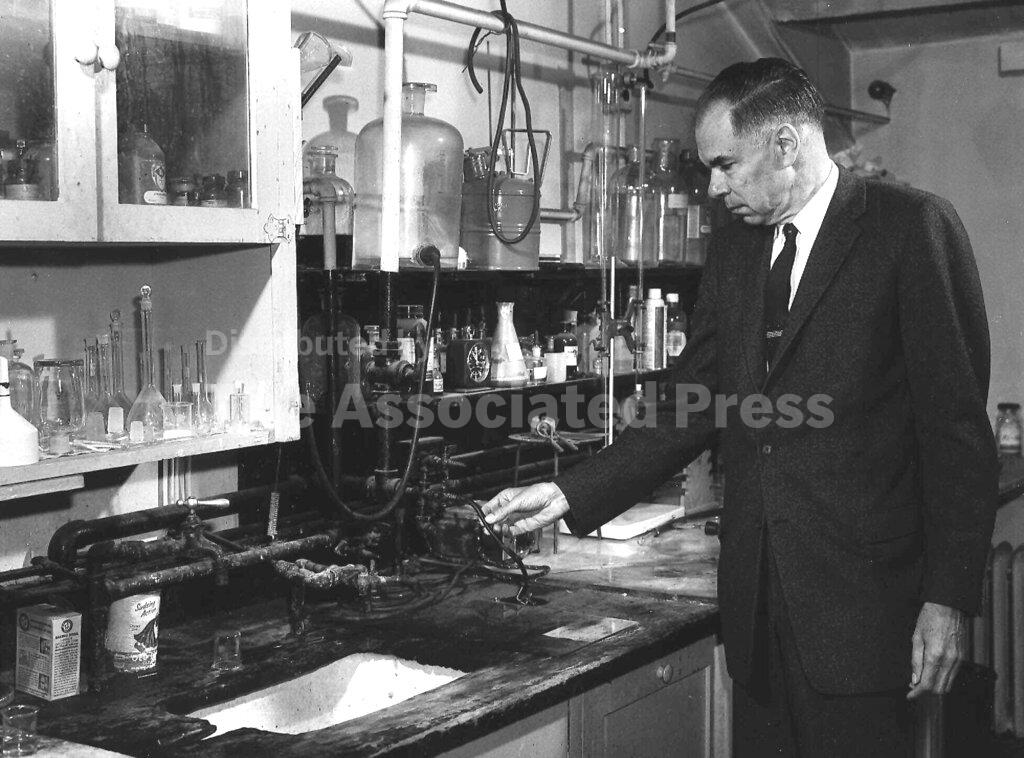
Dr. Glenn T. Seaborg chemically identified the recently discovered new element Plutonium in the 60-inch cyclotron at the University of California at Berkeley, California, United States. Seaborg, together with Arthur C. Wahl and Joseph W. Kennedy, produced and identified the second known transuranic element (atomic number 94), on February 23, 1941, in Room 307 of Gilman Hall, which is now a National Historic Landmark. (McMillan had discovered the first transuranic element, neptunium [atomic number 93], the previous year at Berkeley.) In addition to plutonium, best known for its use as a fuel in certain types of nuclear reactors and as an ingredient in some nuclear weapons, Seaborg and his coworkers discovered nine more new elements (atomic numbers 95–102 and 106) between 1941 and 1955. Seaborg and his collaborators produced plutonium-239 through the bombardment of uranium. In their experiments bombarding uranium with deuterons, they observed the creation of neptunium, element 93. But it then underwent beta-decay, forming a new element, plutonium, with 94 protons. Plutonium is fairly stable, but undergoes alpha-decay, which explained the presence of alpha particles coming from neptunium. Thus, on March 28, 1941, Seaborg, physicist Emilio Segrè and Berkeley chemist Joseph W. Kennedy were able to show that plutonium (then known only as element 94) was fissile, an important distinction that was crucial to the decisions made in directing Manhattan Project research.
With military and civil authorities of French Indo-China fearing grave developments, three French warships headed by the 7,000-ton cruiser Lamotte-Picquet quietly slipped from their Saigon river anchorage today and sailed for an unannounced destination.
France will fight with all the resources at her command any effort to impose an unjust peace on Indo-China in that country’s border conflict with Thailand, an official spokesman declared tonight in Vichy.
The Japanese military mission in Indo-China is watching with growing concern warlike French preparations going on in North Indo-China adjacent to military bases granted to Japan under the French-Japanese agreement of last Fall, the Japanese official Domei news agency reported today from Hanoi.
Germany is “moving heaven and earth” to induce a Japanese attack on the British Empire in the Far East, simultaneous with German attacks in Europe, Africa and the Near East, but British forces are ready for anything that may happen, Victor Purcell, Director-General of Information and Publicity, said today in a broadcast address to the peoples of Southeast Asia.
Born:
Ron Hunt, MLB second baseman and third baseman (MLB All-Star 1964, 1966; New York Mets, Los Angeles Dodgers, San Francisco Giants, Montreal Expos, St. Louis Cardinals), in St. Louis, Missouri.
Gordy Lund, MLB shortstop, second baseman, and third baseman (Cleveland Indians, Seattle Pilots), in Iron Mountain, Michigan (d. 2024).
Naval Construction:
The Royal Navy modified Black Swan-class sloop HMS Woodpecker (U 08) is laid down by William Denny & Brothers (Dumbarton, Scotland).
The Вое́нно-морско́й флот СССР (ВМФ) (Soviet Navy) “M” (Malyutka)-class (3rd group, Type XII) submarine M-36 is commissioned.
 History Diaries