British and South African forces defeated the Italians at Jilib. British 11th and 12th African Divisions attacked and overran Italian positions at Jelib, Somaliland, Italian East Africa. The Italians are completely routed, over 30,000 being killed, captured or dispersed into the bush. SAAF fighters kept the Regia Aeronautica out of the picture. The cruiser HMS Shropshire bombards Brava, on the coast between Kismayu and Mogadishu.
Greek King George II and Commander-in-Chief General Alexander Papagos met with British Foreign Secretary Anthony Eden and General Archibald Wavell in Athens, Greece, designing a defense plan that assumed Yugoslavia would remain neutral. There is some reluctance on the part of the Greeks to accept the help offered by Eden, on the grounds that insufficient British help might serve only to precipitate an attack by the Germans. Eden’s task is to reassure the Greeks that, although the forces being offered, which would have to be withdrawn from the army fighting the Italians in North Africa, are all that Britain can spare at the moment, they are well-equipped and trained and will acquit themselves well. Talks are well under way this evening and look like lasting well into the night, with the Greeks insisting that they will fight with or without British help.
British monitor HMS Terror was spotted at about noon by a German Ju-88 aircraft off the Libyan coast. 5 Ju-88 aircraft were launched from Sicily, Italy at 1533 hours, and they intercepted HMS Terror 10 miles north of Derna, Libya at 1830 hours. Heavily damaged by near misses, HMS Terror was abandoned by her crew at 2200 hours. Minesweeper HMS Fareham and corvette HMS Salvia attempted to tow her back to port, but this effort would ultimately fail.
German military staff arrive in Sofia, Bulgaria, as 17 divisions, eight of which are heading for Greece, cross the border. German staff officers arrived in Sofia, Bulgaria, almost simultaneously with the arrest of 50 Bulgarian radical agrarian party leaders capable of leading a popular revolt against the expected German occupation of King Boris’ little realm. While Bulgarian Communists sent out appeals for passive resistance to any German invasion, students angrily shouted against “German occupation of Bulgaria” outside the Sofia hotel where the German officers established residence. Demonstrations were held in several cities in Bulgaria protesting the German presence in the country.
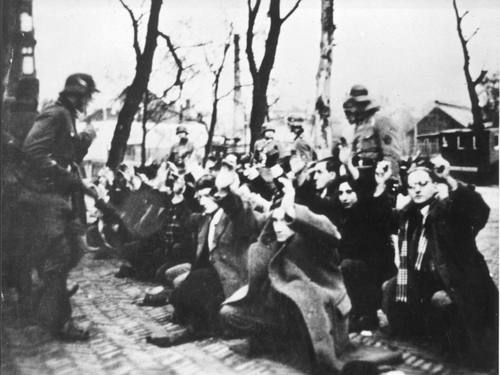
As a result of an incident at the Jewish ice cream parlor Koco where several police officers were wounded and other fights between pro-Nazi groups and Jewish self-defense groups a large scale pogrom was undertaken by the Germans. 425 Jewish men, age 20-35 were taken hostage over the weekend of February 22-23. These men were eventually sent to the Buchenwald and Mauthausen concentration camps, where most of them died within the year.
The daily bread ration in the Warsaw Ghetto is set at three ounces, as deaths from starvation reach 400 a week. An order is issued stating that any Pole selling food to a Jew outside the Warsaw ghetto will automatically be sentenced to three months hard labor.
IG Farben company decides to build its Buna-Werke (rubber factory) adjacent to Auschwitz Concentration Camp to have easy access to slave labor and safe cover from Allied bombing.
Not many young British women dream of a life in uniform but increasing numbers are volunteering for the services. Most of them go into the Auxiliary Territorial Service — the ATS — though the Wrens, who work with the Royal Navy, are seen as the elite and the WAAFs have a certain glamour by association with pilots. In the ATS, women are trained to do almost anything that does not involve them directly in combat. Many are learning to operate the aiming mechanisms of anti-aircraft guns, though they are not allowed to fire them; large numbers are also trained as drivers and mechanics. Cooking, cleaning and clerical work are the commonest jobs. The most novel, and the physically hardest job in the Women’s Auxiliary Air Force (WAAF) is crewing the barrage balloon operations. The balloons are so heavy that teams of ten men are being replaced by 16 women. WAAFs also train as mechanics, photographers, bomb plotters and radio operators. But not everyone believes that the women are doing a good job. One woman told a mass observation survey: “Those ATS girls are a disgrace. They come in this pub at night and line up against that wall. Soldiers then give them drinks and when they’re blind drunk they carry them out into the street.”
A silent economic and social revolution is rumbling beneath the surface of a Britain united to win the war and, above all, united to win a better life for the average man who has proved himself a hero under bomb attacks. The social caste system which molded English life from feudal times appears to be cracking under the necessity of the nation standing as one against the axis. The wartime planned economy is effecting changes in the nation’s business and industrial life so drastic that none expects a return to prewar conditions. Some businesses are gone, never to return. Workers are promised a large share in the prof its of industry and restoration of the rights set aside by the wartime urgency for “all-out” production of war weapons without regard to any other consideration. Britain’s place in world economy also is shifting inevitably. The war even though It be a victorious war may cost the nation Its ancient leadership of the financial world.
Arthur T. “Bomber” Harris became a British Air Marshal.
Free French troops, with their own equipment, have arrived in Eritrea after a 1,500-mile march across Africa to join the British drive on Cheren, it was disclosed tonight. , The French, after crossing the continent, were transported by sea to the Eritrean coast where they disembarked in the first landing effected since the British advance started January 15. Bearing their own rifles, machine-guns, ammunition, trench mortars and other equipment, the French forces traveled all the way across French Equatorial Africa in American trucks without losing a single vehicle.
Filipp Golikov was awarded the Order of Lenin for the first time.
Dmitry Pavlov was promoted to the rank of General of the Army.
RAF Bomber Command dispatches 2 Blenheims during daylight; turned back.
RAF Bomber Command dispatches 29 Wellingtons overnight to attack warships in Brest harbor but only 11 bombed. No losses but 4 aircraft crashed in England.
U-96, commanded by Kapitänleutnant Heinrich Lehmann-Willenbrock, sank the abandoned British tanker Scottish Standard (6999grt), which was straggling behind convoy OB.287 after being damaged by German bombers in 59-09N, 16-18W on the 21st, in 59-20N, 16-12W. On 21 Feb 1941 the Scottish Standard (Master John Ward), a straggler from convoy OB-287, was damaged by bombs from a German Fw200 Condor aircraft (I./KG 40) in 59°19N/16°14W. Five crew members were lost. The master, 37 crew members and one gunner were picked up by HMS Montgomery (G 95) (Cdr H.F. Nash, (retired), RN) and landed at Oban. At 1235 hours on 22 February, U-96 sighted the abandoned tanker with the bow deeper in the water and bomb damage to the superstructure and had to dive because a destroyer appeared. At 1549 hours, the tanker was hit near the bridge by a coup de grâce and she sank after being hit by a second coup de grâce three minutes later, but this could not be observed by the Germans because they had to evade an attack of the destroyer, which dropped 37 depth charges and damaged the U-boat. The 6,999-ton Scottish Standard was carrying ballast and was bound for New York, New York.
U-108, commanded by Kapitänleutnant Klaus Scholtz, sank Dutch steamer Texelstroom (1617grt) in 63-15N, 20-30W. At 2224 hours on 22 Feb 1941 the unescorted Texelstroom (Master A.J.E. Lefering) was hit under the rear mast by a G7e torpedo from U-108 but no effect could be observed and the ship changed course towards the coast while sending light signals. At 2246 hours, a first coup de grâce was fired but it exploded prematurely and the second fired at 2254 hours also malfunctioned but hit the bow as a surface-runner, causing the ship to sink in three minutes. Due to snowfall the visibility was bad, still Scholtz reported seeing lifeboats with lights. Despite of being only 25 miles from Iceland, there were no survivors. The 1,617-ton Texelstroom was bound for Grimsby, England.
Italian submarine Marcello was sunk west of the Hebrides by destroyer HMS Montgomery. Also in the escort group with Montgomery were destroyer HMS Hurricane and corvette HMS Periwinkle.
Light cruiser HMS Aurora, which joined off Cape Wrath, arrived at Scapa Flow at 1534 with British transports Queen Emma and Princess Beatrix from the Clyde. At 2130, light cruiser Aurora departed Scapa Flow carrying anti-aircraft guns and four gun crews from battleship HMS Nelson to strengthen the anti-aircraft defenses at Skaalefjord.
Destroyer HMS Avon Vale departed Greenock at 1645 for Scapa Flow to carry out working up exercises. The destroyer arrived at Scapa Flow at 1430/23rd.
Destroyer HMS Icarus, escorted by destroyers HMS Berkeley, HMS Tynedale, and HMS Vansittart, laid minefield JK in the English Channel.
British tanker Luxor (6554grt) was damaged by German bombing at Swansea.
British steamer Kingston Hill (7628grt) was damaged by German bombing in 59-44N, 12-33W. The steamer arrived at Loch Ewe under tow on the 25th.
British steamer Keila (3621grt) was damaged by German bombing in 59-44N, 12-33W. The steamer reached the Clyde under her own power.
Off Newfoundland, German battleship Gneisenau sank British steamer Trelawney (4689grt) in 47-12N, 40-13W, British tanker Harlesden (5483grt) in 47-12N, 40-18W, British steamer Kantara (3237grt) in 47-12N, 40-13W from dispersed convoy OB.285, British steamer A. D. Huff (6219grt) in 47-12N, 40-13W from dispersed convoy OB.286. One crewman was killed on Trelawney and the rest were taken prisoner. Seven crew members were lost on Harlesden and the rest were taken prisoner. The entire crew of the Kantara was made prisoner. Two crewmen were killed and the rest taken prisoner from A. D. Huff. German battleship Scharnhorst sank British tanker Lustrous (6156grt) in 47-12N, 40-13W. All crew from Lustrous were taken prisoner.
German minelayers Brummer, Cobra, and Konigin Luise and escorted by the 5th Minesweeping Flotilla from Bergen laid minefield SWINE between the Shetlands and Korsfjord.
Monitor HMS Terror was damaged by the near miss of an air bomb off Benghazi at dawn. As the monitor was leaving Benghazi for Tobruk, she was damaged by striking two mines. The monitor was further damaged at 1825/23rd in an Italian air attack. Minesweeper HMS Fareham and corvette HMS Salvia attempted to tow the monitor. Destroyers HMS Dainty and HMS Hasty were sent to her assistance, but destroyer Hasty never made contact. Destroyer Dainty, delayed by defects, was unable to leave Tobruk until 0530. The monitor sank at 0415/24th off Derna in 32-59N, 22-32E. There were no casualties. The crew was taken on corvette Salvia and minesweeper Fareham. Australian light cruiser HMAS Perth was sailed at 0330 from Alexandria to assist. Light cruiser HMS Ajax and destroyers HMS Mohawk and HMS Nubian were also to depart Alexandria on the 24th to support monitor Terror. However, with word of the monitor’s loss, the sailing was cancelled. There were no casualties in the loss of the monitor.
Polish ship Warsawa (2487grt), British steamer Knight of Malta (1553grt), and armed boarding vessel HMS Chakla arrived at Tobruk with stores and personnel.
At Tobruk, anti-submarine whaler HMS Southern Sea was damaged in a collision with a lighter.
Submarine HMS Regent unsuccessfully attacked Italian shipping off Tripoli.
Three opponents hammered at the U.S. administration’s British aid bill in the Senate today, and one of them, Senator McCarran, Nevada Democrat, predicted it would put the United States into war within 60 days after its enactment. Senator Taft, Ohio Republican, said that the bill would put “the issue of war” before the country within six months, and Senator Capper, Kansas Republican, asserted that it would give the president “complete war-making powers.” While the Senate worked through an extraordinary Saturday afternoon session in order to hasten action on the bill, administration supporters discussed among themselves the question of accepting two amendments, one suggesting that the president consult legislative leaders from time to time on operation of the British aid program, and another naming Britain, Greece and China as the countries to be aided under the bill.
The first open threat of filibustering tactics against the Administration’s Lend-Lease bill in the Senate was made from the floor at the close of today’s session by Senator Wheeler of Montana and Senator Clark of Missouri, two of the five informal managers of the opposition to the bill. The threat was made in reply to what they both called “pressure tactics” by Senator Barkley of Kentucky, majority leader, to speed up the debate next week. Mr. Barkley recalled that the Lend-Lease bill has been under consideration in the Senate for four full weeks, including the public hearings before the Foreign Relations Committee, and announced that he would move on Monday that the Senate convene every day thereafter, until the bill is disposed of, at 11 AM, instead of noon, the usual meeting hour. He added that he would ask the Senate to sit later in the day (it has been recessing at about 5 PM each day) and that various amendments to the bill be considered whenever no Senator has a set speech ready to deliver.
A poll of the Senate disclosed fifty-two certain votes today for the British-aid bill, with some uncommitted Senators indicating that they would vote for it when the roll was finally called. In response to questions by The Associated Press, fifty-two Senators said that they were for the bill, with twenty against it. A total of twenty-one declined to commit themselves. Two were unavailable. With one Senate seat vacant, a majority is forty-eight. In addition to several of the uncommitted members who said that they would probably vote for the bill, a half dozen others said they would support the measure if various amendments were adopted. The poll recorded forty-six Democrats, five Republicans and one Independent for the bill, with eight Democrats, eleven Republicans and one Progressive against it. Eleven Democrats and ten Republicans were uncommitted, with one Democrat and one Republican unavailable.
Expenditure of billions of dollars “effectively and efficiently” is making the United States Navy “the most powerful protective force in the world,” and it will not fail “in the event of foreign attack,” according to a monograph by Secretary Knox which was published today by the American Council on Public Affairs. Discussing the purposes of the expanded naval program, Secretary Knox said: “We can take no chances on the sea or under it or over it. We must dominate all three avenues of approach to our shores. If we do not obtain such dominion, we shall become liable to destruction.” The program of establishing bases at strategic points, Secretary Knox wrote, was intimately connected. with the problem of defense, and was not a plan for aggression. This theory applied to Guam, he asserted. “If the fleet is able to meet and defeat an enemy in mid-ocean,” Mr. Knox said, “that enemy is not going to get very close to bombing or shelling New York or San Francisco. So the Navy has always wished for more and better-protected outlying bases — not to attack foreign countries, but to meet an attack and defeat an attack before it can even come near to the homeland.”
Vice-President Henry A. Wallace said tonight that “the price of democracy and peace on this hemisphere is based on our being more willing than the Nazis to sacrifice our goods, our time, and, if need be, our lives.” He made this assertion in an address before the National Farm institute, and, it was understood, read and approved by President Roosevelt. It was his first address since he assumed the vice-presidency. “Our only hope for peace is to prevent England from being destroyed by the Nazis,” he declared. “Let those who fear the consequences of war keep that in mind.”
Senator Burton K. Wheeler of Montana described as a “deliberate lie” today an assertion by Dr. Frank Kingdon and Herbert Bayard Swope that a recent New York rally of the America First Committee and the Keep America Out of War Congress was “un-American.”
The Institute for Propaganda Analysis is under investigation by the House Committee on Un-American Activities headed by Representative Dies, J.B. Matthews, chief investigator for the committee, said today.
J. Edgar Hoover, director of the Federal Bureau of Investigation, said today he had asked Congress for 700 additional special agents immediately to protect the defense program against spies and saboteurs. At the same time, he stated that the steps already taken to safeguard defense plants had proved effective and that the situation was “well in hand.” The request for additional agents, at a cost of about $970,000 for the balance of the year ending June 30, was presented to a House appropriations subcommittee. Since the current emergency began, 500 agents have been added to the staff.
An undercover investigation of land prices charged the government for defense projects was disclosed today in an announcement that for the second time fees of War Department land agents had been slashed.
A program under which new shipbuilding plants may obtain their first forces of supervisors from men trained in the old line private yards and Navy yards was announced today by Secretary Knox as a result of a conference between representatives of shipbuilding contractors, the Navy Department and the Maritime Commission.
As a means of effecting a considerable saving in the purchase of canned and non-perishable foods for the expanding Army, the War Department announced today that purchasing would be centralized at the three Quartermaster Depots in New York, Chicago and San Francisco. The products will then be delivered to Army stations throughout the country.
Miss Betty Price is the first Barnard College student to be accepted by the Civil Pilot Training program, which is being conducted at Columbia University. Miss Price, who lives in Ridgewood, New Jersey, is a member of the senior class and majoring in government and economics.
The 209th anniversary yesterday of the birth of George Washington, celebrated in New York under gray skies, was for the most part a solemn occasion, with speakers all over the country comparing the present crisis to those faced by the first President and recalling that he had said: “To be prepared for war is one of the most effectual means of preserving peace.”
Roy Harris’ “Ballad of a Railroad Man” premieres.
Eighty-two employees at Plant No. 1 of the General Motors Fisher Body division in Flint, Michigan have been discharged, causing a row between the United Automobile Workers, C.I.O., and the management, it was made known today.
German heavy cruiser Admiral Scheer sank Dutch steamer Rantau Pandjang (2542grt) at 8-24S, 51-35E. Two crewmen were lost and the rest were taken prisoner. A Walrus from Light cruiser Glasgow sighted Scheer and the Admiralty ordered all British units to converge on that location in an attempt to sink Scheer. Aircraft carrier HMS Hermes and light cruiser HMS Capetown came out from Mombasa. Heavy cruisers HMAS Australia and HMS Hawkins were detached from convoy WS.5B. Light cruiser HMS Emerald recently detached from convoy WS.5B. Australian heavy cruiser HMAS Canberra was released from convoy US.9 after being relieved by light cruiser HMS Leander. Heavy cruiser HMS Shropshire was called from patrol to the south of Scheer. Light cruiser HMS Enterprise was called from patrol to the north of Scheer. However, Scheer was able to lose the seaplane and escaped back into the South Atlantic. The search was called off on the 24th.
A new effort by the Chinese Government to rebuild a united front with Chinese Communist groups was revealed by the official Chinese news agency tonight. The effort indicated that the troubles over the disposition of the Communist Fourth Route Army have not been settled despite the drastic action already taken by Chungking in dissolving this army as a military unit. The new united front move centered on a direct appeal to Mao Tse-tung, the Chinese Communist military leader, and Chu Teh, the Chinese Communist political leader, requesting that they give full support to the Chinese Central Government. The message was said to complain of “undisciplined action” by Communist groups in various provinces. and asked that the Communists fulfill their pledge of support to General Chiang Kai-shek.
France rejected today a Japanese-sponsored proposal which, reliable informants said, was a demand that approximately one-third of them western Indo-China Provinces of Laos and Cambodia be ceded to Thailand.
Born:
Hipólito Mejía, 51st President of the Dominican Republic, in Gurabo, Dominican Republic.
Bill Swain, NFL linebacker (Los Angeles Rams, Minnesota Vikings, New York Giants, Detroit Lions), in Dickinson, North Dakota.
Leland Mitchell, ABA shooting guard (New Orleans Buccaneers), in Kiln, Mississippi (d. 2013).
Naval Construction:
The Royal Australian Navy Bathurst-class minesweeper-corvette HMAS Echuca (J 252) is laid down by the Williamstown Dockyard (Williamstown, Victoria, Australia).
The Вое́нно-морско́й флот СССР (ВМФ) (Soviet Navy) “S” (Stalinec)-class (2nd group, Type IX-modified) submarine S-38 is laid down by Marti Yard (Nikolayev, U.S.S.R.) / Yard 198.
The Вое́нно-морско́й флот СССР (ВМФ) (Soviet Navy) “S” (Stalinec)-class (3rd group, Type IX-modified-2) submarine S-39 is laid down by Marti Yard (Nikolayev, U.S.S.R.) / Yard 198.
The Kriegsmarine (German Navy) Type VIIC U-boat U-257 is laid down by Bremer Vulkan-Vegesacker Werft, Bremen-Vegesack (werk 22).
The Royal Navy Hunt-class (Type III) escort destroyer HMS Blean (L 47) is laid down by Hawthorn Leslie & Co. (Hebburn-on-Tyne, U.K.).
The U.S. Navy Aloe-class net tender USS Catalpa (YN-5, later AN-10) is launched by the Commercial Iron Works (Portland, Oregon, U.S.A.).
The U.S. Navy Aloe-class net tenders USS Mango (YN-19, later AN-24) and USS Redwood (YN-25, later AN-30) are launched by the American Shipbuilding Co. (Cleveland, Ohio, U.S.A.).
The Kriegsmarine (German Navy) Type VIIC U-boat U-81 is launched by Bremer Vulkan-Vegesacker Werft, Bremen-Vegesack (werk 9).
The Royal Canadian Navy Flower-class corvette HMCS Edmunston (K 106) is launched by Yarrows Ltd. (Esquimalt, British Columbia, Canada).
The Royal Navy Fairmile B-class motor launch HMS ML 200 is commissioned.
The Royal Navy British Power Boat 60-foot-class motor torpedo boat HMS MTB 332 is commissioned.
The Royal Navy Dance-class ASW trawler HMS Mazurka (T 30) is commissioned. Her first commanding officer is T/Lieutenant Victor Richard Tyrrell, RNR.
The Royal Navy “U”-class (Second Group) submarine HMS Union (N 56) is commissioned. Her first commanding officer is Lieutenant Robert Malcolm Galloway, RN.
 History Diaries